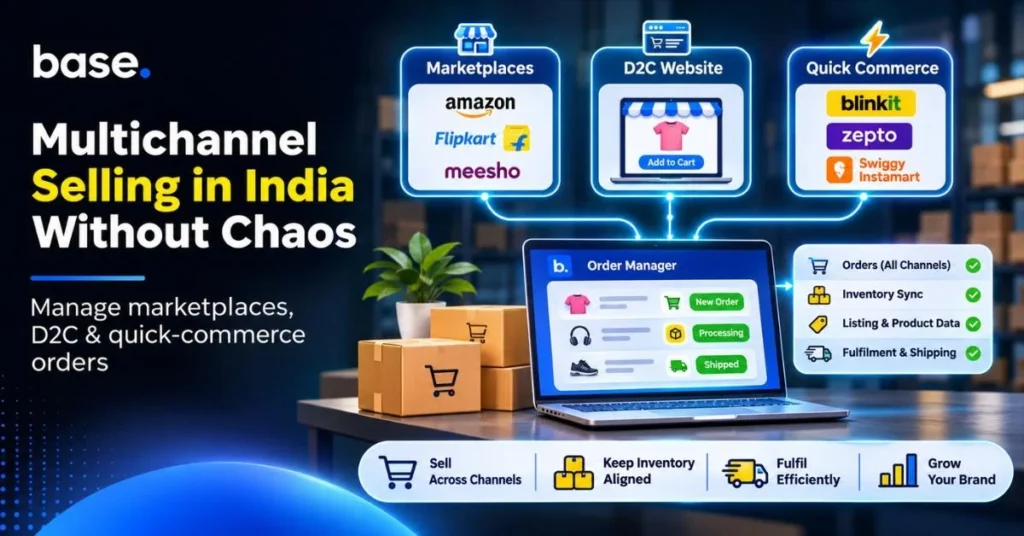
Multichannel selling means offering products through more than one sales channel, such as marketplaces, a brand-owned website and quick-commerce platforms. For Indian brands, new channels can expand reach but also multiply operational work: orders come through different systems, listings need tailored information, inventory must be accounted for and fulfilment teams need clear instructions. McKinsey’s report on Indian ecommerce identifies marketplaces, quick commerce and D2C as distinct routes for Indian MSMEs. A coordinated order management approach can bring connected orders into a clearer workflow while preserving channel-specific processes. Shared visibility does not make the channels identical.
What is multichannel selling?
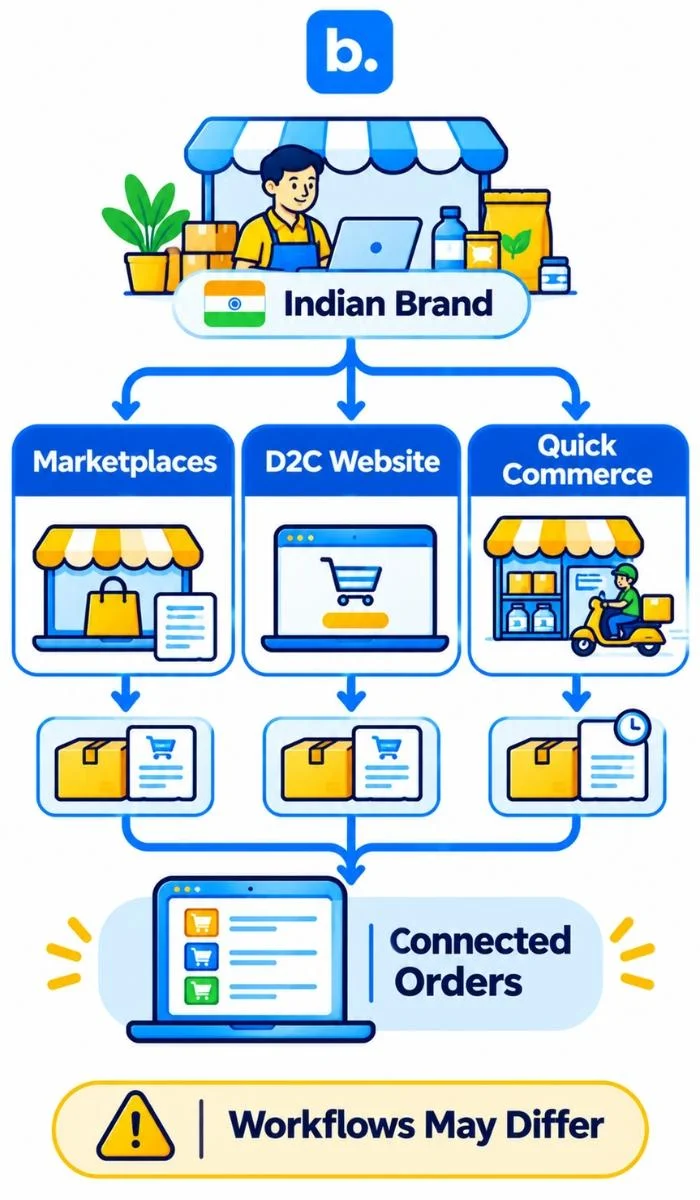
Multichannel selling means offering products through several channels, which may initially be managed separately. A consumer electronics brand might sell on Amazon and Flipkart, take direct orders through Shopify and offer selected products through quick-commerce partners.
The terms describe different models:
- Multichannel selling: operating several channels, potentially with separate systems.
- Omnichannel commerce: connecting channels for a more integrated customer and operating experience. Multiple listings alone do not make a business omnichannel.
- Marketplace selling: using a third-party ecommerce platform with its own seller processes.
- D2C ecommerce: selling directly through a brand-owned website, app or other direct channel.
- Quick commerce: selling through platforms designed for rapid, often hyperlocal fulfilment.
Integration between orders, product records, inventory and fulfilment determines how connected the operation is. The right channel mix depends on demand, margins, product suitability and the team’s ability to serve customers reliably.
The three main ecommerce channels in India
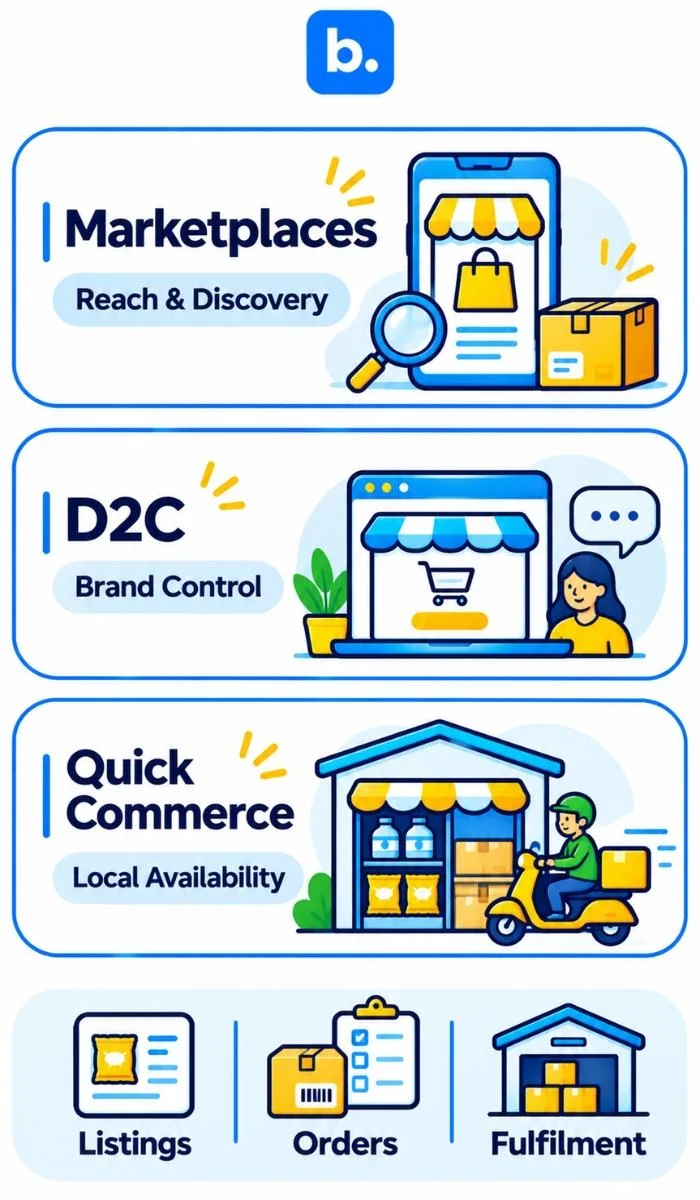
Indian brands may combine marketplace sales, D2C and quick commerce, but each channel has a distinct commercial and operational role.
Marketplaces: reach and discovery
Amazon, Flipkart, Myntra and Meesho give sellers access to shoppers already using those platforms. Marketplace order management includes maintaining listings and attributes, monitoring prices and availability, processing cancellations and returns, and meeting dispatch and service requirements.
Fulfilment varies: the seller, a marketplace service or another partner may dispatch orders. Confirm who owns each step and which system provides the actionable status. Listing requirements may also call for channel-specific descriptions, attributes or images based on a shared product record.
D2C: control of the brand-owned channel
A D2C website or app gives a brand greater control over storefront, merchandising, promotions and customer communication. Shopify and WooCommerce are examples of storefront platforms, though stacks differ.
The brand must also maintain its catalogue, capture and validate orders, confirm prepaid or COD status, coordinate inventory and shipping, and handle queries, returns and refunds. D2C is not automatically simpler: it places more of the operating process directly with the brand.
Quick commerce: local availability and rapid fulfilment
Blinkit, Zepto and Swiggy Instamart offer customers selected products through platforms designed for rapid delivery. Their operating models can depend on local fulfilment points, product availability and platform-specific supply or order workflows. A central warehouse quantity is not necessarily available for sale through a particular local point. Assortment, inventory ownership and the brand’s fulfilment role depend on its arrangement with the platform.
For example, a packaged-food brand might have 5,000 units in its central warehouse but only 300 units supplied to selected local fulfilment points. Those figures are hypothetical: the central total alone does not show what is available to a customer in a given area. Stock may need to be allocated, transferred and received locally, and a platform may control parts of the fulfilment process. CareEdge Advisory estimated India’s quick-commerce gross order value at about ₹64,000 crore in FY25 and projected around ₹2 lakh crore by FY28. The latter is a forecast, not an achieved result. The operational point remains: quick commerce is not simply ordinary marketplace fulfilment with a faster delivery promise.
Why managing multiple sales channels becomes difficult
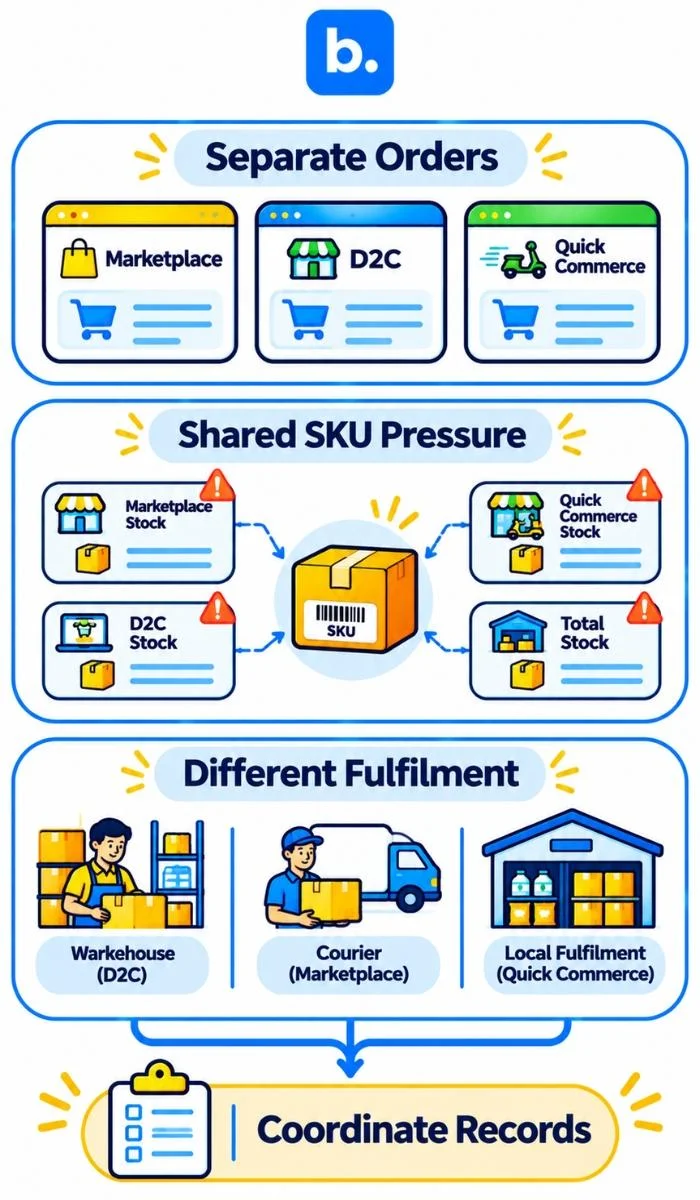
The challenge is not only the number of channels. It is the additional records, workflows and decisions that each channel can create.
Orders arrive through different systems
Marketplace, D2C and quick-commerce orders may appear in separate panels. Without a consolidated process, employees switch tools to check status, prepare fulfilment and update records, increasing the chance of missed or inconsistently handled orders. An unconnected order will not automatically appear in another system.
Stock and product information need coordination
The same SKU may be offered across several channels. If a sale is not reflected elsewhere, the business may continue accepting orders against units already committed. For example, if 20 units are available and ten sell on a marketplace, six on the website and four through another channel, the business needs to account for all three sales. The timing and behaviour of stock updates depend on the integrations and configuration; they should be tested rather than assumed to be instantaneous.
Product data creates another challenge: channels may need different titles, images, descriptions, category fields or variants. Maintain a consistent core record with tailored channel content. For detail on the stock coordination problem, see our multichannel inventory sync article.
Fulfilment and reporting are fragmented
A D2C shipment may use a brand-selected courier, while a marketplace order or quick-commerce order may follow platform-specific or local workflows. One dispatch procedure may not fit all. Sales, cancellations and status can also sit in separate systems. Decide which system is authoritative for each measure; an OMS does not necessarily consolidate settlements or accounting records.
How an order management system coordinates multichannel selling
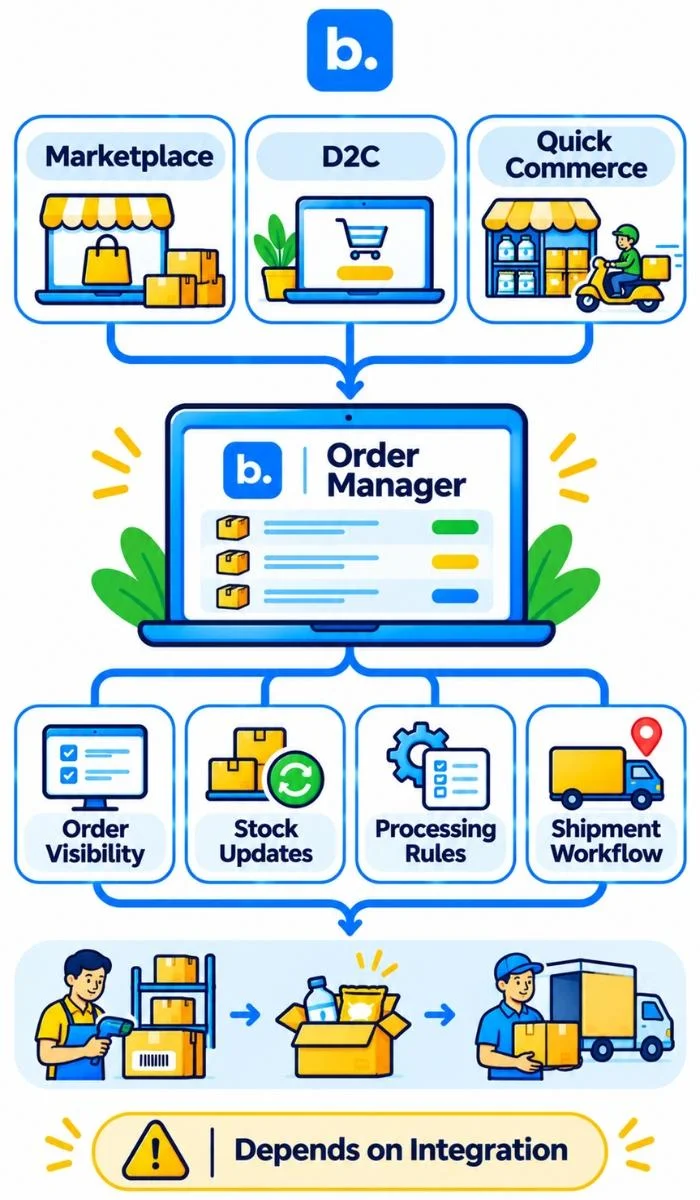
An order management system (OMS) collects and manages orders from connected channels and supports their movement through fulfilment. Depending on integration and configuration, it can monitor status, coordinate supported stock updates and connect order workflows with stores, warehouses or carriers. This is the central role of an order management system for ecommerce.
Order processing software may handle tasks such as order entry or label printing; an OMS coordinates the wider order lifecycle across connected channels. It does not replace seller portals, quick-commerce partner systems, D2C storefronts or warehouse work.
The system labels alone do not explain the boundaries. These functions may be separate products or combined within a platform:
| System or capability | Main role |
|---|---|
| OMS | Coordinates orders and processing across connected sales channels |
| Ecommerce integration | Exchanges supported information between connected platforms |
| IMS | Maintains inventory records and stock visibility |
| WMS | Supports warehouse work such as receiving, storage, picking, packing and stocktakes |
| PIM | Maintains product information and channel-specific product data |
An OMS can show connected marketplace and D2C orders in one working view and help assign processing tasks. Inventory coordination depends on SKU matching, update timing and integration capability; verify any allocation or location-level rules.
For fulfilment, an OMS may support status changes, pick lists, connected-carrier shipments, labels and notifications. Staff or partners still pick, pack and hand over goods. Systems can surface payment issues, unavailable products, failed updates, cancellations or returns, but not every exception is resolved automatically.
How to build a practical multichannel operating model
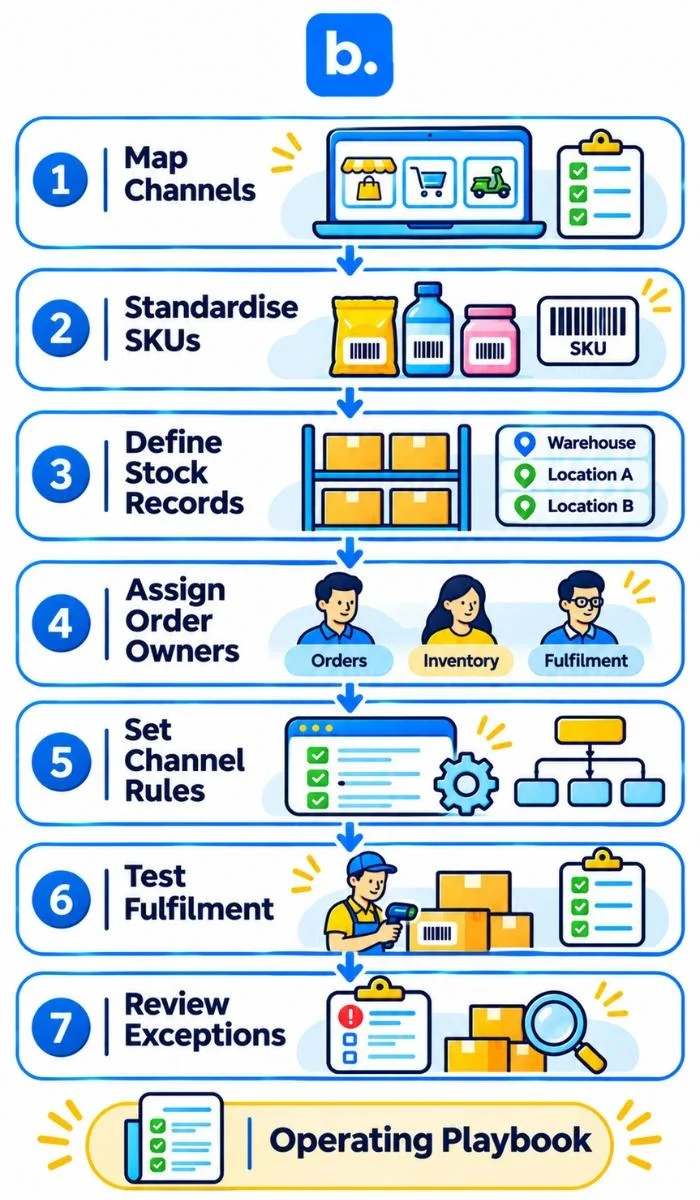
Software without clear ownership can move confusion into another dashboard. Define the operating model before opening or scaling a channel.
- Map every active channel. Record each marketplace account, D2C storefront and quick-commerce partner, where its orders appear and which team owns daily operations.
- Establish a consistent product catalogue. Standardise SKUs, barcodes, variants and pack sizes, while maintaining channel-specific listing content where required. A 500 g pack and a 1 kg pack must remain distinct sellable SKUs even if they share a product family.
- Decide where inventory is managed. Identify the main stock record and how connected systems receive updates. If there are several warehouses or local fulfilment points, define location-level records and how transfers are recorded rather than treating all units as one unrestricted pool.
- Define order ownership and fulfilment. Agree where each order is processed and who handles every stage. The following is a general model, not a description of every platform contract:
| Order source | Where the order is received | Who handles fulfilment |
|---|---|---|
| Marketplace | Connected OMS or seller system | Seller, marketplace service or contracted partner, depending on arrangement |
| D2C website | Storefront and connected order system | Brand warehouse or its fulfilment partner |
| Quick-commerce platform | Platform system or connected OMS, where supported | Platform, brand or partner, according to the operating agreement |
- Set channel-specific processing rules. Define dispatch timelines, order priorities, packing requirements and customer communications. A D2C shipment may follow the brand’s normal courier workflow, while a marketplace order or quick-commerce supply arrangement may have separate requirements.
- Test the complete order lifecycle. Use varied products and order types to check listing and SKU mapping, order capture, stock updates or reservations, status changes, picking and packing, shipment handover, tracking, cancellations, returns, reporting and exceptions. A single successful test order is not enough.
Make ownership of product records, stock decisions, orders, fulfilment and customer updates explicit. More channels or software cannot resolve unclear responsibilities.
Common multichannel selling mistakes to avoid
Avoid expanding to a new channel before checking order-processing capacity and fulfilment arrangements. Do not assume every channel uses the same SKU rules, stock updates or dispatch process. Other common pitfalls include inconsistent product identifiers, treating central stock as available at a local quick-commerce point, and connecting systems without testing order and inventory behaviour.
Also avoid assuming that an OMS automatically manages accounting, settlement reconciliation or every returns workflow. Track more than sales growth: cancellations, fulfilment performance and contribution margins matter. If teams maintain spreadsheets alongside connected systems, define who updates them and how they are reconciled.
How to choose order management software for ecommerce
The right order management software for ecommerce depends on the channels, integrations, order volume, warehouse setup and fulfilment model a business actually uses. Evaluate an OMS platform against real workflows rather than a general feature list. Check how the OMS software handles your actual channel and fulfilment setup.
| Evaluation area | What to check |
|---|---|
| Channel coverage | Does it support the specific marketplaces, D2C platforms and quick-commerce connections required? |
| Order workflow | Can connected orders be viewed, processed and monitored centrally? |
| Inventory | How are stock changes, reservations and location records handled? |
| Product data | Can the business maintain core data and channel-specific listings? |
| Fulfilment | Does it connect with the relevant warehouses, carriers or partners? |
| Automation | Which actions can be automated, and what conditions trigger them? |
| Integration scope | What data moves, in which direction and how frequently? |
| Reporting and cost | What operational reporting is included, and what are subscription, integration and implementation costs? |
A long integrations directory is not enough by itself. Confirm that the exact connection supports the required data, accounts and actions, and ask how failures are surfaced. Test actual orders and exceptions before choosing. For a separate vendor comparison, see our order management software for ecommerce businesses in India article; this article focuses on the operating model, not rankings.
How Base.com fits into a multichannel selling setup
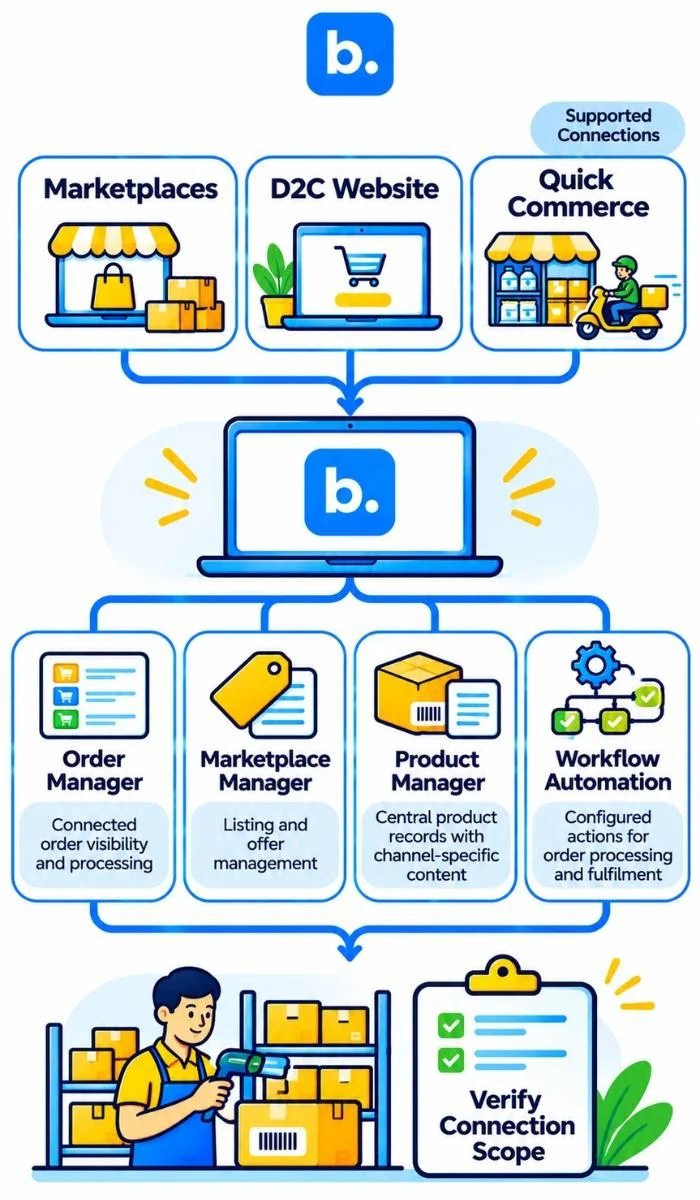
Our Order Manager brings orders from connected marketplaces and stores into one panel. Depending on the setup, orders can be processed there or forwarded to a connected store or ERP. Our Marketplace Manager supports listing, offer management, order forwarding, and stock and price synchronisation for supported connections. Our Product Manager supports central product information and channel-specific content, while Workflow Automation documents configured actions such as status changes, customer messages, invoices, shipments and printing.
Our Blinkit integration page describes importing Blinkit orders into Base.com. The Zepto integration page describes the same order-import workflow. Our Swiggy Instamart integration page also describes order import. The pages describe use of supported inventory, Pick&Pack, invoicing and shipping tools, but exact capabilities depend on the connection and setup. These integrations do not mean that base.com controls dark stores, platform onboarding, replenishment or every local stock update, nor do they replace a platform’s own portal. Confirm the workflow for your account before relying on a connection.
Conclusion
Multichannel selling can broaden a brand’s reach, but it requires consistent product information, coordinated orders, credible inventory records and clear fulfilment ownership. Marketplaces, D2C and quick commerce can share visibility where supported without sharing identical processes. Map the real workflows first, then choose the order management and integration setup that fits them.