

Beauty brands improve product information on Nykaa by converting label copy into structured data: ingredients as fields, claims as substantiated attributes, shades as a modelled hierarchy. Nykaa catalog management rewards completeness because the buyer arrives to evaluate a formulation, not to compare prices. Listings with thin data lose to listings with depth, regardless of product quality.
Why Nykaa Catalog Management Is the Hardest in Indian E-commerce
Beauty is the most information-dense category in retail. A single serum carries a full ingredient list, a concentration claim, a skin-type suitability, a usage protocol, a shelf life, a patch-test instruction, and a regulatory declaration set.
Nykaa’s buyer reads all of it. That is the difference from a general marketplace, and it changes what good Nykaa catalog management looks like.
Four structural factors drive the difficulty.
- Onboarding is curated, not open. There is no instant sign-up and no open catalogue upload. Category teams review brand authenticity, product quality, and regulatory readiness before approval, with verification commonly taking around one to two weeks once documentation is complete. The platform’s value comes from that filter.
- Compliance is part of the catalog, not adjacent to it. Beauty brands need ingredient disclosures, manufacturing details, and licence documentation appropriate to their product type. Ingestibles and cosmetics sit under different regimes, and imported cosmetics carry additional registration requirements.
- Image standards are enforced. Poor image quality is a leading cause of catalog rejection. The hero image is expected on a pure white background at sufficient resolution to support zoom, with no watermarks, text overlays or promotional badges.
- Search rewards depth. A listing with two images and a forty-word description copied from the pack will sit behind competitors carrying a full image stack, ingredient callouts and a substantial benefit-led description. The gap is not marginal.
The commercial context supports the effort. Indian e-commerce is tracking toward roughly $226 billion with D2C compounding near 40% CAGR, and Nykaa’s customers spend more per transaction than general-marketplace shoppers because they arrive with category intent.
1. Structure Your Ingredient List for Better Discovery and Compliance

Most brands paste the ingredient list into the description field as a block of text. That is the single largest missed opportunity in Nykaa catalog management.
An ingredient list held as prose cannot be filtered, validated, or reused. Held as structured data, it becomes a discovery asset and a compliance control.
What structuring means in practice:
- Full ingredient list in INCI naming, ordered by concentration as on the pack
- Key actives extracted as separate named fields with concentrations where you disclose them
- Free-from flags as boolean attributes rather than marketing text
- Allergen and fragrance declarations as discrete fields
- Ingredient list version-controlled, so a reformulation updates every affected listing
Buyers in beauty search by ingredient more than in almost any other category. Someone looking for niacinamide at a specific concentration, or avoiding a particular fragrance compound, is performing an attribute search. If your actives sit inside a paragraph, you are invisible to that search.
Match the pack exactly.
The ingredient list in the catalog must match the printed pack. A mismatch is both a compliance exposure and a trust failure in a category where buyers photograph labels and post comparisons.
This is where a governed system pays. Base.com holds the ingredient set against the master product record with version history, so a reformulation propagates to every channel and the previous version remains auditable.
2. Make Every Claim Substantiated and Consistent Across Channels

Beauty claims are the highest-risk content in the catalog.
“Dermatologically tested,” “clinically proven,” “hypoallergenic,” “non-comedogenic,” and percentage-efficacy claims each imply evidence. Nykaa’s category review assesses claims, and inconsistent claims across listings, packaging, and your own website invite challenge.
| Claim type | What you need on file | Catalog treatment |
| Tested claims | Test report and testing body | Attribute field plus description mention |
| Concentration claims | Formulation specification | Numeric field, not prose |
| Free-from claims | Full ingredient verification | Boolean attribute |
| Certification claims | Valid current certificate | Attribute plus expiry tracking |
| Efficacy percentages | Study methodology and sample size | Stated with the study context |
| Sustainability claims | Supporting documentation | Attribute, avoid vague wording |
Hold claims as attributes with supporting-document references attached, not as free text. Disciplined Nykaa catalog management means any claim on a listing can be traced to evidence in under a minute.
Drop claims you cannot substantiate. In a curated category, an unsupportable claim is a bigger risk than a missing one.
3. Build a Shade and Variant Architecture That Reduces Returns
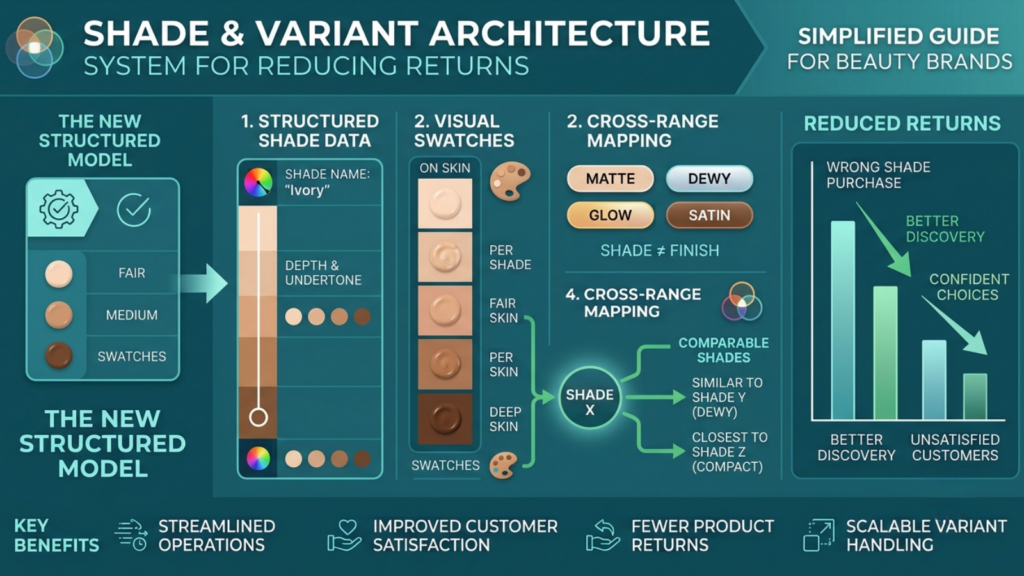
Colour cosmetics create the deepest variant structures in beauty, and most brands model them badly.
A foundation range with 24 shades across three finishes and two sizes is 144 sellable units. Handle that as a flat list, and the panel becomes unmanageable within two seasons.
| Structural error | Consequence |
| Every shade as a standalone listing | Reviews and ranking signals fragment across 24 weak entries |
| All shades under one entry with one image | Buyer cannot see the shade they are ordering, returns rise |
| Shade names without undertone or depth data | Buyers cannot self-select, driving exchange and return volume |
| Inconsistent shade naming across ranges | Internal catalog becomes unsearchable |
| Sizes modelled as shades | Inventory posts against the wrong unit |
What good shade data includes:
- Shade name plus a structured depth indicator
- Undertone as a controlled field, not a description
- Swatch image per shade, on skin where the category expects it
- Finish as a separate attribute from shade
- Mapping to comparable shades in your own range, which reduces wrong-shade purchases
Shade architecture is where Nykaa catalog management most directly affects returns. A buyer who cannot determine their shade from the listing either does not buy or buys wrong.
4. Populate the Full Beauty Attribute Set for Filter Coverage
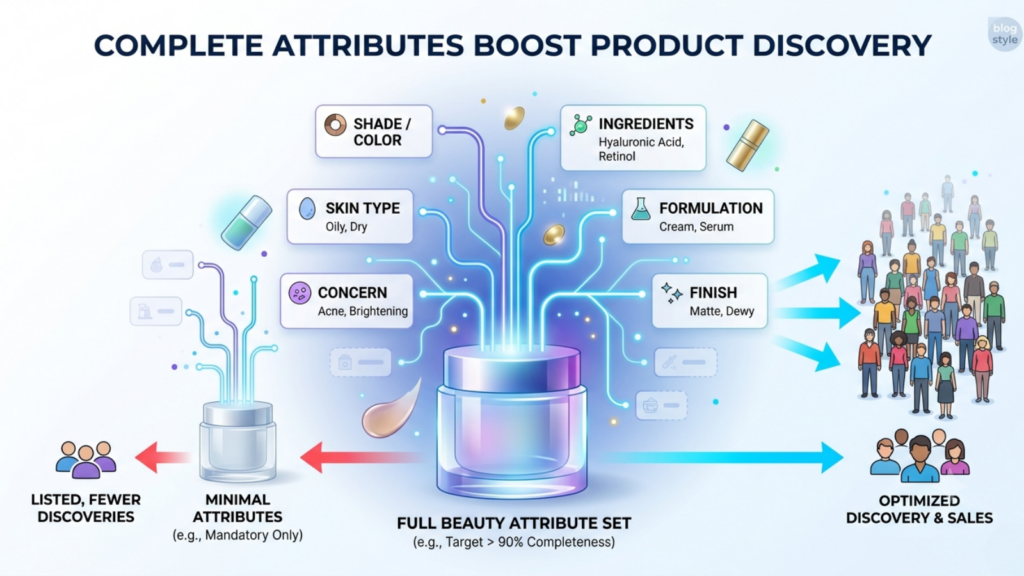
Nykaa’s discovery runs on filters, and beauty filters are unusually granular. Populating only mandatory fields gets you listed rather than found.
| Attribute group | Commonly left blank | Why it matters |
| Suitability | Skin type, hair type, skin tone range | Primary filter path in skincare and base makeup |
| Concern | Acne, pigmentation, ageing, frizz, dandruff | How buyers actually navigate the category |
| Formulation | Texture, finish, coverage, SPF value, pH | Distinguishes near-identical products |
| Actives | Key ingredient, concentration | High-intent ingredient searches |
| Preference | Vegan, cruelty-free, fragrance-free, non-comedogenic | Fast-growing filter usage |
| Usage | Time of day, frequency, application area | Reduces misuse complaints |
| Format | Pump, dropper, tube, jar, sachet, refill | Increasingly filtered, affects hygiene perception |
Set a completeness target above 90% on the full set per subcategory and measure it before upload. Attribute depth is the least visible part of Nykaa catalog management and the part that determines how many filter paths reach your product.
5. Write Benefit-First Descriptions Instead of Label Transcriptions
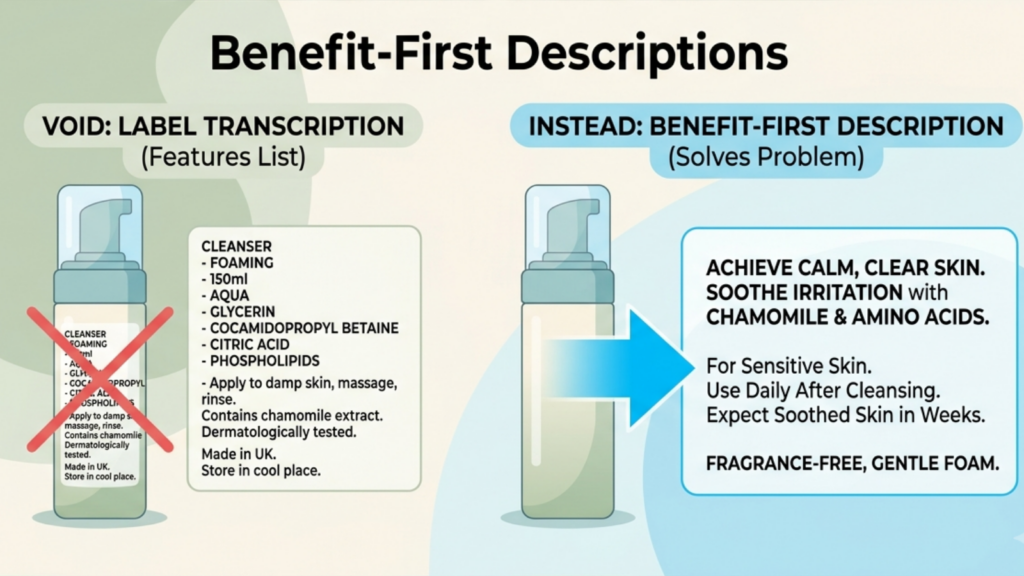
The most common description failure is transcribing the pack.
The pack has limited space and legal constraints. The listing has neither. Copying the pack wastes the field.
Structure that works:
- Open with the outcome the buyer wants, in one or two sentences
- Follow with the mechanism, naming the active and what it does
- State who it is for, and who it is not for
- Give the usage protocol, including where it sits in a routine
- State what to expect and over what timeframe
- Close with formulation notes: free-from, texture, fragrance
Write as a beauty advisor answering questions beside the customer. That framing produces the content Nykaa’s buyer is looking for and naturally covers the attributes the search index reads.
Length matters here. Substantial, specific descriptions outperform short ones in this category, provided the substance is real rather than padding.
6. Build a Complete Image Stack That Converts

Beauty is evaluated visually, and the carousel is where conversion happens.
Nykaa expects a hero image on a pure white background at sufficient resolution for zoom, with no watermarks or overlays. Beyond that, the remaining slots are yours, and most brands leave them empty.
- Hero: compliant white-background pack shot
- Texture: the product itself, swatched or dispensed
- Shade swatch: on skin, across a representative tone range
- Ingredient callout: key actives with concentrations
- Usage: where it sits in a routine, application method
- Pack detail: dispenser type, size reference, refill compatibility
- Compliance panel: ingredient list legible, so buyers can read it
- Video: short application or texture demonstration
The ingredient-list image deserves emphasis. Beauty buyers actively look for it, and providing it legibly signals confidence in the formulation.
7. Treat Shelf Life, Batch and Expiry as Catalog Data

Beauty is one of the few categories where the product expires, and most catalog systems are not built for it.
This creates failures that look operational but are actually data failures: stock shipped close to expiry, listings live for a discontinued formulation, or a batch recall that cannot be traced to the listings affected.
What to hold in the catalog:
- Shelf life from manufacture, as a numeric field
- Period after opening, where applicable
- Batch identifier linkage, so a listing can be traced to production
- Minimum remaining shelf life at dispatch, as a business rule
- Formulation version, so a reformulated product is distinguishable
- Discontinuation date, so listings retire rather than lingering
Set a minimum-remaining-life rule and enforce it in your own system before dispatch. Mature Nykaa catalog management prevents the near-expiry shipment rather than handling the complaint afterwards.
Why this needs a unified system
Shelf-life rules only work if the catalog knows what the warehouse holds. Base.com shares one product record across catalog, order and warehouse modules, so a minimum-remaining-life rule can be enforced at picking rather than existing as a policy nobody can operationalise.
8. Get Net Quantity and Pack Data Exactly Right
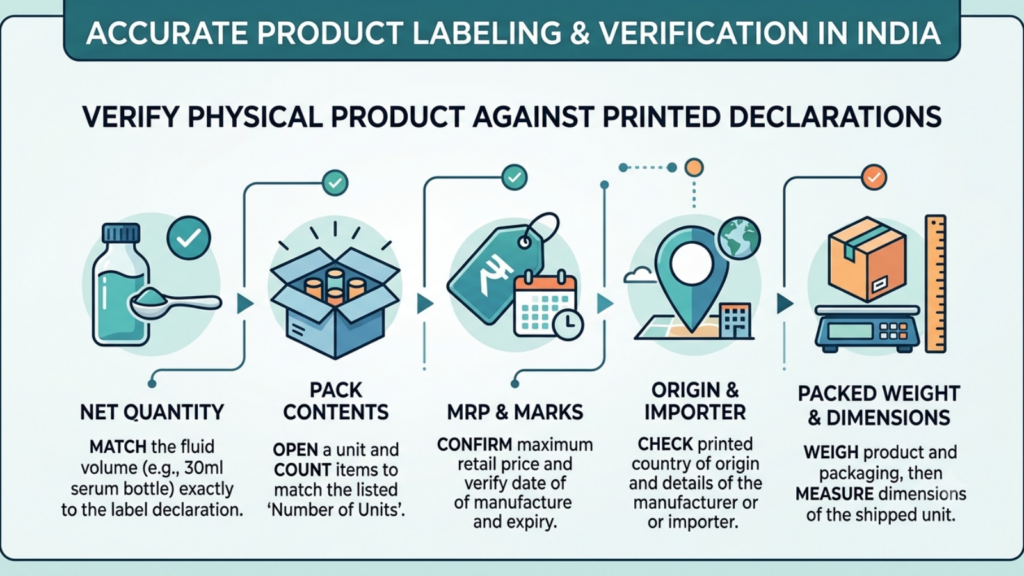
Small errors here produce disproportionate consequences.
Net quantity, fill volume and pack contents are regulated declarations for packaged goods in India, alongside manufacturer or importer details, country of origin, MRP and date markings. They must match the pack exactly.
They also drive buyer expectation. A serum listed at 30ml that arrives at 20ml generates a return and a review that outlasts the order.
Verify against physical product:
- Net quantity matching the printed declaration
- Pack contents counted from an opened unit
- Packed weight on a calibrated scale
- Dimensions of the shipped unit
- Country of origin and manufacturer or importer details as printed
- MRP matching the tag
Do this per SKU before listing, not as a sample. Accurate Nykaa catalog management on these fields is also your defence in a returns dispute.
9. Flag Restricted and Transport-Sensitive Products Correctly
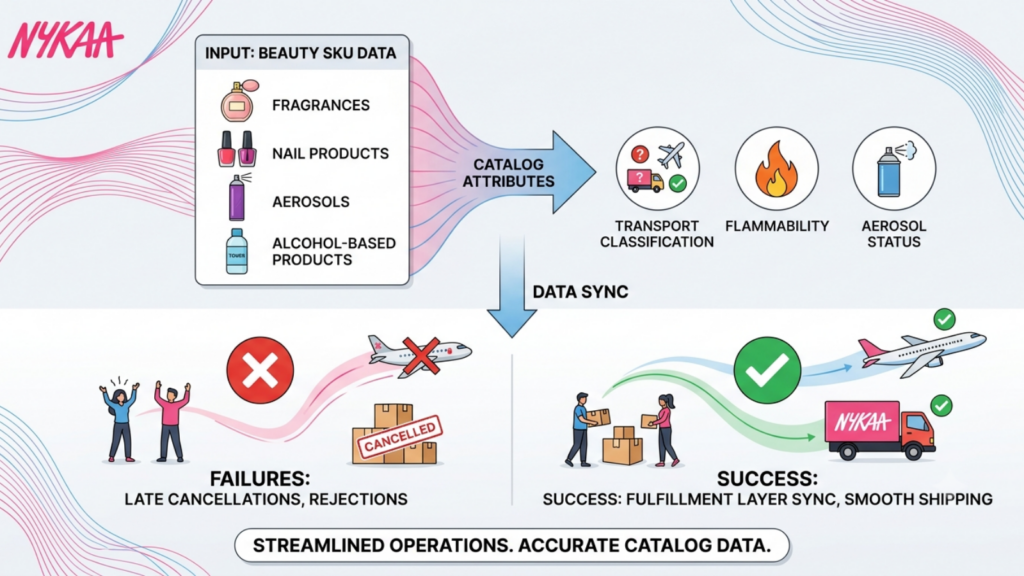
Fragrances, nail products, aerosols, and alcohol-based formulations carry handling restrictions that affect serviceability and shipping.
Misclassifying these creates failures late in the chain: orders accepted then cancelled, shipments rejected by carriers, or serviceability gaps the listing did not disclose.
Hold transport classification as a catalog attribute against every affected SKU, alongside flammability, aerosol status, and volume thresholds. Then ensure the field actually reaches the fulfilment layer rather than sitting unused in a spreadsheet.
This is a small number of SKUs causing a disproportionate share of operational noise, which makes it a high-return fix in Nykaa catalog management.
10. Close the Loop with Reviews, Questions and Returns Data
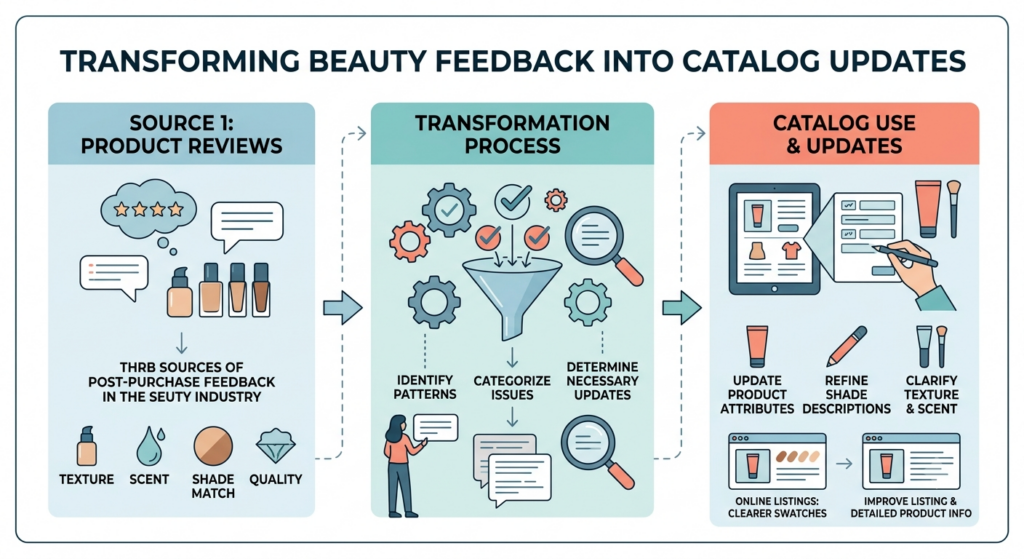
Beauty generates unusually rich post-purchase feedback, and most of it is catalog instruction that brands read as sentiment.
Three sources, three uses.
- Reviews: Identify recurring comments about texture, scent, shade, or product quality and update the relevant catalog attributes.
- Buyer Questions: Track frequently asked questions and address them directly in the product description or attributes.
- Returns & Complaints: Analyze recurring return reasons by SKU, identify the responsible catalog field, and make the required correction.
| Return reason | Catalog root cause | Correction |
| Wrong shade | Insufficient shade data or swatch | Add undertone, depth, on-skin swatch |
| Reaction or irritation | Missing suitability or allergen data | Populate skin type, allergens, patch-test note |
| Not as described | Overclaim in description | Rewrite to match formulation |
| Smaller than expected | No scale reference | Add dimension reference image |
| Texture unexpected | Texture attribute blank | Populate texture, add texture image |
| Near expiry | No minimum-life rule enforced | Set and enforce the rule |
A repeated buyer question is a gap in your product information. Treating it that way, rather than as a service ticket, is what separates brands whose listings improve from brands whose listings only accumulate answers.
Note also that returns disputes operate to deadlines. Missed dispute windows are a quiet margin leak, and the catalog data that supports a dispute has to exist before the dispute opens.
Nykaa Catalog Management Checklist: 10-Point Summary
A well-managed Nykaa catalog depends on accurate product information, complete beauty attributes, compliant images, consistent variants, and up-to-date inventory. This 10-point checklist covers the essential catalog management steps brands should review before launching, updating, or scaling products on Nykaa.
| # | Action | Primary benefit |
| 1 | Structured ingredient data | Ingredient-led discovery, compliance control |
| 2 | Substantiated claims as attributes | Approval and risk reduction |
| 3 | Shade and variant architecture | Fewer wrong-shade returns |
| 4 | Full attribute set | Filter coverage |
| 5 | Benefit-first descriptions | Conversion and search relevance |
| 6 | Complete image stack | Conversion and trust |
| 7 | Shelf life and batch data | Prevents near-expiry complaints |
| 8 | Accurate net quantity and pack data | Compliance and dispute defence |
| 9 | Transport classification | Fewer cancellations |
| 10 | Feedback loop | Continuous improvement |
Who Should Own Each Part of Nykaa Catalog Management
Catalog management works best when ownership is assigned by function rather than across a fixed group of SKUs. Regulatory and formulation teams should handle product claims and compliance-sensitive information, while catalog executives manage category-specific attributes and product data. Content, creative, quality, supply chain, and customer service teams should each own the areas that require their specific expertise.
This division also makes accountability clearer. The regulatory or formulation lead can manage items 1, 2, and 7; the catalog executive can own items 3 and 4; content or brand can manage item 5; creative or studio can handle item 6; quality and supply chain can take responsibility for items 8 and 9; and the catalog lead, working with customer service, can own item 10.
Track five numbers every month: attribute completeness by subcategory, first-pass catalog approval rate, catalog-related return rate, the share of SKUs with a complete image stack, and the share of product claims with supporting documentation on file. Establishing these baselines makes it possible to see whether Nykaa catalog management is actually improving rather than simply reflecting a successful product launch.
Why the Master Product Record Must Sit Outside the Panel
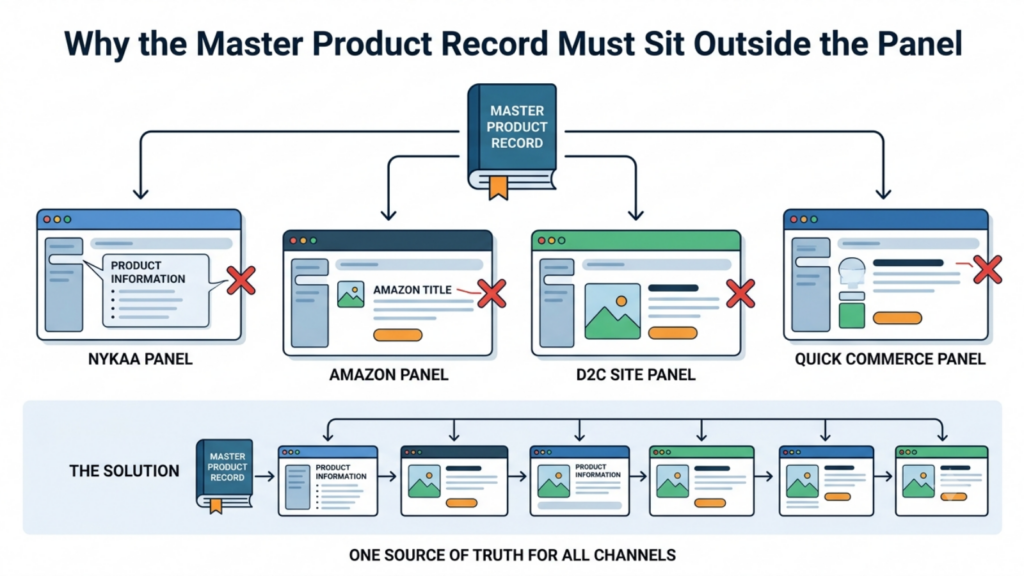
One brand launching 40 SKUs can manage all of this manually. A brand running 600 SKUs across Nykaa, Amazon, its own D2C site, and quick commerce cannot.
The failure pattern is consistent. The team corrects an ingredient list on Nykaa, misses it elsewhere, fixes each channel separately, and within two quarters no one knows which version is authoritative. In beauty, this is worse than in other categories, because the divergent field may be a regulated declaration.
Durable Nykaa catalog management requires corrections to live in a master product record that every channel reads from. Panel-only edits are overwritten at the next bulk push, which is why the same defect reappears every quarter.
Base.com is built that way. Catalog, order management, and warehouse operations share one product record, with rule-based validation before publication and version history on every attribute change. For beauty specifically, that means an ingredient list, a claim set, and a shelf-life rule are held once, versioned, and used by the catalog, the warehouse, and every sales channel simultaneously.
The practical difference is when errors surface. In a spreadsheet workflow, they surface as a customer complaint or a compliance query. In a governed catalog, validation catches them before publication.
Where to Start: Ingredients and Shades First
If you act on two items, take the ingredient structure and the shade architecture.
Ingredients drive how beauty buyers search. Shade data drives whether they buy the right thing. Both are structural, both are hard to retrofit, and both pay across every channel you sell on rather than only on Nykaa.
Strong Nykaa catalog management is not about writing better copy. It is about holding better data and letting the copy follow from it.