

Fashion brands scale on Myntra by fixing the style-to-SKU hierarchy first, then automating the photography and quality-check pipeline that sits on top of it. Catalogue management on Myntra seller panel breaks at variant depth, not at SKU count, because one style can carry six colourways and eight sizes. Solve the data model before adding styles.
Why Myntra Catalog Management Is Different From Other Marketplaces
A brand running 2,000 SKUs on Amazon and Flipkart will manage. The same brand at 2,000 styles on Myntra will not, and the reason is arithmetic.
A single kurta style in six colours and eight sizes is 48 sellable units under one style record. Multiply that across a seasonal drop, and the variant count outruns any spreadsheet-based process.
Three structural differences make catalogue management on Myntra seller panel a distinct discipline.
- Myntra is a curated marketplace, not an open one. Brand approval is an application and review process rather than self-registration, commonly taking several weeks, and Myntra rejects a large share of applicants. Catalog width is part of the assessment, with brands typically expected to bring a meaningful number of unique styles across more than one category.
- Quality check runs before listings go live. Myntra’s quality-check layer rejects images and product data at submission. Rejections are batched and often vague, so a bad template can fail hundreds of styles at once.
- The taxonomy is fashion-native. Article type, fit, occasion, fabric, pattern, sleeve length, and neckline are structural fields that drive the filter tree, not optional enrichment. A generic marketplace template drops most of them, which is why catalogue management on the Myntra seller panel cannot be run from an Amazon bulk file.
The audience justifies the effort. Myntra holds the largest share of Indian online fashion and reported roughly 60 million weekly active users in 2026, against an Indian e-commerce market tracking toward $226 billion and D2C compounding near 40% CAGR.
1. Fix the style, SKU, and vendor article hierarchy first
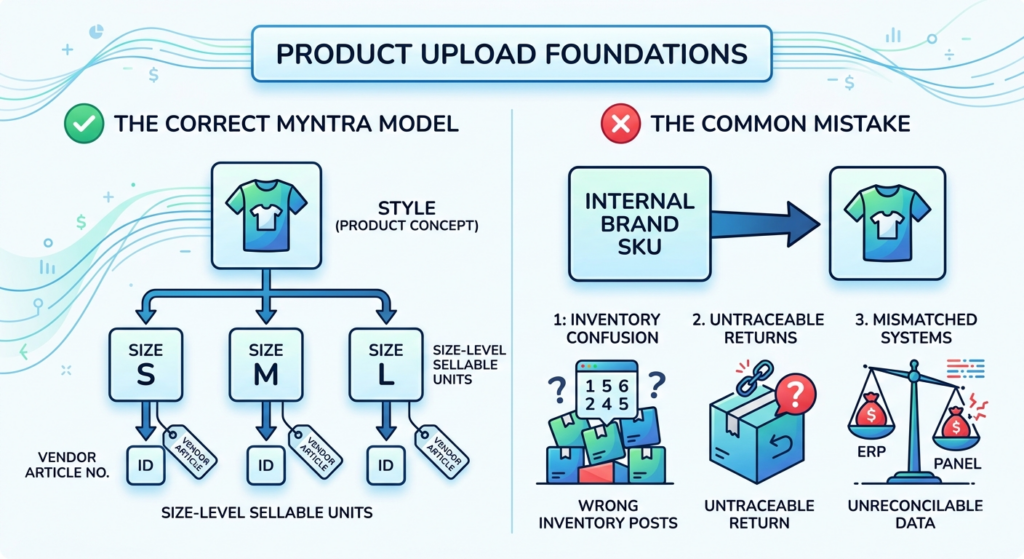
Everything downstream depends on this, and most brands get it wrong at the point of first upload.
Myntra’s model is hierarchical. A style is the product concept. Beneath it sit size-level sellable units. Your own vendor article number links each unit back to your internal system.
When brands map their internal SKU codes directly to Myntra styles, without a clean intermediate layer, three failures follow: inventory posts against the wrong size, returns cannot be traced to a unit, and reconciliation between your ERP and the panel stops matching.
| Layer | What it represents | Common error |
| Style | The design, one per colourway in most categories | Treating one style as covering all colours |
| Size-level unit | The actual sellable item | Sizes created as separate styles |
| Vendor article number | Your internal identifier | Reused across colours, breaking traceability |
| EAN or barcode | Physical identification | Missing, or duplicated across sizes |
Fix this before scaling. Catalogue management on Myntra seller panel is manageable at 200 styles with a broken hierarchy and unmanageable at 2,000.
Build the hierarchy in your master system, not in the panel
The panel is a publishing destination. If the hierarchy only exists inside Myntra, you cannot reuse it for Ajio, Nykaa Fashion, or your own D2C site, and every channel gets rebuilt from scratch.
Base.com models parent-child style relationships and size-level variants natively in the master product record, so the family structure exists before anything is pushed. The same structure then serves every channel rather than being recreated per marketplace.
2. Run catalog on a seasonal calendar, not a restock calendar

Fashion catalogs behave differently from consumables. You are not restocking the same SKU indefinitely. You are launching drops, running them for a season, and retiring them.
This changes the operating rhythm. Catalogue management on the Myntra seller panel should be planned as a series of launch windows, each with a fixed lead time, rather than as continuous maintenance.
| Stage | Lead time before go-live | Work |
| Design freeze | 12-14 weeks | Style list locked, colourways confirmed |
| Data preparation | 10-12 weeks | Attributes, size charts, article types |
| Photography | 8-10 weeks | Shoot, edit, QC-compliant output |
| Upload and QC | 6-8 weeks | Submission, rejection cycles, resubmission |
| Live and indexed | 4-6 weeks | Listings live ahead of the sale window |
| Event nomination | 3-4 weeks | EORS or festive slot submission |
Brands that compress this to three weeks spend the season fighting rejections instead of selling. Catalogue management on Myntra seller panel rewards lead time more than it rewards effort.
3. Treat quality check as a design constraint, not a review step

Myntra’s quality check is the single largest source of delay in catalogue management on Myntra seller panel, and it is treatable.
The mistake is workflow order. Most brands shoot, upload, get rejected, then learn the rule. The fix is to encode the rules into the shoot brief and the data template so failures cannot be produced in the first place.
Build a pre-submission gate covering:
- Image dimensions, background and framing against current specifications
- Mandatory attribute completeness per article type
- Size chart presence and format
- Prohibited content: watermarks, text overlays, visible price stickers, competing brand marks
- Colour naming consistency against Myntra’s accepted values
- Fabric composition and care instructions populated
Run this gate on your own data before submission. A rejection caught internally costs minutes. A rejection caught by Myntra costs days, and during festive intake it can cost a week. First-pass approval rate is the single clearest indicator of whether catalogue management on Myntra seller panel is working.
This is exactly where a governed catalog earns its cost. Base.com runs rule-based completeness validation against the master record before publication, so a style missing a size chart or a mandatory fabric attribute is blocked at source rather than rejected downstream.
4. Industrialise the photography pipeline
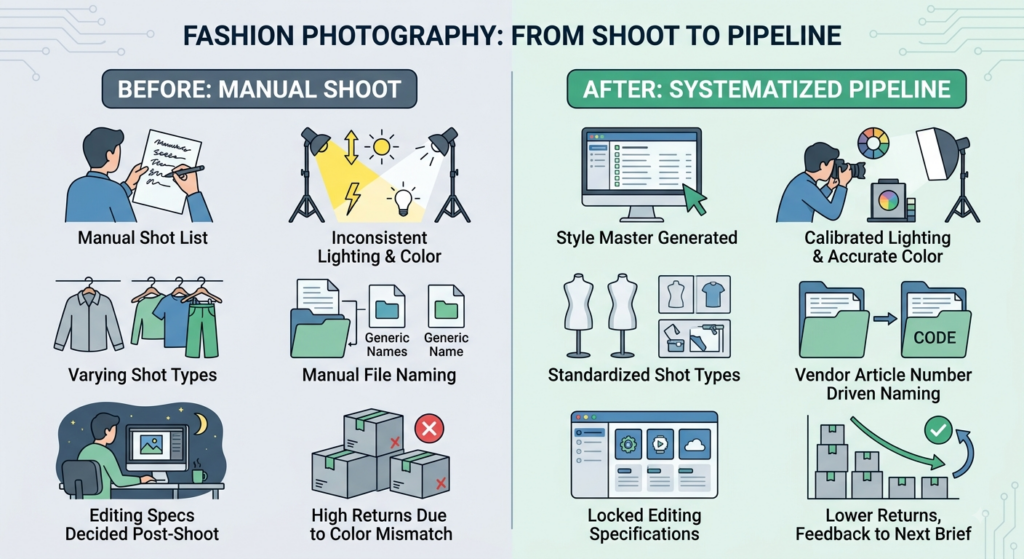
Photography is the highest recurring cost in fashion catalog operations and the least systematised.
At 500 styles per season with multiple shots per style, the shoot is a manufacturing process. Treat it as one.
What separates a pipeline from a shoot:
- A shot list generated from the style master, not written manually
- Consistent lighting and colour calibration so on-screen colour matches delivered product
- Standard shot types per article type, fixed in advance
- File naming driven by vendor article number, so ingestion is automatic
- Editing specifications locked to platform requirements before the shoot, not after
- A rejection log that feeds back into the next brief
Colour accuracy deserves specific attention. Fashion carries the highest return rates in Indian e-commerce, and COD returns run at roughly 25-30% across categories. Colour mismatch is a leading avoidable cause, and it is a photography problem, not a logistics problem.
Effective catalogue management on Myntra seller panel treats the shot list as catalogue data. If your photographer works from a separate spreadsheet, the two will diverge within one season.
5. Govern size charts as structured data

Size charts are the highest-leverage return-reduction asset in a fashion catalog, and most brands treat them as images.
An image cannot be validated, versioned, or reused. A structured size chart can.
What a governed size chart requires:
- Measurements in centimetres, stated as garment measurements or body measurements, explicitly labelled
- One chart per fit type, not one chart per brand
- Version control, so a pattern change updates every style using that chart
- Mapping to Myntra’s size values, including where your sizing does not align to standard ranges
- A note on stretch, shrinkage or wash behaviour where relevant
Brands that maintain size charts as loose image files end up with the same style carrying three different charts across three channels. Buyers notice. Returns follow.
Within catalogue management on Myntra seller panel, size chart governance is the change with the clearest and fastest margin effect, because avoided returns drop straight through to contribution.
6. Populate the full fashion attribute set, not the mandatory minimum
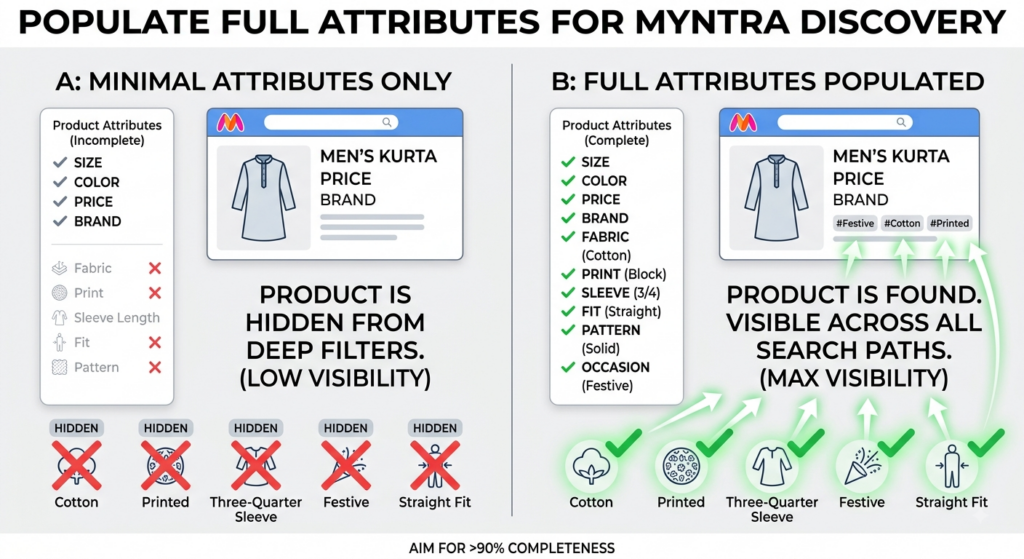
Myntra’s discovery experience runs on filters. A buyer narrowing to women’s, ethnic, straight kurta, cotton, three-quarter sleeve, printed, festive is filtering on six attributes. Miss any one, and you are excluded from that result set entirely.
Most brands populate mandatory fields, pass QC, and stop. That is the difference between being listed and being found.
| Attribute group | Fields commonly left blank | Why it matters |
| Construction | Fabric composition, weave, lining, closure | Primary filters in ethnic and formal wear |
| Fit | Fit type, length, rise, sleeve length, neckline | Highest-usage filters in apparel |
| Occasion | Occasion, season, festive suitability | Drives festive and wedding demand |
| Care | Wash care, iron instructions | Reduces returns and post-purchase complaints |
| Sustainability | Material sourcing, certifications | Growing filter usage in premium segments |
| Print and pattern | Pattern type, print scale, embellishment | Core discovery path in ethnic wear |
Set a completeness target above 90% on the full attribute set per article type, not just the mandatory subset, and measure it monthly. Attribute depth is the least visible part of catalogue management on the Myntra seller panel and the part that decides how many filter paths reach your product.
7. Manage colourways as first-class objects
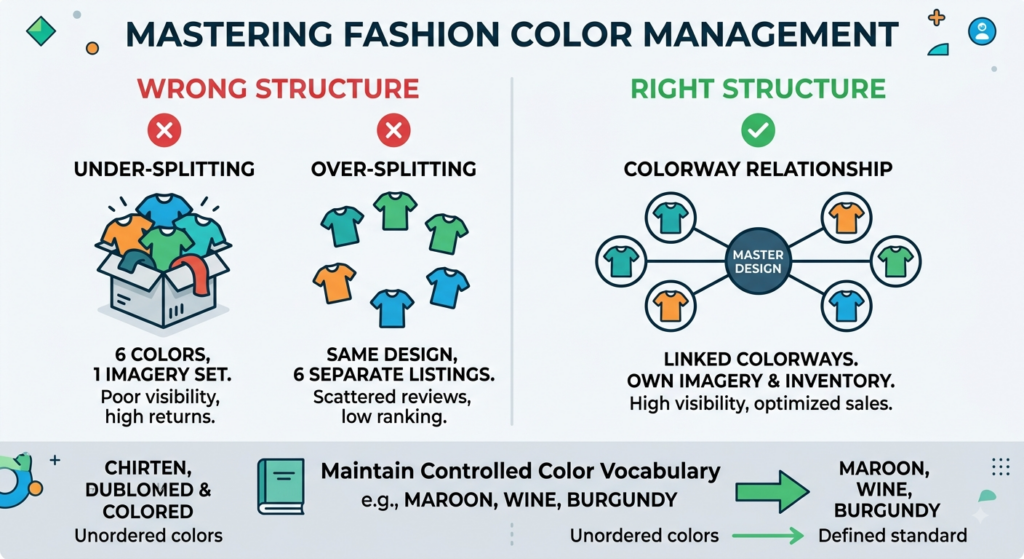
In fashion, colour is not a minor variant. It is often a separate style with its own imagery, its own inventory position and its own sell-through curve.
Two failure patterns are common.
- Under-splitting. Six colours crammed into one style with one set of images. Buyers cannot see what they are buying, and returns rise.
- Over-splitting. The same design listed six times with no relationship between the records, so reviews and ranking signals scatter and none of the six performs.
The correct structure links colourways as related styles while giving each its own imagery and inventory. Getting this right is the difference between a design that ranks and six that do not.
Colour naming discipline matters here too. “Maroon,” “wine” and “burgundy” used interchangeably across seasons makes your own catalogue unsearchable internally, which is where catalogue management on Myntra seller panel usually starts to fail at scale. Maintain a controlled colour vocabulary in the master record.
8. Sync inventory at size level, in near real time

Size-level inventory is where fashion operations differ most from every other category.
A style showing “in stock” while size M is exhausted produces a specific and expensive failure: the buyer’s most likely size is unavailable, conversion drops, and if the sync lag is bad enough, an order is accepted and then cancelled.
Cancellations damage seller metrics on Myntra in ways that outlast the individual order. This is why catalogue management on Myntra seller panel cannot be separated from inventory operations in fashion, even though the two are usually owned by different teams.
Requirements:
- Stock positions held at size level, never at style level
- Sync frequency matched to velocity, tightened during EORS and festive windows
- Buffer logic on fast-moving sizes to absorb sync lag
- A single stock position shared across Myntra, Ajio, Nykaa Fashion and D2C, so the same unit is not promised twice
- Automatic delisting of a size at zero, with automatic relisting on replenishment
That last requirement is where separate catalog and inventory systems fail. If your catalog tool does not know current stock and your order system does not know catalog structure, size-level accuracy is impossible to maintain manually.
Base.com holds one product record shared across catalog, order, and warehouse modules, so a size-level stock change and a catalog change act on the same object rather than on two systems that must later be reconciled.
9. Prepare for EORS and festive windows as catalog projects
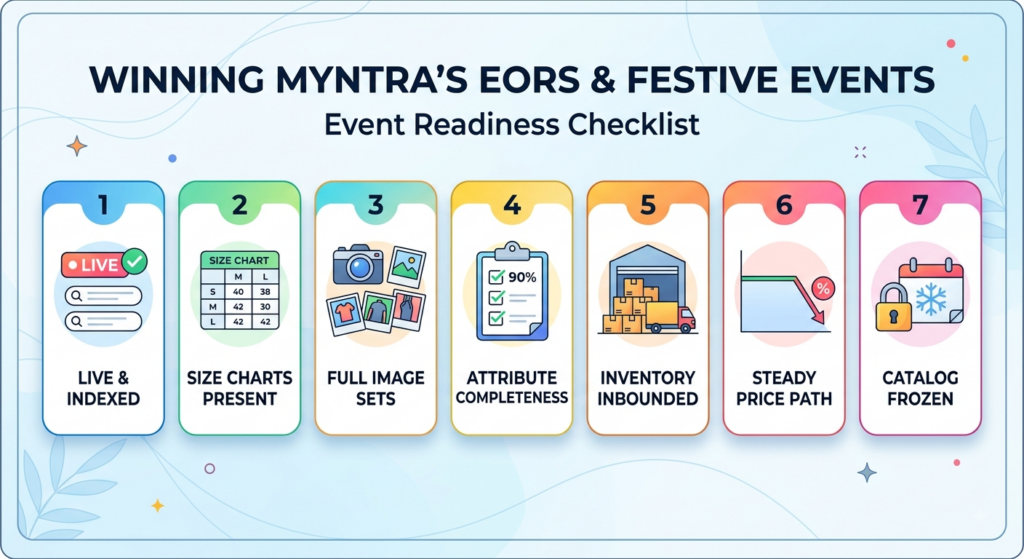
Myntra’s End of Reason Sale and its festive events are the two windows that decide a fashion brand’s year. Both are won in the preceding quarter.
The mistake is treating event preparation as a pricing exercise. Deal nomination frequently depends on listing health, and a style that fails QC or lacks mandatory attributes will not be approved regardless of the discount attached.
Event readiness checklist:
- Every priority style live and indexed, not pending QC
- Size charts present on all nominated styles
- Full image sets, not the two-image minimum
- Attribute completeness above target on nominated styles
- Size-level inventory confirmed and inbounded where the model requires it
- Price path held steady in the weeks before, so the event discount is genuine
- Catalog frozen one to two weeks out
The freeze is not optional. Changes made close to an event lose accumulated ranking, which is the most common self-inflicted injury in catalogue management on Myntra seller panel.
10. Close the loop with returns data

Fashion returns are high enough that they function as a continuous catalog audit, if you read them.
Cluster returns by reason code, then map each cluster back to the catalog field that caused it.
| Return reason | Catalog root cause | Correction |
| Size or fit | Wrong or missing size chart, wrong fit attribute | Correct chart, verify fit type |
| Colour not as shown | Uncalibrated photography | Reshoot with colour reference |
| Fabric not as expected | Composition blank or inaccurate | Populate and verify composition |
| Quality below expectation | Imagery over-flattering the product | Add honest detail shots |
| Wrong item received | Vendor article mapping error | Fix mapping, audit sibling sizes |
| Style looks different on | No model shot or scale reference | Add on-model imagery |
Feed every correction into the master record rather than editing inside the panel. Panel-only edits are overwritten at the next bulk push, which is why the same defect reappears every season.
Mature catalogue management on Myntra seller panel treats the returns report as the primary input to next season’s data template.
How to Build a Scalable Myntra Catalog Management Operating Model
Ten improvements do not survive contact with a busy season unless the operating model supports them.
Split ownership by function, not by SKU range.
| Function | Owner | Cadence |
| Style master and hierarchy | Catalog lead | Continuous |
| Attributes and taxonomy | Catalog executive | Per drop |
| Photography and QC compliance | Creative or studio | Per drop |
| Size charts | Product or tech design | Per fit change |
| Inventory sync | Supply chain | Daily, hourly in events |
| Returns analysis | Catalog lead with finance | Monthly |
Measure five numbers monthly. Live style percentage, attribute completeness by article type, first-pass QC approval rate, size-level stock accuracy, and return rate attributable to catalog causes. Without a baseline, you cannot tell whether catalogue management on Myntra seller panel improved or whether demand simply rose.
Do not run corrections channel by channel. The failure pattern is universal: fix Myntra, discover the same attribute wrong on Ajio and your D2C site, correct each separately, and within two quarters no one knows which value is authoritative.
How to Measure Myntra Catalog Performance With the Right KPIs
Brands underestimate catalog work because it does not appear as a line item. It appears as photography spend, agency retainers, and the salary of whoever is fixing rejections at eleven at night.
Price it properly before deciding whether to systematise it.
| Cost line | Manual process | Governed catalog |
| Data preparation per style | 20-40 minutes | 5-10 minutes after template setup |
| QC rejection cycles | 2-4 per drop, days each | Most caught pre-submission |
| Photography rework | Recurring, driven by spec drift | Rare, spec locked to master |
| Multi-channel duplication | Full rebuild per channel | Single push |
| Returns from catalog defects | Absorbed silently | Traced and corrected |
The last line is usually the largest and the least measured. If catalog-attributable returns run even a few percentage points above where they should, on a fashion catalog that number dwarfs the software cost.
Approach catalogue management on Myntra seller panel as a margin function rather than an administrative one, and the investment case makes itself.
The True Cost of Manual Myntra Catalog Management
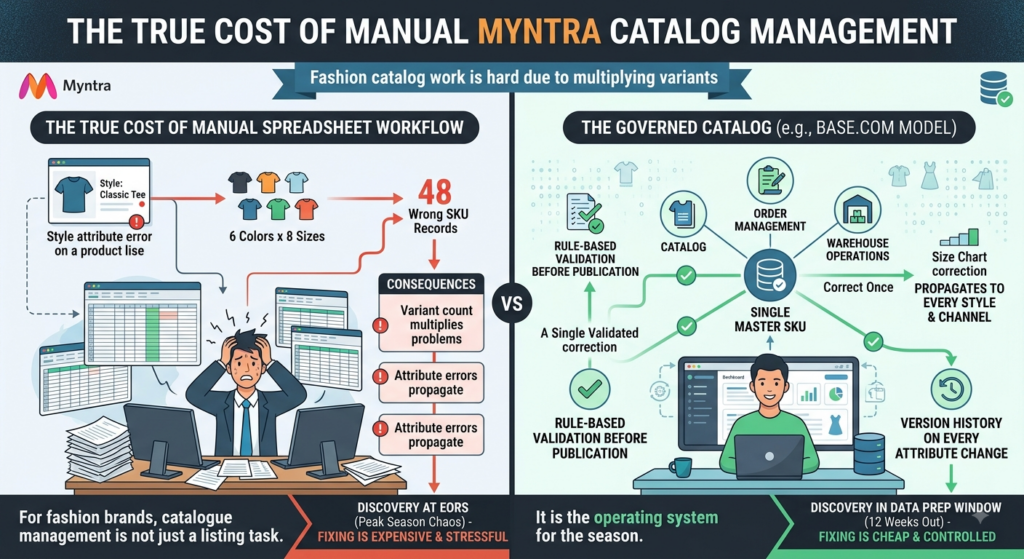
Fashion is the hardest category for multi-channel catalog work because the variant count multiplies every problem. One attribute error on a style with six colours and eight sizes is 48 wrong records.
This is the case for holding catalog, order management and warehouse operations on one product record rather than stitching a PIM to a separate OMS.
Base.com is built that way. Catalog, orders, and warehouse read from a single master SKU, with rule-based validation before publication and version history on every attribute change. A size chart corrected once propagates to every style using it, across every channel, and survives the next bulk push.
The practical difference is when you discover errors. In a spreadsheet workflow, you discover them during EORS. In a governed catalog, you discover them in the data preparation window, twelve weeks out, when fixing them is cheap.
For fashion brands, catalogue management on Myntra seller panel is not a listing task. It is the operating system for the season.
How a Unified Product Catalog Improves Myntra and Multi-Channel Operations
If you take one thing from this list, take the first item. Style, size-level unit, and vendor article number must be clean before you add volume.
Brands that scale successfully on Myntra fixed the data model at 200 styles. Brands that struggle scaled to 2,000 and then tried to fix it, during a festive quarter, with a team already at capacity.
Sound catalogue management on Myntra seller panel is not about working faster. It is about building a structure that does not need heroics.
Frequently Asked Questions
What is catalogue management on Myntra seller panel?
Why do Myntra listings get rejected at quality check?
How far in advance should fashion brands prepare a Myntra drop?
How does catalogue management on Myntra seller panel reduce returns?
Should size and colour variants be separate listings on Myntra?