

Meesho suppliers manage large catalogs by getting three things right before adding volume: correct catalog grouping, accurate weight and dimension data, and disciplined pruning of non-performers. Product listing on Meesho differs from other marketplaces because commission is zero, so shipping weight and return rates decide your margin rather than a commission percentage.
Why Meesho Catalog Management Needs a Completely Different Approach Than Amazon or Flipkart
Suppliers who scale on Amazon and Flipkart assume the same playbook applies. It does not, and the reasons are commercial rather than technical.
Commission is zero, so cost sits elsewhere. Meesho charges no commission across categories. What remains is shipping, billed by weight slab and delivery zone, plus returns. A wrong weight declaration is a permanent margin leak on every unit shipped.
The buyer is value-focused and price-sensitive. Order values skew low, with much of the platform’s volume concentrated in the roughly ₹150 to ₹600 band across categories like sarees, kurtis, jewellery, home decor and kitchen tools. There is no room to absorb operational waste.
Demand comes from beyond the metros. Around 80% of Meesho orders originate outside the top cities, across a pincode network well above 19,000. Serviceability and delivery reliability matter more than brand polish.
Returns are the highest hidden cost. A returned COD order incurs both forward and reverse shipping. On Indian e-commerce, COD returns run at roughly 25-30% across categories, and Meesho’s high-COD, price-led mix sits at the harder end of that range.
Product listing on Meesho therefore has to be optimised for shipping economics and return avoidance, not for premium presentation.
1. Understand What a Product Catalog Actually Means on the Meesho Platform

This is the most common structural mistake, and it compounds with every upload.
On Meesho, a catalog is not one product. It is a grouped listing that can carry multiple related products or variants under one entry. Suppliers who treat each SKU as its own catalog end up with thousands of thin entries competing with each other.
Suppliers who over-group face the opposite problem: unrelated items bundled together, so buyers cannot find the specific variant they want.
|
Approach |
Result |
|---|---|
|
One catalog per SKU |
Internal competition, diluted performance signals, unmanageable panel |
|
One catalog per genuine product family |
Clean performance data, easier pricing, better conversion |
|
One catalog spanning unrelated products |
Buyer confusion, higher returns, poor conversion |
Decide the grouping rule before your next bulk upload. Retrofitting it across 4,000 entries is a quarter of the work.
2. Build a Repeatable Bulk Upload Process for Meesho Product Listings

Meesho supports single-catalog upload and bulk upload through category-specific templates. At scale, only the second matters.
Single upload is fine for testing one product. It is not a method for adding 500. Suppliers still uploading manually at high volume are spending most of their catalog capacity on data entry rather than on decisions.
What a repeatable bulk process needs:
- A master data file in your own system, not in the Meesho template
- A mapping layer that converts your master fields into each category template
- Validation run before upload, so errors are caught in your file rather than by the panel
- A version of every uploaded file retained, so you can identify what changed
- Named owner per category template, because templates differ by category
Meesho’s panel validates uploads and flags errors such as missing HSN codes. Treat that as a backstop rather than your quality process. Product listing on Meesho becomes efficient when your own file is already clean.
3. Fix Tax and Compliance Fields Once and Manage Them Centrally

HSN codes, GST percentages, and mandatory category attributes are the most common cause of rejected bulk uploads.
The efficient fix is a single authoritative mapping of product category to HSN and GST rate, held centrally and referenced by every upload. Most suppliers instead retype these per template, which guarantees drift.
Note also that Meesho permits registration without GSTIN in certain permitted categories using an alternative enrolment identifier. If you operate under that route, your eligible category list is narrower, and building catalogs in ineligible categories wastes the work.
4. Price Your Products Against Weight Slabs Instead of Against Competitors
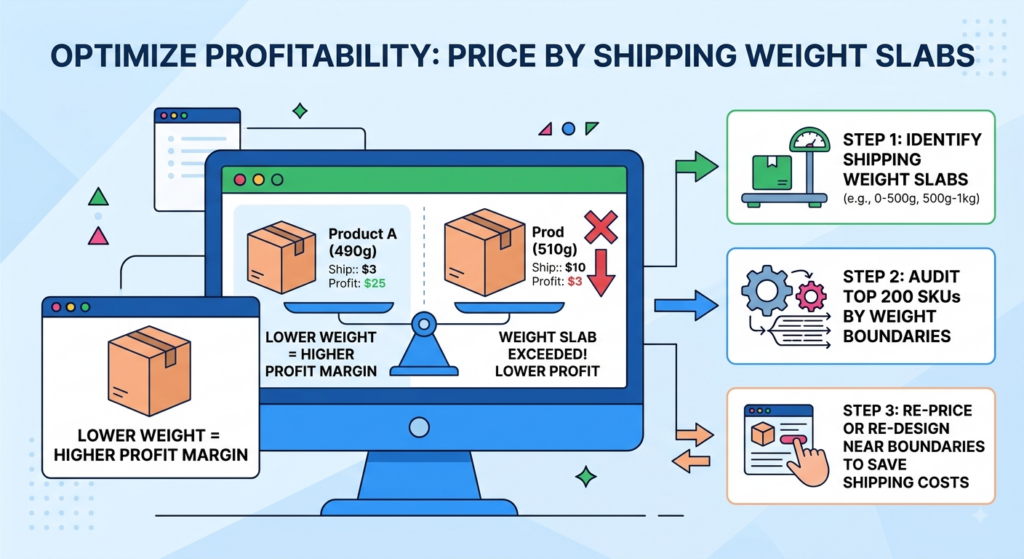
With zero commission, your unit economics reduce to selling price, product cost, shipping, and returns.
Shipping is charged by weight slab. This creates a hard commercial rule most suppliers miss: a product sitting just above a slab boundary can be meaningfully less profitable than the same product just below it.
|
Lever |
Effect on margin |
|---|---|
|
Reduce packed weight below a slab boundary |
Direct saving on every order |
|
Reduce packaging bulk |
Lower volumetric weight |
|
Correct an over-declared weight |
Recovers ongoing overcharge |
|
Bundle to lift order value within the same slab |
Better margin per shipment |
Audit your top 200 SKUs by order volume against slab boundaries. This is usually the single highest-value exercise in Meesho catalog management, and it is invisible unless you look for it.
5. Treat the Meesho Price Recommendation Tool as Input, Not as an Instruction
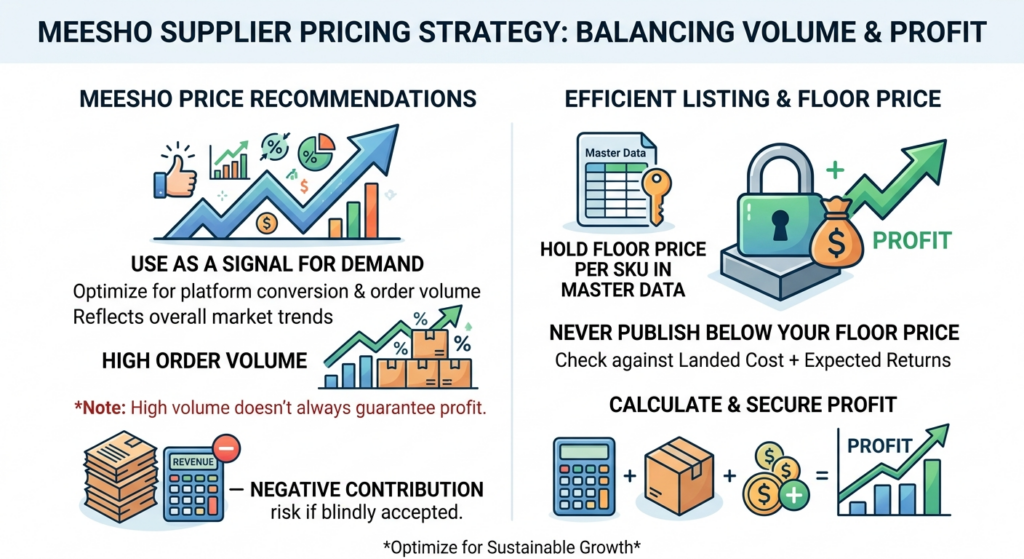
Meesho’s panel provides price recommendations to help suppliers stay competitive. The recommendations optimise for platform conversion, which is correlated with your interest but not identical to it.
Use recommendations as a signal about where demand sits, then check the number against your own landed cost including expected returns. Accepting every recommendation across a large catalog is how suppliers end up with high order volume and negative contribution.
Efficient product listing on Meesho means holding a floor price per SKU in your master data and never publishing below it, regardless of what any tool suggests.
6. Optimise Product Images for a Mobile-First, Value-Focused Meesho Buyer

Meesho’s buyer browses on a phone, often on a constrained connection, and decides fast.
This changes what a good image is. Clarity beats artistry.
- Show the product filling the frame, clearly, in the first image
- Show scale early, because dimension confusion drives returns
- Show the product in a realistic context that matches the buyer’s expectation
- Show what is actually in the pack, especially for sets and combos
- Avoid dense text overlays that become illegible on a small screen
- Avoid heavily styled imagery that flatters the product beyond reality
That last point is commercial, not aesthetic. Imagery that oversells produces orders that come back, and a returned COD order costs you shipping in both directions.
7. Write Product Titles the Way Meesho Buyers Actually Search

Meesho search behaviour is descriptive and category-led rather than brand-led. Buyers search for the thing, not the label.
|
Weak title |
Stronger title |
|---|---|
|
Brand name plus style code |
Product type, fabric, key attribute, pack size |
|
Long keyword string |
Front-loaded core description within the visible length |
|
Aspirational language |
Concrete attributes buyers filter on |
Lead with the product noun and the two or three attributes that distinguish it. Pack quantity should be explicit, because combo and set demand is strong at Meesho’s price points.
Keep it readable. Product listing on Meesho does not reward keyword stuffing, and titles are truncated on mobile.
8. Make Weight and Dimension Accuracy a Standing Audit Practice

This deserves its own point because it affects two costs simultaneously.
Under-declared weights create settlement disputes and reconciliation work. Over-declared weights quietly overcharge you on every shipment. Wrong dimensions cause packing mismatches and transit damage, which returns as a preventable return.
Re-measure physically. Do not trust supplier-provided specifications or figures carried over from an old system.
Set a cadence: full audit annually, top-200-by-volume quarterly, and any new SKU measured before it goes live.
9. Attack Return to Origin Problems at the Catalog Level, Not the Logistics Level
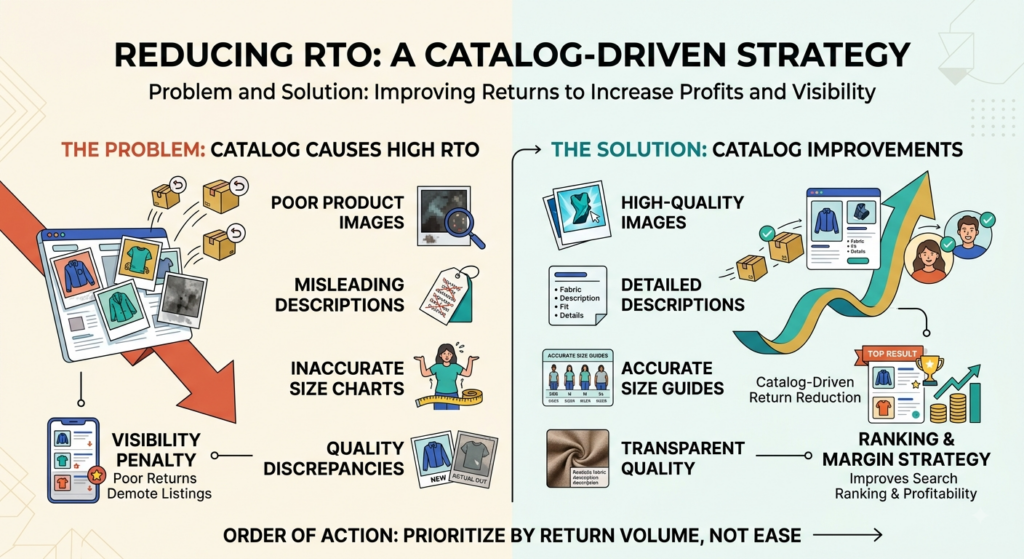
Return to origin is the defining economic problem of Meesho supply, and most of its causes sit in the catalog rather than in logistics.
|
RTO or return cause |
Catalog fix |
|---|---|
|
Size or fit mismatch |
Add measured size chart in centimetres |
|
Colour differs from image |
Colour-calibrated photography |
|
Product smaller than expected |
Add scale reference image |
|
Material not as expected |
Populate fabric or material composition accurately |
|
Missing items in a set |
Explicit contents image and title |
|
Quality below expectation |
Honest detail shots, remove overclaims |
High RTO also carries a visibility penalty, because poor return performance can demote listings. That makes catalog-driven return reduction a ranking strategy as well as a margin strategy.
Work this list in order of return volume, not in order of ease.
10. Protect Your Supplier Rating and Dispatch Performance on Meesho

Meesho surfaces a supplier rating that influences organic visibility, and dispatch performance feeds it. Orders left unactioned run into auto-cancellation windows.
At small scale, this is manageable manually. At several thousand catalog entries with orders arriving continuously, it is not.
Catalog-side actions that protect rating:
- Delist any SKU you cannot dispatch within the SLA, rather than accepting and cancelling
- Keep inventory positions accurate so you never accept an order you cannot fill
- Retire SKUs whose supply is unreliable, even if they sell well
- Flag SKUs with recurring quality complaints for correction or removal
A high-selling SKU with unreliable supply damages the visibility of your entire catalog. Removing it is usually the profitable decision.
11. Control Variant Depth Deliberately Across Your Product Catalog
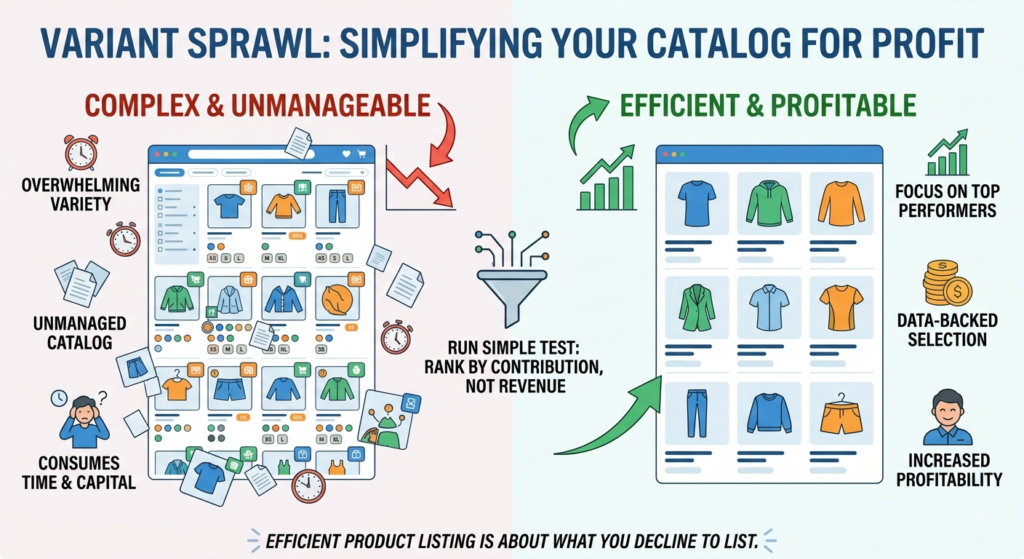
Variant sprawl is how a manageable catalog becomes an unmanageable one.
Every added colour or size multiplies photography, data entry, inventory tracking, and return analysis. Some of that depth earns its cost. Much of it does not.
Run a simple test per family: rank variants by contribution, not revenue. In most Meesho catalogs, a minority of variants generate the large majority of profitable orders, while the tail consumes operational capacity and occupies working capital.
Add depth where data supports it. Efficient product listing on Meesho is as much about what you decline to list as what you list.
12. Prune Non-Performing Catalog Entries on a Fixed Quarterly Schedule

Large Meesho catalogs accumulate dead entries because nothing forces their removal.
Set a quarterly review with explicit criteria, so the decision is mechanical rather than emotional.
|
Signal |
Threshold to review |
Likely action |
|---|---|---|
|
Zero orders |
Two consecutive quarters |
Delist |
|
Return rate far above category norm |
Any quarter |
Fix catalog cause, or delist |
|
Negative contribution after returns |
Any quarter |
Reprice or delist |
|
Recurring quality complaints |
Two or more instances |
Delist pending correction |
|
Chronic stockouts |
Two consecutive quarters |
Delist until supply stabilises |
Pruning improves more than tidiness. A smaller, healthier catalog raises your average performance metrics, which is what visibility responds to.
13. Hold One Single Inventory Position Across All Your Sales Channels

Most Meesho suppliers also sell elsewhere. Separate inventory tracking per channel is how the same unit gets promised twice.
The outcome is a cancellation, which costs rating and visibility on a platform where both drive orders.
What correct sync requires:
- One stock position per sellable unit, shared across every channel
- Sync frequency matched to velocity, tightened during sale events
- Buffers on fast movers to absorb sync lag
- Automatic delisting at zero and relisting on replenishment
- Reservation logic so an order on one channel reduces availability everywhere
This is the point at which spreadsheet-based catalog management stops being viable. Product listing on Meesho at scale requires the catalog and the stock position to be the same object rather than two files someone reconciles weekly.
Base.com addresses this by holding one master product record shared across catalog, order, and warehouse modules, so a stock movement and a catalog change act on the same record. A weight correction made for shipping accuracy also updates the packing rule and the declared weight, rather than requiring three separate edits in three systems.
14. Sequence Meesho Advertising After Organic Catalog Validation

Meesho Ads run on a cost-per-click basis from the supplier panel. At zero commission and thin absolute margins, ad discipline is stricter than on other marketplaces.
The practical sequence:
- Let a new catalog run organically first and observe conversion
- Advertise only entries that already convert without support
- Start at suggested bids rather than aggressive ones
- Cap spend as a percentage of revenue that your actual margin supports
- Concentrate budget into sale event windows, where conversion is materially higher
Advertising a poorly built catalog entry amplifies the loss. Fix the listing first, which is why product listing on Meesho comes before any ad budget.
15. Close the Loop Between Returns Data and Catalog Correction
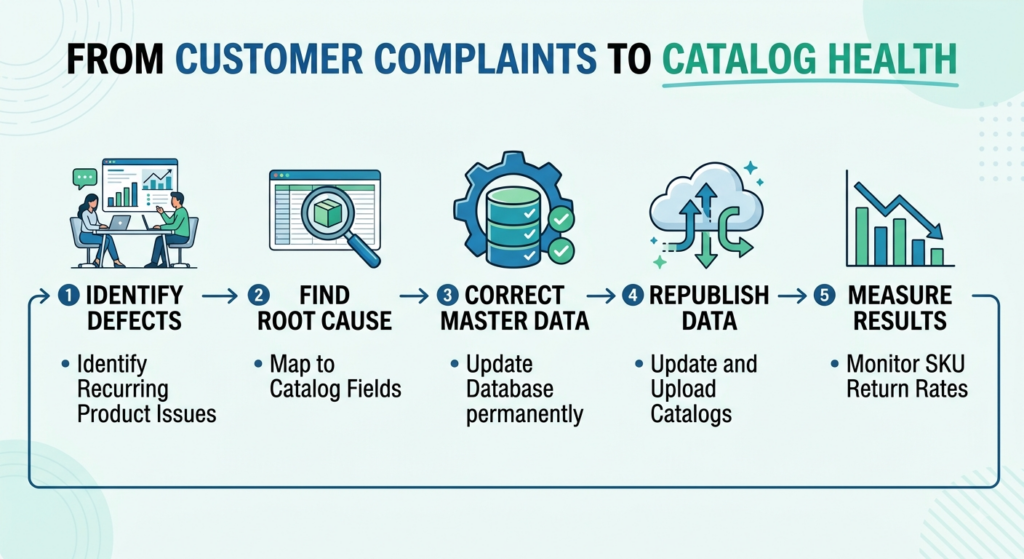
The panel exposes returns, quality flags, and customer complaints. Most suppliers read these as individual cases. Read them as catalog defects instead.
Monthly routine:
- Export returns and complaints, cluster by SKU and reason
- Map each cluster to the catalog field responsible
- Correct in your master data, then republish
- Track whether the return rate for that SKU falls in the following month
- Delist anything that does not improve after two correction attempts
Corrections made only inside the panel are lost at the next bulk upload. That is why the same defect reappears every quarter in catalogs managed panel-first rather than master-first.
The 15-Point Summary for Efficient Meesho Catalog Management
A well-managed Meesho catalog needs more than accurate product uploads. Sellers need to maintain consistent product information, images, variants, pricing, inventory, and catalog structure while keeping listings optimized for visibility and conversions.
The following 15-point summary brings together the most important practices for building, maintaining, and scaling an efficient Meesho catalog.
|
# |
Action |
Primary benefit |
|---|---|---|
|
1 |
Correct catalog grouping |
Cleaner data, less internal competition |
|
2 |
Repeatable bulk upload process |
Capacity to scale |
|
3 |
Central HSN and GST mapping |
Fewer rejections |
|
4 |
Price against weight slabs |
Direct margin |
|
5 |
Price floor per SKU |
Protects contribution |
|
6 |
Mobile-first imagery |
Conversion and fewer returns |
|
7 |
Search-aligned titles |
Discovery |
|
8 |
Weight and dimension audit |
Direct margin |
|
9 |
Catalog-level RTO reduction |
Margin and visibility |
|
10 |
Rating and SLA protection |
Organic visibility |
|
11 |
Deliberate variant depth |
Operational capacity |
|
12 |
Scheduled pruning |
Higher average performance |
|
13 |
Single inventory position |
Fewer cancellations |
|
14 |
Ads after organic validation |
Efficient spend |
|
15 |
Returns feedback loop |
Continuous improvement |
What Changes When Your Meesho Catalog Reaches 5,000 Entries
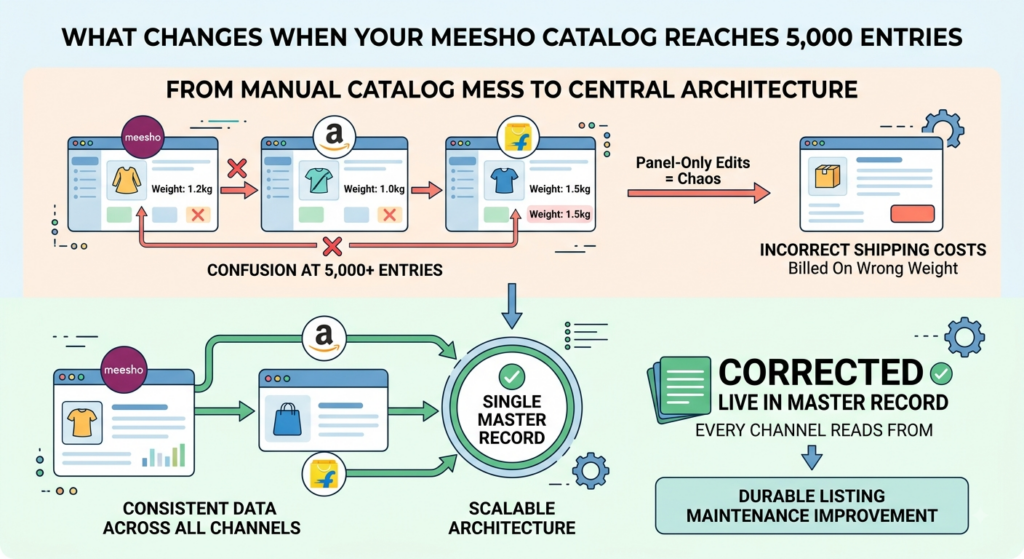
Everything above is achievable manually at 300 entries. At 5,000 across Meesho, Amazon, Flipkart, and your own site, the constraint stops being effort and becomes architecture.
The failure pattern is consistent. The team fixes a weight in Meesho, misses it on the other channels, corrects each separately, and within two quarters nobody knows which figure is authoritative. Meanwhile, shipping is being billed on whichever number happened to be wrong.
Durable product listing on Meesho requires corrections to live in a master record that every channel reads from. Panel-only edits are maintenance, not improvement.
Base.com is built on that principle. Catalog, order management, and warehouse operations share a single product record, with rule-based validation before publication and version history on every attribute change. For Meesho suppliers specifically, the fields that decide profitability, weight, dimensions, and pack contents are held once and used everywhere, including by the warehouse and the courier.
The difference shows up when you find errors. In a spreadsheet workflow, you find them in a settlement report months later. In a governed catalog, validation catches them before the upload.
Start With Catalog Grouping and Weight Slab Accuracy First
If you act on two items from this list, take points 1 and 4.
Catalog grouping determines whether your panel is manageable. Weight slab accuracy determines whether your orders are profitable. Neither is glamorous, and both pay immediately.
Efficient product listing on Meesho is not about listing more. It is about listing a smaller, cleaner, correctly measured catalog that does not leak margin on every shipment.