
Every Indian D2C brand needs ten software layers: storefront, order management, warehouse execution, shipping aggregation, returns handling, payments and COD risk, customer messaging, analytics, support, and accounting with GST. The best ecommerce software for D2C brands in India covers these layers without forcing you to reconcile between five disconnected systems.
This guide is organised by layer, not by vendor. Brands rarely fail because they picked the wrong tool. They fail because they bought layer seven before layer three and spent two years patching the gap.
How should an Indian D2C brand think about its software stack overall?
Your stack has two halves that behave very differently. The demand half- storefront, marketing, analytics- gets attention because it drives revenue, and founders enjoy it.
The fulfilment half- orders, warehouse, shipping, returns, reconciliation- decides whether that revenue survives contact with reality. India’s ecommerce market runs at roughly $226 billion, and COD return rates between 25% and 30% mean a quarter of your demand-side wins reverse themselves downstream.
The table below maps the ten layers against the problem each one solves and the point at which brands typically need it.
| Layer | Tool category | Problem it solves | Usually needed by |
| 1 | Storefront platform | Selling directly at all | Day one |
| 2 | Payments and COD risk | Collecting money, filtering bad orders | Day one |
| 3 | Shipping aggregation | Courier rates and pickups | First 50 orders |
| 4 | Accounting and GST | Compliance and true margin | First quarter |
| 5 | Customer support desk | Response time and repeat purchase | 100 orders a day |
| 6 | Order management system | Multi-channel order chaos | 200 orders a day |
| 7 | Returns and RTO management | Reverse logistics losses | 200 orders a day |
| 8 | Warehouse management | Picking accuracy at scale | 500 orders a day |
| 9 | Customer messaging and CRM | Repeat rate and retention | 500 orders a day |
| 10 | Analytics and attribution | Knowing what actually works | ₹5 crore revenue |
What are the 10 tools every Indian D2C brand should actually be running?
Each layer below follows one format: what it does in Indian conditions, what to check before buying, when to skip it, and how it typically gets priced. Read the “skip it if” line carefully, because buying early wastes more money than buying late.
1. Storefront platform
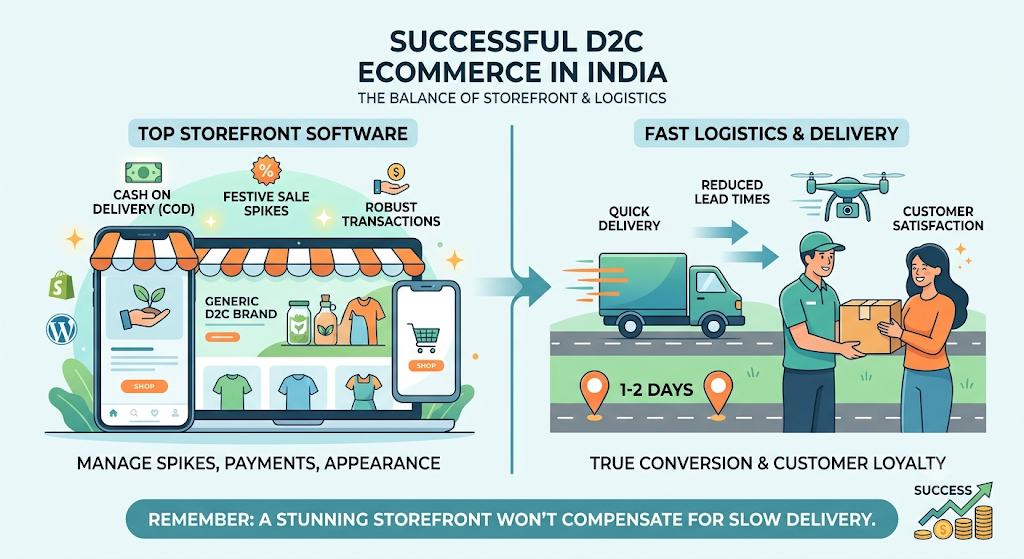
Your storefront sits at the top of the best ecommerce software for D2C brands in India. It hosts the transaction, but in India it also has to handle COD as a first-class payment method and survive traffic spikes during festive sales. Shopify dominates the mid-market, WooCommerce serves brands wanting control, and native app builders matter once repeat customers dominate.
Most founders over-invest here. A beautiful storefront converts nothing extra if delivery takes nine days.
What to check before you buy
- Native COD support with order confirmation flows, not a plugin workaround
- Clean API access so downstream systems can pull orders reliably
- Indian payment gateway integrations that settle without manual intervention
- Performance on mid-range Android phones over patchy mobile data
Skip it if: you sell only on marketplaces and have no direct channel yet.
Typical pricing: monthly SaaS plus transaction percentage.
2. Payments and COD risk

A payment gateway collects prepaid money. A COD risk layer decides which cash orders deserve shipping at all, which matters far more to your margin.
Every COD order carries a real probability of refusal at the door. Shipping all of them equally means funding your own losses.
What to check before you buy
- Risk scoring based on pincode, order value, and customer history
- Automated order confirmation over WhatsApp or SMS before dispatch
- Partial prepaid conversion prompts at checkout
- Settlement timelines and reconciliation reporting
Skip it if: your COD share sits below a fifth of orders.
Typical pricing: percentage per transaction, or per-order for risk tooling.
3. Shipping aggregation
A shipping aggregator compares courier rates, books pickups, and gives you fallback options when one partner fails in a region. Single-courier dependence is the fastest route to a delivery crisis.
Indian courier performance varies sharply by pincode. The partner that excels in Maharashtra may underperform badly in the Northeast.
What to check before you buy
- Courier breadth including regional and hyperlocal partners
- NDR management workflows with automated customer contact
- Weight discrepancy dispute handling, which quietly costs brands real money
- Serviceability data accuracy at pincode level
Skip it if: you ship under ten orders a day and negotiate directly.
Typical pricing: per shipment, often bundled into courier rates.
4. Accounting and GST

GST compliance in ecommerce involves place-of-supply logic, e-way bills above state thresholds, and marketplace TCS reconciliation. Generic accounting software handles none of this natively.
Brands that treat compliance as a year-end activity discover problems during assessment, when fixing them costs far more.
What to check before you buy
- Automated GST invoice generation at the point of dispatch
- E-way bill generation triggered by consignment value and distance
- Marketplace settlement and TCS reconciliation
- Integration with your order system rather than manual CSV uploads
Skip it if: never. This layer is mandatory from your first invoice.
Typical pricing: annual licence, often per user.
5. Customer support desk: how does response time affect repeat purchase in India?

A support desk consolidates WhatsApp, email, Instagram, and call queries into one view with order context attached. Without it, agents ask customers for order numbers the system already knows.
Indian D2C support volume skews heavily toward two questions: where is my order, and how do I return it? Both are answerable automatically.
What to check before you buy
- WhatsApp Business API integration, since that is where Indian customers message.
- Order and tracking data visible inside the agent view
- Automated responses for tracking and return status queries
- Regional language handling if you sell beyond metro cities
Skip it if: one person handles all queries in under an hour daily.
Typical pricing: per agent per month.
6. Order management system
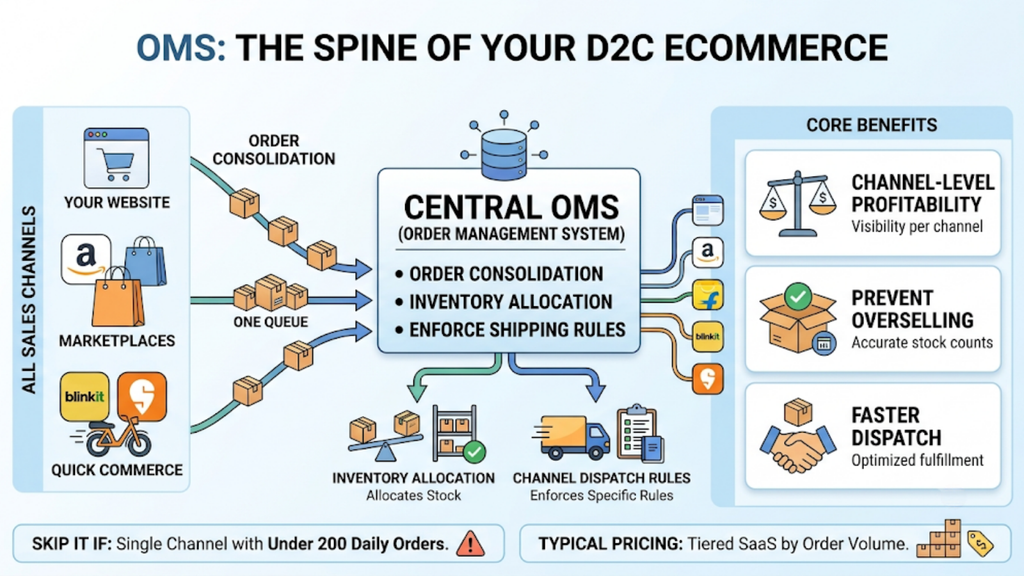
An OMS consolidates orders from your website, marketplaces, and quick commerce into one queue, allocates inventory, and enforces channel-specific dispatch rules. It is the spine of the best ecommerce software for D2C brands in India.
The trigger is channel count, not revenue. Three channels create more operational complexity than one channel at triple the volume.
What to check before you buy
- Maintained connectors for every channel you sell on today and next year
- Inventory allocation logic that prevents overselling across channels
- Channel-level profitability visibility, not just order counts
- Quick commerce dispatch handling if that channel matters to you
Skip it if: you sell on one channel with under 200 daily orders.
Typical pricing: tiered SaaS by order volume.
7. Returns and RTO management
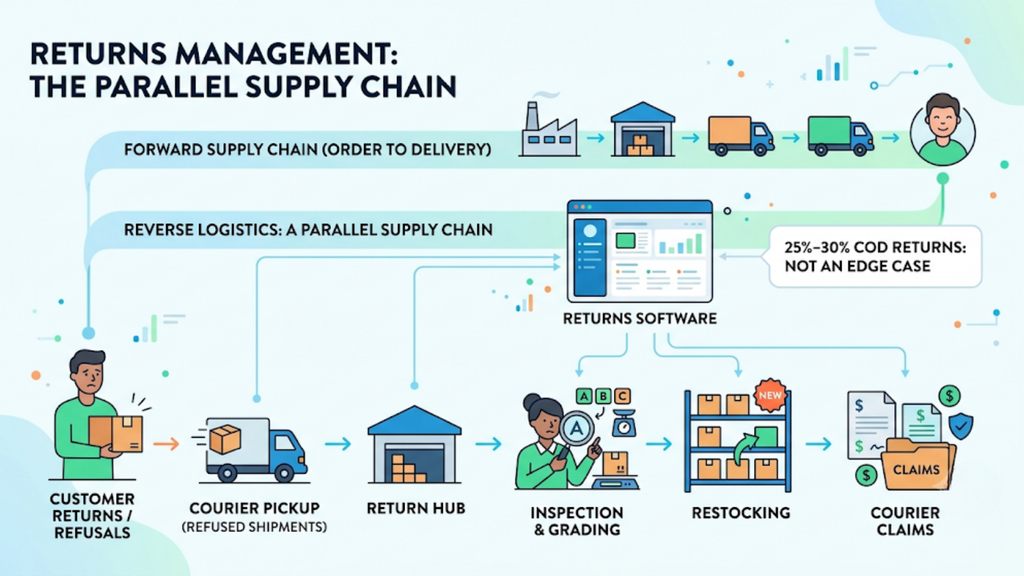
Returns software handles the journey after a customer refuses or returns a shipment: inspection, grading, restocking, and claims against couriers. Most stacks treat this as an afterthought and lose money accordingly.
With COD returns running between 25% and 30%, reverse logistics is not an edge case. It is a parallel supply chain.
What to check before you buy
- Separate handling for RTO and customer-initiated returns
- Grading workflows that route stock to sellable, refurbish, or write-off
- Automated claim filing against courier damage and loss
- Speed from inbound receipt to restocked and sellable
Skip it if: your return rate sits in single digits, which is rare in Indian D2C.
Typical pricing: included in OMS platforms, or per-return standalone.
8. Warehouse management

A WMS directs picking, enforces scan verification, and controls putaway inside your facility. It converts a warehouse from memory-driven to system-driven.
Warehouse execution is the layer brands postpone the longest within the best ecommerce software for D2C brands in India. SKU count breaks manual picking before order volume does. A brand adding shades or sizes multiplies pick complexity faster than it multiplies revenue.
What to check before you buy
- Barcode scan verification at both pick and pack
- Bin-level, batch, and expiry tracking depth
- Training time for a new warehouse associate
- Hardware requirements including scanners and label printers
Skip it if: you dispatch under a hundred orders daily from a shallow catalogue.
Typical pricing: tiered SaaS, plus hardware capital cost.
9. Customer messaging and CRM
Messaging tools run segmented campaigns across WhatsApp, email, and SMS, triggered by customer behaviour. In India, WhatsApp carries open rates no other channel matches.
Acquisition costs rise every year. Brands that never build repeat purchases remain permanently dependent on paid media.
What to check before you buy
- WhatsApp Business API with template approval support
- Segmentation using order history and product category
- Abandoned cart and replenishment automation
- Attribution reporting that separates incremental revenue from organic repeat.
Skip it if: your category genuinely has no repeat cycle.
Typical pricing: per message or per contact, monthly.
10. Analytics and attribution

Analytics tools connect ad spend, orders, returns, and contribution margin into one view. Platform dashboards will not do this, because each ad platform reports its own contribution generously.
Contribution margin after returns is the only number that matters, and the best ecommerce software for D2C brands in India should surface it without manual work. A campaign showing strong return on ad spend can still lose money once RTO costs land.
What to check before you buy
- Return and RTO data included in profitability calculations
- Channel-level contribution margin, not just revenue attribution
- Cohort analysis for repeat purchase behaviour
- Data pulled from your order system rather than ad platforms alone
Skip it if: you run a single channel and can reconcile manually.
Typical pricing: monthly SaaS by data volume or order count.
How do you evaluate vendors selling the best ecommerce software for D2C brands in India?
Vendor demos across every layer look similar, because each one shows a clean catalogue on a quiet day. These five checks separate genuine capability from a good presentation.
- Run your own messy data through it. Send your real SKU master with its duplicates and inconsistent naming. Clean demo data hides the problems you will actually face.
- Ask for a reference at your volume. A customer dispatching ten times your orders tells you nothing useful about your experience.
- Test support on a weekend. Raise a real ticket on a Saturday evening and time the response. Sales peaks never arrive on Tuesday mornings.
- Read the integration documentation yourself. A vendor claiming an integration exists and a vendor maintaining it directly are different situations.
- Ask what happened during the last festive season. Every platform had incidents. Vendors who describe theirs honestly are usually the safer choice.
In what sequence should an Indian D2C brand buy these ten tools?
Sequencing matters more than selection. The table below maps growth stage to the layers worth adding, based on where operational pain typically appears.
| Growth stage | Daily orders | Add these layers | Common mistake at this stage |
| Launch | Under 50 | Storefront, payments, shipping, accounting | Buying marketing automation too early |
| Traction | 50 to 200 | Support desk, basic returns process | Delaying GST automation |
| Scale | 200 to 500 | Order management, returns software | Adding channels without orchestration |
| Operational maturity | 500 to 2,000 | Warehouse management, messaging | Buying a WMS before fixing SKU data |
| Consolidation | Above 2,000 | Analytics, platform consolidation | Running five disconnected systems |
How should these tools connect to each other across your stack?
Integration quality determines whether your stack helps or hurts. The best ecommerce software for D2C brands in India shares data cleanly rather than claiming compatibility on a slide. Ten well-chosen tools that do not share data create more manual work than five that do.
- One system owns inventory. Two systems holding stock counts will eventually disagree, and your team will stop trusting both.
- Order data flows downstream, never sideways. Storefront and marketplaces feed the order layer, which feeds warehouse and shipping. Loops create duplicates.
- Returns write back to inventory automatically. Manual restocking is where inventory accuracy dies.
- Finance reads from operations, not from spreadsheets. GST and reconciliation should draw on the same order records your warehouse used.
- Every integration needs an owner. Connectors break silently. Somebody must notice within hours, not at month-end.
Which layers should you consolidate and which should stay separate?
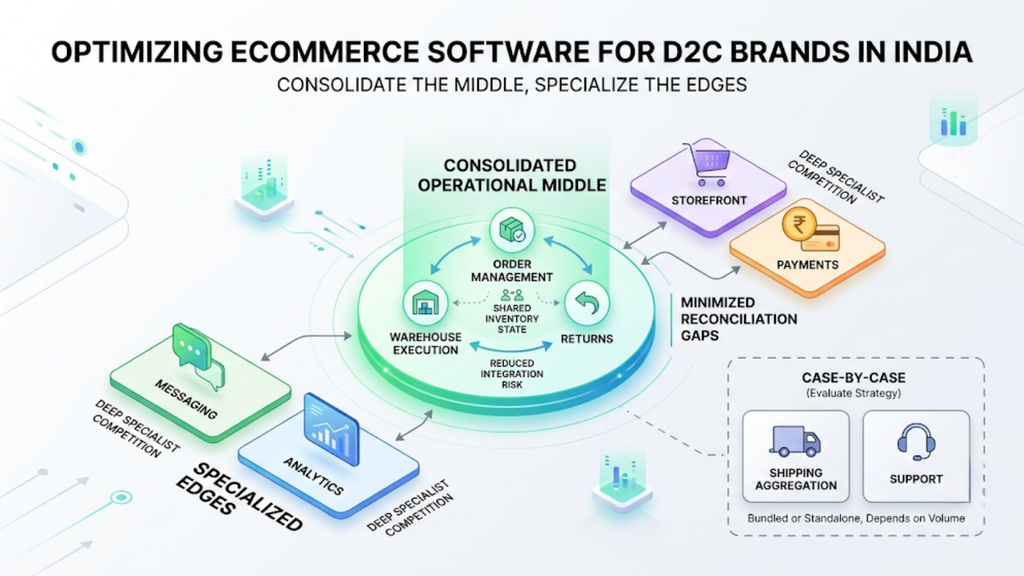
Consolidation reduces integration risk but concentrates vendor dependence. The best ecommerce software for D2C brands in India tends to consolidate the operational middle while leaving the edges specialised.
Consolidate these: order management, warehouse execution and returns. These three share inventory state constantly, and splitting them across vendors creates the reconciliation gaps that cost brands the most.
Keep these separate: storefront, payments, messaging and analytics. Each has deep specialist competition, switching costs stay manageable, and bundling them rarely improves quality.
Judge case by case: shipping aggregation and support. Both work well bundled or standalone depending on your volume and courier strategy.
How much should an Indian D2C brand budget across these ten layers?
Software spend should track operational complexity rather than revenue. The split below reflects how brands running the best ecommerce software for D2C brands in India typically allocate.
| Spend area | Share of software budget | Notes |
| Operations core (OMS, WMS, returns) | Largest share | Scales with order volume and warehouse count |
| Storefront and payments | Transaction-linked | Rises automatically with revenue |
| Shipping and logistics | Per shipment | Usually your highest variable cost overall |
| Marketing and messaging | Discretionary | Easiest to overspend on early |
| Analytics and support | Smallest share | Add once complexity justifies it |
Ask every vendor for a three-year total cost at projected volume. Implementation, connector development and premium support sit outside the licence fee and surprise most buyers in year two.
What mistakes do Indian D2C brands make when building their software stack?

Stack mistakes rarely announce themselves, and none of them get solved by buying more of the best ecommerce software for D2C brands in India. These five appear repeatedly, and each one compounds quietly over months.
- Buying demand tools before fulfilment tools. Marketing automation on top of broken operations amplifies a bad customer experience faster.
- Treating returns as a finance problem. Returns are an operations problem with financial symptoms. Software chosen by finance alone rarely fixes the dock.
- Choosing tools that cannot talk to each other. Ask for the actual API documentation during evaluation, not a slide claiming integration exists.
- Ignoring the Indian specifics. GST logic, COD workflows, and WhatsApp messaging are not optional localisation. They are core requirements.
- Never remove anything. Stacks accumulate. Review annually and cut tools nobody has opened in three months.
Where does Base.com fit within the best ecommerce software for D2C brands in India?
Base.com operates in the operational middle of the best ecommerce software for D2C brands in India, the layers where fragmentation costs brands the most. Order management, warehouse execution, and returns handling run on one system rather than three that must agree with each other.
That position reflects a specific view of where D2C brands actually lose money. The storefront rarely breaks. The gap between an order being placed and that order arriving correctly is where margin disappears.
Brands still choose their own storefront, payment gateway, messaging tool, and analytics platform. Base.com consolidates the operational spine those tools depend on.