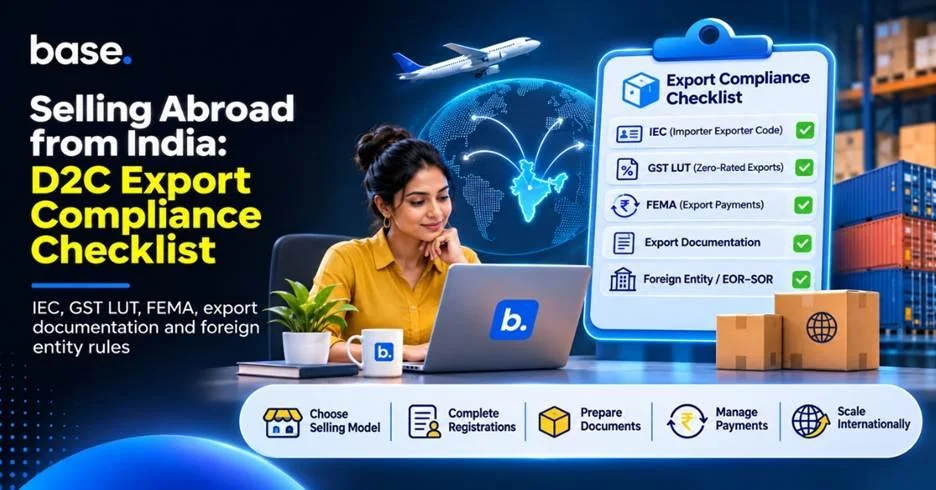
Selling overseas from India is regulated at the exporter registration, the tax, the customs paperwork and the payment route home. This guide sets out the selling abroad from India compliance checklist in the order most D2C brands meet it; it covers physical-product exporters, not services.
Which selling model fits your expansion plan?
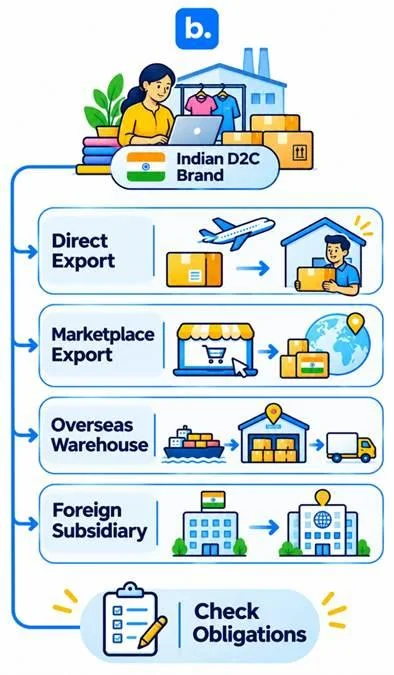
Your selling model decides which registrations, tax routes and payment rules apply before anything ships. Indian brands generally operate through one of four structures:
● Sell directly to overseas buyers. Orders are dispatched from India; you are the exporter of record.
● Sell through a marketplace export programme. The platform collects the order; you export each consignment.
● Hold inventory in an overseas warehouse. Stock is exported in bulk and sold abroad, changing payment timelines and foreign tax exposure.
● Establish a foreign subsidiary. The Indian entity invests abroad, adding overseas investment reporting on top of export rules.
Which selling model shapes your compliance planning first?
Each model adds obligations rather than replacing them: warehousing adds customs and foreign tax considerations; a subsidiary adds investment reporting. Warehousing abroad creates no foreign entity; a foreign entity removes no Indian export obligations.
What is the IEC and why must you get it first?
The Importer Exporter Code (IEC) is a ten-digit number issued by the Directorate General of Foreign Trade (DGFT) and linked to your PAN; no commercial export of goods clears India without it.
Who needs an IEC and who does not?
Every business importing or exporting goods commercially needs one; service exporters need it mainly when claiming Foreign Trade Policy benefits. For physical products, the IEC is effectively unavoidable.
How do you apply for and maintain an IEC?
Apply online on the DGFT portal with PAN, address and bank details; approval is electronic. Two points matter:
● Annual update is mandatory. Confirm or update details electronically between April and June each year, even when nothing has changed.
● Missed updation risks deactivation. The code is restored after a completed update, but shipments can stall meanwhile.
How does GST apply when you sell abroad from India?
Exports of goods are zero-rated supplies under Section 16 of the IGST Act. Zero-rated is not exempt: you charge no GST on the export invoice, yet input tax credit (ITC) on purchases stays refundable.
Is GST exempt or zero-rated on exports?
Zero-rated. An exempt sale would block ITC and raise your costs. Note that IEC, GST and FEMA remain separate compliances.
What is GST LUT and when should you file it?
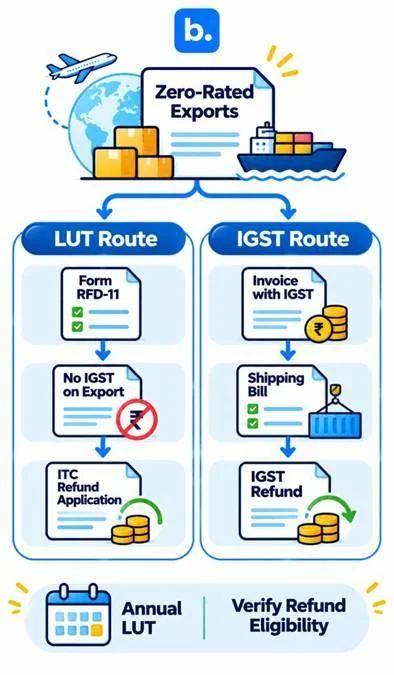
A Letter of Undertaking (GST LUT), filed in Form GST RFD-11 on the GST portal, lets you export without paying IGST on the invoice:
● Filed online and free, it is valid for one financial year; file a fresh LUT before your first export each April.
● Most exporters qualify; a business prosecuted for evasion above ₹2.5 crore may instead be asked to furnish a bond.
● Export invoices must state "SUPPLY MEANT FOR EXPORT UNDER LUT WITHOUT PAYMENT OF INTEGRATED TAX"; shipments go in Table 6A of GSTR-1.
Should you export under LUT or pay IGST and claim a refund?
| Route | Cash flow | Refund path |
|---|---|---|
| LUT: export without IGST | No tax locked up | Refund of unutilised ITC in Form GST RFD-01 |
| Pay IGST on the invoice | Tax locked until refund | Refund of IGST paid via shipping bill |
What should you remember about refunds?
A LUT does not guarantee a refund; filings, invoice content and documentation decide eligibility. Claim ITC refunds regularly; blocked working capital compounds with volume.
What does FEMA require when export payments arrive?
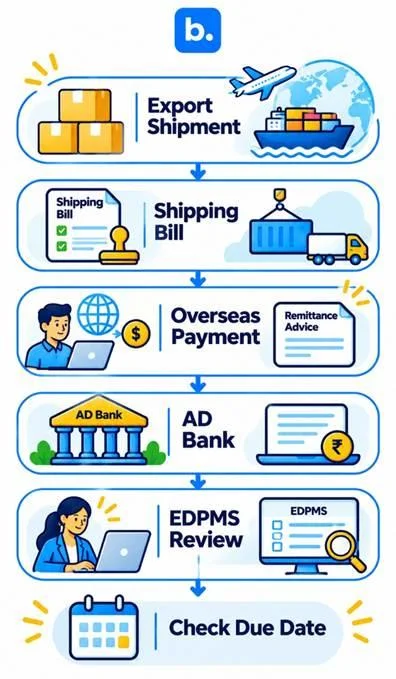
The Foreign Exchange Management Act (FEMA) governs how export proceeds are received and reported. Your Authorised Dealer (AD) bank receives the foreign currency, matches it against shipping bills in the Export Data Processing and Monitoring System (EDPMS) and closes entries.
Where do export payments get reported?
Every shipping bill enters EDPMS through customs; your AD bank matches each inward remittance; collect remittance advice per receipt.
What payment timelines apply in 2026?
Under the consolidated 2026 export regulations, as amended up to 2 November 2026 (see RBI):
● Goods exports: within nine months from the date of shipment.
● Services exports: outside the scope of this physical-goods checklist. Under the 2026 FEMA regulations, export proceeds for services must generally be realised and repatriated within nine months from the invoice date. Where the export is invoiced and/or settled in INR, the period is twelve months.
● Overseas warehouse model: nine months from the warehouse sale date.
● INR-invoiced or INR-settled exports: twelve months.
Your AD bank can extend these periods for recorded reasons; approach it before a deadline lapses.
How are delayed or short payments handled?
Entries left unrealised past their due date draw escalation: the exporter can be cautioned in EDPMS and restricted to advance payment or letter-of-credit terms until regularised. Short receipts and write-offs are permitted only within conditions agreed with the AD bank. Older guides citing fifteen months predate the 2026 consolidation.
What records should you maintain?
Maintain copies of contracts, invoices, shipping bills, transport documents, remittance advice and correspondence with AD bank for every shipment. This will help to complete EDPMS and obtain refunds for GST.
What customs and product documentation must you prepare?
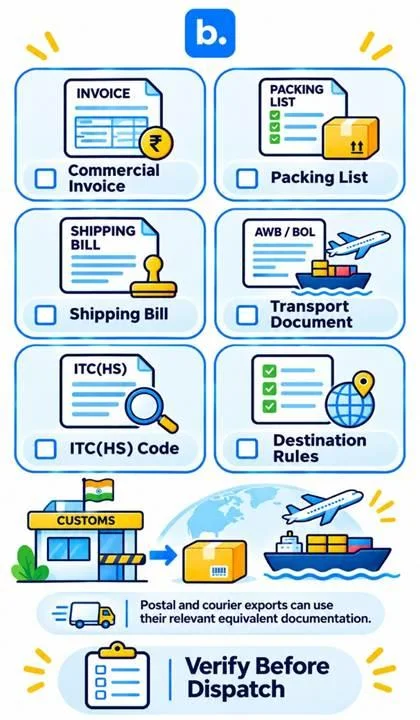
Goods are cleared based on documents so every shipment requires the same documentation and the product must be exportable from India and be acceptable in the destination country.
Which documents accompany every export shipment?
● Commercial invoice and packing list detailing goods, value and quantity.
● Shipping bill (via ICEGATE). If exporting by post then a Postal Bill of Export is required. If exporting by courier then shipping documents will be provided by the courier.
● Transport documentation (Airway Bill / Bill of Lading).
● IEC and AD code. The AD code needs to be registered at the port of export before shipping bills are created.
How do you confirm a product can be exported?
Every product must have an ITC(HS) tariff code. Check the export policy for the product on the DGFT system. Products can be free, restricted (requires authorisation) or prohibited. Just because a product is freely sold in India doesn’t mean it can be exported.
What about destination-country rules?
Import markets have their own rules regarding labelling, safety standards, registrations and duties. Check the requirements that apply to your specific product and destination before shipping.
Do you need a foreign entity to sell abroad?
No. Most Indian D2C brands will be able to sell internationally using their Indian entity. Having a foreign subsidiary is a structural decision to scale.
When does selling as an Indian entity suffice?
With IEC, GST, customs and FEMA obligations met, direct exports, marketplace programmes and third-party overseas fulfilment all run from an Indian entity. Stock held through a logistics partner is warehousing, not a foreign entity.
What changes when you set up a foreign subsidiary?
Investing in a foreign entity is Overseas Direct Investment (ODI) under the FEMA overseas investment framework notified in 2022. In practice:
● Report the investment in Form FC through your AD bank; a Unique Identification Number is allotted to the entity.
● File an Annual Performance Report by 31 December each year, plus the annual FLA return where applicable.
● Total financial commitment is generally capped at 400 per cent of the Indian entity’s net worth under the automatic route.
What are the local obligations?
A subsidiary will often inherit the responsibility for registering for local sales tax/VAT, importer-of-record obligations and product compliance. It is important to understand the scope of obligations based on the local jurisdiction with local advisors.
What is the new EOR and SOR framework for ecommerce exports?
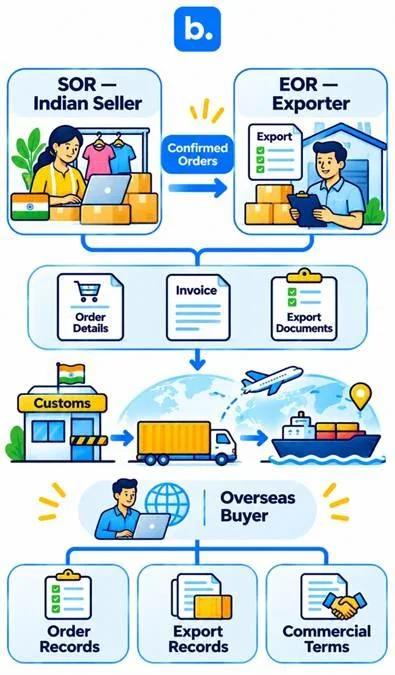
On 5 August 2026, DGFT introduced a new framework to facilitate exports for e-commerce. There are now two roles involved:
● Exporter on Record (EOR): This is an exporter registered with DGFT who will export the goods on their own behalf. They have specific obligations.
● Seller on Record (SOR): The Indian seller/brand. The EOR will export goods on behalf of them. This allows smaller sellers to get involved.
Requirements:
● Orders must be against confirmed orders from overseas. Stock cannot be held for export.
● Goods must be Indian origin. The EOR will have a digital, ring-fenced, auditable system for orders and stock.
● Rebates are paid to the seller within 30 days. The EOR can hold up to 10% of stock for administration. They must be certified annually by a CA/CMA.
This makes it easier to enter the market but is not a ‘get out of jail free card’ as there are still commercial terms, returns and logistics costs in the EOR agreement.
What changed in 2026 that affects your planning?
Four verified developments belong in your planning:
● Courier export cap removed. From 1 April 2026, the ₹10 lakh per-consignment value limit on commercial courier exports was removed as a Union Budget 2026–27 measure (see PIB); high-value orders can move by courier.
● Courier returns simplified. Returned or rejected e-commerce exports can be re-imported through a risk-based process with a dedicated returns module.
● FEMA timelines consolidated. The nine- and twelve-month periods above apply under the consolidated regulations.
● EOR and SOR introduced. The August 2026 framework creates a supervised route for smaller sellers.
What staged checklist should you follow before scaling exports?
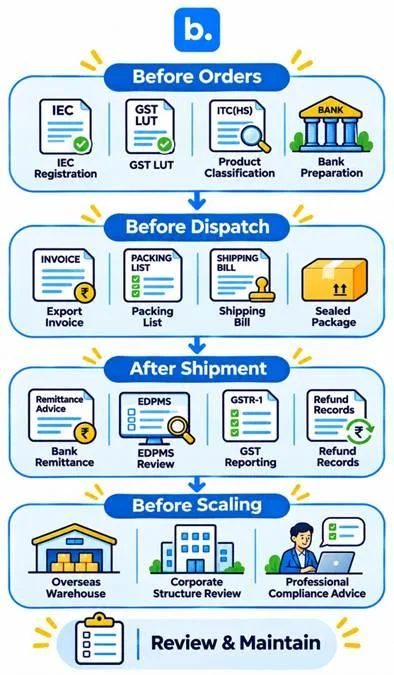
Run compliance as a sequence. Confirm early that your ecommerce platform integration passes the order fields export invoices need.
| Stage | Actions |
|---|---|
| Before your first international orders | Obtain IEC and register your AD code; register under GST and file the LUT for the year; classify products under ITC(HS) and confirm exportability; check destination rules; arrange AD bank payment flows. |
| Before every dispatch | Issue a compliant export invoice with the LUT legend where applicable; file the shipping bill or equivalent; match documents to the order. |
| After every order | Track receipts against the nine- or twelve-month clock; monitor EDPMS entries to closure; report exports in GSTR-1 and claim refunds regularly. |
| When expanding your structure | Reassess entity, warehouse and tax registrations; complete ODI reporting and annual filings if a foreign entity is involved; evaluate the EOR/SOR route for relevant lines. |
How does Base.com fit into export operations?
At base.com, we handle the operational layer around compliance rather than the compliance itself. As an ecommerce integration platform, we keep international and domestic orders in one queue: our TikTok Shop integration and Shopify integrations pull channel orders into the same Order Manager workflow your team uses for domestic sales. See how we manage orders on Shopify, Amazon and Flipkart channels in one place.
After connecting your ecommerce platforms, we will transfer your orders, stock and catalogues seamlessly across all channels. We are unable to provide any compliance services so we will not register your IEC, LUT, shipping bills or FEMA returns. We are also unable to provide any legal, tax or financial advice.
What should be reviewed by professionals?
Have your LUT/refund position reviewed by a Chartered Accountant/GST Practitioner, have your payment/ODI position reviewed by a FEMA professional or your AD bank. Have your classification and documentation reviewed by a customs broker. Make sure you have checked the rules and dates against the latest notifications.
Conclusion
Indian compliance can be a sequential process. You will need to start with your sales models, then move onto IEC, GST, customs and FEMA. Finally, you will have your structural decisions. Follow the steps in this checklist, and keep records for each shipment. This guide should be used as a base to start from. As your volumes increase, ensure you have your position reviewed by professionals.