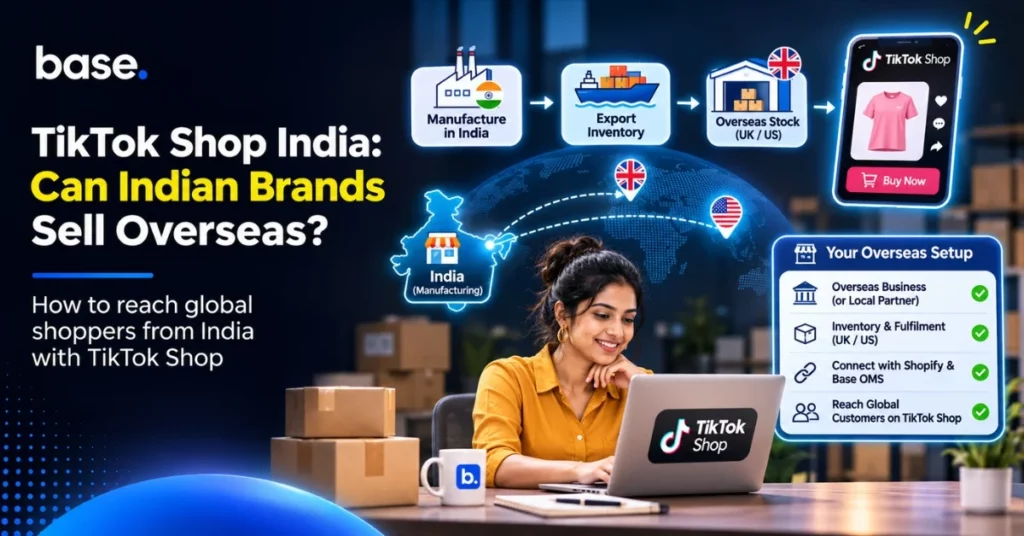
Yes, Indian brands can sell on TikTok Shop in overseas markets, but they cannot register as local Indian sellers. To enter a market such as the UK or US, you need an eligible overseas business or a local selling partner that meets TikTok’s seller requirements.
Your products can still be manufactured in India. The important decision is which business will own and operate the TikTok Shop, where the inventory will be stored and how customer orders will be fulfilled.
If you already have an overseas company, distributor or local stock, you may have a starting point. If not, you need to assess the available selling routes before investing in an overseas setup.
At base.com, we help businesses connect their approved TikTok Shop with their existing e-commerce operations, making it easier to manage product listings, inventory, prices and orders alongside other sales channels.
Is TikTok Shop available in India?
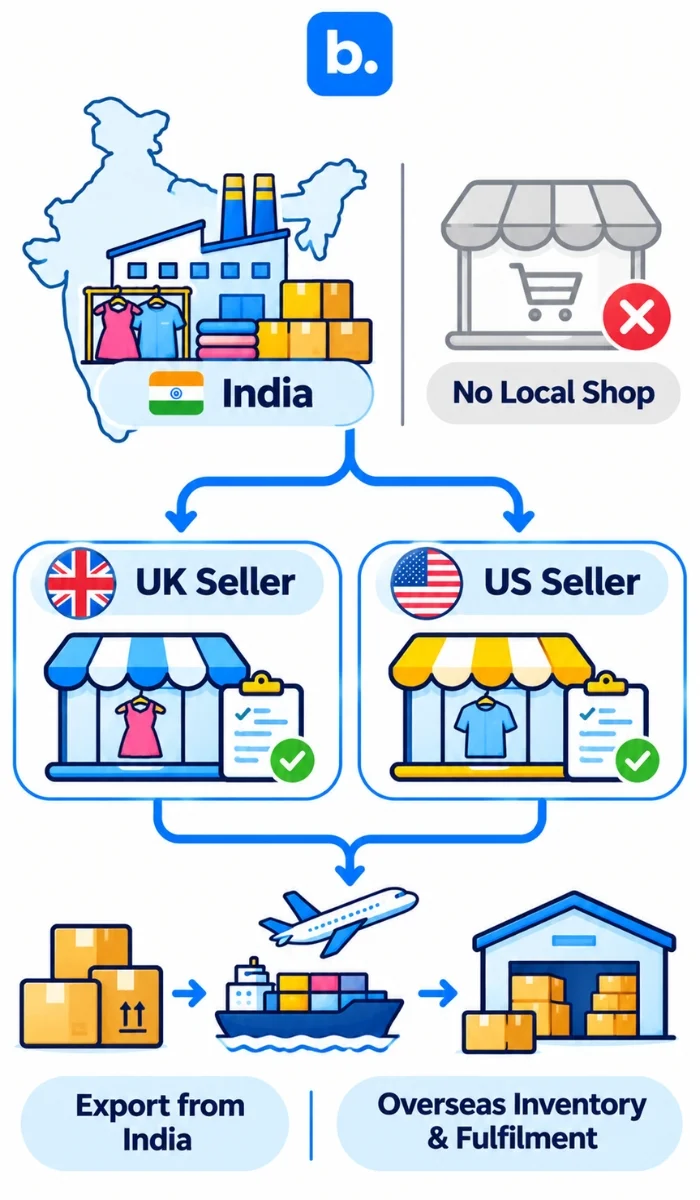
No. India is not currently listed as a TikTok Shop seller market. TikTok also remains blocked in India following the government’s June 2020 restriction. This means Indian businesses cannot register for a local TikTok Shop using an Indian business registration.
The government blocked TikTok in June 2020. Its August 2025 clarification said no order had been issued to lift the ban.
That’s different from asking whether an Indian brand can supply products to an overseas seller. You can explore that route while keeping manufacturing in India. The first decision is which business will run the Shop in the customer’s market.
How can Indian brands sell on TikTok Shop overseas?
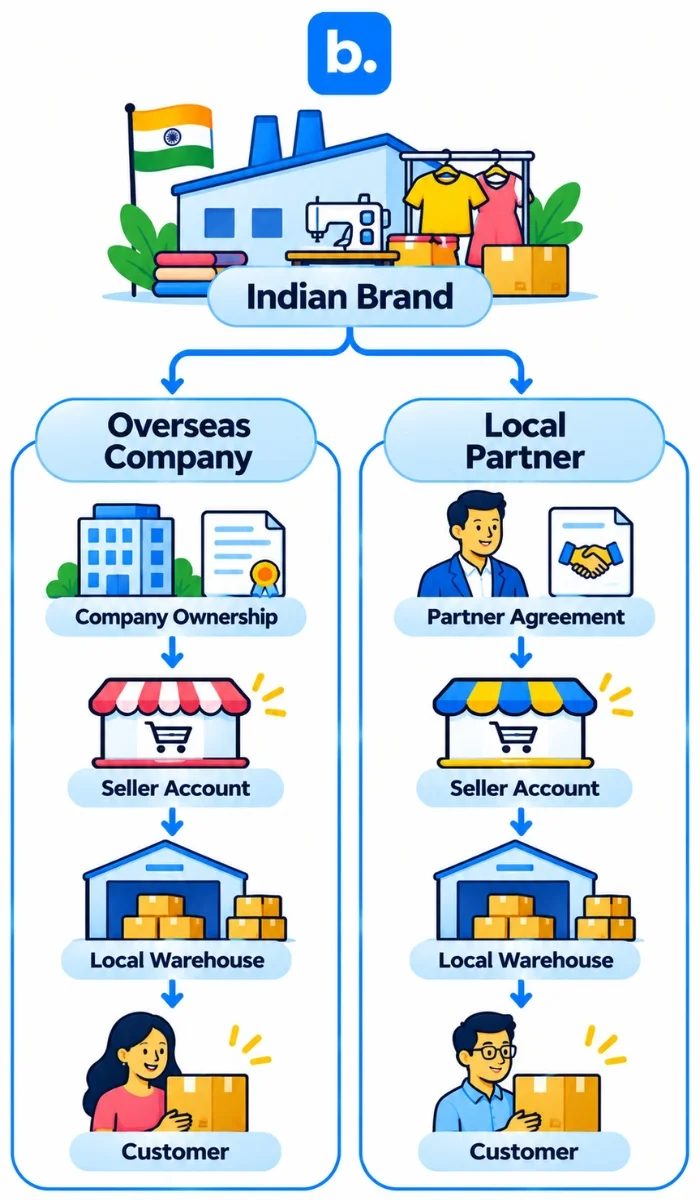
There are two commercial routes worth considering: operate the Shop through your own eligible overseas company, or supply a local distributor or retailer that already has an approved Shop. The seller is the business registered on the Shop, not simply the person appearing in its videos.
| Route | Who operates the Shop? | Your Indian business’s role |
|---|---|---|
| Your own overseas company | That company applies and becomes the seller if approved. | Manufacture or source products, export stock and coordinate the brand’s operations. |
| An overseas distributor or retailer | The partner sells through its own approved account. | Supply products and agree the brand rights, commercial terms and responsibilities. |
If you already export to a distributor, ask whether its business and product category qualify for TikTok Shop. That gives you a concrete starting point rather than setting up a second overseas business immediately.
If you want your own company to sell, check the proposed ownership, representative and fulfillment arrangements with TikTok before paying for incorporation.
For a partner-operated Shop, put the agreement in writing. Cover who owns inventory, sets prices, receives payouts, creates content, answers customers and handles returns. TikTok’s US intellectual property policy also sets out brand-authorisation documents where required.
Who handles the TikTok account?
Plan this alongside the business setup. Your Indian team can prepare product information and coordinate exports, while the authorised overseas team handles marketplace activity. If India-based staff need account access, confirm the permitted roles and locations with TikTok.
A VPN changes the connection you use. It doesn’t establish company, identity or seller eligibility.
What do you need for a TikTok Shop?
You need more than a company registration certificate. TikTok checks the business, the people representing it and the arrangements for selling and fulfilling orders.
These are two published routes to investigate:
| Market | Route to check | Important requirements |
|---|---|---|
| United Kingdom | A UK-incorporated corporate seller. | UK company registration, a UK business address, identity and address verification for the business representative, and an eligible business payout account. Goods must be legally imported into the UK, with applicable import VAT and customs duties addressed. Inventory must be stored in the UK. Local-to-local orders require domestic dispatch and domestic returns. |
| United States | A US-registered business applying as a corporate seller. | A US business address, Employer Identification Number (EIN), Ultimate Beneficial Owner (UBO) information, and verification of the primary representative. The primary representative must meet TikTok’s US address, identity and SSN/ITIN requirements. Non-US passports may be accepted for UBO verification. Approval depends on TikTok’s review of the business and its representatives. |
Under the UK registration policy, the business representative must ordinarily provide a valid identity document and proof of a UK residential address. Larger enterprises may be permitted to appoint a Primary Authorised User who lives outside the UK, but this is subject to TikTok’s discretion. Confirm that your proposed representative meets the requirements before beginning registration.
For the US, TikTok’s corporate seller registration process requires information about the US business, its Ultimate Beneficial Owners (UBOs) and its primary representative. UBOs are individuals who meet TikTok’s ownership-disclosure requirements. Non-US passports may be accepted for UBO verification, but the primary representative must meet separate US address, identity and SSN or ITIN requirements.
An Indian-owned US company should therefore check whether its ownership structure and proposed primary representative meet TikTok’s requirements before proceeding with incorporation. Having a US company registration and EIN alone does not guarantee approval.
Start with the country where your business has a practical foothold. A distributor, a suitable representative or stock already held locally may be more useful than choosing a market only because it has a large audience.
How do you ship products from India to overseas customers?
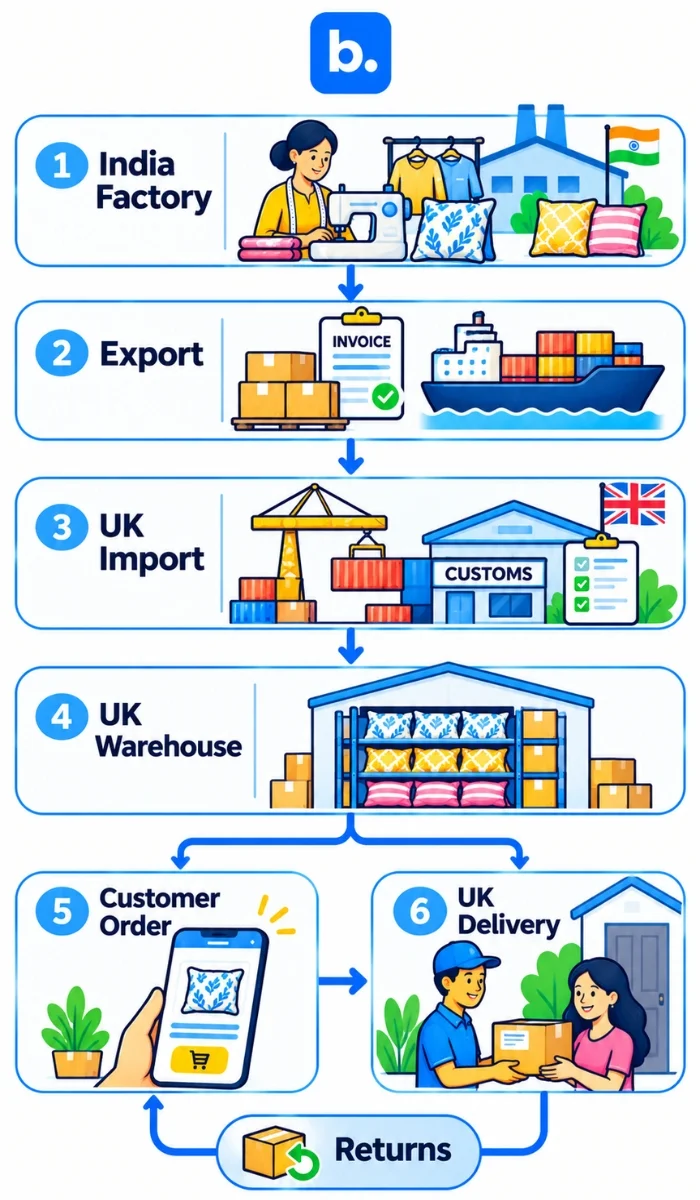
For the UK local-to-local route, export stock to the UK first, then fulfil customer orders domestically. Manufacturing can stay in India; the stock advertised for UK fulfilment needs to be available there.
Suppose you make cushion covers in India and work with a UK distributor that already has an approved Shop.
- You agree which products the distributor will sell and who will import them.
- Your Indian business prepares the export documents and sends the goods.
- The importer arranges UK customs clearance, and the stock reaches the fulfilment warehouse.
- The overseas seller publishes the listings through its approved Shop, using the correct product information and available quantity.
- A customer orders through TikTok Shop. The warehouse picks, packs and dispatches the order using the account’s approved shipping arrangement.
- The seller handles tracking, customer service, returns and the marketplace payout.
Keep the two payments clear. The overseas seller receives the Shop’s customer payments through its accepted payout account. Your Indian business is paid for the goods under the supply agreement and export invoice.
For another market or programme, check the permitted dispatch location before building your delivery promise. The UK local-to-local rules are not a worldwide shipping rule.
What documents should you prepare?
Keep the Indian export paperwork and overseas seller-registration paperwork separate. They support different parts of the transaction.
For the Indian exporter
Prepare your Importer-Exporter Code (IEC), unless exempted, along with the shipment records. DGFT’s Foreign Trade Policy, sections 2.05 and 2.06, lists the core documents:
- Commercial invoice and packing list, combined or separate.
- The applicable Shipping Bill, Bill of Export or postal export declaration.
- A Bill of Lading, Airway Bill or other relevant transport receipt.
Agree the applicable GST treatment and export-payment arrangements with your advisers and bank. RBI’s export regulations cover authorised-dealer payment and export-proceeds requirements.
For the overseas seller
Gather company registration, ownership and representative records, address proof, required tax information, payout details and warehouse and returns information. Use the checklist for that market and seller route rather than borrowing one from another country.
If you’re funding an overseas company from India, involve your designated Authorised Dealer bank, which handles the relevant foreign-exchange arrangements, under the RBI’s overseas-investment framework.
For the products
Confirm the category rules, labels, certificates and brand permissions for the destination. Build these into the product file before listing, especially when another business is selling your brand.
How can you manage TikTok Shop and Shopify together?
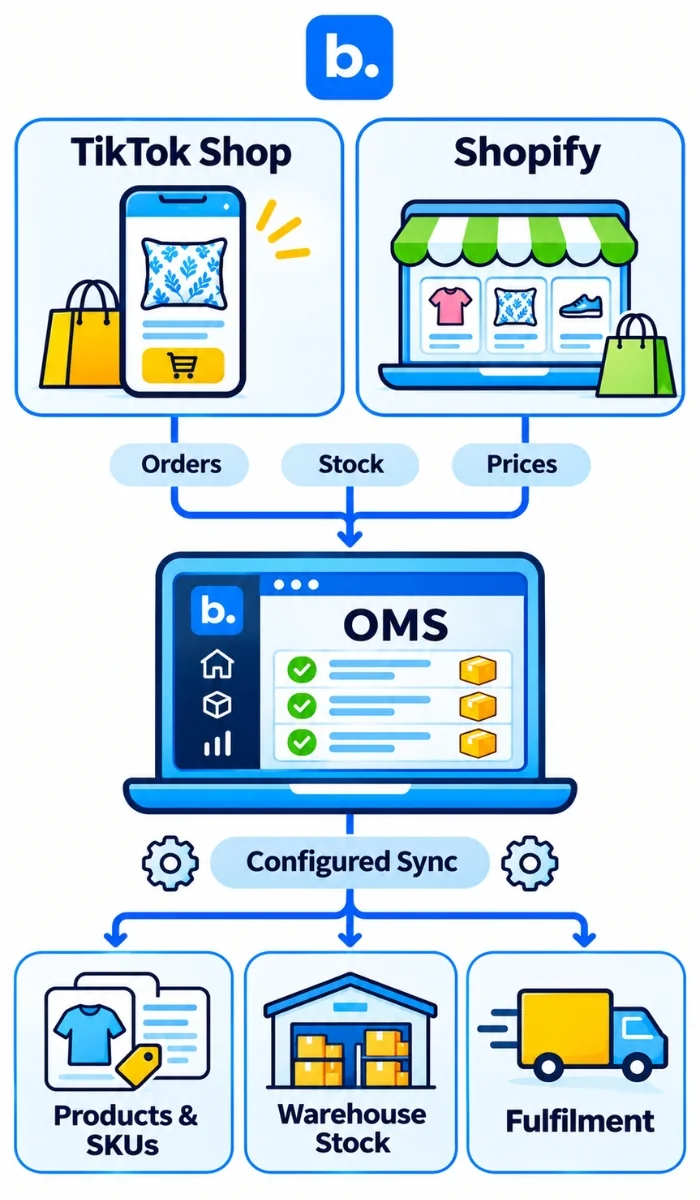
Connect the approved Shop to the inventory and order systems used by the overseas seller. That gives the team a way to manage the new channel alongside its existing store.
At base.com, our two-way TikTok Shop integration supports product listings and order processing. We help you bring the day-to-day work together:
| What you need to do | How we help |
|---|---|
| List products | Use selected inventory sources, import existing offers and link them to the right products and variants. |
| Keep stock and prices aligned | Synchronise quantities and prices using the sources and rules you configure. |
| Process orders | Bring TikTok Shop orders into Order Manager or forward them to a connected store or enterprise resource planning (ERP) system. |
| Organise fulfilment | Use picking and packing tools, automatic actions, selected shipping carriers and tracking-number forwarding. |
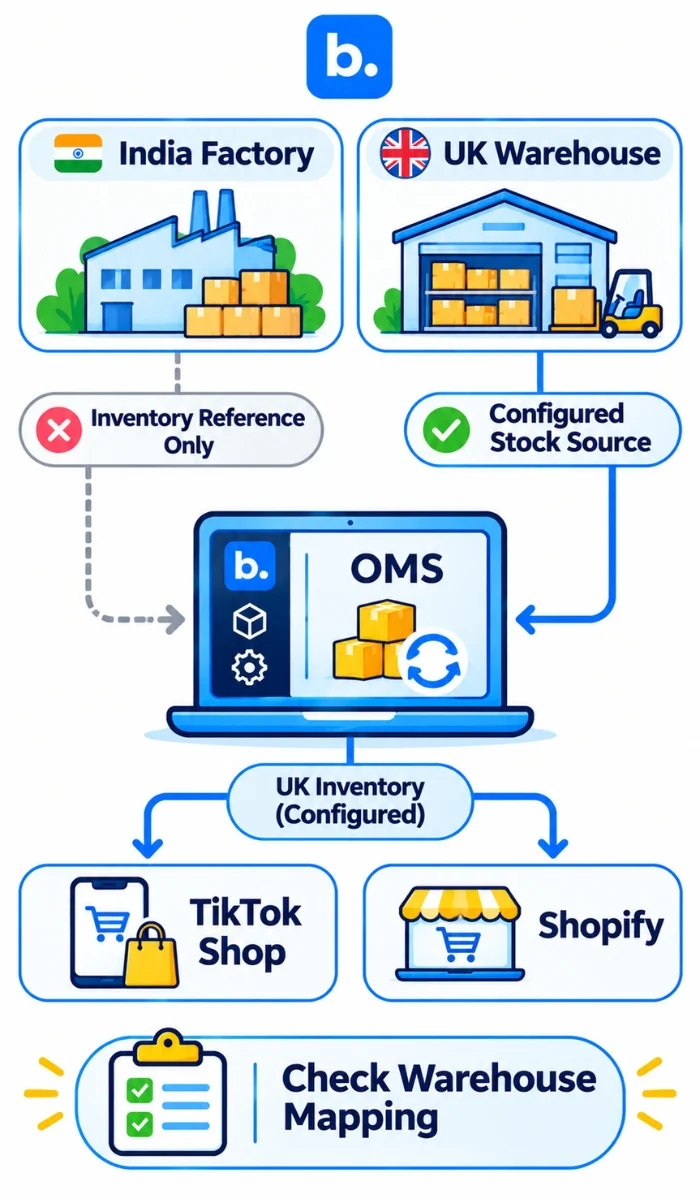
Take the cushion-cover example. If Shopify and TikTok Shop sell from the same UK stock, both channels need to use the correct stock record. Goods still in your Indian factory shouldn’t inflate the quantity shown as available for UK fulfilment.
Warehouse mapping lets you link an inventory warehouse to the corresponding TikTok Shop warehouse. Product mapping connects each stock-keeping unit (SKU), your product identifier, to the right product and variant.
Our Shopify integrations support store and marketplace order flows, prices and stock. Choose where orders will be processed: Order Manager, Shopify or a connected ERP. An e-commerce integration platform is most useful when everyone knows which system owns the stock, prices and order workflow.
How do you connect your Shop and test the first order?
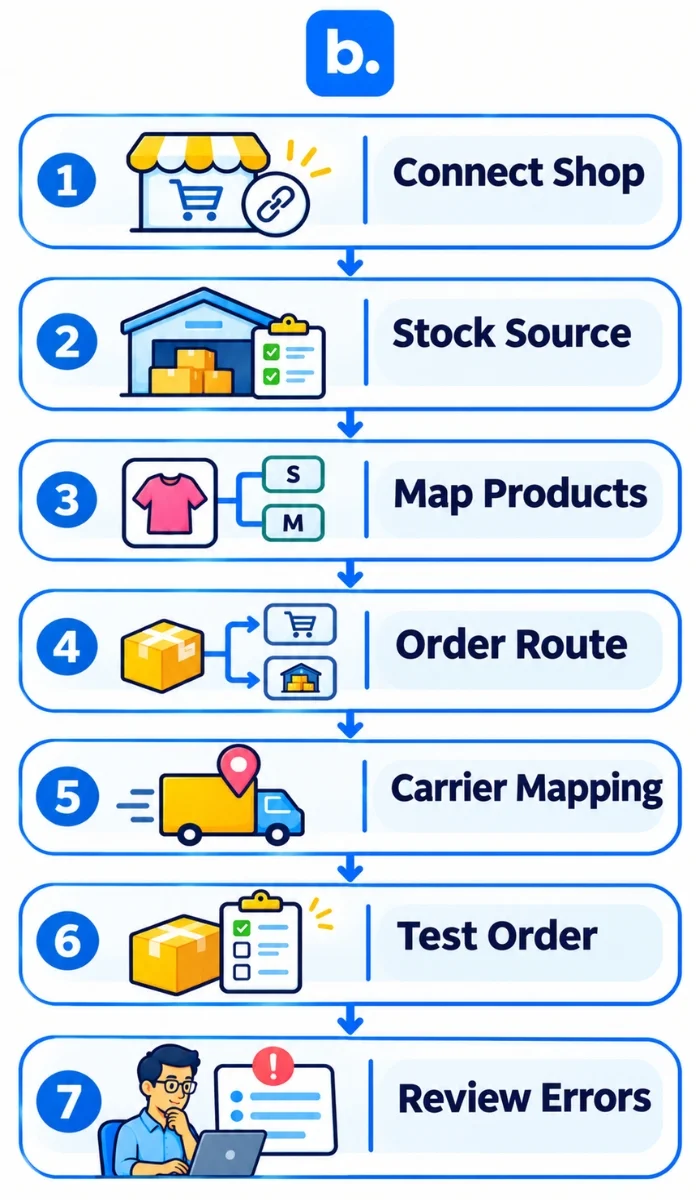
Connect the account, link the products and test a complete order before expanding the catalogue. An e-commerce platform integration needs those checks even when the products already exist on both systems.
- Add the approved Shop. Go to Integrations > Add Integration > Marketplace, choose TikTok and select the relevant market. Authorise through the main seller account and save. Market availability depends on the account’s configuration.
- Choose your stock and price sources. Select the inventory and price group you want to use. Map the warehouse that will actually fulfil those orders.
- Link products and variants. Import existing offers where needed, then match them to inventory products before enabling stock and price synchronisation.
- Set the order route. Enable order retrieval, choose the incoming status and agree where the team will process orders.
- Map carriers and tracking. Check that each tracking number is sent with the correct carrier. If you use TikTok Shipping, follow its separate label-retrieval workflow rather than assuming standard tracking-number forwarding covers it.
- Run an end-to-end test. Check the listing, incoming order, stock update, shipment and tracking. Give someone responsibility for reviewing failed updates.
Finalise titles, descriptions and photographs before publishing. Our TikTok Shop integration setup guide explains the settings and when changes to active product details require relisting.
Treat integration with an ecommerce platform as a handover between systems. Confirm the product, warehouse, price and order records being passed across, rather than assuming a saved connection means the workflow is ready.
What should you do before you launch?
Start with a small catalogue you can fulfil reliably. Work through the costs using current quotations and your account’s actual terms: product cost, export freight, import charges, storage, pick-and-pack, local delivery, returns, marketplace fees, content, advertising and currency conversion.
Make content and customer support part of the plan too. TikTok Shop supports shopping through in-feed videos, LIVE videos and product showcases. Decide who will prepare those materials, publish them through authorised accounts and answer customers.
Before your first batch, agree:
- Which business owns the Shop and receives payouts.
- Who imports and holds the stock.
- Where customer orders and returns will go.
- Which system controls inventory and prices.
- Who handles content, customer support and operational errors.
If you already sell through several channels, assess a multi-channel integration platform around that setup. Share your Shop market, account status, store or ERP, warehouse locations and shipping model with our team so we can discuss the relevant connection.
Conclusion
Indian brands can make overseas TikTok Shop sales part of their export plans. Choose the business that will sell, prepare the stock and paperwork, and agree who handles orders, customers and payments. There’s no local TikTok Shop India market, but a qualifying overseas seller provides a route to shoppers abroad. At base.com, we help connect the approved Shop’s product, stock and order workflows. Discuss your TikTok Shop setup with your current arrangements in hand.