
How to improve warehouse picking speed in India during a sale event comes down to one problem: your warehouse was designed for average days, not peak days.
During a Big Billion Day, a brand flash sale, or a festive season spike, order volumes hit 5-10x your daily average. Your bin layout, pick paths, and fulfillment software were not built for that load. The result is missed SLAs, packing errors, and RTOs before the shipment even leaves your facility.
This guide covers exactly why picking speed collapses under pressure, and what Indian D2C and FMCG brands are doing to fix it permanently.
Why Sale Events Break Warehouse Picking
Most warehouse managers blame headcount when picking slows down during a sale. Headcount is rarely the real problem.
When order volume spikes, three structural failures happen simultaneously. Pick paths become congested. Pickers spend 30-40% of their time walking instead of picking. And the WMS cannot dynamically reassign tasks in real time, so high-priority orders sit in queue with standard orders.
India’s ecommerce market is projected to reach $226 billion by 2026, with a growing share of that revenue concentrated in 48-72 hour sale windows. Your warehouse either absorbs that spike cleanly or it doesn’t. There is no middle ground on sale day.
The Bin Location Trap
In a static bin layout, the SKUs closest to packing are the ones that moved fastest last month, not the ones forecasted to move fastest during this sale. A skincare brand running a vitamin C serum promotion will find that SKU binned at the back of the warehouse because it was slow in October.
Pickers walk further per pick, precisely when they need to walk less. This is one of the most common and most fixable causes of slow picking during Indian sale events.
How to improve warehouse picking speed in India starts here: re-slot your top 50 forecasted sale SKUs to golden zone bins, chest height, within the first 20-30% of your pick path, at least five days before the sale begins.
How Indian Sale Events Are Structurally Different
Global WMS benchmarks do not account for India’s COD reality. COD orders make up 55-65% of D2C volumes in Tier 2 and Tier 3 cities. COD return rates run at 25-30%, compared to 8-12% for prepaid orders.
During a sale, you are not just processing high volume. You are processing high-risk volume. An incorrect pick on a COD order produces an undeliverable package, a customer rejection, and a direct cost you cannot recover.
Picking accuracy is a P&L metric, not a back-office one.
India’s D2C sector is growing at 40% CAGR. Brands scaling through that growth need warehouse operations that can handle peak volume without accuracy degrading. How to improve warehouse picking speed in India means solving for accuracy at speed, not speed alone.
The 6 Root Causes of Slow Picking During Sales
A flash sale going live while your warehouse is still moving at its everyday pace is one of the fastest ways to turn a revenue opportunity into a customer service problem.
Order volume spikes, pick lists multiply, and every inefficiency that was manageable on a normal Tuesday becomes a bottleneck with a countdown attached to it. Before you can fix slow picking, you need to know exactly what is causing it. Most operations trace back to the same six problems.
| Root Cause | What Happens | Operational Impact |
| Static bin layout | Top sale SKUs binned far from packing | +40% walking time per pick |
| No pick path optimization | Pickers criss-cross aisles without sequence | 2-3x pick time vs. optimized path |
| Manual pick confirmation | No scan = no verification at the bin | 3-4% error rate per shift |
| WMS cannot reprioritize | Express orders sit in queue with standard | SLA misses on premium shipments |
| No wave planning | All orders released at once, traffic jams form | Picker collisions and bin congestion |
| Packing station bottleneck | Picks complete but packing cannot keep up | Orders pile up, dispatch windows missed |
Each of these is solvable. Most Indian brands are blocked by two or three, not all six. Identifying which combination is causing your slowdown is the first operational step.
How to Improve Warehouse Picking Speed in India: The Fix for Each Root Cause
Indian e-commerce is moving faster than most warehouse operations are built to handle. According to a 2023 report by Redseer Strategy Consultants, India’s e-commerce market is expected to reach $150 billion by 2026, driven largely by tier-2 and tier-3 city demand that puts pressure on fulfilment infrastructure that was never designed for this volume.
At the same time, according to Shiprocket’s fulfilment benchmarks, the average order processing time in Indian warehouses runs 40 percent longer during peak sale periods than on regular trading days. That gap does not close on its own.
It closes when you identify the specific root cause behind the slowdown and apply the right fix to it. Here is what that looks like in practice for each of the six causes.
Fix 1: Move From Single-Picker to Zone Picking
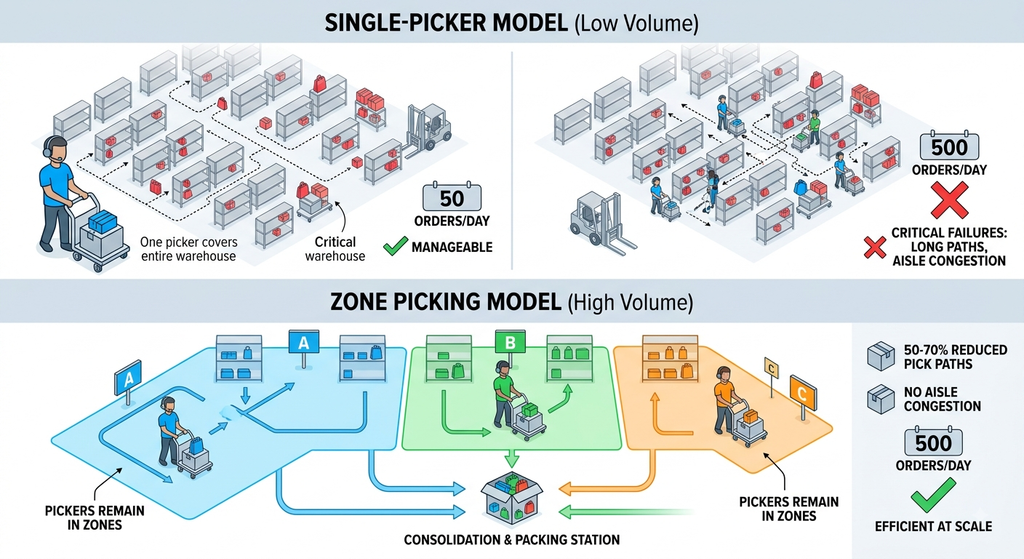
In a single-picker model, one person picks all items for one order. At 50 orders per day, this is manageable. At 500 orders, it breaks down entirely.
Zone picking assigns each picker to a defined warehouse zone. Orders are split across zones, each picker handles their section, and the picks are consolidated at the packing station. Pick path length drops by 50-70% at scale. Aisle congestion disappears because pickers are no longer criss-crossing the same aisles.
How to improve warehouse picking speed in India at any meaningful scale requires zone picking as a baseline configuration, not an advanced option. Base.com’s warehouse management module supports zone-based pick task assignment natively, with task routing logic that accounts for zone capacity and active picker count in real time. Operations managers can configure zones from a central dashboard without developer involvement.
Fix 2: Enforce Scan Confirmation at Every Pick

Manual picking without scan confirmation is the single largest driver of packing errors in Indian warehouses. Scan-based pick confirmation reduces errors by up to 85%. For a brand shipping 1,000 orders per day, even a 2% error rate means 20 wrong shipments daily, each carrying RTO risk and replacement cost.
The common objection is that scanning slows pickers down. It does not, when the WMS is configured correctly. A well-designed scan flow adds 1-2 seconds per pick and eliminates 15-20 minutes of downstream error resolution per wrong pick caught.
Base.com’s mobile scan interface is built for picker simplicity: one-tap confirmation, audio feedback on successful scan, and automatic task progression. Pickers require minimal training. Error rates drop within the first shift of implementation. This is one of the most direct answers to how to improve warehouse picking speed in India that also improves accuracy simultaneously.
Fix 3:Run a Pre-Sale Slotting Audit
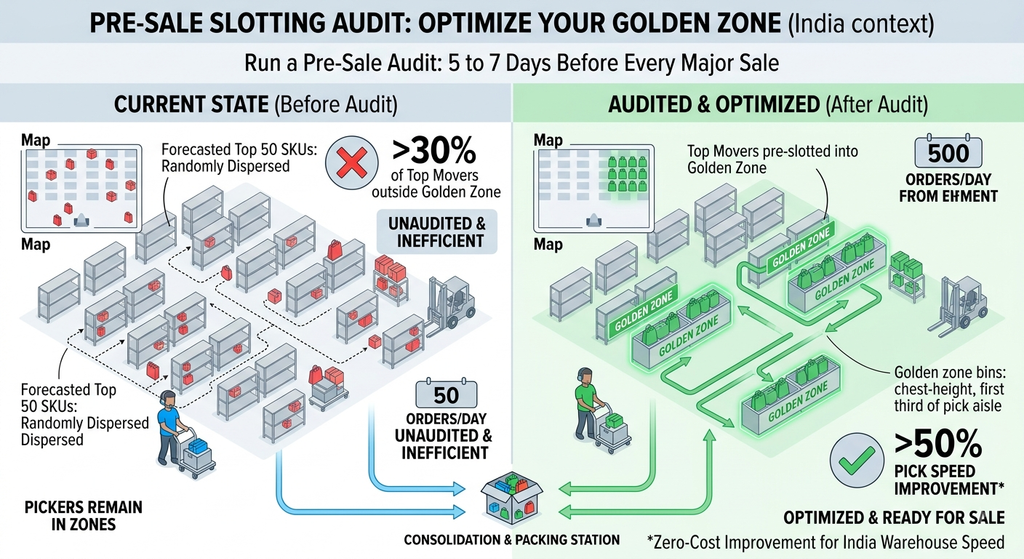
Five to seven days before every major sale, pull your forecasted top 50 SKUs from your order management system. Map each one to its current bin location. If more than 30% of your top movers are outside the golden zone, re-slot before the sale goes live.
Golden zone bins are defined as chest-height shelves within the first third of your primary pick aisle, the positions where a picker can locate, confirm, and retrieve an item fastest. Re-slotting these positions before a sale is one of the highest-leverage, zero-cost improvements available for how to improve warehouse picking speed in India.
It requires no software changes. It requires process discipline. Brands that institutionalize this review before every major sale event build a compounding operational advantage over competitors running static layouts year-round.
Fix 4: Implement Wave Planning
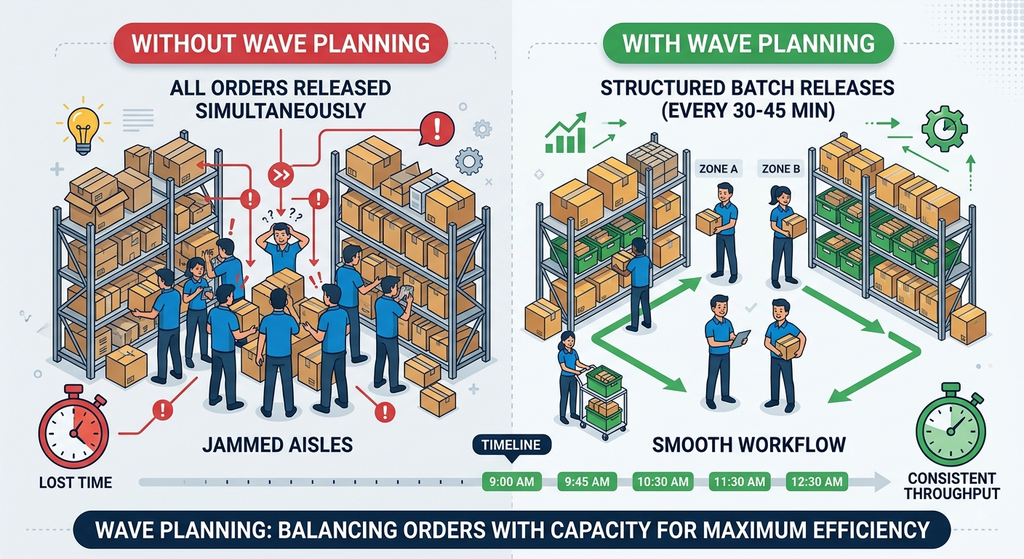
Releasing all sale orders to the pick floor simultaneously creates instant traffic jams. Two pickers converging on the same bin at the same time is a lost two minutes, replicated hundreds of times across a sale day.
Wave planning releases orders in structured batches, typically every 30-45 minutes, sized to match current pick floor capacity. The WMS calculates the optimal wave size based on active pickers, zone capacity, and current task queue depth.
The result is consistent throughput, no bin congestion, and measurable improvement in picks-per-hour per picker. Wave planning is not an advanced feature. It is how Indian brands processing 500+ orders per day maintain operational stability during spikes.
Base.com’s order management layer integrates wave release logic directly with multi-channel order inflow from Flipkart, Amazon, Shopify, Meesho, and D2C storefronts, so wave planning accounts for total order load, not just one channel at a time.
Fix 5: Real-Time SLA-Based Pick Prioritization

During a sale, express orders, same-day orders, and next-day orders cannot sit in the same flat queue as standard orders. They need to surface automatically to the top of pick task assignments, without an operations manager manually intervening in the queue.
A WMS that cannot reprioritize dynamically forces supervisors to micromanage at exactly the moment they should be overseeing the floor. At 2,000 orders per day, this is not scalable.
How to improve warehouse picking speed in India for time-sensitive orders requires SLA-aware prioritization at the system level. Base.com’s fulfillment engine dynamically reprioritizes pick tasks based on SLA deadlines, carrier cut-off times, and order priority tiers. Pickers see the right task at the right time without manual dispatcher involvement.
Fix 6: Audit Packing Station Capacity Before the Sale
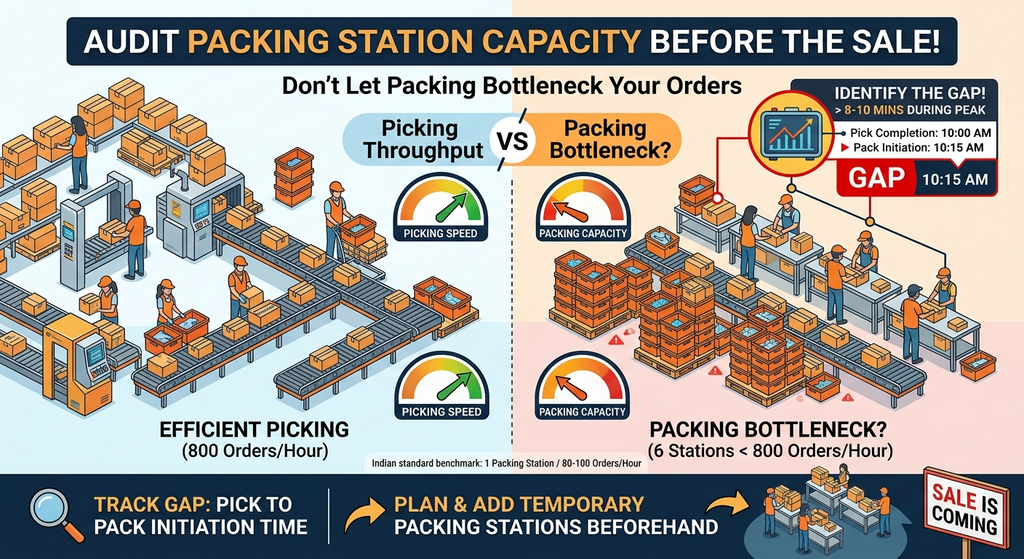
Picking speed improvements are wasted if packing is the constraint. The standard benchmark for Indian warehouse operations is one packing station per 80-100 orders per hour. If you are processing 800 orders per hour with six packing stations, picks will pile up regardless of picker throughput.
How to identify this in your operation: track the gap between pick completion time and pack initiation time per order. If this gap averages more than 8-10 minutes during peak, packing is your bottleneck, not picking.
Fix this before the sale, not during it. Adding temporary packing stations is a same-day intervention that works. Adding them at 2pm on sale day does not.
Picking Speed Benchmarks: Where Indian Warehouses Stand
Understanding how to improve warehouse picking speed in India requires knowing what good looks like for your operation size.
| Warehouse Size | Manual Picking (picks/hr) | With WMS Optimization | With Zone Picking |
| Small, under 500 orders/day | 40-60 | 70-90 | 90-120 |
| Mid-size, 500-2,000 orders/day | 35-55 | 65-85 | 85-115 |
| Large, 2,000+ orders/day | 30-50 | 60-80 | 80-110 |
These benchmarks reflect Indian warehouse configurations with standard FMCG and D2C SKU profiles. Fashion and electronics categories with higher SKU counts and smaller bin density typically run 10-15% below these numbers due to item location complexity.
If your operation is processing 500+ orders per day and sitting below 55 picks per hour, you have addressable inefficiencies. The gap between your current rate and the optimized benchmark is the operational case for investment in a platform like Base.com.
How Base.com Solves Picking Speed for Indian Operations
Base.com is built for Indian ecommerce operations, not adapted from global WMS platforms that do not account for COD complexity, multi-depot fulfillment, or India’s channel fragmentation across Flipkart, Amazon, Meesho, Nykaa, and D2C.
How to improve warehouse picking speed in India is addressed by Base.com at three operational layers.
- Order layer: Multi-channel order inflow normalized into a single fulfillment queue with SLA-based prioritization logic. Orders from all channels are weighted by delivery commitment before they reach the pick floor, so pickers always work the right order first.
- Warehouse layer: Zone picking configuration, dynamic pick task assignment, barcode scan confirmation on mobile devices, and wave planning, all built into the fulfillment module without requiring third-party integrations. This is the operational core of how Base.com addresses how to improve warehouse picking speed in India at scale.
- Analytics layer: Real-time picking throughput dashboards, error rate tracking by picker and by zone, packing station utilization metrics, and pre-sale slotting recommendations generated from historical velocity data and incoming sale forecasts.
Indian brands using Base.com have reduced order processing cycles from multi-hour windows to sub-30-minute execution at comparable order volumes. That improvement comes directly from eliminating manual coordination in pick-pack-ship workflows, the same workflows that break during every sale event without a purpose-built system.
The Direct Link Between Picking Speed and RTO
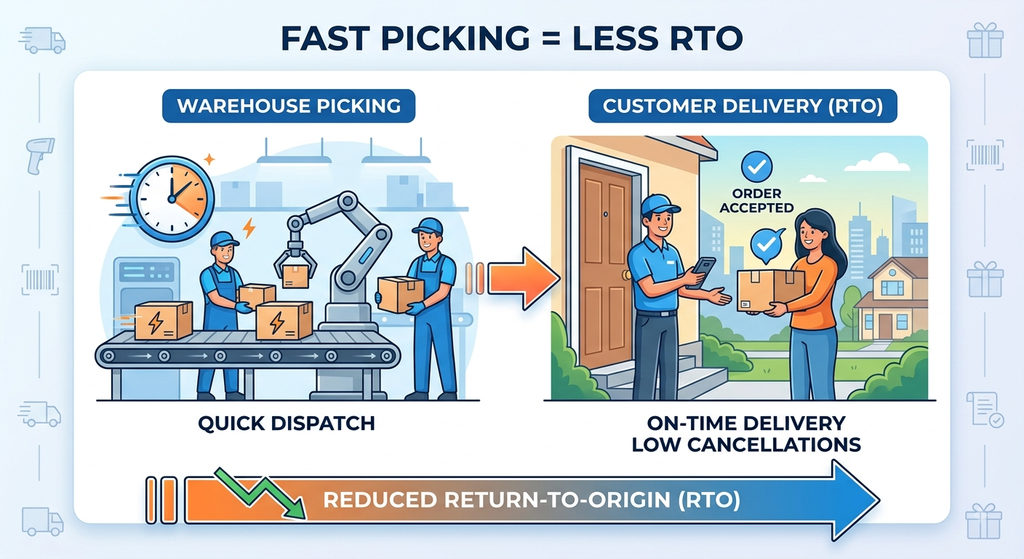
India’s RTO problem is well-documented. Industry averages sit at 20-30% for D2C brands, with COD-heavy categories running higher. A driver that is underappreciated: delayed dispatch caused by slow picking.
When pick speed collapses during a sale, orders that should ship same-day or next-day slip to day two or day three. Customer-initiated cancellations spike. Carrier pickup windows are missed. Packages arrive outside the expected delivery window and get rejected on delivery.
How to improve warehouse picking speed in India is not just an operations initiative. It is an RTO reduction initiative.
Every hour recovered in pick-to-dispatch time reduces the cancellation risk window. Base.com’s carrier integration and SLA tracking creates a closed loop: if a pick task is at risk of missing a carrier cut-off time, the system flags it for priority handling before the window closes, not after.
Brands that have invested in picking speed optimization through Base.com consistently report that same-day SLA compliance and RTO rates move together. Fix one, and the other follows.
Common Mistakes Indian Brands Make Before a Sale

Most Indian brands spend weeks on the discount strategy and days on the creative. The warehouse gets 24 hours notice, if that. These are the mistakes that turn a well-planned sale into a fulfilment disaster before the first order is even picked.
1. Hiring More Pickers Without Fixing the Process
Additional headcount on a broken pick path gives you more people walking inefficiently. You are scaling the problem, not solving it. Fix bin layout, zone configuration, and wave planning first. Add headcount if throughput is still constrained after the process is right.
2. Ignoring Bundle and Kitting Complexity
Sale events in India frequently feature bundles, buy 2 get 1, combo packs, gifting sets. These require multi-location picks that can triple walk time per order if not accounted for in wave planning. Pre-kitting popular bundles before the sale begins eliminates this complexity at source. This is a standard operational recommendation for how to improve warehouse picking speed in India during high-bundle-volume events like Diwali or Valentine’s season.
3. Skipping the Dry Run
Running a simulated high-volume day five to seven days before the sale exposes bottlenecks you cannot predict from planning spreadsheets. Most Indian brands skip this step. Brands that run dry runs consistently outperform on SLA compliance during actual sale events. One pre-sale dry run is worth more than three post-sale retrospectives.
4. Not Syncing Inbound and Outbound Timelines
Brands that receive fresh sale stock in the 48 hours before the sale go live create inbound congestion at the exact moment the warehouse needs to be configured for peak outbound throughput. Plan sale stock inbound at least 72 hours before go-live. Picking speed on sale day is partially determined by how well the warehouse is organized before the first order arrives.
Sale Day Operations Checklist for Warehouse Managers
A sale going live is not the finish line. It is the starting gun. Everything that happens in the first two hours of a sale determines whether the rest of the day runs smoothly or spirals into delays, mispicks, and escalations. This checklist covers what needs to be confirmed, assigned, and active before the clock starts.
| Task | When | Responsible |
| Slotting audit for top 50 sale SKUs | 5-7 days before | WMS / Ops Manager |
| Packing station capacity check | 3 days before | Warehouse Head |
| Sale stock inbound complete | 72 hours before | Inbound Team |
| Wave planning configuration in WMS | 2 days before | WMS Admin |
| Zone assignment and picker briefing | 1 day before | Team Lead |
| Scan device charge and function check | Morning of sale | IT / Ops |
| Real-time throughput dashboard active | Live on sale day | Ops Manager |
| Post-sale error rate and SLA review | Within 24 hours | Quality / Ops |
Running this checklist as a fixed pre-sale process eliminates the reactive firefighting that costs Indian warehouse teams 2-4 hours of productive picking capacity on every sale day they are underprepared for.