At around ₹30Cr, the game quietly changes for most D2C founders in India. Until this point, growth is driven by speed. Marketing experiments work, WhatsApp follow-ups convert, marketplaces bring volume, and founders can personally step in when something breaks. The business feels fast and responsive.
Then scale kicks in. Logistics bills increase sharply, especially with higher RTO rates on COD orders that often touch 20 to 30 percent in categories like fashion and home. Payment cycles stretch to 7–15 days on marketplaces, while suppliers still expect faster payouts.
Ad costs on Google and Meta continue to rise each year, but conversion efficiency is not scaling proportionally. In 2025, Google Search CPC rose 12.88% YoY to an average of $5.26, with 87% of industries seeing increases and Beauty & Personal Care surging nearly 60%. Meta CPC remains lower at $0.50 – $1.50, yet competition is intensifying.
While Google ROAS averages 3.5:1 to 4.5:1 and Meta delivers 2.19:1 (prospecting) to 3.61:1 (retargeting), e-commerce ROAS dipped ~4% YoY. Meanwhile, Indian D2C brands face a 40% rise in CAC over three years, with repeat purchase rates still below 30%, compressing margins despite stable headline ROAS.
This combination creates pressure. Revenue grows, but free cash flow shrinks. Founders spend more time managing inventory, returns, GST reconciliations, and vendor escalations than building the brand. On the outside, the brand looks stable. Inside, every decision feels risky.
This stage is not about effort. It is about structure. Brands that recognize this early build systems and move forward. The rest stay busy, but stuck.
Why Many D2C Brands Slow Down Around ₹30Cr
₹30Cr is where hustle stops working and systems start mattering. Until this stage, growth runs on Meta scaling, Google intent capture, and founder speed. A few winning SKUs fund ads, inventory mistakes are manageable, and cash flow gaps can be patched.
After ₹30Cr, small inefficiencies become expensive. A 3–4% spike in RTO can wipe out gains from a 12.88% rise in Google CPC. A 1.5% reconciliation gap at this scale can mean ₹40–50 lakhs leaking annually. Over-ordering one SKU can lock ₹2–3Cr in dead inventory for months.
Marketing may show a 3.5:1 ROAS, but payback windows stretch because CAC is up nearly 40% over three years and repeat rates remain below 30%. The ceiling isn’t in demand — it’s operational readiness: SKU-level margin clarity, forecasting discipline, freight control, and clean financial visibility.
Why Early Success Can Be Misleading
 In the early years, most Indian D2C brands win because they move fast. Founders are deeply involved. Decisions happen on WhatsApp. Problems are solved in hours, not weeks. This works well when volumes are manageable.
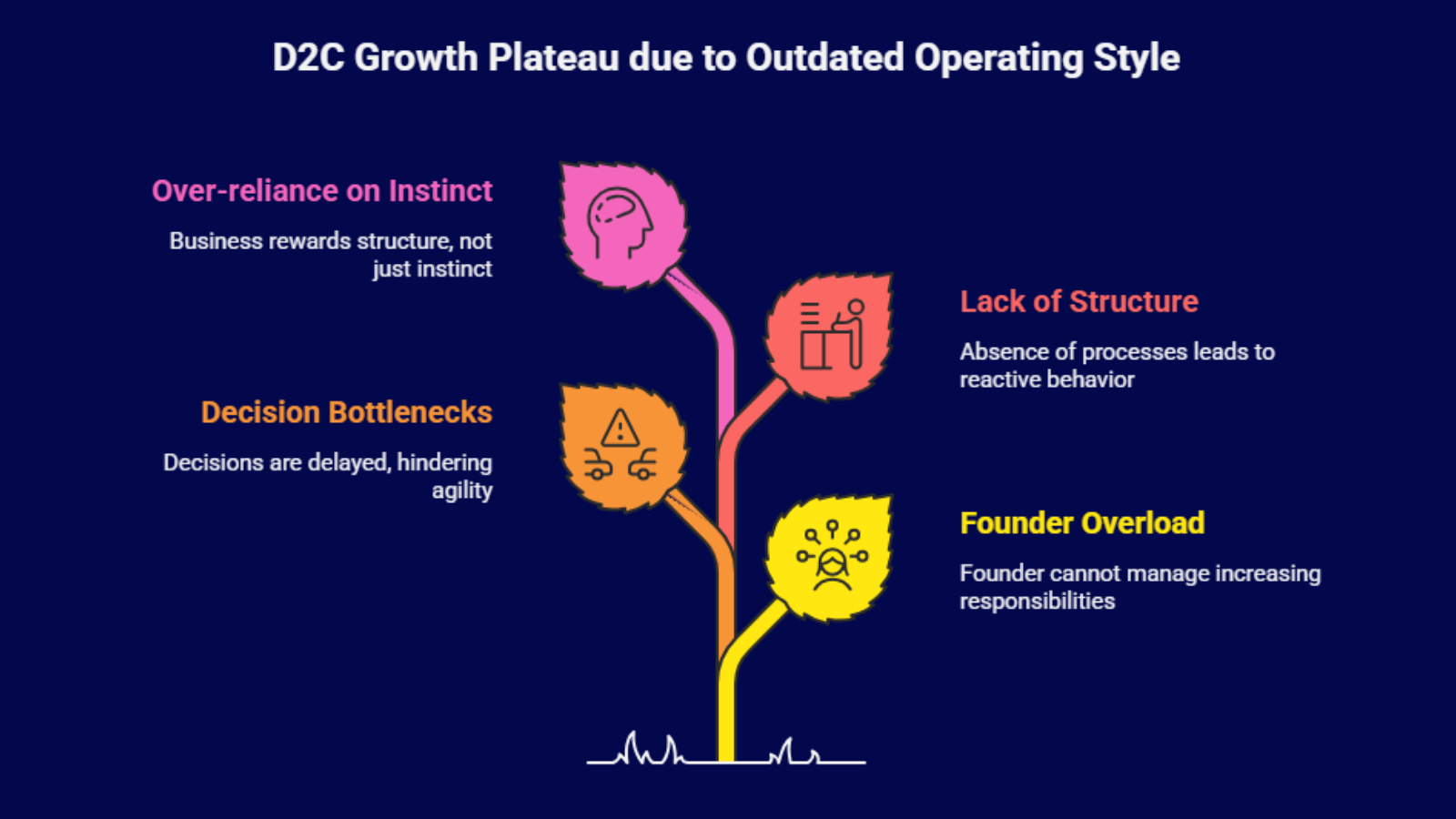
As revenue crosses ₹30Cr, this same setup starts breaking down. The founder cannot be everywhere. Decisions pile up. Teams wait for approvals. What once felt agile now feels reactive. This is where many D2C brands start feeling pressure, even though sales are still coming in.
The business has outgrown its operating style, but the operating style has not evolved yet.
Once the brand crosses this stage, discipline becomes more important than speed. The business no longer rewards instinct alone. It rewards structure, clarity, and repeatable processes. This shift catches many founders off guard and pushes them into a D2C growth plateau.
1. Cash Cycles Stretch Longer
Cash flow becomes harder to manage as the business scales, especially in the Indian D2C ecosystem, where payment delays are common. Revenue may look strong, but access to cash becomes uneven.
- Marketplace payouts typically arrive 7 to 15 days after delivery
- COD orders block cash until the order is completed or returned
- RTOs and customer returns delay revenue realization further
- GST input credits often take time to reflect due to reconciliation gaps
The result is a business that appears profitable on paper but feels constantly short on cash. This pressure slows decisions, limits inventory planning, and increases dependence on short-term credit.
2. Customer Acquisition Costs Rise
Paid marketing does not behave the same way at scale. Early traction flattens out, and growth becomes more expensive with each passing quarter.
- CPMs increase as more brands compete in the same category
- Existing creatives lose effectiveness over time
- Discounts become necessary to maintain conversion rates
- Organic demand does not grow fast enough to offset paid spends
As CAC rises and repeat purchase stays flat, margins shrink quietly. This is when the D2C growth plateau becomes visible, even though traffic and order volume may still look healthy.
3. Inventory Mistakes Become Costly
The inventory decisions that were manageable at a lower scale become high-risk at ₹30Cr. Inventory errors are harder to reverse and tie up large amounts of capital.
- Overstocking ahead of festive or sale seasons blocks cash
- Slow-moving variants pile up in warehouses
- Return rates are underestimated in fashion and lifestyle categories
- Clearing inventory requires deep discounts
One wrong buying decision can impact cash flow for months. Discount-led clearance hurts profitability and weakens long-term brand perception.
4. Teams Grow, But Output Does Not
As revenue grows, hiring increases. But without structure, output does not scale at the same pace.
- Roles and responsibilities remain unclear
- Founders continue acting as the main approval layer
- Decision-making slows as teams wait for direction
- Accountability becomes diffused across functions
Instead of freeing up founder time, larger teams create more work due to lack of coordination. Founders stay busy, but progress feels slower and heavier.
None of these problems appear overnight. They build quietly, layer by layer. Sales still happen, but growth feels heavier and harder to sustain. This is the true beginning of the D2C growth plateau.
Brands that recognize this shift early invest in systems and clarity. The rest stay operationally busy, but strategically stuck.
Why Growth Slows Down Even When Demand Is Still There
 Most D2C brands do not stop growing because customers suddenly lose interest. In fact, demand often continues to exist. What really changes is the business’s ability to handle that demand smoothly. Around ₹30Cr, this gap becomes very visible, especially for Indian sellers managing multiple channels, high COD volumes, rising logistics costs, and tight cash flow. What once felt manageable now feels stretched.
Below are five connected reasons that explain why growth slows down at this stage and why many founders struggle to get back to steady momentum.
1. Paid Ads Stop Doing the Heavy Lifting
In the early days, paid ads feel like a growth lever you can control. Increase Meta budgets, turn on Google Search, and orders follow. That is how many Indian D2C brands scale from ₹1Cr to ₹10Cr quickly.
But beyond ₹25–30Cr, the math shifts. Google Search CPC has already risen double digits YoY, and Meta CPMs spike every festive quarter. The same creative that once delivered 4:1 ROAS now struggles to hold 3:1 without higher discounts. A beauty brand running 25 percent festival offers may show strong revenue, but net contribution after returns and influencer payouts shrinks sharply.
We often see brands reporting 3.5:1 Google ROAS and celebrating monthly targets, while finance tracks CAC rising nearly 40 percent over three years. Repeat purchase rates remain under 30 percent, meaning customers are not compounding value. During Diwali or Big Billion Days, ad budgets double just to “defend” sales. Growth continues, but margins thin quietly. The brand is now paying repeatedly for the same customer.
2. Contribution Margins Are Not Clearly Visible
At ₹30Cr, revenue hides structural weaknesses. Many brands still operate on spreadsheets, tracking gross margin but not true contribution.
A ₹28Cr apparel brand may show 60 percent gross margin. But once ₹120 shipping, ₹70 reverse logistics, 2 percent payment gateway fees, marketplace commissions, influencer seeding, and a 28 percent return rate are factored in, CM2 turns negligible. Yet the SKU keeps scaling because it “sells well.”
We have seen brands push a hero SKU that looks profitable in terms of top line, only to realize months later that heavy COD returns in Tier 2 pincodes wiped out margin entirely. Without SKU-level profitability clarity by channel, brands unintentionally scale loss-making volume. That creates a silent plateau: revenue grows, but financial strength does not.
3. Inventory Decisions Start Hurting Cash
Inventory mistakes at ₹5Cr are recoverable. At ₹30Cr, they are expensive.
A footwear brand stocking aggressively before a sale might commit ₹4Cr to one design. Sell-through stalls at 45 percent, returns spike due to fit complaints, and damaged pairs pile up. Cash is locked for 120 days. To liquidate, the brand increases discounts and ad spend, pushing CAC up further.
We regularly see ₹6-8Cr worth of stock sitting in one colourway the founder loves but the market has rejected. Sampling feedback was strong. Influencers approved it. But real demand shifted. Instead of cutting losses early, brands push paid traffic to move slow stock. That drains marketing efficiency and freezes working capital, slowing future launches.
4. Customer Experience Slips Quietly
The plateau rarely begins with falling demand. It begins with friction.
Courier delays during peak season stretch delivery from three days to seven. Refund timelines extend from 48 hours to a week due to return volume. Support tickets increase, but headcount does not scale proportionally.
Customers hesitate before reordering. Repeat rates drop from 32 percent to 26 percent over six months. The brand compensates with higher acquisition spend. CAC rises. The cycle tightens.
5. Founders Become the Bottleneck
In early stages, founder control accelerates growth. At scale, it slows it.
An operations lead identifies a courier partner causing 18 percent RTO in certain pincodes but waits for founder approval to switch. Marketing holds back new channel tests pending budget sign-off. Inventory buys pause because one person must validate everything.
The founder stays busy all day, yet progress feels slower. Decision latency increases. Accountability blurs. Execution weakens.
The ₹30Cr ceiling is rarely about demand. It is about operational readiness. When complexity scales faster than systems, growth does not stop. It simply becomes fragile.
The Unit Economics Reality Check
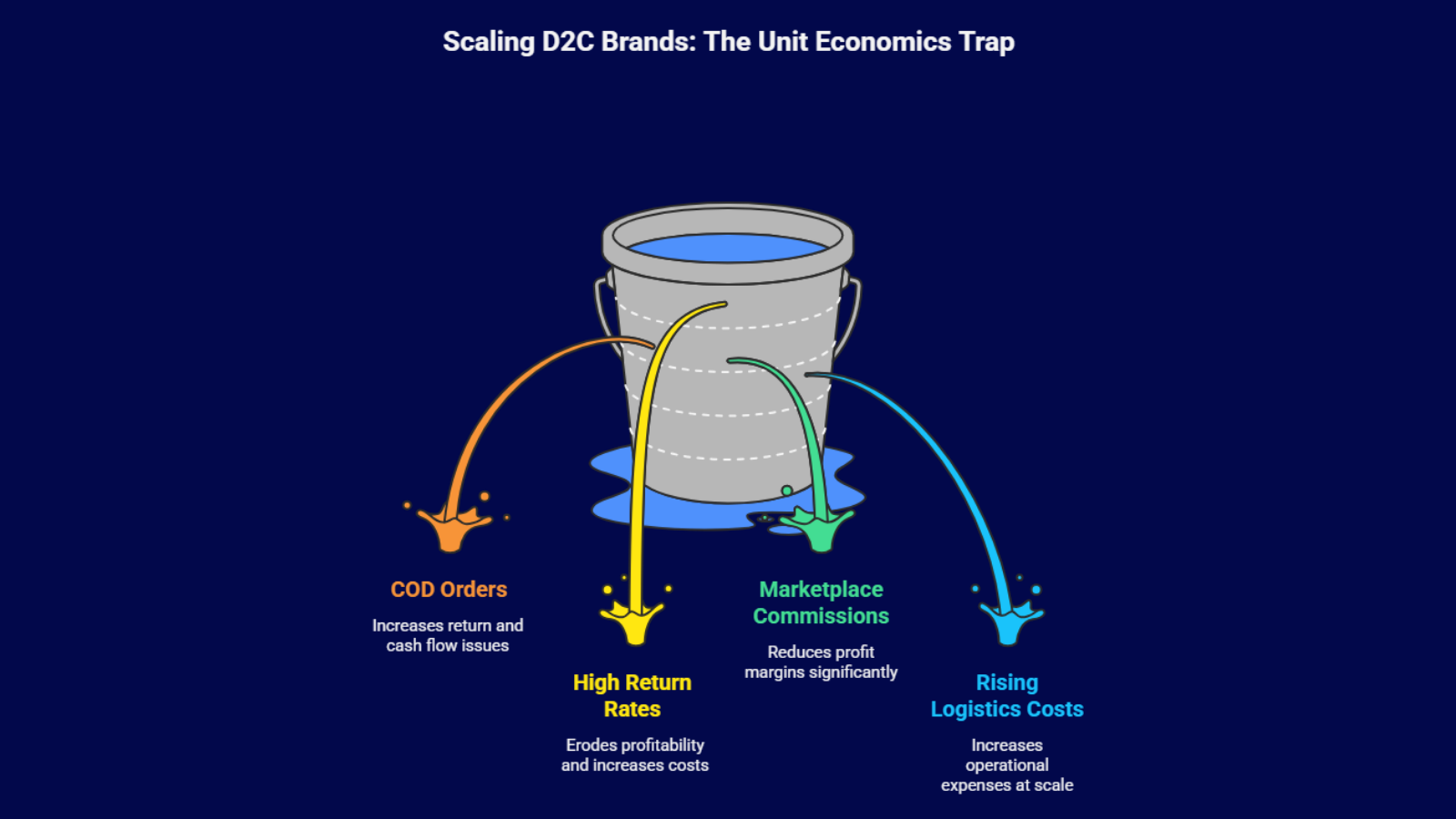 At ₹30Cr, growth starts exposing the truth about the business. Until this stage, it is possible to hide weak unit economics behind rising revenue. Orders are coming in, ads are running, and the top line keeps moving. But when the scale increases, every small inefficiency gets multiplied.
This is why scaling without strong unit economics does not just slow growth. It amplifies losses.
For Indian D2C brands, this problem is sharper because of COD-heavy orders, high return rates, marketplace commissions, and rising logistics costs. A brand can look successful on the outside and still struggle to generate real cash internally. This is the point where many D2C brands realize that revenue alone is not a safety net.
What Healthy Unit Economics Actually Look Like
Before pushing for faster growth, a brand needs a stable foundation. That foundation comes from unit economics that works consistently, not occasionally.
Here is what healthy unit economics usually look like for a scalable D2C business:
| Metric | Healthy Range |
|---|---|
| Contribution Margin | 25 to 35 percent |
| Repeat Purchase Rate | 35 percent or higher |
| CAC Payback Period | Under 6 months |
| Inventory Turns | 6 to 8 times per year |
These numbers matter because they show whether growth is creating value or just volume.
For example, if a brand takes more than 6 months to recover its customer acquisition cost, scaling ads only increases cash pressure. If inventory turns are slow, money stays locked in stock instead of funding growth. Brands that ignore these basics often remain D2C brands stuck, even when revenue crosses impressive milestones.
Why Funding Does Not Fix the Problem
 Funding is often seen as the solution when growth slows. Many founders believe that raising capital will unlock the next phase. In reality, capital does not fix broken systems. It only amplifies what already exists.
If unit economics are weak, funding increases burn. If operations are inefficient, funding adds complexity. This is why many D2C brands struggle to raise money and still struggle to grow profitably.
A common Indian scenario looks like this. A brand raises capital to scale ads and inventory. Sales increase, but returns rise as well. Logistics bills grow. Cash burn accelerates. Within 12 to 18 months, the brand is under pressure again, only this time with higher stakes.
Instead of solving problems, funding deepens the D2C growth plateau and shortens the runway. The brands that use capital well first fix clarity, discipline, and systems. Only then does funding become a growth accelerator.
10 Practical Ways D2C Brands Can Break the ₹30Cr Growth Block
Reaching ₹30Cr proves that a D2C brand has demand, a product that works, and a market that exists. Getting stuck there usually means the business needs to evolve, not restart. The good news is that this stage is fixable if founders focus on the right levers instead of pushing harder on the old ones.
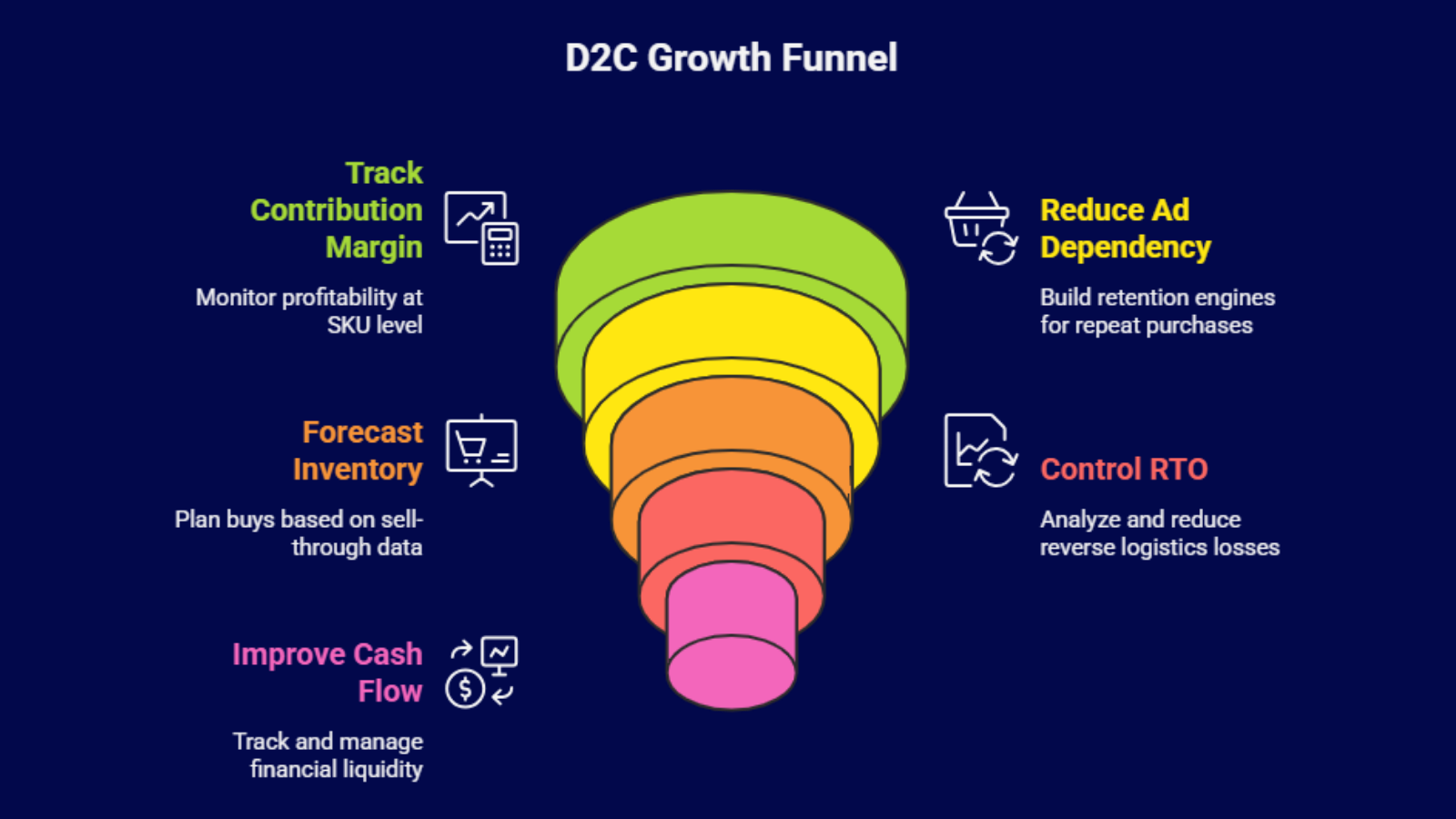 Below are ten practical, India-specific ways D2C brands can move past this stage and build sustainable growth. Each of these addresses a real bottleneck that shows up around ₹30Cr and explains how it can be fixed in a structured way.
1. Track contribution margin daily. Move beyond revenue dashboards. Monitor CM1 and CM2 at SKU level after ads, freight forward and reverse, payment gateway fees, COD charges, marketplace commissions, and returns. A product delivering 4:1 ROAS can still destroy margin if return rates cross 25%.
2. Reduce paid ad dependency. If 70 to 80% of sales depend on Meta and Google, rising CPCs will squeeze profitability. Build retention engines like WhatsApp reactivation, email flows, loyalty tiers, bundles, and subscriptions to push repeat purchase rates beyond 30%.
3. Forecast inventory using real sell-through data. Plan buys based on 30 to 60 to 90 day velocity, size-level returns, and seasonal trends. Avoid MOQ-driven bulk purchases that lock ₹2 to ₹3Cr in slow-moving SKUs.
4. Control RTO scientifically. Analyse RTO by pincode, courier partner, payment mode, and SKU. Tighten COD policies in high-risk zones and strengthen NDR follow-ups to cut reverse logistics losses.
5. Improve cash flow visibility. Track daily exposure in COD, marketplace receivables, refunds, and vendor payments. Even a 15 to 20 day delay in settlements can strain liquidity at this scale.
6. Strengthen warehouse and dispatch discipline. Enforce SLA tracking, packaging audits, QC checkpoints, and volumetric weight monitoring to reduce cancellations and courier penalties.
7. Align marketing with payback timelines. If CAC recovery stretches beyond 90 to 120 days, growth becomes fragile. Budget around realistic cash cycles, not vanity revenue targets.
8. Build clear functional ownership. Separate P and L accountability across marketing, supply chain, and finance. Define KPIs like inventory turns, return rate percentage, and cash conversion cycle. Founder approval should not be a bottleneck.
9. Stop scaling unprofitable channels. Pause marketplaces, affiliates, or paid campaigns that dilute contribution margin, even if they add topline revenue. Protect profitability before volume.
10. Bring in experienced execution partners. At this stage, operational precision matters more than experimentation. Operators familiar with Indian logistics, COD dynamics, and marketplace reconciliations can prevent costly trial and error mistakes.
How Base.com Helps D2C Brands Fix This Faster
Breaking out of the ₹30Cr plateau requires structure, clarity, and execution at scale. This is where Base.com becomes a strategic advantage for D2C brands.
Base.com helps brands bring all moving parts together. From improving visibility into unit economics and cash flow to streamlining operations, inventory planning, and execution, Base.com enables founders to regain control without slowing growth. Instead of reacting to problems, brands start operating with discipline and confidence.
If your D2C brand has demand but feels constantly under pressure, it is not a growth problem. It is a systems problem. Talk to Base.com to understand how structured execution can help you scale beyond ₹30Cr without chaos and finally move past the growth block.
FAQs
1. Why do D2C brands struggle with profitability even after high revenue?
High revenue does not always mean healthy margins. Rising ad costs, returns, logistics expenses, and discounts eat into profits. Without tracking contribution margins closely, brands grow sales but lose money on each additional order.
2. What is the biggest mistake D2C founders make while scaling?
The biggest mistake is scaling too fast without fixing systems. Founders push ads and inventory, assuming growth will stabilize later, but weak operations and unit economics only amplify losses at a larger scale.
3. How do returns and RTOs impact D2C growth in India?
Returns and RTOs directly impact cash flow and margins. High COD returns increase logistics costs, delay refunds, and block inventory. Over time, this reduces profitability and slows reinvestment into growth.
4. Why does growth slow even when customer demand exists?
Growth slows when internal capacity cannot support demand. Delays in fulfillment, poor inventory planning, rising CAC, and unclear ownership reduce execution speed, even if customers are still willing to buy.
5. What metrics should D2C founders track after ₹30Cr?
Founders should track contribution margin, CAC payback period, repeat purchase rate, inventory turns, and cash locked in receivables. These metrics show whether growth is sustainable or just increasing pressure.