
Growth usually feels predictable in the early stages. Orders come in daily, ad dashboards look healthy, and cash seems to move in a steady rhythm. But as Indian D2C brands cross roughly ₹2 crore in annual revenue, something subtle starts to change. The same inventory decisions that once felt safe begin to slow everything down. By the time a brand approaches ₹10 to ₹20 crore, inventory cash flow quietly becomes the biggest constraint.
At this stage, inventory is no longer just about availability. It turns into a locked capital. Founders pay suppliers upfront or within short credit cycles, while sales trickle back over weeks through COD settlements, delayed returns, and uneven demand. This mismatch is where D2C inventory issues start compounding. What looked like growth suddenly feels like pressure.
For Indian sellers, this problem is amplified by local realities. Demand spikes during festivals, drops sharply after. Tier two and tier three markets behave very differently from metros. COD orders increase RTO risk. Inventory that does not move fast enough starts eating into inventory cash flow before anyone notices.
What Indian D2C brands typically experience at this stage
- Inventory purchases grow faster than actual sell-through
- Cash gets stuck in warehouses instead of marketing or new launches
- Slow-moving SKUs begin to pile up quietly
- Returns and RTO delay inventory reuse
- Forecasting becomes guesswork instead of data-driven
This is the point where inventory stops supporting growth and starts controlling it. Brands that recognize this early can fix inventory cash flow without slowing down. Brands that ignore it usually feel the impact much later, when options are limited.
Why Inventory Feels Safe but Becomes Dangerous at Scale
In the early days of a D2C brand, inventory feels reassuring. Having stock on hand means fewer cancelled orders, faster deliveries, and happier customers. For Indian sellers starting, this approach works because volumes are manageable and decisions are simple. If sales increase, you buy a little more. If demand dips, the impact is limited. Inventory still feels like control.
That sense of safety slowly fades as the business scales. Once order volumes increase and warehouses multiply, inventory stops being flexible. Brands begin ordering in bulk to secure better pricing or meet supplier MOQs. Payments move out faster than before, while sales come back unevenly through COD settlements, partial returns, and delayed replacements. This is where inventory cash flow quietly starts tightening.
The danger lies in the gap between cash out and cash in. Inventory is paid for immediately or within short credit cycles, but sales convert over weeks or even months. When returns, discounts, and slow-moving SKUs enter the picture, this gap widens further. Many Indian D2C brands discover their first major D2C inventory issues right after adding a second warehouse or expanding to new pin codes.
When inventory grows faster than actual sales velocity, cash stops circulating. It does not disappear, but it becomes unavailable. This is why founders often feel cash stress despite healthy revenue.
What typically changes at scale for Indian D2C brands
- Inventory is ordered in larger, less frequent batches
- Supplier payment cycles become shorter or fully prepaid
- Sales fluctuate across regions and seasons
- Stock remains unsold longer due to wider catalogs
- Inventory cash flow starts depending on assumptions, not facts
This shift rarely feels dramatic at first. It feels gradual, which is why it often goes unnoticed until pressure builds.
How Inventory Directly Impacts Cash Flow
 Cash flow is not the same as profitability. A brand can be profitable on paper and still struggle to pay bills on time. Inventory is usually the reason. Cash flow is about timing, and inventory disrupts that timing more than any other factor.
When a D2C brand pays suppliers today and sells the stock over the next 60 to 120 days, inventory cash flow immediately comes under strain. In India, COD further stretches this cycle. Money is tied up in transit, returns, and settlements before it can be reused. As brands scale, D2C inventory issues worsen when reorders are placed based on projected growth instead of actual sell-through.
At higher volumes, even small forecasting errors become expensive. Ordering 10 percent extra stock at scale can block several lakhs for months. That cash could have been used for marketing, technology, or improving customer experience.
Direct ways to inventory block cash flow
- Capital remains locked inside warehouses
- Marketing spends are delayed or reduced
- Brands become dependent on overdrafts or credit lines
- Founders feel personal liquidity pressure
- Decision-making slows due to a lack of free cash
Inventory does not just occupy physical space. It occupies mental space as well. Every growth decision starts getting filtered through the question of cash availability. This is when inventory stops supporting scale and starts controlling it, making inventory cash flow one of the most critical metrics for Indian D2C sellers to manage deliberately.
The Indian D2C Reality Most Founders Miss
Indian D2C brands operate in a complex environment. COD orders, high return rates, festival-driven demand, and uneven logistics performance make inventory planning harder than it looks.
Many D2C inventory issues in India come from copying global playbooks that do not fit local demand patterns.
1. Overbuying Inventory Is the Silent Killer
 Overbuying inventory rarely feels like a mistake when it happens. It feels responsible. Founders believe they are preparing for growth, preventing stockouts, and negotiating better pricing. The problem is that the damage does not show up immediately. It appears months later, when inventory starts ageing, and cash becomes tight.
Excess inventory increases holding costs, forces deeper discounts, and leads to write-offs. This is one of the most damaging D2C inventory issues because it affects both margins and inventory cash flow at the same time. Money that could have been used for ads, product improvements, or expansion remains stuck on shelves.
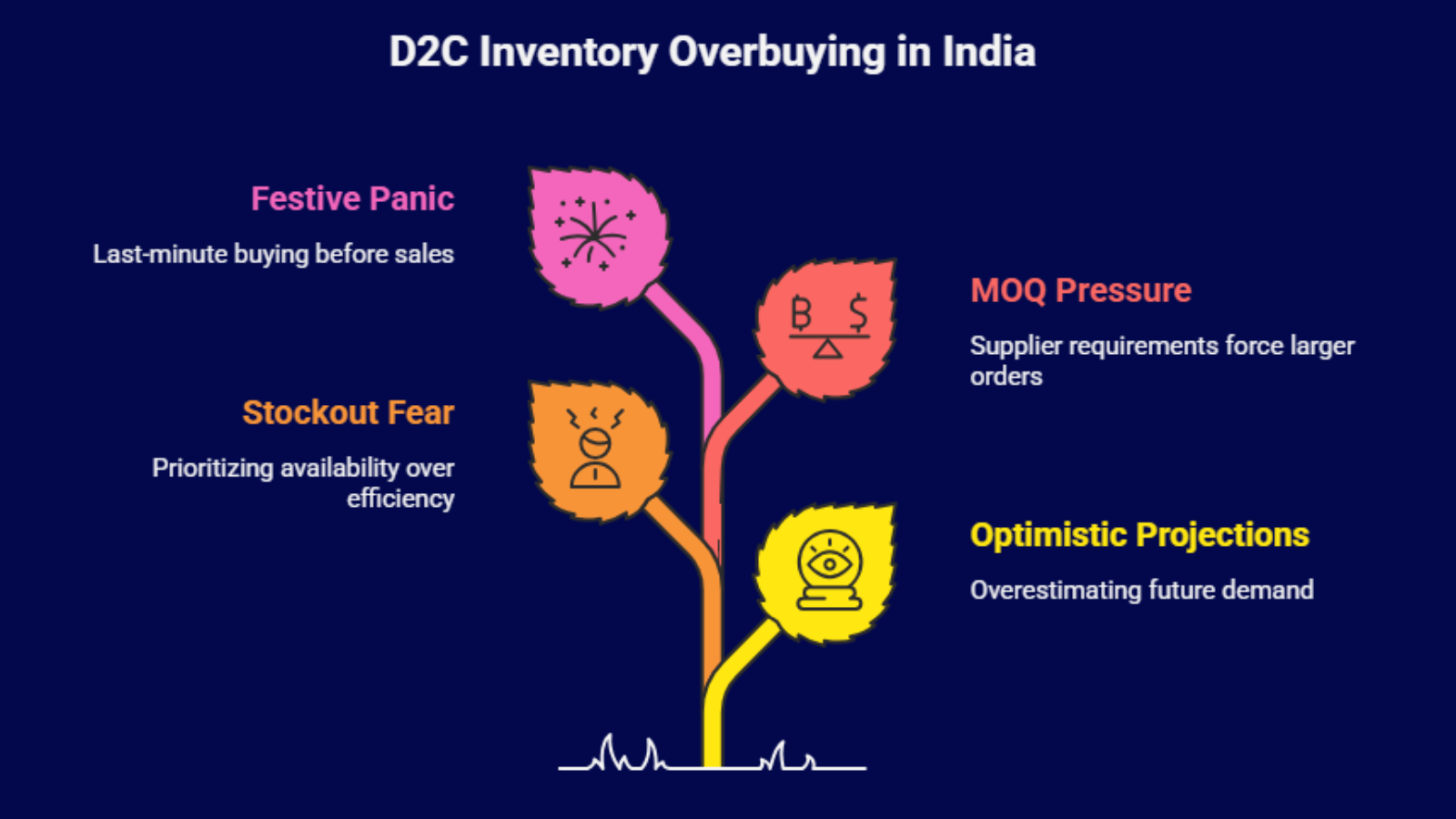
For Indian brands, overbuying is often driven by supplier constraints and seasonal pressure. Minimum order quantities and festival expectations push founders to order more than they demand.
Common reasons Indian D2C brands overbuy
- Optimistic growth projections based on short-term spikes
- Fear of running out of stock during peak periods
- MOQ pressure from manufacturers and importers
- Panic buying ahead of festive sales
Every extra unit ordered without demand clarity weakens inventory cash flow and reduces flexibility in future decisions.
2. How Slow-Moving SKUs Drain Inventory Cash Flow
Not all inventory behaves the same way. A brand can show strong overall revenue while a few SKUs quietly drain cash in the background. Slow-moving SKUs are one of the most overlooked D2C inventory issues, especially in brands that launch products frequently.
These SKUs trap capital without generating returns. They take up warehouse space, complicate replenishment planning, and eventually require discounting to move. While fast-moving products fund growth, slow movers silently reduce inventory cash flow.
The problem becomes worse at scale because slow movers multiply. Each new launch adds risk, and without strong exit strategies, the catalog becomes bloated.
Impact of slow-moving SKUs on cash flow
- Capital remains locked without sales returns
- Warehouse and handling costs increase
- Discounts reduce overall contribution margins
- Replenishment decisions become less accurate
Inventory cash flow improves only when slow-moving SKUs are identified early and addressed aggressively, either through liquidation, bundling, or discontinuation.
3. The Hidden Cost of Returns and RTO
 Returns do more than reverse revenue. They freeze inventory cash flow. A returned order blocks capital from the moment it leaves the warehouse until it is either resold or written off. In India, COD heavy models increase RTO rates, making this one of the most expensive D2C inventory issues at scale.
Returned stock often takes weeks to come back. During this time, it cannot be sold again. Once it arrives, quality checks, repackaging, or further damage further delay resale. Some items become unsellable altogether, forcing write-offs.
Return related inventory problems
- Inventory unavailable while in transit
- Product quality degradation during handling
- Repackaging and inspection costs
- Delayed resale and slower inventory turnover
Every return stretches inventory cash flow further and reduces the ability to reinvest quickly.
4. Inventory Ageing Is a Cash Flow Warning Signal
Inventory ageing tells the truth that founders often avoid. When stock sits too long, cash is already compromised. If inventory crosses 90 days without movement, inventory cash flow is under serious pressure.
Many D2C inventory issues begin because ageing data is either ignored or not tracked at the SKU level. Brands focus on overall inventory value but miss where the real blockage lies.
Healthy inventory ageing benchmarks
| Inventory Age | Cash Flow Impact |
|---|---|
| 0 to 30 days | Healthy movement |
| 31 to 60 days | Needs monitoring |
| 61 to 90 days | High-risk zone |
| Above 90 days | Cash effectively locked |
Inventory cash flow improves only when ageing is actively managed and acted upon.
5. Forecasting Errors Multiply at Scale
 Forecasting errors do not grow linearly. They multiply by scale. At ₹50 lakh monthly revenue, a 10 percent error may feel manageable. At ₹5 crore monthly revenue, the same error can block months of inventory cash flow.
This is why demand forecasting becomes one of the most dangerous D2C inventory issues as brands grow. Small misjudgments lead to large capital lockups.
Forecasts often fail because they rely on optimism rather than data. Marketing-driven growth assumptions, lack of channel-level visibility, and mixing new customer demand with repeat demand distort projections.
Why forecasts fail at scale
- Marketing optimism replaces sell-through data
- Channel-level performance is ignored
- New and repeat demand are not separated
- Regional demand differences are overlooked
Bad forecasts destroy inventory cash flow silently. By the time the impact is visible, the cash is already stuck, and recovery becomes slow and expensive.
How Inventory Affects Marketing and Growth
Growth in D2C rarely slows because demand disappears. It slows because cash stops moving smoothly. When inventory cash flow tightens, marketing is usually the first function to feel the pressure. Ad spends are reduced, new channels are paused, and experiments that once drove growth are quietly put on hold. This shift often happens without a clear warning, making it easy to miss the real cause.
For Indian D2C sellers, this connection is especially strong. Inventory is often overbought to prepare for growth or festivals, which locks capital for months. That same capital is usually what funds performance marketing. When it gets stuck in warehouses, ad budgets shrink. As marketing slows, sales momentum weakens. When sales weaken, inventory takes even longer to move. This is how D2C inventory issues slowly turn into growth plateaus.
Inventory cash flow and marketing cash flow are tightly linked. Marketing creates demand, but inventory enables fulfillment and revenue realization. If inventory planning weakens, marketing cannot scale. If marketing slows, inventory turnover drops further. Many brands try to fix growth by optimizing ads, while the real problem sits inside warehouses.
The typical cycle starts with inventory overbuying, followed by cash getting locked, ad budgets being cut, sales slowing, and inventory moving even more slowly. Unless this cycle is broken deliberately, it keeps repeating.
How Smart Brands Fix Inventory Cash Flow at Scale
 Brands that scale sustainably do not slow down growth to fix inventory. They fix inventory so growth can continue without stress. The biggest shift they make is mental. Inventory is no longer treated as a monthly or quarterly task. It becomes a daily operating metric tied directly to inventory cash flow. This shift alone changes decision-making across teams.
Instead of asking how much stock is available, smart brands ask how fast stock is moving and how quickly cash will return. They stop chasing bulk discounts that look attractive on paper but lock capital for months. Shorter reorder cycles allow them to stay flexible, respond to demand changes, and protect inventory cash flow even during volatile periods like festive seasons or ad spikes.
Catalog discipline is another key change. As brands grow, SKU count often increases faster than demand clarity. Smart brands simplify their catalogs by doubling down on proven products and controlling experimental launches. This reduces complexity and prevents slow movers from silently draining inventory cash flow.
The most important shift is how inventory connects with sales and marketing. Inventory planning is no longer isolated. It reflects campaign calendars, channel performance, and regional demand patterns. This alignment reduces surprises and keeps inventory cash flow predictable.
What smart D2C brands do differently in practice
- Track sell-through at the SKU level across all channels daily, not monthly
- Replenish inventory in smaller, more frequent cycles to avoid overbuying
- Plan inventory separately for metros, tier two, and tier three markets
- Liquidate slow-moving stock early through bundles or targeted discounts
- Use integrated systems to get real-time visibility into sales and inventory
By building discipline around these habits, D2C inventory issues start resolving themselves. Inventory cash flow improves because capital moves faster. Marketing regains flexibility because budgets are no longer blocked. Founders regain confidence because growth becomes steady instead of stressful. This is how smart brands scale without letting inventory control their future.
Why Systems Matter More Than Gut Feeling
At scale, intuition fails. Systems win.
Manual spreadsheets cannot handle multi-warehouse, multi-channel inventory. Inventory cash flow improves only when visibility is real-time, and decisions are automated.
Most unresolved D2C inventory issues come from a lack of unified systems. Inventory problems are rarely about intent. They are about visibility and control.
Base.com helps D2C brands understand exactly where their cash is stuck in inventory and how long it will take to come back. Instead of only tracking revenue, it connects sales, SKUs, reorders, and cash flow in one simple dashboard so founders can see the real picture.
Before placing large purchase orders, brands can check how it will impact their working capital over the next few months. It also highlights slow-moving products early, so money doesn’t stay blocked in dead stock. In short, Base.com helps d2c brands grow without running out of cash.
With better control, inventory cash flow improves naturally, without slowing growth or increasing risk.
If inventory is starting to feel heavy instead of helpful, it is time to fix the system behind it.
FAQs
1. Why do D2C brands run out of cash despite good sales?
Most D2C brands run out of cash because money gets stuck in inventory, returns, and delayed COD settlements. Even with strong sales, slow inventory movement and ageing stock create inventory cash flow gaps.
2. What causes inventory problems in D2C businesses?
Inventory problems are caused by overbuying, inaccurate demand forecasting, too many SKUs, high returns, and a lack of real-time visibility. These D2C inventory issues grow faster as the brand scales.
3. How much inventory should a D2C brand ideally hold?
Ideally, a D2C brand should hold 30 to 45 days of fast-moving inventory. If a large portion sits beyond 60 days, inventory cash flow pressure starts building quickly.
4. Does excess inventory affect marketing and growth?
Yes. Excess inventory locks up working capital, which reduces available marketing budgets. When ads slow down, sales drop, inventory moves more slowly, and growth plateaus, even when customer demand exists.
5. How can D2C brands reduce inventory cash flow pressure?
D2C brands can reduce inventory cash flow pressure by cutting slow SKUs, ordering in smaller batches, tracking ageing weekly, planning region-wise demand, and using centralized systems for inventory decisions.