Scaling a D2C brand looks exciting from the outside, but in India, the stress starts showing fast once you move from 1 crore to 10 crore in annual revenue and your daily orders jump past 1,000. The reason is not marketing alone. It is the gap between D2C founder challenges and ops leadership D2C. Founders push growth, but operators protect margins, cash, and delivery promises.
For Indian sellers, scaling brings three realities that many teams underestimate.
First, returns can spike sharply on marketplaces. In categories like fashion and accessories, return rates often sit in the 20 to 35 percent band, which quietly kills cash flow because COD refunds, reverse logistics, and restocking delays add up.
Second, your working capital gets locked in inventory. If your average stock cover moves from 30 days to 60 days, you are effectively funding growth with your own cash.
Third, marketplaces and D2C behave differently. On Amazon and Flipkart, ads can lift sales quickly, but settlement cycles, fees, and penalties for late dispatch can reduce profitability even when revenue looks strong.
This is why ops leadership D2C matters early. Tight demand forecasting, SKU-level contribution tracking, and courier performance reviews are the fastest way to reduce D2C founder challenges without slowing growth.
Why Founder vs Operator Gaps in D2C Scaling Matter
In the early stages, the founder drives everything. Product decisions, marketing, hiring, vendor negotiations, and even customer complaints. That hustle builds the brand. But as the business scales, complexity increases.
- Customer acquisition costs rise by 20 to 40 percent after initial scale.
- Return rates in D2C categories like fashion can go above 25 percent.
- Inventory holding costs increase sharply once the SKU count crosses 100.
Without strong ops leadership, D2C, these pressures compound. And that is where most D2C founder challenges become visible.
Let us break down the top 10 gaps.
Top 10 Founder vs Operator Gaps in D2C Scaling
When an Indian D2C brand moves from early traction to serious scale, the pressure changes completely. At 100 orders a day, mistakes are manageable. At 1,000 orders a day across your website, Amazon, Flipkart, and maybe Meesho, small gaps become expensive problems. This is where most D2C founder challenges begin to surface.
Founders think about growth, visibility, and momentum. Operators think about predictability, cost control, and delivery timelines. Both are right. But when these perspectives are not aligned, scaling becomes chaotic. Strong ops leadership D2C bridges this gap by turning ambition into systems.
Below are the 10 most critical founder versus operator gaps that Indian D2C sellers face, along with practical solutions.
1. Vision vs Process Discipline
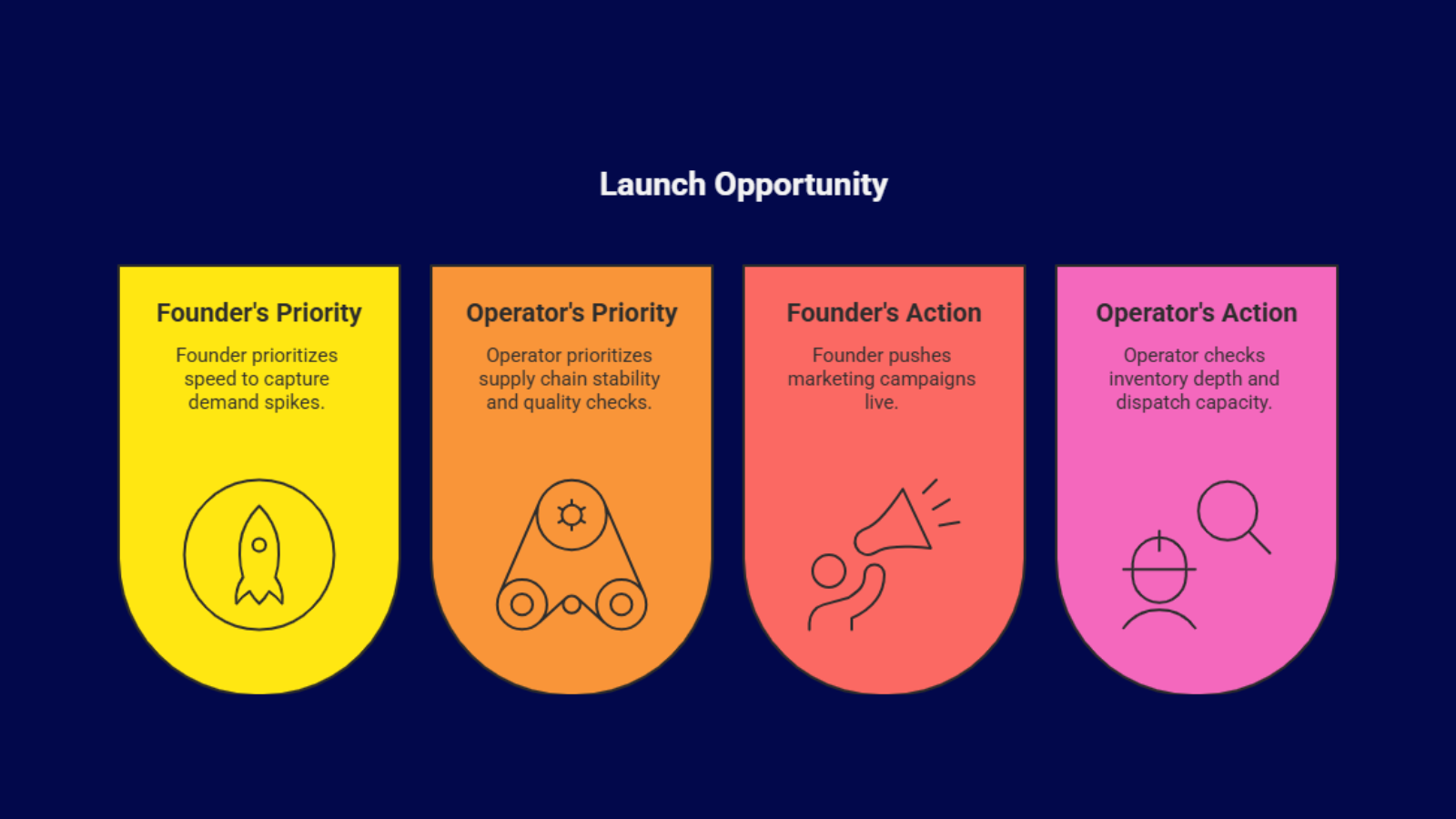 A founder sees a festive launch opportunity and wants to go live before Diwali sales. The operator asks whether raw materials are locked, packaging vendors are ready, and courier capacity is confirmed.
The Gap
- The founder prioritizes speed to capture demand spikes.
- Operator prioritizes supply chain stability and quality checks.
- Founder pushes marketing campaigns live.
- Operator checks inventory depth and dispatch capacity.
In India, festive seasons can contribute 25 to 40 percent of annual sales for many D2C brands. But stockouts during peak sales not only reduce revenue, they also damage marketplace rankings. Amazon penalizes late shipments and cancellations, which impacts Buy Box visibility.
Solution
An integrated platform that connects inventory planning, demand forecasting, and marketing calendars ensures that launches are backed by supply readiness. This reduces last-minute firefighting and addresses core D2C founder challenges early through structured ops leadership D2C.
2. Growth Focus vs Unit Economics Focus
Founders celebrate revenue milestones. Crossing 10 crore feels like validation. Operators ask a harder question. What is the contribution margin after ads, returns, and logistics?
The Gap
- Founder tracks revenue and ROAS.
- Operator tracks contribution margin per SKU.
- Founder celebrates 3x revenue growth.
- Operator questions 5 percent net margin.
In Indian marketplaces, combined commission, ads, and logistics can take 30 to 45 percent of the selling price. If return rates are 20 percent, the effective margin shrinks further.
One of the biggest D2C founder challenges is scaling revenue without tracking SKU-level profitability.
Solution
An integrated dashboard that consolidates ad spend, platform fees, return cost, and logistics data at the SKU level helps founders and ops leadership D2C align on real profitability, not vanity metrics.
3. Brand Building vs Backend Infrastructure
Founders invest in influencer campaigns and performance marketing. Operators invest in ERP systems, warehouse management, and barcode tracking.
The Gap
- Founder optimizes creatives and landing pages.
- Operator optimizes pick-pack-dispatch accuracy.
- Founder drives demand.
- The operator manages fulfillment SLAs.
In India, delayed shipments and wrong product dispatches directly impact ratings. A drop from 4.3 to 3.8 stars can reduce conversion significantly.
Many D2C founder challenges that look like marketing problems are actually operational bottlenecks.
Solution
An integrated system that connects storefront orders, marketplace orders, and warehouse operations ensures inventory sync, automated order routing, and real-time tracking. Strong ops leadership D2C supported by technology reduces fulfillment errors and improves repeat purchase rates.
4. Short-Term Wins vs Long-Term Systems
 Flash sales drive quick revenue. Heavy discounts increase order volumes. But do they increase profit?
The Gap
- The founder runs aggressive discount campaigns.
- The operator monitors inventory aging and return spikes.
- Founder expands to new marketplaces.
- Operator checks team capacity and warehouse throughput.
In India, COD still accounts for a large portion of orders in many categories. High discounts often increase COD returns, which can go above 30 percent in certain segments.
These patterns intensify D2C founder challenges when systems are not prepared.
Solution
Integrated planning tools that simulate demand impact before campaigns help balance growth and operational capacity. Strong ops leadership D2C ensures discounts are aligned with stock depth and courier performance data.
5. Intuition vs Data Discipline
Founders trust market instincts. They sense trends from Instagram and customer feedback. Operators want data.
The Gap
- The founder selects SKUs based on trend momentum.
- The operator checks the sell-through rate and aging stock.
- Founder upgrades packaging for brand appeal.
- The operator calculates per unit cost increase.
If 40 percent of SKUs contribute only 15 percent of revenue, then carrying these blocks of working capital. Without structured reviews, D2C founder challenges increase as inventory grows.
Solution
Weekly dashboards on sell-through, dead stock, and reorder points create clarity. Integrated systems make data accessible, enabling founders and ops leadership D2C to make aligned decisions.
6. Hiring Fast vs Hiring Structured
With 20 team members, informal communication works. At 50, confusion begins.
The Gap
- The founder hires quickly to solve immediate pain.
- The operator designs the org structure with defined KRAs.
- The founder reacts to problems.
- The operator plans capacity based on the forecast.
Unclear ownership leads to delayed dispatch, missed follow-ups, and vendor mismanagement. These are silent D2C founder challenges that show up as operational inefficiencies.
Solution
Clear SOPs integrated into operational platforms ensure task visibility and accountability. Strong ops leadership D2C builds structured teams instead of reactive hiring.
7. Cash Spending vs Cash Flow Management
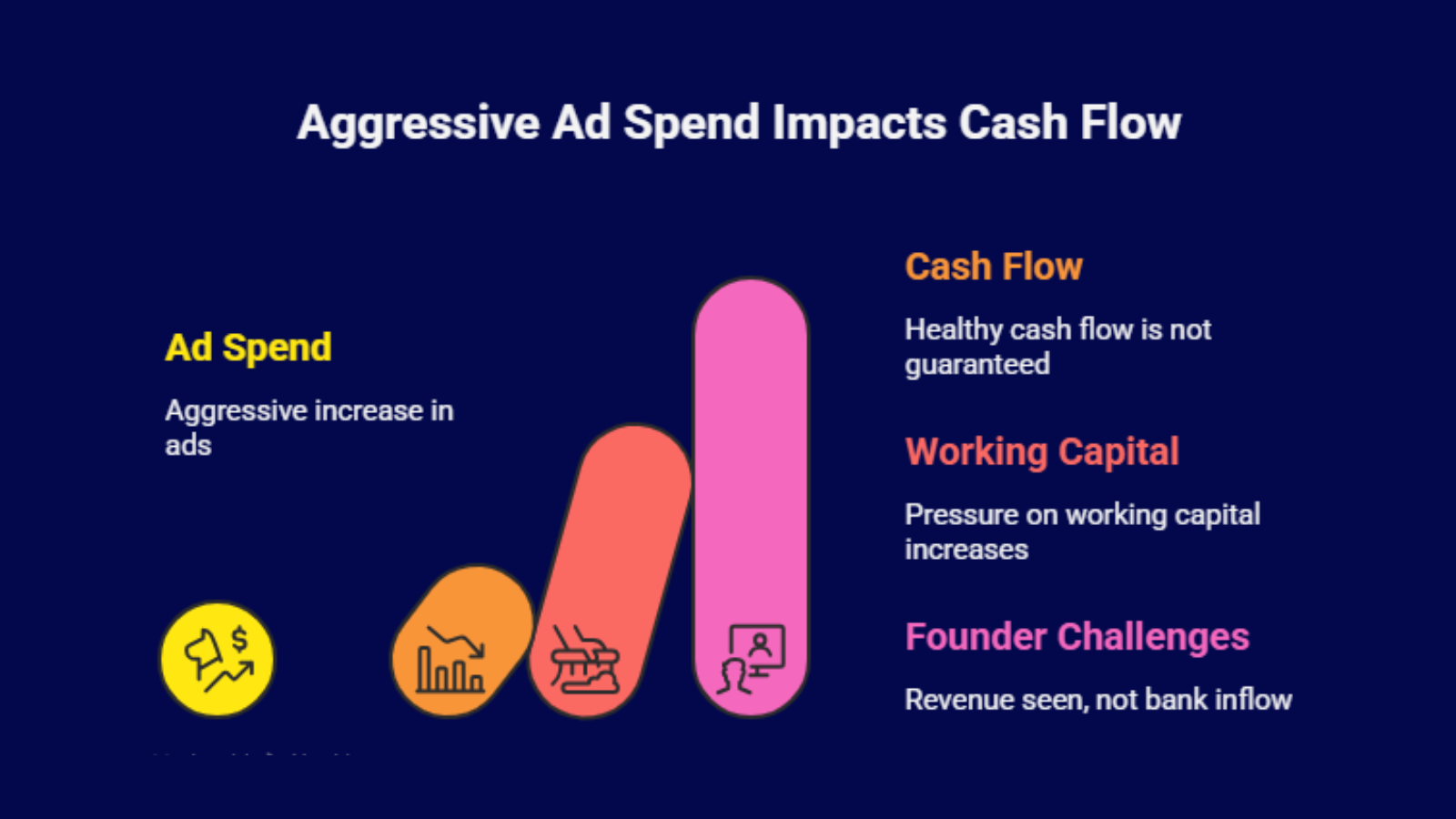 Revenue growth does not mean healthy cash flow.
The Gap
- The founder increases ad spend aggressively.
- The operator tracks the cash conversion cycle.
- The founder orders bulk inventory for a lower unit cost.
- The operator negotiates payment terms with suppliers.
Marketplace settlements in India can take 7 to 14 days. Add return delays and reverse logistics, and working capital pressure increases sharply.
Many D2C founder challenges arise because founders see revenue in dashboards but do not track actual bank inflow.
Solution
An integrated finance and inventory view that connects sales, returns, and settlement cycles helps ops leadership D2C manage liquidity better and avoid sudden cash crunches.
8. Product Expansion vs SKU Rationalization
Adding new categories feels like growth.
The Gap
- The founder expands from 50 to 300 SKUs.
- Operator identifies 30 to 40 percent of low-performing SKUs.
- The founder pushes new launches monthly.
- Operator tracks warehouse complexity.
Every additional SKU increases storage cost, forecasting complexity, and return handling.
These hidden costs add to D2C founder challenges during scaling.
Solution
Integrated SKU performance analytics help identify profitable lines and phase out weak performers. Strong ops leadership D2C focuses on depth in winning SKUs rather than random expansion.
9. Founder Dependency vs System Dependency
In the early days, the founder approves every decision.
The Gap
- The founder signs off on pricing, vendor, and campaign decisions.
- The operator builds delegated authority frameworks.
- The founder solves daily issues.
- The operator builds preventive controls.
As order volumes grow, bottlenecks slow execution. Teams wait for approvals, delaying dispatch or campaign adjustments.
This is a common but overlooked D2C founder challenges scenario.
Solution
An integrated workflow platform with defined approval layers reduces dependency. Mature ops leadership D2C builds decision frameworks instead of relying on founder intervention.
10. Storytelling vs Execution Consistency
 Founders promise 48-hour shipping and easy returns. Operators track actual dispatch times and courier performance.
The Gap
- The founder markets speed.
- Operator tracks SLA adherence.
- The founder promises premium packaging.
- The operator monitors the packaging defect rate.
In India, logistics partners vary by zone. Tier 2 and Tier 3 deliveries may take longer. If marketing promises are not aligned with operational reality, brand trust drops.
These mismatches fuel ongoing D2C founder challenges.
Solution
Integrated logistics tracking systems that measure courier performance by region allow ops leadership D2C to align brand messaging with real delivery capability.
Why an Integrated Platform Changes the Game
Scaling D2C in India is complex because sales happen across your website and multiple marketplaces, each with different fee structures, settlement cycles, and operational rules.
An integrated platform connects:
- Inventory across channels
- Marketplace and D2C orders
- Ad spend and SKU-level profitability
- Returns and reverse logistics
- Finance and settlement tracking
- Warehouse performance metrics
When founders and ops leadership D2C operate on the same data, alignment improves. Decisions become data-backed instead of emotional. Growth becomes sustainable instead of stressful.
Most D2C founder challenges are not about ambition. They are about systems not keeping up with ambition. And that is where structured operational leadership supported by integrated technology makes the difference between chaotic scaling and profitable scaling.
Final Thoughts
D2C markets in India are not what they were three years ago. Customer acquisition costs across Meta and Google have increased sharply in most categories, while marketplaces like Amazon and Flipkart have tightened SLA norms, return policies, and seller performance benchmarks. Today, fast delivery, accurate dispatch, and smooth returns are not advantages. They are basic expectations. This is why strong ops leadership D2C is no longer optional.
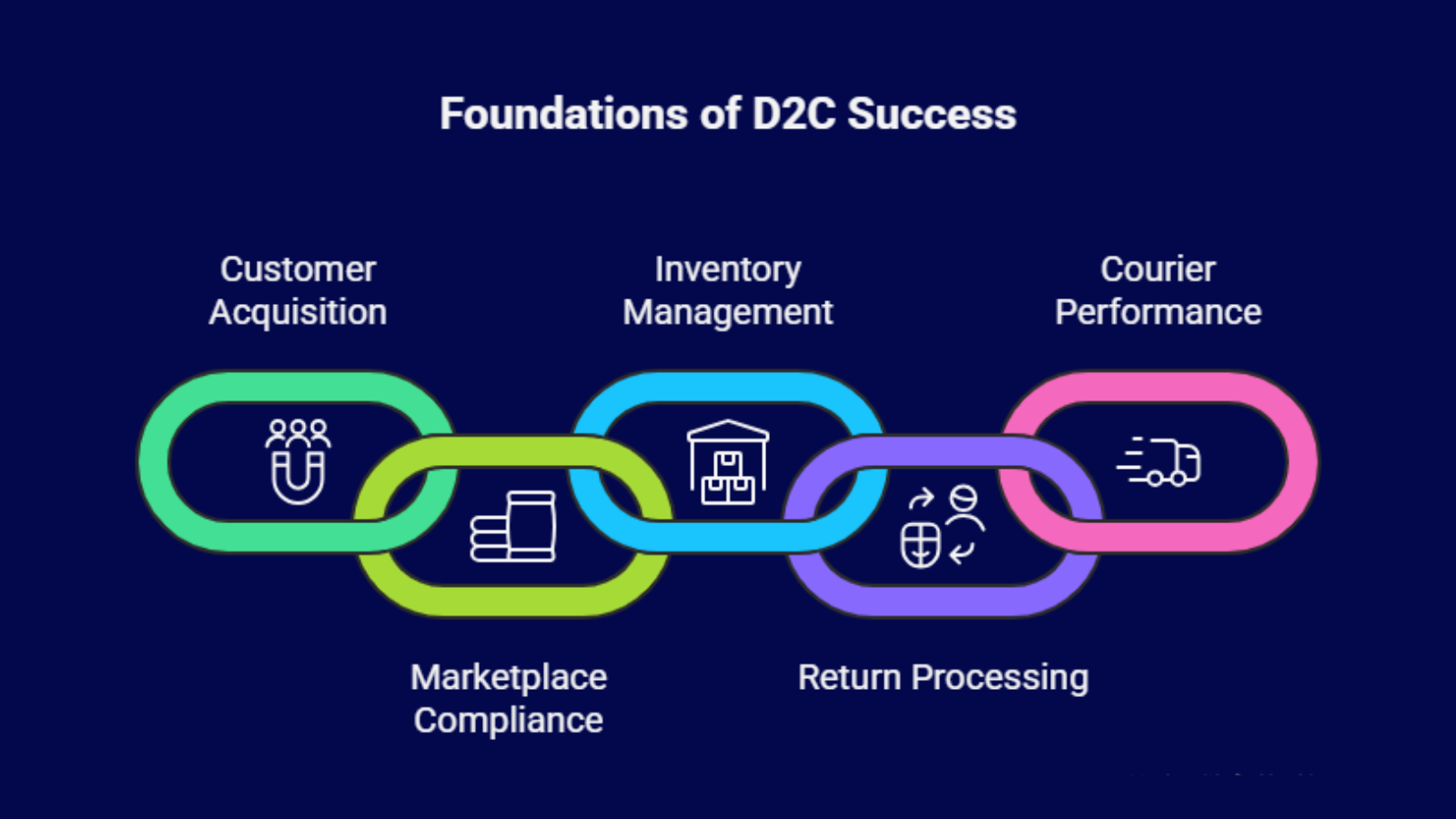 Most D2C founder challenges at the 5 to 50 crore stage are operational. Founders focus on growth, brand, and marketing. But once volumes scale, you need experienced Operations Managers who understand inventory turns, return rate control, courier performance, and marketplace compliance. A strong OM bridges daily execution with long-term systems. They translate the founder’s vision into repeatable processes.
This is where Base.com supports Indian D2C brands. Instead of fragmented tools and manual tracking, Base.com provides integrated operational visibility across inventory, orders, returns, and profitability. For founders facing D2C founder challenges, structured ops leadership D2C, combined with the right platform, brings clarity and control.
If growth feels chaotic, it is often not a marketing issue. It is an operations gap. Strengthening your operator side with experienced OMs and a system like Base.com can turn unpredictable scaling into sustainable, profitable growth.
Frequently Asked Questions
1. What are the biggest D2C founder challenges during scaling?
The biggest D2C founder challenges include weak unit economics, inventory mismanagement, high return rates, founder dependency, and lack of structured reporting. These issues grow as order volume increases and complexity rises.
2. Why is ops leadership D2C important after initial traction?
Ops leadership D2C ensures systems, forecasting, and cash management are in place. Without it, brands scale inefficiencies, leading to stockouts, delayed shipments, and falling margins.
3. When should a D2C brand hire operations leadership?
Brands should consider ops leadership D2C once monthly orders cross operational comfort or when revenue grows 3x year on year. Early investment prevents future chaos.
4. Can founders manage operations themselves?
In early stages, yes. But as complexity grows, the D2C founder challenges increase. Dedicated ops leadership D2C allows founders to focus on vision while systems handle execution.
5. How do you reduce founder vs operator conflict?
Clear role definitions, shared KPIs, and regular performance reviews help. Aligning revenue goals with operational capacity reduces friction and minimizes D2C founder challenges.