
Most Indian D2C brands eventually reach a stage where scaling purely through paid acquisition becomes harder. CAC rises year over year, competition intensifies, and incremental ROAS starts softening. Growth does not stop, but it becomes more expensive and more dependent on platform dynamics.
However, marketplaces are not a margin rescue lever. When D2C ROAS is within market benchmarks, D2C typically delivers stronger contribution margins. Marketplace commissions, platform fees, and pricing pressure often make them structurally lower margin.
Brands usually consider marketplaces for a different reason. They offer broader visibility, built-in high intent traffic, and access to customers beyond existing D2C strongholds.
At that point, marketplaces become a strategic distribution expansion decision focused on reach and diversification, not a reaction to falling margins.
Not because founders suddenly love marketplaces, but because they are looking for stability. Indian buyers already trust platforms like Amazon and Flipkart. They feel safer trying a new brand there. That shift in customer behaviour is what pushes many brands to rethink their growth path.
On most Indian marketplaces, total cost structure looks like this:
• Commission: 15-25%
• Shipping + handling: 8-12%
• Returns + RTO impact: 5-10%
If your gross margin is below 45%, your contribution margin will compress fast.
Before taking this step, Indian sellers need to understand where they are in their journey, what problems marketplaces can actually solve, and how a clear D2C marketplace strategy can support long-term growth without damaging the brand they worked hard to build.
Why Marketplaces Are Still Powerful for Indian D2C Brands
 Before discussing timing, it is important to understand why marketplaces continue to play a major role in India’s D2C ecosystem. Despite the growth of brand-owned websites, marketplaces remain one of the fastest ways to access demand at scale.
Marketplaces already have what most D2C brands struggle to build in their early and mid stages: traffic, trust, and operational reach. Platforms like Amazon, Flipkart, Myntra, Meesho and Nykaa attract millions of ready-to-buy users every day. These customers are not browsing casually. They are actively searching with the intent to purchase.
For Indian sellers, the D2C vs marketplace debate usually starts because marketplaces reduce friction. They remove many barriers that slow down early and mid-stage growth, especially in a country where trust, payments, and logistics still influence buying decisions heavily.
Key Advantages Marketplaces Offer
Marketplaces work because they simplify access to demand while handling several operational challenges in the background.
- Built-in demand with high buying intent, reducing the need for heavy awareness spends
- Faster access to Tier 2 and Tier 3 cities, where brand websites struggle with trust and reach
- Established payment, logistics, and returns infrastructure that would take years to build independently
- Higher trust for first-time buyers who are hesitant to transact on unknown brand websites
This does not mean marketplaces are always the right move from day one. Their strength lies in timing and execution, not blind expansion.
When Entering a Marketplace Makes Sense for D2C Brands
 Marketplaces amplify what already works. They rarely fix a broken core. Entering too early or too late can damage margins and momentum. The decision needs to be deliberate.
1. When Your Website Sales Have Stabilized
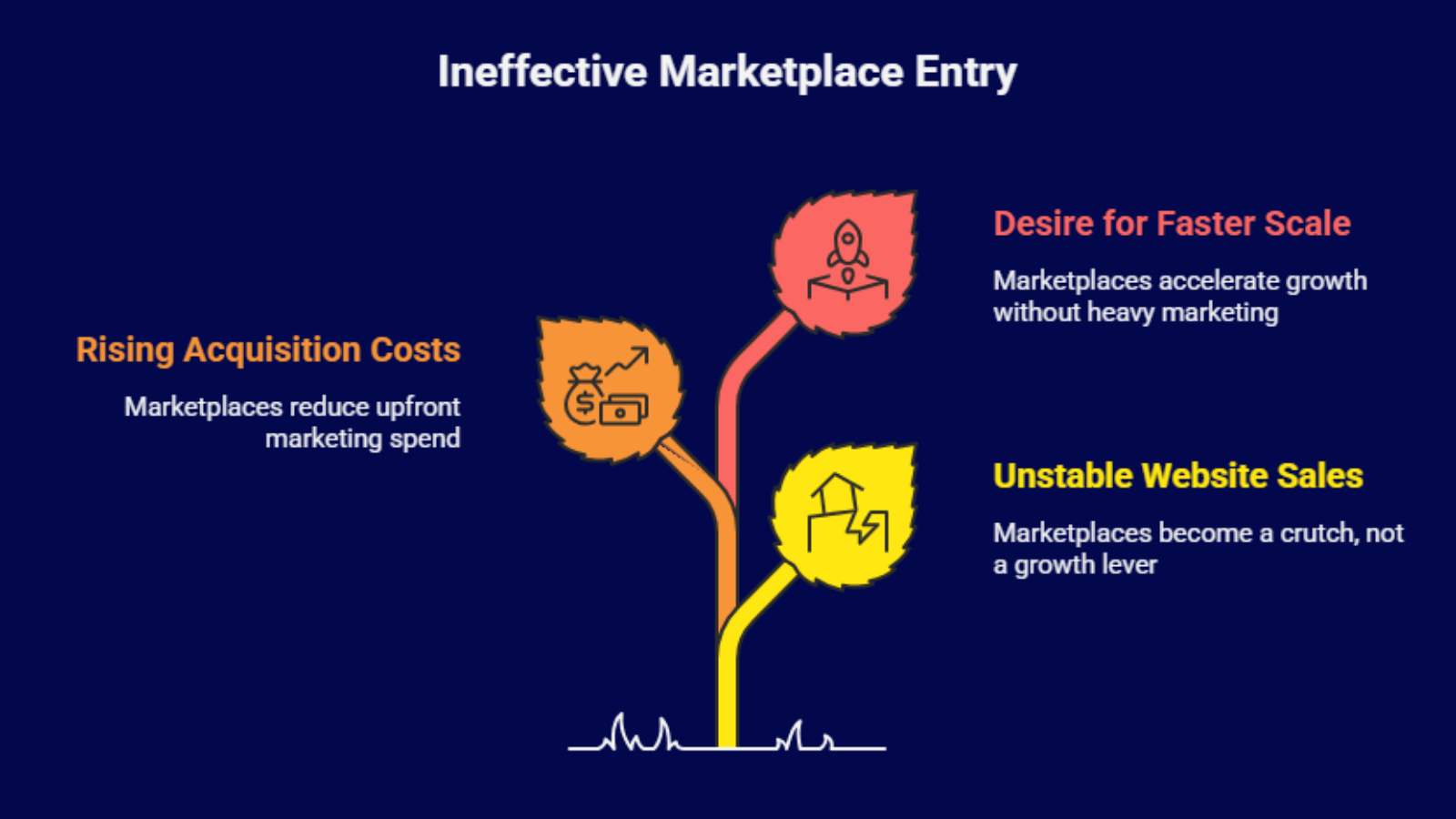
A common mistake is entering marketplaces before your own website has found its footing. When this happens, brands use marketplaces as a crutch instead of a growth lever.
You should consider marketplaces only after:
- Website conversion rate is consistently above 1.8–2.2%
- Repeat purchase rate exceeds 25%
- Contribution margin (post logistics and ads) is at least 20%
- Inventory turns are 4x+ annually
This ensures your D2C marketplace strategy decision is based on scaling a proven product, not chasing volume out of desperation.
Clear signs that you are ready include:
- Stable conversion rates on your website
- Repeat customers returning without heavy discounts
- Clear understanding of your best-selling SKUs and variants
At this stage, marketplaces help you multiply what already works.
2. When Customer Acquisition Costs Start Rising
Paid marketing is often the first growth engine for D2C brands. Over time, it becomes expensive. CPMs rise, creatives fatigue, and ROAS drops.
If you notice that:
- Facebook and Google ads are getting more expensive every quarter
- Growth depends heavily on paid traffic
- Marginal returns on ad spend are declining
Marketplaces can help rebalance your acquisition mix.
In the D2C vs marketplace equation, marketplaces reduce upfront marketing spend because discovery is built into the platform. Customers search, compare, and buy without the brand paying for every click. This makes marketplaces particularly useful when CAC starts hurting contribution margins.
3. When You Want Faster Scale Without Heavy Marketing Spend
Scaling your own website is slow and expensive. It requires content, influencer activity, paid ads, and time to build trust.
Marketplaces accelerate this process because:
- Customers are already searching for products
- Reviews and ratings improve organic visibility
- Sales velocity improves ranking within categories
For example, a personal care brand selling through its website may take months to build trust in Tier 2 cities. On a marketplace, the same brand can start seeing orders within weeks because customers trust the platform more than the brand.
This is where a smart D2C marketplace strategy helps brands grow volume without burning cash on awareness alone.
When You Should Avoid or Delay Marketplaces
Marketplaces are powerful, but they are not always the right move. Entering without preparation can damage margins and brand positioning.
1. When Your Margins Are Too Thin
Marketplaces come with layered costs. These include commissions, shipping fees, storage charges, and return handling costs.
If gross margin is below 45%, marketplace commissions (20%), logistics (10%), and return losses (8–12%) will likely push CM2 into single digits or negative territory. Many brands discover this only after scaling volume and seeing cash drain faster than revenue grows.
This is a critical D2C vs marketplace checkpoint. Marketplaces reward efficiency. Weak unit economics get exposed quickly.
2. When Brand Experience Is Your Core Differentiator
If 60%+ of your website revenue comes from bundles, upsells, or cross-sell flows, marketplaces will dilute that value because you lose funnel control and customers as a majority of the sales is due to storytelling.
Marketplaces limit:
- Custom branding and packaging experiences
- Upsell and cross-sell journeys
- Access to direct customer data and behavior
If your brand relies heavily on experience, education, or community, it is often better to delay marketplaces until awareness is strong. Once customers know and trust the brand, marketplaces can be used as an additional channel rather than the primary one.
The Right Way to Think About Marketplaces
 Marketplaces are not a replacement for your D2C website. They are a distribution layer. When used correctly, they complement owned channels rather than compete with them.
The best-performing Indian D2C brands treat marketplaces as a scaling tool, not a foundation. They enter at the right time, with the right SKUs, clear margin targets, and strong operational discipline.
When timing, economics, and execution align, marketplaces stop being a margin drain and start becoming a powerful growth lever.
D2C vs Marketplace: What Works Best at Each Growth Stage
Understanding D2C vs marketplace is easier when broken down by stage.
| Growth Stage | Best Channel Focus | Why This Works at This Stage |
|---|---|---|
| Early Stage | Own Website | At this stage, the priority is learning. Selling through your own website gives full control over pricing, customer data, and brand experience. Indian D2C brands can test messaging, understand customer behavior, refine product-market fit, and improve unit economics without marketplace commissions or strict policies. |
| Growth Stage | Website + Marketplace | Once demand is proven, marketplaces help accelerate scale. The website continues to build brand recall and repeat purchases, while marketplaces provide access to ready-to-buy traffic, Tier 2 and Tier 3 customers, and organic discovery. This mix reduces dependence on paid ads and diversifies acquisition channels. |
| Expansion Stage | Multi-Marketplace | At this stage, the focus shifts to volume and reach. Being present across multiple marketplaces allows brands to maximize category visibility, improve sales velocity, and capture demand across platforms. Strong operations and margin control are essential here to manage commissions, returns, and logistics efficiently. |
A balanced D2C marketplace strategy evolves, not overnight.
How Marketplaces Fit Into a Smart D2C Growth Plan
Marketplaces work best when they are used as an extension of your D2C growth plan, not a substitute for it. A smart approach is to use marketplaces for reach and your own website for retention.
Marketplaces help brands access new customers who are already in buying mode, especially in Tier 2 and Tier 3 cities, where trust and logistics play a bigger role. They also perform well during festive and sale-led spikes, when demand is already high, and discovery happens faster.
At the same time, a brand’s own D2C channel should focus on what marketplaces cannot offer. Higher margins, direct ownership of customer data, and the ability to drive repeat purchases through personalized communication and loyalty.
When marketplaces bring in volume, and the D2C channel builds long-term value, this blended D2C marketplace strategy creates stability, reduces dependence on paid ads, and supports sustainable growth over time.
Key Metrics to Track Before Entering Marketplaces
Before listing a single product on a marketplace, D2C brands need clarity on their numbers. Marketplaces magnify both strengths and weaknesses. If the fundamentals are weak, scale only makes losses visible faster. This is why many marketplace expansions fail, not because the platform does not work, but because the brand was not ready.
| Metric | Formula | Why It Matters on Marketplaces |
|---|---|---|
| Contribution Margin (Post Fees) | Revenue per Order − COGS − Marketplace Commission − Shipping − Returns − Payment Fees | Shows whether each order is actually profitable after all marketplace costs |
| Average Order Value (AOV) | Total Revenue ÷ Total Orders | Higher AOV helps absorb logistics and commission costs more efficiently |
| Return Rate | Returned Orders ÷ Total Orders | High return rates increase reverse logistics costs and block working capital |
| Inventory Turnover | Cost of Goods Sold ÷ Average Inventory | Indicates how quickly stock moves and how well supply matches demand |
When these numbers are visible and healthy, marketplaces become a powerful growth lever. When they are ignored, scale only amplifies problems.
Common Mistakes D2C Brands Make on Marketplaces
 Many D2C brands enter marketplaces without a clear plan. The excitement of instant traffic often leads to rushed decisions that hurt margins and brand positioning later.
One of the biggest mistakes is listing the entire catalogue instead of starting with the top-performing SKUs. Marketplaces work best when brands focus on products with strong demand, good reviews, and predictable supply. Another common error is blindly matching website discounts. Marketplaces already have price-sensitive audiences, and excessive discounting trains customers to wait for deals rather than value the product.
Ignoring reviews and ratings is another costly oversight. On marketplaces, reviews are not just feedback; they directly influence ranking and conversion. Brands that do not actively manage customer feedback lose visibility quickly. Poor inventory planning also causes damage.
Stockouts kill momentum, while excess inventory leads to penalties and forced discounts. A thoughtful D2C marketplace strategy approach prevents these problems by prioritizing discipline over speed.
How Marketplaces Strengthen Your D2C Brand and How to Choose the Right One
When used correctly, marketplaces do far more than generate incremental sales. They strengthen the overall D2C engine in ways that are easy to miss if you only look at short-term revenue.
One of the biggest benefits is pricing validation. Marketplace demand quickly shows whether customers accept your price point without a heavy marketing push. If a product sells consistently without aggressive discounts, it signals a strong value perception that can later be leveraged on your own website.
Another major advantage comes from reviews and ratings. On marketplaces, reviews act as instant trust builders. Products with strong ratings convert better not just on the platform, but also when customers encounter the brand elsewhere.
Many first-time buyers discover a brand on a marketplace, read reviews, and later search for the brand directly. This improves website conversion rates and reduces CAC over time.
A critical trade-off with marketplaces is the lack of customer data ownership. Brands typically do not get full access to customer details, which limits remarketing, lifecycle marketing, and LTV expansion. Unlike d2c, where CAC improves over time through retention and repeat purchases, marketplace CAC does not compound in the same way.
However, marketplaces bring large volumes of high intent buyers who are ready to transact, something early and growth-stage d2c websites often struggle to generate consistently on their own.
Credibility signals such as bestseller tags, high review counts, and strong seller ratings also act as social proof, making the brand look established and reliable. This indirect impact is often overlooked in D2C marketplace strategy planning, even though it plays a significant role in long-term growth.
Choosing the right marketplace is equally important. Not every platform suits every brand, and success depends on alignment rather than scale alone.
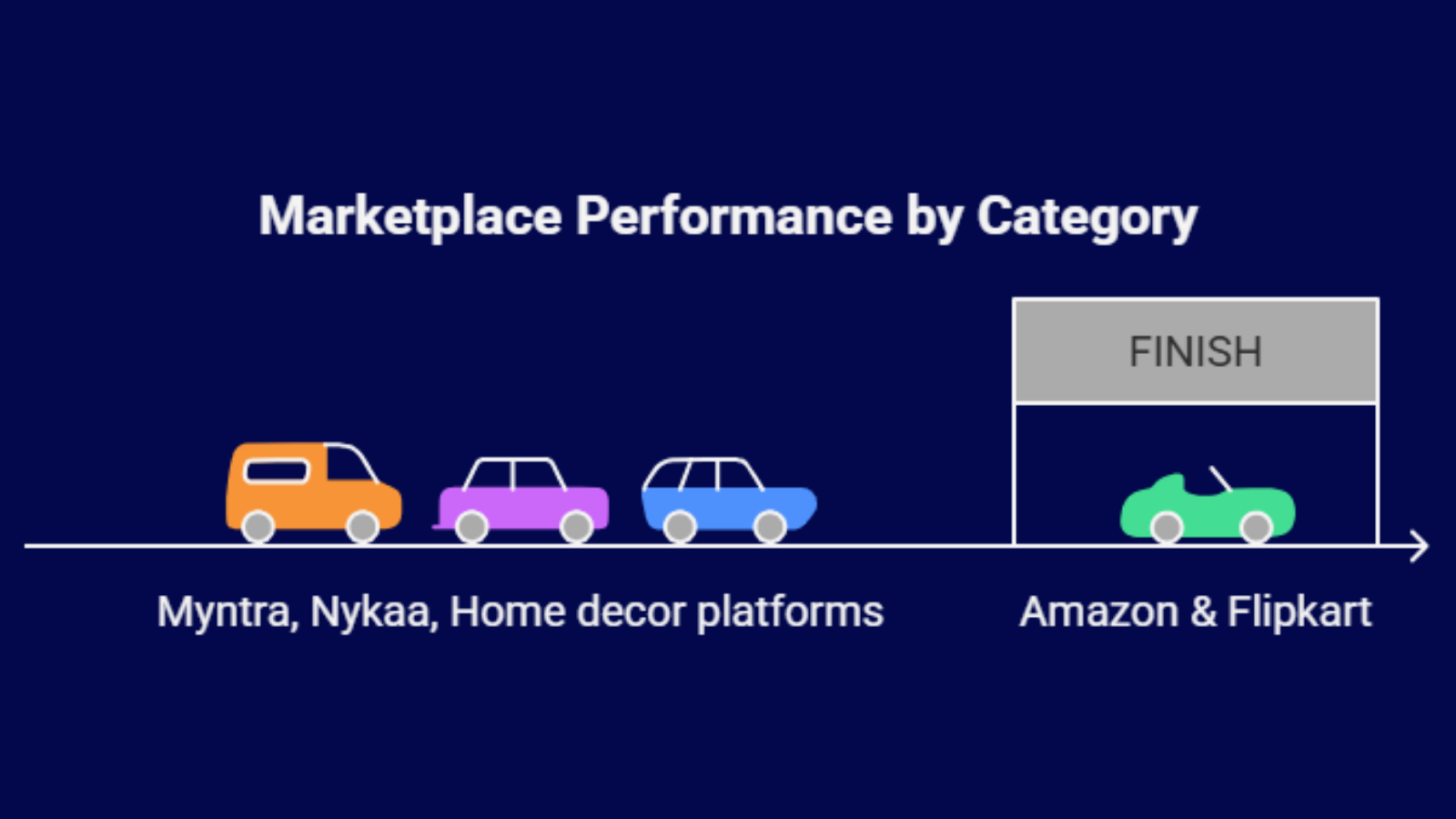 For fashion and lifestyle brands, Myntra works best because customers browse with discovery in mind. Visual presentation, trends, and reviews strongly influence buying decisions. This makes Myntra ideal for apparel, footwear, and accessories, where styling and inspiration matter as much as price.
For beauty, personal care, and wellness brands, Nykaa is usually the strongest fit. Customers come to Nykaa to explore, compare ingredients, read reviews, and discover new brands. This environment supports premium pricing, education-led selling, and repeat purchases, which are critical for beauty categories.
For mass-consumption, home, electronics, and utility products, Amazon and Flipkart perform best. Buyers on these platforms typically have high purchase intent and prioritize availability, delivery speed, and competitive pricing. These marketplaces are well-suited for products with broader appeal and repeat demand.
For home decor, furniture, and lifestyle products, platforms that support detailed listings and customer reviews tend to work better because buyers spend more time evaluating options. Marketplaces with strong logistics and damage-handling capabilities are especially important here due to higher product value and size.
Across all categories, the rule remains the same. The best marketplace is the one where your target customer already shops, trusts the platform, and feels comfortable buying similar products.
Choosing the right platform strengthens your D2C marketplace strategy outcomes by aligning category behavior, customer expectations, and operational realities instead of forcing scale in the wrong place.
Operational Readiness Is What Makes or Breaks Marketplace Success
 Marketplaces are powerful, but they are unforgiving when operations are weak. Unlike your own website, marketplaces penalize delays and mistakes immediately through lower rankings, poor ratings, and reduced visibility. This is why operational readiness is the real deciding factor in whether a marketplace channel scales or stalls.
To succeed, your brand needs strong inventory forecasting to avoid stockouts and overstocking, fast dispatch timelines to meet platform SLAs, and reliable return handling systems to protect margins and customer trust.
Brands that fail on these basics damage their ratings quickly, and recovery becomes difficult. This is often the breaking point in D2C marketplace execution.
Managing one marketplace is manageable. Managing multiple platforms manually is not. This is where Base.com helps. Base syncs inventory across channels, manages orders and returns, tracks performance in one dashboard, and enables scale without operational chaos.
Marketplaces are neither good nor bad. Timing is the strategy. Enter when your product is validated, margins can absorb fees, and operations are ready. Avoid them when you are still experimenting, brand control is critical, or margins are fragile.
FAQs
1. Is it better to sell on a marketplace or through a D2C website?
Both serve different purposes. A D2C website helps build brand, margins, and customer relationships, while marketplaces help with reach and discovery. The best results come from using both with a clear D2C marketplace strategy balance.
2. When is the right time for a D2C brand to enter marketplaces?
The right time is after product-market fit is proven and website sales are stable. Entering too early without margin clarity or operational readiness often leads to losses and poor ratings.
3. Are marketplaces profitable for D2C brands in India?
Yes, but only when unit economics are strong. Brands with healthy contribution margins, controlled returns, and efficient logistics can make marketplaces profitable. Weak fundamentals make scaling painful.
4. How do marketplaces affect customer acquisition cost for D2C brands?
Marketplaces reduce upfront acquisition costs because discovery is built into the platform. However, brands still pay through commissions and fees, which must be planned into overall CAC and margins.
5. Can D2C brands grow without marketplaces in India?
Yes, but growth is usually slower and more expensive. Marketplaces accelerate reach, especially in Tier 2 and Tier 3 cities. A smart D2C marketplace strategy uses marketplaces to complement, not replace, D2C growth.