

Send your first consignment to marketplace fulfilment centres 25 to 30 days before an Indian sale opens, and stage a second tranche 10 to 14 days out once the first is confirmed checked in. Sending everything at once is the most common and most expensive timing error.
Both early and late carry real costs. The job is finding the corridor between them.
When to Send Inventory Before an Ecommerce Sale
Most sellers treat this as a one-sided risk. Send early, be safe. That has not been true for several years, and in 2026 it is less true than ever.
Marketplace Pulse analysts, quoted in trade coverage of Amazon’s 2026 storage fee overhaul, describe what they call the corridor problem: too much inventory triggers storage and aged-inventory fees, while too little triggers the low-inventory fee. They assess that the corridor was already tight in 2025 and in the second half of 2026 is roughly half as wide.
The mechanics behind that, on the US marketplace, are instructive even though the rate card differs by country:
- The aged-inventory surcharge trigger tightened from 271 days to roughly 180 days, meaning stock ages into penalty territory about three months sooner than it used to.
- Peak-season storage rates run materially higher than off-peak. On the US marketplace, the published H2 2026 schedule moves standard storage from $0.87 per cubic foot in January-September to $2.40 per cubic foot in October-December.
- A storage utilisation surcharge applies when stock levels are too high relative to sell-through, triggering at roughly 22 or more weeks of supply. A brand-new shipment can trigger it on arrival if you have overstocked.
- A low-inventory-level fee applies when days of supply fall below roughly 28.
The strategic point survives the caveat. Deciding when to send inventory before an ecommerce sale is no longer about safety margin alone. It is an optimisation between two penalties, and the peak-season storage premium falls precisely on the months Indian sellers are tempted to ship early into.
The Five Clocks That Decide When to Send Inventory Before an Ecommerce Sale
Work backwards from the sale, not forwards from today. Five separate clocks feed the answer, and when to send inventory before an ecommerce sale is simply their sum plus a margin.
| Clock | Typical Indian range | Variance risk |
| Supplier lead time | 7-45 days by category | High during festive season |
| Inbound transit to FC | 2-7 days by lane | Moderate |
| Appointment availability | 3-14 days wait during festive | Highest |
| Fulfilment centre check-in | 2-10 days during peak | Highest |
| Storage cost clock | Starts at check-in | Predictable, cumulative |
Ranges are operating heuristics compiled for this guide, not published benchmarks. Measure your own from the last two cycles.
The two clocks marked highest variance are the ones that decide the answer. Supplier lead time and transit are reasonably predictable. Appointment availability and check-in time are not, because they depend on how congested the network is, which depends on what every other seller is doing in the same week.
- Appointment Availability Is Rationed, Not Scheduled
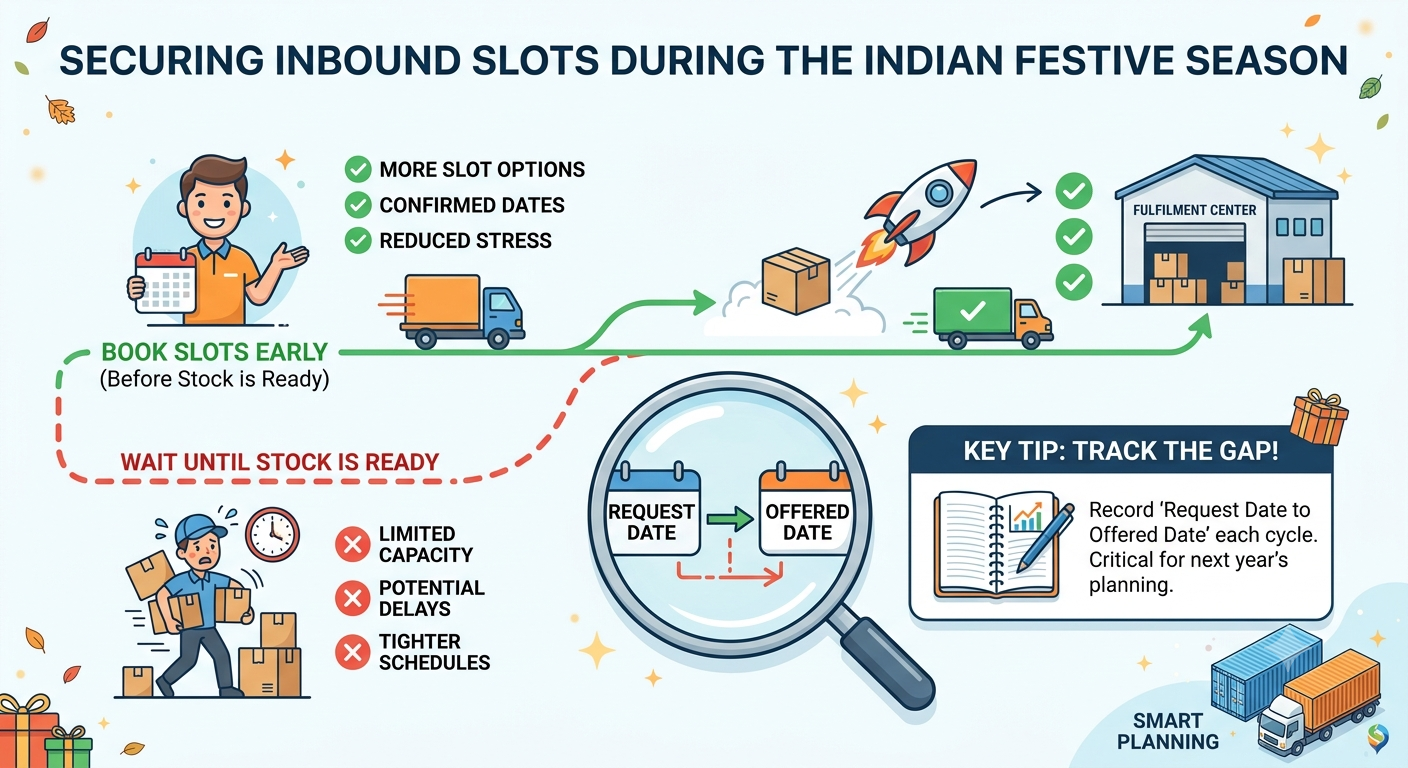
Fulfilment centre inbound slots during the Indian festive season behave like courier pickup capacity: they are allocated to sellers who booked early, not distributed on demand.
A slot requested at T-20 may return a date at T-8, which quietly converts a comfortable plan into a tight one. Book the appointment before the stock is ready rather than after, and treat the confirmed slot date as the fixed point the rest of the schedule works around.
Record the gap between request date and offered date every cycle. That single number is the most useful input you will carry into next year’s calculation, and almost no seller tracks it.
- Check-In Is the Clock Sellers Consistently Underestimate
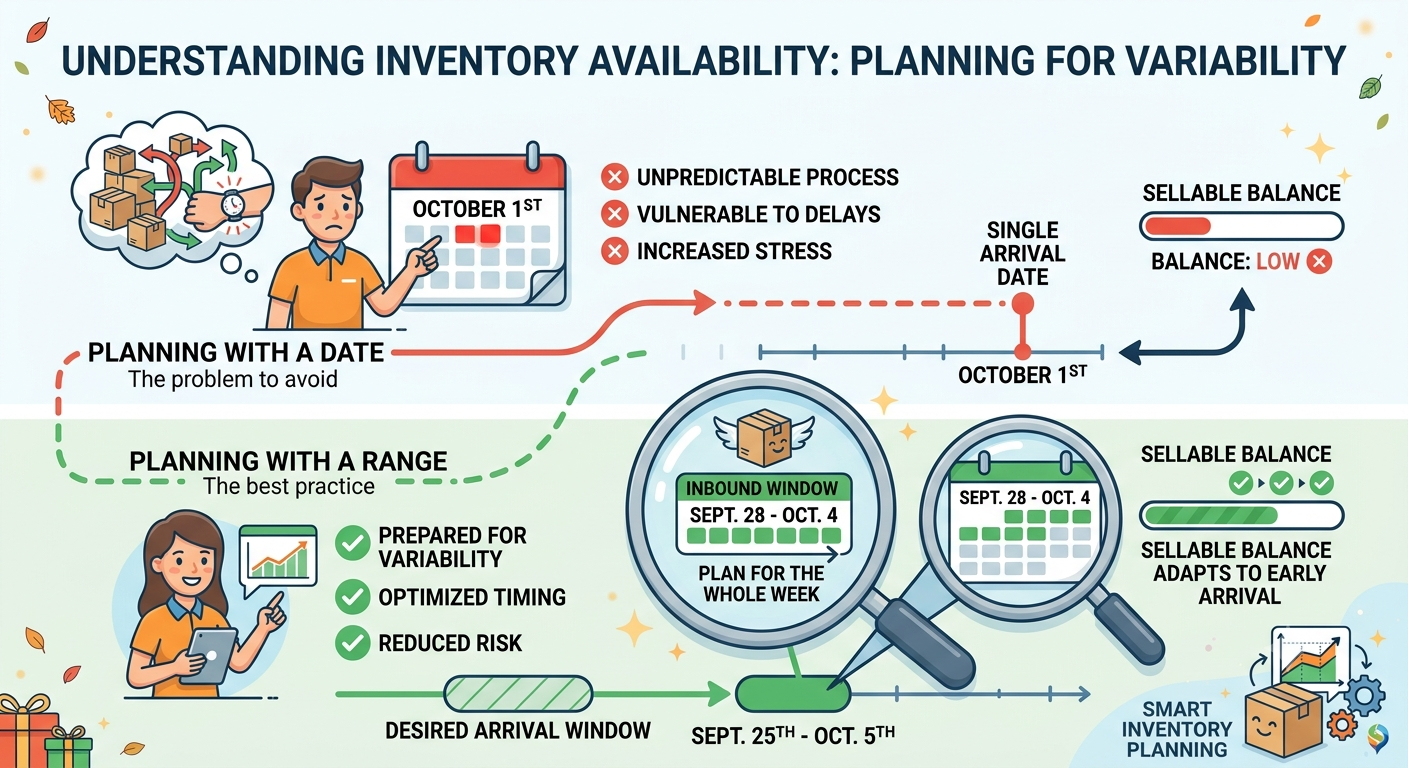
A consignment that arrives at the fulfilment centre on schedule is not available to sell. It becomes available when it is checked in and reflected in your sellable balance.
During Indian festive inbound, fulfilment centres run at capacity. A check-in that takes two days in June can take a week in late September.
This is why the honest answer to when to send inventory before an ecommerce sale is expressed as a range rather than a date. You are planning for a variable you do not control.
- The Storage Clock Starts at Check-In, Not at Sale Open
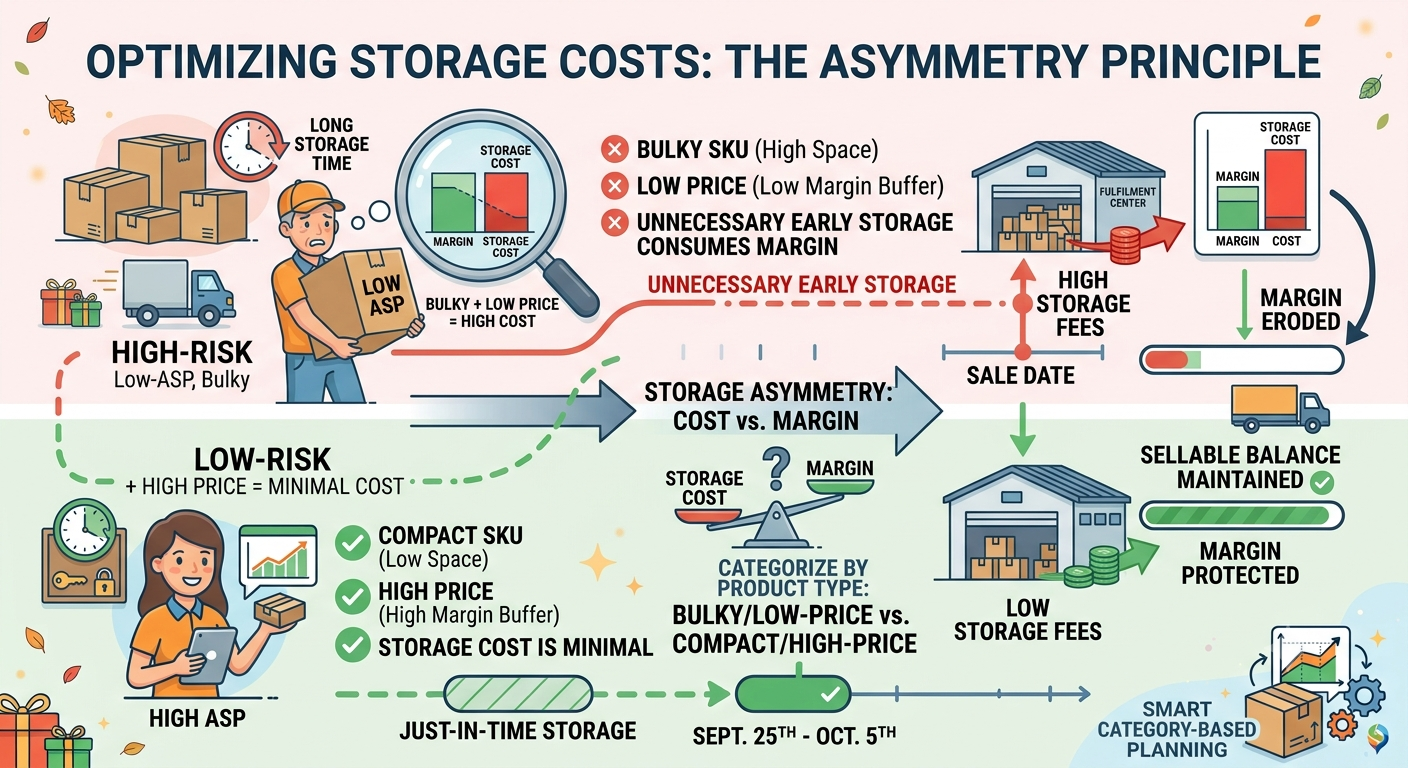
Every extra week your stock sits in a fulfilment centre before the sale is a week of storage cost on units generating no revenue, at the season’s highest rates.
For a low-ASP, bulky SKU, three weeks of unnecessary early storage can consume a meaningful share of the unit margin. For a high-ASP compact SKU, it is close to irrelevant.
That asymmetry is why the send date should differ by category, which the next section covers in detail.
The Backward Calculation That Answers When to Send Inventory Before an Ecommerce Sale
Target send date = Sale open date − (check-in time + appointment wait + transit + safety margin)
Worked example for an Indian seller shipping to a marketplace fulfilment centre:
- Sale opens: 22 September
- Check-in during festive peak: 7 days
- Appointment wait: 7 days
- Transit: 3 days
- Safety margin: 8 days
- Total: 25 days → dispatch by 28 August
Then apply the staging rule. Send roughly 60-70% of the committed volume in that first consignment, confirm check-in, and send the balance 10-14 days out.
Staging costs a little more in freight. It buys you a confirmation checkpoint, which is worth considerably more than the freight difference, and it converts when to send inventory before an ecommerce sale from one irreversible decision into two smaller reversible ones.
When to Send Inventory Before an Ecommerce Sale by Category
Category changes the answer more than scale does. Three variables move together: supplier lead time, storage cost sensitivity, and how badly the product degrades or dates while it waits.
Return rate matters here too. NRF benchmark data puts the overall ecommerce return rate at roughly 19-20%, with apparel at 20-40%, footwear 17-30%, electronics 8-15%, and beauty 4-12%. India-specific reporting puts the national average nearer 15-20%, with fashion at 25-30% and electronics at 5-8%. Verify both sets against your own data before adopting them.
1. Fashion and Apparel: Send Early, Because Size Curves Cannot Be Corrected Late

- Send window: 30-35 days before the sale opens.
- Why earliest: Fashion carries the widest SKU fragmentation of any category. A size-curve gap discovered at T-10 cannot be filled, because your supplier is running festive volume for everyone.
- Storage sensitivity: Moderate. Apparel is compact relative to value, so early storage costs comparatively little.
- Staging: Send the full size curve in tranche one. Top up middle sizes only in tranche two, since M and L deplete fastest.
- Watch: Return rates of 25-30% mean a quarter of dispatched units come back. Plan returns processing capacity alongside inbound, or recoverable stock becomes a mid-sale stockout.
2. Beauty and Personal Care: Send Late, Because the Expiry Clock Is Running

- Send window: 18-22 days before sale open.
- Why later: Batch-dated stock loses saleable shelf life every day it sits. Marketplaces also enforce minimum remaining shelf life at inbound, and a consignment that arrives too close to its threshold can be rejected outright.
- Storage sensitivity: Low in cost terms, high in expiry terms.
- Staging: Send by batch, keeping newer batches for tranche two so the oldest stock sells first.
- Watch: Confirm the marketplace’s minimum remaining shelf-life requirement for your category before dispatch. This single check prevents the most avoidable inbound rejection in the category.
3. Consumer Electronics: Send Late, Because Price Erodes

- Send window: 18-25 days before sale open.
- Why later: Electronics depreciate in list price continuously, and high ASP means storage on unsold units is a high absolute cost. Returns are low, at around 5-8% domestically, so you need less buffer sitting in the network.
- Storage sensitivity: High in absolute rupees, because unit values are large.
- Staging: Weight tranche two more heavily than in other categories, at roughly 50/50, since replenishment velocity is usually good.
- Watch: Serial-number and warranty documentation requirements can slow check-in. Confirm labelling compliance before dispatch, not after rejection.
4. Home, Kitchen and Furniture: Send Earliest, Because Volume Is the Constraint

- Send window: 35-45 days before sale open.
- Why earliest: Large-format SKUs consume disproportionate cubic volume, which means fulfilment centres accept them more slowly, and appointment availability is tighter.
- Storage sensitivity: Highest of any category, because storage is priced on cubic footage and these SKUs are bulky relative to value.
- The tension: You must send earliest, and you pay the most to sit there. Resolve it by sending only your highest-confidence SKUs to platform fulfilment and self-shipping the rest.
- Watch: Plan inbound in cubic metres, not units. A unit-based plan will not physically fit the appointment slot booked.
5. FMCG, Food and Beverage: Send Latest, Because Shelf Life Dominates

- Send window: 12-18 days before sale open.
- Why latest: Short shelf life makes every early day expensive in write-off risk rather than in storage fees.
- Storage sensitivity: Low cost, high spoilage.
- Quick commerce changes the pattern entirely. Blinkit, Zepto and Instamart replenish dark stores in days. Hold stock centrally and push frequently rather than committing deep stock to individual nodes weeks ahead.
- Watch: Enforce FEFO, not FIFO. First-expiry-first-out is the only correct rotation for dated stock, and it must govern which batch goes in which tranche.
6. Health, Wellness and Supplements: Send Moderately Early, With Batch Discipline

- Send window: 20-25 days before sale open.
- Why moderate: Demand is more predictable than in discretionary categories, so forecast confidence supports earlier commitment, but batch and expiry exposure caps how early is sensible.
- Storage sensitivity: Moderate.
- Staging: Ring-fence subscription commitments before deciding tranche sizes. Subscription units are not promotional inventory.
- Watch: Regulatory exposure on expired dispatch is materially worse than the cost of a stockout. Batch traceability must survive the tranche split.
7. Jewellery, Watches and Accessories: Send Late, Because Capital Is Concentrated

- Send window: 15-20 days before sale open.
- Why later: Very high ASP means every day of early storage represents significant blocked capital. Obsolescence is low, so unsold stock genuinely carries forward, which reduces the penalty for under-sending.
- Storage sensitivity: Low in cubic terms, very high in capital terms.
- Staging: Skew heavily to tranche two. For this category, under-sending is usually the correct error.
- Watch: Security and insurance requirements can constrain which nodes accept the stock and how quickly.
8. Baby, Toys and Juvenile: Send Early, Because Gifting Demand Concentrates Late

- Send window: 28-35 days before sale open.
- Why early: Age-band and size fragmentation resembles fashion, and gifting demand concentrates hard in the final 72 hours before Diwali, when there is no time to correct a gap.
- Storage sensitivity: Moderate to high; toys are often bulky relative to value.
- Staging: Front-load the gifting SKUs, hold everyday SKUs for tranche two.
- Watch: Safety and compliance documentation must accompany the consignment. Returned units in this category need more rigorous inspection before restocking.
Category Timing Summary
| Category | Send window before sale | Tranche 1 / Tranche 2 | Dominant constraint |
| Home, kitchen, furniture | 35-45 days | 70/30 | Cubic volume, appointment slots |
| Fashion and apparel | 30-35 days | 70/30 | Size curve completeness |
| Baby, toys, juvenile | 28-35 days | 70/30 | Age-band fragmentation |
| Consumer electronics | 18-25 days | 50/50 | Price erosion, capital |
| Health and supplements | 20-25 days | 60/40 | Batch and expiry |
| Beauty and personal care | 18-22 days | 60/40 | Remaining shelf life |
| Jewellery and accessories | 15-20 days | 40/60 | Blocked capital |
| FMCG, food, beverage | 12-18 days | 50/50 | Spoilage |
All windows and tranche splits are operating heuristics constructed for this guide from category economics. They are starting points to calibrate against your own check-in times and sell-through, not published standards.
Destination Changes: When to Send Inventory Before an Ecommerce Sale Too
Category sets the range. Destination sets where inside the range you land.
| Destination | Send timing | Reasoning |
| Amazon FBA | Earliest of your options | Check-in variance is highest; storage clock starts on arrival |
| Flipkart Fulfilment | Similar to FBA | Same congestion dynamics during festive inbound |
| Seller Flex / Smart Fulfilment | Later | Stock sits at your node; no FC check-in queue |
| Own warehouse | Latest | Full control; no appointment, no external check-in |
| Quick commerce dark stores | Latest, replenished continuously | Days-level replenishment cycle |
The pattern is consistent: the less control you have over the receiving process, the earlier you must send, and the more you pay to have sent early.
This is a real argument for keeping a larger share of volume in your own warehouse and self-shipping, particularly for categories where storage costs bite hardest.
Why Staged Consignments Beat One Large Shipment
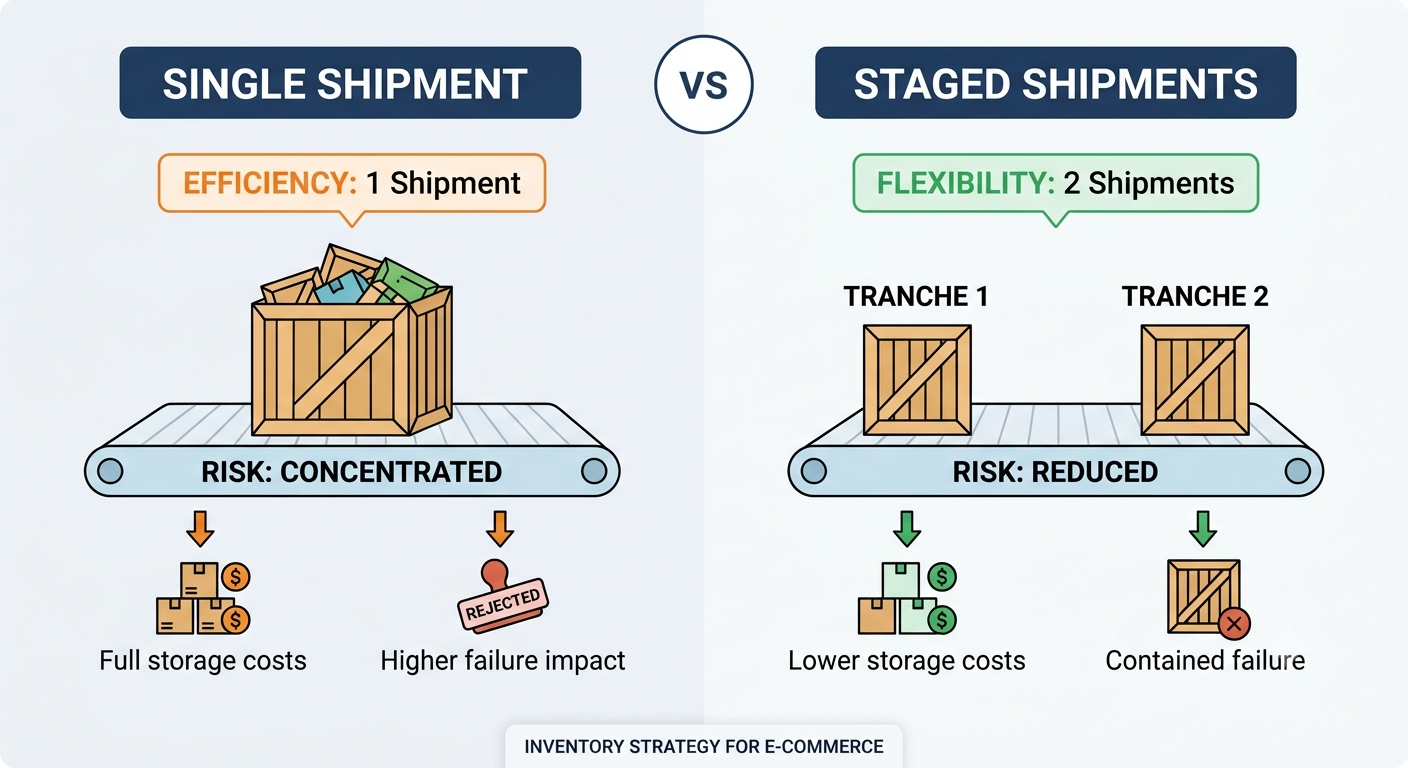
Once you have calculated when to send inventory before an ecommerce sale, the next decision is whether to send it all on that date.
Sending everything in one consignment feels efficient. It concentrates every risk into a single event.
What staging buys you:
- A confirmation checkpoint. If tranche one checks in cleanly, you know the lane, the labelling and the appointment process all work before committing the balance.
- A correction window. Early sell-through data from the pre-build period can adjust tranche two. One shipment gives you no chance to use that signal.
- Lower average storage exposure. Half your volume arriving two weeks later is two weeks of storage you do not pay on those units.
- Contained failure. A rejected or delayed consignment costs you part of your stock position rather than all of it.
What staging costs:
- Additional freight and handling on the second consignment.
- A second appointment slot, which must be booked at the same time as the first.
Book both appointments together at T-35. Assuming you can book the second one later, during festive congestion, is the mistake that makes staging fail.
Size the tranches by confidence rather than evenly. Tranche one should carry the volume you are certain will sell at any plausible demand level, which is usually your hero SKUs at their low-case forecast. Tranche two carries the volume that depends on the sale performing at or above plan.
That framing also tells you what to do if tranche one checks in late. The correct response is usually to reduce tranche two and self-ship the difference from your own warehouse, rather than pushing the same volume into a congested network with less time for it to clear.
What It Actually Costs to Get When to Send Inventory Before an Ecommerce Sale Wrong
| Error | Immediate cost | Downstream cost |
| Sent too early | Peak-season storage on idle units | Aged-inventory exposure; capital blocked at the worst point in the cash cycle |
| Sent too late | Missed appointment; stock not checked in for day one | Lost sale on highest-traffic days; ranking decay from the availability gap |
| Sent all at once | No confirmation checkpoint | A single rejection or delay compromises the entire position |
| Sent to the wrong node | Regional SLA breach | Higher RTO from slower delivery; stock stranded where demand is not |
Late is worse than early on the biggest revenue days, which is why the safety margin belongs in the calculation. But early is no longer free, which is why the margin should be measured rather than generous.
The practical resolution is asymmetric margin by SKU class. Give your hero SKUs a generous margin, because a stockout there costs the sale and the ranking. Give the long tail a tight one, because a late arrival on a C-class SKU costs very little and the storage saved across many SKUs is real money.
How Base.com Supports Inbound Timing Decisions
Base.com is an ecommerce operating system combining order management, product and inventory management, marketplace listing control, shipping and workflow automation in one platform. Its Product Manager module explicitly combines ERP, WMS and PIM functions, including inventory control, stock documents and deliveries.
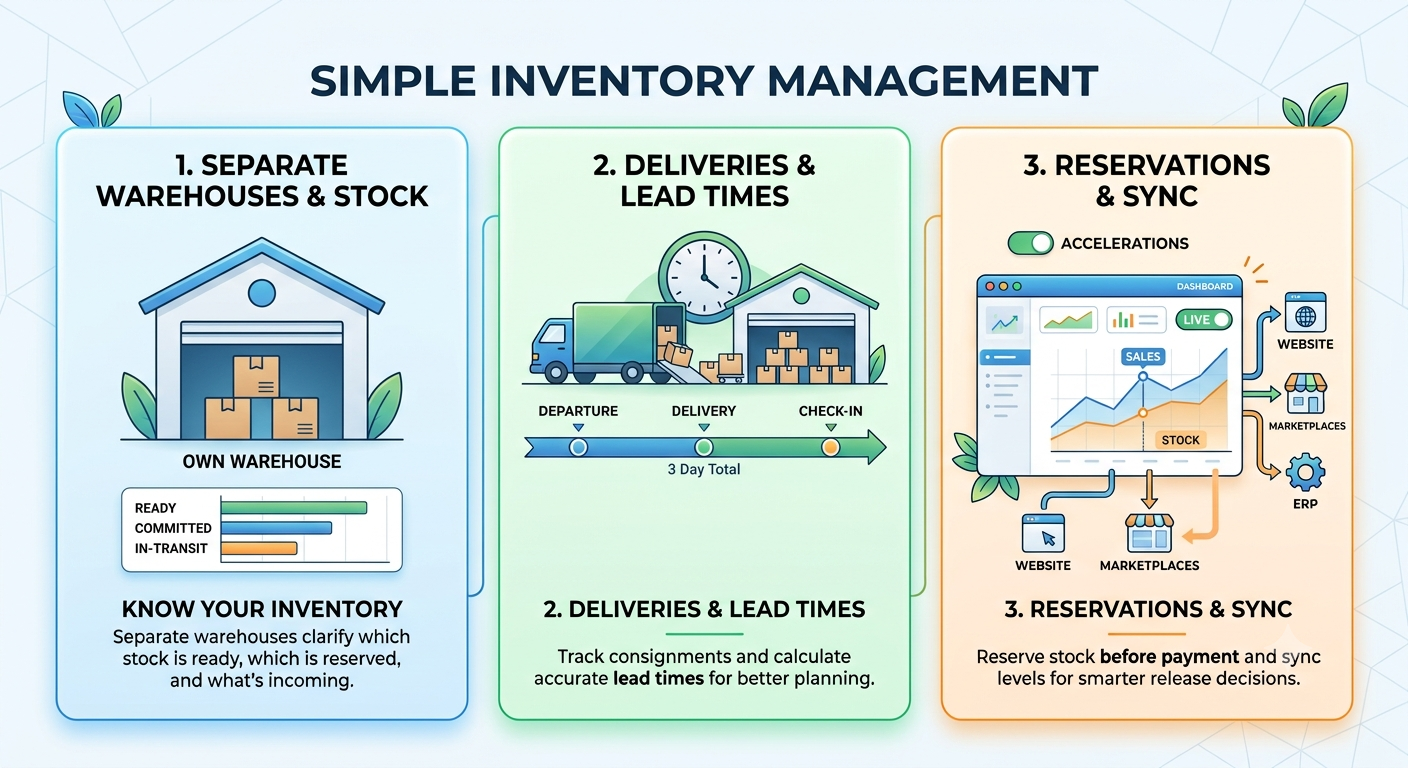
Three capabilities bear on when to send inventory before an ecommerce sale specifically.
- Separate warehouses with their own documents and deliveries. Base.com supports assigning one or more warehouses to an inventory, each with separate stock levels, documents, deliveries and stocktakings. That separation is what lets you see committed marketplace stock, in-transit stock and own-warehouse stock as distinct pools rather than one blurred total, which is the precondition for any staging decision.
- Deliveries and stock documents. Recording inbound consignments as deliveries against a specific warehouse gives you a system record of what was sent when, which is what turns “check-in felt slow last year” into a measured lead time you can plan against next cycle.
- Reservations and live synchronisation. Stock can be reserved before orders are paid, and synchronisation runs every eight hours, hourly, or live, with a dedicated Accelerations module for periods when higher sales are expected. Accurate available-to-promise is what tells you whether tranche two is needed early, on time, or at all.
The broader point is that timing decisions depend on measured lead times, and measured lead times depend on having recorded the last two cycles properly.
Deciding When to Send Inventory Before an Ecommerce Sale Is a Measurement Problem
There is no universal number of days, and any guide offering one is describing a category and a destination it has not named.
What exists is a calculation: check-in time plus appointment wait plus transit plus a margin sized to your own variance, adjusted by category economics and by how much control you have over the receiving process. Run it per destination, stage the consignments, and record what actually happened at each stage.
With Indian festive GMV projected to cross ₹1.15 lakh crore in a 30-35 day window and fulfilment networks congested across the entire market simultaneously, the sellers who time this well are the ones who measured last year. Base.com records deliveries and stock documents against separate warehouses, which is what converts a vague sense that check-in was slow into a lead time you can plan around.
Calculate backwards. Stage the consignments. Book both slots at once. Record every date.