

Your stock topology decides which sync tool fits you, not your revenue. The best inventory sync software for marketplace sellers in India varies completely depending on whether your inventory sits in one warehouse, several, a retail store, or somebody else’s fulfilment centre.
This guide groups the best inventory sync software for marketplace sellers in India by where your stock physically lives. Find your arrangement first, then read only that section.
Why does the physical arrangement of your stock decide which sync tool fits?
Syncing one warehouse to three marketplaces is arithmetic. Syncing four locations, a retail store and a 3PL, to the same three marketplaces is allocation, and those are different problems requiring different software.
Sellers who ignore this buy a tool built for someone else’s warehouse layout, which is why the best inventory sync software for marketplace sellers in India always starts with topology. It syncs correctly and still shows the wrong number, because it cannot model where the stock actually is.
India’s ecommerce market runs at roughly $226 billion, and marketplace sellers typically list the same units across three or more platforms simultaneously.
| Your stock arrangement | Core sync challenge |
| One warehouse, many marketplaces | Preventing double-sale of the same unit |
| Several warehouses or regional nodes | Deciding which location serves which order |
| Warehouse plus physical retail stores | Reconciling store sales against online stock |
| Stock held by a fulfilment provider | Trusting a third party’s count |
| Small catalogue, low volume | Keeping it simple without overspending |
What does a single oversell actually cost an Indian marketplace seller?
Sellers treat oversells as embarrassing rather than expensive, which is why the best inventory sync software for marketplace sellers in India often looks optional until you total the damage. The line items below show why the arithmetic argues for fixing sync properly.
| Cost of one oversell | What it covers |
| Cancelled order | Revenue that never arrives |
| Account health damage | Amazon metrics and Flipkart ratings both degrade |
| Search visibility loss | Poor seller metrics reduce listing exposure |
| Customer acquisition wasted | Marketing spend that produced nothing |
| Support time | An agent apologising for a system failure |
The visibility damage outlasts the cancelled order by weeks. Marketplace algorithms reduce exposure for sellers with poor fulfilment metrics, so one oversell suppresses listings that were converting perfectly well.
That delayed cost is why sellers consistently underestimate the problem. The cancellation is visible and small, while the visibility loss is invisible and large.
Which tools sync a single warehouse across multiple Indian marketplaces reliably?
Group one covers the most common arrangement: a single facility feeding Amazon, Flipkart, Myntra, and a website. Most of the best inventory sync software for marketplace sellers in India targets exactly this setup. The job is preventing two platforms from selling the same unit.
1. Base.com

Base.com maintains one inventory pool and allocates against it as orders arrive, so no marketplace ever sees the quantity another channel has already committed. Because warehouse execution runs on the same platform, the count reflects what pickers actually removed rather than what the system assumed.
That link matters more than sync frequency. A fast sync of an inaccurate count simply spreads the error faster across every channel.
How it syncs: single stock pool with allocation at order capture and confirmation from warehouse scans.
Best for this stock setup: one or two warehouses feeding several marketplaces plus a direct website.
What breaks it: catalogue mapping errors, where the same product carries mismatched identifiers across channels.
2. Unicommerce

Unicommerce holds India’s most extensive marketplace connector library, built across years of Amazon, Flipkart, and Myntra behaviour. Connector maturity matters because sync failures usually originate in marketplace API quirks rather than in your logic.
Sellers listing across many platforms benefit most, since rare failure modes have already been encountered elsewhere.
How it syncs: central inventory with rule-based distribution across connected channels.
Best for this stock setup: high-volume sellers across many marketplaces with a dedicated operations team.
What breaks it: configuration drift, where rules set months ago no longer match current channel strategy.
3. EasyEcom
EasyEcom syncs inventory across marketplaces while reconciling settlements against the same order records. Sellers see both what sold and what actually got paid, on one set of numbers.
Its B2B handling means wholesale consignments draw from the same pool, which prevents the classic error of selling online stock already promised to a distributor.
How it syncs: central inventory shared across marketplace and B2B order flows.
Best for this stock setup: sellers mixing marketplace revenue with wholesale distribution.
What breaks it: unrecorded manual stock movements between B2B and online allocations.
Which tools sync stock across several warehouses or regional nodes?
Group two covers sellers holding inventory in more than one place, where the best inventory sync software for marketplace sellers in India must allocate as well as synchronise. Sync alone is insufficient here, because the system must also decide which location serves each order.
4. Increff
Increff tracks units individually rather than counting bins, which keeps multi-location inventory accurate as stock transfers between facilities. Fashion sellers gain the most, since size and colour variants create the largest opportunity for miscounting.
Accurate location-level data also makes allocation smarter, because the system knows precisely what sits where.
How it syncs: piece-level records aggregated into channel-facing availability.
Best for this stock setup: high-SKU sellers running multiple warehouses.
What breaks it: stock transfers recorded after the fact rather than scanned in motion.
5. Omniful

Omniful was built after quick commerce existed, so it handles the very different stock rhythms of Blinkit or Zepto alongside marketplace orders. Quick commerce reserves inventory differently from Amazon, and older systems struggle to model both.
Sellers splitting stock between dark stores and central warehouses need that dual handling.
How it syncs: multi-location inventory with channel-specific allocation rules.
Best for this stock setup: sellers combining marketplaces with quick commerce.
What breaks it: insufficient stock depth to support meaningful splits across locations.
6. WareIQ

WareIQ holds inventory across regional nodes and syncs aggregate availability to your channels. Sellers gain faster delivery while the provider handles location-level complexity.
Aggregate availability hides a risk. Stock showing as available nationally may sit in a node far from the customer who orders it.
How it syncs: provider-held inventory aggregated to channel-level availability.
Best for this stock setup: brands outsourcing fulfilment while competing on delivery speed.
What breaks it: regional imbalance, where one node stocks out while another holds surplus.
Which tools sync online marketplace stock with physical retail inventory?
Group three covers sellers with retail doors, the hardest case for any of the best inventory sync software for marketplace sellers in India can offer. Store stock changes without any system event, which makes this the hardest sync problem on the list.
7. Vinculum

Vinculum treats retail stores as fulfilment locations, so store inventory becomes available to marketplace orders. That expands sellable stock without buying more of it.
The same capability creates risk. Stock promised to a marketplace can sell over the counter minutes later, so store systems must report continuously.
How it syncs: unified inventory across stores, warehouses, and online channels.
Best for this stock setup: brands running twenty or more retail doors alongside marketplaces.
What breaks it: store point-of-sale systems reporting sales in batches rather than immediately.
8. Ginesys

Ginesys grew from retail ERP and point of sale, so store transactions update inventory natively rather than through an integration. Its ecommerce layer carries that position to marketplaces.
Retail chains gain an accurate single ledger. Online-only sellers gain very little.
How it syncs: retail ERP inventory extended to marketplace channels.
Best for this stock setup: established retail chains selling on Amazon and Flipkart.
What breaks it: stores operating on disconnected billing systems outside the main platform.
Which tool syncs stock held inside a third-party fulfilment centre?
Group four covers sellers whose inventory sits in somebody else’s building, where the best inventory sync software for marketplace sellers in India uses the provider. You depend on their count, so verification mechanics matter more than sync speed.
9. Eshopbox
Eshopbox operates fulfilment centres and syncs the inventory it holds directly to your marketplace listings. Provider-held stock removes your warehouse burden along with your direct visibility.
Reconciliation rights matter here more than features. Ask how discrepancies get identified and who absorbs the loss when counts diverge.
How it syncs: provider-controlled inventory published to connected sales channels.
Best for this stock setup: brands with no warehouse of their own.
What breaks it: unreconciled shrinkage, where the count drifts without either party noticing.
Which tool suits small Indian sellers running simple catalogues at low volume?
Group five covers sellers for whom the best inventory sync software for marketplace sellers in India would cost more than the problem it solves. Simplicity is a legitimate requirement, not a compromise.
10. Zoho Inventory

Zoho Inventory syncs stock across major channels and handles purchase orders, working cleanly for sellers already using Zoho Books. Setup takes hours, and cost stays low.
It manages inventory rather than orchestrating operations, so marketplace dispatch discipline sits outside its scope.
How it syncs: scheduled channel updates from a central stock record.
Best for this stock setup: low-volume sellers with shallow catalogues and one location.
What breaks it: volume growth, where scheduled updates lag behind real-time selling.
How do you know your marketplace stock sync is already failing
Sync problems announce themselves before customers notice. These five signals appear in your own data first, and each one costs money while it goes unaddressed.
- Your team checks shelves before confirming stock. When people verify physically, the system has already lost their trust.
- Buffer quantities keep increasing. Rising buffers mean somebody experienced an oversell and reacted rather than diagnosed.
- Cancellation rates differ sharply by channel. One marketplace cancelling more than others points to a specific connector problem.
- Stock counts differ between systems. Two tools showing different numbers for the same SKU is not a rounding issue.
- Reorders arrive for items you already hold. Unprocessed returns and stranded stock both distort purchasing decisions.
Review these monthly rather than reacting to complaints. Every one of them is visible in your data before a customer experiences the failure.
Why does buffer stock signal a sync problem rather than solve one
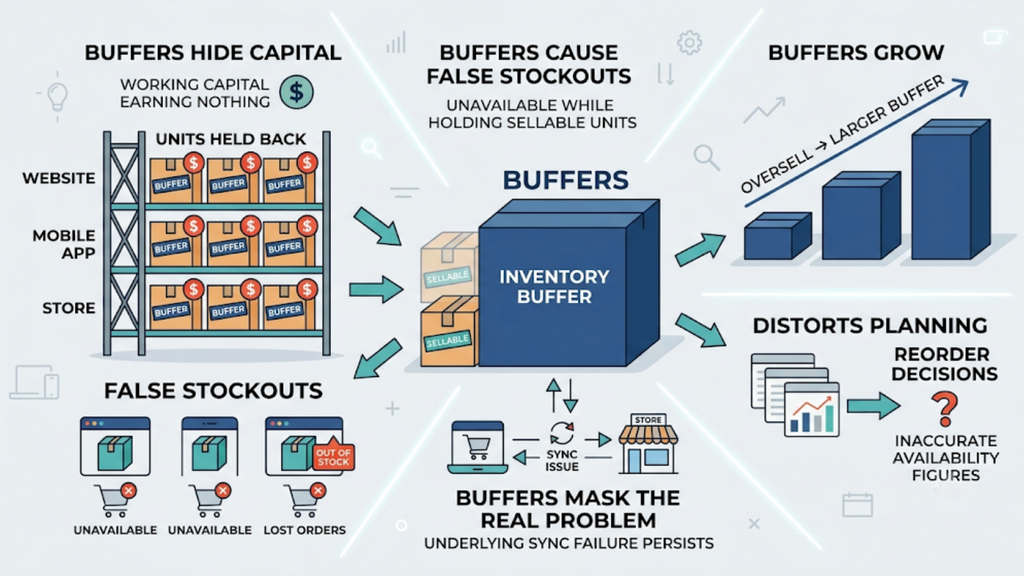
Most Indian sellers hold buffer quantities on each marketplace to avoid overselling, rather than fixing sync with the best inventory sync software for marketplace sellers in India. Buffers work, and they cost more than sellers calculate.
- Buffers hide capital. Units held back across three platforms represent working capital earning nothing.
- Buffers cause false stockouts. You show unavailable while holding sellable units, losing orders you could fulfil.
- Buffers grow over time. Every oversell prompts a larger buffer, and nobody reduces them afterwards.
- Buffers distort planning. Reorder decisions use availability figures that were never accurate.
- Buffers mask the real problem. They treat the symptom while the underlying sync failure persists.
Removing buffers safely is the clearest measurable return from proper sync software. Track buffer quantity before and after implementation.
What actually causes marketplace stock sync to break in practice
Sync rarely fails because the software stopped working, and the best inventory sync software for marketplace sellers in India cannot prevent all five causes below. These five causes account for most real-world failures Indian sellers encounter.
- Catalogue mapping errors. The same product carries different identifiers across channels, so updates reach the wrong listing.
- Unrecorded manual movements. Stock moved between locations or channels without a system entry corrupts every downstream count.
- Marketplace API changes. Platforms update their interfaces, and connectors fail quietly until somebody notices.
- Two systems claiming ownership. When an order platform and a warehouse tool both write stock counts, they will eventually disagree.
- Returns processed late. Unopened return parcels are real inventory the system cannot see.
Assign one person to review sync health weekly. Most of these failures announce themselves in the data days before a customer notices, and a fifteen-minute weekly check catches nearly all of them.
Watch connector status after every marketplace platform update. Those updates arrive without warning and break connectors quietly rather than visibly.
What should Indian sellers fix before they buy any sync software
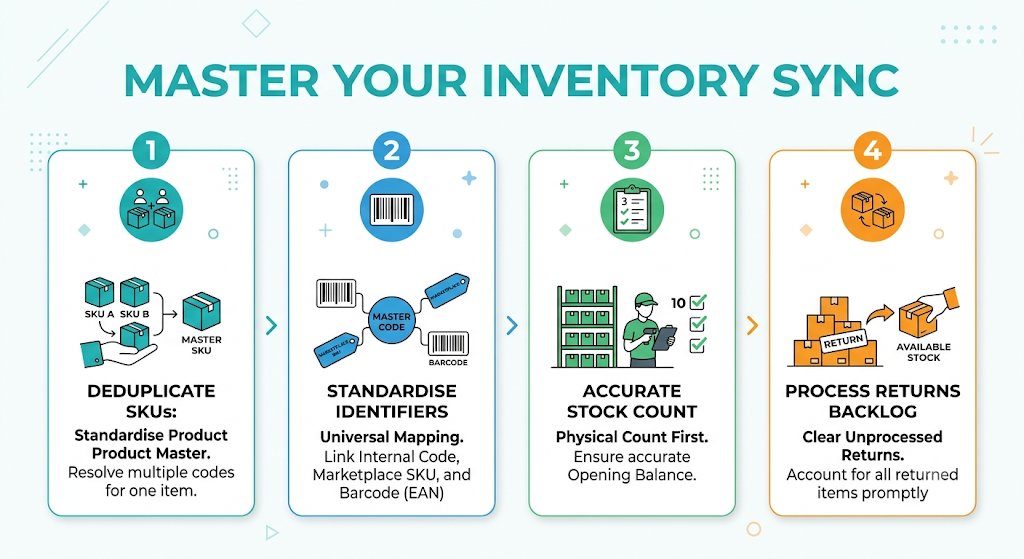
Software inherits whatever mess your data already contains. These four cleanup jobs decide whether your new tool works on day one or three months later.
- Deduplicate your SKU master. The same product listed twice under different codes guarantees mapping errors across every channel.
- Standardise identifiers across channels. Your internal code, marketplace SKU, and barcode should map cleanly, with one authoritative reference.
- Count your physical stock properly. Sync starts from an opening balance, and a wrong opening balance stays wrong until the next full count.
- Clear your returns backlog. Unprocessed returns are real units the system cannot see, so they corrupt the count from the first day.
Most implementation delays trace back to these four rather than to configuration. Doing them before you sign shortens go-live considerably.
How should Indian sellers choose from these inventory sync tools
Work through these five checks with each shortlisted option from the best inventory sync software for marketplace sellers in India. They test the things that actually break rather than the features vendors demonstrate.
- Confirm your stock topology is supported. Multi-location and store-level stock need explicit capability, not a workaround.
- Ask who owns the stock count. One system must be authoritative, and the vendor should say plainly which one that is.
- Test with your real catalogue. Run your actual SKU master including duplicates, since mapping errors cause most failures.
- Check connector maintenance. Ask whether the vendor maintains each marketplace connector directly or relies on a partner.
- Ask about sale-event behaviour. Request a reference customer who ran a festive spike and ask what their buffer looked like.
Final Thoughts
Base.com approaches sync as an allocation problem rather than a broadcasting problem. Rather than pushing a number outward to each channel, it holds one pool and commits units against orders as they arrive.
That distinction matters because broadcasting always lags. Any gap between a sale on one channel and the update reaching another is a window in which overselling happens.
Warehouse execution on the same platform closes the second gap, since scanned picks confirm what physically left the building. Sellers still choose their own storefront, couriers, and accounting tools, while Base.com holds the inventory truth those systems reference.