


How to manage inventory across warehouses efficiently comes down to four connected layers working together: one shared stock ledger, smart order-to-warehouse allocation, GST-compliant interstate transfer handling, and warehouse-level reconciliation. Miss any one layer and the other three cannot fully compensate, since a brand with perfect allocation logic still oversells if its underlying stock ledger is fragmented across locations.
This guide breaks down each layer in detail, the specific mistakes that undermine multi-warehouse operations in India, and how a genuinely unified system handles all four simultaneously rather than as separate point tools. By the end, you should have a concrete framework for how to manage inventory across warehouses in your own operation, not just a list of generic best practices.
What Makes Multi-Warehouse Inventory Management Different
Managing inventory across a single warehouse is fundamentally a counting problem: know what you have, know where it sits on the shelf. Managing inventory across multiple warehouses adds a routing and consistency problem on top, since the same SKU can now exist in different quantities across different physical locations simultaneously.
India’s ecommerce market has crossed $226 billion, and D2C brands are growing at a 40% CAGR, a growth rate that pushes many brands from a single warehouse to two or three within just a couple of years. This transition is where inventory accuracy problems typically first appear, since a process that worked fine for one location does not automatically scale to several.
Businesses in 2024 achieved only an 83% average inventory accuracy rate across ecommerce operations generally, and multi-warehouse operations tend to sit below this average specifically, since every additional location adds another point where stock data can drift from physical reality. This is exactly why managing inventory across warehouses requires a different approach than simply repeating single-warehouse practices at each location independently.
The Four-Layer Framework for Managing Inventory Across Warehouses
Learning how to manage inventory across warehouses effectively means treating it as four distinct but connected problems, not one generic inventory question.
Layer 1: One Shared Inventory Ledger
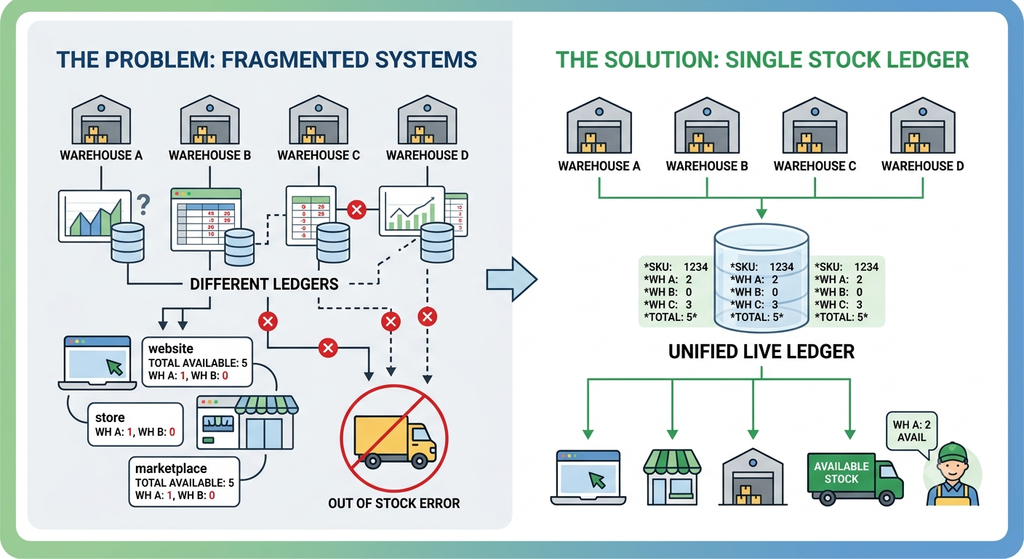
The foundational requirement for how to manage inventory across warehouses is a single stock ledger that every warehouse, and every sales channel, reads from and writes to. Without this shared foundation, each warehouse effectively becomes its own silo, with its own count that has to be manually reconciled against every other location, undermining the entire approach to how to manage inventory across warehouses before it even begins.
A fragmented, warehouse-by-warehouse counting system creates a specific and expensive failure: a SKU showing as available in aggregate across all locations while actually being out of stock at the specific warehouse assigned to fulfil a given order. This gap is invisible until a picker reaches an empty bin mid-fulfilment.
A shared ledger architecture solves this by tracking stock at the warehouse level within one unified system, so “total available” and “available at Warehouse B specifically” are both accurate numbers pulled from the same live data, not reconciled separately after the fact.
Layer 2: Smart Order-to-Warehouse Allocation

Once stock visibility is unified, the next layer in how to manage inventory across warehouses is deciding which warehouse should fulfil each specific order. This decision needs to weigh three factors simultaneously: which warehouses actually hold the required stock, which warehouse is closest to the delivery pincode, and which warehouse can still hit the order’s SLA window given current courier cut-off times.
Manual allocation, a person deciding by instinct or a simple rule like “always ship from the nearest warehouse,” breaks down quickly once stock levels vary unpredictably across locations. A warehouse that is geographically closest is useless for a specific order if it happens to be out of stock on that particular SKU.
Automated allocation logic solves this by evaluating all three factors together for every single order, assigning it to the warehouse that can actually fulfil it fastest given real, current stock levels, not a static assumption about which warehouse “usually” handles that region.
Layer 3: GST-Compliant Interstate Transfer Handling
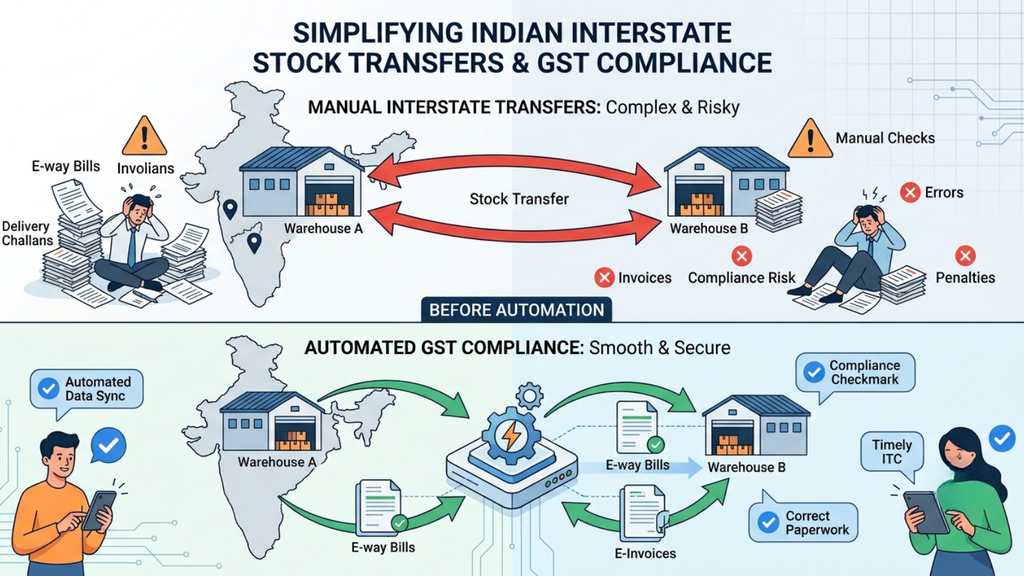
Moving stock between warehouses across state lines in India carries specific GST implications that a single-warehouse operation never has to think about, and this is a layer many guides on how to manage inventory across warehouses overlook entirely. Every interstate transfer needs correct documentation, and getting this wrong creates both a compliance risk and, at scale, a genuine cash flow problem tied to input tax credit timing.
This layer is frequently underestimated by brands scaling into a second or third warehouse, since the operational complexity of running two locations gets most of the attention while the compliance complexity of moving stock between them gets treated as an afterthought.
Automating GST-compliant documentation generation for every interstate transfer removes this risk entirely, generating correct paperwork the moment a transfer is initiated rather than requiring a manual compliance check after the fact.
Layer 4: Warehouse-Level Reconciliation and Visibility
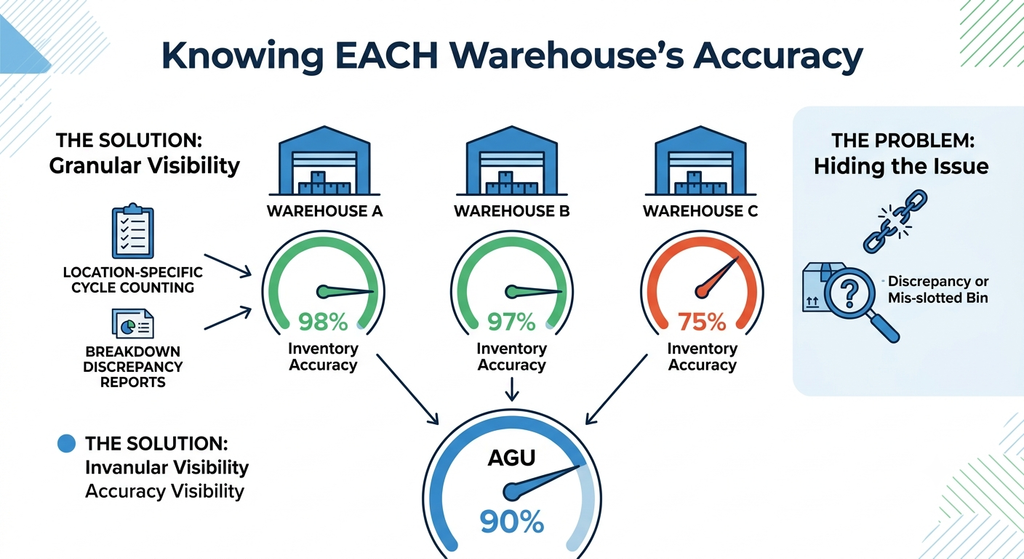
The final layer in how to manage inventory across warehouses is knowing, in real time, exactly how accurate each individual warehouse’s stock count actually is, not just the aggregate number across the network. A brand running three warehouses needs visibility into each one’s accuracy independently, since a problem concentrated at one location can be masked by strong performance at the other two if only the blended total is tracked.
Cycle counting has to happen at each warehouse on its own schedule, and discrepancy reports need to be broken down by location so a specific problem, a mis-slotted bin at Warehouse C, for instance, can be identified and corrected rather than lost in a network-wide average.
Without warehouse-level granularity in this final layer, a brand can believe its overall multi-warehouse inventory management is healthy while one specific location quietly accumulates a growing accuracy problem.
Demand Forecasting Across Multiple Locations
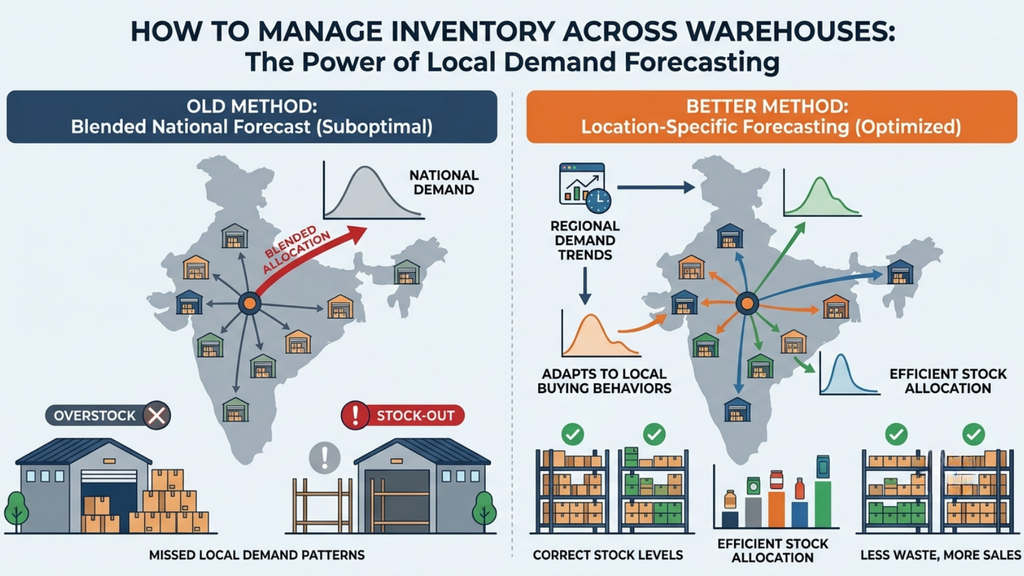
A layer often missed in discussions of how to manage inventory across warehouses is demand forecasting at the individual location level, not just at the SKU level network-wide. A bestselling SKU nationally can still be a slow mover at one specific warehouse if that location serves a region with different buying patterns.
India’s D2C sector growing at a 40% CAGR means regional demand patterns shift quickly as a brand’s customer base expands into new geographies. A warehouse that serves Tier 2 and Tier 3 cities, where COD accounts for 55-65% of ecommerce orders, needs different stock buffers than a metro-focused warehouse with a higher prepaid order share.
Forecasting stock needs per warehouse, rather than applying one blended national forecast evenly across every location, is a critical part of how to manage inventory across warehouses without either overstocking slow-moving regional variants or stocking out on genuinely high-demand local SKUs. This location-specific forecasting layer works best when it draws on the same real-time sales data that powers allocation and reconciliation, rather than a separate, disconnected planning exercise run on a different schedule.
Common Mistakes Brands Make Managing Multiple Warehouses

A handful of specific mistakes show up repeatedly as brands scale from one warehouse to several, and each one undermines a genuine attempt at how to manage inventory across warehouses effectively.
1. Treating each new warehouse as an independent operation.
Setting up a second warehouse with its own separate stock tracking, rather than connecting it into the same unified ledger as the first, recreates the single-warehouse mindset at a scale where it no longer works.
2. Allocating orders by simple geographic rule rather than real stock levels.
A rule like “ship north India orders from the Delhi warehouse” fails the moment that warehouse runs low on a specific SKU, since the rule does not account for actual current inventory.
3. Underestimating GST complexity on interstate transfers.
Brands often budget significant planning time for warehouse logistics and courier contracts while treating GST documentation on stock transfers as a minor administrative detail, until an audit or cash flow issue reveals otherwise.
4. Tracking accuracy only at the network level, not per warehouse.
A blended accuracy number across three locations can hide a serious problem at one specific site, delaying the correction until it has already caused multiple failed picks.
Preparing Multiple Warehouses for Sale-Event Demand Spikes

Sale events expose multi-warehouse weaknesses faster than steady-state operations do. Order volume during Big Billion Days or the Great Indian Festival can spike 5-10x above the daily average within a 48-72 hour window, and this spike does not distribute evenly across every warehouse.
A brand that has not planned how to manage inventory across warehouses specifically for peak demand often finds one location overwhelmed while another sits comparatively idle, since regional promotional response and existing stock distribution rarely align perfectly with the demand surge.
Pre-positioning stock ahead of a known sale event, based on each warehouse’s historical peak-period performance rather than its average-day volume, closes this gap before it becomes a fulfilment bottleneck.
A mispicked item costs an Indian ecommerce seller between Rs. 200 and Rs. 600 once reverse shipping, customer service, and reshipping are accounted for, and this cost multiplies quickly when a specific warehouse is under-stocked and forced into rushed, error-prone emergency replenishment mid-sale.
Building sale-event stock pre-positioning into the standard playbook for how to manage inventory across warehouses is one of the highest-leverage preparations a multi-location brand can make before its next major promotional period.
How Base.com Manages Inventory Across Multiple Warehouses
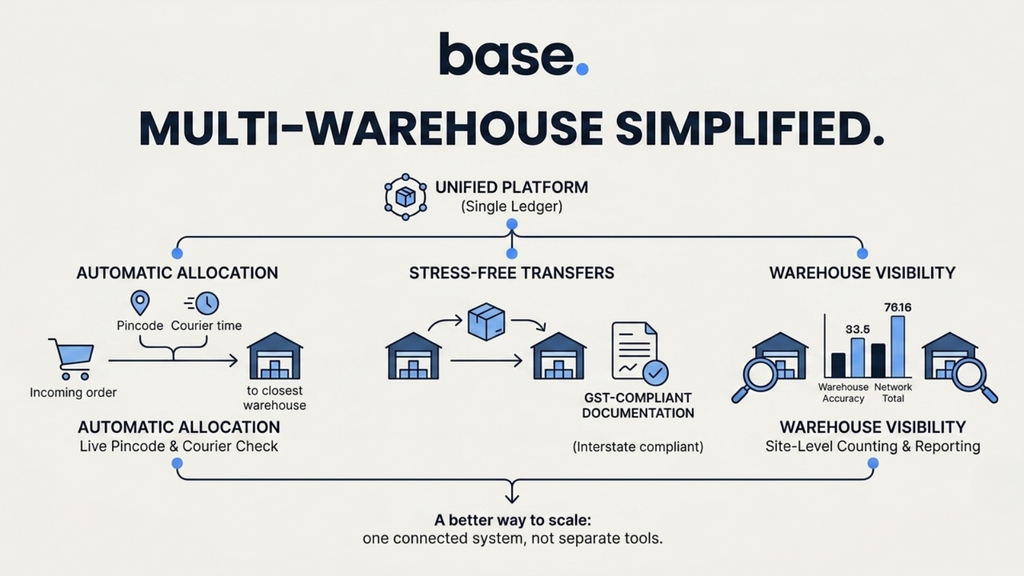
Base.com is an order and warehouse management platform built specifically for Indian D2C, marketplace, and B2B sellers, and multi-warehouse operation is a core design consideration rather than an add-on feature. The platform’s approach to how to manage inventory across warehouses is built around the same four layers described above, implemented as one connected system rather than four separate tools.
Base.com maintains one shared inventory ledger across every connected warehouse, with stock visible both as a network-wide total and broken down by individual location. When an order is placed, the platform’s allocation logic checks live stock at every warehouse, delivery pincode proximity, and courier cut-off times simultaneously, assigning the order automatically to the location best positioned to fulfil it.
For interstate stock transfers between warehouses, Base.com generates GST-compliant documentation automatically at the point of transfer, removing the manual compliance check that otherwise sits between a transfer decision and its execution. Cycle counting and discrepancy reporting run at the warehouse level, giving operations teams visibility into each location’s accuracy rather than a single blended number that can mask a problem concentrated at a single site.
This is what managing inventory across warehouses looks like when the underlying system is built around multi-location operation from the start, rather than a single-warehouse tool with a second location bolted on afterward.
Measuring Multi-Warehouse Inventory Health
A few specific metrics reveal whether a multi-warehouse operation is genuinely under control, rather than just appearing stable in aggregate. These are the numbers that separate a real answer to how to manage inventory across warehouses from one that only looks correct on a summary dashboard.
| Metric | What It Reveals |
| Per-warehouse accuracy rate | Whether any single location is dragging down overall performance |
| Cross-warehouse allocation accuracy | Whether orders are consistently routed to the warehouse that can actually fulfil them fastest |
| Interstate transfer documentation completion rate | Whether GST compliance is keeping pace with transfer volume |
| Time from transfer initiation to stock availability | Whether transferred stock becomes sellable quickly or sits in limbo |
| Network-wide vs. per-location stockout rate | Whether stock is genuinely available where it is needed, not just somewhere in the network |
Tracking these five numbers, rather than a single blended accuracy figure, is the clearest way to confirm that how to manage inventory across warehouses is actually working as a system, not just working on paper.


[…] order management cuts processing time by 40% and pushes inventory accuracy above 90%, compared to manual processes. India’s ecommerce logistics sector handles […]
[…] shift to domestic manufacturing is not just a cost or geopolitical decision. It is an inventory management decision. Domestically manufactured products have shorter lead times, more predictable […]
[…] multi-warehouse management supports this architecture natively. Both the in-house warehouse and the 3PL node appear as […]
[…] pick-and-pack rules, including different handling for bulky kitchenware, appliance cartons, and multi-item packing. The decision moves from packer judgement to system […]
[…] software works well until a distributor starts juggling purchasing, GST-compliant invoicing, and multi-warehouse stock in one workflow. At that point, the ERP vs inventory management software gap becomes an operational […]
[…] number and connects it to a reorder point, a safety stock level, a supplier purchase order, and a warehouse allocation decision. Without that connective layer, even an accurate forecast sits unused as a spreadsheet […]
[…] best order management software for ecommerce combines real-time multi-channel order capture, automated inventory allocation, and marketplace-specific dispatch rules, measured in actual numbers: G2 ratings above 4.3, […]
[…] inventory management is the process of selling products before they reach your warehouse while tracking those […]
[…] visibility and transfers: Base.com shows stock location by location and records inter-warehouse movements as structured […]
[…] places stock across regional fulfilment nodes so parcels start closer to the customer. Reducing distance shortens delivery more reliably than […]
[…] and onboarding, including on-site warehouse mapping and full floor-team training on batch […]
[…] Multi-warehouse sellers see this cause more than anyone else. A seller shipping from Bengaluru and Delhi can hold enough total stock and still trigger the Flipkart showing out-of-stock but stock available error if the listed location is empty. […]