


To manage inventory across multiple ecommerce marketplaces, run a single source of truth for stock, decide per marketplace whether inventory is pooled or allocated, maintain clean SKU-to-listing mapping on every channel, and synchronise in near real time. Overselling is almost always a mapping or latency failure, not a stock failure.
The hard part is not the syncing. It is deciding which marketplaces share a pool and which do not.
Why This Is an Architecture Problem, Not a Software Problem
A mid-size Indian brand today typically sells on Amazon.in, Flipkart, Myntra, Meesho, Ajio, Nykaa, JioMart, its own Shopify store, and increasingly Blinkit, Zepto and Instamart. That is nine to eleven channels drawing from one physical warehouse.
The scale of what goes wrong when this is handled badly is well documented. IHL Group’s 2026 Inventory Distortion Study puts the global cost of out-of-stocks and overstocks combined at $1.7 trillion a year, equal to 6.2% of global retail sales, with 65.6% attributed to out-of-stocks. Gartner data indicates 58% of retail and DTC brands run inventory accuracy below 80%. Both are global figures rather than India-specific, but the mechanism is universal.
Multichannel selling in India is not optional. As one industry guide puts it, it is closer to the minimum viable operating model than a growth tactic. The question is not whether to be on multiple marketplaces but how to manage inventory across multiple ecommerce marketplaces without the complexity compounding faster than the revenue.
Three things make this genuinely hard:
- Marketplaces have incompatible inventory models. Some require dedicated stock. Some read from an open pool. Treating them identically breaks both.
- Sync latency varies by integration. A channel updating every four hours and a channel updating live cannot safely share the last unit of a SKU.
- Commitment is often irreversible. Stock inside a marketplace fulfilment centre serves that marketplace only.
The Three Inventory Models Behind How to Manage Inventory Across Multiple Ecommerce Marketplaces
Every marketplace connection uses one of three models. Getting this classification right is the foundation of the entire architecture.
|
Model |
How it works |
Oversell risk |
Best for |
|---|---|---|---|
|
Pooled |
All channels read one shared available pool |
Highest; depends entirely on sync speed |
Self-fulfilled channels with fast sync |
|
Allocated |
A fixed quantity is dedicated per channel |
Very low |
Marketplace-fulfilled, or channels requiring reserved stock |
|
Hybrid |
Core allocation plus shared buffer on top |
Low to moderate |
Most Indian sellers, most of the time |
Pooled maximises availability. Every channel can sell every unit, so nothing is stranded. The cost is that the last unit is visible to nine channels simultaneously, and only synchronisation speed prevents two of them selling it.
Allocated eliminates oversell by construction but strands stock. Units allocated to a channel that underperforms cannot serve a channel that overperforms.
Hybrid is where most well-run Indian operations land: a floor allocation per channel to protect listing health, plus a shared buffer that any channel can draw from, with the buffer sized to sync latency.
The practical rule for how to manage inventory across multiple ecommerce marketplaces is that pooling is only as safe as your slowest sync. If one integration updates every four hours, either exclude it from the pool or size the buffer to cover four hours of peak demand.
The Five Failure Modes in How to Manage Inventory Across Multiple Ecommerce Marketplaces
|
Failure mode |
Root cause |
Where it surfaces |
|---|---|---|
|
Overselling |
Sync latency or duplicate SKU mapping |
Amazon, Flipkart, Meesho |
|
Phantom stockout |
Unreconciled reservations, returns, or unmapped SKUs |
Any channel |
|
Stranded allocation |
Over-committed stock on an underperforming channel |
Marketplace FCs |
|
Component drift |
Bundles not splitting into component SKUs |
Combo-heavy catalogues |
|
Reconciliation gap |
Settlement and returns not matched back to stock |
Month-end, quietly |
Overselling is the visible one. Stranded allocation is usually the expensive one, because it is invisible until the season ends. Both are architecture failures rather than purchasing failures, which is why how to manage inventory across multiple ecommerce marketplaces is answered in configuration rather than in procurement.
How to Manage Inventory Across Multiple Ecommerce Marketplaces Channel by Channel
This is where generic multichannel advice fails Indian sellers. The marketplaces do not behave alike, and the differences are structural rather than cosmetic.
1. Amazon.in
Fulfilment options: FBA, Easy Ship, Self Ship, and Seller Flex, where Amazon manages inventory at your own warehouse.
Inventory model: Allocated for FBA, pooled for Easy Ship and Self Ship.
What makes it distinctive: Amazon runs an Inventory Performance Index, scored from 0 to 1,000, calculated on your balance of sold and on-hand inventory, excess and aged inventory, long-term storage fees, listing issue resolution speed, and your ability to keep popular products in stock. Over-committing to FBA damages the score, which in turn affects your storage capacity allocation.
Practical guidance: Commit conservatively to FBA and hold your flexible stock in Easy Ship. Use Amazon’s free Restock Inventory tool, which calculates days of supply and recommends reorder quantities from your sales velocity, as a baseline input rather than ignoring it.
2. Flipkart
Fulfilment options: Flipkart Fulfilment, Smart Fulfilment, and seller-fulfilled.
Inventory model: Allocated for Flipkart Fulfilment, hybrid for Smart Fulfilment, pooled for seller-fulfilled.
What makes it distinctive: Flipkart operates a replacement order flow alongside standard returns. A replacement consumes a fresh unit immediately while the returned unit comes back on a separate timeline. Blending Flipkart replacements and Amazon returns into a single returns assumption is a common and consequential modelling error.
Practical guidance: Model replacements as fresh demand, not as returns. Flipkart’s ranking also responds to sales velocity, so a stockout costs the velocity signal in addition to the units.
3. Myntra

Myntra is the most structurally distinctive marketplace in Indian ecommerce for inventory purposes, and it deserves the most detail.
M-Direct: Sellers must reserve a percentage of inventory exclusively to Myntra. This is a hard allocation. Those units are unavailable to every other channel regardless of how they are performing.
PPMP (Pure Play Marketplace): An open inventory model, effectively dropship, with no reserved allocation required. It supports multi-location order creation and inventory push, and sellers can integrate their own OMS via API. Myntra Logistics is the sole shipping partner under PPMP, and the default fulfilment SLA is commonly configured at 2 days.
Omni: Allows fulfilment from multiple locations including retail stores, with Myntra assigning each order to the nearest fulfilment location holding stock. Availability is restricted to sellers meeting Myntra’s criteria.
Practical guidance: The M-Direct versus PPMP choice is an inventory architecture decision before it is a commercial one. M-Direct strands stock; PPMP keeps it pooled but hands last-mile control to Myntra Logistics. For sellers running tight inventory across many channels, PPMP’s open pool is usually the better structural fit, though the tighter fulfilment SLA demands genuine dispatch discipline.
Verify current model availability and SLA configuration with your Myntra account manager, since these terms change and vary by seller tier.
4. Meesho

Inventory model: Typically pooled, seller-fulfilled.
What makes it distinctive: Price-led, high volume, and heavily concentrated in tier-2 and tier-3 markets, which correlates with higher RTO exposure. India’s average RTO rate sits between 20% and 30% against a global benchmark closer to 8-12%, and COD-heavy price-led channels sit at the higher end. Treat these as directional and verify against your own courier data.
Practical guidance: Buffer Meesho for RTO churn rather than for velocity alone. A meaningful share of dispatched units returns, and those units are out of circulation for six to ten days before they are sellable again.
5. Ajio and Nykaa

Inventory model: Varies by seller agreement; commonly allocated or hybrid.
What makes them distinctive: Both are curated, category-focused platforms, Ajio in fashion and lifestyle, Nykaa in beauty and personal care. Catalogue and listing requirements are stricter than on horizontal marketplaces, which makes SKU mapping errors more likely and more consequential.
Practical guidance: For Nykaa in particular, batch and expiry tracking must survive the integration. Beauty returns are low, commonly cited at 1-5% domestically, so your available figure is more reliable here than in fashion, but expiry exposure replaces return exposure as the dominant risk.
6. JioMart
Inventory model: Varies; commonly hybrid.
What makes it distinctive: Strong tier-2 and tier-3 reach with a grocery and FMCG weighting.
Practical guidance: For dated stock, enforce FEFO rotation across the integration rather than relying on channel-level batch selection.
7. Quick Commerce: Blinkit, Zepto, Instamart
Inventory model: Allocated to dark stores, replenished continuously.
What makes it distinctive: The replenishment cycle is days, not weeks, and stock sits at many small nodes rather than a few large ones. Redseer projected quick commerce as the fastest-growing festive segment in 2025.
Practical guidance: Hold buffer centrally and push to dark stores frequently rather than committing deep stock to individual nodes. Node-level over-allocation in quick commerce strands inventory across dozens of locations simultaneously, which is far harder to recover than one over-committed FC.
8. Your Own D2C Store

Inventory model: Pooled, fully controlled.
What makes it distinctive: Highest contribution margin, complete control over the checkout, and the only channel where you set the availability rules.
Practical guidance: Protect stock here rather than treating it as the residual. Many Indian sellers unintentionally starve their highest-margin channel by committing everything to marketplace fulfilment first. Your D2C store should also carry your flexible buffer, since it is the pool you can point anywhere.
9. ONDC
Inventory model: Pooled via network participation.
What makes it distinctive: Inventory published once through a network participant can surface across multiple buyer applications, which multiplies reach without multiplying integrations.
Practical guidance: Confirm exactly how your seller-app partner handles stock updates and what latency applies before pooling ONDC with time-sensitive channels. The reach benefit is real; the sync characteristics vary by participant and should be verified rather than assumed.
A reasonable default for any new or unfamiliar channel is to start it on a small fixed allocation rather than adding it to the shared pool immediately. Run it allocated for one full cycle, measure the actual sync behaviour and order flow, then decide whether it earns pool access. This costs a little stranded stock and removes the risk of an unknown integration consuming units that a proven channel needed.
Marketplace Summary
|
Marketplace |
Typical inventory model |
Dominant risk |
Buffer guidance |
|---|---|---|---|
|
Amazon.in (FBA) |
Allocated |
IPI damage from over-commitment |
Commit conservatively |
|
Amazon.in (Easy Ship) |
Pooled |
Sync latency |
Hold flex here |
|
Flipkart Fulfilment |
Allocated |
Stranded stock |
Commit conservatively |
|
Flipkart (seller-fulfilled) |
Pooled |
Sync latency |
Standard |
|
Myntra M-Direct |
Hard allocation |
Stranded stock |
Minimise |
|
Myntra PPMP |
Pooled |
Dispatch SLA pressure |
Standard, with dispatch discipline |
|
Meesho |
Pooled |
RTO churn |
Buffer for returns cycle |
|
Ajio / Nykaa |
Allocated or hybrid |
Mapping and expiry errors |
Category-specific |
|
Quick commerce |
Node-allocated |
Node-level stranding |
Shallow node, deep central |
|
Own D2C |
Pooled |
Being starved by marketplace commitment |
Protect deliberately |
|
ONDC |
Pooled |
Unknown sync latency |
Verify before pooling |
Model classifications reflect common configurations and vary by seller agreement and tier. Confirm yours with each platform.
SKU Mapping Is the Foundation: How to Manage Inventory Across Multiple Ecommerce Marketplaces Rests On

Unmapped and duplicate-mapped SKUs cause more overselling in Indian multichannel operations than genuine stock shortfalls do.
The problem compounds with channel count. One SKU listed on nine marketplaces means nine mappings, each of which can drift when a listing is edited, a variant is added, or a catalogue is bulk-updated.
A working mapping discipline:
One master SKU code, owned centrally, never edited channel-side.
A documented mapping audit before every peak period and after every bulk catalogue update.
Barcodes verified to scan at the pick face, not just present in the data.
Variant-level mapping checked explicitly, since variants are where duplicate mappings hide.
Bundles configured to split automatically into component SKUs, or component stock drifts from the first bundle sale.
Anyone learning how to manage inventory across multiple ecommerce marketplaces should fix mapping before touching sync configuration. Faster synchronisation of wrong mappings just distributes the error more quickly.
What should be the Buffer Strategy Across Channels?
Buffers are the shock absorber in how to manage inventory across multiple ecommerce marketplaces, and most sellers size them by habit rather than by cause.
Buffers exist to absorb two things: forecast error and sync latency. Size them to whichever is larger.
- Sync-latency buffer. For a channel syncing hourly at peak velocity, the buffer must cover an hour of peak demand for that SKU. Move to live sync and this buffer shrinks toward zero, which frees working capital.
- Channel-priority buffer. Protect your highest-contribution channels first. That usually means D2C and your best-performing marketplace, not the one with the most volume.
- A-class concentration. Hold buffer on the top 20% of SKUs that typically drive 70-80% of volume, half on the middle tier, none on the long tail. Verify that split against your own data rather than assuming the Pareto ratio holds.
- No buffer changes mid-peak. Buffer changes ripple across every connected channel simultaneously. Review at fixed points; change at fixed points; document every change.
One structural point is worth stating plainly: a buffer is a payment you make for uncertainty you have not removed. Every hour of sync latency, every unaudited mapping, and every unmeasured lead time is bought back with stock sitting idle. Sellers who treat buffer size as a fixed policy tend to carry the same cost year after year, while sellers who treat it as a symptom reduce it by fixing the underlying cause.
That reframing also settles most internal arguments about buffer levels. The question is not whether 15% feels safe. It is what specific uncertainty the 15% is compensating for, and whether that uncertainty is cheaper to fix than to fund.
Synchronisation Architecture: The Technical Core of How to Manage Inventory Across Multiple Ecommerce Marketplaces
The design question is simple: what is the maximum acceptable gap between a unit leaving your warehouse and every channel knowing?
At business-as-usual volume, hourly is usually adequate. At 3.5x festive velocity, an hourly sync means a listing can sell stock that left the warehouse 59 minutes ago.
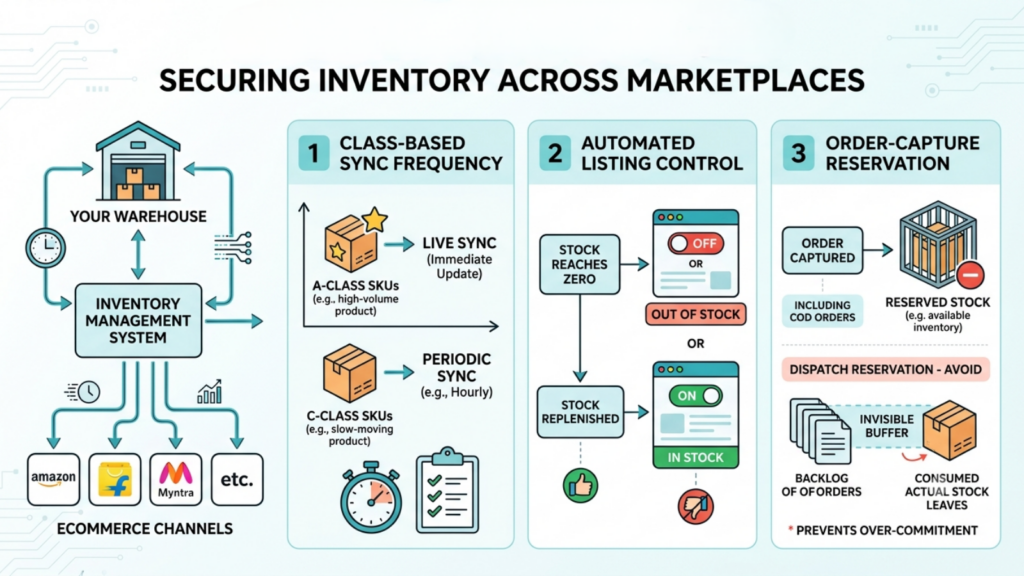
Three rules that hold across channel counts:
Set sync frequency by SKU class, not uniformly. A-class SKUs justify live sync; the long tail rarely does.
Automate listing closure at zero stock and relisting on replenishment, so a stockout never becomes an oversell and a marketplace defect.
Reserve stock at order capture rather than at dispatch. With COD around 45% of Indian D2C orders, an unshipped backlog otherwise consumes your buffer invisibly.
How Base.com Supports Multichannel Inventory
Base.com is an ecommerce operating system combining order management, product and inventory management, marketplace listing control, shipping and workflow automation in one platform. Its Product Manager module explicitly combines ERP, WMS and PIM functions.
Five capabilities map directly onto how to manage inventory across multiple ecommerce marketplaces as described above.
- One order and inventory pool across channels. Orders from marketplaces, online shops, phone and in-person sales land in a single Order Manager, which is the precondition for a genuine single source of truth rather than reconciled spreadsheets.
- Configurable synchronisation, including live. Stock sync runs every eight hours, hourly, or live, and price sync at 24-hour, 12-hour, four-hour, hourly, or real-time intervals. A dedicated Accelerations module raises sync frequency for periods when higher sales are expected, which is what lets you run tight buffers at peak without permanently paying for maximum frequency.
- Automatic listing closure and relisting. Listings can end automatically when stock reaches zero and reactivate when the product is replenished, across every connected channel simultaneously.
- Multi-warehouse separation. One or more warehouses can be assigned to an inventory, each with separate stock levels, documents, deliveries and stocktakings. This is what keeps allocated marketplace stock out of your pooled available figure, the single most important structural control in the whole architecture.
- Reservations and bundle splitting. Products can be reserved before orders are paid, and bundles can be configured to split automatically into component SKUs when an order is fetched, which prevents component drift in combo-heavy catalogues.
Base.com publishes a large integration library. Confirm the current list of Indian marketplace integrations directly with the vendor before committing, since published documentation does not consistently enumerate India-specific channel coverage.
Metrics That Tell You the Architecture Is Working
|
Metric |
Formula |
Target |
|---|---|---|
|
Oversell rate |
Oversold orders ÷ total orders |
Under 0.5% |
|
Sync latency |
Dispatch to channel update |
Under 5 minutes on A-class |
|
Mapping error rate |
Unmapped or duplicate mappings ÷ active listings |
0% |
|
Stranded allocation |
Units in underperforming channel pools ÷ total allocated |
Under 10% |
|
Channel concentration |
Largest channel share of stock commitment |
Reviewed, not capped |
|
Inventory accuracy |
Matching cycle counts ÷ total counts |
Above 98% |
Targets are directional planning benchmarks constructed for this article, not published industry standards. Calibrate against your own history.
Getting How to Manage Inventory Across Multiple Ecommerce Marketplaces Right Is a Structural Decision
The sellers who handle nine channels cleanly are not working harder than the ones drowning in three. They made two decisions early and held to them.
The first is a single source of truth, with committed and available stock held as genuinely separate pools rather than one blurred number. The second is a per-marketplace classification, pooled, allocated, or hybrid, applied deliberately rather than inherited from whatever each integration happened to default to.
Everything else follows: mapping discipline, sync cadence by SKU class, buffers sized to latency, reservations at capture, automatic listing control. None of it is complicated individually. All of it fails if the two structural decisions were never made.
With Indian festive GMV projected to cross ₹1.15 lakh crore in a 30-35 day window and every channel peaking simultaneously, how to manage inventory across multiple ecommerce marketplaces is the operating question that determines whether adding a channel adds margin or adds chaos. Base.com consolidates orders, inventory, warehouses, and channel sync into one platform, which is what makes the single source of truth real rather than aspirational.
Classify each channel. Map every SKU. Sync to the slowest constraint. Protect the pool you control.
Frequently Asked Questions
Should I pool inventory across all marketplaces or allocate per channel?
How do I prevent overselling when I sell on Amazon, Flipkart and Myntra at once?
Does Myntra require dedicated inventory?
How many marketplaces should an Indian seller run at once?
What is the first thing to fix when learning how to manage inventory across multiple ecommerce marketplaces?



[…] who ignore this buy a tool built for someone else’s warehouse layout, which is why the best inventory sync software for marketplace sellers in India always starts with topology. It syncs correctly and still shows […]