

An integrated inventory management system for multi-brand ecommerce in India is not a feature upgrade for businesses managing more than one brand simultaneously. It is the operational foundation on which everything else depends. When inventory data is fragmented across tools, when reporting lives in disconnected dashboards, and when warehouse teams operate without a single source of truth, decisions slow down, errors compound, and the complexity of running multiple brands becomes a liability rather than a strength.
This is a challenge that plays out across India’s multi-brand ecommerce landscape in remarkably similar ways. Operators come to Base.com with high expectations, specific requirements, and a clear understanding of what an inadequate inventory system costs a multi-brand operation at scale. What they find is not just a software platform. They find a partner willing to understand their warehouse realities before building a solution around them.
This is the detailed account of how a growing multi-brand ecommerce operation moved from fragmented, patchwork operations to a single integrated inventory management system for multi-brand ecommerce in India, and what that transformation meant for inventory accuracy, reporting quality, and operational confidence across every brand in its portfolio- a pattern that is increasingly common among Indian multi-brand operators as they scale.
The Multi-Brand Inventory Problem Is a Different Category of Challenge
Running a single-brand ecommerce operation is complex. Running a multi-brand operation is a fundamentally different category of challenge. Every brand adds a layer of SKU complexity, reporting requirements, warehouse allocation logic, and performance visibility that a single-brand setup never faces.
India’s ecommerce market is at $226 billion and expanding rapidly. Multi-brand operators are growing within that expansion, but growth compounds the inventory problem if the underlying system is not built to handle it. More brands mean more SKUs, more warehouse locations, more channel integrations, and more reporting dimensions. A system that works adequately for one brand at manageable volume begins to crack when two or three brands are running through it simultaneously at scale.
The standard response to this problem in Indian ecommerce has been to add tools. An inventory tool here. A reporting dashboard there. A spreadsheet to bridge the gap between them. The result is a patchwork that technically covers the requirements but provides no confidence in the data it produces. When inventory figures come from three different sources and reconciliation is a manual weekly exercise, the business is not managing inventory; it is managing the uncertainty created by a fragmented system.
Multi-brand operators need to move beyond that model entirely. They need a genuine integrated inventory management system for multi-brand ecommerce in India, not another tool to add to the stack.
What Multi-Brand Operators Specifically Need
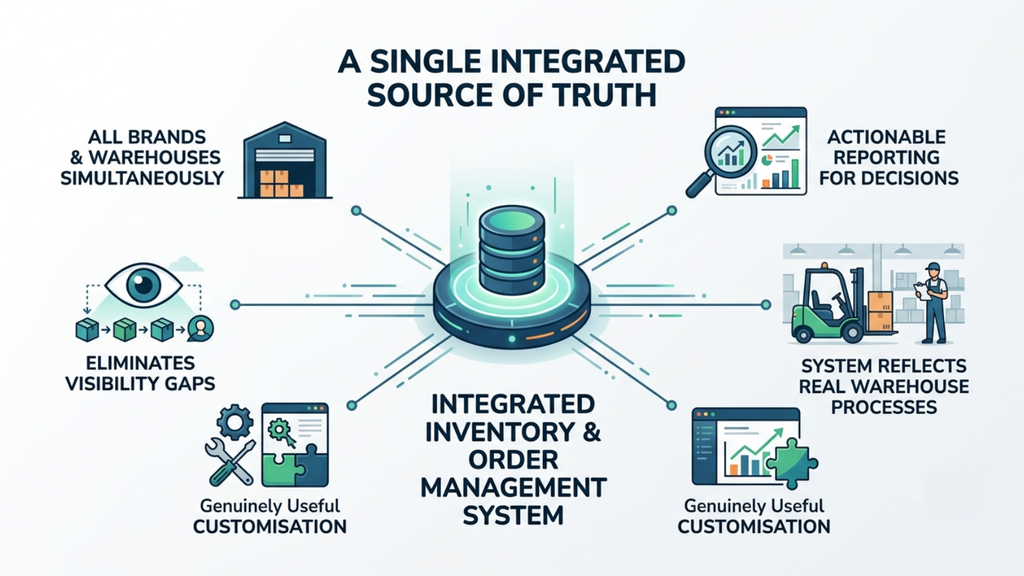
The requirements that surface again and again among multi-brand operators are specific and non-negotiable, not because these teams are difficult, but because they understand precisely what poor inventory management costs a multi-brand operation over time.
The requirements are clear:
- A single integrated source of truth for inventory across all brands and warehouse locations simultaneously
- Reporting detailed enough to drive actual decisions, not passive dashboards that display data without enabling action
- A system that reflects real warehouse processes rather than forcing the team to adapt operations to fit rigid software defaults
- Customisation that makes the platform genuinely useful in day-to-day execution, not just technically capable on a feature checklist
- Accuracy that eliminates the need for extra tools to fill the visibility and reporting gaps that fragmented setups always create
These requirements rule out most standard inventory platforms available in the Indian market. Generic solutions built for single-brand operations cannot accommodate multi-brand complexity. Platforms offering customisation as an expensive add-on cannot deliver the depth of adaptation multi-brand operators need. Systems with strong order management but shallow reporting cannot serve a team requiring data clarity across multiple brands simultaneously.
Multi-brand operators need an integrated inventory management system for multi-brand ecommerce in India that is built for their level of operational complexity. Base.com has built exactly that.
Why Standard Inventory Tools Fail Multi-Brand Operations
To understand what Base.com builds for multi-brand operators, it is important to be precise about why standard approaches are insufficient, and why this insufficiency is structural, not incidental.
1. The Fragmented Tool Problem
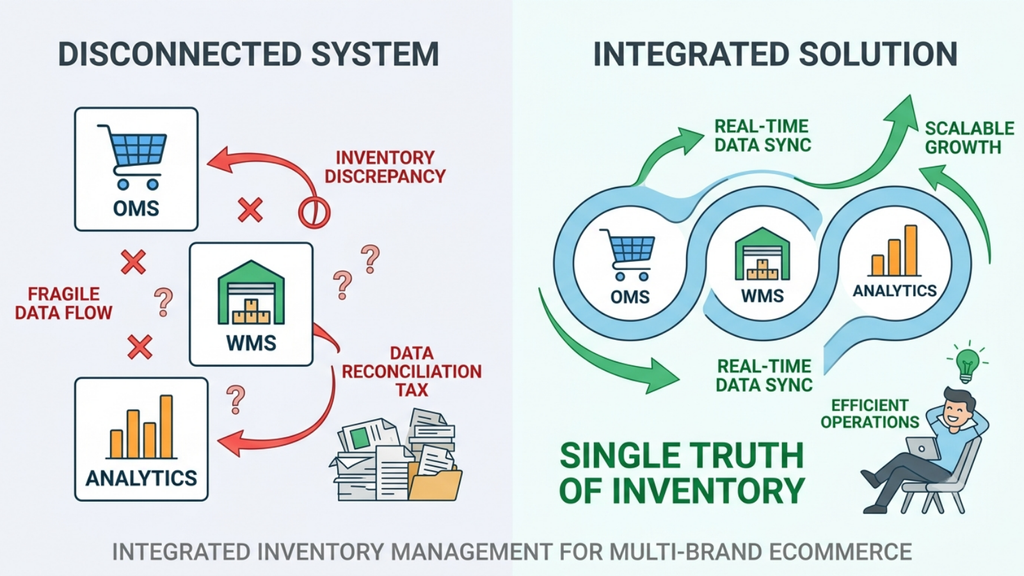
Most multi-brand operators in Indian ecommerce run on a combination of tools, each designed for a specific function in isolation. An OMS for order routing. A WMS for warehouse operations. A separate analytics platform for reporting. Spreadsheets for reconciliation between all of them. Each tool performs its function. None of them communicates with the others reliably.
The consequence is data fragmentation at every level. Inventory figures in the OMS do not consistently match figures in the WMS. The reporting platform pulls from one data source while operations teams work from another. When a discrepancy appears, and in fragmented systems, discrepancies are constant, the team traces the data trail back through multiple tools to find where the divergence occurred. This process consumes hours that should be spent on operations, not data archaeology.
For a single-brand operation, this friction is manageable with sufficient team effort. For a multi-brand operation, it is a daily operational tax that scales with every brand added to the portfolio. The only real solution is an integrated inventory management system for multi-brand ecommerce in India that eliminates the fragmentation at its root.
2. The Reporting Gap

Standard inventory platforms in India typically offer reporting at the level of basic stock counts, order volumes, and surface-level fulfilment metrics. For a multi-brand operation that needs to understand performance across brands, compare inventory movement patterns, track warehouse utilisation by brand, and generate operational reports that drive genuine management decisions, that level of reporting is fundamentally inadequate.
The gap between what standard platforms report and what multi-brand operations need to understand forces teams to either accept lower visibility into their own operations or build manual reporting processes on top of the platform. Neither option is sustainable at scale.
3. The Rigidity Problem
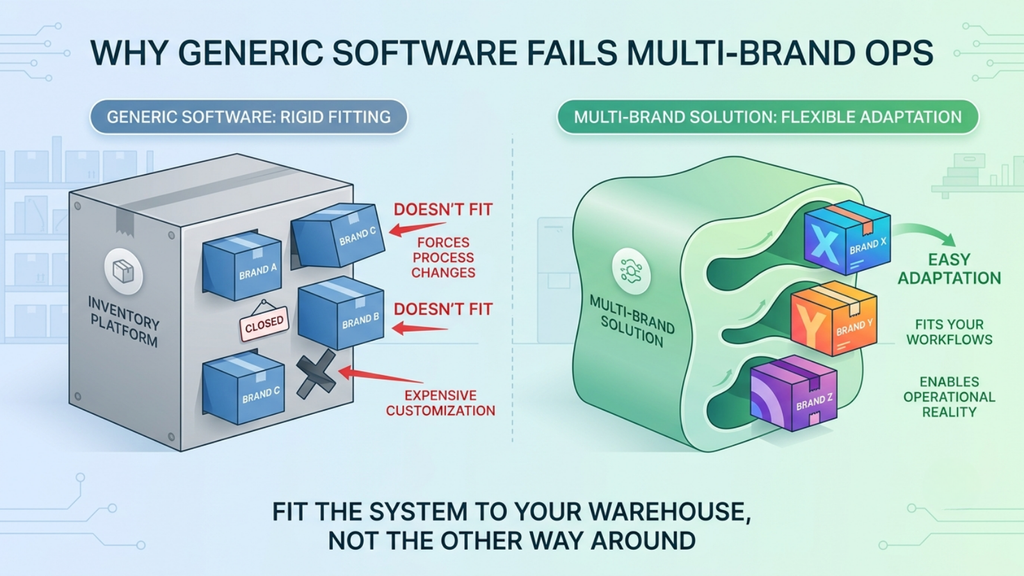
Generic inventory platforms are built around assumed standard workflows. They expect a standard receiving process, a standard pick-pack-ship sequence, and standard reporting dimensions that apply to a theoretical average ecommerce business. When an operation’s actual warehouse processes deviate from those standards, which is almost always the case for multi-brand operations because they have inherently non-standard requirements, the platform either forces disruptive process changes or requires expensive custom development to accommodate operational reality.
For most multi-brand operators, this rigidity is not acceptable. Teams need a system that reflects how their warehouse actually operates, not one that requires the warehouse to change how it operates to fit the software.
How Base.com Builds the Right Solution for Multi-Brand Operators
Base.com approaches these challenges by deeply understanding warehouse operations, identifying gaps, and designing a system aligned with real workflows.
1. Starting With the Warehouse, Not the Software Demo
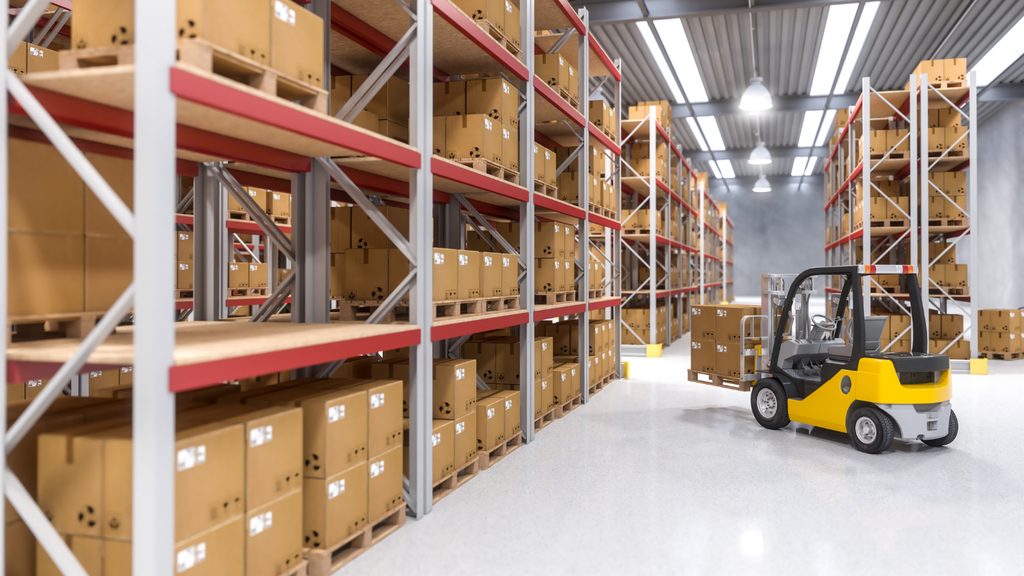
The first and most consequential thing Base.com does differently is understand a multi-brand operator’s warehouse challenges firsthand before designing any configuration or solution. This implementation philosophy- ground-level understanding first, software configuration second- is what separates platforms that deliver genuine operational value from those that deliver technically impressive feature demonstrations that fail under real operating conditions.
Base.com’s implementation team engages directly with the warehouse environment to understand:
- How inventory actually moves across brands and locations in day-to-day operations
- Where the existing system creates friction, requires manual workarounds, or produces data that the team cannot trust
- What reporting the management team needs but is not currently receiving from any existing tool
- How the existing warehouse workflow needs to be accommodated, reflected, or evolved within the new system
This ground-level understanding shapes every configuration decision that follows. The integrated inventory management system for multi-brand ecommerce in India that Base.com builds is not a generic product implementation. It is a system specifically architected to match an operator’s operational reality, the warehouse processes, the brand portfolio complexity, the reporting requirements, and the accuracy standards the team expects and demands.
For Indian multi-brand operators evaluating platforms, this implementation approach should be a primary differentiator criterion. A vendor that invests in understanding your operations before configuring the system will consistently deliver better outcomes than one that applies a standard setup template and leaves adaptation to the client.
2. Building the Single Integrated System
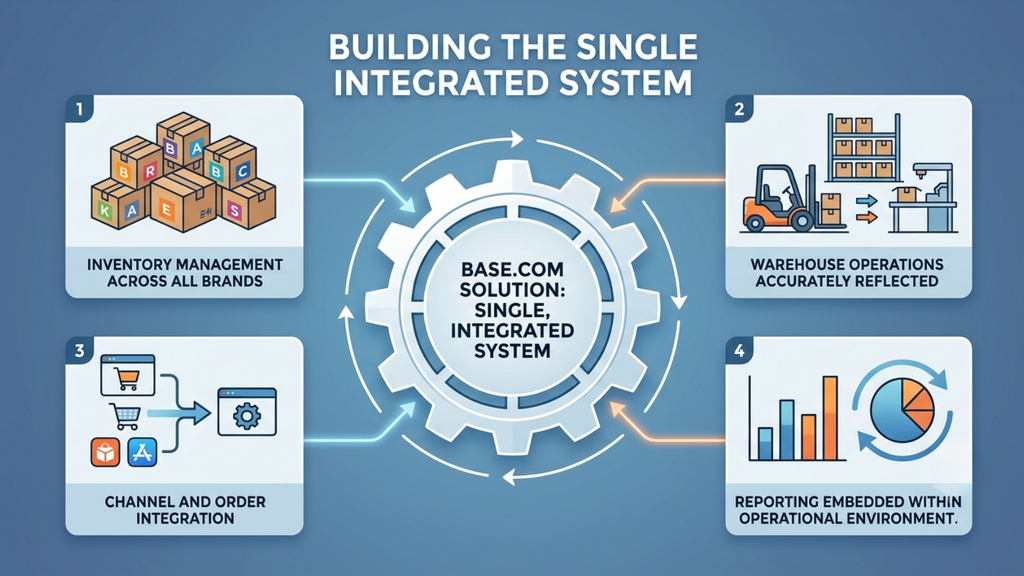
The centrepiece of Base.com’s solution is a single, integrated operational environment that replaces the patchwork of disconnected tools most multi-brand businesses end up managing across brands.
This integration covers every critical operational dimension:
- Inventory management across all brands. Every SKU across every brand in a portfolio is managed within a single system with a unified data architecture. No separate inventory databases for different brands. No reconciliation exercise to align figures from tools that do not communicate. One system, one version of inventory truth, accessible to every team member who needs it. This is the core promise of an integrated inventory management system for multi-brand ecommerce in India, and Base.com delivers it without compromise.
- Warehouse operations accurately reflected. The system is configured to match an operator’s actual warehouse processes, receiving logic, putaway workflows, pick-pack-ship sequences, and inter-brand stock management, rather than requiring the team to operate within generic software assumptions. When the warehouse process differs from a standard model, the system accommodates the difference rather than flagging it as a deviation requiring manual override.
- Channel and order integration. Orders arriving from multiple channels across multiple brands are managed within the same operational environment, with inventory positions updating in real time as orders progress through the fulfilment pipeline. The inventory figure visible in the system is the inventory figure the warehouse is actually working with at that moment.
- Reporting embedded within the operational environment. Critically, reporting is not a separate module or an export function feeding an external analytics platform. It is built directly into the same system handling inventory and warehouse operations, meaning reports draw from the same live data the system is operating on, with no translation layer between operational data and management visibility.
3. Detailed Reporting That Becomes a Decision-Making Tool
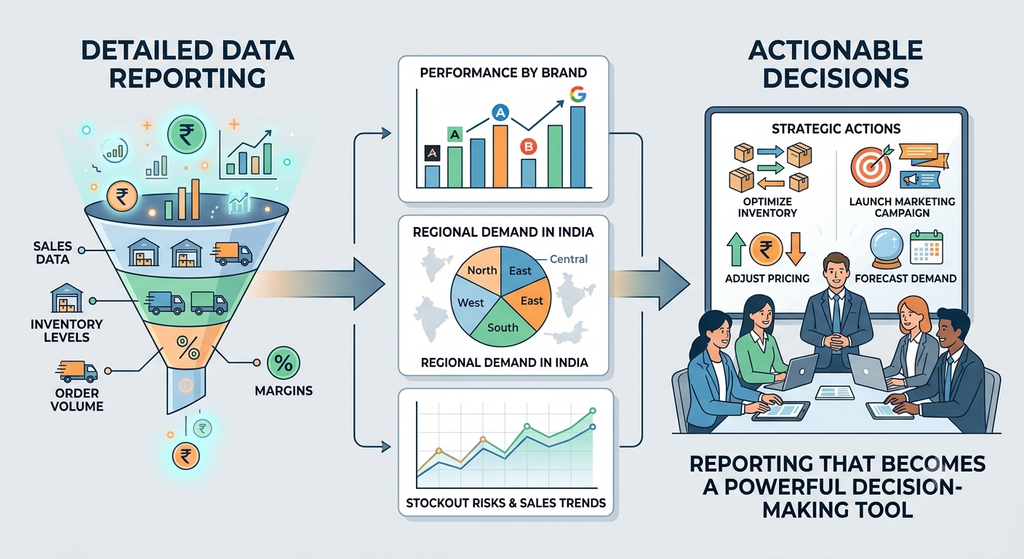
Reporting is consistently one of the most specific and heavily emphasised requirements multi-brand operators bring to the evaluation and implementation process. Teams do not want a passive dashboard. They want reporting detailed enough to drive genuine operational and strategic decisions, the kind of reporting that an integrated inventory management system for multi-brand ecommerce in India should deliver as standard.
Base.com configures reporting that covers every dimension a multi-brand management team typically needs:
| Reporting Dimension | What It Enables |
| Brand-level inventory performance | Stock movement, turnover rates, and accuracy per brand in the portfolio |
| Warehouse utilisation by brand | Visibility into space allocation and warehouse efficiency across all brands |
| Order fulfilment performance | SLA compliance, processing speed, and exception rates by brand and channel |
| Stock accuracy reconciliation | Real-time comparison between system inventory and physical warehouse positions |
| Operational trend analysis | Patterns in inventory movement, order flow, and fulfilment performance over time |
| Custom report configurations | Reports designed around specific management decision requirements |
| Cross-brand comparison views | Performance benchmarking across brands within the portfolio |
This level of reporting transforms how management teams engage with their own operational data. Instead of spending significant time aggregating figures from multiple tools and constructing manual reports that are outdated before they are distributed, teams can generate the specific views they need directly from the live system, with complete confidence in the accuracy of the underlying data.
4. Customisation Built Around Operational Reality
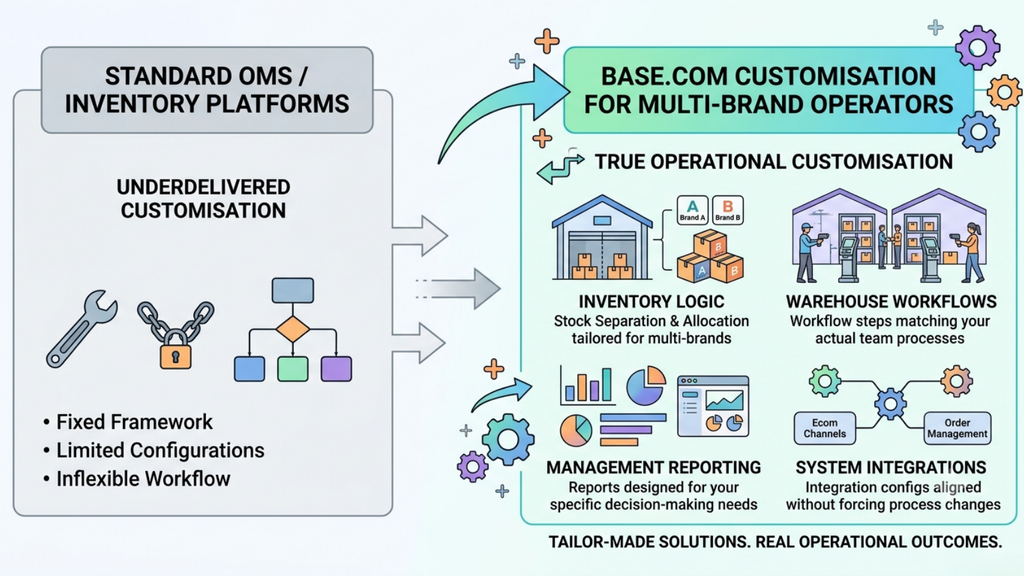
Across every dimension of implementation, Base.com’s customisation capability is central to the outcome multi-brand operators experience. This deserves specific attention because customisation is one of the most frequently overpromised and most consistently underdelivered capabilities among Indian inventory and OMS platforms.
For many platforms, customisation means selecting from a set of configuration options within a fixed framework. The workflow can be adjusted at the margins, but the underlying logic is immovable. For multi-brand operators, whose operational requirements for an integrated inventory management system for multi-brand ecommerce in India push well beyond standard frameworks, this surface-level customisation is insufficient.
Base.com’s customisation goes to the operational level:
- Inventory management logic configured for specific multi-brand stock separation and allocation requirements
- Custom workflow steps matching how the warehouse team actually executes receiving, putaway, picking, and dispatch
- Reporting structures designed around the specific decisions a management team needs to make, not generic report templates
- Integration configurations aligned with an operator’s channel and order management requirements without requiring operational process changes
The result is a system that feels designed for that specific operation, not adapted from a generic template with visible compromises. That distinction has real operational value. A system that genuinely fits the team’s workflows is used more consistently, trusted more completely, and produces more accurate outputs than one that the team has to work around at every non-standard step.
What Changes After Base.com Is Implemented
Across multi-brand operators, implementation of Base.com tends to produce the same broad pattern of outcomes: real-time visibility, improved accuracy, faster decision-making, and reduced operational complexity across multi-brand inventory and warehouse operations.
1. Inventory Accuracy Becomes Structural, Not Effortful
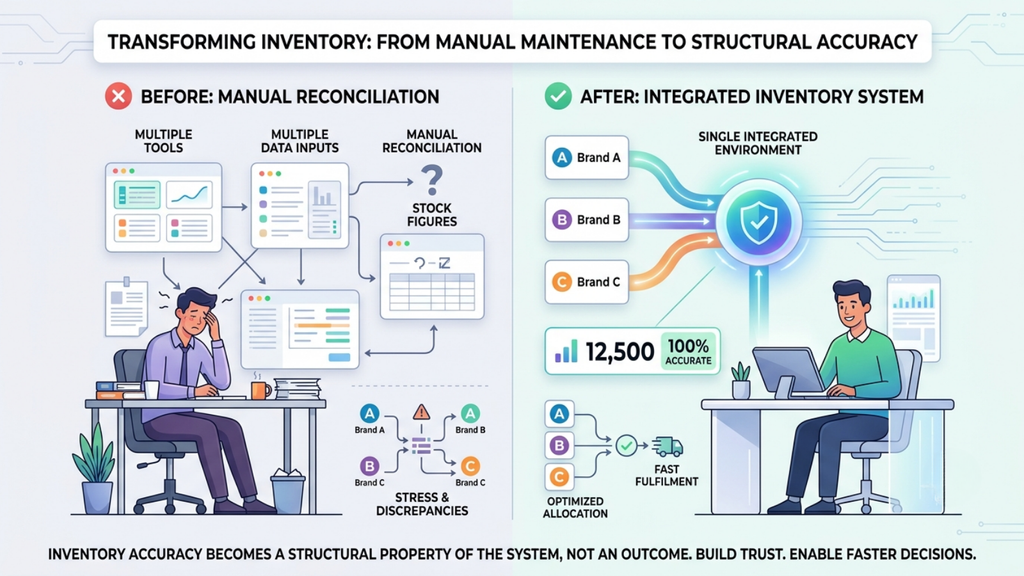
Before an integrated system, inventory accuracy in a multi-brand operation typically requires constant active effort. Figures need to be reconciled across tools. Discrepancies need to be investigated and resolved. Manual processes fill the gaps the system leaves open. Accuracy is something the team works toward daily, not something the system reliably delivers.
After Base.com, inventory accuracy becomes a structural property of the system rather than an outcome the team has to maintain manually. The single integrated environment means there is one data source, one version of stock figures, and one process feeding that source. The conditions that previously created discrepancies- multiple tools, multiple data inputs, and manual reconciliation between them- no longer exist.
For a multi-brand operation where inventory decisions directly affect brand performance, stock allocation, and fulfilment capacity, this accuracy shift is typically the most practically impactful outcome of implementing a proper integrated inventory management system for multi-brand ecommerce in India. The team can trust the numbers. That trust enables faster decisions, more confident stock management, and a fundamentally more stable operating environment.
2. Reporting Shifts From Passive to Actionable
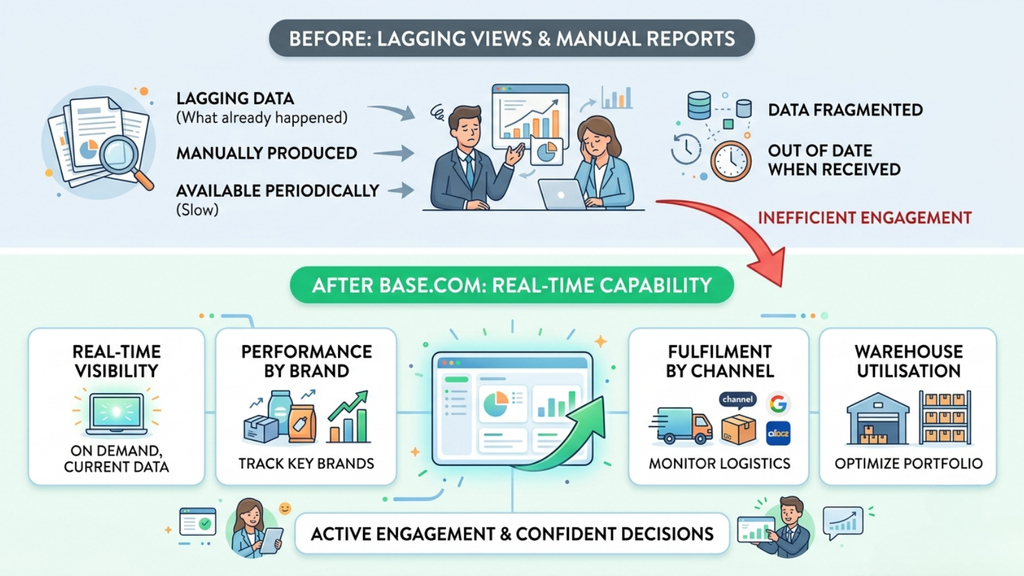
The improvement in reporting quality changes how a management team engages with operational data at every level. Before an integrated system, reports tend to be lagging views of what has already happened, produced manually, available periodically, and frequently out of date by the time they reach the people who need them to make decisions.
After Base.com, reporting becomes a real-time capability that the management team can use actively to manage the business. Performance by brand, fulfilment metrics by channel, and warehouse utilisation across the portfolio are all visible from a single system, on demand, with confidence in the accuracy of every figure.
| Operational Dimension | Before an Integrated System | After Base.com |
| Inventory data source | Multiple fragmented tools | Single integrated system |
| Stock figure accuracy | Requires manual reconciliation | Real-time, system-maintained |
| Reporting process | Manual, periodic, delayed | On-demand, live, configurable |
| Workflow flexibility | Rigid defaults, forced compromises | Custom-configured to actual operations |
| Extra tools required | Multiple, to fill system gaps | None, all within one platform |
| Management confidence in data | Low, discrepancies frequent | High, single source of truth |
| Scalability for new brands | Significant integration project | Configuration exercise |
3. The Extra Tools Are No Longer Needed
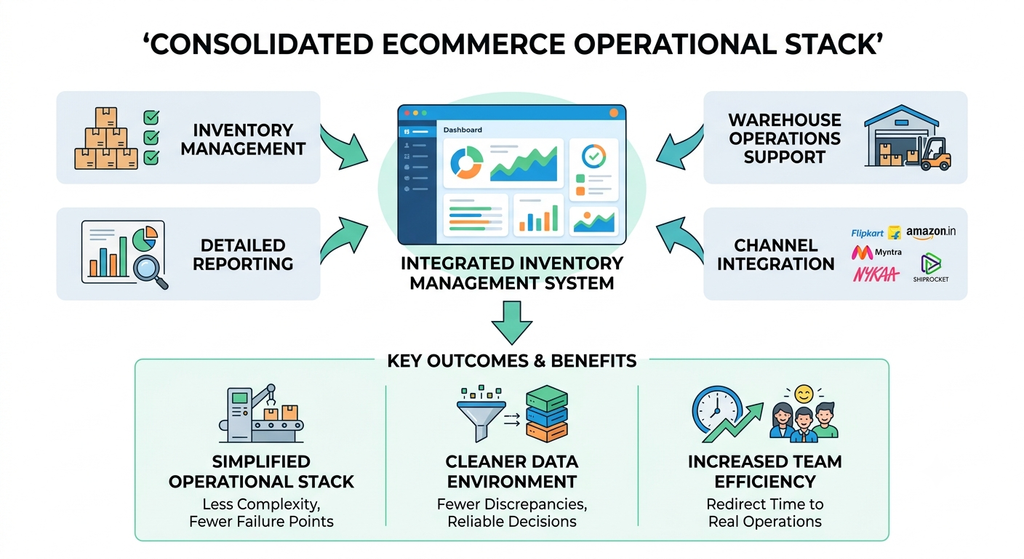
One of the most practically significant outcomes of a Base.com implementation is the elimination of the supplementary tools most multi-brand operators have been maintaining to fill gaps in a previous system. Every additional tool in an operations stack is a maintenance overhead, a data integration risk, and a potential source of discrepancy. Removing those tools simplifies the operational environment substantially.
With Base.com providing inventory management, warehouse operations support, channel integration, and detailed reporting within a single environment, the need for parallel tools disappears entirely. The operational stack becomes simpler, the data environment becomes cleaner, and the team can redirect the time previously spent managing tool discrepancies toward managing actual operations.
This consolidation is one of the highest-value outcomes of a properly implemented integrated inventory management system for multi-brand ecommerce in India. Fewer tools mean fewer failure points, fewer integration risks, and a more reliable data environment from which to make every operational and strategic decision.
4. A Scalable Foundation for Portfolio Growth

The deepest value Base.com creates for multi-brand operators is not the immediate operational improvement, significant as that is. It is the foundation it creates for continued growth across the brand portfolio.
A multi-brand operation that is adding brands needs an inventory and reporting system that absorbs that addition without requiring a re-implementation project. Adding a brand to a fragmented, multi-tool setup is a complex integration exercise. Adding a brand to a well-architected integrated inventory management system for multi-brand ecommerce in India is a configuration exercise; the underlying architecture is already designed for it.
Base.com is built to give multi-brand operators exactly that. The system is designed to accommodate additional brands, additional warehouse locations, and additional reporting dimensions as the portfolio grows. India’s D2C ecommerce segment is growing at 40% CAGR. Multi-brand operators who build the right operational foundation now will absorb that growth without proportional operational strain. Those who do not will face a re-implementation project under the worst possible conditions, in the middle of rapid growth.
What Makes Base.com a Differentiator for Multi-Brand Inventory Management
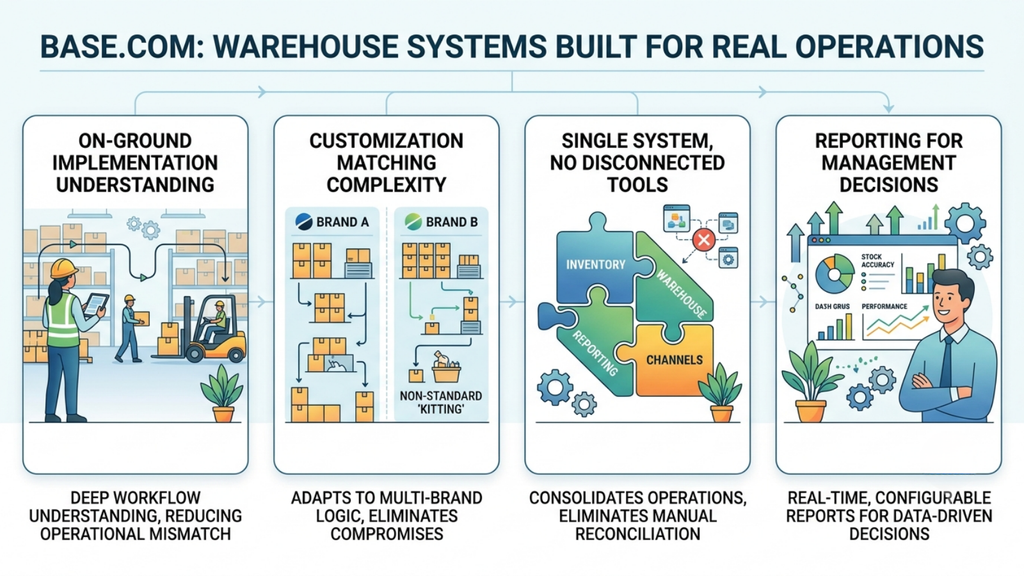
Base.com stands apart by going beyond surface-level features and building systems that align with real warehouse operations, multi-brand complexity, and decision-making needs. Its approach focuses on operational fit, not just functionality, ensuring that inventory systems work seamlessly under real-world conditions while supporting long-term scalability for Indian ecommerce businesses.
On-Ground Implementation Understanding
- Deep understanding of actual warehouse workflows before system configuration
- Focus on how stock moves, is stored, and is handled daily
- Reduces mismatch between system design and operational reality
- Ensures smoother adoption by warehouse and operations teams
Depth of Customisation That Matches Operational Complexity
- System adapts to brand-specific inventory and warehouse logic
- Supports non-standard workflows and multi-brand requirements
- Custom reporting aligned with business decision-making needs
- Eliminates compromises caused by rigid, template-based platforms
Single System Replacing Multiple Disconnected Tools
- Consolidates inventory, warehouse, and reporting into one platform
- Eliminates manual reconciliation across tools
- Reduces data discrepancies and integration dependencies
- Creates a scalable foundation for adding new brands and channels
Reporting Built for Management Decisions
- Real-time, configurable reports across brands and warehouses
- Enables faster, data-driven decision-making
- Provides accurate visibility into performance and stock
- Transforms reporting from a passive output into an active strategy tool
Key Evaluation Criteria for Multi-Brand Operators Selecting an Inventory System
| Evaluation Criterion | What to Look For |
| Single system integration | Manages inventory, warehouse operations, and reporting in one environment |
| Multi-brand native architecture | Multiple brands within one instance, not separate implementations |
| Customisation depth | Workflows and logic are adapted to actual operations, not just configured within fixed options |
| Reporting capability | Live data, configurable views, designed for management decision-making |
| Implementation approach | Vendor understands warehouse challenges before configuring the system |
| Scalability | Additional brands and locations added without re-implementation |
| Data accuracy architecture | Accuracy maintained through system design, not manual reconciliation |
For multi-brand ecommerce operators in India, inventory management is not just a backend function; it is a core driver of operational efficiency and growth. Fragmented tools create inaccuracies, delays, and scaling challenges, while an integrated system brings clarity, control, and consistency across brands and warehouses.
The right platform is not defined by feature count alone, but by how well it fits real operations, adapts to complexity, and supports decision-making. As this pattern shows across Indian multi-brand ecommerce, choosing a system like Base.com that aligns with actual workflows and delivers real-time visibility can transform inventory from a bottleneck into a competitive advantage.
Ready to build a more accurate, integrated inventory system for your multi-brand operation? Talk to us.