
The best order management software for ecommerce combines real-time multi-channel order capture, automated inventory allocation, and marketplace-specific dispatch rules, measured in actual numbers: G2 ratings above 4.3, implementation timelines under four weeks, and support for order volumes ranging from a few hundred to several thousand a day. This guide ranks the 10 platforms sellers are evaluating most in 2026, with a full comparison analysis, real G2 data, and a detailed breakdown of each platform’s definition, features, advantages, disadvantages, and ideal use case.
Order management software is projected to be a $2.44 billion global market, and the platforms that lead this category share a specific set of measurable traits, not just marketing claims. This guide walks through exactly what those traits are, with numbers attached at every step.
What Makes Order Management Different for Ecommerce
Ecommerce order management is not the same problem as retail or B2B order processing. An ecommerce seller receives orders continuously, from multiple storefronts, at unpredictable volumes, often with payment collected on delivery rather than at checkout.
A single ecommerce brand can be shipping from its own Shopify store, Amazon, Flipkart, Meesho, and Myntra simultaneously, each with a different order feed format and a different SLA clock running. Effective ecommerce order management software has to aggregate all of that into one queue, not five separate ones.
Sale events compound this further. Order volume during Big Billion Days or the Great Indian Festival can spike to 5-10x the daily average within a 48-72 hour window. Software built for steady, predictable retail order flow breaks down exactly when an ecommerce seller needs it most.
Cash on delivery adds a layer retail order management never has to solve. COD accounts for 55-65% of ecommerce orders in Tier 2 and Tier 3 Indian cities, and COD return rates run at 25-30% nationally. An ecommerce-specific OMS has to validate and risk-score every COD order before committing warehouse and courier resources to it.
The Ecommerce Order Lifecycle: From Cart to Delivery
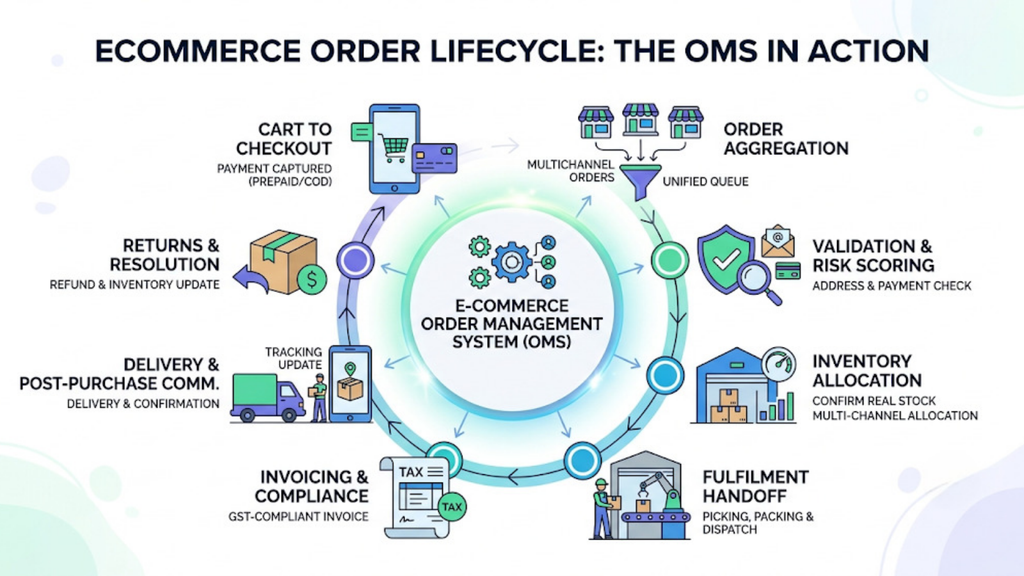
Every ecommerce order moves through a lifecycle that looks different from a single-channel retail transaction. Mapping it out shows exactly where a genuinely ecommerce-built OMS earns its value.
- Cart to checkout. The order is placed on a marketplace or storefront, with payment method, COD or prepaid, captured at this step.
- Order aggregation. The OMS pulls this order into a unified queue alongside every other channel’s orders, typically within 15-30 minutes of placement.
- Validation and risk scoring. Address completeness, payment confirmation, and for COD specifically, pincode-level return risk gets checked before the order moves forward.
- Inventory allocation. The system confirms real stock availability at a warehouse that can hit the order’s SLA window, critical when the same SKU sells across four or more channels at once.
- Fulfilment handoff. The order passes to the warehouse for picking, packing, and dispatch, with the OMS tracking status at every step.
- Invoicing and compliance. A GST-compliant invoice generates automatically, reflecting the channel, buyer location, and applicable tax treatment.
- Delivery and post-purchase communication. Tracking updates sync back to the customer and the originating channel, with COD orders benefiting from delivery-day confirmation nudges.
- Returns and resolution. A returned or cancelled order triggers a refund, an inventory update, and, where applicable, a marketplace claim, closing the loop back to accurate stock counts.
An OMS that only automates steps 1 through 5 is solving half of what ecommerce actually requires. Genuinely strong platforms treat invoicing, delivery communication, and returns as core functions, not afterthoughts bolted on later.
How We Evaluated These Platforms
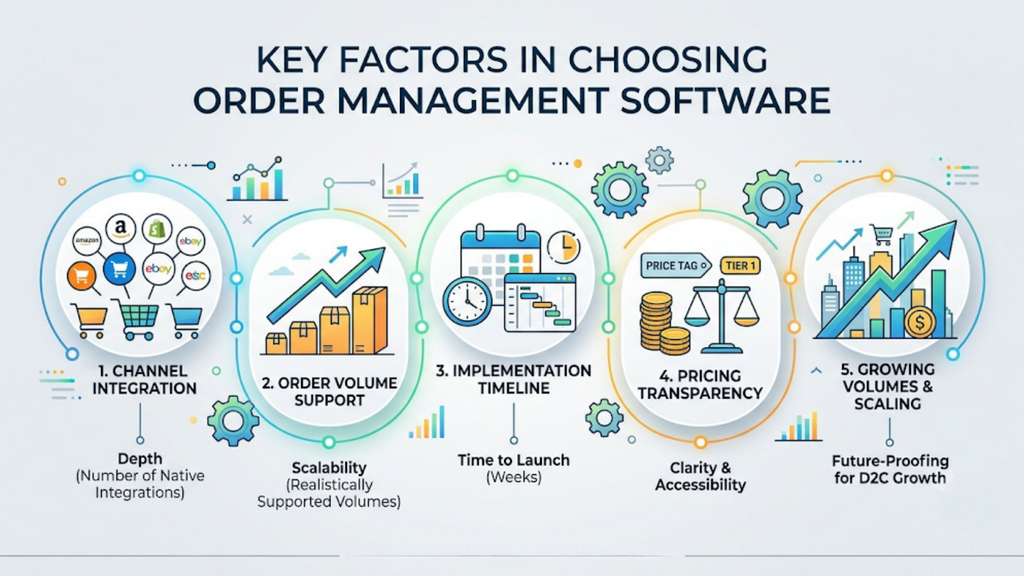
Choosing the best order management software for ecommerce requires comparing platforms on identical, quantifiable criteria rather than vendor claims. We scored each entry against five measurable factors.
- Channel integration depth (number of native marketplace and cart integrations)
- Order volume the platform is realistically built to support
- Implementation timeline in weeks
- Pricing transparency and entry-tier accessibility
Ecommerce order volumes are growing fast enough that these numbers matter more than they did even two years ago. India’s ecommerce market alone has crossed $226 billion, growing at a 40% CAGR for D2C brands specifically, which means the best order management software for ecommerce has to scale from hundreds to thousands of daily orders without a full re-platform.
Comparison Analysis: Best Order Management Software for Ecommerce, by the Numbers
Choosing an order management system involves more than comparing features; it requires understanding how each platform performs across pricing, integrations, automation, scalability, and fulfillment capabilities. This side-by-side comparison breaks down the key metrics that matter most, making it easier to identify the best order management software for your ecommerce business.
| Platform | Ideal Daily Order Volume | Typical Implementation Time | Entry Pricing Signal |
| Base.com | 100-10,000+ | 2-3 weeks | Custom quote |
| Unicommerce | 500-10,000+ | 3-4 weeks | No public pricing |
| Vinculum (Vin eRetail) | 300-5,000 | 3-4 weeks | No public pricing |
| Increff | 200-5,000 | 2-4 weeks | No public pricing |
| EasyEcom | 50-500 | 1-2 weeks | No public pricing |
| Zoho Inventory | 10-300 | Under 1 week | Free tier available |
| SAP Business One | 1,000+ | 8-16 weeks | No public pricing |
| WareIQ | 50-1,000 | 2-3 weeks | Custom quote |
| ShipHero | 500-5,000+ | 4-8 weeks | Contact for pricing |
| Extensiv Order Manager | 100-2,000 | 2-4 weeks | Fixed pricing tiers |
Three numbers stand out from this table. First, the highest-rated platforms on this list cluster tightly between 4.3 and 4.7 out of 5, meaning the real differentiator for most buyers of the best order management software for ecommerce is fit, not raw satisfaction score. Second, implementation time ranges from under a week to as long as 16 weeks, a 16x difference that matters enormously for a growing seller who cannot afford a long rollout. Third, only three of the ten platforms publish any pricing information at all, which is why requesting a live, volume-specific quote is essential before comparing total cost of ownership.
Top 10 Best Order Management Software for Ecommerce
As ecommerce businesses expand across multiple marketplaces, websites, and fulfillment channels, managing orders manually becomes increasingly difficult. The best order management software centralizes every order in one place, automates fulfillment workflows, synchronizes inventory in real time, and helps businesses scale without operational bottlenecks.
1. Base.com
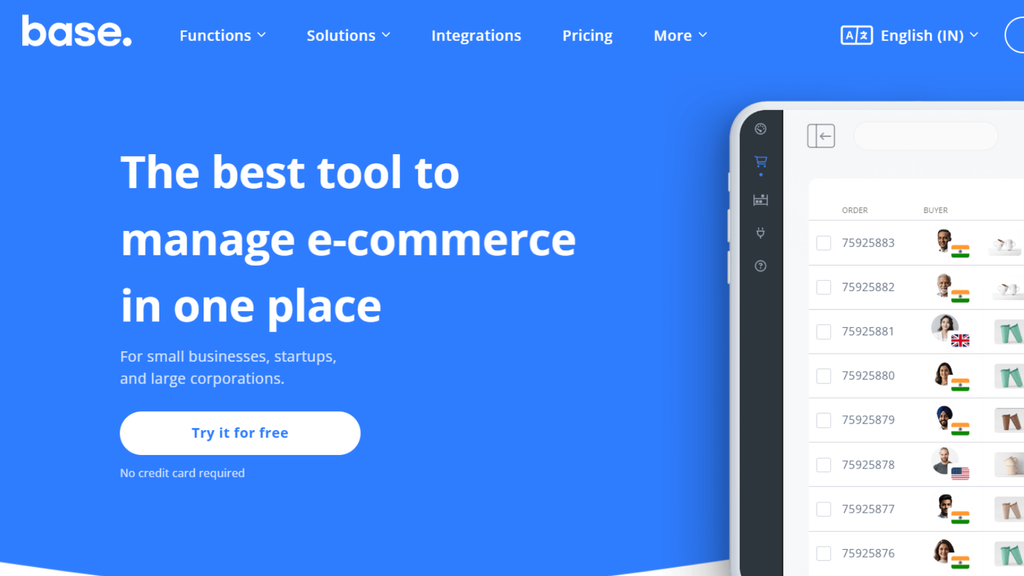
Base.com is an order and warehouse management platform built specifically for Indian D2C, marketplace, and B2B sellers, unifying order capture, COD risk scoring, inventory allocation, and dispatch across every channel in one system.
Best for: Sellers processing 100 to 10,000+ orders a day across Amazon, Flipkart, Meesho, Myntra, and their own website, who need COD-aware order validation and SAP connectivity as they scale.
Among the best order management software for ecommerce sellers who need COD, GST, and multi-marketplace complexity solved natively, not bolted on after the fact.
| Do | Don’t |
| Use it if COD orders make up a meaningful share of your daily volume | Don’t expect a generic global template experience; it is built around Indian order patterns specifically |
| Use it if you sell across 3 or more channels needing one order queue | Don’t onboard without mapping your SKU master first; cutover is faster when this is clean |
Features: Base.com’s ecommerce feature set is built around the specific points where Indian order flow breaks down.
- Marketplace order aggregation: pulls orders from Amazon, Flipkart, Meesho, Myntra, and the brand’s own storefront into one queue within 15-30 minutes of placement, so no channel needs a separate manual check.
- SLA-tagged order queue: every order is colour-coded by dispatch deadline the moment it enters the system, so warehouse staff always work the most urgent order first, not the one that arrived first.
- Pincode-level COD risk scoring flags: high-RTO pincodes before an order is confirmed for dispatch, not after a failed delivery attempt has already cost outbound freight.
- Real-time inventory allocation: checks live stock across every warehouse before confirming an order, preventing the same unit from being promised on two channels within minutes of each other.
- Automated GST-compliant invoicing: generates the correct tax treatment per channel and buyer location automatically at the moment of dispatch, removing a common compliance failure point.
- Native SAP connector: pushes order and invoice data directly into SAP for brands running enterprise distribution alongside their ecommerce channels.
- Live exception dashboard: surfaces orders at risk of missing SLA, stuck in a courier handoff, or awaiting COD confirmation, before they become customer-facing failures.
Advantages: Built for India’s COD and multi-marketplace order flow from day one, closing the three most common revenue leaks Indian D2C brands face: overselling, missed SLAs, and failed COD deliveries. The 2-3 week implementation timeline and native SAP connectivity make it a rare combination of fast time-to-launch and long-term enterprise scalability.
Disadvantages: As a newer entrant, third-party review volume on G2 is still building, so buyers who weigh review count heavily will find less public sentiment to draw on today. This is a timing gap, not a functionality gap, best assessed through a live demo rather than review volume alone.
G2 link: https://www.g2.com/products/base/reviews
2. Unicommerce
Unicommerce is an established order, inventory, and warehouse management system supporting multi-channel ecommerce and offline retail operations across roughly 75 verified G2 reviews at a 4.5/5 average rating.
Best for: Larger catalogues and sellers processing 500 to 10,000+ orders daily who need broad, pre-built integration coverage.
One of the most recognised names among the best order management software for ecommerce sellers prioritising integration breadth.
| Do | Don’t |
| Use it if you need order integrations across a very large number of channels and couriers | Don’t expect the simplest learning curve; new users report the interface can feel dense initially |
| Use it if you value an established, high-review-volume platform | Don’t assume every module is included at the entry pricing tier |
Features: Unicommerce’s depth shows most clearly in how many distinct order scenarios it has already built connectors for.
- Centralised ecommerce order database: every order, regardless of channel, lands in one system, giving a single source of truth instead of five separate marketplace dashboards.
- Multichannel checkout-to-dispatch order syncing: orders move from placement to dispatch tracking without manual re-entry at any stage.
- Multi-warehouse routing for ecommerce fulfilment: automatically assigns an order to the warehouse best positioned to hit its delivery window.
- 3PL order management: extends order visibility to third-party logistics partners, useful for brands that outsource part of their fulfilment.
- Marketplace-specific connections: supports a wide range of Indian and international marketplaces out of the box, reducing the need for custom integration work.
- Order-to-dispatch tracking per channel: gives visibility into where every order sits in its lifecycle, broken down by the channel it originated from.
Advantages: The wide integration ecosystem lets brands with large, complex catalogues avoid building custom connectors for niche marketplaces or couriers. Strong brand recognition in Indian ecommerce and roughly 75 verified reviews backing its 4.5/5 G2 rating give buyers a reasonably deep pool of real sentiment to evaluate.
Disadvantages: Some G2 reviewers note the interface can feel overwhelming for new users during initial onboarding. Teams should budget more onboarding time than a lighter platform requires and confirm which modules are included at their pricing tier.
G2 link: https://www.g2.com/products/unicommerce/reviews
3. Vinculum (Vin eRetail)
Vin eRetail, from Vinculum, is an omnichannel order management suite connecting online marketplaces, webstores, and physical retail stores, rated 4.6/5 across roughly 66 G2 reviews.
Best for: Retailers processing 300 to 5,000 orders a day across both offline stores and online channels who need a single order view.
A strong pick among the best order management software for ecommerce businesses with a genuine offline-plus-online footprint.
| Do | Don’t |
| Use it if you run physical retail stores alongside online order channels | Don’t expect it to be the cheapest option for a pure online-only D2C brand |
| Use it if GST and e-way bill compliance features matter to your order workflow | Don’t skip evaluating which specific Vinculum product fits your need; they are modular |
Features: Vin eRetail’s feature set leans into the specific challenge of running offline and online order flow through one system.
- Omnichannel order aggregation: combines orders from physical stores, webstores, and marketplaces into a single view, useful for retailers who did not start as pure ecommerce brands.
- Real-time order sync across stores and marketplaces: keeps stock and order status consistent whether a sale happens on the shop floor or on a marketplace app.
- GST and e-way bill compliance support: generates compliant documentation automatically for interstate stock movement, a common pain point for multi-location retailers.
- Catalogue management: keeps product listings consistent across every channel from one content source, reducing mismatched descriptions or pricing between platforms.
- Dispatch tracking: gives visibility into order status from confirmation through to courier handover, regardless of which channel the order originated from.
Advantages: Genuine parity between offline and online order handling is Vin eRetail’s strongest advantage, a use case many ecommerce-only platforms treat as an afterthought. Its 4.6/5 G2 rating, the highest among Indian-market platforms here, reflects an established vendor that has navigated multiple GST and compliance rule changes already.
Disadvantages: The modular product structure, split across Vin OMS, Vin WMS, and Vin PIM, means buyers need to evaluate which specific product or combination matches their requirement rather than assuming one package covers everything.
G2 link: https://www.g2.com/products/vin-eretail-oms/reviews
4. Increff
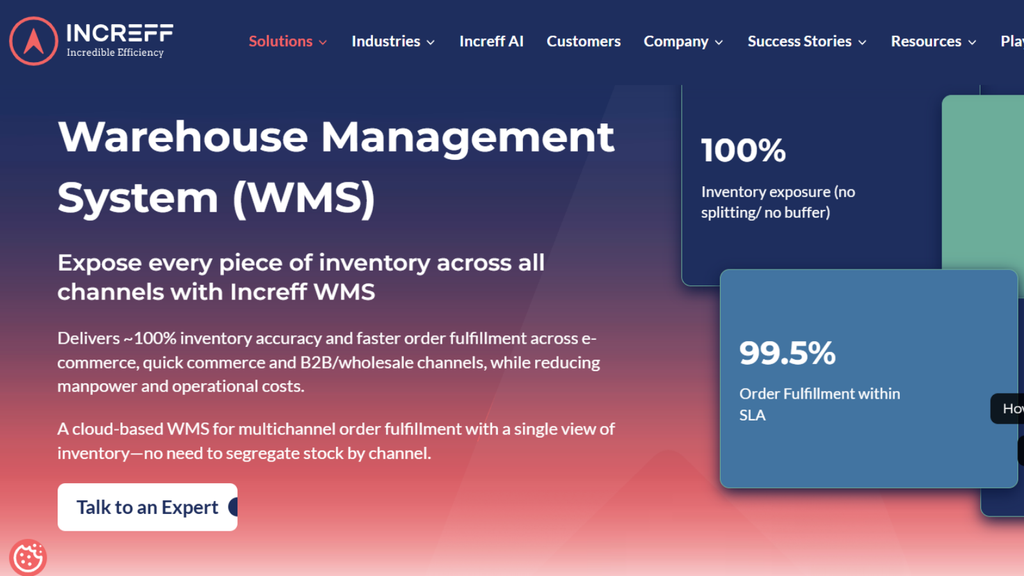
Increff is a cloud-hosted order and warehouse management platform giving fashion and lifestyle brands a single, real-time view of orders and inventory, rated 4.7/5 across roughly 100 G2 reviews, the highest rating on this list.
Best for: Fashion, footwear, and lifestyle brands processing 200 to 5,000 orders a day needing high order-fulfilment accuracy.
The highest-rated platform among the best order management software for ecommerce sellers in the fashion and lifestyle category specifically.
| Do | Don’t |
| Use it if order-fulfilment accuracy and unique-piece barcoding matter for your category | Don’t expect the deepest reporting customisation; some reviewers note this as a limitation |
| Use it if you are a fashion, footwear, or lifestyle brand specifically | Don’t assume it is the best fit outside fashion-adjacent categories without evaluating your own workflow |
Features: Increff’s feature set is built specifically around order and pick accuracy for fashion and lifestyle catalogues.
- Unique piece barcoding for serialisation: assigns a distinct barcode to every individual unit, not just every SKU, enabling item-level tracking through the full order lifecycle.
- Near real-time order and inventory syncing: keeps stock and order status aligned across channels with minimal lag, reducing the overselling risk common in fast-moving fashion drops.
- 99.5%+ order fulfilment SLA accuracy claimed by the vendor: a specific, vendor-reported benchmark for how reliably orders ship within their committed window.
- Single view of orders across online and offline channels: useful for fashion brands running both retail stores and marketplace listings from the same stock pool.
Advantages: Increff carries the highest G2 rating on this list at 4.7/5, backed by roughly 100 reviews. Its reputation is strongest around order accuracy and warehouse execution, which matters disproportionately for fashion brands where a wrong size or colour shipped is a near-certain return.
Disadvantages: Some reviewers note that report customisation options are more limited than they would like. Its strongest fit is fashion and lifestyle categories specifically, so brands outside that category should evaluate whether the serialisation-first approach still adds proportional value.
G2 link: https://www.g2.com/products/increff-wms/reviews
5. EasyEcom
EasyEcom is an omnichannel order and inventory management solution aimed at small and growing online sellers, rated 4.5/5 across roughly 12 verified G2 reviews.
Best for: Growing D2C brands processing 50 to 500 orders a day wanting a straightforward, cost-effective starting point.
Frequently shortlisted among the best order management software for ecommerce brands prioritising affordability during early scaling.
| Do | Don’t |
| Use it if you are a smaller brand wanting a cost-effective entry point | Don’t expect the most advanced feature depth compared to more established enterprise platforms |
| Use it if centralised order and vendor management are your core needs | Don’t underestimate the initial setup time; some users note certain workflows take time to learn |
Features: EasyEcom’s feature set targets the specific pain points of a growing, still-small ecommerce operation.
- Centralised order tracking: consolidates orders from every connected channel into one dashboard, removing the need to check separate seller portals each morning.
- Vendor management: tracks purchase orders and supplier performance alongside customer order data in the same system.
- Bin allocation: assigns specific warehouse bin locations to SKUs, giving smaller warehouses a basic slotting structure without needing a full WMS.
- Real-time order sync: updates stock and order status across channels as sales happen, reducing the overselling risk that hits growing brands hardest.
- Order management dashboard: gives a single view of order status, from placement through dispatch, without switching between tools.
Advantages: EasyEcom is genuinely cost-effective for growing brands, one of the more accessible entry points on this list, and scales reasonably well without requiring a full re-platform in the first year or two. Its 4.5/5 G2 rating matches several larger, more established platforms on this list.
Disadvantages: Lower review volume, around 12 reviews, makes it harder to benchmark sentiment with the same confidence as more established platforms. Some reviewers also note certain workflows feel complex during initial setup and onboarding.
G2 link: https://www.g2.com/products/easyecom/reviews
6. Zoho Inventory
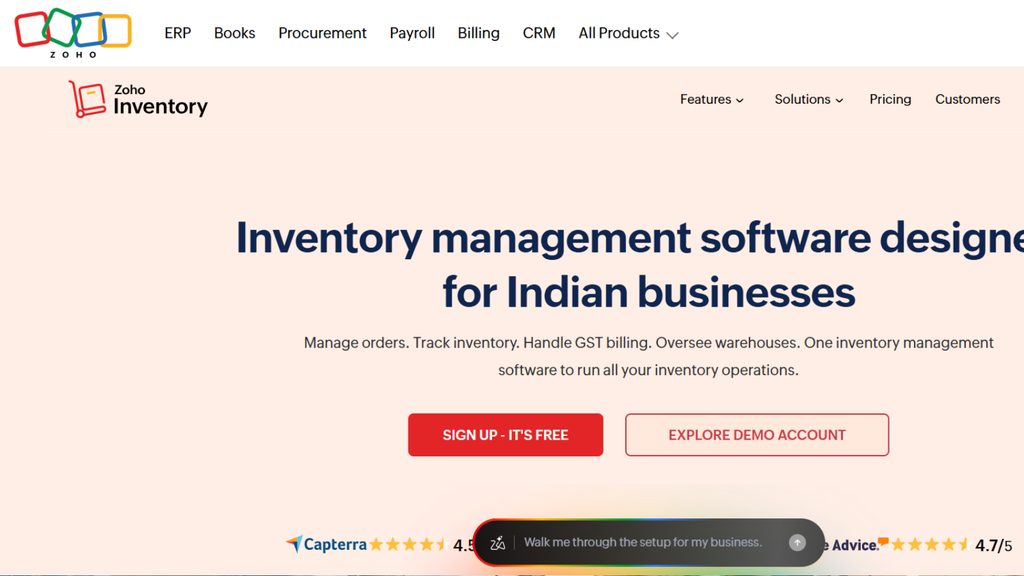
Zoho Inventory is a cloud-based order and inventory management tool built to integrate natively with the broader Zoho software suite, rated 4.3-4.4/5 across roughly 107 G2 reviews.
Best for: Small businesses processing 10 to 300 orders a day already using Zoho Books, Zoho CRM, or other Zoho products.
A dependable, low-cost option among the best order management software for ecommerce teams standardised on the Zoho stack.
| Do | Don’t |
| Use it if you already run Zoho Books, Zoho CRM, or Zoho Commerce | Don’t expect the deepest India-specific marketplace and COD logic compared to purpose-built ecommerce OMS platforms |
| Use it if you want a genuinely free entry tier to start with | Don’t expect the most advanced order-volume handling at enterprise scale |
Features: Zoho Inventory’s feature set is defined by how tightly it connects to the rest of the Zoho ecosystem.
- Centralised order database: tracks every order alongside inventory counts in one system, viewable from the same dashboard used for Zoho Books or Zoho CRM.
- Low stock notifications: alerts the team automatically when a SKU crosses a configured reorder threshold, reducing manual stock-checking.
- Multi-warehouse order management: supports moderate-scale operations running more than one storage location.
- Integrations with ecommerce platforms: connects to a range of storefronts and marketplaces, though with less India-specific marketplace depth than purpose-built Indian OMS platforms.
- Native Zoho ecosystem connectivity: order, accounting, and CRM data flow between Zoho products without manual export or import.
Advantages: A genuinely free entry tier makes Zoho Inventory the strongest option for a small business testing whether dedicated order management is worth the switch from spreadsheets. Its integration with the wider Zoho suite means order data flows automatically into existing financial and customer records.
Disadvantages: Less depth on India-specific marketplace and COD-return logic compared to platforms purpose-built for Indian ecommerce operations. It is also not built for the most advanced order-volume scenarios at enterprise scale.
G2 link: https://www.g2.com/products/zoho-inventory/features
7. SAP Business One
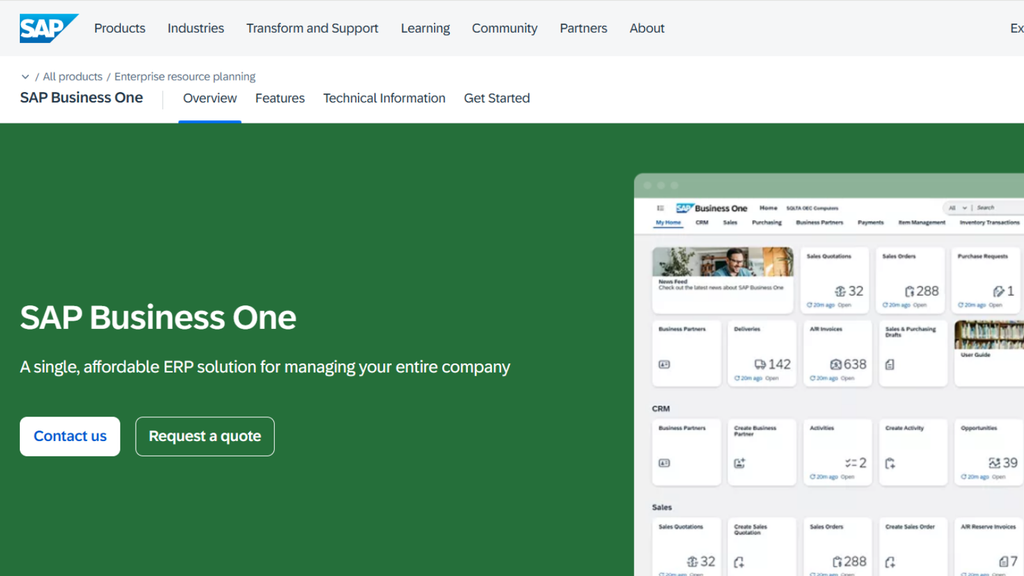
SAP Business One is a full ERP system covering finance, order management, inventory, purchasing, and CRM in a single platform, rated 4.3/5 across roughly 530 G2 reviews, the highest review count on this list by a wide margin.
Best for: Mid-size to enterprise manufacturers, distributors, and B2B sellers processing 1,000+ orders a day who need order management deeply integrated with finance and production.
The most enterprise-grade option among the best order management software for ecommerce sellers scaling beyond pure D2C.
| Do | Don’t |
| Use it if you need order management unified with finance, procurement, and production | Don’t expect the fastest go-live timeline compared to lighter cloud-native OMS platforms |
| Use it if multi-currency, multi-legislation operations are relevant to your business | Don’t underestimate implementation and configuration effort, typically 8-16 weeks |
Features: SAP Business One’s feature set reflects its identity as a full ERP rather than an ecommerce-first order tool.
- Unified finance, order management, inventory, purchasing, and CRM: every business function shares the same underlying data, eliminating the reconciliation gap between separate systems.
- Multi-currency and multi-legislation support: handles order processing across regions with different tax and regulatory requirements, relevant for brands selling internationally alongside India.
- Real-time shared data across departments: an order confirmed in the ecommerce layer immediately reflects in finance and inventory records without a manual sync step.
- Automated approvals and alerts: routes order exceptions or high-value transactions through configurable approval chains automatically.
Advantages: Deep ERP-level integration is unmatched on this list for brands whose order management needs to sit alongside finance and production planning. It carries by far the largest verified review base here at roughly 530 reviews.
Disadvantages: Reviewers consistently note a steeper configuration and onboarding process, typically 8-16 weeks, compared to lighter ecommerce-specific order tools. Choosing it purely for D2C marketplace needs means paying for far more system than a growing brand actually needs day to day.
G2 link: https://www.g2.com/products/sap-business-one/reviews
8. WareIQ
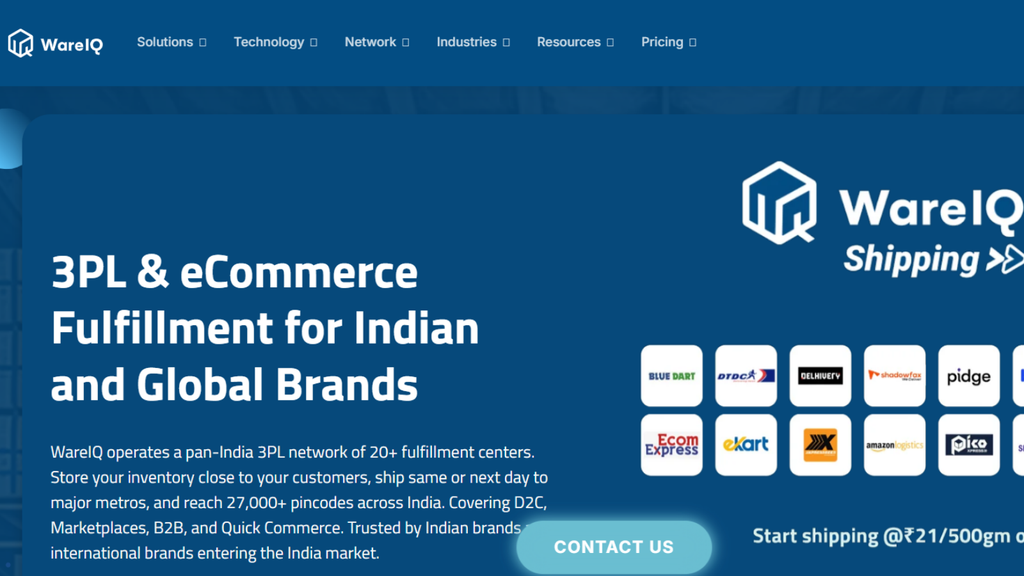
WareIQ combines fulfilment infrastructure, including warehousing and courier network access, with order and inventory management software for Indian ecommerce sellers.
Best for: Brands processing 50 to 1,000 orders a day who want order management software bundled together with actual fulfilment centre and courier access.
A distinct entry among the best order management software for ecommerce sellers because it pairs software with physical fulfilment infrastructure.
| Do | Don’t |
| Use it if you want fulfilment infrastructure and order software from one vendor | Don’t expect a large volume of independent G2 reviews yet to benchmark sentiment |
| Use it if smart inventory placement across fulfilment centres is a priority | Don’t skip requesting references directly given the platform’s more limited public review history |
Features: WareIQ’s feature set centres on pairing order software with physical fulfilment access.
- Smart inventory placement across fulfilment centres: recommends which of its fulfilment centres should hold stock for a given SKU based on where demand is concentrated.
- Order management aggregates: orders across channels into one queue, similar in principle to a standalone OMS.
- Courier integration: connects to multiple courier partners directly through the fulfilment network, reducing the need for a brand to manage courier contracts independently.
- Fulfilment network: access gives smaller and mid-size brands access to a distributed warehouse network without needing to build or lease their own facilities.
Advantages: WareIQ is genuinely useful for brands wanting fulfilment infrastructure and order software bundled from a single vendor. Smart inventory placement across fulfilment centres can meaningfully improve delivery speed for brands without the scale to build their own multi-city footprint.
Disadvantages: Fewer than 5 independent reviews on G2 make it harder to benchmark against more established platforms. Brands with their own dedicated warehouse network may find the bundled model less relevant than a standalone OMS.
G2 link: https://www.g2.com/products/wareiq/reviews
9. ShipHero
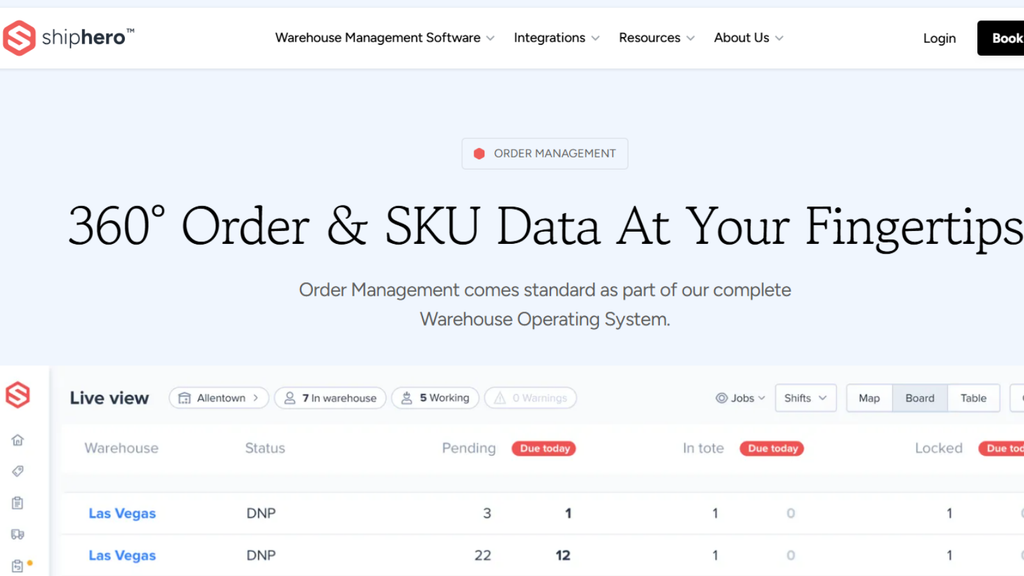
ShipHero is a cloud-based order management and warehouse fulfilment platform rated 4.4/5 across roughly 205 G2 reviews, powering the shipment of more than $8 billion in ecommerce merchandise annually according to the vendor.
Best for: Ecommerce brands and 3PLs processing 500 to 5,000+ orders a day needing order management tightly paired with warehouse execution tools.
A high-volume option among the best order management software for ecommerce brands and 3PLs operating primarily in North America.
| Do | Don’t |
| Use it if you need order management paired tightly with warehouse-floor execution | Don’t expect the same depth of Indian marketplace and GST-specific features as India-native platforms |
| Use it if barcode-driven picking accuracy is a priority | Don’t overlook the 4-8 week implementation window when planning a go-live date |
Features: ShipHero’s feature set is built around pairing order management with hands-on warehouse execution.
- Barcode-driven order picking: enforces scan confirmation at every pick, a vendor-reported driver behind its claimed 99% reduction in mis-picks and mis-ships.
- Rate shopping across couriers: automatically compares courier rates for each order and selects the most cost-effective option that still meets the delivery SLA.
- Order prioritisation rules by warehouse: lets operations teams configure which orders should be worked first based on warehouse-specific rules, not just a flat FIFO queue.
- Mobile-powered fulfilment workflows: gives pickers and packers a mobile interface for real-time task assignment and confirmation on the warehouse floor.
- Real-time order and inventory tracking: keeps stock and order status synced continuously across every connected sales channel.
Advantages: ShipHero carries roughly 205 reviews at a consistent 4.4/5 rating, a statistically meaningful base for evaluating real sentiment. Its reputation for reducing mis-picks is well documented, with the vendor reporting error reductions of up to 99% from barcode scanning enforcement.
Disadvantages: Its typical implementation window runs 4-8 weeks, longer than several other platforms here. It also carries less depth on India-specific COD and GST requirements, reflecting a stronger footprint in North America than Indian ecommerce specifically.
G2 link: https://www.g2.com/products/shiphero/reviews
10. Extensiv Order Manager
Extensiv Order Manager, formerly Skubana, is an order management and ecommerce operations platform rated 4.4/5 across roughly 67 G2 reviews, built for multi-channel sellers needing automation across order routing and purchasing.
Best for: Brands processing 100 to 2,000 orders a day selling across DTC, wholesale, and marketplace channels simultaneously.
A flexible option among the best order management software for ecommerce sellers wanting fixed, transparent pricing tiers.
| Do | Don’t |
| Use it if you sell across DTC, wholesale, and marketplaces simultaneously | Don’t expect native Indian marketplace or COD-specific logic |
| Use it if fixed, published pricing tiers matter to your evaluation process | Don’t expect the same order-volume ceiling as larger enterprise platforms on this list |
Features: Extensiv Order Manager’s feature set is built for sellers running multiple sales models from one system.
- Centralised inventory database: tracks stock across DTC, wholesale, and marketplace channels in a single record, avoiding the split-inventory problem multi-model sellers often face.
- Stock history reporting: gives a historical view of stock movement, useful for spotting slow-moving SKUs or unexpected demand spikes.
- Low stock notifications: flags SKUs approaching a configured reorder threshold automatically.
- Bundles and kit management: supports orders made up of multiple component SKUs, decomposing them at the order level rather than treating a kit as one opaque unit.
- Accounting integrations: connect order data to common accounting platforms, reducing manual reconciliation between sales and finance records.
- Multichannel order syncing: pulls orders from every connected channel into one queue on a defined sync schedule.
Advantages: Extensiv Order Manager backs its 4.4/5 rating with roughly 67 reviews, a reasonably solid base for its size. Its transparent, fixed pricing tiers are a genuine differentiator on a list where most platforms require a custom quote to even estimate cost.
Disadvantages: Not built with India-specific COD, RTO, or GST logic, making it a stronger fit for sellers operating primarily outside India. Its order-volume ceiling also sits lower than some larger enterprise platforms here.
G2 link: https://www.g2.com/products/extensiv-order-manager/reviews
Ecommerce-Native vs. ERP-Native: A Numbers-Based Comparison
Choosing between an ecommerce-native platform and an ERP-native solution isn’t just about features; it’s about how each performs under real operational demands.
This numbers-based comparison evaluates key metrics such as integrations, automation, order processing, scalability, implementation time, and total cost of ownership to help businesses determine which approach delivers the best long-term value.
| Category | Ecommerce-Native (Base.com, Unicommerce, Vinculum, Increff, EasyEcom, WareIQ, ShipHero, Extensiv) | ERP-Native (SAP Business One, Zoho Inventory) |
| Average G2 rating on this list | 4.3-4.7/5 | 4.3/5 |
| Typical implementation time | 1-8 weeks | 8-16 weeks (SAP), under 1 week (Zoho) |
| Marketplace integrations | Native, built-in | Requires middleware for most marketplaces |
| COD and RTO logic | Present in India-native platforms | Not a core focus |
| Best order volume fit | 50 to 10,000+ orders/day depending on platform | 10 orders/day (Zoho) to 1,000+ (SAP) |
Most sellers evaluating the best order management software for ecommerce end up choosing based on order volume trajectory over the next 12-24 months, not just current-day needs, since a re-platform mid-growth carries its own real cost in lost time and data migration risk.