Peak season in Indian ecommerce is not a sprint. It is a stress test. Every operational gap you ignored during slow months gets exposed in the first 48 hours of a sales event. Order Management Systems in India exist to close those gaps before the traffic hits, not after your SLA breach notifications start flooding in.
Indian ecommerce crossed $226 billion in 2024. D2C is compounding at 40% CAGR. But most brand operations teams have not scaled their infrastructure to match these volumes. The result is predictable: COD return rates spike to 25-30% during peak, inventory goes out of sync across channels, split shipments multiply customer service tickets, and warehouse throughput collapses under volume.
This guide gives Indian D2C brands, marketplace sellers, and omnichannel retailers a structured 15-day framework to get operationally ready before their next big sale. It is built around Base.com, one of the leading Order Management Systems in India, and every action item maps to a real configuration or workflow in the platform.
If you are selling on Amazon, Flipkart, Myntra, Meesho, Blinkit, or through your own Shopify or WooCommerce store, this guide is written for your stack.
Why Most Indian Sellers Fail At Peak Season (And How Order Management Systems In India Fix It)
Peak season failures in Indian ecommerce almost always trace back to the same root causes: channel inventory is not in sync, order routing is manual and slow, and there is no single system of record across warehouses and fulfilment partners.
Brands that rely on spreadsheets, WhatsApp confirmations, and disconnected ERPs during a 5x order volume spike are not running operations; they are managing chaos.
Order Management Systems in India, like Base.com, are designed to eliminate that chaos by centralising every order, every SKU, and every fulfilment event into one real-time workflow. The result is not just fewer errors. It has faster fulfilment, lower RTO, and more revenue captured per sale window.
The 15-day framework below is the operational checklist that separates brands that win peak season from brands that survive it.
Day 1-3: Data Foundation: Clean Before You Connect
Day 1: Audit Your SKU Master Across Every Channel

Every downstream failure traces to a broken SKU master. Before you connect any channel to your Order Management Systems in India, verify three things for every active SKU:
- Does your internal SKU ID match the marketplace listing ID on Amazon, Flipkart, and Myntra exactly?
- Are bundle sizes, inner pack counts, and carton configurations accurate in your system?
- Is your inventory count in Base.com reconciled with your physical warehouse count?
Indian brands managing 500-5,000 active SKUs across 4-6 channels typically find 8-12% of their SKU mappings have errors. One wrong mapping during peak routes 1,000 orders to a SKU that your warehouse cannot fulfil. Fix this on Day 1.
Base.com’s SKU master module allows you to map internal codes to channel-specific identifiers at the variant level, colour, size, and pack configuration, so every order that arrives gets matched to the correct warehouse bin immediately, without manual intervention.
Day 2: Reconcile Opening Inventory Across All Warehouses

Before peak, you need one number: the true available-to-promise (ATP) quantity for every SKU at every warehouse Base.com is managing. This is different from your gross inventory figure.
ATP = Physical Stock minus Reserved Stock minus Safety Buffer
Order Management Systems in India that do not maintain ATP in real time create overselling. Overselling during peak hours creates cancellations. Cancellations create negative seller ratings on Flipkart and Amazon that take 60-90 days to recover.
On Day 2, run a full inventory reconciliation in Base.com. Confirm that every warehouse, owned, 3PL, or fulfilment centre is synced. Assign safety buffer quantities by SKU velocity category. Fast-moving SKUs should carry a buffer of 3-5% of expected sales volume.
Day 3: Validate Channel Connections And API Health
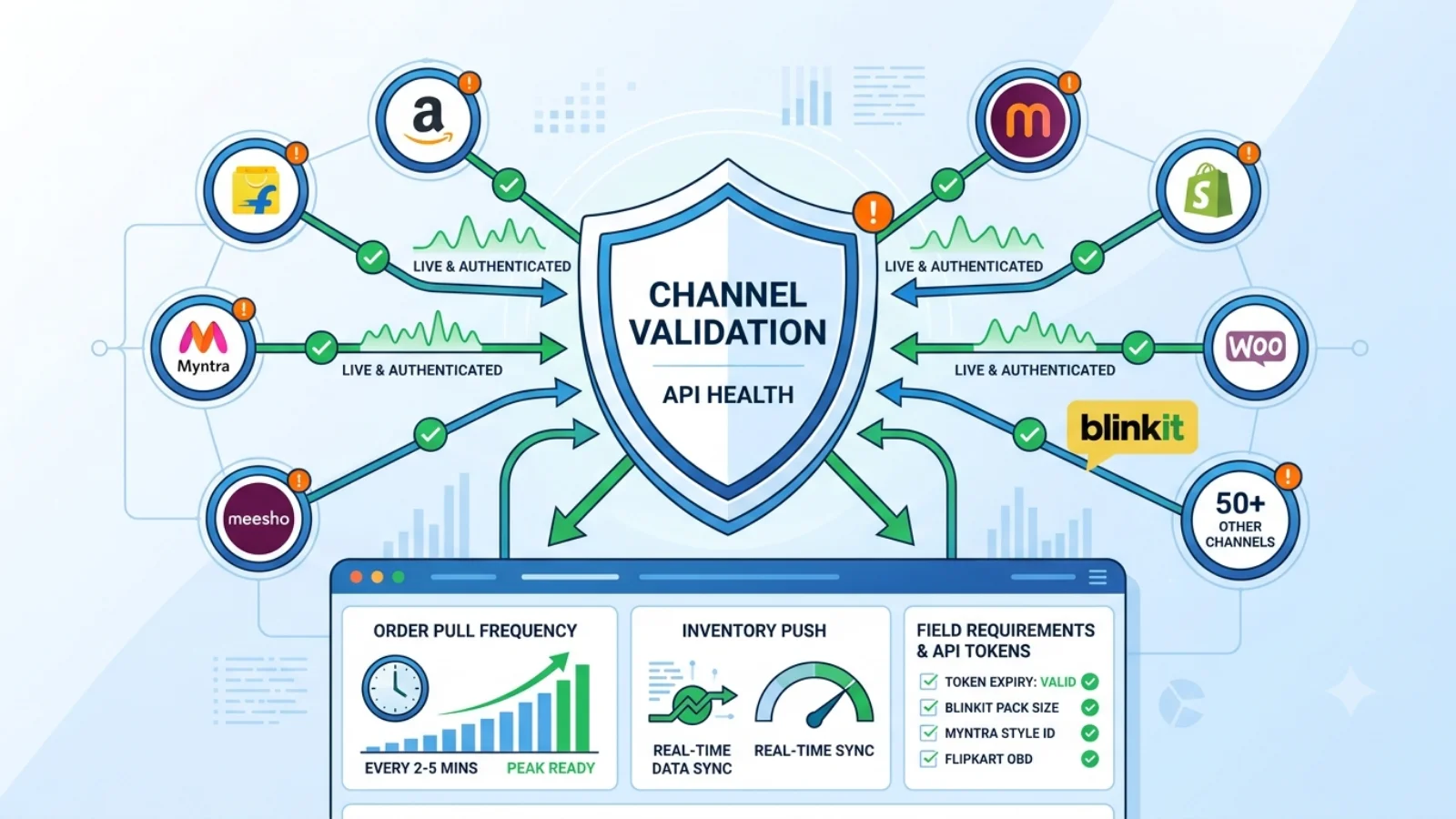
Base.com connects to Amazon, Flipkart, Myntra, Meesho, Shopify, WooCommerce, and 50+ other channels through native API integrations. On Day 3, verify that every active channel connection is live, authenticated, and pulling orders without latency.
Check the following before Day 3 ends:
- Token expiry dates on all marketplace API credentials
- Order pull frequency should be every 2-5 minutes during peak
- Inventory push frequency should be real-time or near-real-time
- Channel-specific field requirements: Blinkit’s pack size validation, Myntra’s style ID format, Flipkart’s OBD field specs
A broken API connection during a 6-hour flash sale means every order from that channel sits unprocessed until someone manually intervenes. In D2C operations in India, that is the difference between 97% fulfilment and 74% fulfilment.
Day 4-6: Order Routing And Fulfilment Logic
Day 4: Configure Order Routing Rules In Base.com
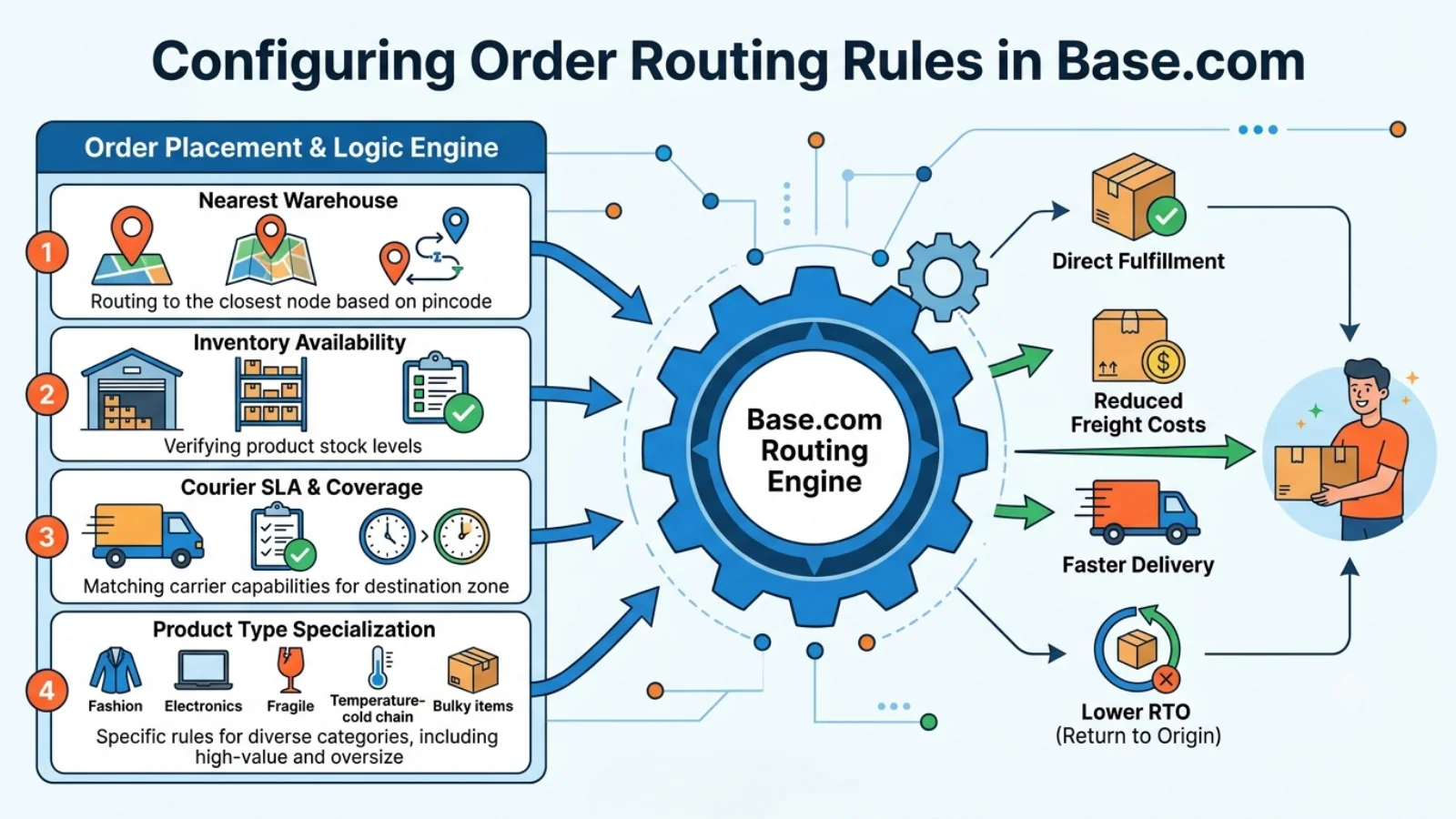
Order routing is where Order Management Systems in India create the most direct operational leverage. Routing logic determines which warehouse fulfils which order, and getting it wrong means unnecessary freight costs, slower delivery, and higher RTO.
Base.com’s routing engine lets you configure priority rules based on:
- Nearest warehouse to the delivery pincode
- Available inventory at each fulfilment node
- Courier SLA compatibility for that delivery zone
- Product category, temperature-sensitive, high-value, and oversize items each need their own rule
For Indian sellers, pincode-level routing is not optional. India has 19,000+ serviceable pincodes across 4-6 delivery zones. A flat routing rule that ignores geography will route Delhi NCR orders from your Bangalore warehouse, adding 48 hours to delivery and increasing RTO by 12-18%.
Configure your routing priority matrix in Base.com on Day 4. Test with a sample of 50 pincodes representing your highest-volume delivery areas before saving.
India’s ecommerce geography is genuinely complex. Tier 1 cities, Mumbai, Delhi, Bangalore, Hyderabad, Chennai, Pune, account for roughly 45% of D2C order volume. Tier 2 and Tier 3 cities, Jaipur, Lucknow, Surat, Indore, Patna, Coimbatore, are now the fastest-growing demand centres, contributing 40%+ of incremental order volume in fashion, health, and home categories. Order Management Systems in India that treat all pin codes identically are not built for this reality.
Base.com’s routing logic can be configured with zone-specific rules. You can prioritise speed for Tier 1 pincodes where next-day delivery is expected, and switch to cost-optimised routing for Tier 3 pincodes where a 3-day window is acceptable. This single configuration change reduces overall logistics cost per order by 6-10% for most Indian D2C brands.
Day 5: Set Up Backorder And Stockout Handling

During peak, you will run out of fast-moving SKUs. The question is not whether stockouts happen; it is what your Order Management Systems in India do when they happen.
Base.com handles stockout scenarios through configurable backorder logic:
- Auto-cancel the order and trigger a customer notification immediately
- Hold the order and fulfil when stock is replenished within a defined window
- Substitute with an alternate SKU if a substitution rule has been pre-configured
For D2C brands on their own website, the substitution logic is a direct revenue saver. A customer who ordered a sold-out SKU and receives an upgrade substitution has a measurably higher retention rate than a customer who receives a cancellation notification.
Configure your backorder handling rules in Base.com on Day 5. Define hold windows by category. Indian customers on premium D2C orders will wait 24-48 hours. Marketplace customers expect immediate resolution.
One configuration most brands overlook: set a reorder trigger in Base.com tied to your backorder queue. When backorders for a specific SKU cross a threshold, say 50 orders waiting, Base.com can automatically raise a procurement alert to your inventory team. This converts the backorder queue from a passive failure indicator into an active replenishment signal. In D2C operations in India, that loop between fulfilment data and procurement decisions is where fast-moving brands separate from slow ones.
Day 6: Courier Allocation And SLA Mapping

One of the most important functions of Order Management Systems in India is courier allocation. During peak, courier capacity is constrained. Bluedart, Delhivery, Ecom Express, XpressBees, and DTDC all apply volume caps on pickups. If your allocation logic is not dynamic, you will saturate one courier and miss SLAs on hundreds of orders.
Base.com’s courier allocation engine supports:
- Multi-courier priority lists by zone and weight bracket
- Automatic fallback to the next available courier when a primary hits capacity
- SLA-based allocation, the courier with the fastest ETA for that pincode gets the order
- COD vs prepaid split routing, premium couriers for prepaid, economy couriers for COD to manage cost per delivery
On Day 6, review your courier priority configuration in Base.com. Add at least two fallback couriers for every delivery zone. For Tier 2 and Tier 3 cities, where 40% of Indian D2C volume now originates, ensure you have a courier partner with strong serviceability, not just the lowest freight rate.
A practical benchmark for best OMS India deployments: maintain a minimum of four active courier integrations simultaneously:
- One premium express partner for prepaid metro orders
- One economy partner for COD and non-metro orders
- One regional specialist for South or East India coverage
- One COD-specific partner with strong Tier 2 remittance speed
Base.com’s courier management module handles all four simultaneously with automatic weight-and zone-based selection. Your team never manually assigns a courier to an individual order.
SLA mapping is the second half of Day 6. For every courier in your Base.com configuration, map their published delivery SLA by zone against your marketplace commitment. If Flipkart promises customers a 2-day delivery on your listings and your courier partner’s SLA for that zone is 3 days, you have a structural SLA breach waiting to happen. Identify these mismatches now. Either renegotiate with the courier, restrict listings in those zones, or switch the allocation to a faster partner in Base.com.
Day 7-9: Warehouse Operations And Pick-Pack Readiness
Day 7: Warehouse Layout And Bin Mapping In Base.com
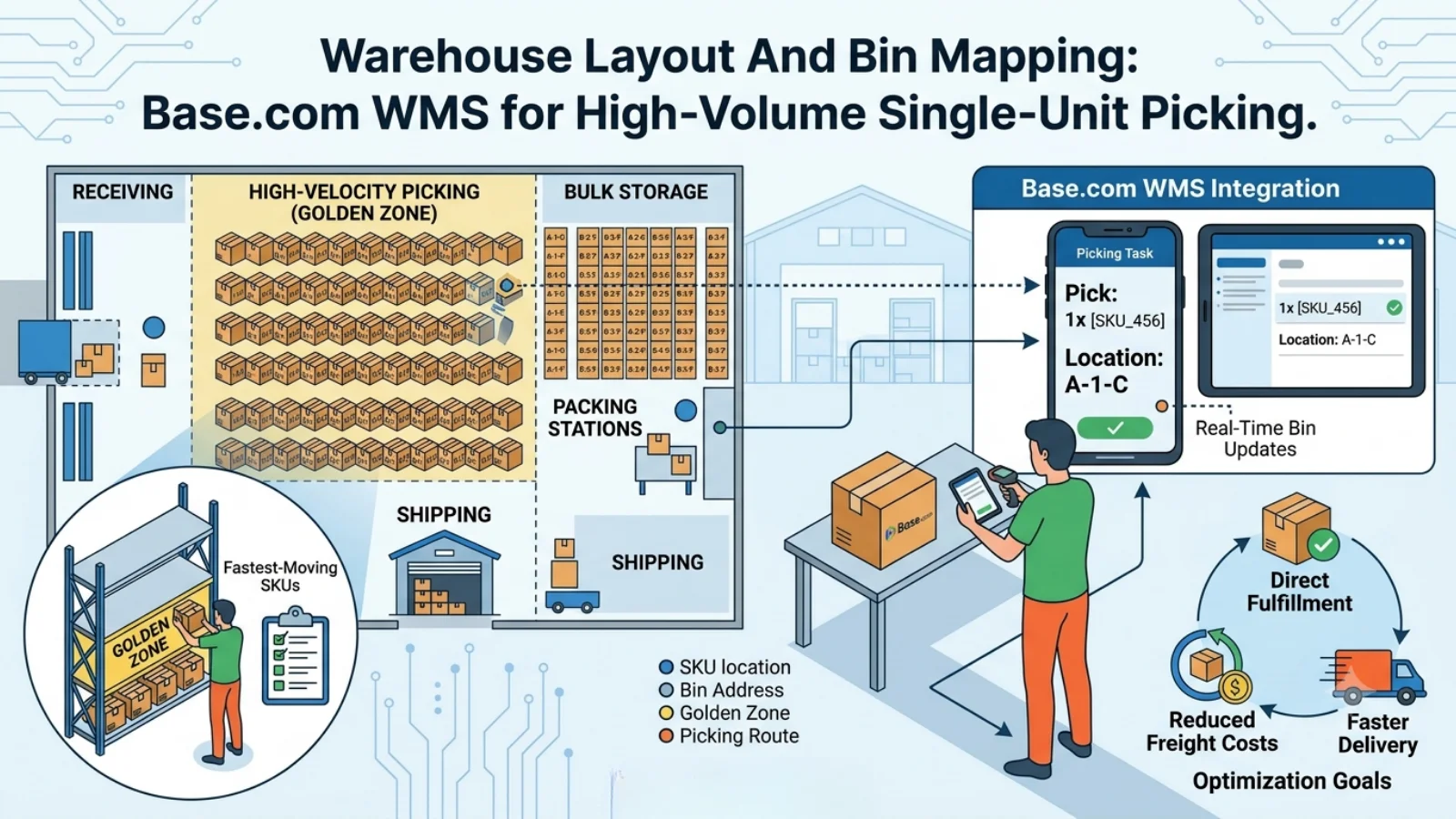
Ecommerce warehouse management in India is a different operational problem from general warehousing. Peak season brings order profiles that are high in volume, low in units-per-order, and time-compressed. Your warehouse layout has to support rapid single-unit picks, not pallet movements.
Base.com’s WMS module supports bin-level inventory tracking. Every SKU is assigned a bin address. Every pick instruction generated by the system includes the exact bin location. Pickers do not search; they navigate.
On Day 7, verify that your bin mapping in Base.com is current. If you have repositioned stock since your last audit, update bin assignments. Fast-moving peak season SKUs should be assigned to bins in the golden zone, closest to the packing station, at waist height, with the highest pick frequency.
Organise your bin zones by velocity tier:
- Zone A, top 20% SKUs by order volume, placed closest to packing stations
- Zone B, next 30% SKUs by order volume, placed in mid-warehouse positions
- Zone C, slow-moving and backup SKUs, placed in outer aisles and upper shelves
A correctly configured warehouse in Base.com reduces average pick time by 30-40%. For a warehouse processing 3,000 orders per day, that is the difference between meeting your courier cutoff and missing it by two hours.
Day 8: Packing Station Configuration And QC Rules
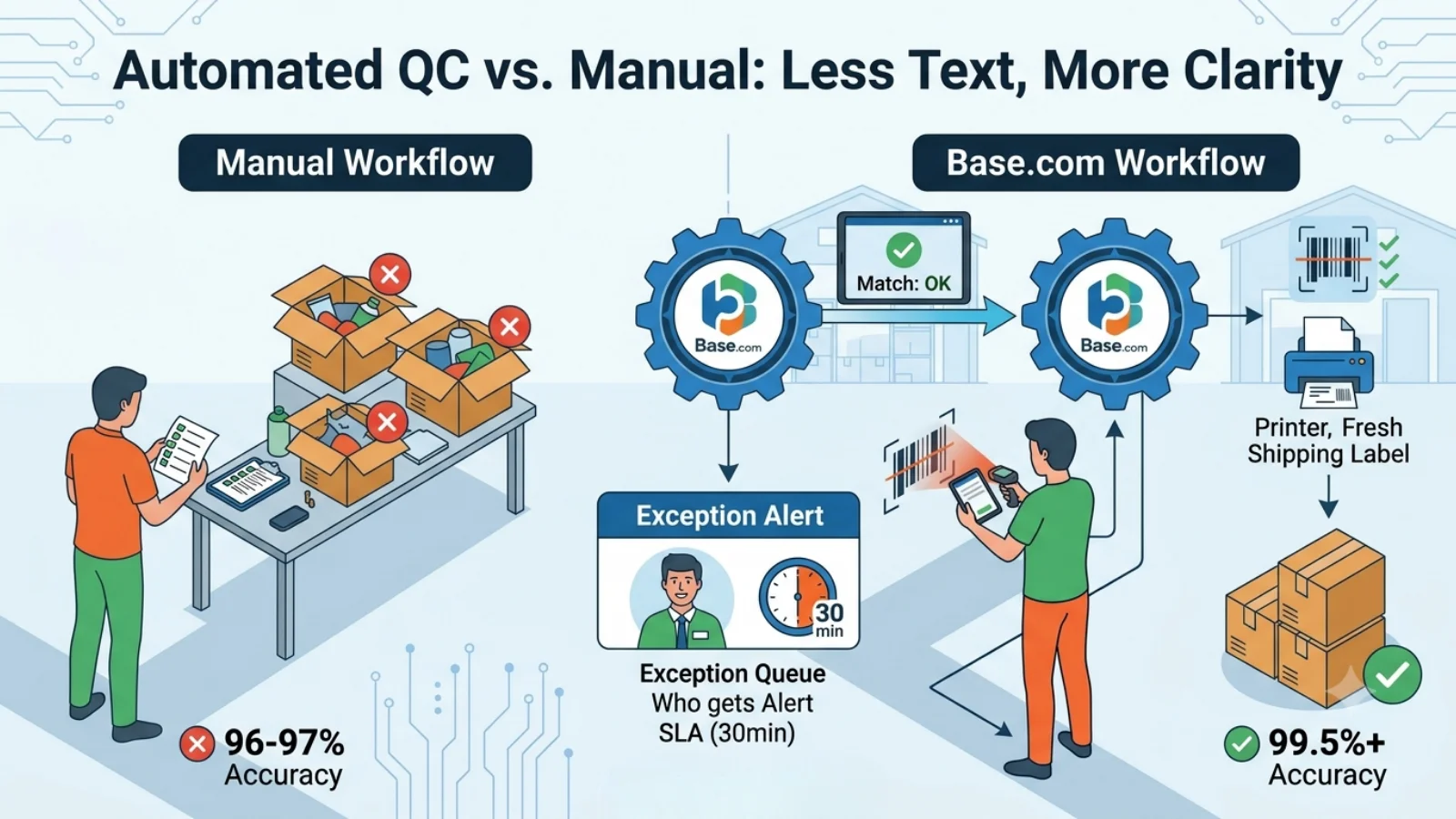
Packing errors during peak are expensive. A wrong item shipped creates a return, a replacement shipment, a customer service interaction, and a rating hit. For the best OMS India benchmarks, packing accuracy should be above 99.5%. Most warehouses operating without a scan-verify system run at 96-97%.
Base.com enforces packing accuracy through mandatory scan verification at the packing station:
- The picker scans the picked item’s barcode at the packing station
- Base.com validates it against the order line item in real time
- A mismatch blocks the pack action and raises an alert to the supervisor queue
- A match triggers automatic shipping label generation and marks the order as packed
On Day 8, configure your packing station workflows in Base.com. Enable scan-verify for all SKUs. Set up your exception queue for mismatches, who gets the alert, what is the resolution SLA, and how the order re-enters the fulfilment flow after correction.
Day 9: Staff Allocation And Shift Planning
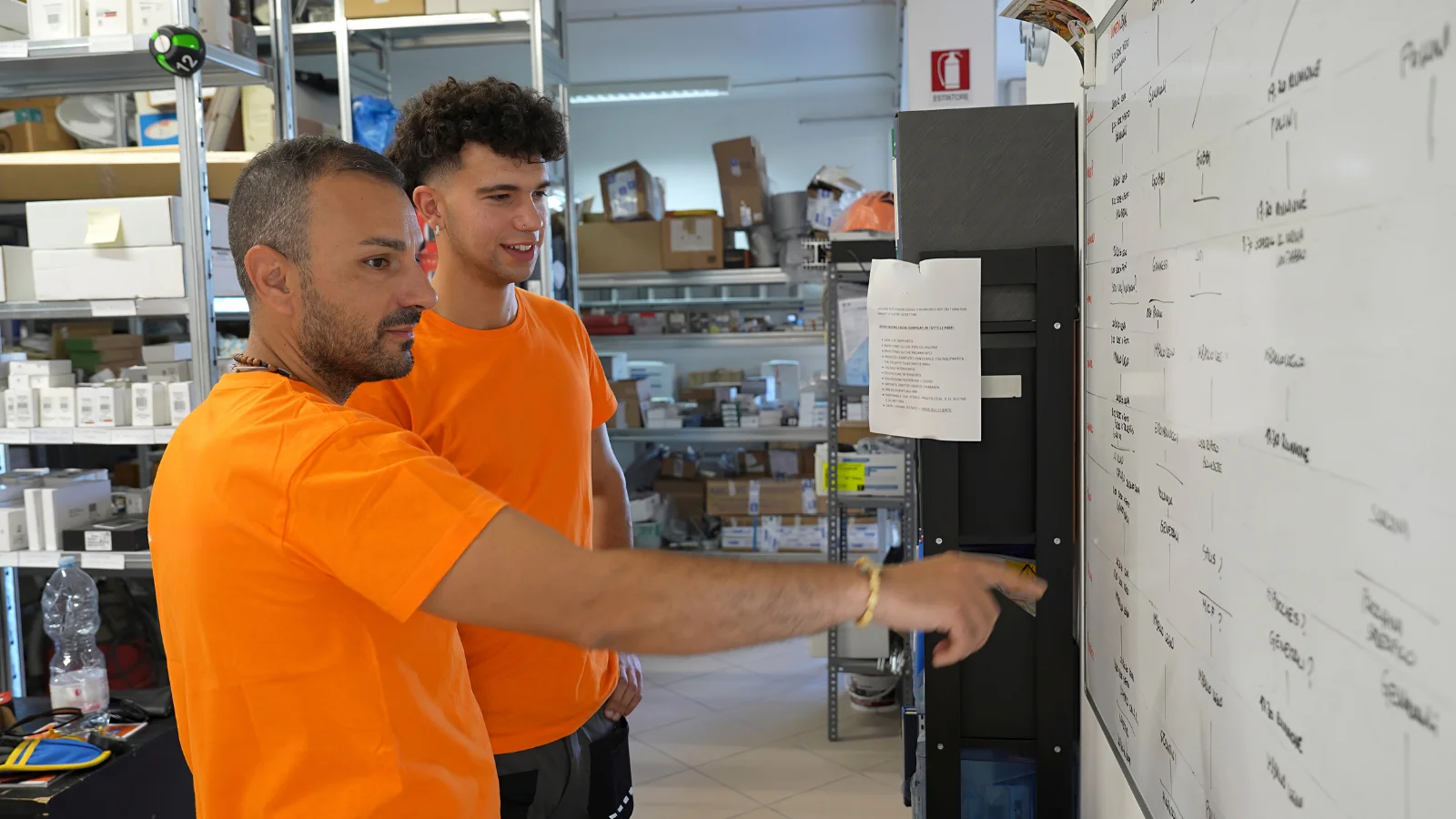
Order Management Systems in India do not replace warehouse staff; they direct them. The best WMS configuration in the world underperforms if you have 40 pickers trying to work with 20 scan guns, or if your peak crew arrives two hours after the order spike has already started.
On Day 9, map your expected order volume by hour across the sales period. Base.com’s analytics module shows your historical order arrival curves. The typical spike pattern for Indian flash sales is 60% of daily volume arriving in the first 3 hours after the sale starts.
Build your shift plan around that curve:
- Staff the first 3 hours of every sales day at 1.3x normal headcount
- Run a dedicated dispatch crew to handle the evening courier cutoff window
- Assign a supervisor to the Base.com exception queue during peak hours
- Have a trained standby team available for the second and third day of multi-day sales
The order management data in Base.com gives you the forecast. Making staffing decisions without OMS data means staffing on intuition, which is how Indian warehouses end up with 1,200 unprocessed orders at 9 PM and a courier pickup at 9:30 PM.
Day 10-12: RTO Prevention And COD Management
Day 10: Build Your RTO Risk Scoring Model
Reduce RTO India is one of the most searched operational queries in Indian ecommerce, and for good reason. RTO rates of 25-30% on COD orders mean one in four orders never successfully delivered. Every failed delivery costs ₹80-₹150 in forward freight, plus return freight, plus restocking cost.
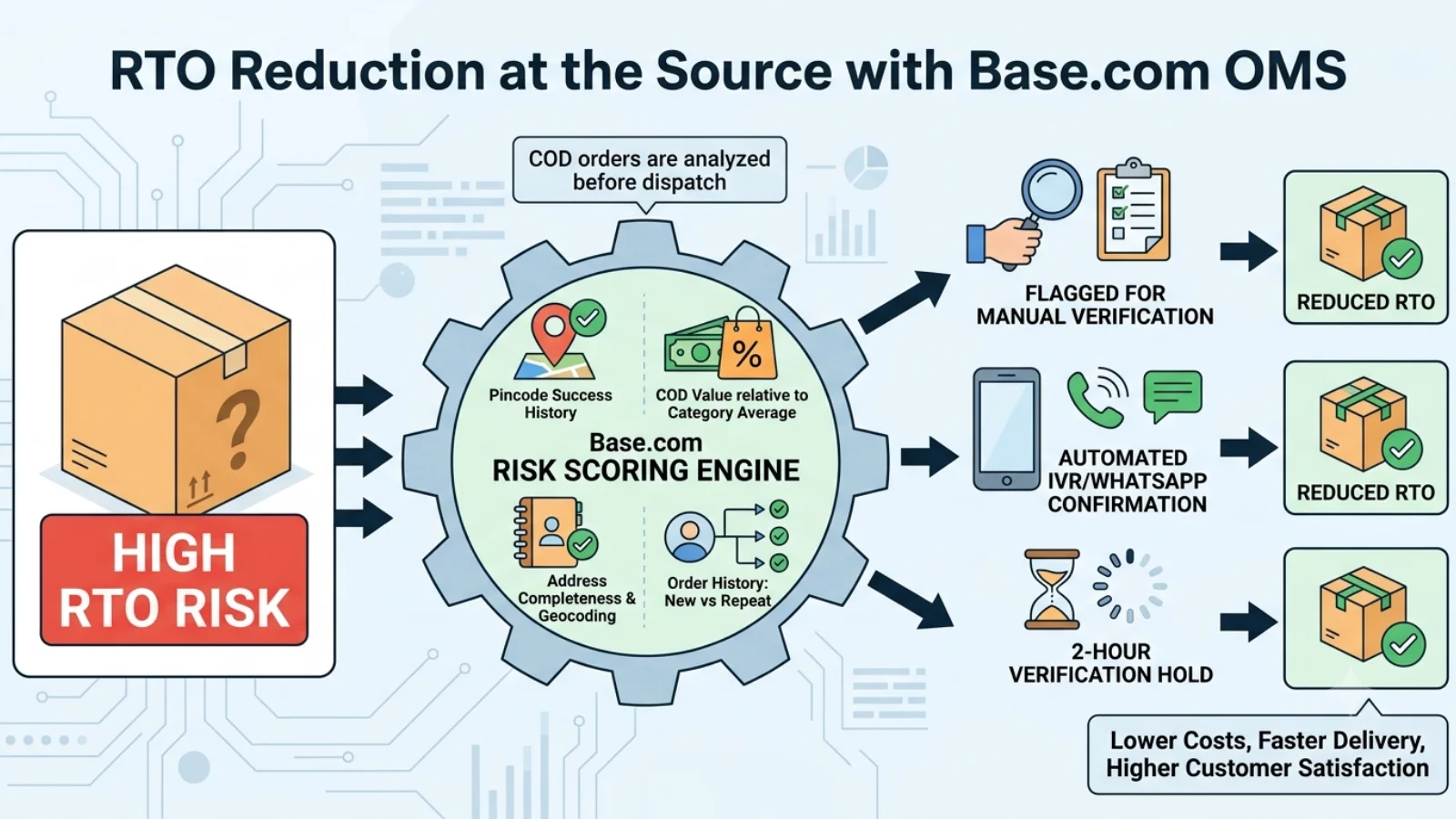
Order Management Systems in India, like Base.com, address RTO at the source through pre-dispatch risk scoring. Base.com analyses order signals before dispatch and assigns an RTO risk score to every COD order:
- Pincode-level delivery success history from previous orders
- COD order value relative to category average
- Address completeness and geocoding confidence
- Customer order history, first-time buyer vs repeat customer
High-risk orders can be handled in three ways in Base.com:
- Flagged for manual verification before dispatch
- Routed into an automated IVR or WhatsApp confirmation workflow
- Held for a 2-hour verification window before the shipping label is generated
On Day 10, configure your RTO risk thresholds in Base.com. Set rules by order value bracket. A ₹2,500 COD order from a high-risk pincode deserves a verification step. A ₹350 COD order from a consistently low-RTO pincode does not need the friction. Brands that implement OMS-driven RTO prevention in Base.com reduce COD return rates by 4-8 percentage points. On 10,000 peak season orders, that is ₹40-₹80 lakh in recovered revenue.
Day 11: NDR Workflow And Delivery Attempt Management
Non-Delivery Reports are the operational reality of Indian last-mile logistics. Customers are unavailable. Addresses are incomplete. Building access is restricted. COD amounts are not ready. Every NDR is a second chance at a successful delivery, if your workflow handles it correctly.
Base.com’s NDR management module:
- Pulls NDR data from all courier APIs in real time, within minutes of the courier filing it
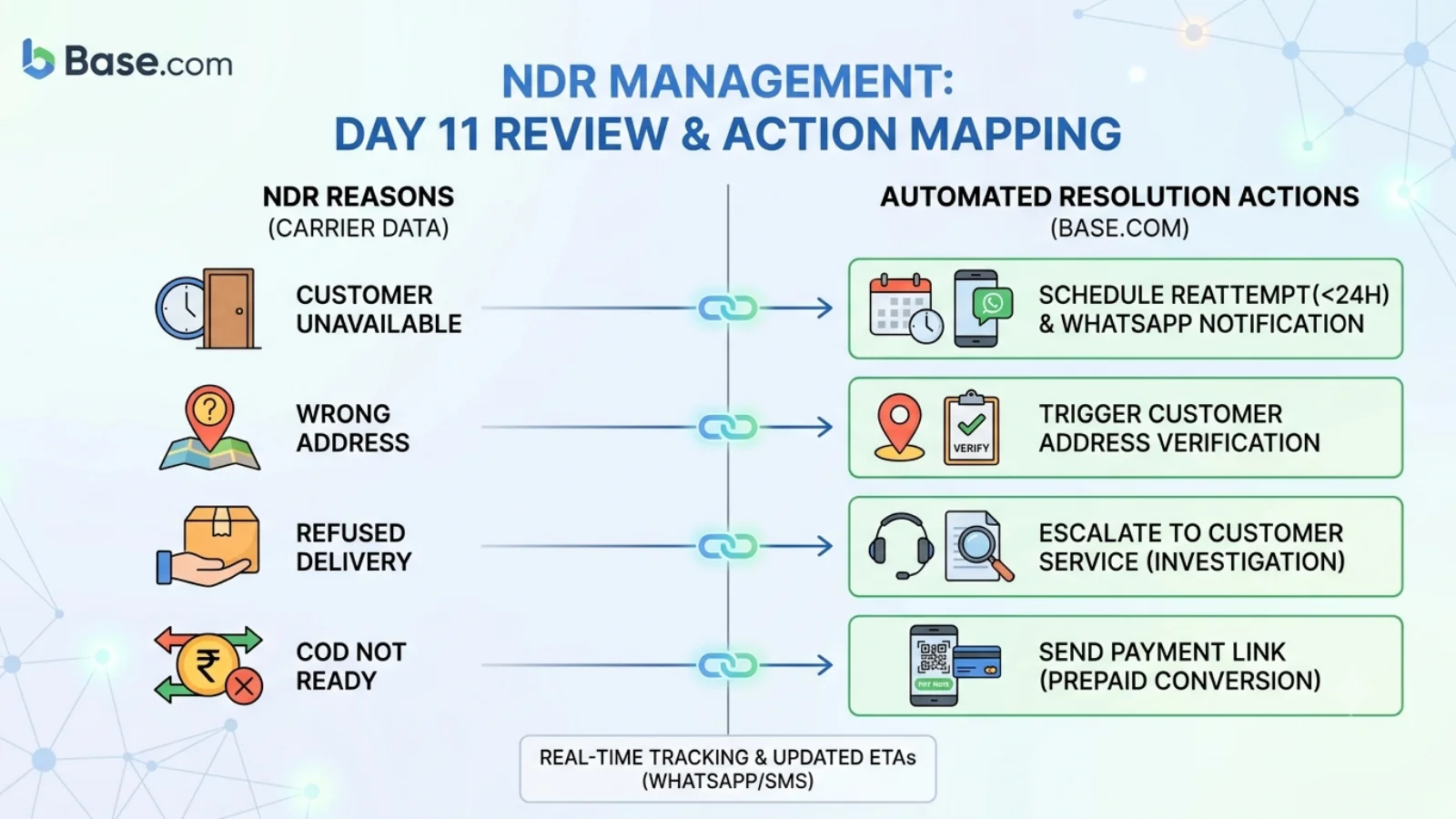
- Categorises NDR reasons: customer unavailable, wrong address, refused delivery, COD not ready
- Triggers the appropriate resolution action automatically for each reason category
- Tracks reattempt scheduling and pushes updated delivery ETAs to customers via WhatsApp or SMS
On Day 11, review your NDR reason-to-action mapping in Base.com:
- Customer unavailable, schedule reattempt within 24 hours, send WhatsApp notification
- Wrong address, trigger customer address verification before the next attempt
- Refused delivery, escalate to customer service immediately for investigation
- COD not ready, send payment link for prepaid conversion before reattempt
The best OMS India deployments treat NDR management as revenue recovery, not just logistics tracking. Every successfully converted NDR is an order you do not have to reacquire through marketing spend.
Day 12: COD Remittance And Reconciliation Setup

For Indian ecommerce brands, COD represents 50-65% of order volume depending on the category. Managing COD remittance, confirming that the cash collected by couriers actually arrives in your bank account, is a critical financial control that most brands handle manually and poorly.
Base.com’s reconciliation module matches courier remittance statements against your OMS order records automatically:
- Every order marked delivered by a courier is matched to a corresponding remittance entry
- Discrepancies, orders delivered but not remitted, or remittances received for undelivered orders, are flagged automatically
- A reconciliation dashboard gives your finance team a daily view of outstanding remittances by courier partner
On Day 12, configure your remittance reconciliation cadence in Base.com. Daily reconciliation during peak is non-negotiable. A weekly reconciliation during a 50,000-order sale week means you are investigating 500 discrepancies at once instead of 70 per day. The compounding effect of delayed reconciliation during peak can result in ₹10-₹20 lakh in temporarily unrecovered COD remittances sitting across courier partners at any given time.
Day 13-14: Reporting, Alerts, And Command Centre Setup
Day 13: Build Your Peak Season Dashboard In Base.com
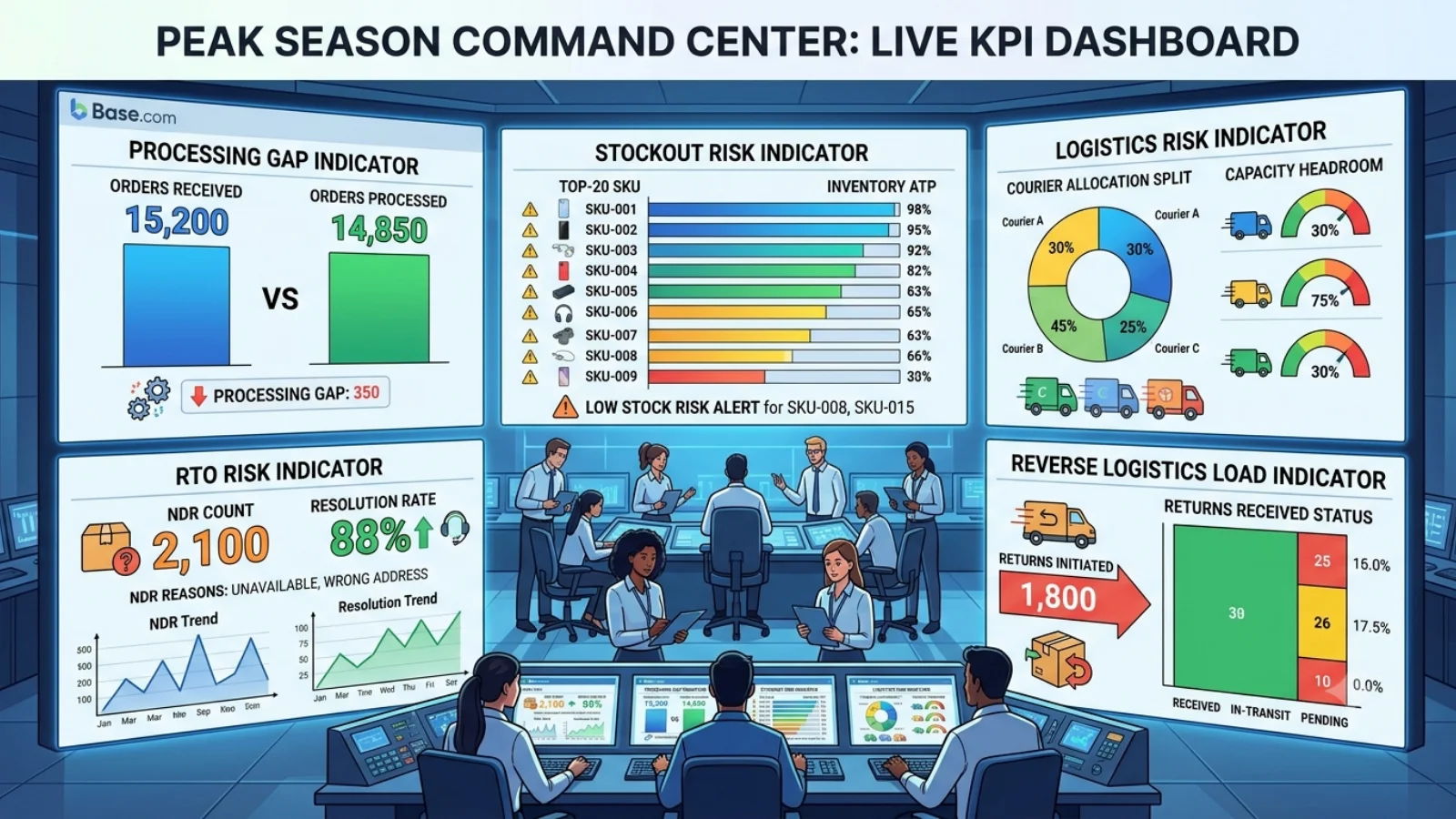
During peak, your operations team needs real-time visibility into five numbers at all times:
- Orders received vs orders processed, this is your processing gap indicator
- Inventory ATP by top-20 SKU, this is your stockout risk indicator
- Courier allocation split and capacity headroom, this is your logistics risk indicator
- NDR count and resolution rate, this is your RTO risk indicator
- Returns initiated vs returns received, this is your reverse logistics load indicator
Base.com’s reporting module lets you build a custom dashboard with live data across all five dimensions. On Day 13, build this dashboard and share access with every team member who will be in the command centre during the sale.
Do not wait until the sale starts to discover that a login is broken or a data feed is delayed. Test the dashboard 48 hours before go-live. Every metric on your Base.com dashboard should connect to a decision rule: if the processing gap exceeds X, activate the overflow team. If ATP on a top SKU drops below Y, pause that listing immediately.
Day 14: Configure Alerts And Escalation Thresholds

Real-time dashboards help. Proactive alerts save you. Base.com supports configurable alert triggers across every operational dimension:
- Processing queue breach, alert if pending orders exceed a defined threshold for more than 15 minutes
- Inventory breach, alert if any SKU drops below its safety buffer quantity
- Courier breach, alert if a courier’s pickup confirmation rate drops below SLA
- NDR spike, alert if NDR rate for a specific courier or zone exceeds your baseline by more than 20%
- API error, alert if any channel connection returns errors for more than 5 consecutive minutes
On Day 14, set up your alert rules in Base.com. Assign every alert to a named responsible owner with a defined response SLA. During peak, an unacknowledged alert that runs for 30 minutes is a customer service problem. One that runs for 3 hours is a seller rating problem.
Ecommerce warehouse management in India at scale requires alert hygiene. Too few alerts and you miss critical events. Too many alerts and your team becomes desensitised. Calibrate thresholds to real operational impact, not technical minimums.
Day 15: Go-Live Checklist And Command Centre Activation

Day 15 is a verification day, not a working day. By Day 15, every system, workflow, and configuration described in this guide should already be in place. What Day 15 requires is a final end-to-end test of the complete order flow in Base.com before the sale goes live.
Run a test order through the complete lifecycle:
- Order placed on each connected channel
- Order received and processed in Base.com with the correct SKU and inventory deduction
- Pick instruction generated and sent to the correct warehouse bin
- Packing scan executed and verified against the order line item
- Shipping label generated with correct courier allocation
- Order status updated back to the originating channel
If every step of this test completes without error, your Order Management Systems in India are ready.
Also confirm before go-live:
- All alert rules are active and assigned to named owners
- Dashboard is live and loading correctly for all command centre users
- Every team member has the correct Base.com access permissions for their role
- Courier API connections are confirmed and tested for the sale period
- Your escalation matrix is documented and distributed to all stakeholders
The brands that win peak season in Indian ecommerce do not win because they spent more on marketing. They win because their operations execute at 99%+ fulfilment accuracy while their competitors drop to 85%. Order Management Systems in India are the infrastructure that makes that difference possible.
Key Operational Benchmarks: Base.com Vs Indian D2C Industry Average
| Metric | Industry Average (Indian D2C) | Base.com Benchmark |
|---|---|---|
| Order processing time | 4-6 hours | Under 30 minutes |
| Packing accuracy rate | 96-97% | 99.5%+ |
| Inventory sync latency | 15-30 minutes | Real-time to 2 minutes |
| COD RTO rate | 25-30% | 15-18% |
| NDR resolution rate | 45-55% | 70-80% |
| Courier SLA adherence | 78-82% | 90-94% |
| Remittance reconciliation | Manual, error-prone | 99%+ automated |
These benchmarks represent real operational outcomes from Base.com deployments across Indian brands in fashion, FMCG, electronics, and health and wellness. Every number in this table is achievable with a correct Base.com configuration, clean data, and the preparation framework in this guide.
Common Pre-Season Mistakes Indian Sellers Make (And How Base.com Prevents Them)
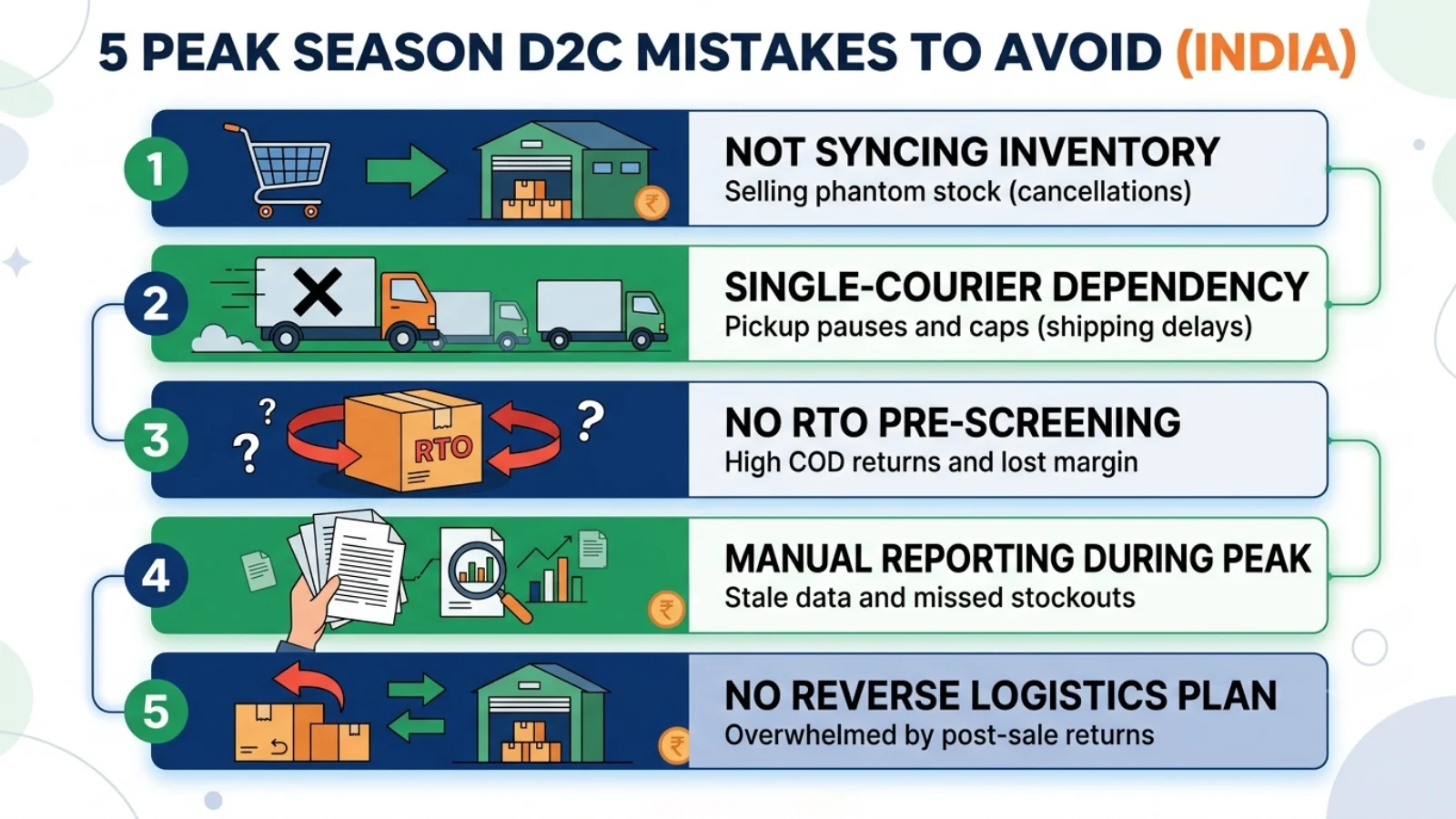
Mistake 1: Not Syncing Inventory Before Go-Live
The most common cause of peak season cancellations in D2C operations in India is selling inventory that does not exist. This happens when brands update their catalogue and run promotions without reconciling physical stock against their Order Management Systems in India. Base.com prevents this through live ATP calculation that accounts for all open orders, reserved stock, and in-transit inventory before confirming availability on any channel.
Mistake 2: Single-Courier Dependency
Brands that have not configured multi-courier fallback discover the problem during peak when their primary courier announces a pickup pause or cap. With Base.com’s multi-courier allocation engine, the system automatically reroutes to the next available courier without any manual intervention. This is a standard configuration in the best OMS India deployments, not an advanced feature.
Mistake 3: No RTO Pre-Screening
Shipping every COD order without pre-screening is the fastest way to destroy Q4 margin. Brands that do not use OMS-driven RTO prevention pay 25-30% RTO rates while Base.com deployments consistently achieve 15-18%. The difference is pre-dispatch risk scoring, a Base.com feature that runs automatically on every order before a shipping label is generated.
Mistake 4: Manual Reporting During Peak
Brands that pull manual Excel reports during a sale event are researching, not operating. By the time a manual report identifies a stockout, the next 200 orders on that SKU have already been accepted. Base.com’s real-time dashboards and alert system replace manual reporting entirely during peak. Every decision is made from live data, not hourly downloads.
Mistake 5: No Reverse Logistics Plan Before Sale Start
Peak season is not over when the orders ship. Return volumes spike 2-3x in the 10-14 days after a major sale event. Ecommerce warehouse management in India requires a configured reverse logistics workflow in Base.com before the sale starts, not scrambled together after returns begin arriving. Configure your returns grading rules, restocking triggers, and refund workflows on Day 12, not Day 16.
How Base.com Powers Order Management Systems In India End-To-End
Base.com is purpose-built for Indian ecommerce operations. Every feature is designed around the specific complexity of selling in India: multi-channel marketplaces, COD-heavy order profiles, GST compliance, multi-warehouse fulfilment, and Tier 2-3 delivery challenges.
Key Modules Relevant to This Guide
OMS Core: Centralised order management across all channels with real-time inventory, routing, and fulfilment workflow automation. Base.com functions as the single source of truth for every order across your business.
WMS Module: Bin-level warehouse management, pick-pack-ship workflow, scan verification, and throughput analytics. Designed for Indian fulfilment operations from 500 to 50,000 orders per day.
Courier Integration: Native integrations with Bluedart, Delhivery, Ecom Express, XpressBees, DTDC, Shadowfax, and 30+ other Indian logistics partners. Multi-courier allocation, NDR management, and remittance reconciliation are built in natively.
Returns Management: Complete reverse logistics workflow from return initiation through grading, restocking, and refund triggers. Integrated with all major channel return APIs.
Analytics and Reporting: Real-time operational dashboards, pre-built peak season reports, and configurable alert rules. Every metric relevant to D2C operations in India is tracked natively in Base.com.
Base.com is not a generic SaaS tool retrofitted for India. It is built ground-up for the operational realities that Indian brands face, COD complexity, marketplace SLA pressure, pincode-level logistics heterogeneity, and the pace of Indian ecommerce growth.
The 15 Days That Determine Your Peak Season Result

The gap between Indian D2C brands that grow during peak season and those that scramble to recover is almost always an operational gap, not a marketing gap.
Order Management Systems in India are the operational layer that closes this gap. Base.com gives you the inventory synchronisation, order routing intelligence, RTO prevention, warehouse execution, and real-time visibility that peak season demands.
This 15-day checklist is not aspirational. Every action item is executable in Base.com today. The brands that follow this framework go into their next Diwali sale, End of Season Sale, or Big Billion Day knowing their operations will hold at 5x volume.
The brands that skip it find out what breaks at 11 PM on Day 2 of a sale, with 1,200 unprocessed orders and a courier cutoff in 30 minutes.
Start Day 1 now.