Most Indian D2C brands learn the difference between OMS and courier aggregator in India the expensive way after a sale event collapses, a marketplace sends a performance warning, or a month-end reconciliation reveals lakhs sitting unreconciled in courier wallets.
The confusion is understandable. Both tools live at the intersection of orders and logistics. Both deal with couriers, labels, and shipments. And courier aggregators have been adding features: inventory sync, NDR dashboards, return tracking, that make them look like broader operational platforms.
They are not. The difference between OMS and courier aggregator in India is not marginal. It is the difference between a tool that moves parcels and a platform that runs operations. This post addresses that difference module by module, so your team knows exactly what each system does, where each one ends, and what the gap between them is costing you every month.
The One-Line Version
A courier aggregator gives you access to multiple couriers through one login. It manages the journey from your warehouse door to your customer’s door.
An OMS manages every step before the label prints and every step after the parcel returns. Inventory, order routing, warehouse operations, GST invoicing, returns, COD reconciliation, marketplace compliance, and cross-channel analytics.
Both are necessary. Neither replaces the other. The difference between OMS and courier aggregator in India becomes a financial problem when brands use a courier aggregator as a substitute for an OMS, and discover the cost only when the gaps compound.
The Cost Context: What the Gaps Actually Cost
Before the module breakdown, the financial stakes need grounding. A fashion brand processing 10,000 monthly orders at a 20% RTO rate loses Rs 7-10 lakh every month. At a 30% RTO rate on the same volume, that figure climbs to Rs 12-15 lakh. For brands processing 10,000 monthly COD orders specifically, Rs 5.8-7.2 lakh disappears in RTO-related expenses before opportunity costs are counted.
These numbers are not exclusively a logistics problem. They are an operations problem. They come from orders shipped to addresses that should have been verified before dispatch. From inventory oversells that created wrong-item deliveries. From NDRs that sat unactioned for 24 hours and were converted to RTOs. From the absence of the operational layer: the OMS that prevents these events from occurring in the first place.
The difference between OMS and courier aggregator in India maps directly onto these loss categories. Each module below identifies which gap is responsible for which cost.
Module 1: Inventory Management

What a Courier Aggregator Does Here
A courier aggregator’s primary function begins at the dispatch stage, when a labelled parcel needs to be assigned to a carrier. Some aggregators, including Shiprocket, have added inventory sync features that pull order data from Shopify and Amazon and maintain a centralised stock count. This layer is lightweight: it tells you how many units of a SKU you have and alerts you when stock is running low.
What it cannot do is maintain a live, enforceable master inventory record that governs all channels simultaneously. The sync is typically batch-based or polling-based, not event-driven at the moment of order creation. There is a latency window, often 5-15 minutes. During that window, the same unit can sell on two channels. No alert fires. No channel is blocked. The oversell completes.
What an OMS Does Here
The difference between OMS and courier aggregator in India is most visible in inventory management. Base.com’s OMS maintains the master inventory record. Every order placed on any connected channel, Amazon, Flipkart, Meesho, Myntra, Shopify, is deducted from this master record at the exact moment of order creation. Not on a sync cycle. Not at label generation. At placement.
Channel-level allocation rules are enforced by the system. If 300 units are allocated to Amazon and 150 to Shopify, no order can deplete one channel’s allocation to serve another. When Amazon’s allocation is exhausted, the Amazon listing goes out of stock automatically, without affecting Shopify’s available inventory. The system enforces this, not the ops team.
The Financial Gap
At 1% oversell rate on 800 daily orders, conservative for any multi-channel brand using batch-sync inventory, that is 8 cancelled orders per day. At Rs 500 contribution margin per order plus marketplace penalty exposure, the monthly cost is Rs 1.2-2 lakh. The difference between OMS and courier aggregator in India on this module alone justifies OMS investment for most brands operating at this volume.
Module 2: Order Routing and Channel Integration
What a Courier Aggregator Does Here
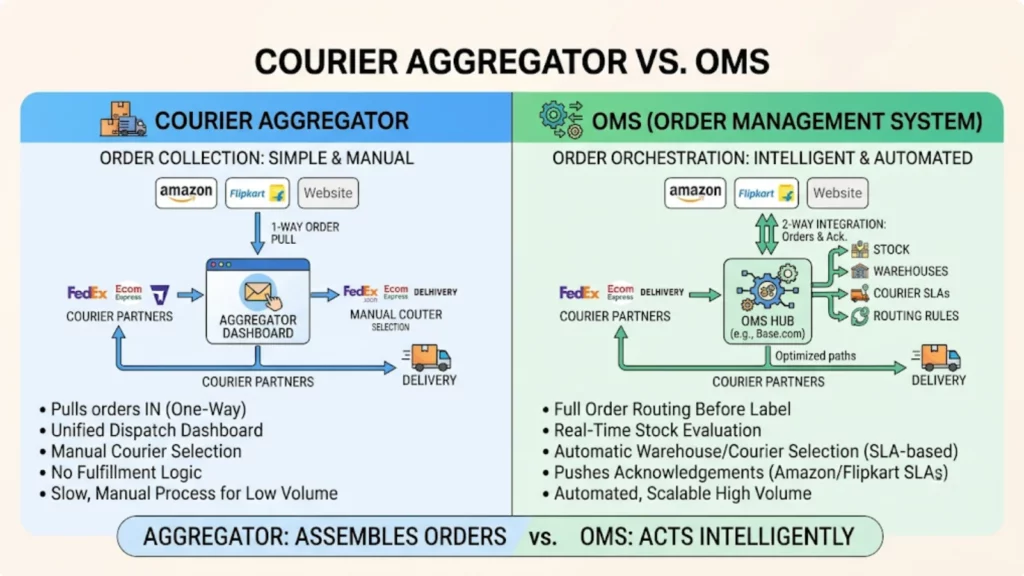
A courier aggregator connects to your sales channels and imports orders into a unified dispatch dashboard. When you open the aggregator, you see your orders. You select or confirm a courier, print a label, and dispatch.
This is functional for low volume. The aggregator’s channel connection is primarily one-directional: it pulls orders in. It does not push fulfillment acknowledgements back to marketplaces in real time. It does not apply routing logic based on warehouse proximity, stock availability, or carrier SLA performance by destination pincode. It does not enforce Amazon’s dispatch acknowledgement SLA or Flipkart’s equivalent timing requirements.
What an OMS Does Here
An OMS manages the full routing decision before the label is assigned. When an order comes in from any channel, Base.com evaluates which warehouse has the stock, which warehouse is closest to the delivery pincode, which courier has the best SLA performance for that specific zone, what the payment type is, and what the channel-specific routing rules specify.
This evaluation runs automatically per order in real time. No manual routing decision is made by the ops team. Base.com pushes dispatch acknowledgements back to Amazon and Flipkart in the required format, and within the required window, a two-way integration, not a one-way order pull.
The difference between OMS and a courier aggregator in India on order routing is between order collection and order orchestration. One assembles orders. The other acts on them intelligently.
Module 3: Warehouse and Pick-Pack Operations

What a Courier Aggregator Does Here
A courier aggregator has no warehouse management functionality. It does not know where in your warehouse a SKU is stored. It does not generate pick paths or batch picking instructions. It does not support barcode scan verification at the pack station. Bin locations, inbound receipts, cycle counts, and QC workflows are entirely outside its scope.
The aggregator’s job begins when the parcel is ready to be labeled. What happened in the warehouse before that, and whether the right item was picked, is invisible to the aggregator. If a packer puts the wrong item in a bag and scans the label, the aggregator dispatches it confidently. The wrong item reaches the customer. The customer refuses it. The RTO is generated. The courier aggregator records the RTO. An OMS, had it been in place, would have prevented it.
What an OMS Does Here
Base.com’s WMS module covers the complete warehouse operation. Every SKU is mapped to a bin location. Inbound receipts are scanned and logged. When an order is allocated, a pick instruction is generated specifying the exact bin location of every item. Batch picking allows one picker to collect items for 20+ orders in a single warehouse walk, reducing labour time per order significantly.
At the pack station, every item is scanned against the open order before the label prints. If the scanned item does not match the order, the system flags it immediately. The label prints only when the scan validation confirms the correct items.
This pack verification step is the direct operational driver of packing error reduction. Without it, packing error rates across Indian D2C warehouses running manual processes average 2-4%. With Base.com’s scan-to-verify, brands consistently reach below 0.5% within 30 days. Each prevented packing error is one fewer wrong-item delivery, one fewer COD refusal, one fewer RTO event at Rs 200-500 in direct losses.
Module 4: GST-Compliant Invoicing

What a Courier Aggregator Does Here
A courier aggregator generates a shipping label and AWB. It does not generate a GST invoice. The label is a logistics document, an airway bill number, a barcode, and a delivery address. It contains no tax information, no GSTIN, no HSN code, no CGST/SGST/IGST split.
Some aggregators have integrations with third-party GST invoicing apps. But the invoice is generated outside the core system, the HSN mapping and state-to-state tax split calculation must be configured separately, and reconciliation between the aggregator’s shipment data and the invoicing app’s records is a manual exercise.
India’s GST authority requires every registered seller to issue a Rule 46-compliant invoice on every order with GSTIN, HSN code, accurate intra-state or inter-state tax split, and consecutive numbering. India has over 1.46 crore active GST registrations as of FY 2024-25. Every brand in that number faces compliance exposure from non-compliant invoicing on every single order.
What an OMS Does Here
The difference between OMS and a courier aggregator in India is clear on invoicing. Base.com generates Rule 46-compliant GST invoices automatically for every order on every channel. CGST/SGST is applied for intra-state orders. IGST is applied to inter-state orders. The system determines which applies based on the origin warehouse and delivery address for each specific order.
HSN codes are mapped at the product level in the master catalogue. Invoice numbering is consecutive and maintained across all channels from a single sequence. GSTR-1 export requires one click. For brands with multiple GSTINs across states, when operating from multiple warehouse locations, Base.com manages each GSTIN separately with correct tax attribution per dispatch origin.
No third-party invoicing app. No manual reconciliation. No compliance exposure.
Module 5: Returns Management
What a Courier Aggregator Does Here
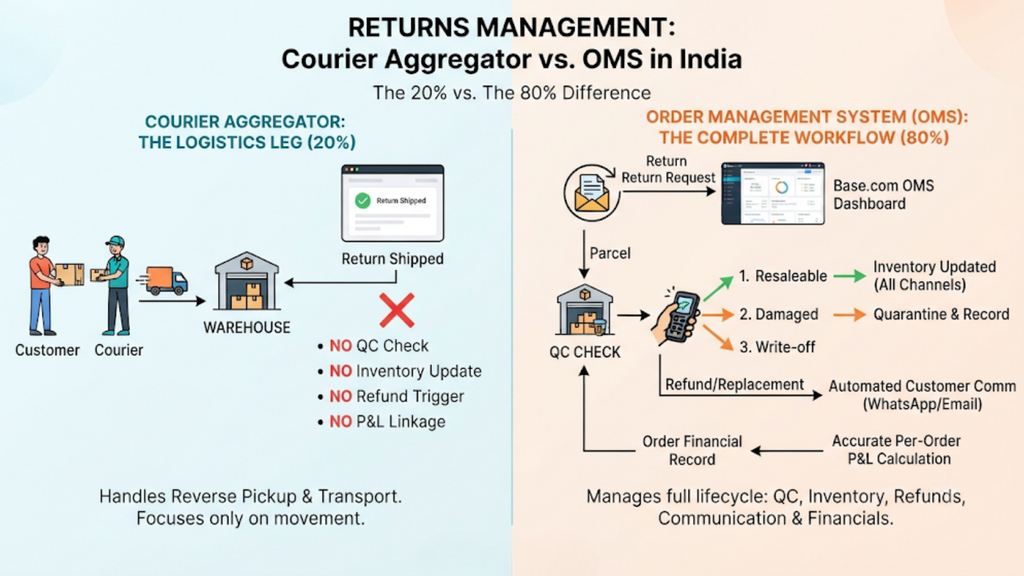
A courier aggregator handles the logistics leg of a return, scheduling a reverse pickup from the customer’s address and transporting the parcel back to the seller’s warehouse. This is the transport function.
Most aggregators also provide a returns tracking dashboard showing the status of reverse shipments. Some have added basic return initiation workflows.
What they do not manage: why the return was initiated, the QC result when the product arrives back, whether the item is resaleable or damaged, the inventory update once the item clears QC, the refund or replacement trigger, the customer communication during the return journey, or the linkage between the return event and the original order’s financial record.
The transport leg is 20% of the returns management problem. The other 80% is what an OMS handles.
What an OMS Does Here
Base.com’s returns workflow covers the complete lifecycle. A return request from any channel enters Base.com’s unified returns queue. Reverse pickup is initiated from within the system. When the item arrives, the receiving team scans it against the original order and logs the QC outcome: resaleable, damaged, or write-off. If resaleable, Base.com immediately updates available inventory across all channels. If damaged, it is quarantined with a SKU-level damage record.
Refund or replacement is triggered from the same interface based on QC outcome and configured business rules. Customer communication is automated, with WhatsApp or email confirming each step of the return journey. Every return is linked to the original order in Base.com’s financial record, enabling accurate per-order P&L calculation that accounts for reverse logistics costs.
The difference between OMS and courier aggregator in India on returns is the difference between knowing a parcel came back and knowing its condition, its inventory status, what the customer is owed, and what that return event costs your P&L.
Module 6: COD Reconciliation
What a Courier Aggregator Does Here
A courier aggregator handles COD collection and remittance. When a COD order is delivered, the courier collects cash and remits it to the seller, on cycles ranging from 48 hours to 14 days, depending on the aggregator and volume tier. Shiprocket’s standard plan remits on a 7-day cycle. Some aggregators maintain 14-day cycles, with better terms available only at enterprise tiers.
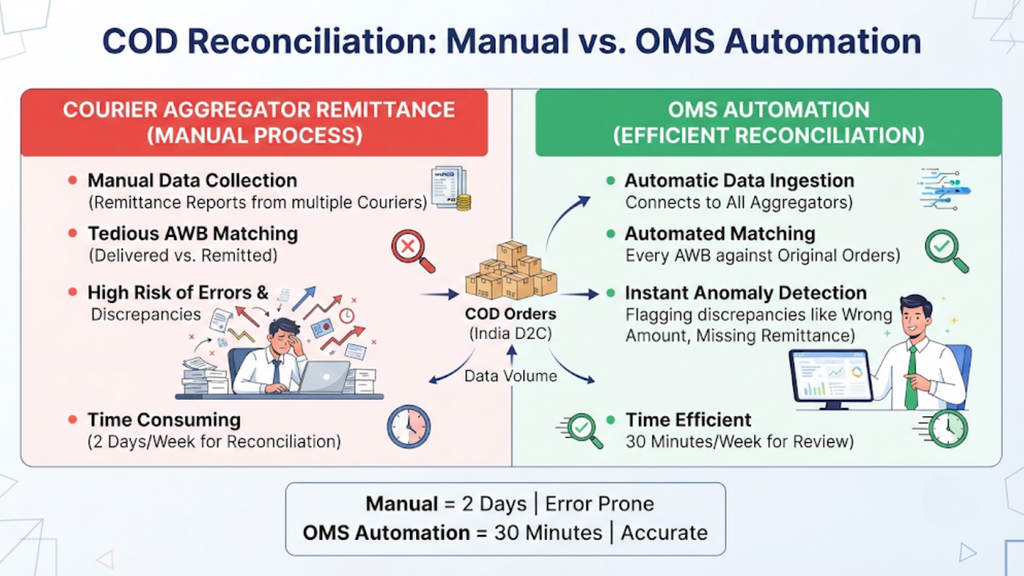
The aggregator provides a remittance report listing deposited amounts and corresponding AWB numbers. Matching AWBs to original orders, verifying that every delivered COD order has been remitted at the correct amount, and identifying discrepancies: the entire reconciliation exercise lands on the brand’s finance team.
COD accounts for 45% of Indian D2C orders in 2026. For a brand processing 1,000 daily orders with 45% COD across three couriers on different cycles, weekly reconciliation can consume two full finance team days. Unreconciled discrepancies that are not caught within 30 days are frequently unrecoverable from couriers; they fall outside the dispute window.
What an OMS Does Here
The difference between OMS and courier aggregator in India on COD reconciliation converts a manual finance burden into an automated exception review. Base.com ingests remittance data from all connected couriers automatically. Each remittance is matched against the original order record. Discrepancies (delivered orders not remitted, remittance amounts that do not match order values, duplicate entries) are flagged automatically in a discrepancy queue.
The finance team reviews exceptions, not the full dataset. Two days of weekly reconciliation become 30 minutes. Disputed amounts are identified within days of occurrence, while they are still within the courier’s dispute resolution window. For brands processing Rs 30-50 lakh in monthly COD volume, the working capital implications of accurate, timely reconciliation are material.
Module 7: Marketplace Performance Metrics
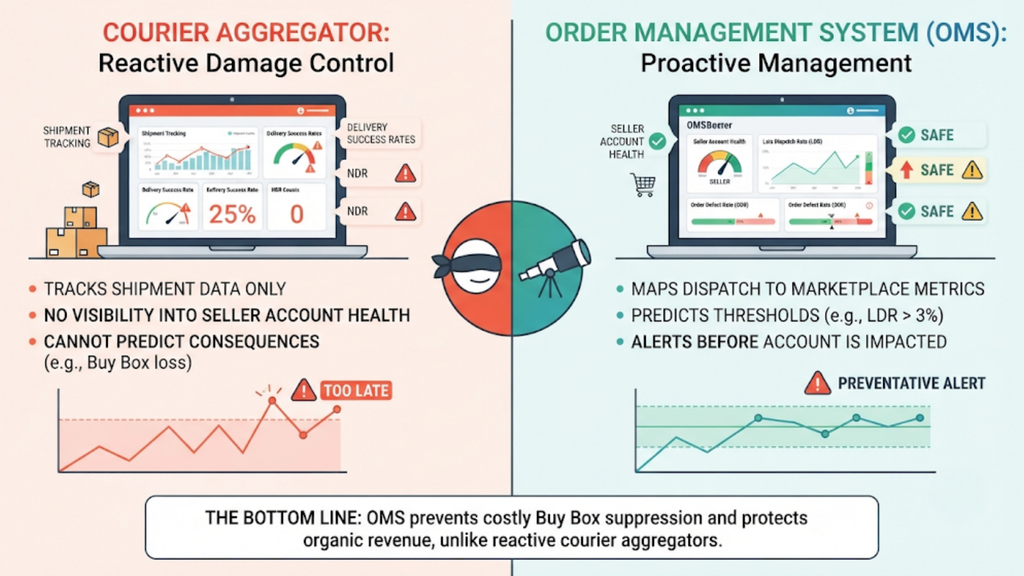
What a Courier Aggregator Does Here
A courier aggregator tracks shipment-level performance, dispatch timing, delivery success rate, NDR counts, and average delivery time. It can show you which orders were dispatched late. It cannot show you what that tardiness means for your Amazon account health or Flipkart seller rating.
Amazon calculates Late Dispatch Rate and Order Defect Rate from its own systems, using data about your seller account specifically. A courier aggregator has no view into your marketplace seller account metrics, no visibility into whether you are approaching the thresholds that trigger consequences, and no mechanism to alert you before those thresholds are breached.
What an OMS Does Here
Base.com tracks dispatch timing and maps it to the marketplace metrics that govern your seller accounts. Amazon’s Late Dispatch Rate threshold is 4%. Order Defect Rate must stay below 1%. Flipkart has equivalent thresholds. When your Late Dispatch Rate is trending toward 3%, Base.com surfaces an alert before Amazon sends a warning.
A single sale event where the ops team is unaware of metric degradation for 48 hours can cause Buy Box suppression. That suppression depresses organic ranking for weeks after the underlying operational issue is resolved. The difference between OMS and courier aggregator in India on marketplace metrics is proactive management versus reactive damage control, and the difference in lost organic revenue over the weeks following a suppression event is typically far larger than the cost of the OMS that would have prevented it.
Module 8: Multi-Channel Analytics and Per-Channel P&L

What a Courier Aggregator Does Here
A courier aggregator provides logistics analytics, shipment volume, delivery success rate by courier and zone, NDR rate, RTO percentage, and average delivery time. These are performance metrics about the shipping layer.
What it cannot tell you: contribution margin per order by channel, whether your Meesho business is profitable after platform fees and RTO losses, how your Shopify order economics compare to Amazon after all operational costs, or which of your six channels is generating the highest net return per rupee of inventory.
What an OMS Does Here
The difference between OMS and courier aggregator in India on analytics is the difference between knowing your delivery performance and understanding your business unit economics.
Base.com’s analytics module calculates order economics on a shared data model across all channels. For every channel, Shopify, Amazon, Flipkart, Meesho, Myntra, you can see orders, GMV, courier cost per order, RTO rate, return rate, and contribution margin for any time period. These figures are comparable across channels because they are calculated from the same data source, not assembled from six different portal exports.
A brand growing Meesho revenue fast may be destroying margin faster because Meesho’s high COD exposure, high RTO rate, and low AOV create negative contribution per order at scale. That insight is invisible without channel-level P&L. A courier aggregator sees only the shipping cost component of that picture. Base.com sees all of it.
Module 9: NDR Management and RTO Prevention
What a Courier Aggregator Does Here
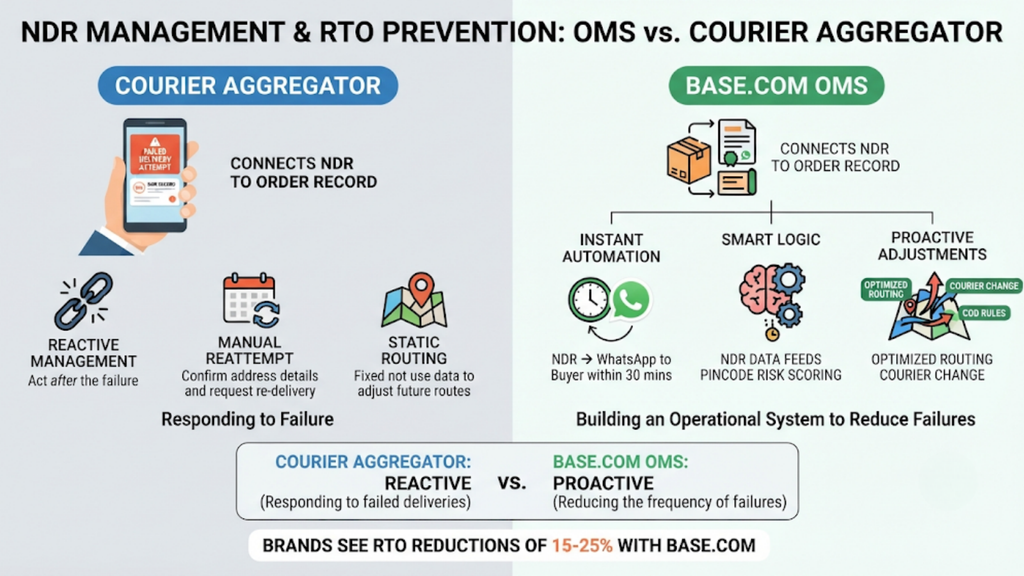
A courier aggregator surfaces NDR data when a delivery attempt fails, and an NDR record is created. Most aggregators provide an NDR management interface showing failed attempts, with options to confirm address details and request a reattempt. Some have added automated WhatsApp notifications that fire when an NDR is generated.
This is reactive NDR management. It operates on the shipment after the failure has occurred. It does not feed back into routing decisions for future orders to the same pincodes. It does not apply risk scoring to identify high-RTO buyers before their orders ship. It does not prevent the structural conditions that generate NDRs in the first place.
What an OMS Does Here
Base.com’s NDR management connects the NDR event to the full order record and feeds outcomes back into operational decisions. When an NDR is generated, a WhatsApp message goes to the buyer within 30 minutes. If there is no response in 4 hours, a second message fires. Unresolved NDRs after 12 hours flag for manual ops team review.
Critically, NDR data in Base.com feeds the pincode risk scoring module. Pincodes with persistent NDR patterns generate automatic routing adjustments for future orders, different courier assignments, COD handling fees, or OTP verification requirements. Brands using this workflow see RTO reductions of 15-25% within 60 days.
The difference between OMS and courier aggregator in India on NDR management is the difference between responding to failed deliveries and building an operational system that reduces their frequency. At 10,000 monthly orders with a 20% RTO rate, a 10 percentage point reduction from better NDR management and routing is Rs 4-5 lakh in monthly savings.
Module 10: Multi-Warehouse Order Routing

What a Courier Aggregator Does Here
A courier aggregator does not manage warehouse location data in any meaningful operational sense. It knows your pickup address, wherever you have configured parcel collection to happen. If you operate two warehouse locations, you are manually deciding which warehouse fulfills each order and ensuring the aggregator’s pickup request goes to the correct address.
Zone-crossing courier charges in India are 40-60% higher than local zone delivery rates. A brand shipping from Bengaluru to Delhi NCR, when the same SKU is stocked in a Noida forward stocking location, pays that zone premium on every such order because the aggregator has no multi-warehouse allocation logic. The cost is invisible per order. Across thousands of orders per month, it is substantial.
What an OMS Does Here
The difference between OMS and courier aggregator in India on multi-warehouse routing is between accidental logistics and optimised logistics. Base.com’s OMS evaluates every order against stock availability across all connected warehouse locations, distance to the delivery pincode, and courier cost from each potential origin.
The nearest stocked location that minimises shipping cost while meeting the delivery SLA is assigned automatically. For brands operating a primary warehouse plus one or more forward stocking locations, this routing delivers measurable shipping cost reduction that appears directly in per-order economics.
The Full Comparison: Module by Module
| Module | Courier Aggregator | OMS (Base.com) |
|---|---|---|
| Inventory management | Basic sync, batch-based, no channel enforcement | Real-time master record, channel allocation, bin-level tracking |
| Order routing | One-way order import | Automated routing with warehouse, courier, and SLA logic |
| Warehouse operations | Out of scope entirely | Batch picking, scan-to-verify, bin mapping, inbound QC |
| GST invoicing | Not provided | Rule 46-compliant, auto-generated, GSTR-1 ready |
| Returns management | Reverse logistics transport only | Full lifecycle reason, QC, restock, refund trigger |
| COD reconciliation | Remittance reports, manual matching | Automated matching, discrepancy flagging |
| Marketplace metrics | Not tracked | LDR, ODR alerts per channel before threshold breach |
| Per-channel analytics | Shipping performance data | Channel P&L, contribution margin, order economics |
| NDR management | Basic notification, manual review | Automated workflow, pincode risk scoring, routing feedback |
| Multi-warehouse routing | Not supported | Automatic per-order, zone-cost-optimised routing |
Why the Confusion Persists
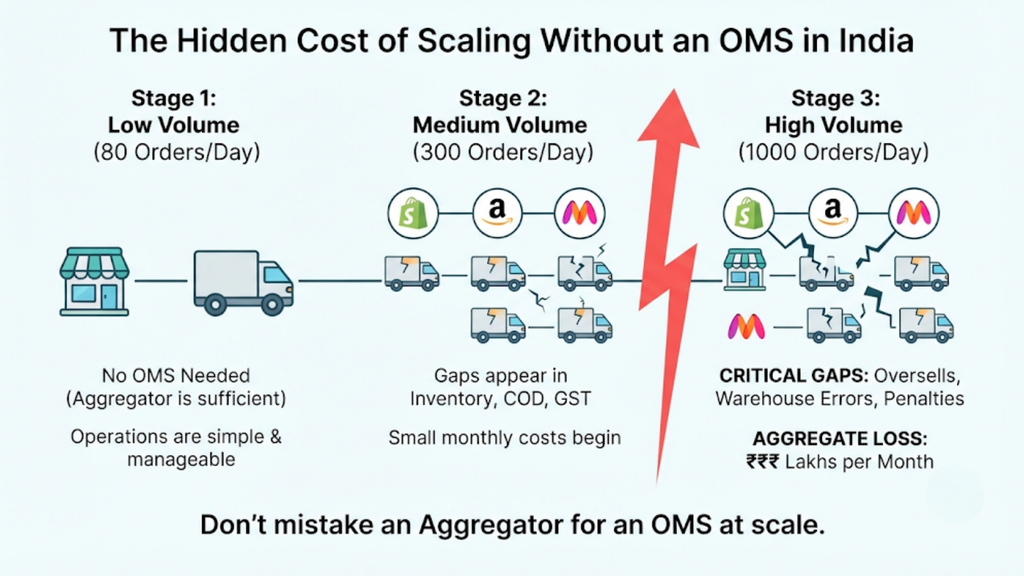
The difference between OMS and courier aggregator in India is blurred by two market dynamics. First, aggregators are expanding their scope. Shiprocket has added inventory sync, fulfilment centres, and basic WMS features. This creates the appearance of a full operations platform without the architecture of one. The added features serve the aggregator’s core business, shipping volume, not the brand’s operational completeness.
Second, at low volume, the gaps are invisible. A brand shipping 80 orders per day from a single Shopify channel can run entirely on a courier aggregator without feeling the pain. Inventory is simple. COD reconciliation is manageable. GST invoicing is handled by a third-party app. Returns are infrequent.
At 300 orders per day across three channels, each gap starts generating a monthly cost. At 1,000 orders per day, the aggregate monthly loss from operating without an OMS in oversells, GST exposure, unreconciled COD, warehouse errors, and marketplace penalties is measured in lakhs, not thousands.
What Base.com Does That No Courier Aggregator Can
Base.com is an OMS and WMS built for Indian multi-channel D2C operations. It integrates natively with Amazon India, Flipkart, Meesho, Myntra, Shopify, and 40+ courier partners, including Delhivery, XpressBees, Ecom Express, Shadowfax, Ekart, Blue Dart, DTDC, and Smartr, as well as aggregators.
The courier integration in Base.com covers every carrier and aggregator access, with rule-based allocation and automatic fallback routing built into the OMS layer. Brands using Base.com do not need a separate courier aggregator; the carrier access layer is a module within the OMS architecture.
The difference between OMS and courier aggregator in India becomes operationally irrelevant for Base.com users because both functions are available from one platform, with shared data across all ten modules described above.