An OMS eliminates the need for a dedicated operations team by centralising order routing, inventory sync, SLA tracking, and returns across Meesho, Myntra, and every other channel you sell on, from a single dashboard. Brands doing 500+ orders a day across both platforms are running lean because they automate what used to require three to five ops executives.
This article breaks down exactly how to manage Meesho orders with an OMS India, what the right system must do for Myntra specifically, and why the ops bottleneck is not a headcount problem, it is a tooling one. If you are an Indian D2C or marketplace brand asking how to manage Meesho orders with an OMS India without adding headcount, this is the complete operational answer.
The Real Problem: Two Platforms, Two Separate Worlds
Meesho and Myntra are structurally different marketplaces, and that difference is exactly what makes managing them together so operationally expensive without the right system. Meesho is value-commerce driven, high COD volumes, tier 2 and tier 3 buyer concentration, and a zero-commission model that attracts price-sensitive SKUs from smaller and mid-size brands.
Myntra is curated fashion, with strict seller onboarding gates, quality compliance requirements, and a platform standard that penalises late dispatch and poor packaging heavily. Selling on both simultaneously without a centralised system creates failures that are predictable, repeatable, and expensive.
The specific breakdowns that Indian brands run into when managing both channels manually include:
- Stock updated on Meesho after a Myntra sale results in overselling the same unit
- Separate seller portal logins mean manual order pulling from two dashboards every morning
- Returns from Meesho and Myntra sit in different queues with no unified visibility across channels
- SLA breach penalties accumulate silently when no one is actively watching dispatch TAT
- COD orders on Meesho from high-RTO pincodes get dispatched without any pre-check, burning outbound and return freight
At around 50–60 orders daily across 100+ SKUs, the manual approach begins to break down. At 200+ orders, it collapses entirely. You forget to update stock after a Myntra flash sale, and the same item sells on Meesho, creating an oversold situation that damages your seller metrics on both platforms simultaneously. This is where order management software India stops being optional. It becomes the operational foundation, not a nice-to-have.
What “No Ops Team” Actually Means in Practice
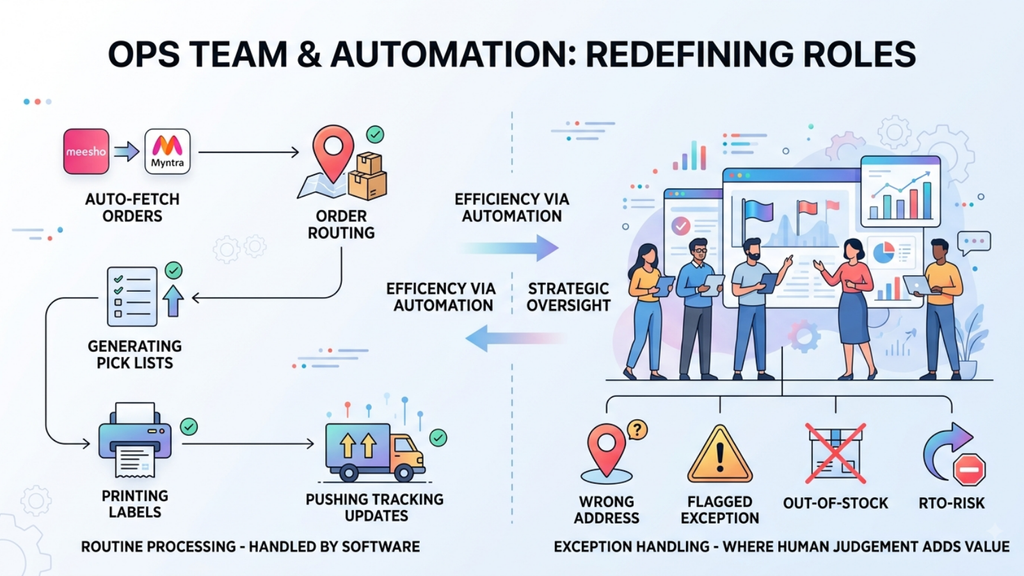
There is a common misconception that removing an ops team means removing oversight. It does not. It means moving human attention from routine processing to exception handling, which is where human judgement actually adds value. The software handles everything that follows a rule. The people handle everything that does not.
In a lean, OMS-driven operation, the system takes care of the following without manual instruction:
- Auto-fetching orders from both Meesho and Myntra portals on a defined sync interval (typically every 15–30 minutes)
- Routing each order to the correct warehouse or fulfilment location based on stock availability, SLA window, and courier cut-off times
- Generating pick lists sequenced by urgency, not arrival order
- Printing shipping labels and courier manifests in bulk without manual input
- Pushing tracking updates back to the marketplace automatically once the courier scans the shipment
- Flagging exceptions, wrong addresses, out-of-stock items, RTO-risk orders, for human review
The humans in this setup focus on escalations, returns disputes, vendor-level inventory planning, and the exceptions the system surfaces. The OMS handles the rest. This is the model that brands on Base.com have adopted, and it scales from 200 orders a day to 5,000 without changing the team size.
The foundational question for any brand at this stage is not whether to automate, but how to manage Meesho orders with an OMS India while simultaneously keeping Myntra operations equally tight.
How to Manage Meesho Orders with an OMS India, The Mechanics

Understanding how to manage Meesho orders with an OMS India starts with understanding what Meesho demands from sellers operationally. Most brands underestimate Meesho’s operational complexity because the platform is associated with small-seller simplicity, but at 200+ daily orders, that simplicity disappears fast. The question of how to manage Meesho orders with an OMS India is ultimately about building a system layer that absorbs the platform’s operational demands without translating them into manual work for your team.
Meesho’s seller experience is designed for small and mid-size businesses, but its SLA framework is unforgiving at scale. The platform runs a Next Day Dispatch (NDD) programme for high-visibility sellers, missing NDD SLAs consistently drops your listing rank and reduces order flow. Meanwhile, Meesho’s in-platform tracking is often delayed or incomplete, which means brands relying on the seller portal for shipment visibility are always behind.
A well-integrated OMS addresses these Meesho-specific requirements at the system level. Here is what the OMS must handle for Meesho specifically:
| Requirement | What the OMS Must Do |
| NDD compliance | Auto-prioritise NDD orders at the top of the pick sequence |
| COD order volume | Flag COD orders for pincode-level RTO risk before label generation |
| Tracking delays | Push tracking updates via direct courier API, bypassing Meesho’s feed |
| Returns volume | Auto-receive returns and trigger a QC workflow on receipt |
| Zero-commission model | Report margin per SKU, gross revenue on Meesho does not equal net |
Brands that learn how to manage Meesho orders with an OMS India stop relying on Meesho’s seller panel for day-to-day operational visibility entirely. The OMS becomes the source of truth for order status, stock counts, SLA compliance, and returns, across Meesho and every other channel simultaneously.
The COD Problem on Meesho Is a Data Problem

India’s COD return rate sits between 25–30% nationally. On Meesho, where tier 2 and tier 3 buyers dominate order volumes, COD penetration is even higher. Every return-to-origin event is a double cost, outbound shipping to the customer plus return freight back to the warehouse. At scale, this compounds into a significant margin drain that most brands attribute to “the nature of the channel” rather than a solvable operational problem.
It is solvable. The solution is embedding RTO intelligence into the pre-dispatch workflow rather than analysing it retrospectively. Before an order is dispatched, the OMS can cross-reference the delivery pincode against historical RTO rate data and either surface it for manual review, block COD automatically for flagged zones, or trigger a WhatsApp confirmation to the buyer.
Base.com’s OMS layer connects this RTO intelligence directly to the fulfilment workflow. When a COD order arrives from Meesho with a flagged pincode, the system flags it before label generation, not after the courier has already made a failed delivery attempt. This is why learning how to manage Meesho orders with an OMS India means more than order syncing. It means building RTO prevention into the dispatch step itself, which is where it can actually reduce RTO India rates instead of just measuring them.
How to Manage Myntra Orders Without a Separate Team
Myntra’s operational demands are different from Meesho’s but equally punishing when managed manually at scale. Where Meesho’s primary challenge is COD volume and RTO exposure, Myntra’s challenge is compliance, and the cost of non-compliance is listing demotion, penalty deductions, and returns that cannot be claimed.
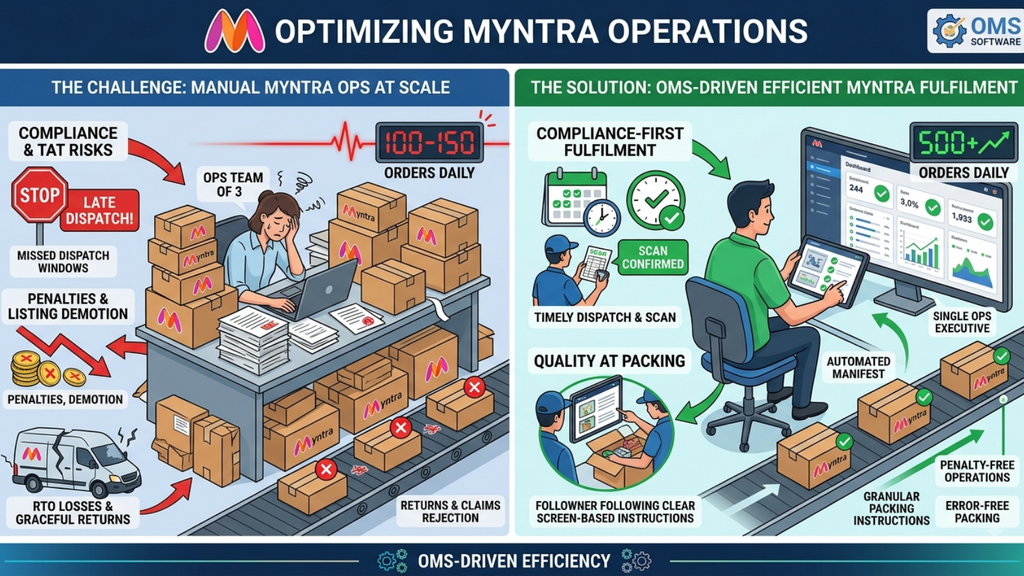
Myntra monitors dispatch TAT closely and penalises sellers who miss dispatch windows consistently by pushing them down in listing algorithms. Return to Origin on Myntra happens when a customer refuses delivery or is unavailable, and at Myntra’s price points, every RTO represents a meaningful per-unit loss. The platform’s returns process also includes item-level quality checks. Brands that ship incorrect items, missing accessories, or improperly packed orders face claims rejections that require manual escalation to resolve.
The operations challenge for Myntra has two layers that any OMS must handle:
- Compliance-first fulfilment: Every Myntra order must be dispatched within the committed window, and the courier manifest must be scanned within a specific time after label generation. An OMS that auto-generates manifests and tracks scan confirmations removes this risk entirely.
- Quality at packing: Myntra’s returns process is granular. The OMS must generate packing instructions at the order level so that warehouse staff know exactly what goes in each shipment, reducing the chance of wrong items or missing components.
Without an OMS, a three-person ops team might manage 100–150 Myntra orders daily before errors start accumulating. With the right order management software India, a single ops executive can oversee 500+ Myntra orders with exception-based intervention, and never miss a dispatch window.
Myntra and Meesho Inventory Sync Is Where Most Brands Fail
The inventory sync problem is the most common point of failure for brands selling on both platforms. Meesho and Myntra draw from the same physical stock but operate through separate seller portals with independent inventory counts. Without a central OMS enforcing a single inventory ledger, overselling is not a risk, it is a certainty at any meaningful volume.
Base.com addresses this with real-time inventory buffer logic. When stock on any SKU falls below a configurable threshold, the OMS automatically reduces available quantity or de-lists the item across all connected channels simultaneously, Meesho, Myntra, Amazon, Shopify, or any live sales endpoint. No manual update. No lag. One inventory count, multiple channel views, and zero manual reconciliation. Brands that have solved how to manage Meesho orders with an OMS India correctly treat inventory sync as the first configuration step, not an afterthought. This is multi-channel order management India done correctly.
The 5 Workflows an OMS Automates So You Don’t Need an Ops Team
The case for running Meesho and Myntra without a separate ops team rests on five specific automation workflows. Each one removes a category of manual work that would otherwise require dedicated headcount. Together, they cover the full order lifecycle from receipt to returns, which is the complete scope of what an ops team would otherwise manage manually. Any brand that has figured out how to manage Meesho orders with an OMS India has done so by automating each of these five steps, not just one or two of them.
1. Order Ingestion and Prioritisation
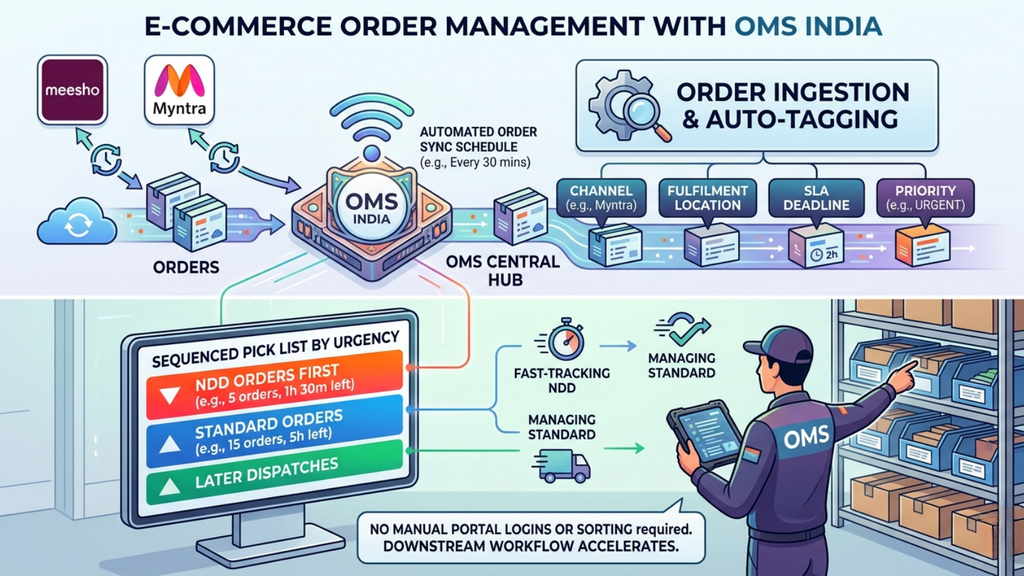
The OMS pulls orders from Meesho and Myntra on a defined sync schedule. Orders are automatically tagged by channel, SLA deadline, and fulfilment location. The pick list is generated already sequenced by urgency, NDD orders surface first, followed by standard orders ranked by dispatch deadline.
No one has to log into the seller portal to check what came in or manually sort what needs to ship first. This is the most fundamental step in learning how to manage Meesho orders with an OMS India, remove the manual pull entirely, and the entire downstream workflow accelerates.
2. Intelligent Order Routing

For brands operating from multiple warehouses or fulfilment centres, order routing is where ops time gets consumed fastest without automation. The OMS routes each order based on the nearest warehouse to the delivery pincode, available stock at each location, and SLA feasibility given the courier’s daily cut-off time.
Base.com’s routing engine evaluates all three variables simultaneously. The order goes to the right location, the right courier is assigned, and the manifest is ready, without any manual decision at the routing step.
3. Label Generation and Manifest Management
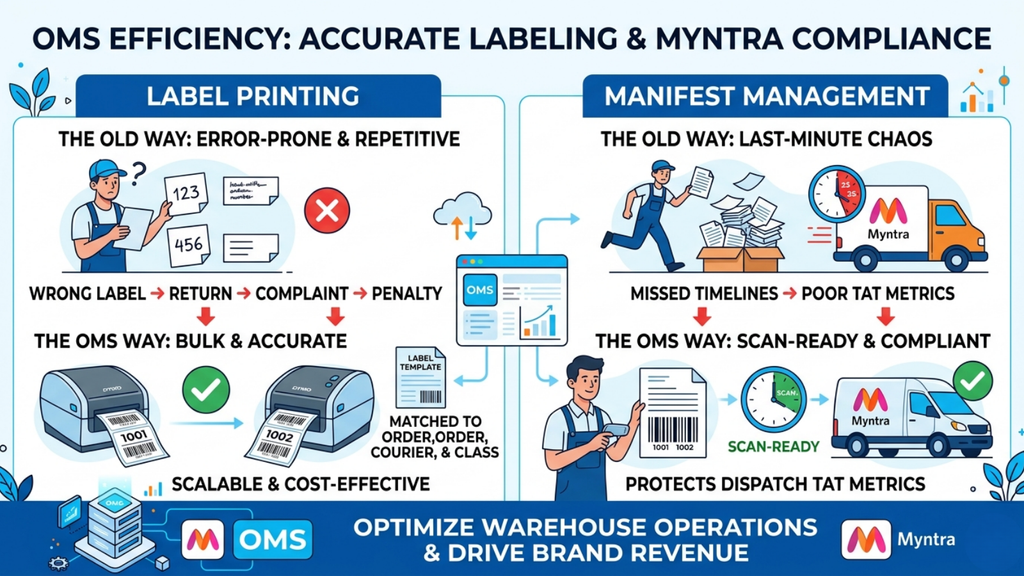
Label printing is repetitive and error-prone at scale. A wrong label on a packed order generates a return, a customer complaint, a marketplace penalty, and the cost of reshipping. An OMS generates labels in bulk, matched to the correct order, courier, and shipping class.
For Myntra specifically, manifest management is compliance-critical, the OMS ensures the manifest is scan-ready and time-stamped before the courier arrival window, which directly protects dispatch TAT metrics.
4. Returns Processing and Inventory Reabsorption

Returns from Meesho and Myntra combined typically represent 20–35% of total order volume depending on category, with fashion skewing toward the higher end. Managing this volume manually requires dedicated returns staff and consistently produces inventory discrepancies.
The OMS auto-triggers a QC workflow the moment a return is logged by the courier, saleable items re-enter available inventory immediately, damaged items are tagged for writeoff, and marketplace claims are pre-populated where the platform supports it. Inventory counts stay accurate without manual intervention.
5. Reporting and Channel-Level P&L

Without consolidated reporting, brands cannot determine which channel is actually profitable after accounting for logistics costs, marketplace fees, and returns. The OMS consolidates order data from Meesho, Myntra, and all other channels into a single reporting view, orders per channel, RTO rate per channel, average dispatch TAT, return rate by SKU, and cost per delivered order.
This is ecommerce automation India that pays for itself in decision quality, knowing that Meesho is generating volume but Myntra is generating margin changes how you allocate inventory and promotional spend.
What to Look for in an OMS for D2C Brands India
Not all order management software India is built for the operational realities of Indian ecommerce. Most platforms built for Western markets do not have native Meesho or Myntra integrations, do not understand COD as a default payment mode, and do not have pincode-level RTO intelligence. The distinction between a generic OMS and one built for Indian D2C scale shows up in specific features. Brands evaluating how to manage Meesho orders with an OMS India should use this feature checklist as their evaluation framework, not generic OMS review sites that are not India-specific.
Here is what separates a functional OMS from one that actually lets you run lean across Meesho and Myntra:
| Feature | Basic OMS | OMS for D2C Brands India (Base.com) |
| Meesho integration | Manual CSV upload | Live API sync with NDD flag support |
| Myntra integration | Basic order fetch | Full manifest + QC returns + SLA tracker |
| Inventory sync | Periodic batch update | Real-time buffer logic across all channels |
| RTO prevention | None | Pincode-level RTO intelligence at dispatch |
| Warehouse routing | Manual assignment | Rule-based auto-routing by proximity and SLA |
| Returns management | Manual tracking | Auto-QC workflow with inventory reabsorption |
| Reporting | Basic order counts | Channel P&L with margin per SKU |
| ERP and SAP integration | Not available | Native SAP SD connector |
Base.com is built for Indian ecommerce at B2B and D2C scale. The platform integrates with Meesho and Myntra natively, syncs inventory in real time across all channels, and handles the full order lifecycle from receipt to returns, without requiring a separate ops team to supervise each step.
Common Mistakes When Managing Meesho and Myntra Together
Most brands that struggle with multi-channel operations are not making large, visible mistakes. They are making a handful of structural errors that compound quietly until they become margin problems or metric penalties. Understanding these before implementing an OMS saves both time and cost during the transition. They are also the exact errors that brands avoid once they correctly work out how to manage Meesho orders with an OMS India, because the OMS configuration process forces you to confront each one.
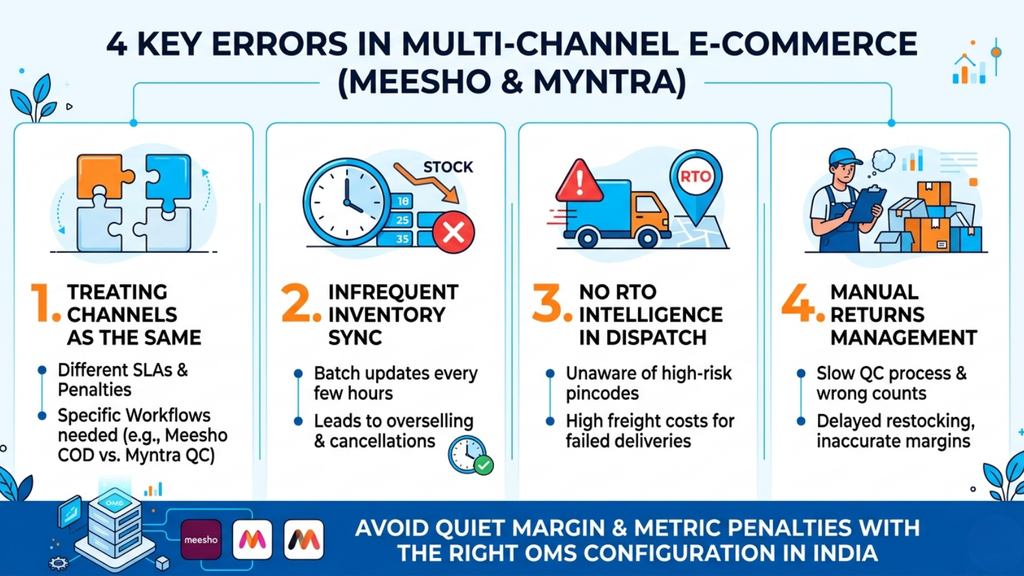
The four most common mistakes Indian brands make when running Meesho and Myntra in parallel are worth addressing directly.
- The first is treating them as the same channel. Meesho and Myntra have different buyer profiles, different dispatch SLA structures, and different penalty frameworks. An OMS configured identically for both will mishandle priorities. Meesho COD orders need RTO risk scoring before dispatch. Myntra orders need quality-compliance packing instructions. The workflows must be channel-specific even inside a unified system. Configuring channel-level rules at setup is not optional, it is what makes the unified system work correctly.
- The second is syncing inventory too infrequently. Batch inventory syncs running every three or four hours are adequate at 50 orders a day. At 300+ orders across both channels, a four-hour sync window means inventory can be off by 60–80 units before the next correction runs. Real-time or near-real-time sync is not a premium feature, it is the baseline requirement for any brand doing meaningful volume across two or more channels.
- The third is not building RTO intelligence into dispatch. Most brands discover an RTO-prone pincode after the third or fourth failed delivery. By then, they have already absorbed three times the outbound freight and three return freight costs on a single SKU-pincode combination. An OMS for D2C brands India should surface this data before dispatch. Base.com’s pincode-level flagging is embedded in the label generation step, not a separate analytics report reviewed weekly.
- The fourth is managing returns manually at the warehouse. Returns from Meesho and Myntra combined can represent a significant share of inbound warehouse activity. Managing them manually without an OMS-driven QC workflow means inventory counts are perpetually behind, saleable returned stock sits unprocessed, and margin calculations are inaccurate. The OMS should auto-trigger QC workflows the moment a return is logged by the courier, before it reaches the warehouse floor.
Base.com in Practice, Meesho and Myntra on One Platform
Base.com is an OMS and WMS built specifically for Indian ecommerce brands selling across marketplaces, D2C sites, and ERP-linked distribution. The platform is designed around the operational realities of Indian fulfilment, COD-heavy order flows, tier 2 and tier 3 delivery complexity, marketplace SLA compliance, and SAP or ERP integration for brands with existing enterprise infrastructure.
Here is how brands use Base.com to run Meesho and Myntra without a separate ops team, step by step across the full order lifecycle.
Orders from both channels sync into a single dashboard on a 15-minute refresh cycle. SLA deadlines are auto-calculated from the moment an order is ingested and colour-coded by urgency, NDD orders in red, same-day dispatch in amber, standard in green. No one has to manually check what needs to ship first.
A single inventory ledger governs stock across Meesho, Myntra, and every other active channel. Buffer rules reduce or de-list inventory automatically when thresholds are breached. The same SKU never oversells across channels.
Pick lists are generated by warehouse zone rather than by order. Packers move through zones, not individual orders, which is 40–60% faster at volumes above 200 orders per day and dramatically reduces the error rate from picker fatigue.
Labels generate in bulk for each courier, pre-sorted by manifest. There is no manual sorting at the courier collection point. The manifest is scan-ready before the courier arrives.
On return receipt from either platform, the system triggers a QC step. Saleable items re-enter inventory immediately. Damaged items are tagged and routed to writeoff. Marketplace claims are auto-populated where the platform API supports it.
Channel-level reporting shows Meesho versus Myntra order volume, RTO rate by channel, dispatch TAT compliance percentage, and return rates by SKU, available daily, weekly, or monthly. This is how to manage Meesho orders with an OMS India at 300 orders a day, 1,000 orders a day, or 5,000 orders a day, same system, same team, different volume. For any brand still asking how to manage Meesho orders with an OMS India, Base.com is the answer built specifically for this market.
The Numbers That Make the Case
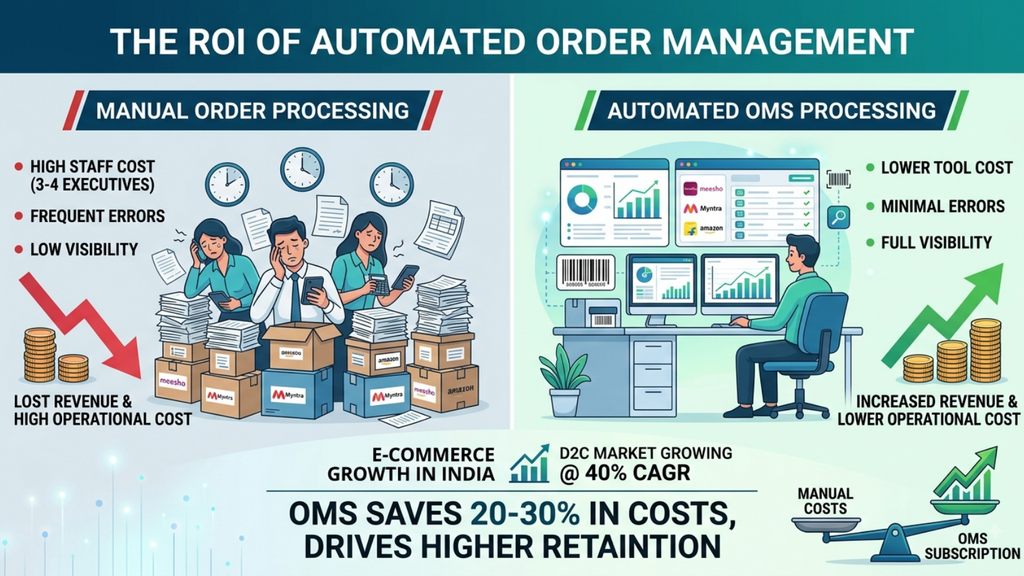
India’s ecommerce market is at $226 billion and the D2C segment is growing at 40% CAGR. COD returns run at 25–30% nationally. Retailers using automated order management software save 20–30% in operational costs, and omnichannel retailers with integrated OMS achieve 45% higher customer retention than brands relying on manual processes.
Every brand that has solved how to manage Meesho orders with an OMS India has done so against this backdrop, high growth, high COD risk, and a market that punishes manual operations at scale.
An ops team manually managing Meesho and Myntra at 500 orders per day requires a minimum of three to four executives. That is ₹4–6 lakh per month in salary costs before management overhead, training, and attrition replacement. An OMS subscription at this order volume costs a fraction of that figure, and removes the error rate that manual processing generates at scale.
The ROI calculation for multi-channel order management India is simple: tool cost versus labour cost versus error cost. At any meaningful volume, the OMS wins on all three dimensions.
When You Are Ready to Automate, Checklist
Before implementing an OMS for Meesho and Myntra, it is worth confirming a few prerequisites. The onboarding process is straightforward, but starting with these in place means the integration is live and accurate from day one rather than requiring cleanup after the fact.
Run through the following before beginning implementation:
- Both marketplace accounts are API-enabled, not just accessible through the seller portal
- Inventory is mapped, either a single warehouse location or multiple locations with clear naming and SKU-level stock counts at each
- SKU master is clean and consistent, the same SKU code is used across all channels, not channel-specific variants
- Return address and courier configurations are confirmed and active for both Meesho and Myntra
- An internal owner is designated for exception management, the OMS focuses human oversight, it does not eliminate it
If these conditions are in place, onboarding to Base.com can bring both channels under a single operational view within days, not weeks. The manual workflows that currently require dedicated ops headcount become exception flows, monitored by one person rather than managed by a team.
That is the practical end state for any brand that has fully worked out how to manage Meesho orders with an OMS India alongside Myntra.
Base.com is an OMS and WMS built for Indian brands selling across Meesho, Myntra, Amazon, Flipkart, Shopify, and D2C channels. If you are managing multi-channel operations and want to reduce ops dependency while improving fulfilment accuracy, speak to the Base.com team.