
Every growing ecommerce brand in India eventually hits the same wall. Orders spike. The team stretches. Manual processes that worked at low volume start consuming hours that the operation simply does not have.
For Real Vision, that wall appeared during peak weeks, when packaging alone was taking 6 to 7 hours a day, and the entire fulfilment workflow was being held hostage by a process never designed for scale. The right OMS for ecommerce brands in India does not just manage orders. It removes the friction that slows a team down when the pressure is highest.
This is the story of how Base.com did exactly that for Real Vision, and why the four hours a day they recovered changed how they think about growth.
Who Is Real Vision
Real Vision is a growing Indian ecommerce brand navigating the operational realities that most brands at their stage know well: increasing order volumes, tightening fulfilment timelines, and a backend workflow built for a smaller, simpler version of the business.
Like many brands scaling across online channels in India, Real Vision reached a point where the gap between what the business needed operationally and what the existing process could deliver was too wide to close through effort alone. They needed a system, not more staff, not more workarounds, not more manual coordination.
They needed an OMS for ecommerce brands in India that was built for the kind of operational pressure that peak weeks create, one that could deliver real, measurable efficiency rather than a cleaner interface layered over the same broken process.
Challenge 1: Packaging Was Consuming 6 to 7 Hours Every Peak Day
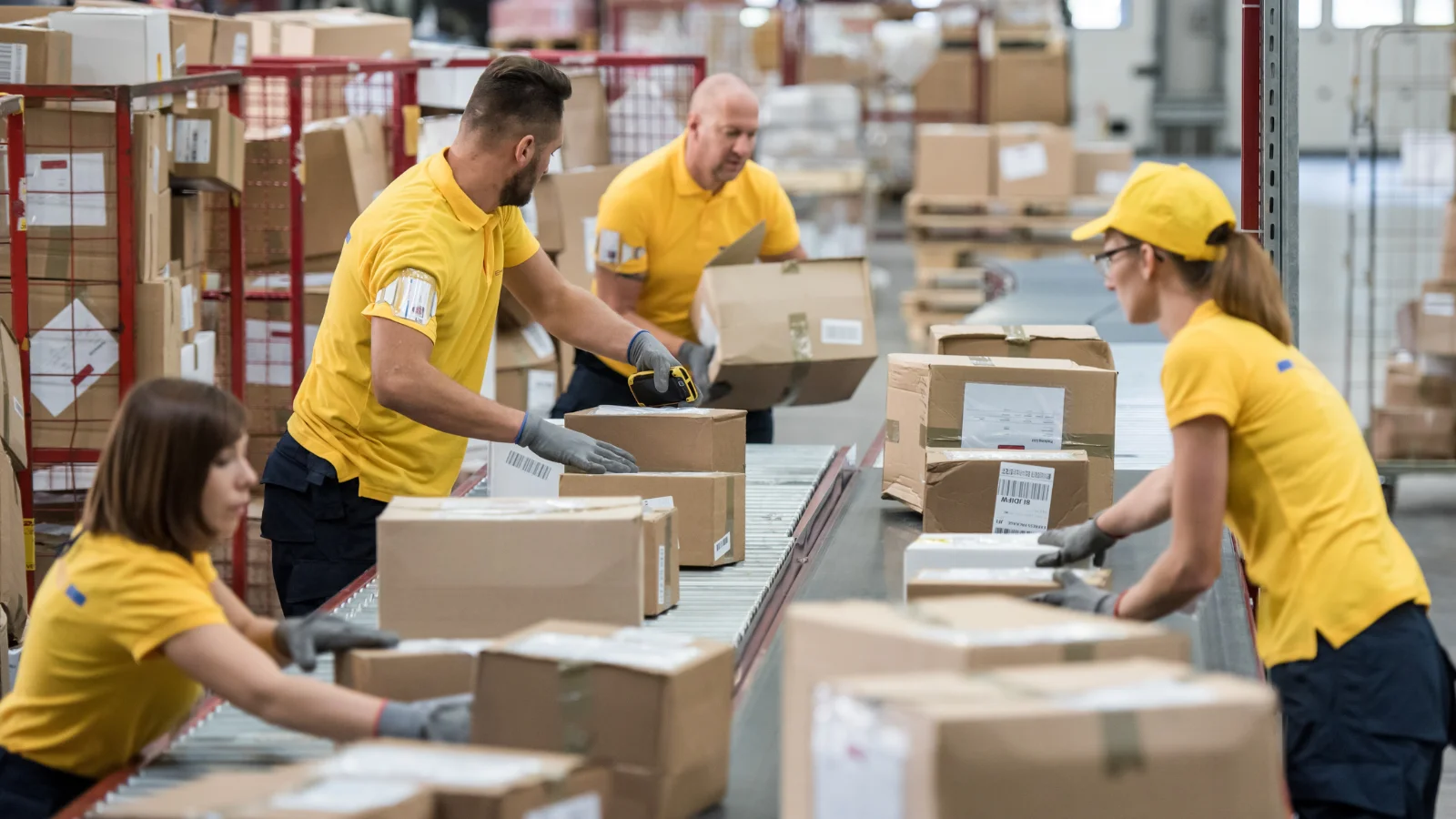
During peak weeks, packaging alone was consuming 6 to 7 hours of Real Vision’s working day. This was not a total fulfilment time. This was packaging specifically, before a single order had been dispatched, before a single courier had been booked, before the dispatch window had properly opened.
The team was already hours deep into manual packaging before the rest of the day’s work could begin. There was no mechanism to speed this up within the existing process. The team was working as fast as the process allowed, and the process was slow by design, because it had been built for a smaller volume of orders.
The packaging bottleneck was not a people problem. It was a process problem. And it compressed the entire fulfilment workflow downstream. Every hour lost to packaging was an hour unavailable for picking, quality checking, courier allocation, and dispatch. On peak days, the team started behind and stayed behind for most of the working day, not because they were not trying, but because the process they were running did not have a path to faster.
How Base.com solved it:
- Base.com restructured the packaging workflow using its Order Manager module, replacing manual sequencing with system-driven queue management.
- Instead of the team deciding which orders to pack next and in what order, the Order Manager organised and directed the packaging queue automatically.
- Orders arrived at the packaging station pre-sequenced by the system; the packaging team’s full attention went to physical execution rather than being split between execution and decision-making simultaneously.
- Base.com’s automatic actions capability triggered packaging-related steps without manual initiation, removing the coordination overhead that had been adding invisible time to every packaging cycle.
- Packaging instructions were generated at the system level per order, eliminating the need for team members to interpret order data and make packaging decisions independently at the station.
- The workflow ran at the same pace on a high-volume peak day as on a normal day because the sequencing logic was system-driven, not effort-driven.
The impact:
Packaging time during peak weeks dropped from 6 to 7 hours per day to 2 hours per day, a reduction of more than 65%. The team saved approximately 4 hours every single day during peak periods. Over a 5-day peak week, this represented 20 hours of recovered operational capacity redirected from manual packaging to productive fulfilment and growth-focused work.
The packaging window became consistent and predictable regardless of order volume. The 2-hour target held whether it was a moderate demand day or the highest-volume day of the week. The team stopped starting peak days behind. Every dispatch window opened with the packaging work already complete.
Challenge 2: Manual Steps Were Embedded Throughout the Entire Fulfilment Workflow
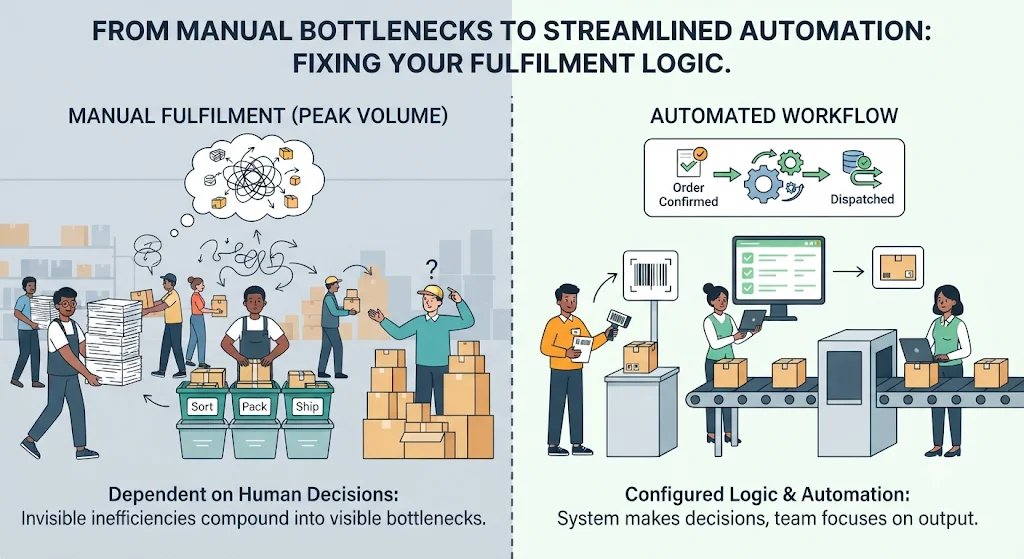
The packaging bottleneck was the most visible problem. Underneath it was a broader structural issue that ran through every part of Real Vision’s operation.
Manual steps were embedded throughout the entire fulfilment workflow. How orders were processed, how tasks were sequenced, how the team coordinated across different stages of getting an order from confirmed to dispatched, all of it depended on human decisions and human execution at every touchpoint.
On normal days, these manual steps were invisible inefficiencies. The team managed them without obvious strain. At peak volume, they compounded into visible bottlenecks that cost the team hours they could not recover.
There was no configured order flow logic driving the operation. No rules determining how orders moved through the system. No automatic actions reducing the repetitive coordination tasks that consume team time without contributing directly to fulfilment output. The team was filling every operational gap manually, and at peak volume, filling those gaps manually was the difference between a manageable day and an overwhelming one.
The challenge was not that the team was working incorrectly. The challenge was that the system had no logic built into it. Every decision that the system should have been making automatically was instead being made by a person, every time, for every order, throughout every peak day.
How Base.com solved it:
- Base.com replaced Real Vision’s fragmented manual workflow with a structured, system-driven fulfilment backbone where configured rules replaced manual decisions at every stage.
- Each stage of the fulfilment process, order receipt, pick instruction generation, packaging queue management, and dispatch coordination, was connected within a single system rather than managed through disconnected human coordination.
- Base.com’s automatic actions capability configured triggers that executed defined process steps, order status updates, task routing, and internal workflow progression, without requiring manual input each time they occurred.
- Entire categories of manual coordination were removed from the team’s daily workload and absorbed by the system’s configured logic.
- Order routing rules determined which station handled which order type, removing the ad hoc assignment decisions that had previously consumed supervisory time throughout the day.
- The workflow ran consistently at the same pace and quality on every shift, for every team member, regardless of individual experience, because the logic was in the system, not in the people.
The impact:
The team’s effort was fundamentally redirected. Instead of spending significant time on repetitive coordination tasks that added no strategic value, the team’s attention went to the parts of fulfilment that genuinely required human execution, physical packing, quality checking, exception handling, and courier coordination.
Operational stress was reduced measurably because the team was no longer holding the workflow together through effort alone. Throughput increased because the manual coordination overhead that had been consuming time throughout the day was absorbed by the system. The operation gained the structural foundation that an OMS for ecommerce brands in India must provide, a workflow that runs reliably under pressure without requiring proportionally more human effort to sustain it.
Challenge 3: Fulfilment Throughput Was Constrained by Time-Heavy Packaging Activity
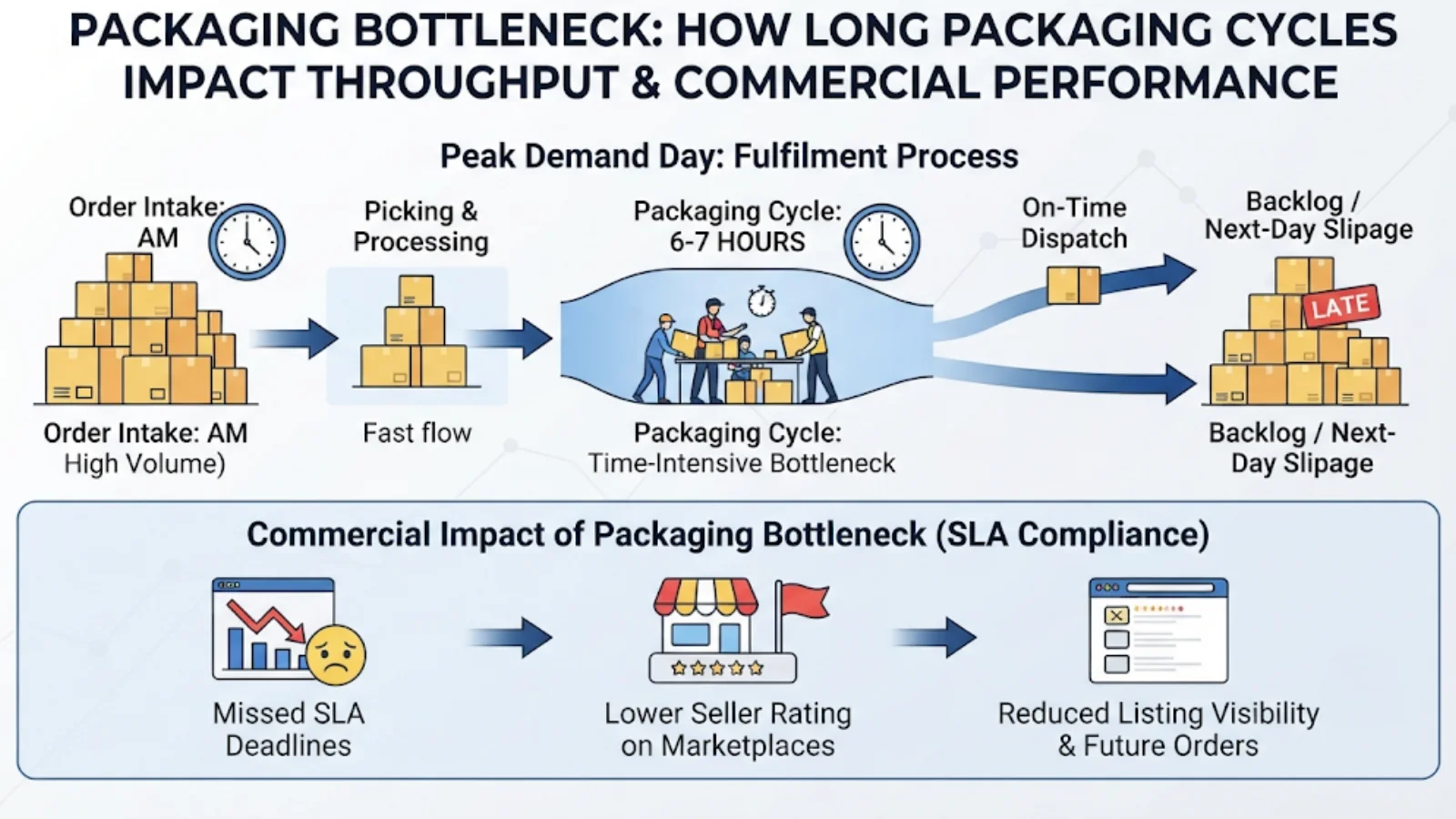
The consequences of a 6-to-7-hour packaging cycle extended well beyond the packaging station. The constraint placed on total daily throughput was significant and systematic.
When packaging consumes the majority of the working day, the number of orders that can be fully processed and dispatched on that day is limited not by picking capacity, not by courier availability, not by team size, but by how many orders can complete the packaging step before the courier pickup window closes.
This meant Real Vision was regularly leaving orders unprocessed at the end of peak days, not because the team had not worked, but because the packaging bottleneck had consumed the time that would have been used to process them. Orders that should have been dispatched same-day slipped to the next day. Dispatch volumes lagged behind confirmed order volumes. SLA windows were under consistent pressure.
For a brand competing across Indian marketplaces where SLA compliance directly determines seller score and listing visibility, this throughput constraint had commercial consequences that went beyond the operational inconvenience. Missed SLA windows penalise sellers. Reduced listing visibility reduces future order flow. The packaging bottleneck was not just a fulfilment problem. It was a commercial performance problem working its way backward from the warehouse floor.
How Base.com solved it:
- Base.com’s Order Manager created a unified processing queue where orders were automatically organised, prioritised by SLA urgency, and pushed to the packaging station in the correct sequence.
- Orders closest to their SLA dispatch deadline surfaced at the top of the queue automatically, without requiring a supervisor to manually monitor timelines and reprioritise the team’s work.
- Pick instructions were generated by the system and pushed to the warehouse floor, reducing the elapsed time between order confirmation and physical packing commencing.
- The removal of manual decision-making from the packaging step meant the team moved through the queue faster, executing without the interruption of sequencing decisions embedded throughout the process.
- Automatic actions maintained workflow momentum between stations. When packaging is completed on an order, the next step is triggered by the system without requiring manual handoff or status update.
- The overall cycle time from order confirmation to dispatch-ready was shortened at every stage, not just at the packaging station.
The impact:
Processing throughput increased because the packaging bottleneck had been structurally removed, not managed better within the same time constraints, but genuinely reduced so that more of the working day was available for other fulfilment stages.
The team could process a higher volume of orders in the same working day without extending hours, adding headcount, or increasing operational strain. SLA compliance during peak weeks improved because recovered packaging time translated directly into more time available to complete fulfilment within marketplace dispatch windows. Orders that had previously slipped to the next day were dispatched same-day. Listing visibility on active marketplaces stabilised because SLA performance improved consistently rather than fluctuating with peak-week pressure.
Challenge 4: High-Demand Periods Exposed the Limits of the Existing Process
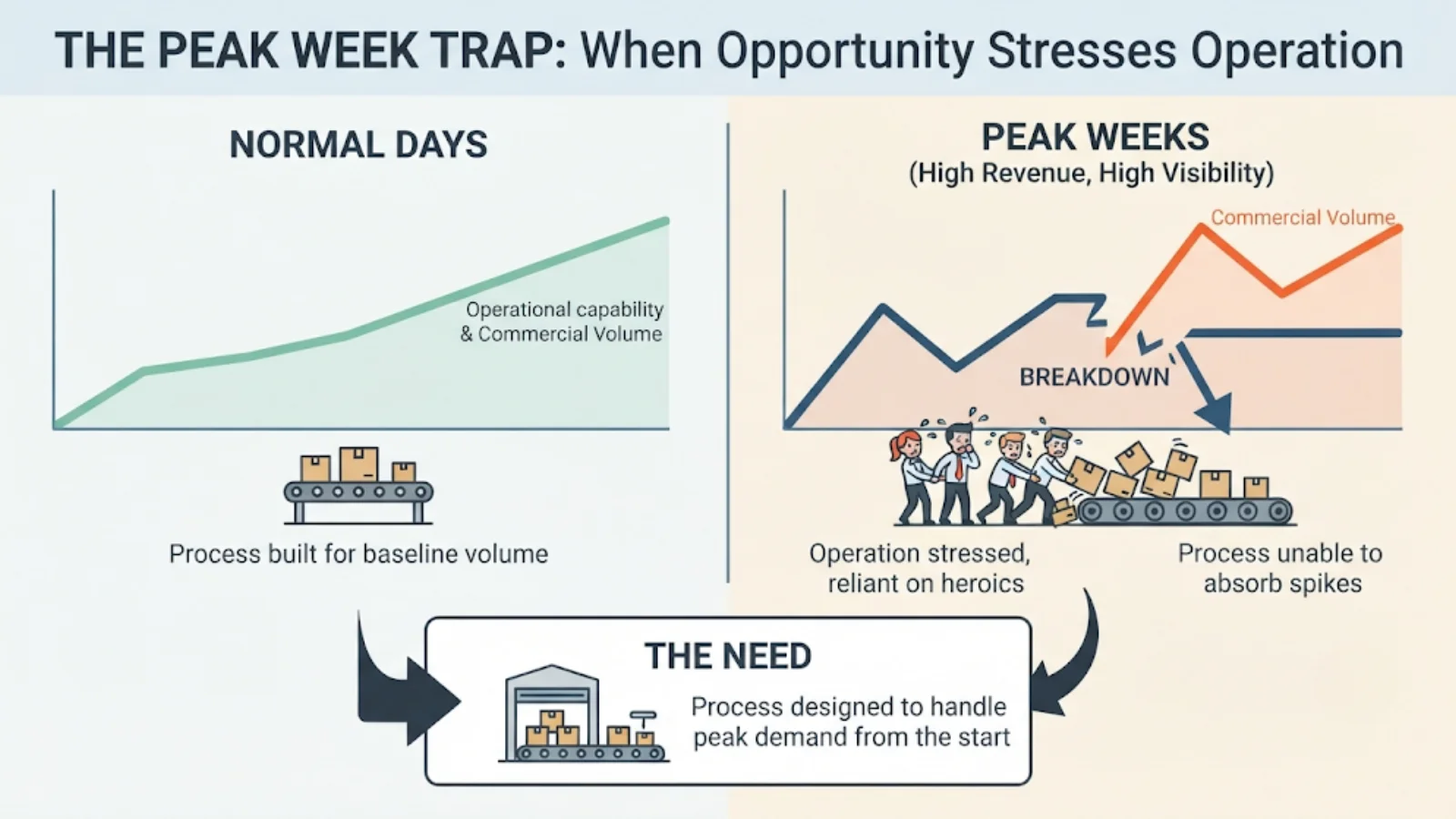
Real Vision’s operation had a structural characteristic that most growing brands recognise once they have lived through it: the existing process performed adequately on normal days and broke down on the days that mattered most.
Peak weeks, the periods that drive the highest revenue, the highest customer acquisition, and the highest visibility for the brand, were the same periods when the operation was most stressed, most behind, and most reliant on individual heroics to get orders out the door.
This inverse relationship between commercial opportunity and operational performance is one of the most damaging dynamics a growing ecommerce brand can find itself in. The weeks you most need the operation to perform are the weeks it is least capable of performing at its best.
The root cause was that the existing process had been built for a steady, manageable baseline volume. It had no capacity to absorb spikes without breaking. Every peak week was essentially a stress test that the process was not designed to pass. The team adapted through effort, working longer, moving faster, cutting corners that could be cut, but effort has limits, and corners have consequences. What Real Vision needed was a process that did not need to be rescued by effort during peak weeks because it was designed to handle peak weeks from the start.
How Base.com solved it:
- Base.com’s implementation was explicitly configured and validated for peak-week performance, not just for normal-day operations, before going live.
- The workflow automation and order sequencing logic were tested under high-volume conditions as part of the implementation process, not discovered under pressure after go-live.
- The configuration was built to maintain consistent efficiency at 3x normal order volume because the rules applied by the system do not degrade when volume increases.
- Peak-week performance was treated as the primary benchmark for implementation success; the question was not “does this work on a normal day,” but “does this work on the hardest day.”
- The Order Manager’s centralised processing queue scaled to absorb higher order volumes without requiring additional manual coordination to manage the increase.
- The team’s physical workload scaled with volume as expected, but the coordination burden did not scale with it, because the system absorbed the additional coordination overhead.
The impact:
Peak weeks became manageable periods rather than operational survival exercises. The workflow Base.com introduced handled demand spikes as designed, rather than straining under them.
Real Vision’s team arrived at peak days with a process that was built for the pressure rather than a process being asked to exceed its design limits. Operational stress during high-demand periods reduced significantly because the team was executing a system-driven workflow rather than holding a manual process together through sustained effort.
The business could plan commercial growth, higher marketing spend during peak periods, new channel expansion, and higher sales-season inventory positions, with confidence that the operational foundation would support increased demand rather than buckle under it.
Challenge 5: Operational Time Was Being Consumed by Repetitive Tasks Instead of Growth-Focused Work
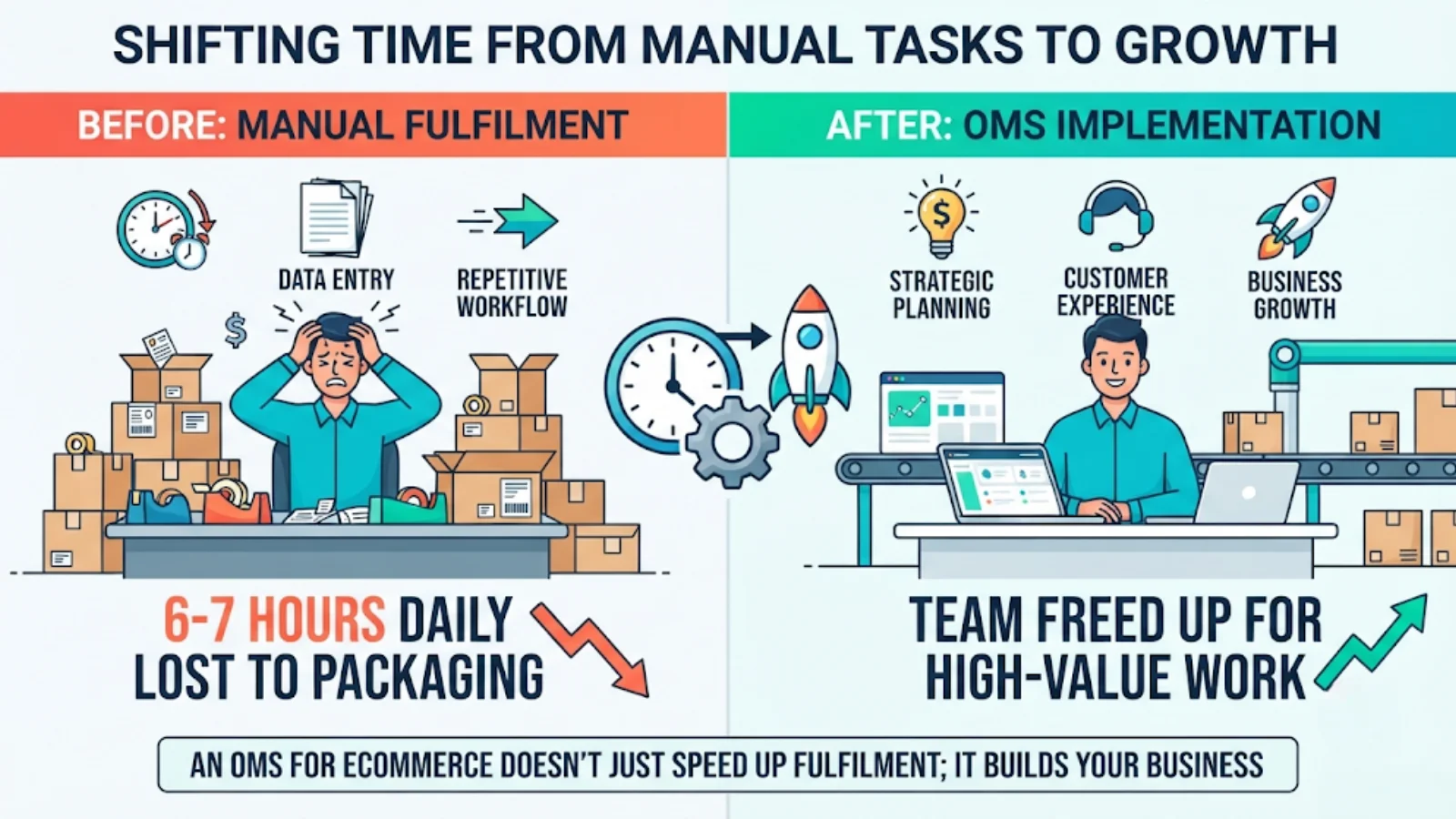
The 6 to 7 hours consumed by packaging every peak day had an opportunity cost that extended beyond fulfilment throughput.
Every hour a team member spent on manual packaging coordination, repetitive status updates, and manual workflow progression was an hour not spent on activities that actually drive business growth. Customer service. Quality improvement. Operational planning. Channel expansion. These are the activities that compound over time and separate brands that scale successfully from brands that plateau.
Real Vision’s team was spending its most productive hours on the lowest-value activities, not by choice, but because the process required it. The team was capable. The constraint was structural. A process built on manual coordination will always consume more human time than is necessary, and the time it consumes is always the time that could be most usefully directed elsewhere.
For a brand evaluating an OMS for ecommerce brands in India, this is one of the most important but least-discussed dimensions of the decision. The question is not just “will this make fulfilment faster?” The question is “will this free the team to do the work that actually builds the business?” At Real Vision, the answer to both was yes.
How Base.com solved it:
- Base.com’s automatic actions capability removed entire categories of repetitive manual tasks from the team’s daily workload, not by streamlining them but by eliminating the need for manual execution.
- Order status updates that previously required manual input at each stage were automated, happening without team intervention as orders progressed through the configured workflow.
- Internal task routing, determining which team member or station handled which step, was managed by the system’s rules rather than by supervisory coordination throughout the day.
- The time freed from repetitive coordination was not absorbed back into the existing workflow. It was genuinely available for redirection to higher-value operational activities.
- Real-time reporting within Base.com gave the management team visibility into operational performance without requiring manual data assembly from multiple sources, itself a significant time recovery for those responsible for operational oversight.
- The system ran the routine. The team focused on the exceptional, the decisions, relationships, and work that a system cannot do and that a growing business genuinely needs its people to do.
The impact:
The 4 hours saved per day during peak weeks were not redistributed into faster packaging or more packaging cycles. They were genuinely recovered for the team to direct at growth-focused work.
Team members who had previously spent their mornings on manual packaging coordination were available for customer service, quality checking, operational review, and planning work that had previously been deferred because there was never enough time. The quality of operational decisions during peak periods improved because the team was not exhausted by hours of manual process maintenance before the fulfilment day had even properly started.
Across the operation, the shift from manual coordination to system-driven execution changed what Real Vision’s team was capable of achieving in a working day, during peak weeks specifically, and in the weeks and months that followed as the operational foundation compounded its value.
Challenge 6: The Business Needed Scalability Without Scaling Chaos
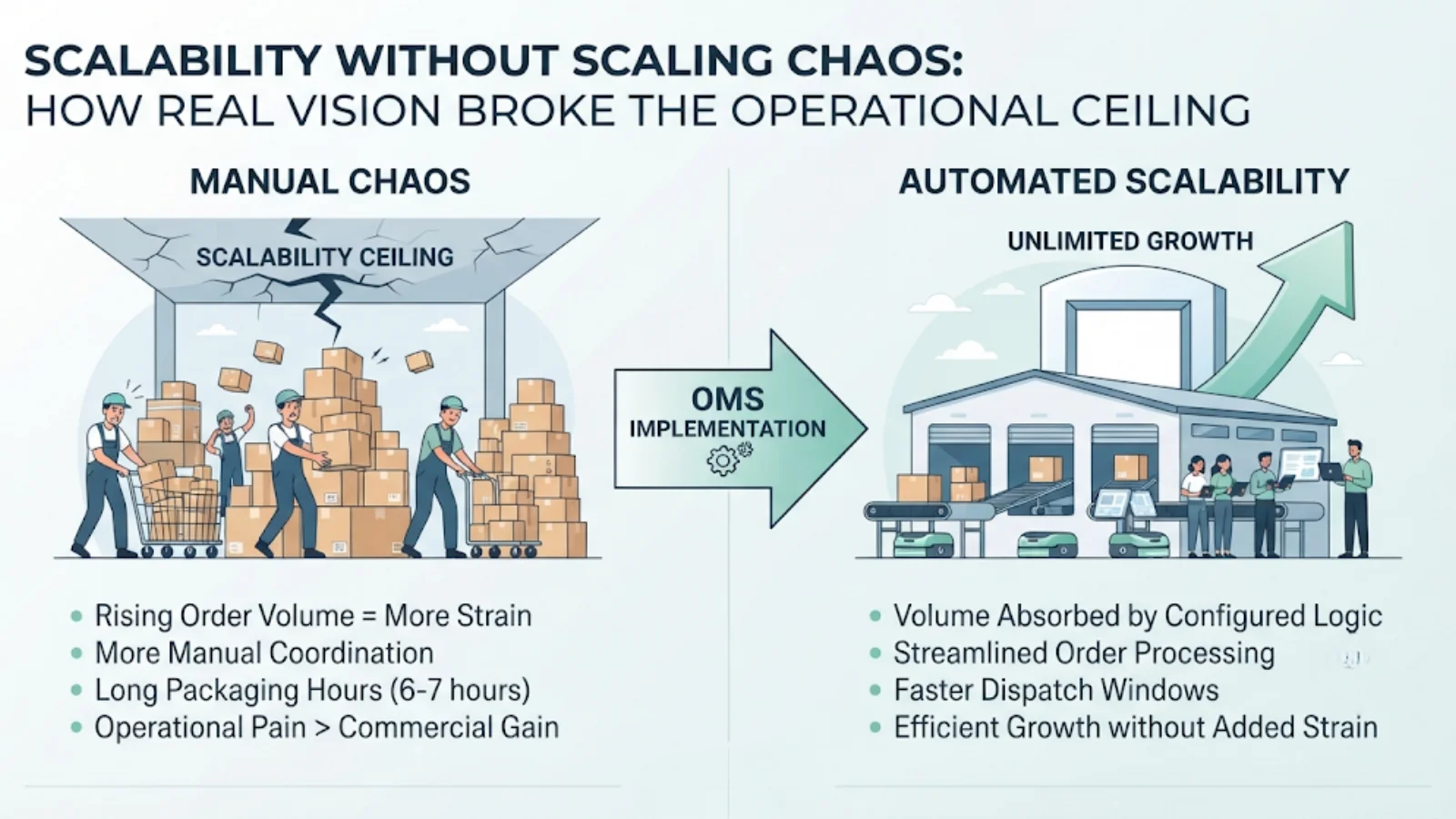
As Real Vision’s order volumes increased, the existing process had no path to better performance. More volume meant more packaging time, more manual coordination, more hours consumed, not the same hours managed more efficiently.
The scalability ceiling was not approaching. It had already arrived. If volumes grew further, as the brand’s commercial ambitions required, the operational consequence was predictable. The team would be further behind earlier in the day. Dispatch windows would compress. SLA compliance would deteriorate further. The brand’s best commercial periods would become its worst operational ones.
For a business investing in growth, having an operation that performs worse as it scales is not a temporary inconvenience. It is a structural barrier that eventually stops growth from compounding. Every brand that relies on manual processes eventually hits this ceiling, the point where growth creates more operational pain than commercial gain.
Real Vision recognised this before the ceiling had fully closed. They were already seeing the early signs, the 6-to-7-hour packaging windows, the peak-week strain, the throughput limitations, and understood that these were not problems that could be resolved by adding people or working harder. They needed a structural change. Specifically, they needed an OMS for ecommerce brands in India that would break the relationship between more volume and more strain, and replace it with a system where volume was absorbed by configured logic rather than absorbed by the team.
How Base.com solved it:
- Base.com’s architecture was designed for volume scalability; the system’s configured rules apply identically at 100 orders per day and at 1,000 orders per day, without degradation in performance or consistency.
- The coordination overhead of additional order volume was absorbed by the system’s automation layer, not transferred to the team as additional manual work.
- The Order Manager’s processing queue scaled to manage higher volumes without requiring structural changes to the workflow configuration; the same setup that handled normal-day volumes handled peak volumes without adjustment.
- Workflow automation ensured that new orders entering the system at any volume level were processed, sequenced, and directed through the fulfilment stages with the same logic and the same speed.
- Base.com’s integration with multiple channels meant that channel expansion, adding new marketplaces or D2C platforms, added revenue without adding proportional operational complexity.
- The scalability built into Base.com’s architecture meant that Real Vision’s fulfilment capacity grew with its commercial ambition rather than constraining it.
The impact:
Real Vision gained a fulfilment operation that could grow without breaking. The business could take on higher-demand periods, run more aggressive marketing campaigns, expand into new channels, and increase sales-season inventory positions, all with confidence that the operational foundation would absorb the additional demand rather than buckle under it.
The 4 hours saved per day during peak weeks became a scalability signal, evidence that the operation had genuine headroom to grow without the next volume increase creating the next operational crisis. Peak weeks became the brand’s best commercial and operational periods simultaneously, rather than the periods where commercial opportunity and operational capability pulled in opposite directions. This is the outcome that defines a genuine OMS for ecommerce brands in India, not just better operations today, but an operational foundation that supports a larger, faster, more ambitious business tomorrow.
Base.com as an Operational Performance Enabler
Most OMS platforms for ecommerce brands in India deliver visibility. Dashboards, order tracking, inventory counts, and reporting tools, all useful, all table stakes. The brands that have moved beyond spreadsheets already have some version of this. What they do not always have is operational performance improvement, the kind that shows up in measurable time savings, removed bottlenecks, and a workflow that performs better under pressure than it did before.
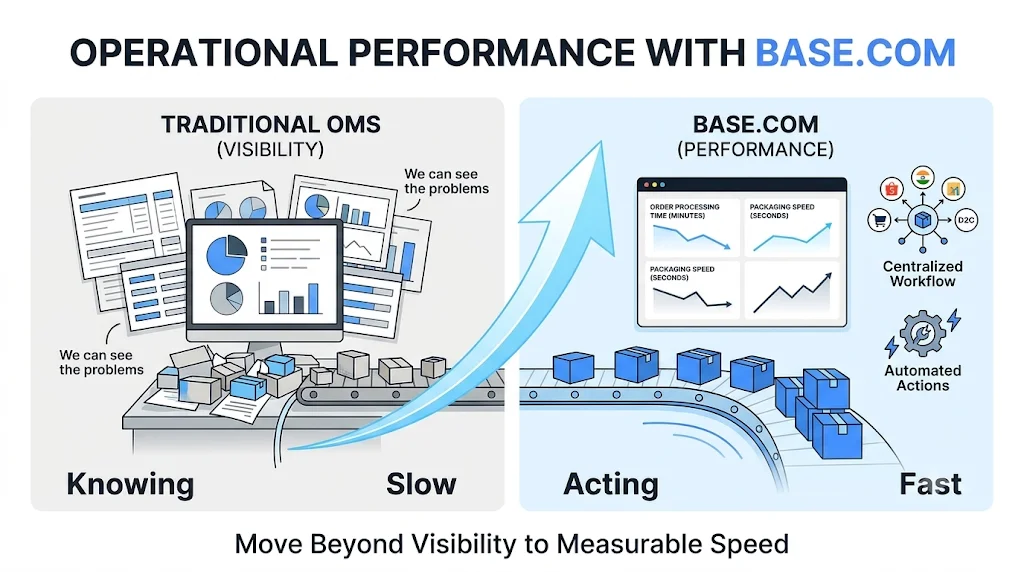
Base.com differentiates by delivering that second kind of value. For Real Vision, the implementation was not about seeing orders better. It was about processing orders faster, packaging them in a fraction of the previous time, and building a workflow that handled peak-week volume without creating peak-week chaos.
The specific capabilities that drove Real Vision’s results, the Order Manager’s workflow centralisation, and the automatic actions capability, are designed around the operational realities of Indian ecommerce brands growing through marketplaces and D2C channels simultaneously. They are not generic tools adapted for the Indian context. They address the operational problems that Indian ecommerce brands actually face at the point of scale.
Real Vision’s outcome demonstrates what Base.com is as an OMS for ecommerce brands in India. Not a management tool with efficiency features attached. An operational performance enabler that changes what a team can achieve during the days that matter most, and builds the operational foundation that a growing business needs to scale without scaling chaos at the same pace as order volume.
Results at a Glance
| Metric | Before Base.com | After Base.com |
|---|---|---|
| Packaging time during peak weeks | 6 to 7 hours per day | 2 hours per day |
| Daily time saved | — | Approximately 4 hours |
| Order processing | Manual, fragmented, effort-dependent | Automated, system-driven, consistent |
| Peak-week experience | Constrained, behind from the start | Manageable, structured, scalable |
| Team capacity | Consumed by repetitive manual tasks | Redirected to growth-focused work |
| Scalability | Limited by the manual process ceiling | System-driven, volume-resilient |
| SLA compliance | Under pressure during peak weeks | Improved through recovered dispatch time |