Marketplace fulfilment for fashion brands in India is not a logistics problem. It is an operational design problem. The speed at which an apparel brand moves from confirmed order to dispatched shipment depends not on how fast the warehouse runs, but on how well the underlying systems are configured for the specific realities of fashion: size-and-colour SKU complexity, cutting and stitching workflows, multi-marketplace label formats, and return rates that routinely exceed 30 to 40%.
Pink Shell understood this distinction only after scaling across Myntra, Flipkart, and Meesho, and discovering that processes built for 100 orders per day were breaking systematically at 500. This is the story of how they fixed it with Base.com, and why the fix went deeper than most operational interventions in Indian fashion ecommerce.
About Pink Shell
Pink Shell is an Indian apparel brand operating across major fashion and general merchandise marketplaces, including Myntra, Flipkart, and Meesho. Like most Indian fashion brands that scale through online channels, Pink Shell’s growth was driven not by a single platform but by simultaneous multi-marketplace presence, each channel carrying different fulfilment requirements, different label formats, and different SLA commitments that the team managed independently.
As order volumes grew, the operational cost of managing this complexity manually grew with it, not linearly, but exponentially. Marketplace fulfilment for fashion brands in India at this scale demands a backend built specifically for it. Pink Shell’s backend, at the point they engaged Base.com, was built for a smaller, slower business and was showing the strain of being asked to do far more than it was designed for.
The Challenge
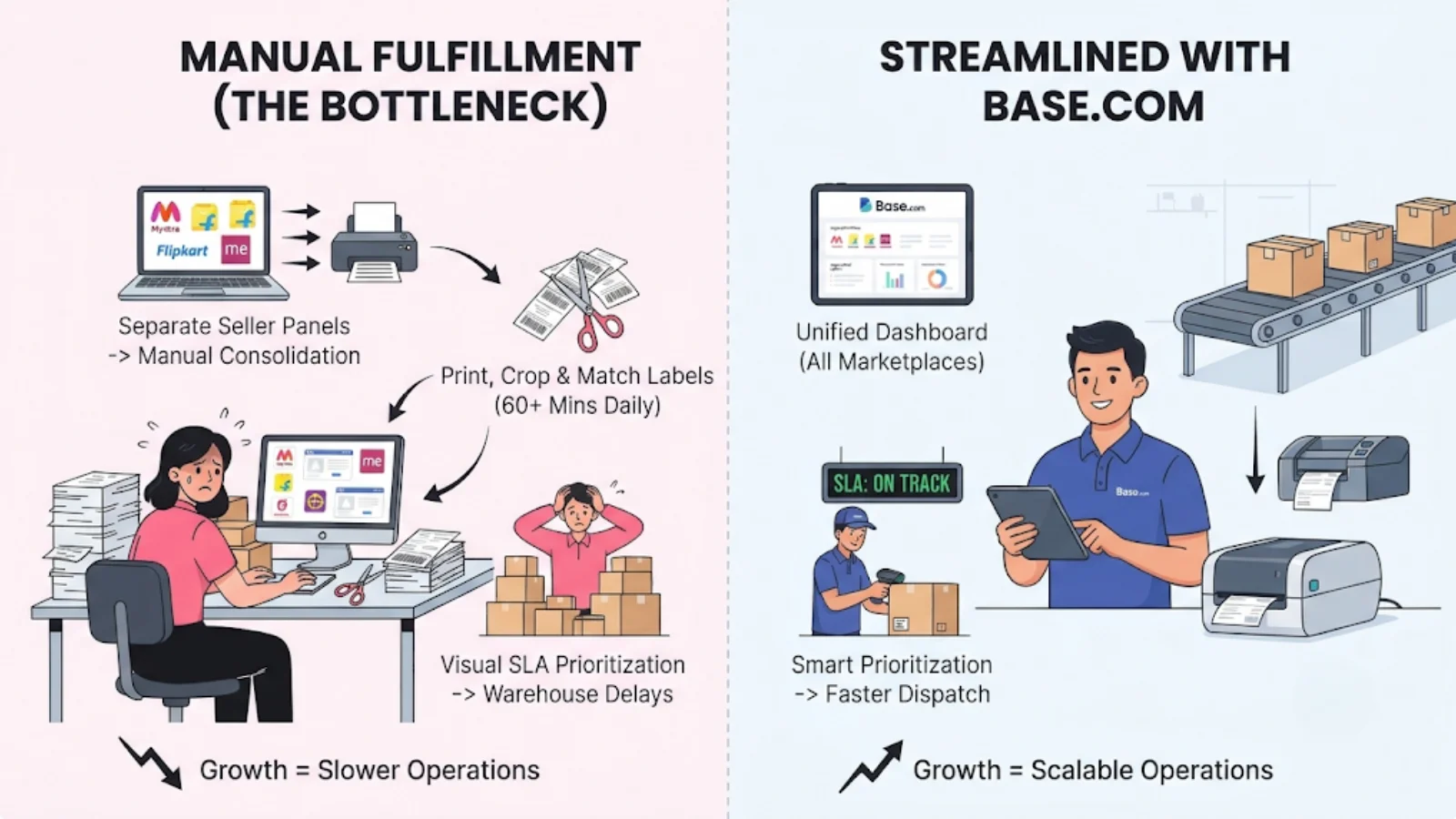
Pink Shell’s operational model before Base.com was built entirely around manual execution. Every step from order receipt to dispatch required direct human intervention, label printing, order retrieval, production coordination, returns management, and marketplace monitoring, all of which depended on individual effort rather than system-driven logic. This was the operating reality of a brand that had grown faster than its processes had evolved.
The label workflow was the most acute and immediately visible bottleneck. Before any item could be picked, packed, or dispatched each day, Pink Shell’s team had to print, crop, and manually match labels for the full day’s order batch. Labels were printed from each marketplace’s seller panel separately in different formats, physically cropped or trimmed, and matched to individual orders by hand.
This process consumed over 60 minutes every single day before a single item had been touched for fulfilment. On high-volume days, the label preparation window compressed the entire dispatch timeline, leaving the warehouse team with a shrinking window to pick, pack, and hand off to couriers within the SLA. For a brand trying to compete in marketplace fulfilment for fashion brands in India, where SLA compliance directly determines seller score and listing visibility, this was not a minor inconvenience. It was a structural ceiling on daily throughput.
Beyond the label bottleneck, the broader order processing workflow was manually intensive at every stage. Orders arriving from Myntra, Flipkart, and Meesho were retrieved from three separate seller panels, consolidated by hand into a working queue, and routed to the warehouse floor through a process that depended entirely on whoever was managing the task at that moment.
Order prioritisation for SLA compliance was done by visual inspection rather than by a system-generated countdown. Any order requiring special handling, a specific size, a fragile SKU, or an express-dispatch flag was identified manually rather than automatically flagged. As volumes grew, the time from order receipt to pick instruction grew proportionally. Growth and operational slowdown were directly correlated, which is precisely the relationship that effective marketplace fulfilment for fashion brands in India must break.
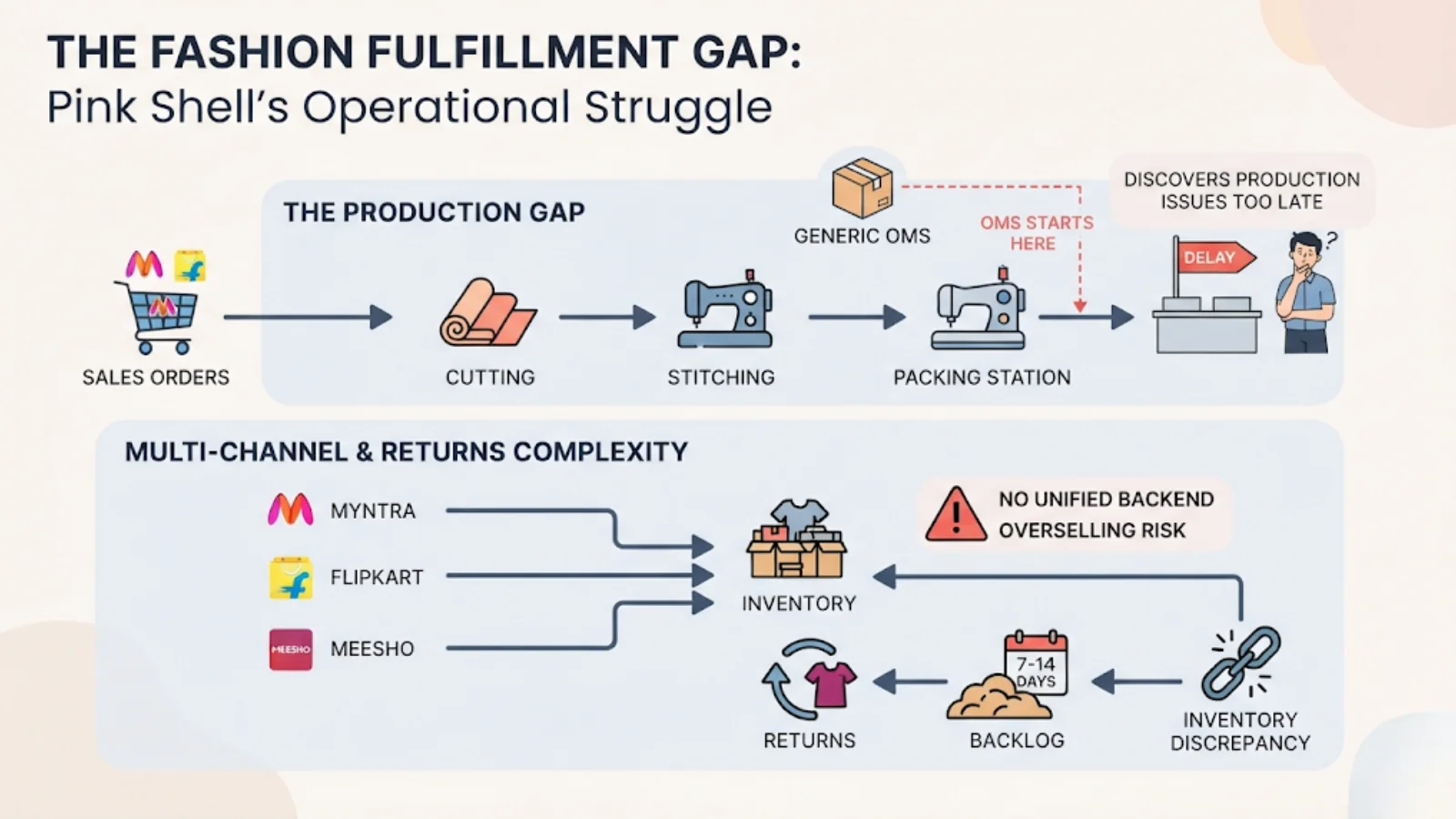
Fashion brands with in-house production carry a pre-fulfilment complexity that most other ecommerce categories simply do not have. Pink Shell’s operations included cutting and stitching activity, internal production steps that had to be completed and coordinated with incoming sales orders before fulfilment could proceed. A generic OMS has no concept of this. It manages the journey from the warehouse receipt onwards.
For Pink Shell, the operational journey began earlier, and the disconnect between where the system started and where the business actually started created a structural coordination failure that impacted the operation every single day. The dispatch team discovered production delays only when a garment failed to appear at the packing station, not with enough advance notice to reprioritise the queue or recover the SLA window. No standard platform was willing or configured to address this gap.
Returns added a third layer of operational pressure. Return rates in Indian fashion ecommerce are structurally high; Myntra fashion return rates routinely exceed 30 to 40%, and Pink Shell had no defined process for managing this volume consistently. Returns arrived at the warehouse and were handled by whoever was available, with QC decisions made on individual judgment rather than defined criteria.
Restockable returns sat in a processing backlog for 7 to 14 days before re-entering available inventory, creating a growing gap between physical stock and system-recorded available stock. This phantom inventory gap triggered false stockout signals, which led to unnecessary purchase orders for items the brand already physically possessed. The absence of structured returns management was costing Pink Shell both working capital and inventory accuracy simultaneously.
Finally, operating across Myntra, Flipkart, and Meesho without a unified backend meant that every new marketplace added operational overhead proportional to the effort required to run the previous ones. Checking order status required opening three separate portals in sequence. Inventory allocation was managed manually with no real-time deduction mechanism.
Overselling risk increased with every new channel. Real-time operational visibility, the ability to know at any given moment how many orders were pending, dispatched, and at SLA risk across all platforms, simply did not exist. Any decision requiring cross-channel context required manually pulling data from multiple sources before a clear picture could be assembled. Pink Shell was approaching the operational ceiling that marketplace fulfilment for fashion brands in India inevitably imposes on brands running multi-channel manual workflows without a unified system underneath them.
Why Pink Shell Chose Base.com
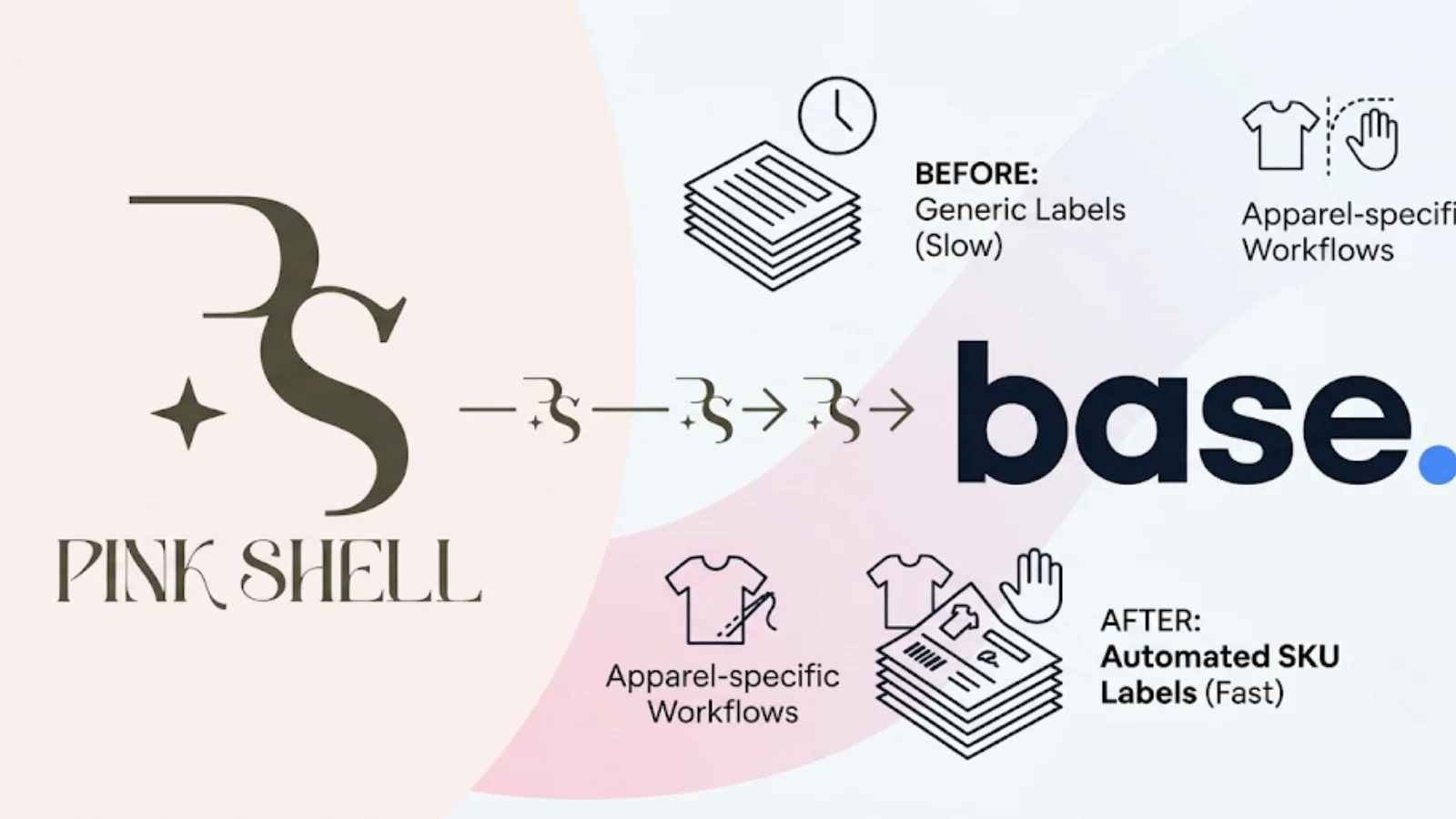
Pink Shell evaluated Base.com specifically because it offered not just a standard OMS but a platform that could be adapted to the specific operational reality of apparel. The Base.com team engaged with Pink Shell’s actual workflows, including the cutting and stitching complexity, and demonstrated a genuine willingness to configure the system around how Pink Shell’s business operated, not around how a generic ecommerce brand operates.
The label automation capability was the most immediately compelling differentiator. Base.com’s ability to automate SKU-wise label creation and batch processing was a concrete, measurable solution to the most acute bottleneck Pink Shell was facing.
The conversation about production workflow customisation reflected a clear understanding of what marketplace fulfilment for fashion brands in India actually requires on the ground, and the support team’s responsiveness during the evaluation process gave Pink Shell confidence that implementation would be actively supported rather than simply deployed.
The Solution
Base.com’s implementation for Pink Shell was not a generic deployment. It was a configured solution designed around the specific operational challenges the brand had identified, each addressed with a targeted system response that matched how an apparel brand with in-house production and multi-marketplace presence actually operates.
1. SKU-Wise Label Automation
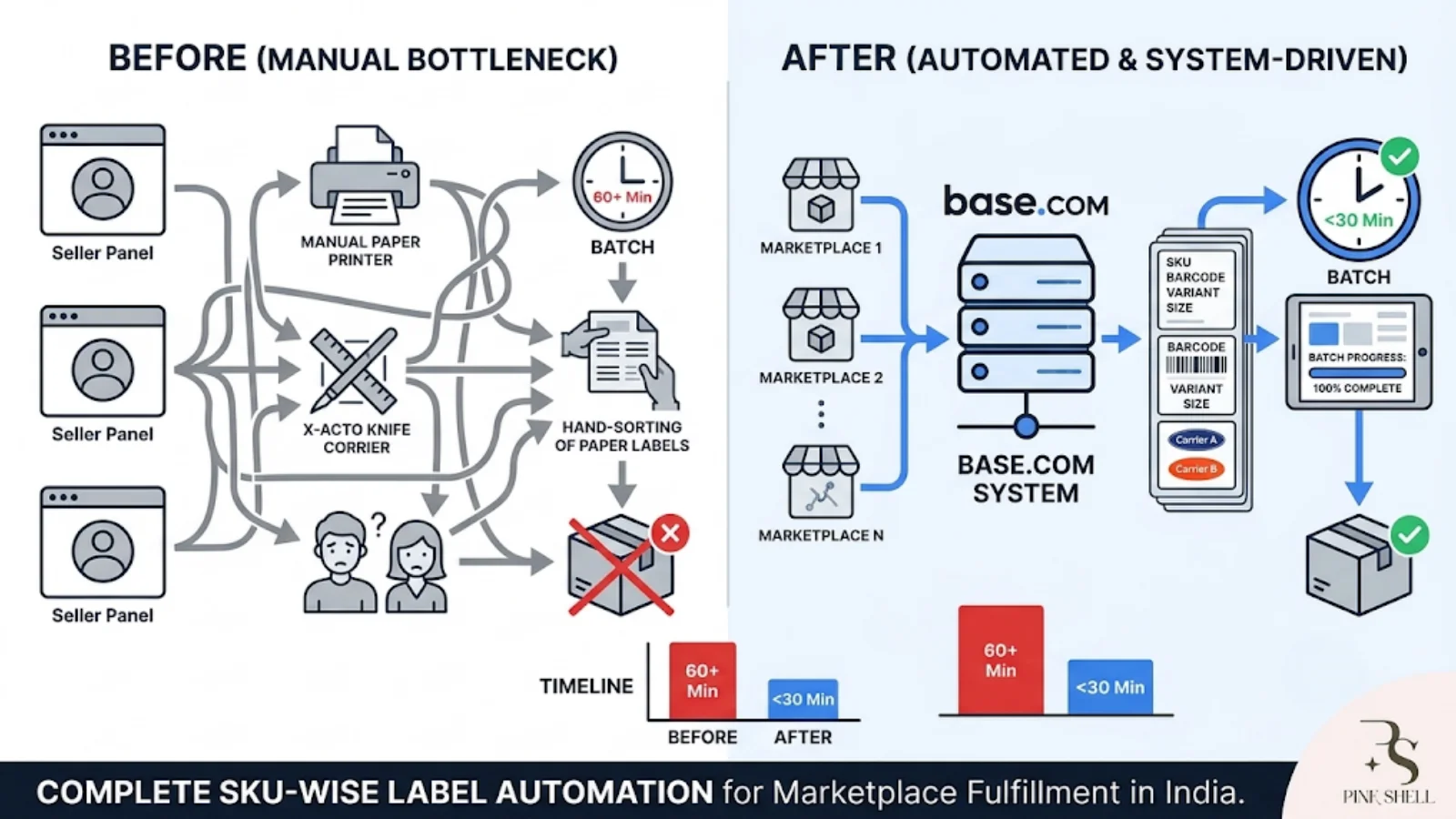
The label workflow was the first and most acute problem Base.com solved. The solution was complete automation of SKU-wise label creation across all connected marketplaces. Base.com generates the correct label format for each marketplace automatically, based on the SKU and order data flowing from each platform. Labels for an entire day’s batch are produced through a single system-driven process, no manual printing from individual seller panels, no physical cropping, no hand-matching of labels to order.
SKU-specific label data, size, variant, barcode, and marketplace routing information are embedded in the generated label automatically. The label generation queue is visible in the Base.com dashboard, making batch progress trackable in real time by the operations team. Label errors caused by manual handling were eliminated because the process is system-driven rather than human-driven. Batch-processing time dropped from over 60 minutes to under 30 minutes, a result Pink Shell’s team experienced on the first day of implementation and compounded every day thereafter.
For a brand competing in marketplace fulfilment for fashion brands in India, eliminating the administrative bottleneck that was consuming the most time-sensitive window of the dispatch day was the single most impactful first change.
2. Centralised Multi-Marketplace Order Processing
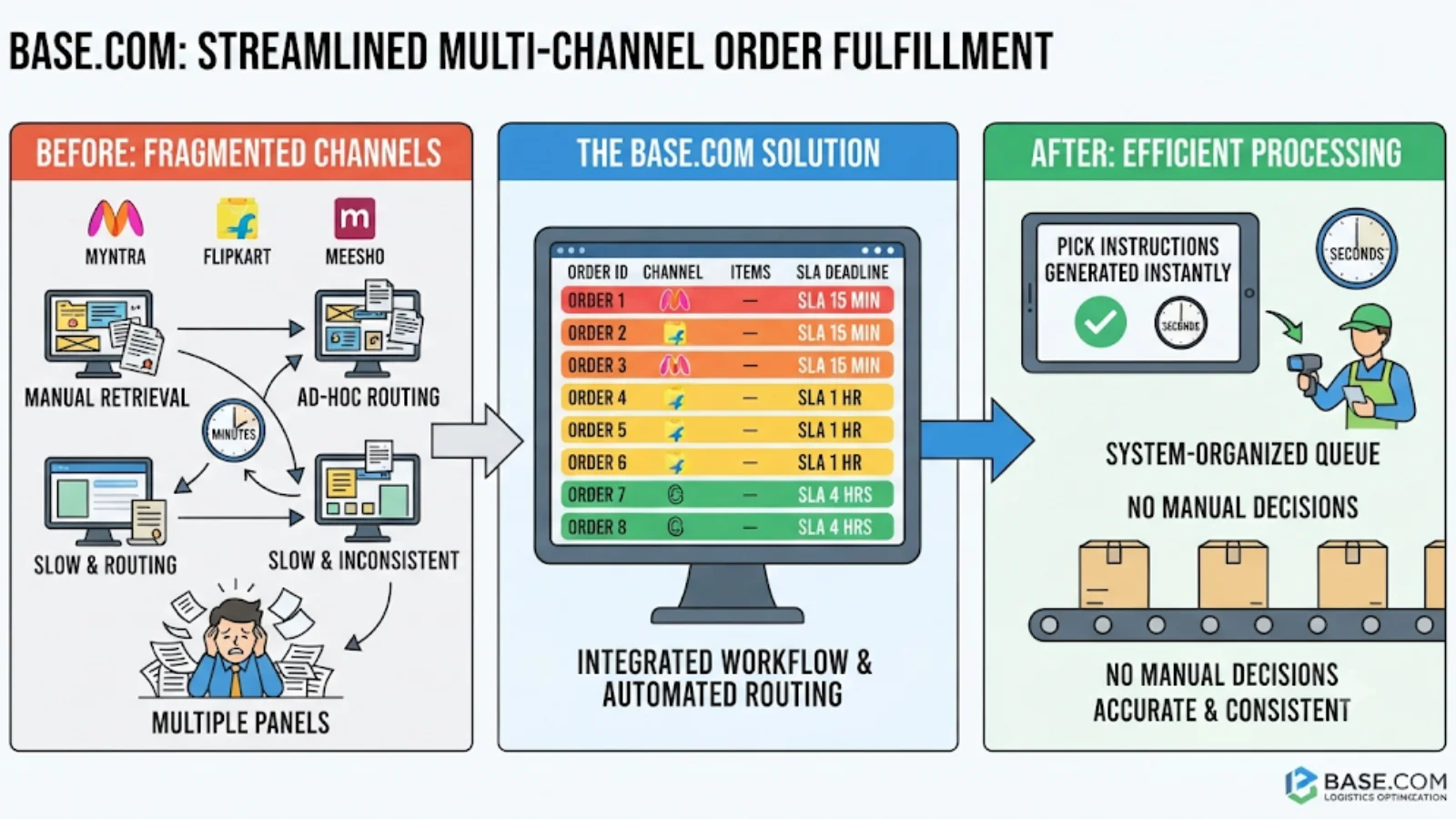
Base.com consolidated all order processing from Myntra, Flipkart, and Meesho into a single operational workflow. The fragmented, multi-panel manual retrieval process was replaced by one dashboard showing all orders from all channels simultaneously, with SLA countdown timers visible per order and automatic prioritisation by dispatch urgency. Orders closest to their SLA deadline surface at the top of the queue without requiring manual review.
Order routing rules determine which station handles which order type, removing the ad hoc assignment that previously consumed time and created inconsistency. Pick instructions are generated automatically and pushed to the warehouse floor without requiring a team member to manually translate order data into picking tasks.
The total time from order receipt to pick instruction generation became a system-driven process measured in seconds rather than minutes. The team no longer made routing decisions under time pressure. They executed a system-organised queue, and the queue was organised correctly every time.
3. Customised Workflow for Cutting and Stitching Departments
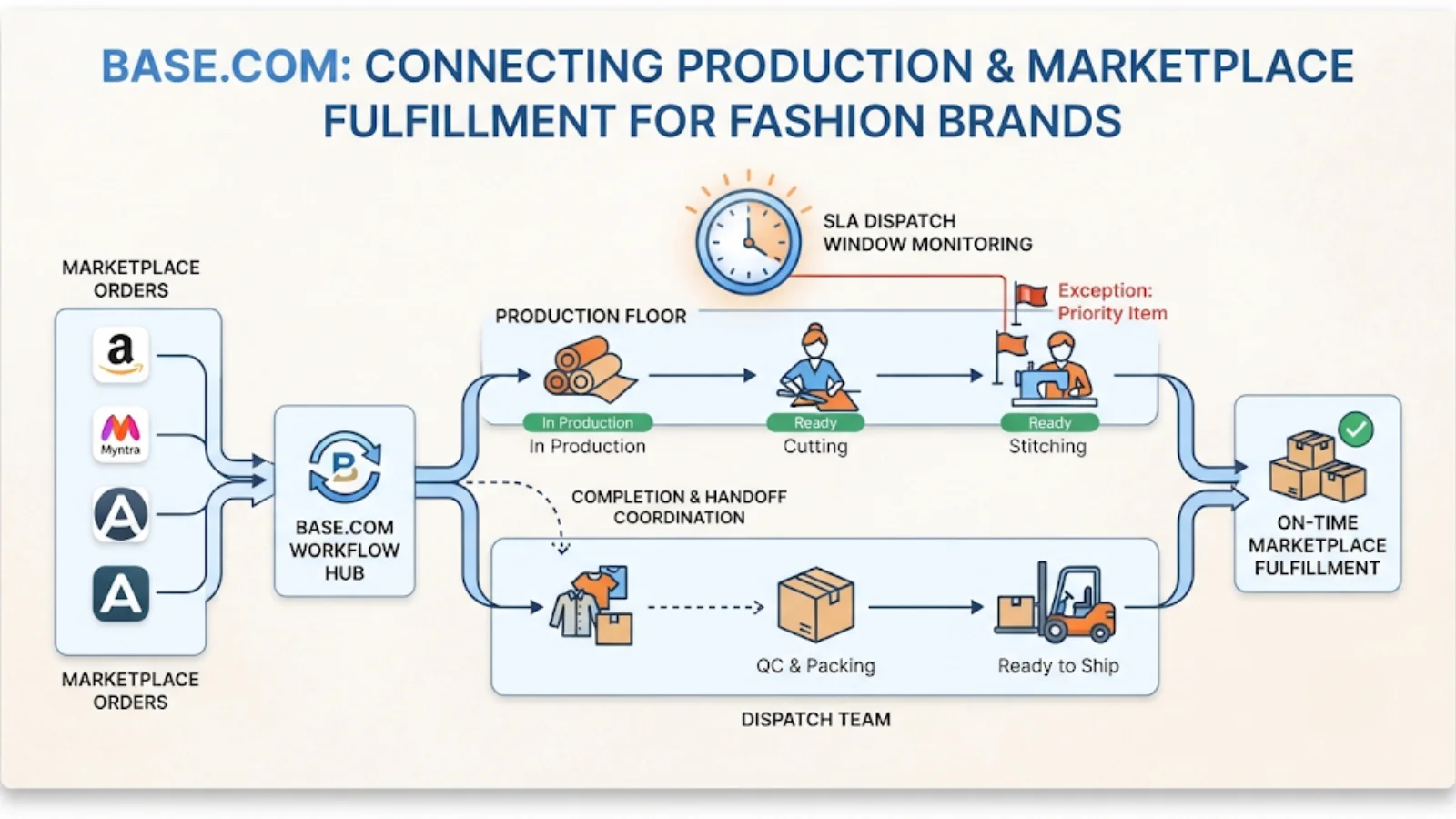
This is the specific capability that makes Base.com a distinct solution for marketplace fulfilment for fashion brands in India with in-house production. Base.com worked directly with Pink Shell to build a configured workflow connecting the production floor with the order management system, upstream of the standard OMS scope that most platforms cover and most vendors do not attempt.
Incoming sales orders from all marketplaces become visible to the cutting and stitching departments within the Base.com workflow, not just to the dispatch team. Production status for each order can be updated within the system, giving the dispatch team real-time visibility into when a garment will be ready for fulfilment. Orders approaching their SLA dispatch window surface automatically as priority items in the production queue, allowing the cutting and stitching teams to sequence work by commercial urgency.
The coordination loop between production completion and dispatch handoff is managed within the system, eliminating the verbal instructions and spreadsheet updates that previously created information delays and errors. Exceptions, orders where production is running behind the SLA window, are flagged automatically, giving the operations manager advance notice before the deadline passes rather than a post-breach report after it has.
4. Structured Returns Management Workflow
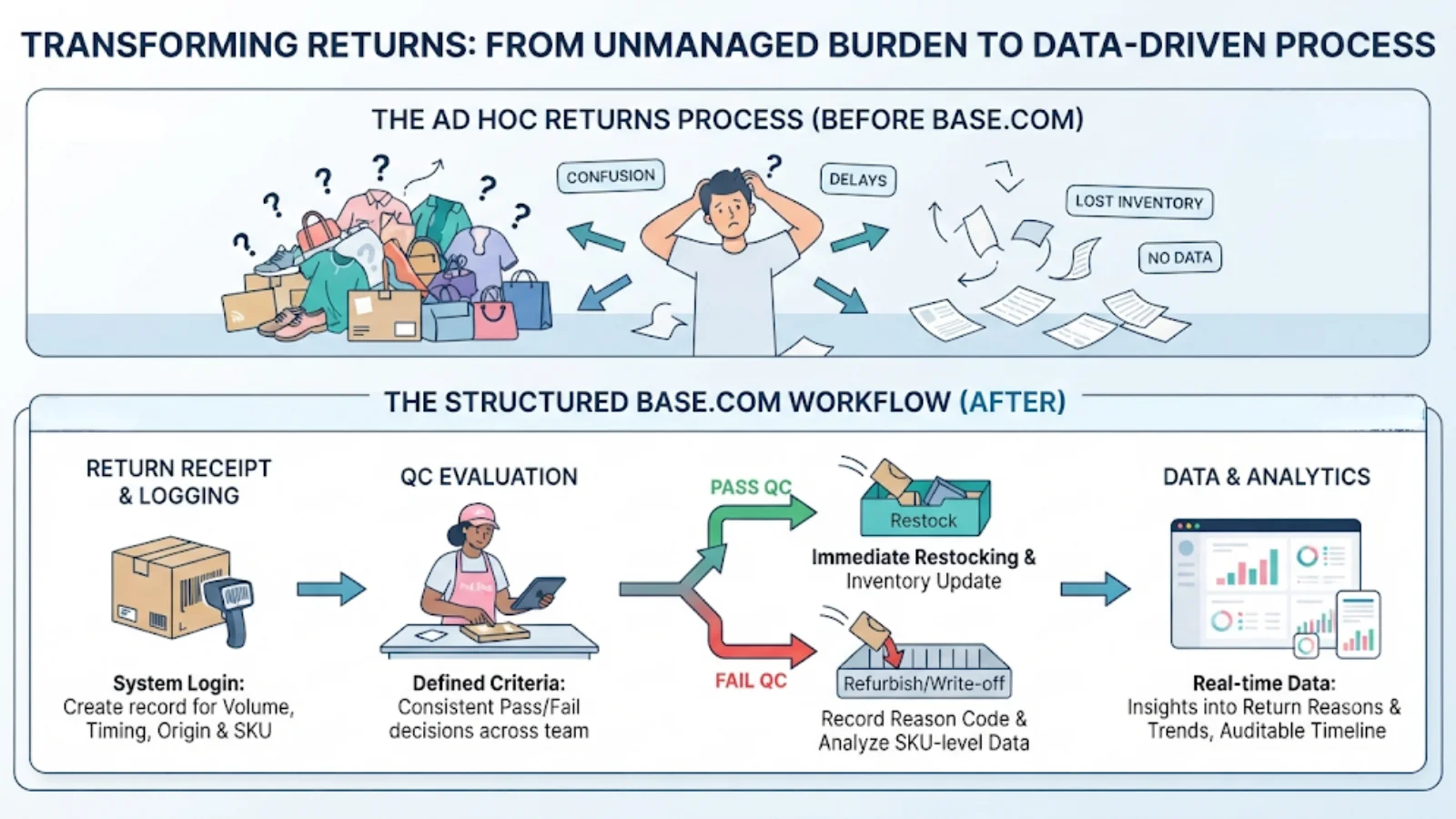
Base.com replaced Pink Shell’s ad hoc returns process with a structured, system-managed workflow that defined every step from return receipt to inventory update. Every return is logged in the system on physical receipt, creating a complete record of return volume, return timing, and return origin by marketplace and SKU. QC criteria are configured within the workflow, pass conditions and fail conditions are defined so that decisions are consistent across the team, not dependent on whoever happens to be handling the return at that moment.
Returns that pass QC are immediately queued for restocking, with inventory updating in the system upon physical confirmation. Returns that fail QC are routed to a defined write-off or refurbish queue with a reason code recorded for every failure. These reason codes accumulate at the SKU level over time, giving Pink Shell data on which products generate the most returns and why.
The total processing cycle for every return is tracked against a defined internal SLA, replacing the indefinite backlog with a managed, auditable timeline. Returns management became a data-generating operational process rather than an unmanaged administrative burden, directly addressing one of the most structurally challenging aspects of marketplace fulfilment for fashion brands in India.
5. Real-Time Unified Dashboard Across All Marketplaces
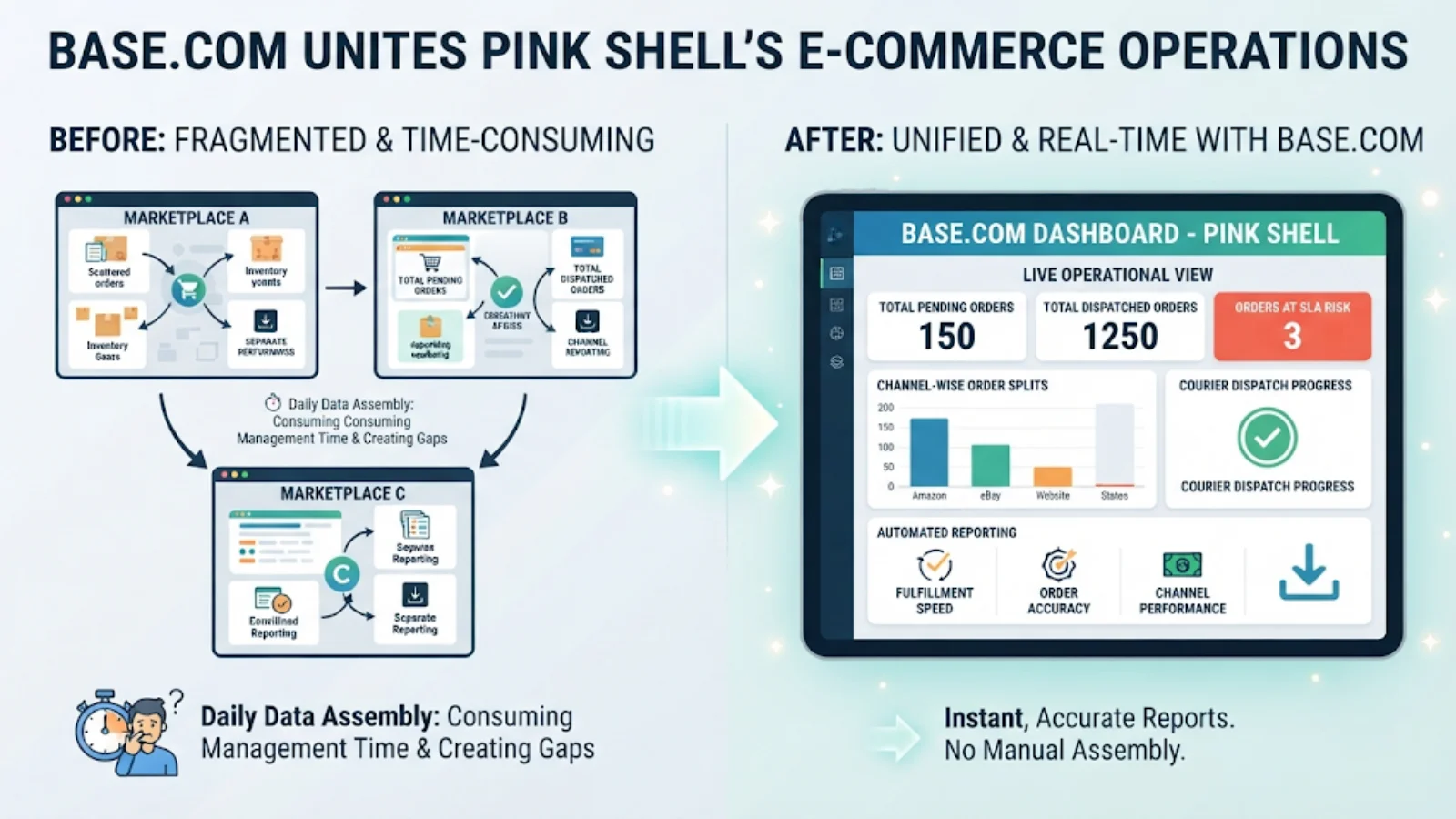
Base.com gave Pink Shell a single unified operational view across all connected marketplaces, with live reporting on order status, inventory levels, dispatch progress, and SLA position. The information that previously required checking three seller panels in sequence was available in one screen in real time, removing the daily information assembly exercise that was consuming management time and creating visibility gaps.
Total pending orders, total dispatched orders, and total orders at SLA risk are visible on one screen at any moment during the day. Inventory levels across all connected channels update in real time as orders are confirmed and dispatched; no manual reconciliation required.
Channel-wise order splits, SLA breach risk alerts, and courier dispatch status are all visible without logging into individual marketplace portals. Daily and periodic performance reports are generated directly from Base.com, covering fulfilment speed, order accuracy, return volumes, and channel performance without requiring manual data assembly from multiple disconnected sources.
The Impact
The results of Base.com’s implementation at Pink Shell were immediate, measurable, and structural. Every operational dimension that had previously been limiting growth improved, and the improvements compounded with every additional day of operation on the new system.
1. Label Processing
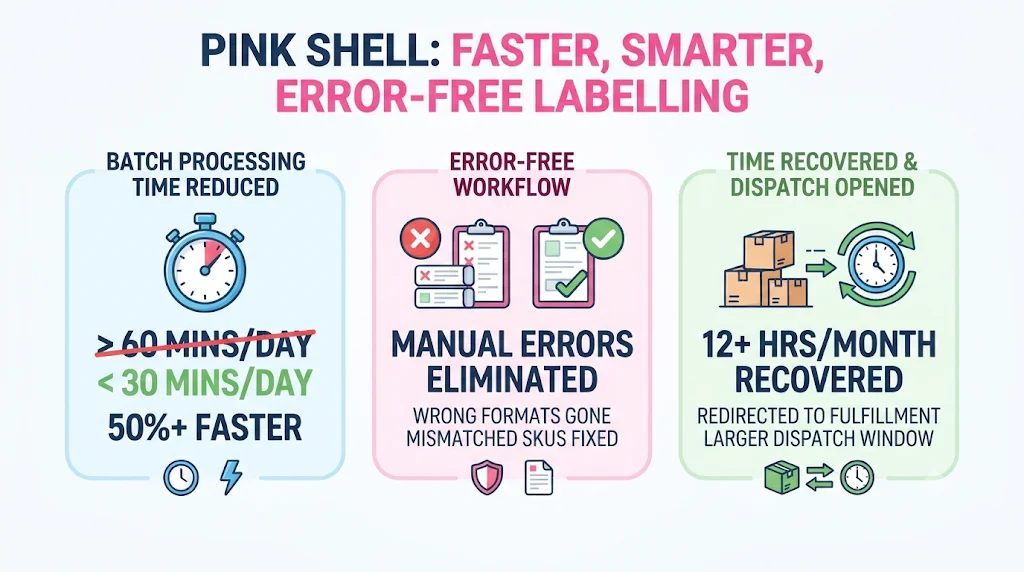
- Batch-processing time for labels dropped from over 60 minutes per day to under 30 minutes, a reduction of more than 50%.
- Over a 25-day working month, this represents more than 12 hours of recovered operational time redirected from administrative pre-work to productive fulfilment activity.
- Label errors caused by manual handling, wrong marketplace format, and mismatched SKU information were eliminated from the workflow.
- The dispatch window that was previously constrained by the label preparation bottleneck opened up, giving the warehouse team a meaningfully larger window to pick, pack, and complete courier handoffs within SLA.
- Pink Shell’s team felt this change on the first day of implementation and has compounded the gain every day since.
2. Order Processing Speed and Accuracy
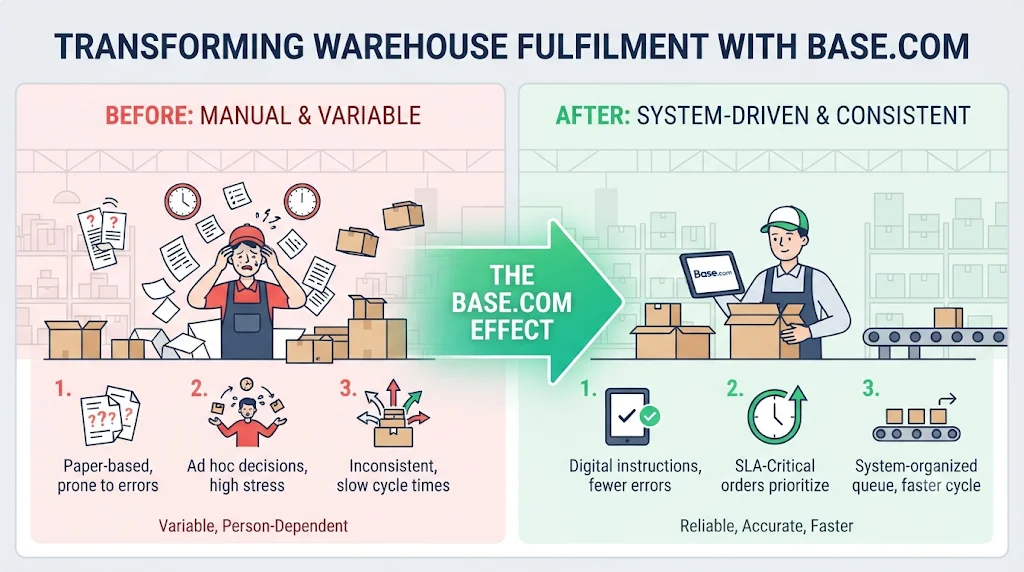
- Order processing became consistent and system-driven rather than variable and person-dependent across every shift and every day.
- Pick instructions were generated by the system rather than interpreted from paper printouts, removing a consistent source of fulfilment errors.
- SLA-critical orders surfaced automatically at the top of the processing queue rather than being identified by someone watching a clock manually.
- The cognitive load on the warehouse team during the dispatch window dropped significantly; they executed a system-organised queue rather than making ad hoc routing decisions under time pressure.
- Operational accuracy improved because fewer steps depended on individual judgment. Each step in the workflow was guided by Base.com’s configured logic, not by convention or memory.
- The overall fulfilment cycle became faster and more reliable simultaneously, a combination that manual process optimisation rarely achieves.
3. Production-to-Dispatch Coordination
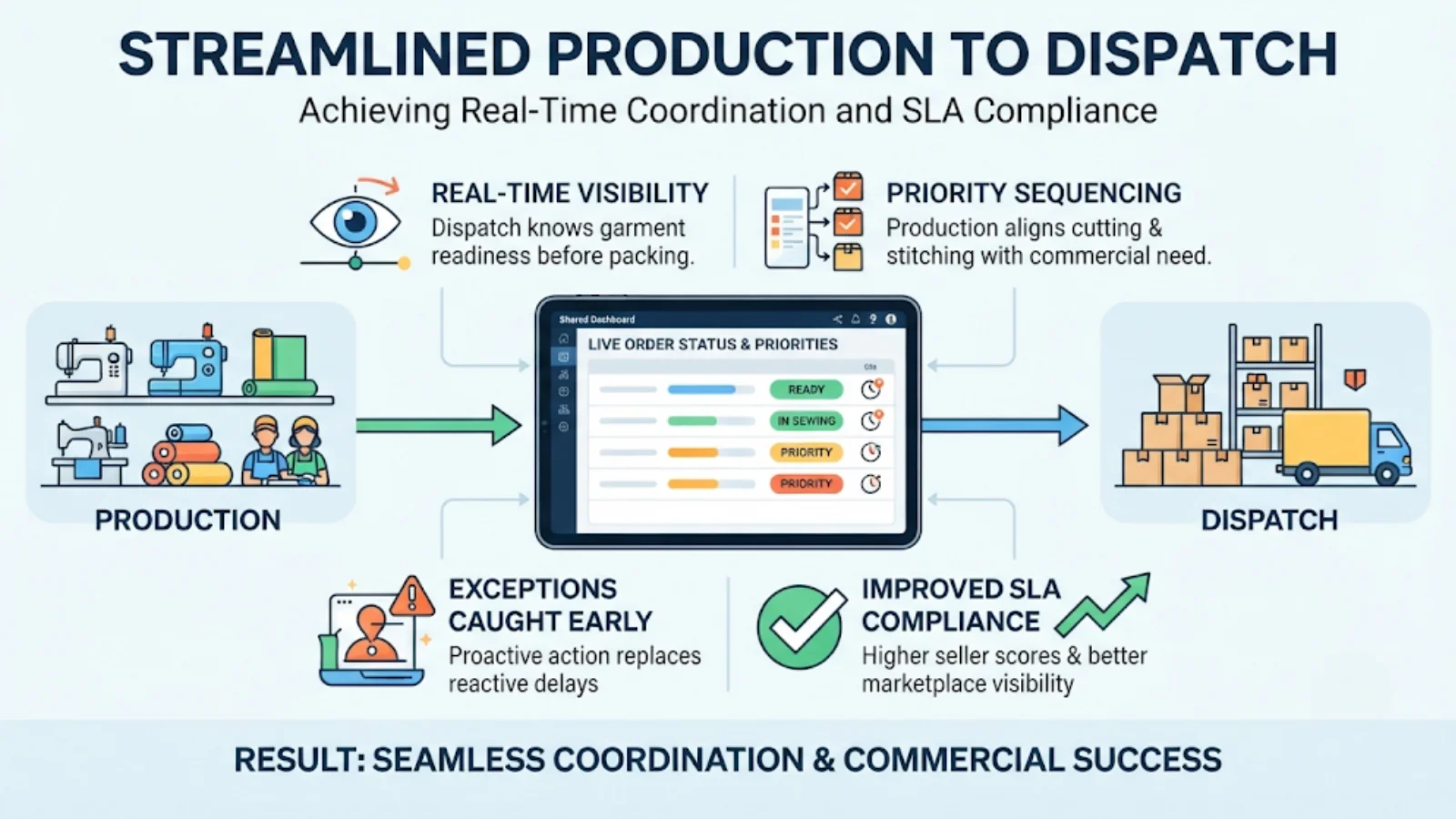
- The dispatch team gained real-time visibility into production status, and they knew when orders would be garment-ready before garments arrived at the packing station.
- The production team gained visibility into order priority and SLA timelines, enabling them to sequence cutting and stitching work by commercial urgency rather than internal production scheduling alone.
- The verbal communication gap between the production floor and the dispatch team, a daily source of delays and last-minute rushes, was replaced by shared, real-time system visibility.
- Late-discovery exceptions were caught early enough to act on rather than documented after the SLA window had already closed.
- Internal coordination across production, warehouse, dispatch, and management improved measurably because all functions worked from the same information rather than from separate, incompatible sources.
- This improvement in production-to-dispatch coordination directly improved SLA compliance, the commercial outcome that determines seller score and listing visibility on every marketplace.
4. Returns Management
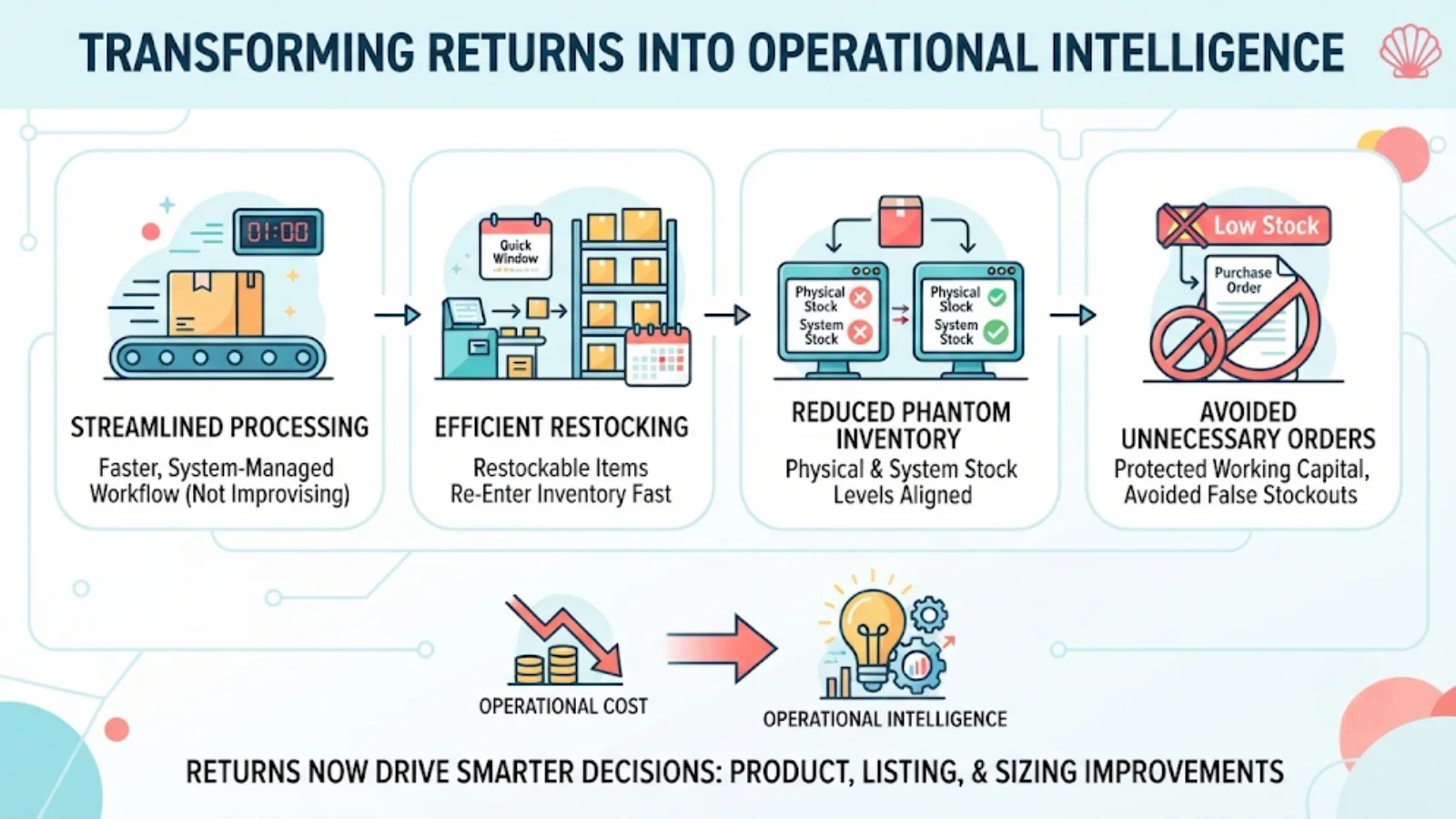
- Returns were processed faster because the team followed a defined, system-managed workflow rather than improvising a process for each return individually.
- Restockable returns re-enter available inventory within a defined processing window rather than sitting in a backlog for 7 to 14 days.
- The phantom inventory gap, the growing discrepancy between physical stock and system-recorded available stock caused by processing delays, has been reduced significantly.
- Unnecessary purchase orders triggered by false stockout signals from unprocessed returns were avoided, protecting working capital.
- Return reason data accumulated at the SKU level, giving Pink Shell’s team actionable information on which items generated the most returns and why, informing product, listing, and sizing decisions with real data rather than assumptions.
- Returns became a source of operational intelligence rather than purely an operational cost.
5. Multi-Marketplace Scalability
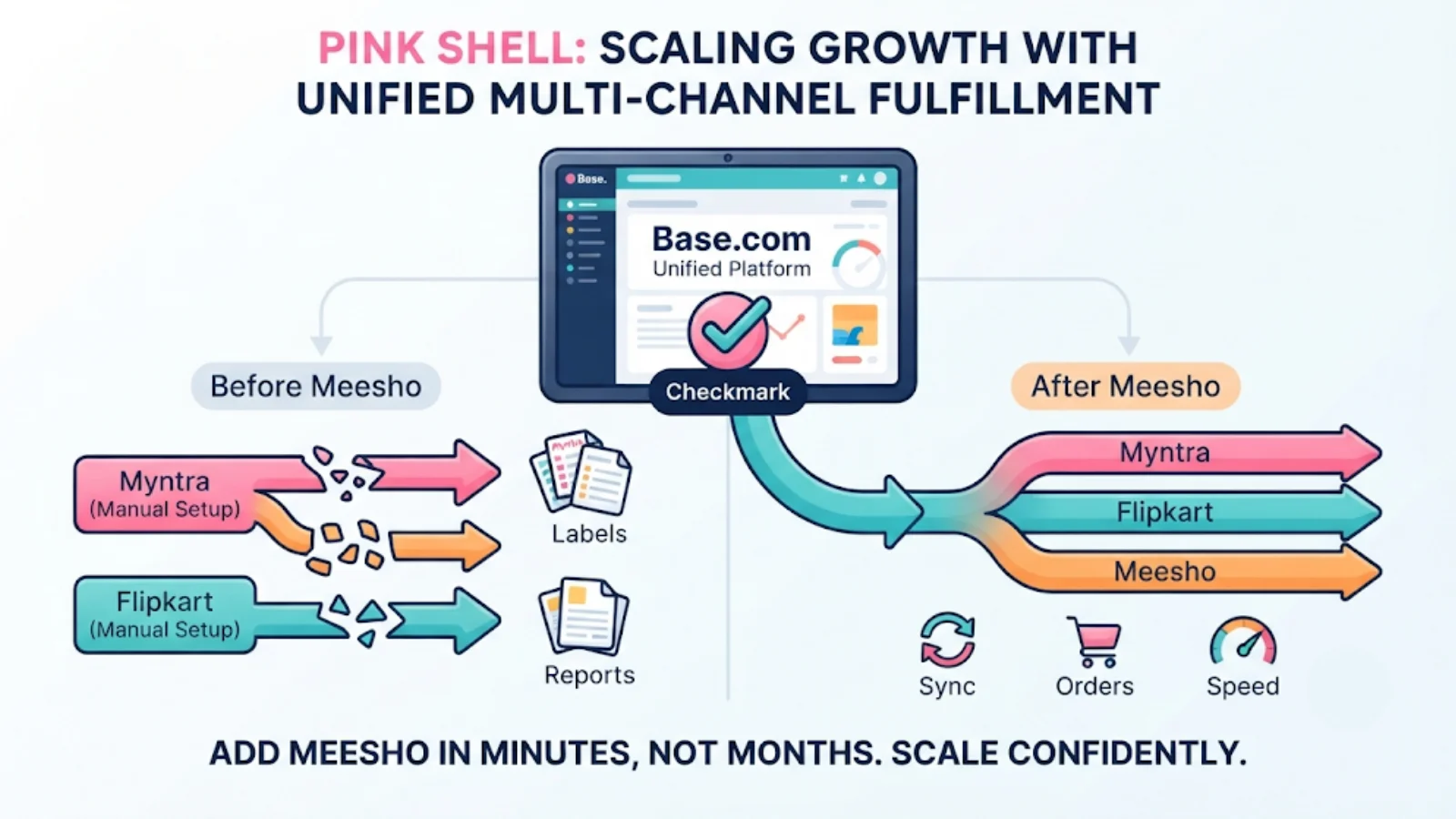
- Pink Shell’s addition of Meesho after initial implementation required channel configuration in Base.com, not a manual workflow rebuild or a parallel administrative setup.
- Label automation, inventory sync, order routing, and SLA monitoring extended to Meesho through the same system already managing Myntra and Flipkart, with no additional operational complexity for the team.
- The operational team did not learn a new process, open a new daily workflow, or add new manual steps for the new channel.
- Multi-channel order visibility, real-time inventory sync, and unified SLA monitoring worked across all three marketplaces from Day 1 of Meesho’s integration.
- Pink Shell gained the ability to scale across platforms with more confidence and control than they had managed at lower volumes on fewer channels, the defining characteristic of marketplace fulfilment for fashion brands in India, done correctly.
- Pink Shell described the overall change as a complete game-changer for growth, the language not of incremental improvement but of a brand that found the operational foundation its ambitions required.
How Base.com Differentiates in Fashion Operations
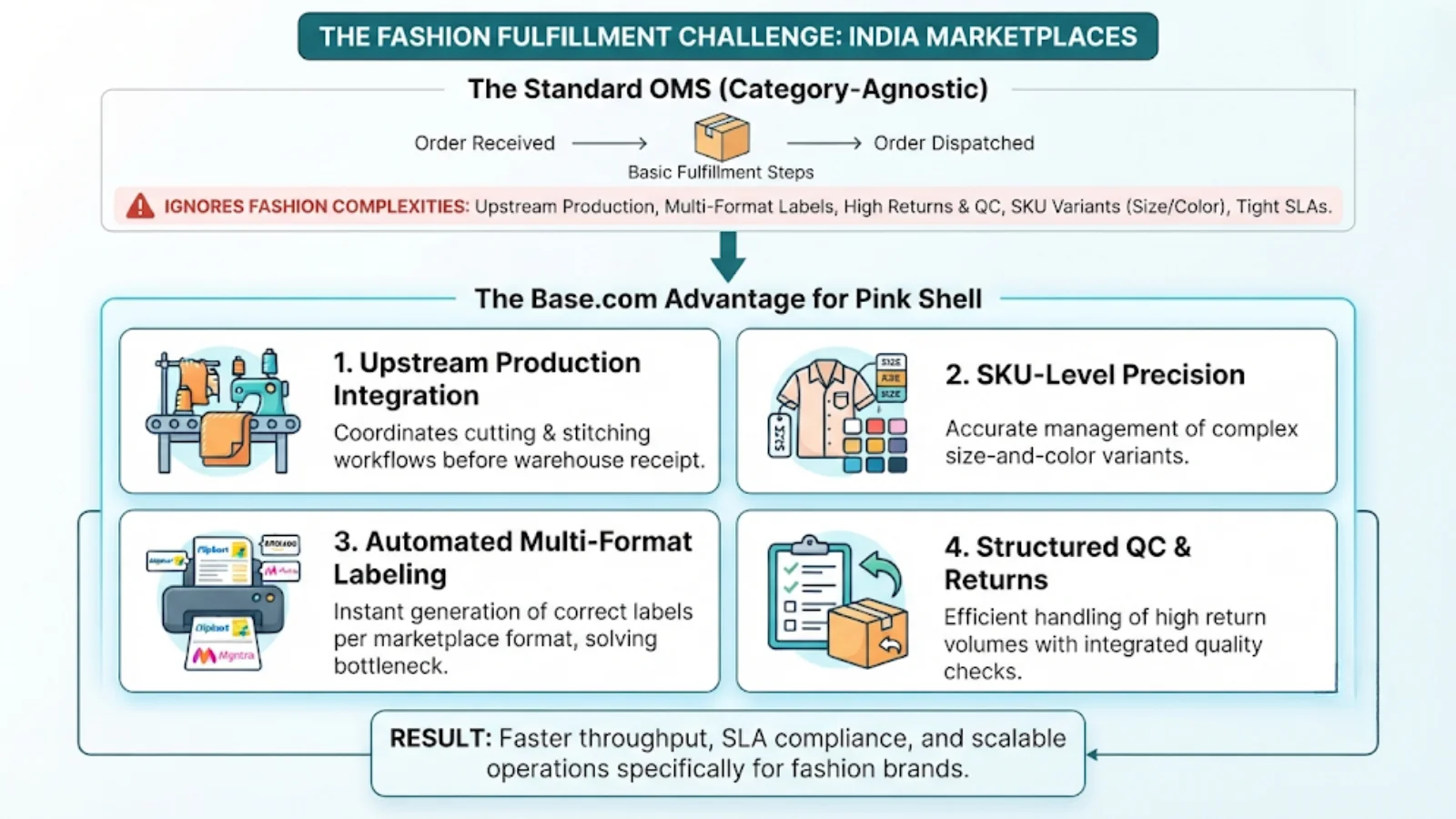
Most OMS platforms approach order management as category-agnostic. An order is an order. A fulfilment step is a fulfilment step. The system manages the flow from receipt to dispatch without accounting for the variables that determine whether that flow is actually executable at an apparel brand’s pace.
Marketplace fulfilment for fashion brands in India is not category-agnostic. It involves production coordination upstream of warehouse receipt, multi-format label requirements per marketplace, high return volumes requiring structured QC, size-and-colour SKU complexity at the variant level, and tight SLA windows across platforms with different dispatch commitments.
Base.com’s differentiation in Pink Shell’s case was built on four distinct capabilities. It automated the specific bottleneck, label generation, that was most directly limiting daily throughput, with marketplace-format awareness and SKU-level precision. It extended the operational scope of the platform upstream into cutting and stitching workflows, a step most OMS vendors do not attempt, and most platforms are not designed to support.
It connected all three marketplaces into a single operational layer with live inventory sync, unified SLA monitoring, and one-screen visibility. And it delivered support responsiveness that Pink Shell specifically highlighted as a differentiator, fast ticket resolution that meant configuration questions and integration issues were resolved at operational speed, not on a support team’s schedule.
Each of these capabilities addresses something that generic platforms leave unsolved. Together, they make Base.com the specific answer to what marketplace fulfilment for fashion brands in India actually demands, not a general-purpose tool applied to a specialised problem, but a platform configured for how apparel operations on Indian marketplaces really work.
Results at a Glance
| Operational Area | Before Base.com | After Base.com |
|---|---|---|
| Label batch-processing time | Over 60 minutes per day | Under 30 minutes per day |
| Order processing | Manual, fragmented, three portals | Automated, unified, single dashboard |
| Production-to-dispatch coordination | Verbal, spreadsheet-based, delayed | System-connected, real-time, SLA-aware |
| Returns management | Ad hoc, unstructured, 7 to 14-day lag | Structured workflow, defined SLA, data-generating |
| Multi-marketplace visibility | Three separate seller panels | One live operational view |
| New channel addition | Manual rebuild per platform | Configuration-based extension |
| Support resolution | Not systematically tracked | Fast ticket resolution highlighted by Pink Shell |
Conclusion: Operations as the Foundation of Marketplace Growth
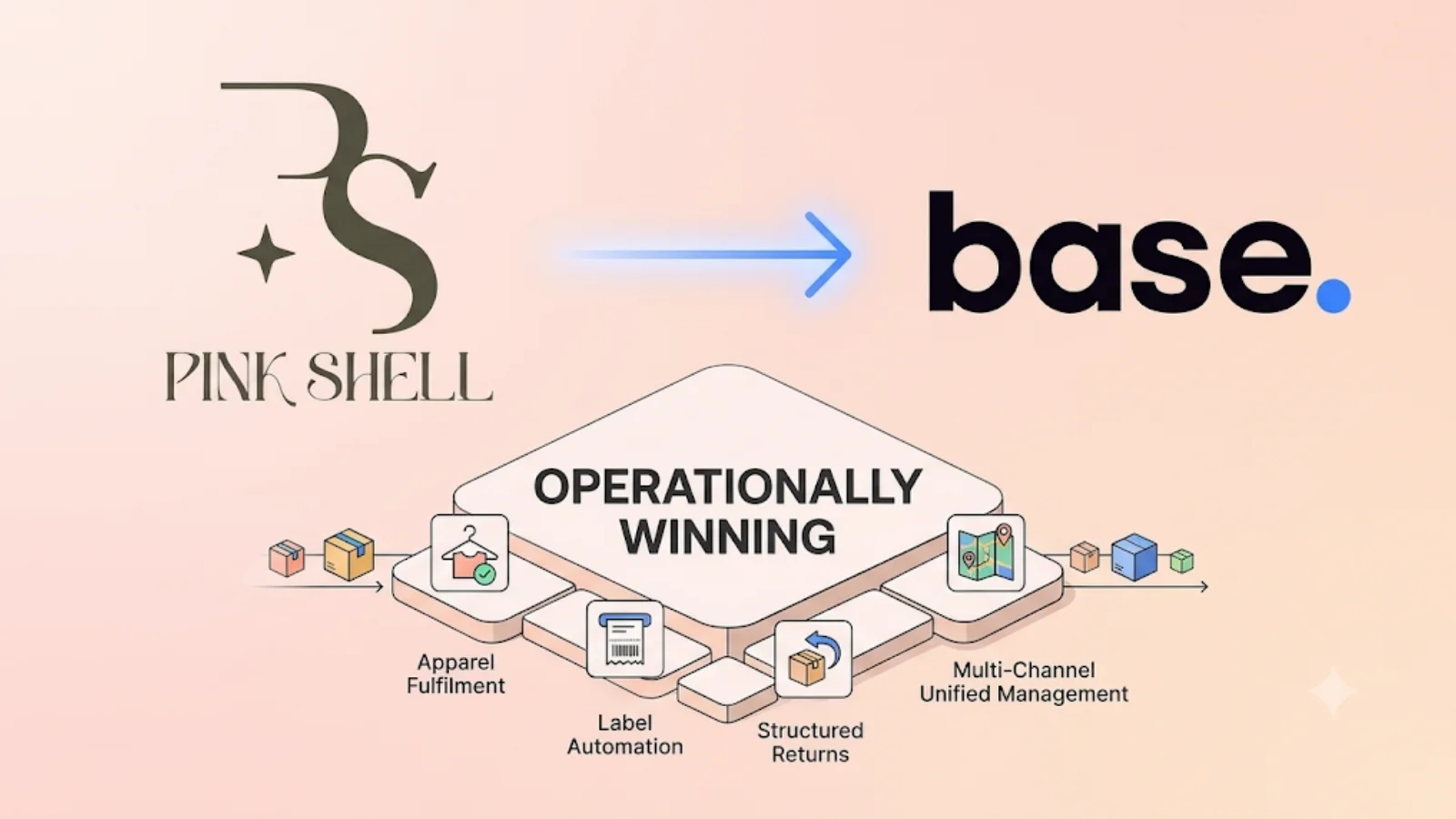
The Pink Shell and Base.com story is not a technology adoption story. It is an operational strategy story. Marketplace fulfilment for fashion brands in India at scale requires systems designed for the specific demands of apparel, production coordination, label automation, structured returns, and multi-channel unified management. Generic platforms do not provide this. Generic processes cannot sustain it.
Base.com gave Pink Shell the operational foundation that their marketplace growth required. The result was not just faster operations, it was a more accurate, more scalable, and more resilient fulfilment engine that positioned Pink Shell to grow across Myntra, Flipkart, and Meesho with confidence, control, and the data to make better decisions at every step.
Marketplace fulfilment for fashion brands in India is won and lost in the operational layer. Pink Shell’s experience with Base.com is a clear and detailed account of what winning looks like in practice.