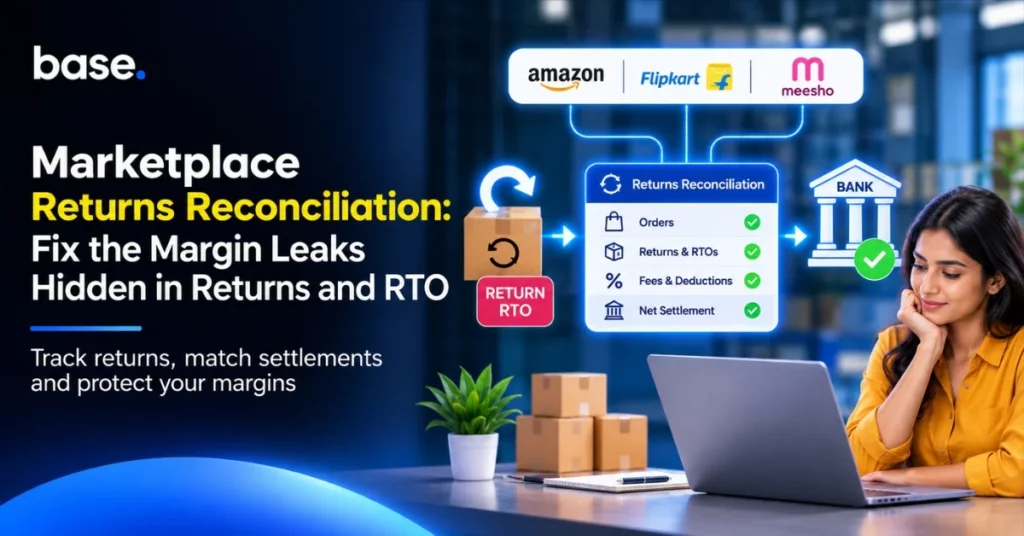
Every return on a marketplace sets off a chain of small financial movements: the refund goes out, and your commission, shipping fee, collection fee, taxes and courier charges should partly reverse. When one of them does not, the gap hides inside your settlement, invisible against payout totals that still arrive on time.
This guide explains what disciplined return settlement reconciliation marketplace practice looks like on Indian channels: what is matched and at what level, where returns and RTO leak money, how the weekly cycle runs without heroics, which claim windows and tax deductions cannot be missed, and which five metrics prove the loop is working. It reflects how we run payment reconciliation across Amazon, Flipkart, Meesho and quick commerce channels from a single order management system, so the practice described here rests on live operational data rather than theory.
Who loses money to returns, and why quietly?
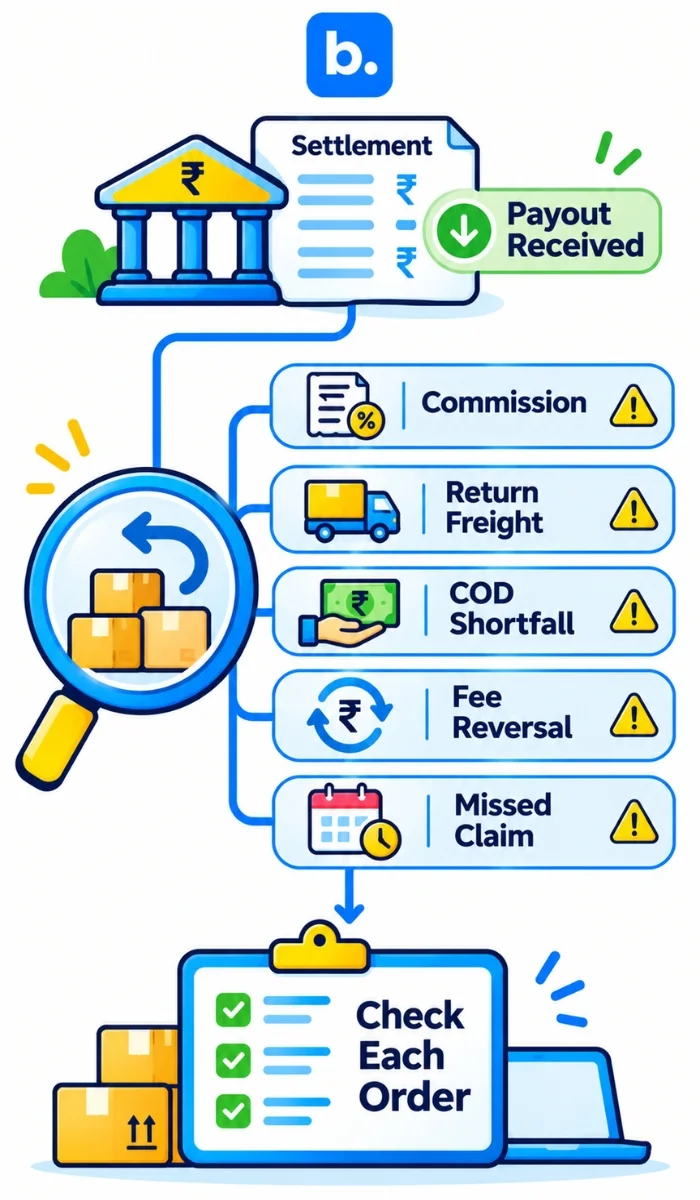
Any brand with meaningful return volumes loses settlement money it cannot see. The losses are quiet because nothing looks wrong: payouts arrive on time, dashboards total correctly, and each individual error is small enough to dismiss.
The pattern changes only when someone matches orders to settlements line by line. Brands that do this routinely find the same failures: unreversed fees, wrongly billed return freight, courier shorts on COD, and claim windows that expired unvisited. This guide is written so each of those surfaces early enough to fix.
What is return settlement reconciliation on marketplaces?
Return settlement reconciliation is the line-level discipline of matching every order’s expected payout against what the marketplace or courier actually settled, after refund, return and RTO adjustments are applied.
Two features define it. First, the expected amount is computed when the order is confirmed, not after the money arrives. Second, the match happens per order and per fee line, never per payout batch.
When should a brand start reconciling?
With the first return-heavy month, not at scale. Retroactive audits recover little because claim windows expire quietly; disputed money is recoverable only while it is young. Begin with the marketplace that generates the most returns, reconcile it properly, and add couriers and other platforms once the rhythm holds.
Why is the payout never equal to the sale amount?
Every settlement carries a deduction stack: category commission, a fixed or closing fee, shipping and collection fees, GST on those fees and tax withheld at source. The payout is the residue of that stack.
A correct-looking payout total therefore proves almost nothing. Only order-level matching can confirm that each deduction inside it was valid.
What does a returned order change financially?
A return or RTO triggers a second wave of adjustments after the first settlement. The refund comes out; some fees reverse fully, others partially, a few not at all.
Return freight may be billed back to you, sometimes at a re-weighed slab. Meanwhile the physical item should re-enter stock, so your books, your inventory and your cash all move together, or fail to.
Where exactly do returns and RTO leak margin?
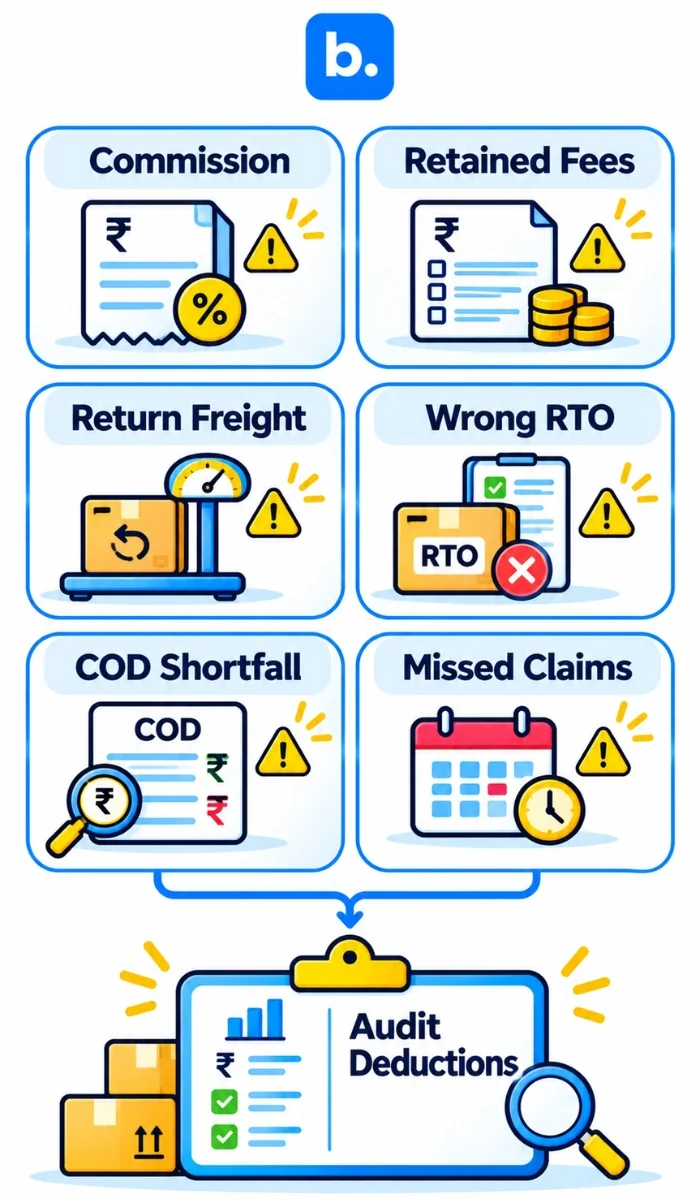
The same failures recur across marketplaces. These six are worth checking on every settlement:
| Leak | What happens | How it hides |
|---|---|---|
| Unreversed commission | Commission retained on a fully refunded order | Reversals post in later cycles than the sale |
| Retained logistics fees | Shipping or collection fee not reversed on return | Fee lines sit in bulk settlement detail |
| Return freight errors | Return shipping re-weighed or charged twice | Reverse-leg weights are rarely audited |
| RTO charged on delivered orders | Courier applies RTO pricing to a delivered order | RTO files and delivery files are separate |
| COD remittance shortfalls | Courier remits less than collected, or skips orders | COD arrives in batches a week or more later |
| Expired claim windows | Recoverable errors age past the dispute deadline | Nobody owns a follow-up calendar |
Even small settlement errors can add up across a high volume of marketplace orders. Let’s look at how you can identify and recover these amounts through a consistent reconciliation process.
How does the reconciliation process work, step by step?
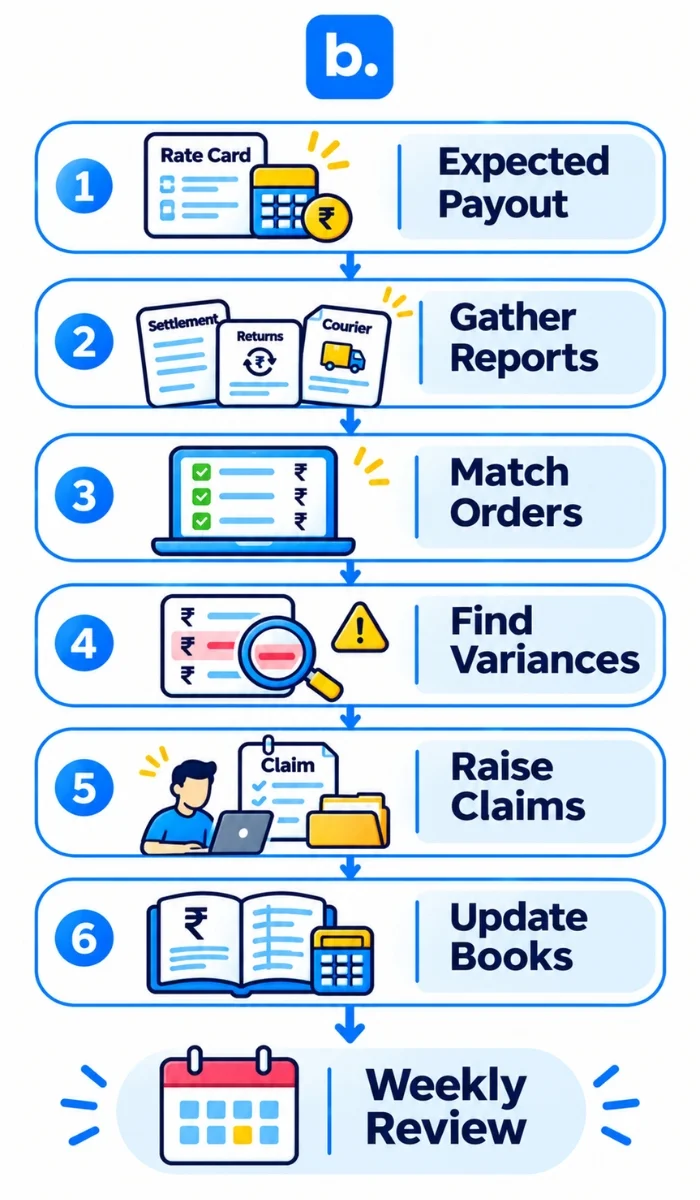
Most teams will begin reconciling payments within a spreadsheet. However, this will quickly become unmanageable when you have a few thousand orders a month. Regardless of whether you do this manually or via automation, there are 6 stages of the reconciliation process.
- Calculate your expected payout by order using your live rate card.
- Gather all of your documents including settlements, returns/refunds and courier COD statements.
- Match the data to your orders and lines. You may find that some totals match but hundreds of individual orders are incorrect.
- Categorise the variance by fee and reason. This will show you any ongoing leakage as a pattern.
- Raise any disputes within the claim window of your marketplace. Attach evidence at the order level.
- Add the reconciled figures into your books.
What belongs in the expected amount per order?
The selling price, commission (category rate), fixed fee, shipping & collection fee, GST on fees, TCS and TDS withheld. You should also understand what the reversal pattern should be if the order is returned or RTO. You cannot evaluate your settlement if you don’t know what to expect as there is no reversal policy in place.
How often should the cycle run?
You should complete this weekly per marketplace and then collate monthly. If you go longer than this you will start to see leakage occur within your claim windows.
What changes at higher order volumes?
Once you reach a few thousand orders a month, you will find that the spreadsheets become a problem. Each marketplace will have a different format, payouts will be split across different settlement dates and the same fee will be named differently on each platform. At this point you will need to use some tooling to match your data at the order level.
A good working process is to gather your settlement, returns and courier documents on a specific day each week. Match the data and categorise your variances. Raise any disputes mid-week with evidence attached. This will help you keep to a good routine and ensure you don’t miss any windows.
Which claim windows and tax deductions must never be missed?
Each marketplace will only allow disputes to be raised within specific timeframes. These will vary depending on the platform and type of claim. Below are examples of what the timeframes are typically. However, always check your current seller agreements to ensure you are aware of what they currently are.
| Marketplace route | Indicative window | Typically covers |
|---|---|---|
| Amazon SAFE-T | Often cited around 30 days from the return event | Damaged, wrong or fraudulent returns |
| Amazon FBA reimbursement | Varies by case; inventory claims run longer | Lost or damaged warehouse stock |
| Flipkart Seller Protection Fund | Roughly 14 days for damaged or wrong returns; longer for missing items | Return abuse and missing stock |
| Meesho tickets | Across two to three payout cycles | Fee, return and shipping disputes |
Also track these two tax deductions separately. Reconcile the GST TCS reported by the e-commerce operator with the relevant GST records and credit reflected in your electronic cash ledger. Check income-tax TDS under Section 194-O against Form 26AS and your books of account. Any mismatch should be followed up with the marketplace or deductor. Filing the applicable GST and income-tax returns remains a separate compliance requirement, and tax credits should be claimed in accordance with the relevant filing rules.
Ensure you have all required evidence ready for any claims. Make sure you have the order ID and SKU, return tracking ID, delivery and RTO evidence (scans/photos), weight evidence and settlement line evidence for each disputed deduction. Most claims will fail due to lack of evidence.
How do you reconcile courier COD remittances?
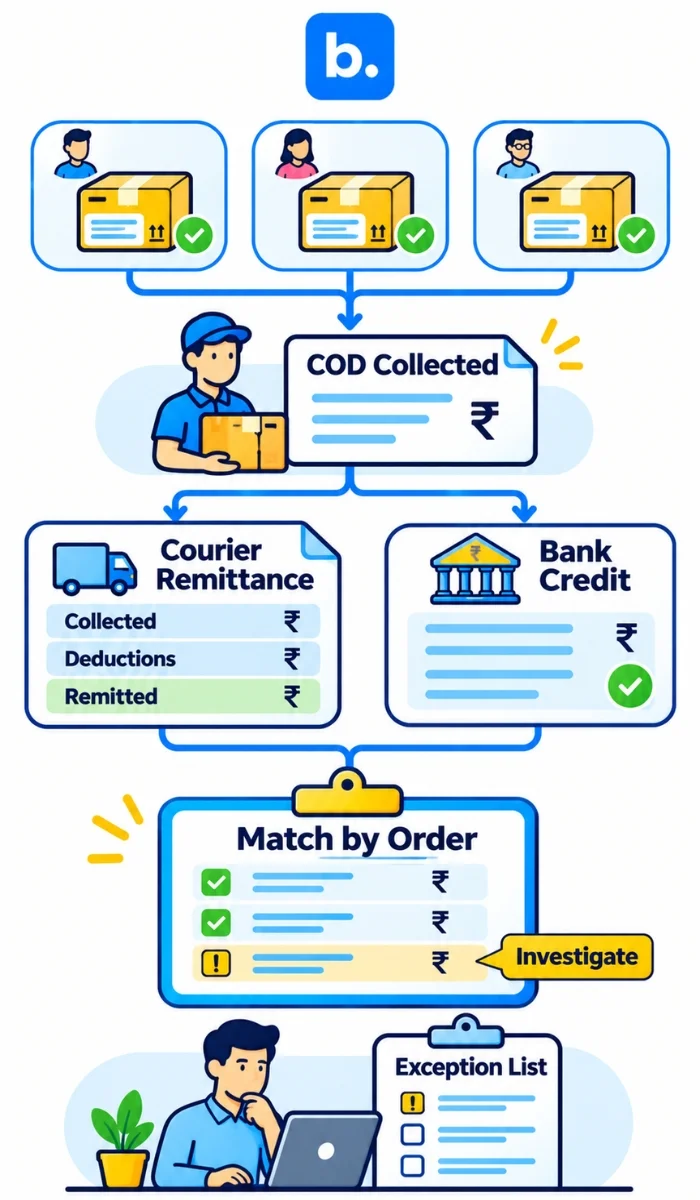
COD orders are not paid through the marketplace. The money is collected by the courier from the customer, the courier will take their fees and send the remainder in batches, usually a week or more after delivery.
You will need to match your batches to the individual orders. The most common issues you will see are:
- Orders that are not included in the batch (often because they were delivered between two batches).
- Incorrect fee deductions.
- Orders that were not delivered but show as collected (only appears if you can match at an order level).
If you are not matching orders that are missing in your batches you will create a bad habit. Match every batch the week they come in and assign one person per courier relationship. If you don’t do this then any disputes will get lost in the shared inbox quicker than any deduction logic.
Which metrics prove your reconciliation is working?
Five numbers tell you whether the process catches money or merely moves spreadsheets:
| Metric | What it measures | Healthy direction |
|---|---|---|
| Order-to-settlement match rate | Orders cleanly matched to settlement lines | Rising towards full coverage |
| Recovered amount | Rupees recovered against flagged variances | Non-zero and tracked |
| Claim-window hit rate | Disputes filed before expiry | Near complete |
| Reconciliation ageing | Age of the oldest unmatched item | Settlements cleared weekly |
| Return-adjusted margin | Margin after returns and unreversed fees, per SKU and channel | Stable or improving |
Review these weekly per marketplace and consolidate monthly. A persistently low match rate is a tooling problem; a persistently low hit rate is an ownership problem, and the two need different fixes.
How does base.com support returns reconciliation day to day?
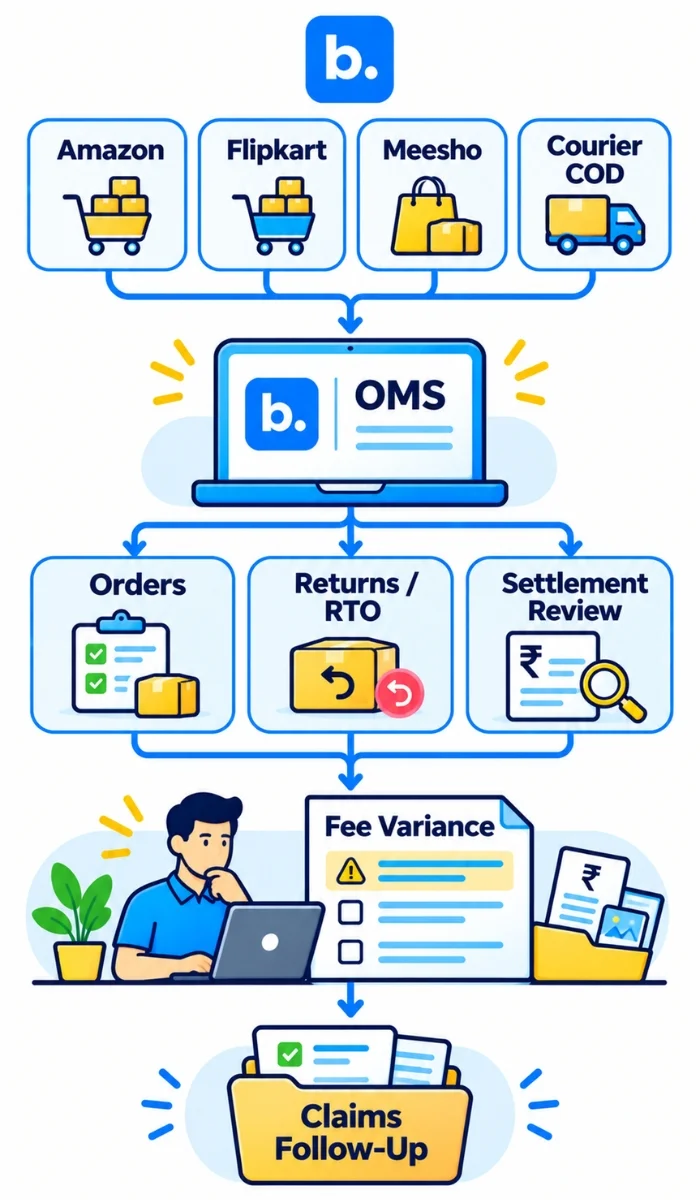
At base.com, we compute the expected payout when an order is confirmed, then ingest settlement, return and courier remittance signals across channels and match them at order level. Variances surface as flagged fee components with their reasons, rather than as an end-of-month surprise.
Brands managing orders in our Order Manager run one ledger for COD and prepaid across marketplaces, quick commerce and their own store, which is what makes the matching meaningful. We have described the wider practice in payment reconciliation for D2C brands in India; this guide focuses on the returns and RTO side. Disputing itself stays with each marketplace under its seller rules, and we would always suggest owning that calendar internally even with tooling in place.
Conclusion
Returns and RTO leak margin through fee reversals that never arrive, courier charges nobody audits and claim windows that expire unvisited. The fix is procedural: compute expectations early, match at order level, dispute on time, reconcile taxes separately and review five metrics weekly. Brands that run this loop recover money that payout totals would never show them.