A beauty brand receives two batches of the same serum. The first arrived in September and expires in March. A second arrived in October but expires in January. If the warehouse picks stock in arrival order, the September batch goes first, even though the October batch expires sooner.
That is the practical problem behind FEFO vs FIFO. Managing stock by SKU quantity alone is not enough for products with a shelf life: batches of the same product can carry different expiry dates. Without batch visibility, stock can expire in storage or reach a customer with too little shelf life remaining.
What is FIFO in warehouse inventory management?
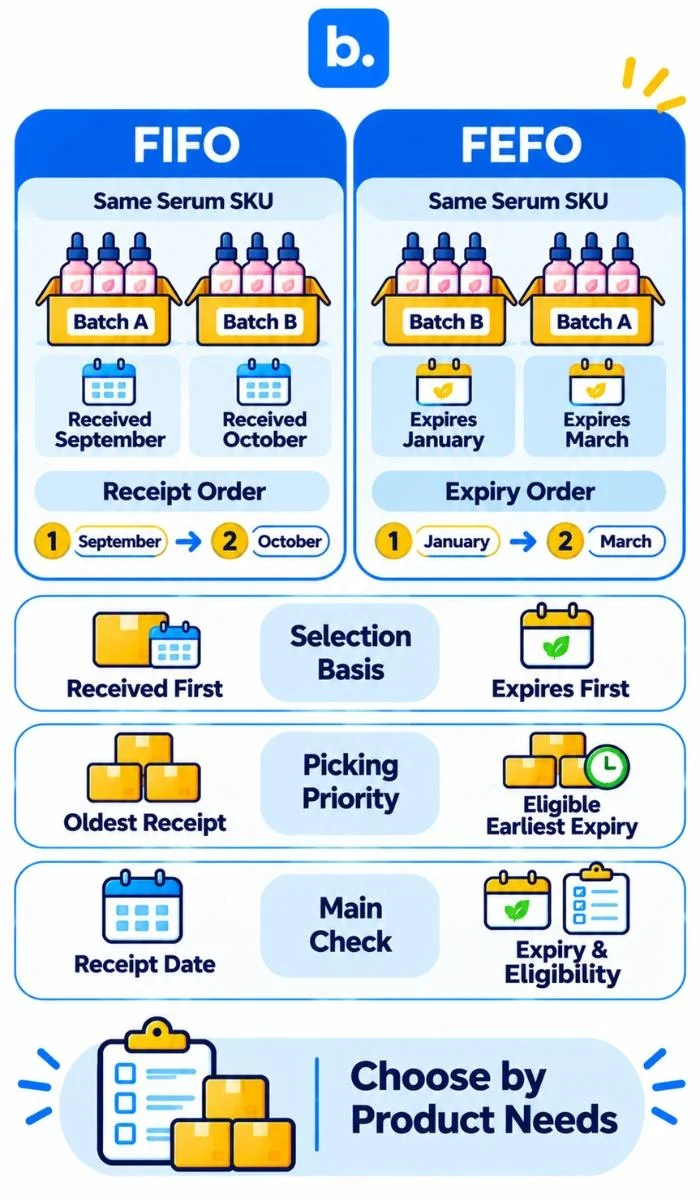
FIFO means First In, First Out: stock received first is prioritised for picking. Teams arrange locations and pick lists so older receipts stay accessible. FIFO suits products with no expiry date or similar shelf life across receipts. For example, 100 units received on 5 September are picked before 100 received on 20 September, if eligible.
FIFO follows receipt order, not necessarily expiry order, so it is not always right for date-sensitive goods.
What is FEFO and how does it work?
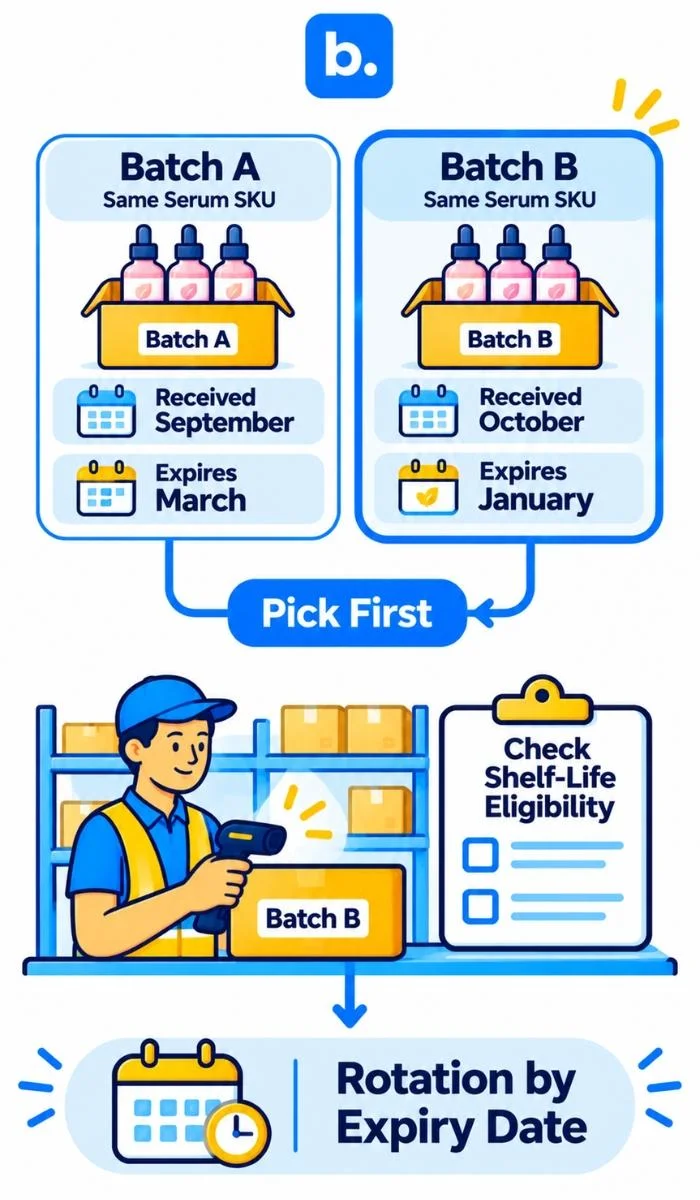
FEFO means First Expired, First Out: the batch with the earliest expiry date is prioritised, regardless of arrival order. In the serum example, the October batch is picked first because it expires in January. This is the principle in WHO standard operating procedures for health products, where the earliest-expiring stock is issued first.
FEFO depends on accurate batch and expiry data and on eligibility. A marketplace or customer may require a minimum remaining shelf life, so the closest-dated batch is not eligible for every order.
FEFO vs FIFO: what is the difference?
| Comparison point | FIFO | FEFO |
|---|---|---|
| Full form | First In, First Out | First Expired, First Out |
| Selection basis | Date stock was received | Product expiry date |
| Main priority | Oldest received stock | Soonest-expiring eligible stock |
| Best suited to | Receipt order is a suitable rotation rule | Products with varying expiry dates |
| Batch visibility | Useful, but not always sufficient alone | Essential for batch-level rotation |
| Main risk if misapplied | Earlier receipts may not expire earliest | Missing expiry data can cause wrong selection |
FIFO follows the receiving sequence; FEFO follows the expiry sequence. When both match, they can produce the same picking order. When they do not, FEFO prioritises the earlier-expiring batch. FIFO remains useful where receipt order is a sensible rule.
Which industries should use FEFO instead of FIFO?
Beauty and personal care. Serums, creams, sunscreens and cosmetics can have defined shelf lives, and batches may expire at different times. Batch details help investigate quality complaints or recalls. Follow the product labelling.
Food and beverage. Packaged food, snacks, beverages and dairy need expiry or best-before dates checked at receiving and picking, and FEFO helps stop older-dated stock remaining in storage. Storage conditions still matter. Expiry and best-before dates are not interchangeable; follow the printed date type.
Health, wellness and nutraceuticals. Supplements, vitamins and protein products benefit from batch traceability so affected stock can be identified quickly. Expired, damaged or recalled stock should be segregated from saleable inventory.
Why batch tracking is essential for FEFO inventory management
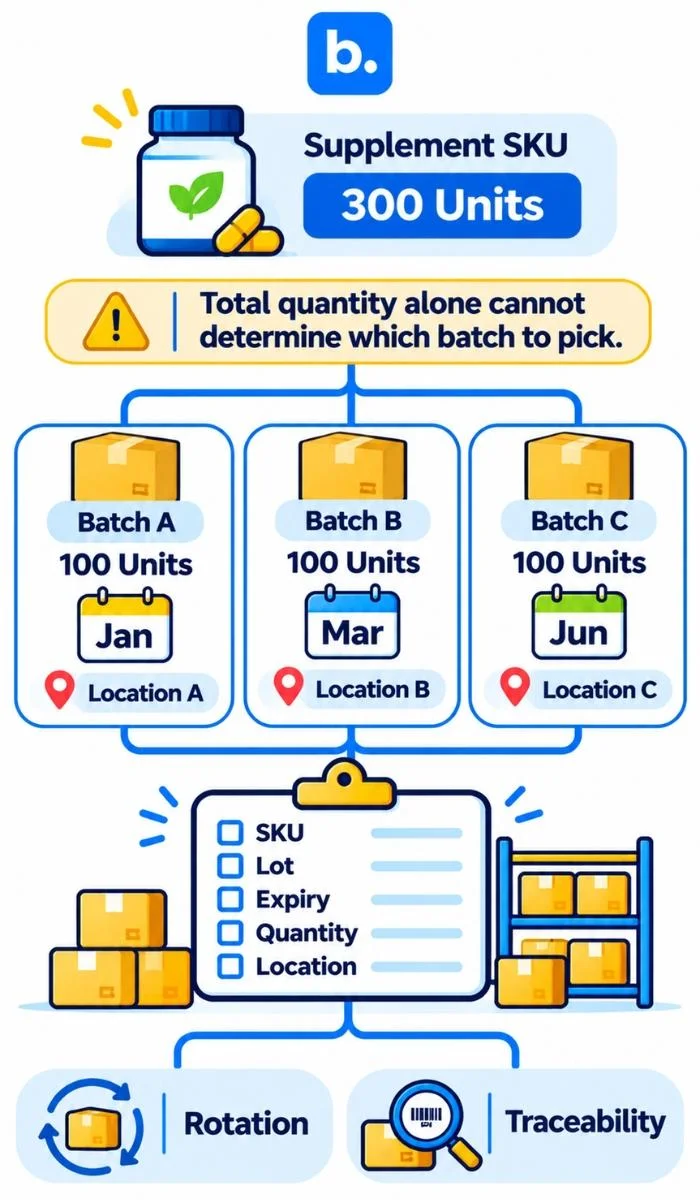
FEFO cannot work if the warehouse tracks only total SKU quantities. Consider 300 units of the same supplement across three batches with different expiry dates: a total of 300 does not say which batch should leave first.
For each batch, consider recording the SKU, batch or lot number, manufacturing date where relevant, expiry date, quantity received, supplier reference, warehouse location, and quantities available, reserved or picked. GS1 guidance likewise supports tracking stock at batch and date level rather than SKU level alone, so FEFO or FIFO logic can be applied and affected stock segregated. Our inventory management system in India article discusses the wider visibility behind this.
Batch-level visibility supports rotation, recall investigations, reconciliation and return inspection. Not every warehouse stock management system captures every field the same way.
How to implement FEFO in an ecommerce warehouse
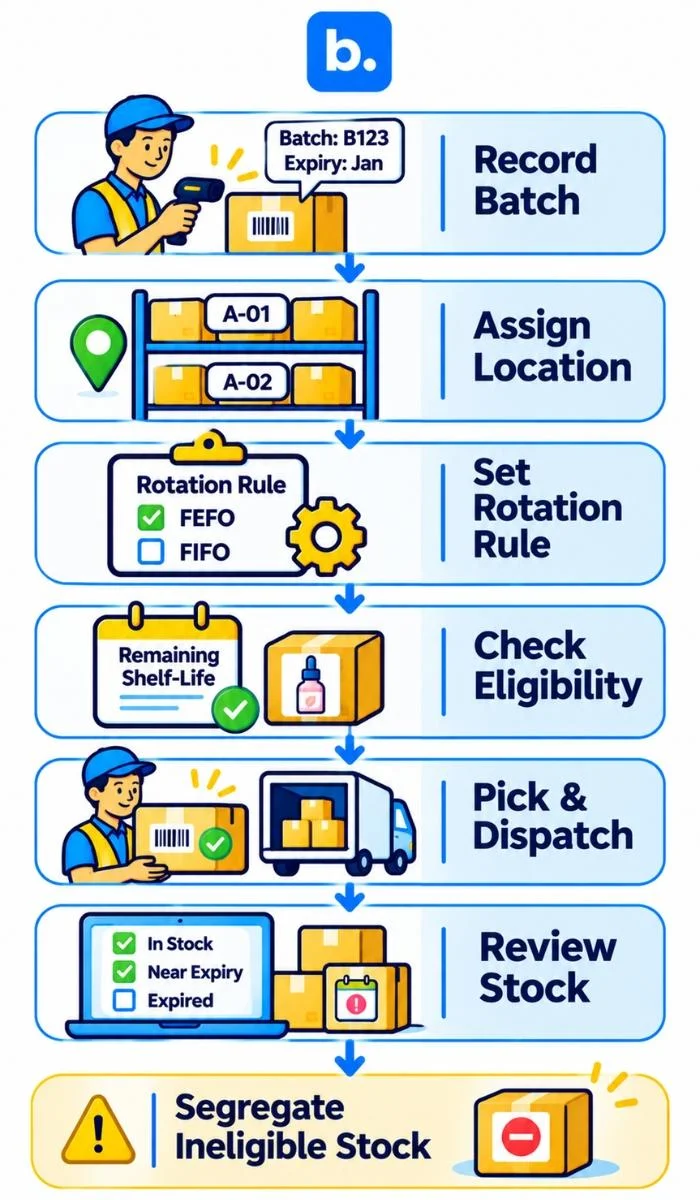
- Capture batch and expiry details during receiving. Record batch, expiry date and quantity on arrival and note discrepancies then, not at picking.
- Assign stock to identifiable locations. Use batch-specific records and visible labels; avoid mixing batches.
- Set rotation rules. Decide which products follow FIFO and which follow FEFO, based on category, shelf life and channel requirements.
- Check remaining shelf life before dispatch. Confirm the earliest-expiring batch meets the destination’s condition; do not assume a universal minimum.
- Review near-expiry and non-saleable stock. Check regularly for approaching expiry, damage, expired stock and holds, and define how ineligible stock is handled.
- Reconcile movements and returns. Keep batch information linked to transfers, picking and dispatch where supported. Inspect returns before making them sellable.
Common FEFO and FIFO inventory management mistakes
Recording expiry at picking instead of receiving leaves the warehouse blind until too late. Treating batches of the same SKU as interchangeable removes the basis for FEFO, and assuming FIFO always gives the correct expiry sequence fails when a later receipt expires sooner. Picking whichever stock is easiest to reach undermines both methods. Ignoring remaining-shelf-life conditions can make a correct rotation unusable, and mixing expired, damaged and sellable stock creates picking risks.
How a warehouse management system supports batch and expiry management
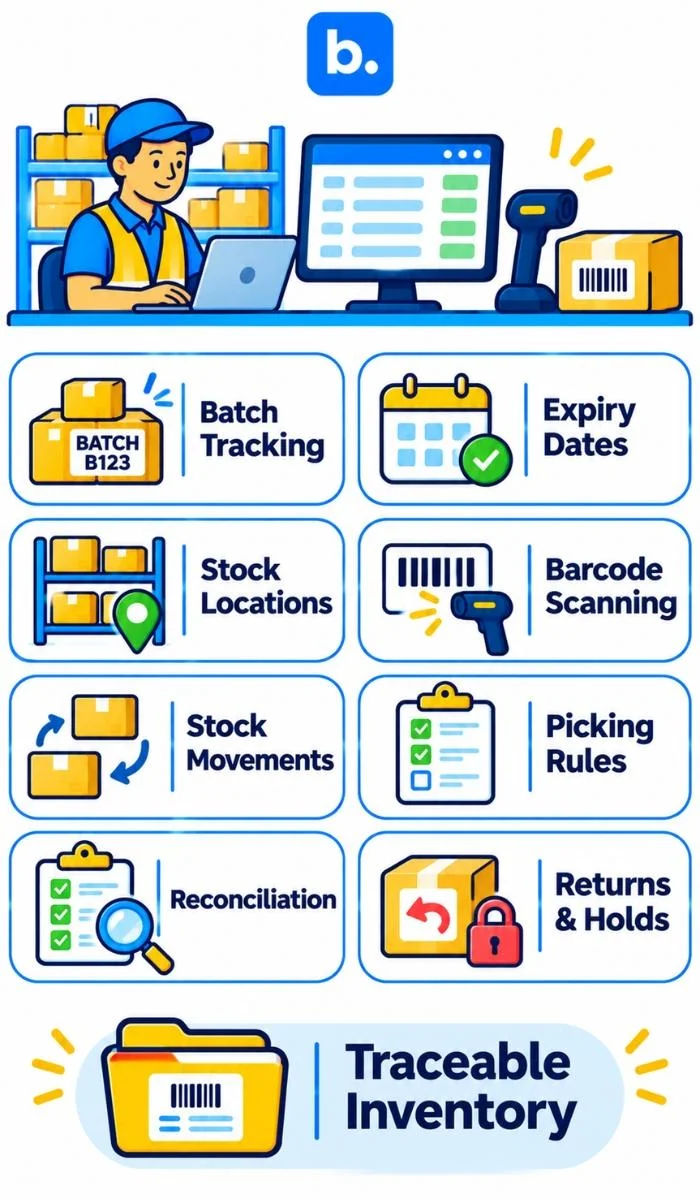
A warehouse management system should support the process, but accurate receiving, correct batch data and clear procedures remain necessary. When evaluating warehouse management software, look for:
| WMS capability | Operational value |
|---|---|
| Batch and lot tracking | Keeps stock identifiable by batch |
| Expiry-date recording | Makes expiry available during operations |
| Location-level inventory | Shows where each batch is stored |
| Barcode scanning | Supports product and batch identification |
| Stock movement records | Maintains traceability as stock moves |
| Picking rules | Applies suitable rotation priorities |
| Inventory reconciliation | Identifies recorded versus physical differences |
| Returns and segregation | Prevents unsuitable stock re-entering available inventory |
Four ideas should not be confused. Batch tracking identifies stock by batch. Expiry tracking records its date. FEFO picking prioritises eligible stock by expiry. Inventory valuation calculates stock cost. Our inventory documentation describes FIFO and FEFO as purchase cost methods, a different use from picking priority. A warehouse management system in India provides broader context, but each capability needs checking in the product.
How our WMS supports batch and expiry visibility
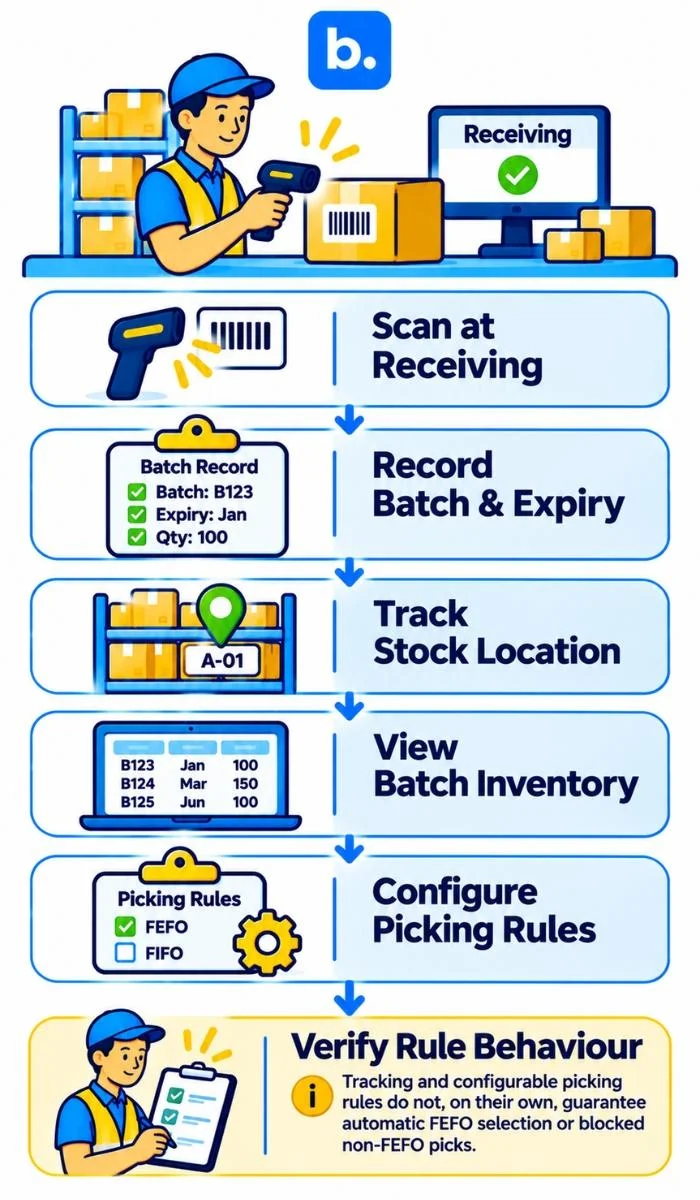
Our WMS tracks batch numbers and expiration dates from receipt to storage, with barcode scanning during goods receiving. It provides real-time stock visibility by batch and expiry date, with warehouse location information. Picking methods and product rotation rules can be configured. Our WMS page describes these capabilities in more detail.
These features improve visibility over date-sensitive stock. They do not, by themselves, prove that every configuration automatically selects the earliest-expiring batch or blocks a non-FEFO pick; that depends on the workflow’s documented behaviour and configuration, so verify how rules are applied in your setup.
Choosing between FEFO and FIFO: what should your business consider?
| Business situation | Rotation approach to consider |
|---|---|
| Products have no meaningful expiry differences | FIFO may be suitable |
| Same SKU arrives with different expiry dates | FEFO is generally more appropriate |
| Products have a defined shelf life | Assess FEFO and remaining-shelf-life restrictions |
| Products face batch-specific holds or recalls | Batch-level tracking is important |
| Channels have different shelf-life requirements | Apply channel-specific eligibility checks |
The right method depends on the product, warehouse process and customer requirements. A business may use FIFO for some groups and FEFO for others. As a warehouse management solution, the aim is to make the chosen rule workable, not to force one rule everywhere.
Conclusion
FIFO prioritises arrival order; FEFO prioritises expiry order. For beauty, food and health brands, batch-level visibility makes reliable rotation possible. Our WMS supports batch and expiry visibility, location-level stock information and configurable rotation rules, helping teams manage date-sensitive inventory with greater control.
Frequently asked questions
What is the difference between FEFO and FIFO?
FIFO prioritises stock received first, while FEFO prioritises stock with the earliest expiry date. They can produce the same sequence when receipt and expiry order match, but they differ when batches of the same product have different shelf lives or expiry dates.
Is FEFO better than FIFO for food products?
FEFO is generally more suitable for food products with expiry or best-before dates, because it prioritises the soonest-expiring stock. Storage conditions, date labelling and channel requirements also matter, so rotation should be combined with eligibility checks before dispatch.
Can a warehouse use both FIFO and FEFO?
Yes. Businesses can apply different rotation rules to different product categories based on expiry characteristics and warehouse requirements, rather than forcing one method across all stock. The chosen rule should be documented so picking teams apply it consistently.
Why is batch tracking important in a warehouse?
Batch tracking supports traceability, expiry visibility, stock rotation, recall investigations and inventory accuracy. It allows teams to identify which batch is affected, where it is stored, and how much of it remains available, reserved or already dispatched.
What is the role of a WMS in FEFO inventory management?
A WMS can hold batch records, expiry information, warehouse locations, scanning workflows and picking rules that support FEFO operations. Actual enforcement depends on the system’s documented capabilities and configuration, so businesses should verify how the rules behave in practice.
What happens to expired stock in a warehouse?
Expired stock should be identified, segregated from saleable inventory and handled under the business’s applicable product, safety and disposal procedures. Businesses should not rely on generic disposal advice, and should confirm the correct process for each product type.