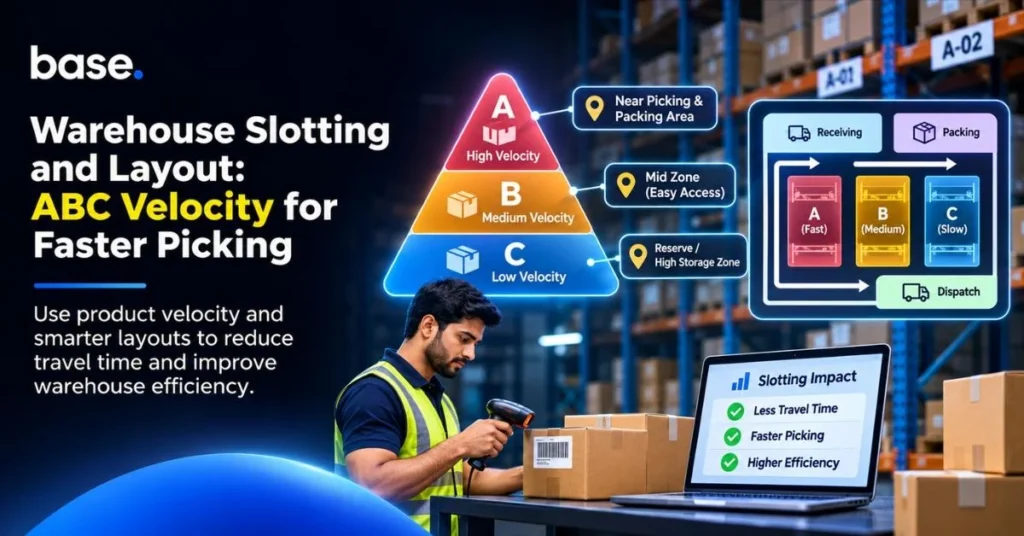
Warehouse slotting assigns each product or SKU to a storage location using picking frequency, demand, size, weight, handling needs and replenishment requirements. ABC velocity slotting groups products by movement so frequently picked items can be placed in suitable, accessible locations. Warehouse layout planning is broader: it arranges areas such as receiving, storage, packing and dispatch. Used together, these decisions can reduce avoidable picker travel and make replenishment more orderly. The fastest-moving product is not automatically best placed beside dispatch; safety, congestion, equipment and storage conditions matter too. Warehouse slotting software can help organise the data, but the decisions still need to fit the operation.
What is warehouse slotting and why does it matter?
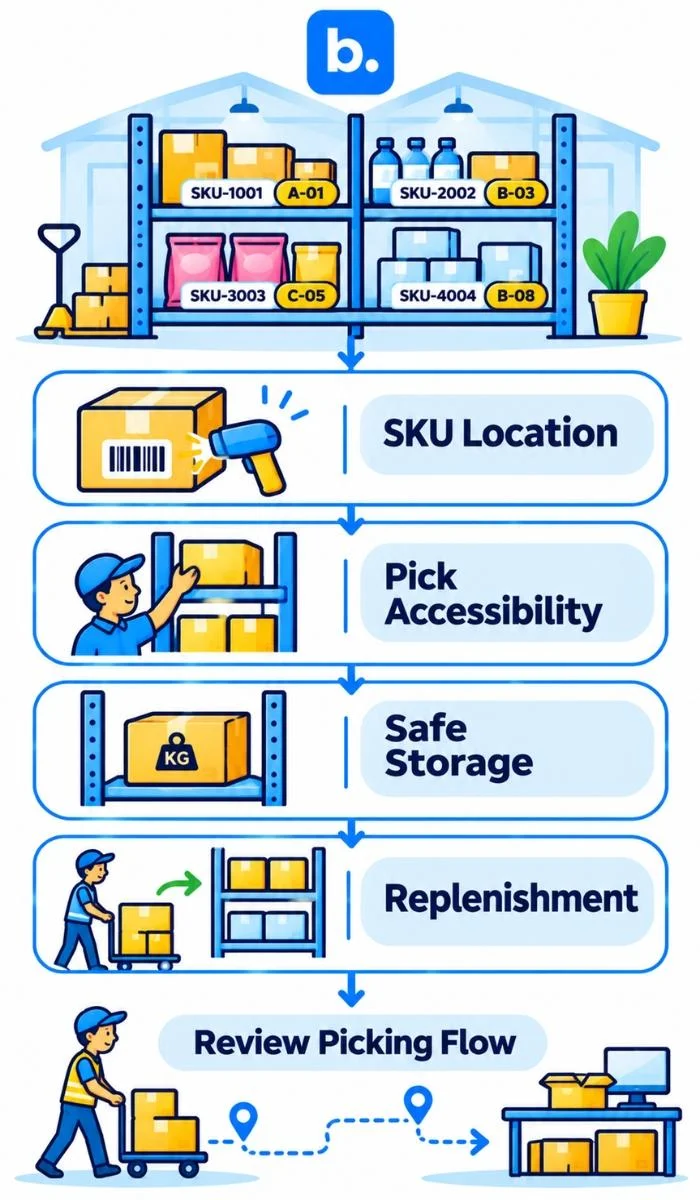
Warehouse slotting is the assignment of products to specific storage locations. It determines which bin holds each SKU, whether fast-moving stock has a convenient pick face, how items fit their locations and how picking and replenishment work together. Slotting is therefore more than moving popular products near the packing bench. A suitable location must fit the product and support the full warehouse workflow.
Poor slotting makes pickers travel further than necessary, leaves frequent picks in awkward positions and can create crowding where many workers reach for the same products. It can also make replenishment inefficient, put heavy or bulky items in unsuitable places, and increase location errors when stock is moved without updating its record. A warehouse can have a sensible overall layout yet still lose time because the individual products are in the wrong locations.
Good slotting aims to make commonly picked inventory accessible, use storage space sensibly, keep replenishment manageable, and support consistent and safe handling. It can reduce avoidable movement, but it cannot by itself eliminate picking mistakes or guarantee a set productivity improvement. Results depend on demand data, physical constraints and whether location records are kept current.
Warehouse layout vs warehouse slotting: what is the difference?
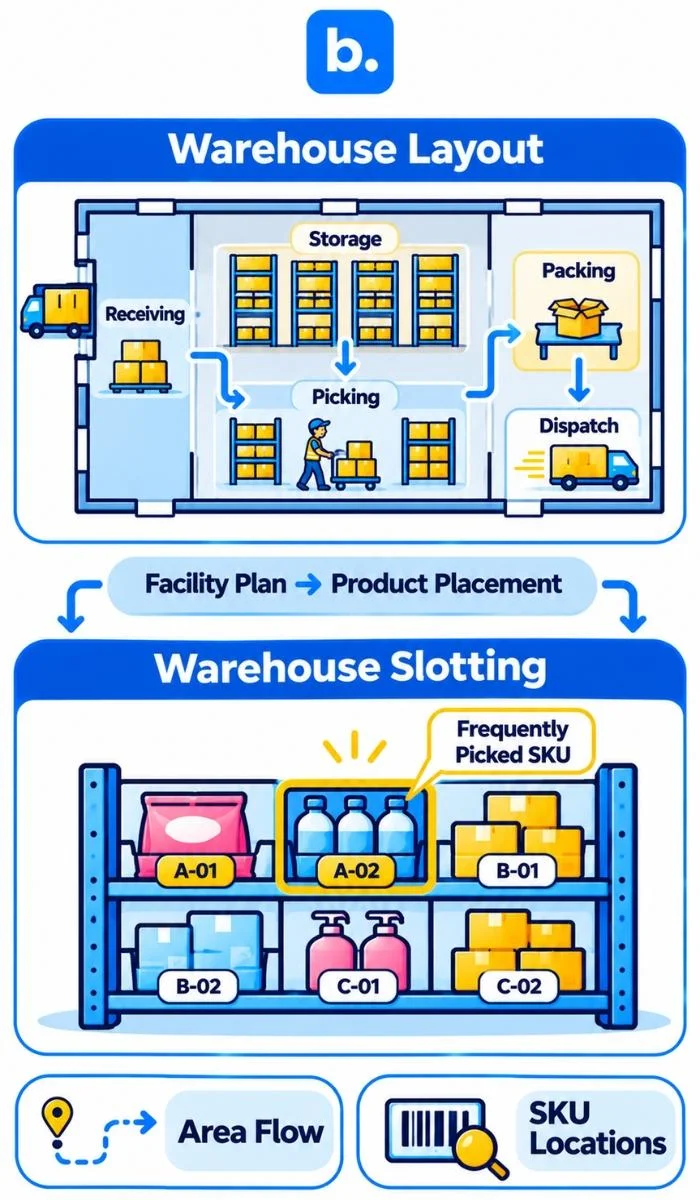
Warehouse layout is the facility-wide arrangement of work areas, storage, aisles and equipment. Warehouse slotting assigns individual products or SKUs to locations within that arrangement. One sets the framework; the other decides where inventory sits inside it.
| Decision | Warehouse layout | Warehouse slotting |
|---|---|---|
| Main focus | Arrangement of the facility | Placement of products in locations |
| Scope | Receiving, storage, picking, packing, dispatch, aisles | SKU, pick face, bin or rack |
| Key factors | Workflow, space, equipment, safety | Velocity, dimensions, weight, demand, replenishment |
| Example | Position packing near dispatch | Move a frequently picked SKU to a suitable pick face |
| Review trigger | Facility or process requirements change | Demand, mix or location performance changes |
The decisions influence each other. If pickers repeatedly cross a busy receiving route to reach fast-moving stock, the layout or the slots may be contributing. But a change in one SKU’s demand does not automatically require a facility redesign. Often, relocating products within the existing zones is enough; repeated congestion or poor flow may signal a broader layout issue.
What is ABC velocity slotting in warehouse management?
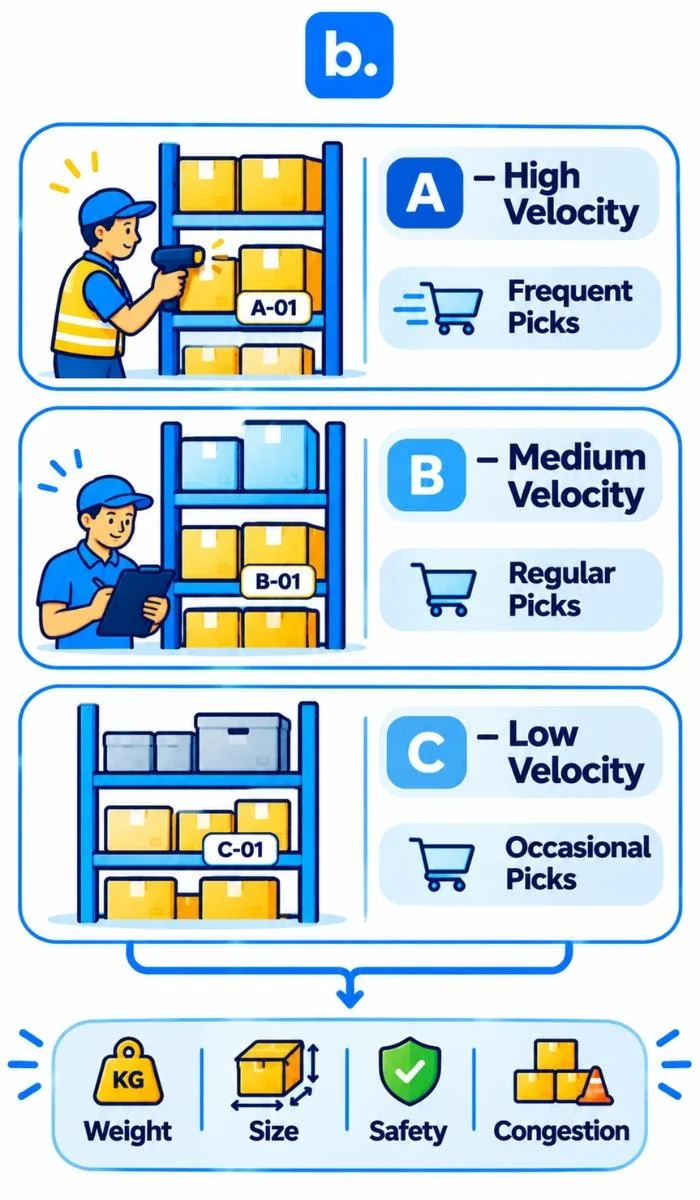
ABC velocity slotting groups products by how often they are picked or moved, then uses those groups to guide storage placement. A products are high-velocity, B products move at a moderate rate, and C products move less often. The principle is to use the most accessible pick locations for items that generate more picking activity, subject to size, safety, replenishment and storage constraints.
| Class | Typical movement pattern | Slotting consideration |
|---|---|---|
| A | Most frequently picked items | Accessible pick faces, with congestion and replenishment considered |
| B | Regular but moderate picks | Convenient secondary locations, reviewed as movement changes |
| C | Lower picking frequency | Less prominent suitable space, still safe to access and replenish |
An ecommerce operation might classify a popular personal care item as A if order history shows frequent picks, while a rarely ordered accessory might be C. These are illustrative only: actual categories come from each business’s data. A-category does not mean every fast mover belongs on the floor beside dispatch. A heavy case may need a lower location; a fragile item may need protected storage; a product with special storage requirements must stay in an appropriate environment. Several popular SKUs placed together can also create queues, so access and congestion must be considered together.
ABC velocity analysis is not the same as every form of ABC inventory analysis. Some businesses classify inventory by annual consumption value, revenue or unit cost to prioritise purchasing and financial control. For slotting, the operational question is usually how often the SKU creates a pick, order line or movement. A high-value product can be slow-moving; a lower-value item can be picked all day. Using sales value alone may therefore rank products poorly for a travel-reduction objective.
Choose a representative measurement period and a clear measure. Pick frequency counts how often staff pick a SKU; order-line frequency counts orders containing it; units picked measures quantity. Each reveals a different aspect of demand. Units alone can overstate the importance of products picked in large batches, while order lines may better reflect repeated visits to a pick face. Seasonal peaks and promotions also matter. A single short period can misclassify a product with predictable seasonal demand, so review the data in context and set category thresholds that suit your catalogue. There is no universal A/B/C percentage split.
How to implement ABC slotting step by step
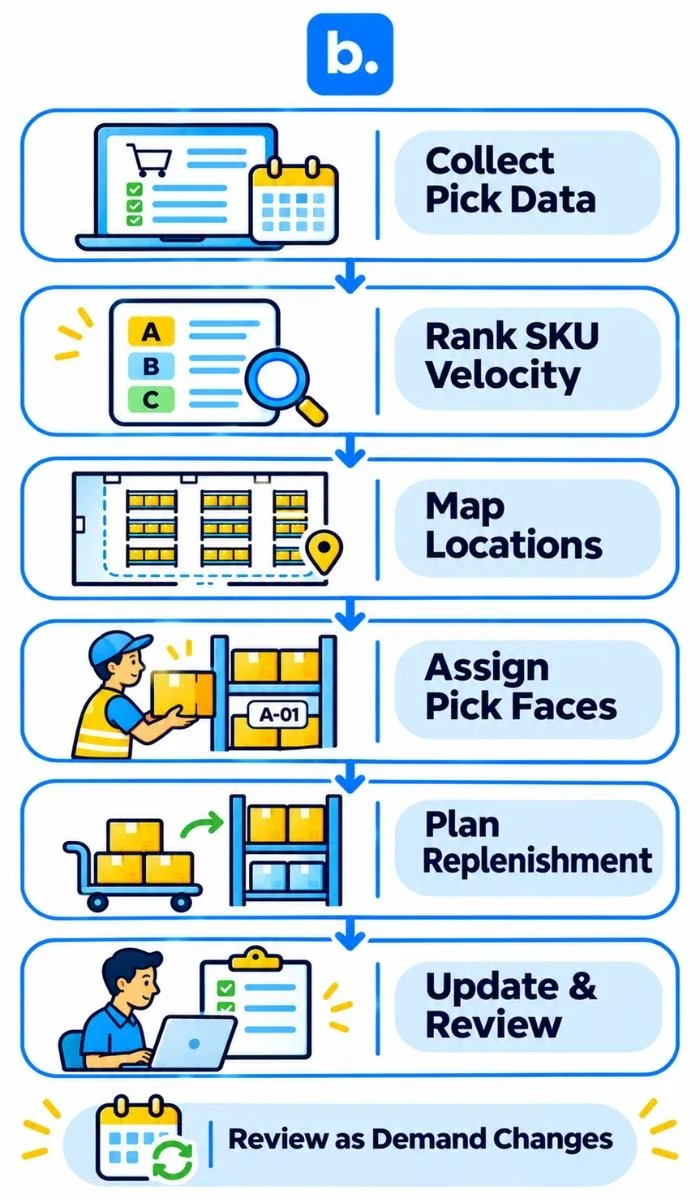
A practical slotting process combines movement data with the physical realities of the warehouse. Oracle’s warehouse slotting documentation describes considering product and location information alongside past or expected pick frequency, sales history, weight and size. A warehouse can use the same principle in a manual review; dedicated optimisation software is not a prerequisite.
1. Collect SKU movement data. Export SKU-level pick history, order-line frequency and units picked for a representative period. Add seasonality, promotions, current locations, product dimensions, weight and any special handling constraints. Sales revenue by itself is a poor proxy for picking workload if the aim is to reduce travel.
2. Rank products using a chosen velocity measure. Decide whether pick frequency, order lines or units best reflects the work you want to improve. Rank SKUs consistently and group them into A, B and C using thresholds based on your own movement profile. Keep high value separate from high velocity: they answer different operational questions.
3. Map locations and constraints. Record available bin and shelf capacities, distance from packing, pick-face accessibility, reserve locations, replenishment routes, equipment access and weight limits. The closest slot is not automatically the best. A product may not fit; a heavy carton may be safer lower down; a popular item may cause congestion in a narrow aisle.
4. Assign SKUs to suitable locations. Place high-velocity products in convenient pick faces where safe and practical. Assign B and C items to locations balancing travel, storage capacity and access. Keep fragile products protected, bulky goods in suitable spaces, and items with specific storage needs in the required conditions. Avoid clustering every popular SKU if that creates queues or obstructs replenishment.
5. Plan replenishment alongside picking. A small forward pick face close to packing may need frequent top-ups. Check its capacity, reserve-stock location, replenishment route and timing. Schedule replenishment to limit interference with peak picking where possible. A slot that saves picker steps but causes repeated replenishment interruptions may not improve total work.
6. Update location records and review results. Record moves in the warehouse stock management system, label locations clearly and tell the team about the new arrangement. Track whether the change improves walking, congestion or replenishment, and revisit the slots as demand, promotions, new products and capacity change. Set a review rhythm appropriate to how volatile the catalogue is; no single review interval suits every warehouse.
Warehouse layout principles that support faster picking
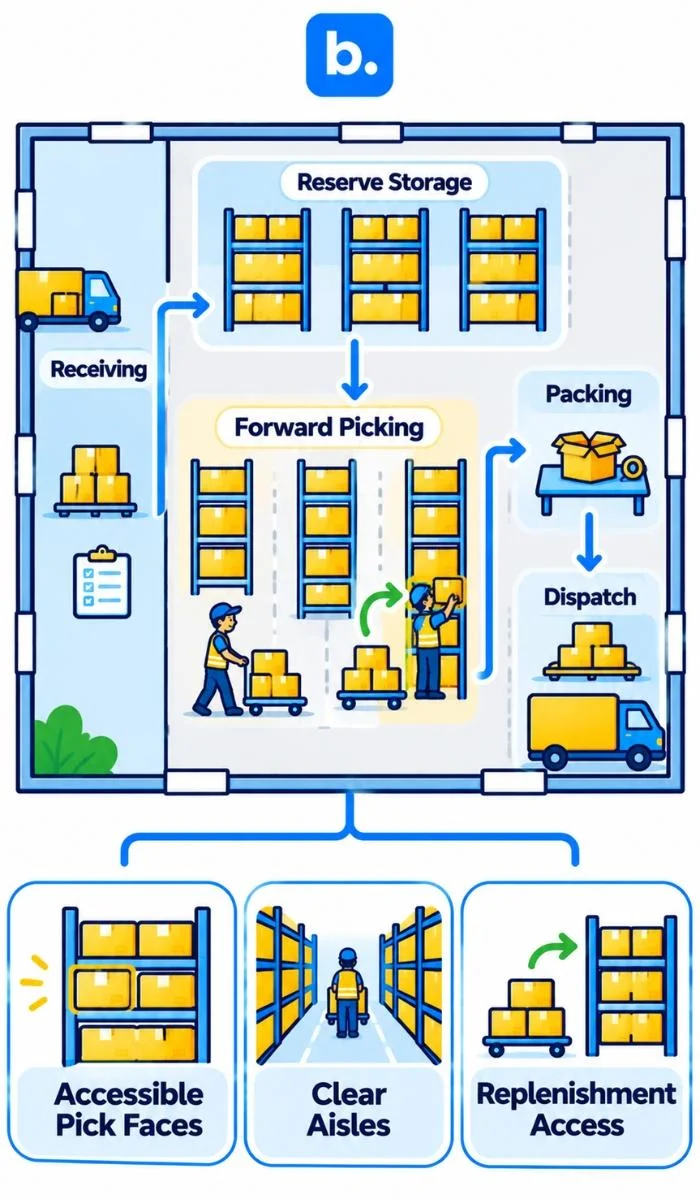
Effective slotting works best when the wider layout supports the flow of goods and people. Arrange receiving, storage, picking, packing and dispatch so that routine work does not create unnecessary crossings or backtracking. The exact design depends on building shape, order profile, equipment and safety requirements; there is no universal aisle width or one layout for every ecommerce warehouse.
Keep high-velocity products in accessible pick faces, but account for ergonomic reach, weight and safe handling. Make enough aisle space for the equipment in use and for pickers and replenishment tasks to coexist. Aisles that become bottlenecks can erase the benefit of placing popular stock nearby. Where order history shows products frequently bought together, consider proximity if it reduces combined travel without compromising slot capacity or creating congestion.
Balance pick faces with reserve storage. Pickers need easy access to forward stock, while replenishment teams need a practical route to replenish it. Use vertical space and suitable racking to make storage work, but do not maximise density at the cost of access, safety or replenishment. The layout should support both the picking path and the work that keeps pick locations stocked.
Common warehouse slotting mistakes to avoid
A frequent mistake is ranking products by revenue when the aim is to reduce picking travel. Revenue and pick frequency are different measures. Another is using outdated movement data: seasonal items, promotions, launches and discontinued SKUs can quickly change the pattern.
Do not assign slots on velocity alone. Ignoring dimensions, weight, fragility or storage requirements can create handling problems. Nor should every A item be placed in one popular zone; queues and blocked replenishment routes may increase total time. Review whether fast pick faces have adequate capacity and a workable replenishment plan.
Finally, ABC categories are not permanent, and software cannot compensate for inaccurate SKU or location data. Record physical moves, keep labels legible, and train staff to follow location procedures. If the same products are repeatedly moved without a clear record, fix the movement process before running another slotting analysis.
How warehouse slotting software and a WMS help
Warehouse slotting software can help analyse SKU movement, compare it with location characteristics and support product-placement decisions. A WMS has a broader role: it maintains inventory and location information and supports warehouse activities such as receiving, storage and picking. Some products include dedicated slotting optimisation; others primarily provide the data and workflows teams use to make and implement decisions. Do not assume every WMS calculates optimal locations or dynamically re-slots products.
When evaluating warehouse management software, check for SKU movement history, accurate location records, product and bin identification, location-directed pick lists, stocktakes and replenishment visibility. Confirm whether slotting recommendations are automatic, what data they use, whether capacity and handling limits are considered, and how staff approve moves. Barcode scanning helps verify products or locations, but does not determine the best slot.
| WMS capability | Why it matters |
|---|---|
| SKU movement history | Supports velocity analysis |
| Location records | Shows where stock is stored |
| Directed pick lists | Guides workers to locations |
| Stocktake and replenishment visibility | Helps maintain location accuracy |
| Slotting optimisation | Check whether it is a distinct, documented feature |
At base.com, our WMS supports warehouse locations, product and location identification, barcode-assisted activities, and pick lists that show product locations. The product page also describes guided picking routes and inventory visibility by location. These capabilities support structured storage and picking, but do not establish automated ABC classification, velocity dashboards or slotting optimisation. See our warehouse management system for the documented scope. Our guide to what a warehouse management system does explains the wider WMS role.
How to know whether your warehouse needs a slotting review
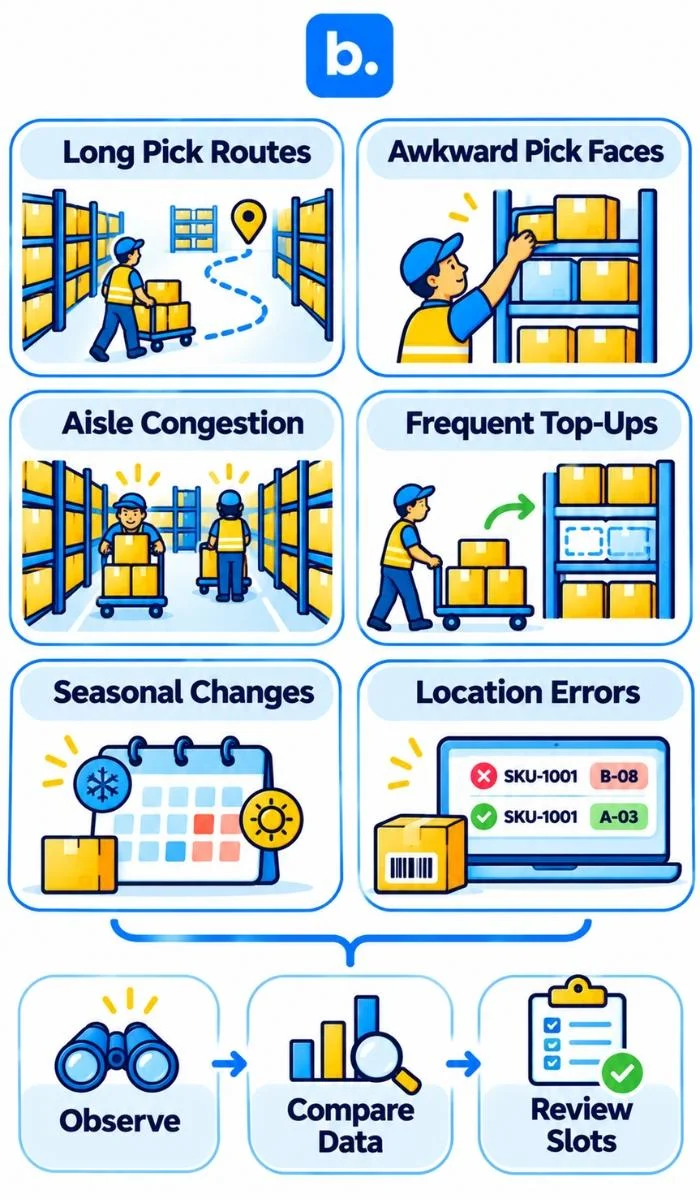
Review slotting if pickers travel long distances for frequently ordered products, popular SKUs sit in awkward locations, replenishment interrupts picking, peak periods bring congestion, or products are repeatedly moved without clear location records. Seasonal changes and new product launches are also reasons to recheck assumptions.
A review does not always mean redesigning the warehouse. Start by comparing movement data with current locations, observing pick routes and identifying bottlenecks or replenishment conflicts. A focused relocation of a few SKUs may be enough. If the pattern points to repeated crossings, poor area flow or capacity constraints, consider whether the layout itself needs adjustment. For Indian ecommerce operations, our overview of a warehouse management system in India provides related warehouse context.
Conclusion
Warehouse slotting works when product placement reflects real picking behaviour, physical constraints and replenishment. ABC velocity analysis can identify which SKUs deserve convenient pick faces, while layout planning shapes the wider flow. Review the data as demand changes and make practical moves before assuming a full redesign or dedicated warehouse slotting software is necessary.
Frequently asked questions
What is warehouse slotting?
Warehouse slotting assigns products or SKUs to suitable storage locations using factors such as pick frequency, demand, dimensions, weight, handling needs and replenishment. The goal is to make picking and storage work efficiently without compromising safety or access.
What is ABC slotting in a warehouse?
ABC slotting groups products by movement or picking velocity. High-velocity A items are considered for accessible pick locations, while B and C items use locations suited to their movement, storage needs and replenishment requirements.
What is the difference between ABC analysis and ABC velocity slotting?
ABC analysis can classify inventory by value, revenue or other criteria. ABC velocity slotting specifically uses movement or picking frequency to guide product placement. The measure should match the objective, such as reducing picker travel.
How often should warehouse slotting be reviewed?
There is no universal schedule. Review when demand volatility, seasons, promotions, new SKUs, capacity or operational performance changes. A stable catalogue may need less frequent review than one with rapid movement shifts.
Does warehouse slotting software automatically choose the best storage location?
It depends on the product. Dedicated slotting tools may recommend placements; a general WMS may mainly support inventory visibility, location records and picking workflows. Check which data and constraints the software actually uses.
Can ABC slotting work in a small ecommerce warehouse?
Yes. Even a small warehouse can use pick history to place frequently ordered products in accessible locations. Consider space, weight, safety and replenishment as well as velocity, and update location records after each move.