
India’s D2C market is projected to reach $60 billion by 2027, growing at 40% CAGR. The top-performing categories are beauty and personal care, fashion, food and nutrition, and home goods. Fulfilment benchmarks that separate high-growth D2C brands from stalling ones include sub-24-hour dispatch, packing error rates below 0.5%, and RTO rates under 15%.
India’s direct-to-consumer economy is no longer an experiment. It is the dominant growth story in Indian retail. Brands that five years ago depended entirely on marketplaces are now building owned channels, controlled supply chains, and customer relationships that compound over time.
The operational infrastructure required to support that shift is what separates brands that scale from brands that plateau. This is the core challenge facing D2C operations in India teams in 2026.
This report covers three things: where the India D2C market stands in 2026, which categories are driving that growth, and what the fulfilment benchmarks look like for brands operating at the frontier. Every number in this article is tied to verifiable data. Every benchmark is actionable.
India D2C Market Size in 2026: The Numbers
India’s overall ecommerce market crossed $226 billion in 2024. The D2C segment within that is expanding faster than the overall market, with a 40% CAGR that outpaces B2C marketplace growth.
The India D2C market is expected to hit $60 billion by 2027. In 2026, estimates place it between $45 billion and $52 billion, making it one of the three largest D2C markets globally alongside the United States and China.
That scale creates a specific set of operational challenges. A $50 billion market spread across 800 million internet users in India is not homogeneous. It spans Tier 1 metros, Tier 2 cities that are growing faster than metros, and Tier 3 and rural markets that are increasingly accessible through quick-commerce and regional logistics networks. Managing D2C operations nationwide at this scale demands infrastructure that most brands are still building.
The opportunity is real. So is the operational complexity.
What Is Driving D2C Growth in India
India’s D2C growth is driven by rising internet penetration, UPI adoption, and expanding access in Tier 2 and Tier 3 cities. Improved logistics, lower entry barriers, and platforms like ONDC enable faster scale. Consumers increasingly prefer personalized, niche products, allowing D2C brands to grow rapidly and compete with traditional retail.
1. UPI and Digital Payment Infrastructure
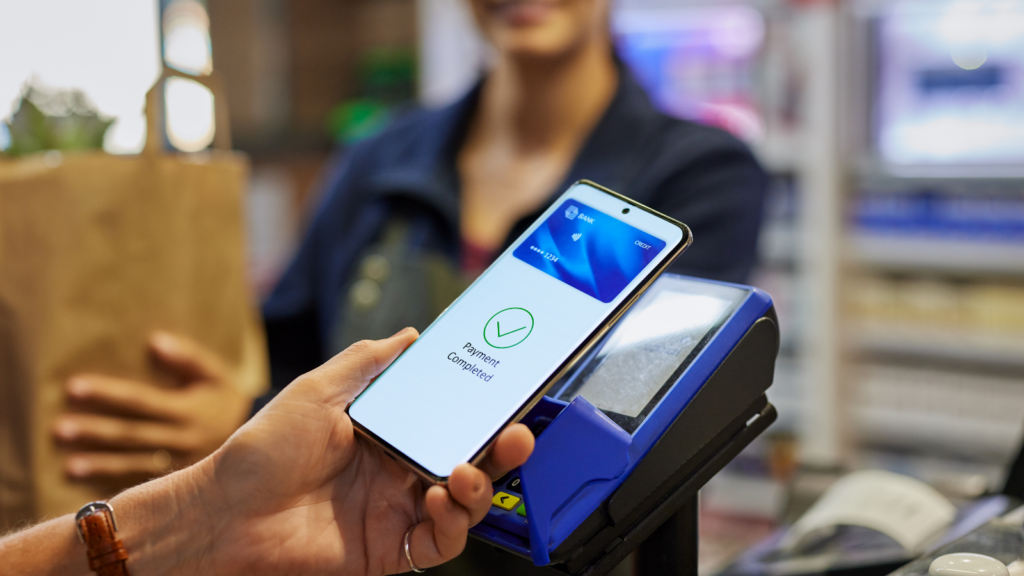
India now processes over 13 billion UPI transactions per month. Digital payment infrastructure has removed the primary friction point in D2C operations in India, the inability to transact securely online.
Prepaid order rates in D2C categories have risen from under 30% three years ago to 45-55% today for established brands. This shift matters operationally because prepaid orders have dramatically lower RTO rates than COD, typically 8-12% versus 25-40% on COD.
Brands with strong D2C operations in India’s infrastructure actively nudge customers toward prepaid at checkout through discounts, faster delivery promises, and payment option placement.
2. Social Commerce and Brand Discovery

Instagram, YouTube, and emerging platforms like Meesho’s social layer have made brand discovery radically cheaper for Indian D2C brands. A brand that would have needed ₹5 crore in television advertising to reach national awareness a decade ago can now build a 2 million-follower community with ₹50 lakh in content investment.
The conversion from social discovery to purchase is now seamless. Meta Shops, WhatsApp Commerce, and embedded checkout on YouTube are collapsing the funnel between awareness and order placement.
The downstream effect for D2C operations in India teams is demand unpredictability. A single viral post can drive 3,000 orders in 48 hours for a brand that was doing 300 orders per day. Without scalable order management software, India’s infrastructure, that spike, becomes a fulfilment crisis.
3. Quick Commerce Expanding the Addressable Market
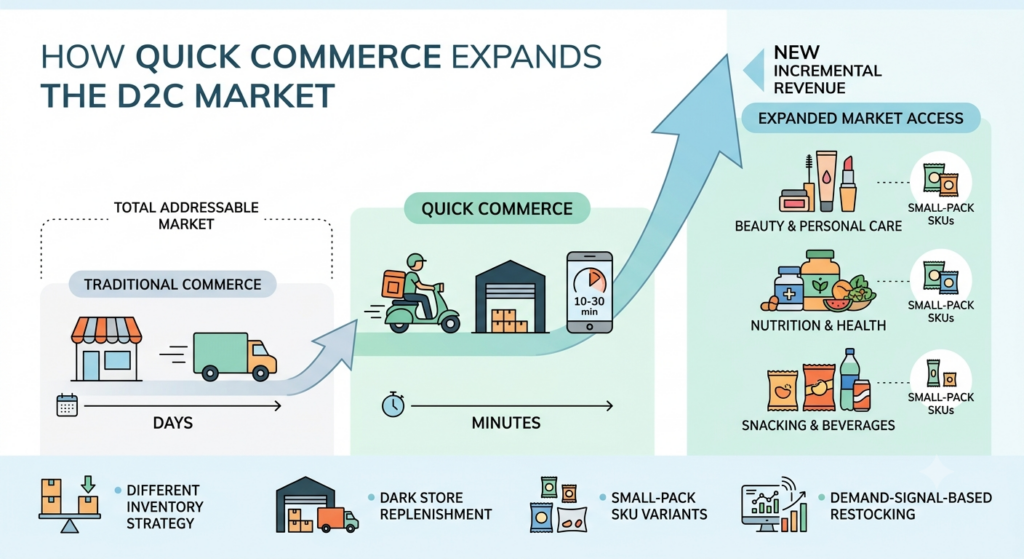
Blinkit, Zepto, Swiggy Instamart, and Amazon Fresh have created a new fulfilment expectation in urban India: 10-30 minute delivery for everyday consumables. D2C brands in beauty, nutrition, and snacking that get listed on quick-commerce platforms access incremental revenue that did not exist three years ago.
Operating on quick-commerce platforms requires a different inventory strategy, dark store replenishment, small-pack SKU variants, and demand-signal-based restocking. These are operationally intensive and cannot be managed on spreadsheets at any meaningful volume. For teams running D2C operations in India across multiple quick-commerce partners simultaneously, a dedicated platform is not optional.
4. Tier 2 and Tier 3 Market Expansion
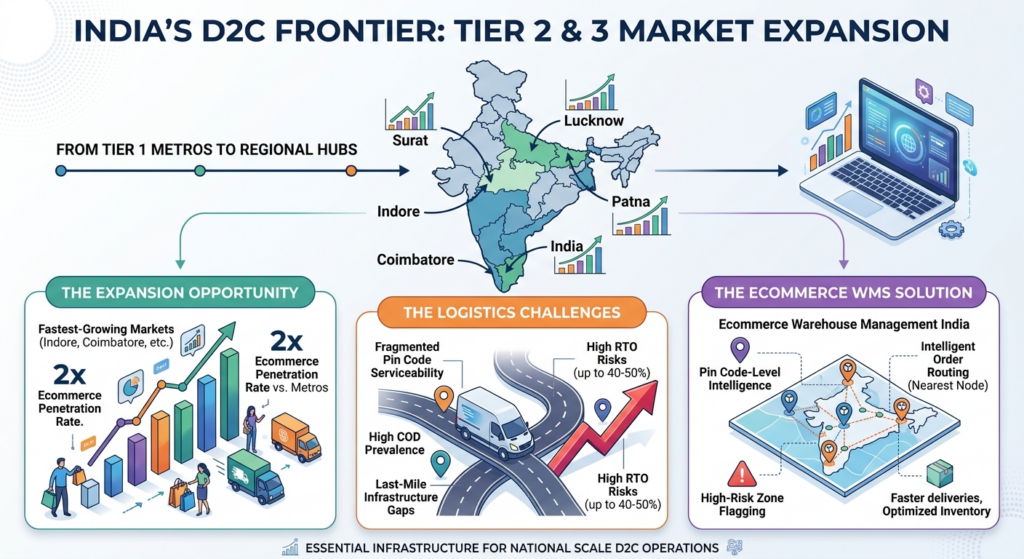
The fastest-growing D2C markets in India in 2026 are not Mumbai and Bangalore. They are Indore, Coimbatore, Lucknow, Surat, and Patna. Ecommerce penetration in these cities is growing at 2x the rate of metro markets.
This expansion creates a logistics challenge. Pin code serviceability, COD prevalence, and last-mile infrastructure in Tier 2 and Tier 3 markets are materially different from those in Tier 1. RTO rates in some Tier 3 pin codes run 40-50% without active management.
Ecommerce warehouse management India platforms that incorporate pin code-level intelligence, routing orders to the nearest fulfilment node, flagging high-risk delivery zones, are essential infrastructure for D2C operations in India teams operating at a national scale.
Top D2C Categories in India 2026
India’s D2C landscape in 2026 is evolving rapidly, with categories like beauty, fashion, health, and food leading the growth. Driven by digital adoption and changing consumer preferences, these segments are seeing strong demand.
Brands focusing on quality, personalization, and fast delivery are capturing market share and scaling quickly across urban and emerging markets.
1. Beauty and Personal Care

The largest D2C category in India by brand count and GMV. Beauty and personal care D2C is estimated at $4.5-5 billion in 2026, growing at 35-40% annually.
The category is driven by ingredient-conscious consumers who distrust legacy FMCG formulations, social proof through dermatologist and influencer endorsements, and high repeat purchase rates that make customer acquisition economics work.
Fulfilment complexity in beauty D2C operations in India is high. SKU counts are large (a single brand may carry 200+ SKUs across variants), shelf life management is critical, and pack size variations create inventory management challenges. An OMS for D2C brands in beauty needs to handle expiry date tracking, batch-level FIFO dispatch, and fragile item handling workflows.
2. Fashion and Apparel

India’s D2C fashion market is estimated at $6-7 billion in 2026. The category is the largest in absolute GMV terms and the most operationally intensive.
Fashion D2C brands deal with the highest return rates of any category, 20-35% on prepaid, 40-60% on COD in some segments. Managing returns at this rate requires reverse logistics infrastructure, quality check workflows for returned items, and reinventory or liquidation decision logic.
Size-related returns are a specific Indian problem. Most Indian D2C fashion brands operate without universal size standardisation. A medium from Brand A does not equal a medium from Brand B. Customer confusion generates avoidable returns that a proper order management system can reduce through size-recommendation nudges and accurate size chart enforcement at checkout.
3. Food, Nutrition, and Nutraceuticals
This category has seen extraordinary growth post-2020. The Indian D2C nutrition market, including protein supplements, health foods, functional beverages, and Ayurvedic products, is estimated at $2-2.5 billion in 2026.
Regulatory complexity (FSSAI compliance), cold chain requirements for certain SKUs, and subscription-heavy business models make this category operationally demanding. Brands in this space benefit significantly from ecommerce warehouse management India platforms that support subscription order batching, temperature-sensitive dispatch routing, and compliance documentation.
4. Home and Lifestyle

The home D2C category, furniture, home décor, kitchenware, and bedding, has accelerated on the back of work-from-home lifestyle shifts. It is estimated at $3-3.5 billion in 2026.
High average order values (₹2,000-₹15,000 per order), fragile product handling, and hyperlocal delivery requirements make this category’s fulfilment profile unique. RTO costs in home D2C operations in India are disproportionately large; a returned ₹8,000 bedding set costs ₹400-600 in reverse logistics and often cannot be resold as new.
India D2C Fulfilment Benchmarks 2026
These benchmarks are derived from operational data across Indian D2C brands operating at ₹10 crore to ₹500 crore annual GMV. They represent performance targets that differentiate high-growth D2C operations in India teams from average ones.
1. Dispatch SLA
|
Benchmark |
Average Brand |
High-Performance Brand |
|---|---|---|
|
Same-day dispatch rate |
45-55% |
80-90% |
|
Next-day dispatch rate |
75-80% |
95%+ |
|
Dispatch breach rate |
15-20% |
Under 3% |
Same-day dispatch is now a competitive differentiator in Indian D2C. Customers in urban India expect next-day delivery as a baseline. Brands that cannot dispatch within 24 hours of order placement lose repeat purchase rates to competitors who can.
Base.com’s dispatch automation engine generates pick lists, packing instructions, and courier labels within minutes of order confirmation. Brands on the platform consistently report same-day dispatch rates above 85% for orders placed before noon.
2. Packing Error Rate
|
Benchmark |
Average Brand |
High-Performance Brand |
|---|---|---|
|
Packing error rate |
2-4% |
Under 0.5% |
|
Wrong item shipped |
1-2% |
Under 0.2% |
|
Wrong quantity shipped |
0.5-1% |
Under 0.1% |
A 3% packing error rate across 10,000 monthly orders means 300 customers receive the wrong item. Each error costs the brand the item, the reverse logistics fee (₹80-150), and the customer relationship. At ₹500 average order value, that is ₹1.5 lakh in direct losses per month, before accounting for churn.
Base.com’s scan-based pack verification requires every item to be scanned against the order before the box is sealed. This brings packing error rates consistently below 0.5%.
3. RTO Rate
|
Category |
Average RTO |
Low-RTO Benchmark |
|---|---|---|
|
Fashion D2C |
28-35% |
15-18% |
|
Beauty D2C |
18-24% |
10-12% |
|
Nutrition D2C |
12-18% |
6-8% |
|
Electronics accessories |
20-28% |
10-14% |
RTO is the single largest margin leak in Indian D2C. A brand doing ₹1 crore monthly GMV with 30% RTO is effectively running on ₹70 lakh in delivered revenue while bearing the operational cost of ₹1 crore in fulfilment.
The brands that have pushed RTO below 15% in fashion and below 10% in beauty share two operational characteristics: they use pin code-level risk scoring before dispatch, and they have active NDR (Non-Delivery Report) intervention workflows that re-engage customers after a failed delivery attempt within 2 hours.
Base.com’s RTO intelligence module implements both. High-risk orders are flagged before dispatch. Failed delivery triggers automatic customer communication within the hour. This is what it means to reduce RTO India at the system level, not just monitoring it, but intervening in the process. It is also why strong D2C operations in India’s infrastructure directly improve net margin, not just logistics efficiency.
4. Inventory Accuracy
|
Benchmark |
Average Brand |
High-Performance Brand |
|---|---|---|
|
Inventory accuracy |
88-92% |
98%+ |
|
Stockout rate on live orders |
3-5% |
Under 0.5% |
|
Oversell rate |
1-2% |
Near zero |
Inventory accuracy below 95% is operationally dangerous. It means orders are being accepted for items that are not actually available, leading to cancellations, customer communication failures, and marketplace penalties.
The root cause is almost always manual inventory management, either spreadsheet-based tracking or OMS platforms that do not sync with the physical warehouse in real time. Ecommerce warehouse management India solutions that maintain bin-level inventory and update on scan confirmation, rather than on database entry, consistently achieve 98%+ accuracy.
5. COD Reconciliation Cycle Time
|
Benchmark |
Average Brand |
High-Performance Brand |
|---|---|---|
|
Time to reconcile remittance |
3-5 days |
Under 4 hours |
|
Discrepancy identification rate |
60-70% |
95%+ |
|
Outstanding COD recovery |
8-12% of COD GMV |
Under 2% |
COD still accounts for 55-65% of orders in Tier 2 and Tier 3 India. Brands doing ₹50 lakh+ monthly GMV with high COD mix are managing remittances from 4-8 courier partners simultaneously, each on different cycles and file formats.
Without automated reconciliation, finance teams spend 3-5 days per month on this work. Discrepancies, short remittances, missing COD amounts, and disputed deliveries are identified late and sometimes written off because recovery is too time-consuming.
Base.com automates COD reconciliation end-to-end: ingesting courier files, matching to order-level data, and surfacing exceptions with the information needed to raise disputes. This is one of the highest-value automation workflows on the platform for D2C operations in India brands with significant COD volume.
The Infrastructure Gap in Indian D2C Operations

The gap between average and high-performance fulfilment benchmarks is not a people problem. The brands hitting 90% same-day dispatch, sub-1% packing errors, and 12% RTO are not staffed with better people. They are running better systems.
The operational infrastructure gap in Indian D2C is wide. A 2024 survey of Indian D2C brands found that 68% of brands doing ₹10-50 crore GMV were still using spreadsheets or basic ERP for order management. Only 22% were using a dedicated order management system integrated with their warehouse.
This infrastructure gap is why the best OMS India conversation is so commercially important. Brands that close the infrastructure gap now are building operational moats that are difficult for competitors to replicate quickly.
The compounding effect is significant. A brand that moves from 30% RTO to 15% RTO does not just save on reverse logistics. It recovers working capital faster, carries less dead inventory, and improves its net margin on every delivered order. Combined with better dispatch SLAs and lower packing errors, the operational uplift from proper infrastructure translates directly into better unit economics, which fund the next stage of growth. This is the compounding return on investing in D2C operations in India’s infrastructure early.
What the Best-Performing Indian D2C Operations Have in Common
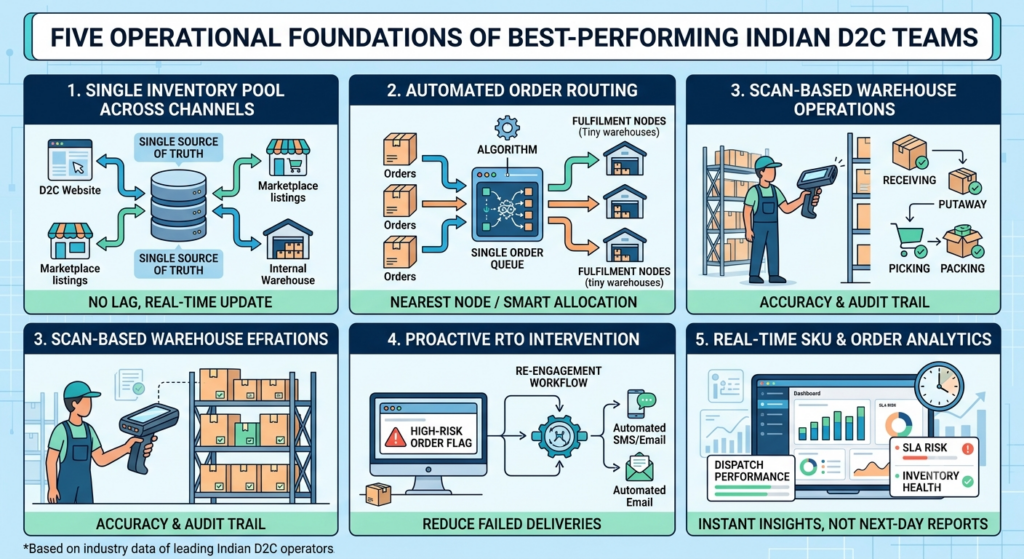
Across the operational data available from the Indian D2C market, high-performing D2C operations in India teams share five infrastructure characteristics:
1. Single inventory pool across all channels. A single source of truth for inventory that updates in real time across marketplace listings, D2C website, and internal warehouse records. No manual sync, no lag.
2. Automated order routing. Orders from every channel flow into a single queue and are automatically routed to the nearest or most appropriate fulfilment node based on inventory availability, courier serviceability, and SLA.
3. Scan-based warehouse operations. Physical warehouse workflows, receiving, putaway, picking, packing, are scan-confirmed. This creates both accuracy and an audit trail.
4. Proactive RTO intervention. High-risk orders are flagged before dispatch. Failed deliveries trigger automated re-engagement workflows within hours, not days.
5. Real-time analytics at the order and SKU level. Operations teams can see dispatch performance, pending orders, SLA risk, and inventory health in real time, not in a report the next morning.
Base.com is the platform that delivers all five for Indian D2C brands. It combines order management software India with full ecommerce warehouse management India depth in a single system, built for the Indian operating environment from day one.
Unlike global platforms that treat COD, Indian marketplace integrations, and pin code-level logistics intelligence as add-ons, Base.com is designed around these requirements. This is why it is increasingly the platform of choice for D2C operations in India, brands moving past ₹10 crore GMV.
Fulfilment as a Competitive Advantage in 2026
In 2020, fast fulfilment was a nice-to-have. In 2026, it is table stakes in most D2C categories.
Customers in India’s Tier 1 cities now expect next-day delivery as a default. Quick-commerce has reset expectations in urban centres. Brands that cannot consistently deliver within 48 hours are visibly slower than the market norm.
The brands that will lead Indian D2C in 2026 and beyond are building fulfilment as a core competitive capability, not outsourcing it entirely to 3PLs, not running it on spreadsheets, but investing in the operational infrastructure that makes consistent, fast, accurate fulfilment possible at scale. For most brands, this starts with getting D2C operations in India infrastructure right before scaling spend on acquisition or new channels.
That infrastructure investment centres on the best OMS India has available, combined with warehouse management depth. It is the operational foundation on which every other D2C growth initiative, new channels, new categories, and new markets depend.
Summary: Key India D2C Market Data Points for 2026
|
Metric |
Value |
|---|---|
|
India D2C market size (2026 est.) |
$45-52 billion |
|
D2C CAGR |
40% |
|
India ecommerce market size (2024) |
$226 billion |
|
COD share in Tier 2/3 orders |
55-65% |
|
Average COD RTO rate |
25-40% |
|
Fashion D2C RTO (average) |
28-35% |
|
Beauty D2C market size (2026) |
$4.5-5 billion |
|
Fashion D2C market size (2026) |
$6-7 billion |
|
Brands using dedicated OMS (₹10-50Cr GMV) |
22% |
|
UPI monthly transactions |
13 billion+ |
Base.com is an order management and warehouse management platform purpose-built for Indian D2C and B2B ecommerce brands. To benchmark your operations against the data in this report, speak to the Base.com team.