
Indian D2C brands switch from spreadsheets to an order management system because spreadsheets cannot handle multi-channel sync, real-time inventory, or automated fulfilment at scale. As order volumes grow past 200-300 orders per day, manual errors, delayed dispatch, and RTO rates increase sharply, costing brands both margin and customer trust.
India’s D2C market is growing at 40% CAGR and is expected to reach $60 billion by 2027. That growth sounds exciting, until your operations team is managing 500 daily orders across Amazon, Flipkart, and your own Shopify store on a shared Google Sheet.
Spreadsheets were never built for this. They break under volume, create data silos, and have no awareness of your warehouse, your courier, or your customer. Order management software was.
This article breaks down exactly why Indian D2C brands, from ₹5 crore bootstrapped labels to ₹100 crore multi-category players, are moving to dedicated order management systems in 2024-2025.
The shift is not about technology preference. It is about operational survival. Every Indian D2C brand operating at a meaningful scale has either already made this switch or is paying a hidden tax every month in errors, inefficiency, and stunted growth, without realising the spreadsheet is the source.
Understanding the specific reasons behind this switch is useful whether you are evaluating platforms now, building a business case internally, or trying to quantify what your current operations are actually costing you.
Why This Switch Is Happening Now in India
India’s ecommerce market crossed $226 billion in 2024. The D2C segment is not a niche anymore; it is mainstream retail with enterprise-level operational complexity.
The problem is that most Indian D2C brands scaled their sales before scaling their operations. They added channels, added SKUs, and added warehouses, but kept the same spreadsheet that worked at ₹20 lakh/month.
At some point, that spreadsheet stops being a tool and starts being a risk.
The tipping point in India is sharper than in Western markets. Reasons specific to India include the COD-heavy order mix, the diversity of logistics partners and pin code serviceability, and the complexity of multi-marketplace compliance requirements. All three of these factors require system-level handling, not manual spreadsheet logic.
Indian brands that move to a dedicated order management system at the right time gain a compounding operational advantage. Their error rates fall, their team capacity frees up, and their data quality improves to a point where they can make better decisions faster than competitors still running on manual workflows.
Reason 1: Multi-Channel Order Sync Breaks Down
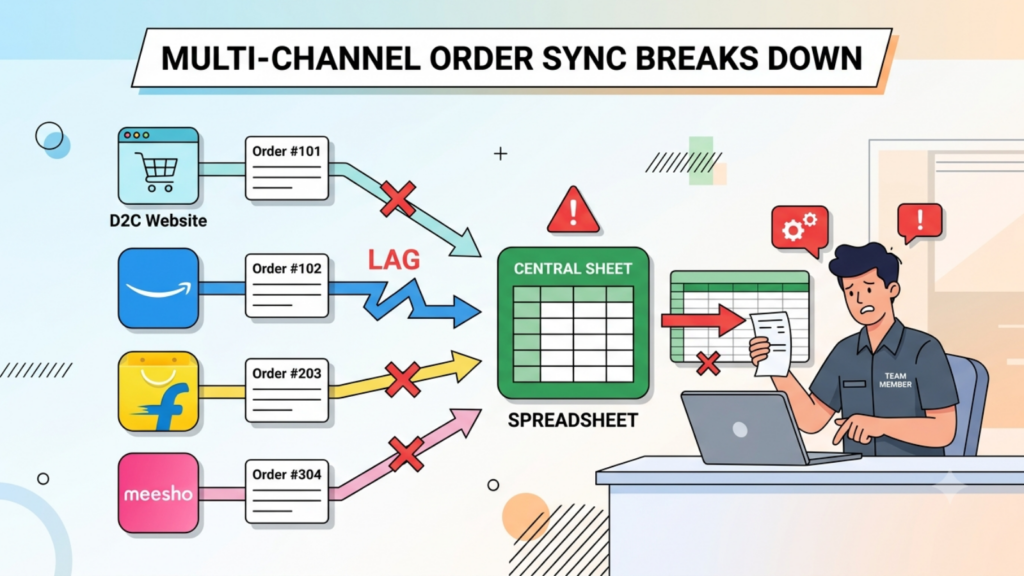
If your brand sells on Amazon, Flipkart, Meesho, and your D2C website simultaneously, a spreadsheet cannot consolidate those orders in real time. Each platform updates independently. Your team ends up manually copying orders, which introduces lag and errors.
OMS platforms like Base.com pull orders from every channel into a single dashboard, updating inventory and order status across all marketplaces simultaneously. A sale on Flipkart immediately reduces stock visibility on Amazon and your website. No manual step required.
India’s top D2C brands often operate across 6-10 sales channels. Without automated sync, overselling and stockouts become daily problems.
This matters more in India than in most markets because of the speed of Indian sales events. During a Big Billion Day or a sale event on your D2C site, order velocity can jump 10-20x within minutes. A spreadsheet-based team cannot process that volume fast enough to prevent overselling. An order management software platform handles the spike automatically.
The best multi-channel order management in India solutions maintain a single inventory pool and a single order queue, regardless of how many channels are feeding into it. Base.com does this natively across all major Indian marketplaces and D2C platforms.
Reason 2: Inventory Accuracy Drops Below Acceptable Thresholds
Spreadsheets are static. Inventory in a live warehouse is not.
When a sale happens, someone has to update the sheet.And when a return comes back, someone has to update it again. When you receive a new stock inward from your manufacturer, the same thing. This manual dependency means your inventory data is always slightly wrong.
In India, where COD return rates run at 25-30% across categories, the volume of inventory movement is enormous. A 3% inventory error rate across 10,000 SKUs means 300 items are either showing as available when they aren’t, or marked as out-of-stock when they’re sitting in your warehouse.
Base.com’s real-time inventory engine tracks every inward, outward, return, and adjustment automatically. Inventory counts update the moment a pick is confirmed in the warehouse.
Reason 3: Packing Errors Increase as Volume Scales
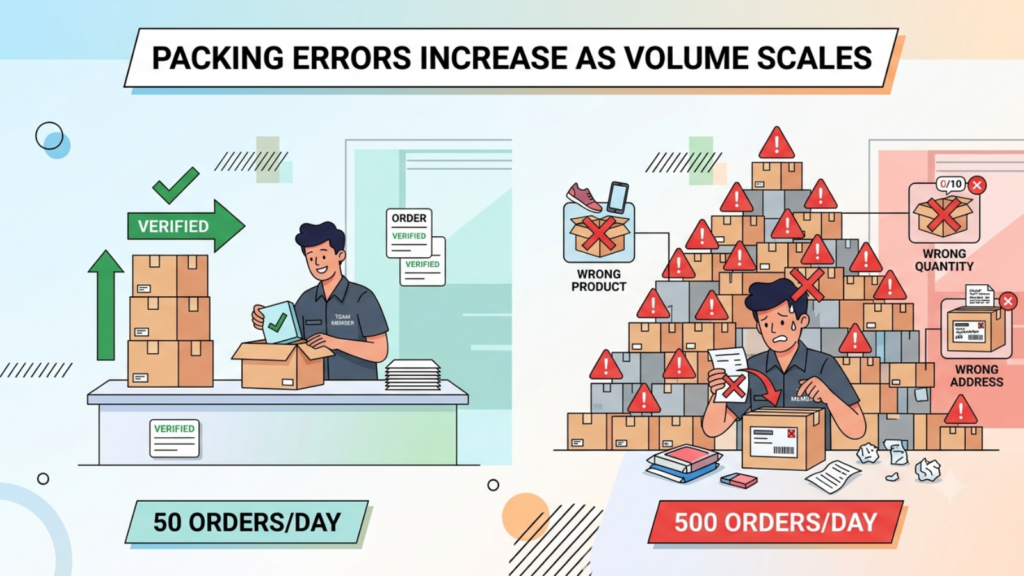
At 50 orders a day, your team can manually verify every packing slip. At 500 orders, that verification breaks down.
Spreadsheet-based operations typically produce packing error rates of 3-5% at scale. That means wrong products shipped, wrong quantities dispatched, or wrong addresses printed. Each packing error costs your brand the item value, the reverse logistics fee, and the customer relationship.
Base.com’s warehouse module introduces scan-based verification at the packing station. Every item is scanned against the order before it is sealed. This drives packing error rates toward 0%.
For Indian D2C brands in fashion, beauty, or electronics, where a wrong SKU can mean a ₹2,000 loss per order, scan-based packing pays for itself within weeks.
Reason 4: RTO Management Requires System Intelligence
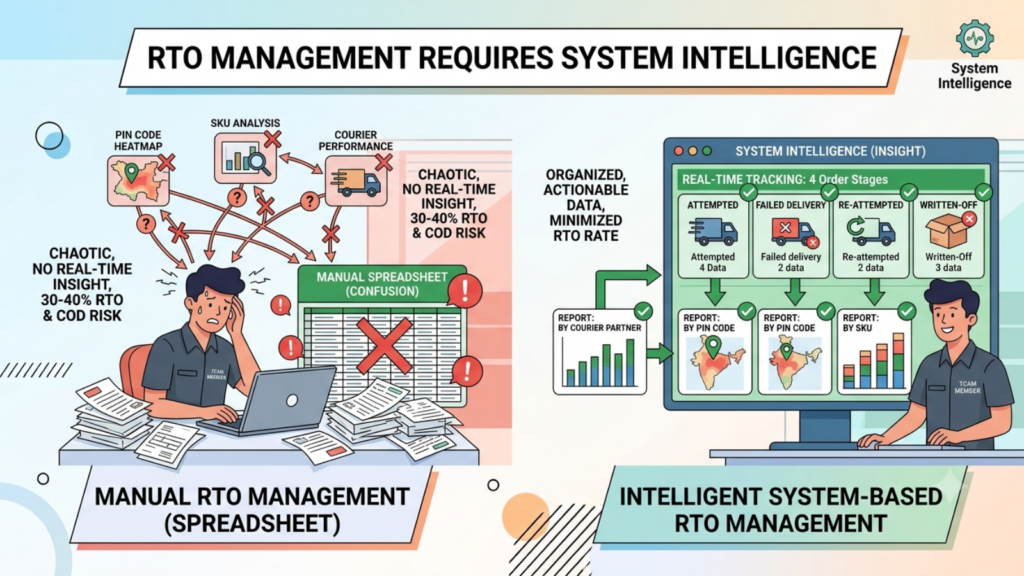
India has among the highest Return to Origin (RTO) rates globally; some categories see 30-40% RTO on prepaid orders and even higher on COD. Managing RTOs manually through spreadsheets is operationally unsustainable.
You need to track which orders were attempted, which failed delivery, which have been re-attempted, and which have been written off. You need that data by courier partner, by pin code, and by SKU. A spreadsheet cannot produce that analysis in real time.
Base.com’s RTO intelligence layer flags high-risk orders before they are dispatched, using pin code serviceability data, historical delivery performance, and order value thresholds. Brands using this feature report meaningful reductions in RTO within the first 60 days.
Reducing RTO by even 5 percentage points on a ₹1 crore/month GMV brand saves ₹5-8 lakh monthly in logistics and product costs.
The reduced RTO India problem is fundamentally an information problem. Your courier knows which pin codes consistently fail delivery. And your historical order data shows which customer segments cancel after placement. Your warehouse data shows which products get refused most often. A proper order management system connects these signals. A spreadsheet cannot, because it does not know any of them in real time.
Base.com’s NDR (Non-Delivery Report) workflow is one of the most actively used features on the platform in India. When a delivery attempt fails, the system automatically triggers a customer communication sequence, captures re-attempt instructions, and routes the outcome back to the order record, all without manual intervention. This closes the loop on RTO management in a way that no spreadsheet-based process can match.
Reason 5: COD Reconciliation Becomes a Finance Nightmare
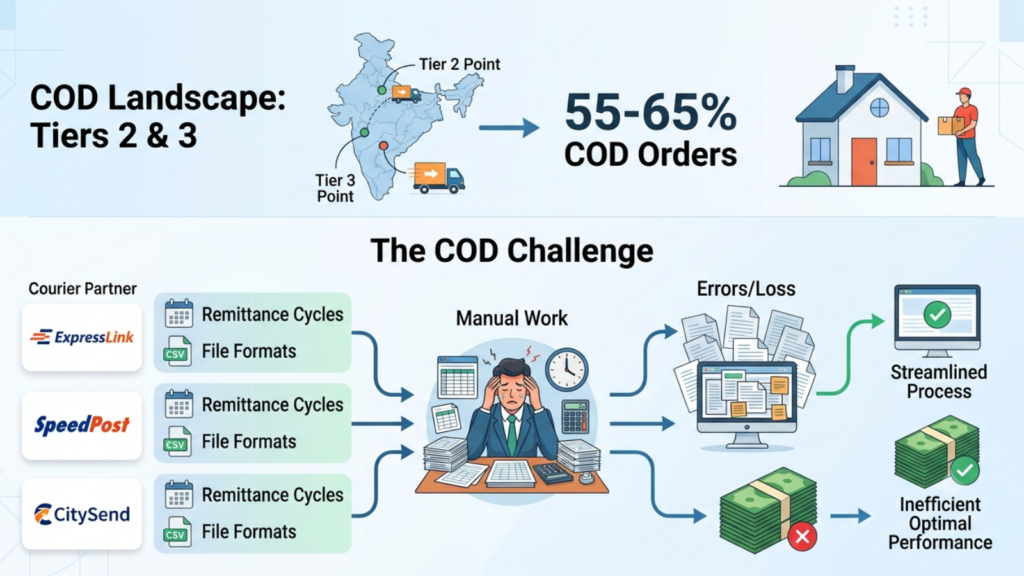
Cash on delivery still accounts for 55-65% of all ecommerce orders in Tier 2 and Tier 3 India. Managing COD remittances from 3-5 courier partners on a spreadsheet is one of the most time-consuming tasks in Indian D2C operations.
Every courier has a different remittance cycle, some weekly, some biweekly. Every remittance file has a different format. Matching each remittance to each order, flagging short payments, and identifying lost COD amounts takes the entire finance team’s bandwidth.
Base.com automates COD reconciliation by ingesting courier remittance files directly, matching them against dispatched orders, and surfacing discrepancies with line-item detail. Finance teams that previously spent 3-4 days per month on this task typically complete it in under 2 hours.
Reason 6: Courier Allocation Is Manual and Suboptimal

When you use a spreadsheet, every order gets assigned to whichever courier your logistics team prefers that day. There is no logic layer, no serviceability check, no rate comparison, no SLA-based routing.
This produces two problems. First, you pay higher shipping rates than necessary because you are not selecting the cheapest eligible courier per order. Second, you ship to pin codes that your selected courier doesn’t service, triggering NDR (Non-Delivery Report) failures.
Base.com’s courier allocation engine assigns each order to the optimal carrier based on pin code serviceability, delivery SLA, rate card, and historical performance. This reduces both logistics cost per order and NDR-triggered RTOs.
Indian ecommerce brands shipping 5,000+ orders per month can typically reduce per-order shipping cost by ₹8-15 through intelligent courier allocation alone.
Reason 7: Reporting and Analytics Are Delayed by Days

A spreadsheet report is always backward-looking. By the time your team has pulled data, formatted it, and shared it, the information is 48-72 hours old.
In fast-moving Indian ecommerce, where sales velocity changes sharply during sales events, category drops, or social media moments, a 72-hour delay in operational reporting is a strategic disadvantage.
Base.com’s analytics dashboard provides live reporting on order throughput, dispatch rates, pending orders, SLA breach risk, and inventory health, updated in real time. Operations managers can see how the day is tracking against targets before the day is over.
Reason 8: Scaling to New Channels and Warehouses Is Blocked
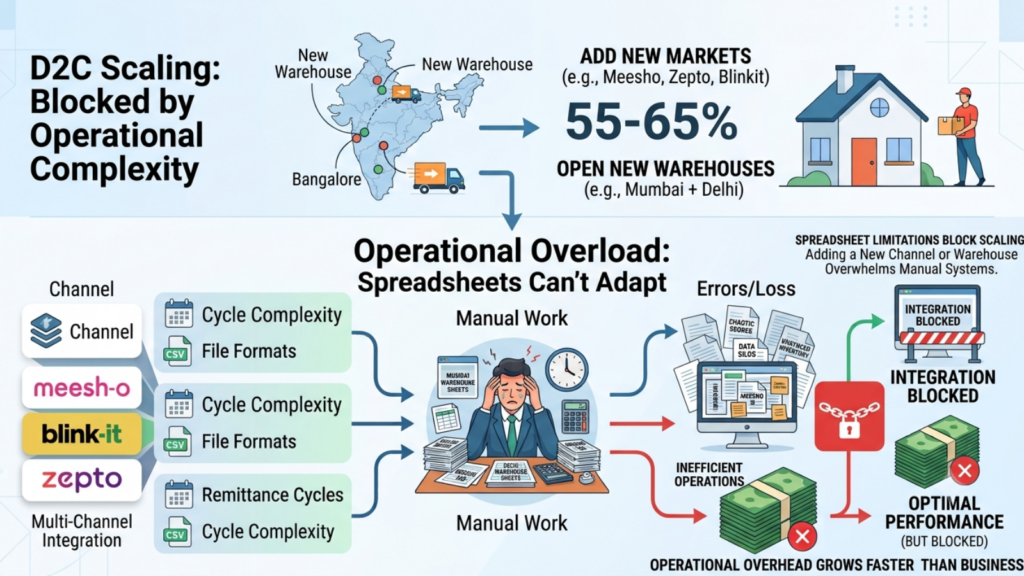
Growth in Indian D2C often means adding a new marketplace (Meesho, Blinkit, Zepto), a new warehouse city (moving from single-city to Mumbai + Delhi + Bangalore), or a new product category.
Every one of these additions is a structural change that a spreadsheet cannot accommodate. Adding a new channel means a new tab. Adding a new warehouse means tracking two separate sheets. The operational overhead grows faster than the business.
Base.com is built to scale horizontally. Adding a new sales channel takes minutes; the platform connects to the marketplace API, pulls orders automatically, and maps them to your existing fulfilment flow. Adding a new warehouse takes one configuration step, after which inventory allocation, pick lists, and dispatch instructions route to that location automatically.
Reason 9: Your Team Is Doing High-Cost Work at Low Value
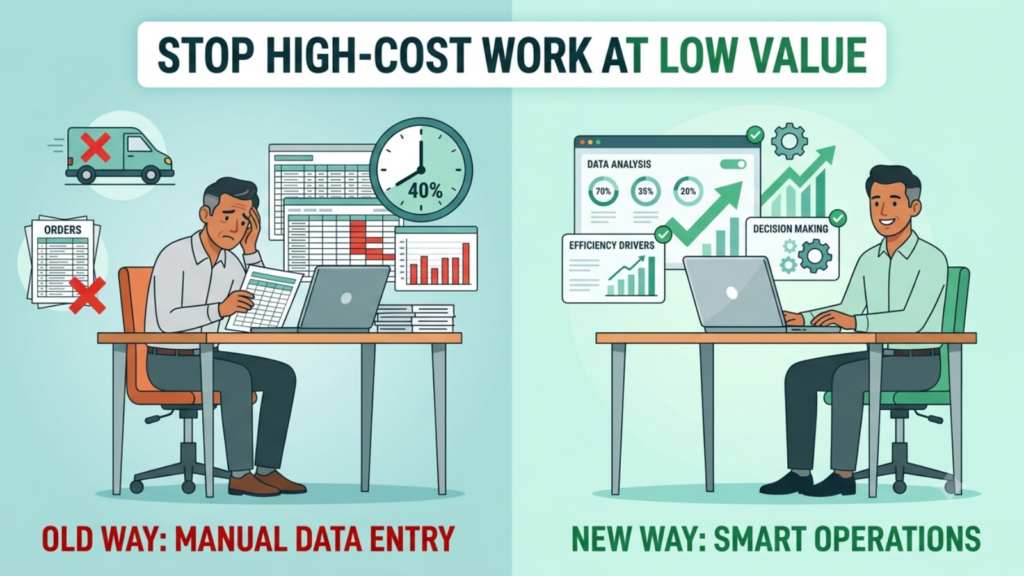
A senior operations executive earning ₹8-12 lakh per year who spends 40% of their time updating spreadsheets, chasing courier emails, and reconciling order data is operating well below their potential.
This is not just a cost problem; it is a talent problem. The best operations talent in Indian D2C wants to work with data, make decisions, and drive efficiency. They do not want to be data entry operators.
Base.com removes the manual data layer entirely. Order ingestion, inventory updates, pick list generation, dispatch confirmation, and courier tracking are all automated. Your team’s time shifts from maintaining records to analysing performance and driving improvements.
Reason 10: You Have No Audit Trail When Things Go Wrong
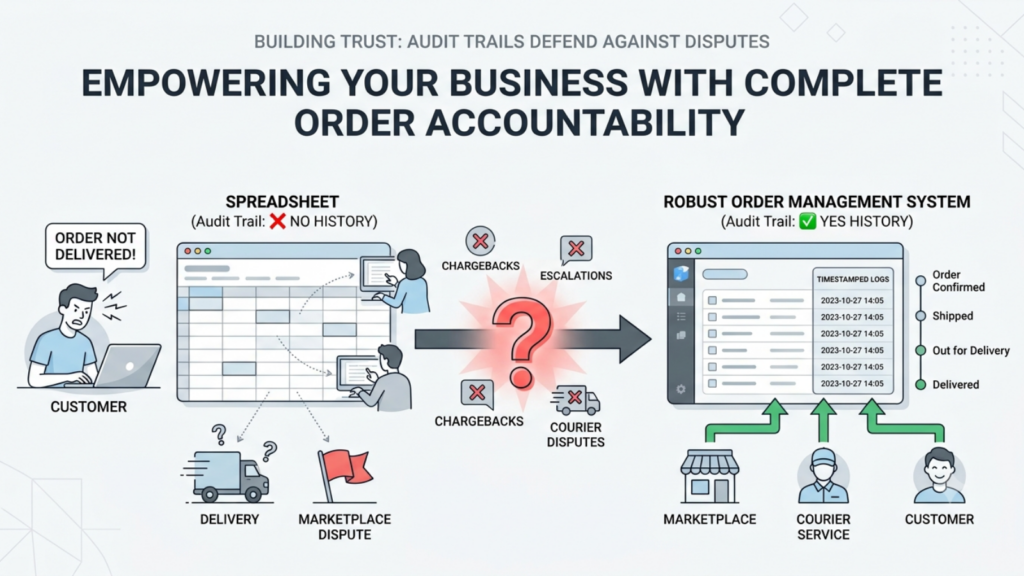
When a customer complains that their order was not delivered, or when a marketplace raises a dispute about a shipment, your ability to respond depends entirely on having accurate, timestamped records.
A spreadsheet has no audit trail. Anyone can edit a cell. There is no version history per transaction. When disputes arise, and in Indian ecommerce, courier disputes, marketplace chargebacks, and customer escalations are frequent, you have no system of record to fall back on.
Base.com maintains a full, immutable audit trail for every order, from creation through pick, pack, dispatch, and delivery. Every status change is timestamped and attributed. When a marketplace dispute requires proof of dispatch, the evidence is available in seconds.
Spreadsheets vs Order Management Software: A Direct Comparison
|
Capability |
Spreadsheet |
Order Management Software (Base.com) |
|---|---|---|
|
Multi-channel order sync |
Manual, lag-prone |
Automated, real-time |
|
Inventory accuracy |
Static, error-prone |
Live, scan-verified |
|
Packing error rate |
3-5% at scale |
Approaching 0% with scan verification |
|
RTO prediction |
None |
Pin code + history-based flagging |
|
COD reconciliation |
Manual, 3-4 days/month |
Automated, under 2 hours |
|
Courier allocation |
Manual, preference-based |
Rule-based, cost and SLA optimised |
|
Reporting |
T+48-72 hours |
Real-time dashboard |
|
Scalability |
Breaks at volume |
Built to scale horizontally |
|
Audit trail |
None |
Full, immutable, timestamped |
|
Team productivity |
Low-value data entry |
Decision-making and analysis |
When Is the Right Time to Switch?
Most Indian D2C brands delay the switch for too long. The typical trigger points are:
- Volume: Consistent 200+ daily orders across channels
- Channels: Operating on 3 or more marketplaces simultaneously
- Warehouses: Managing stock across more than one location
- Team size: More than 3-4 people touching order operations daily
- Error rate: Packing errors, inventory discrepancies, or RTO rates trending upward
If two or more of these conditions apply to your business, you are past the point where a spreadsheet is viable. The cost of continuing to operate on spreadsheets, with errors, in lost margin, in team hours, typically exceeds the cost of an order management system within 60-90 days.
There is also a softer signal that brands often miss: when your operations team stops proactively flagging problems because they are too busy keeping up with daily volume. That is the point at which spreadsheet-based operations shift from a manageable constraint to an active competitive disadvantage.
The best time to evaluate order management software in India was three months ago. The second-best time is now.
Why Indian D2C Brands Choose Base.com
Base.com is built specifically for the Indian ecommerce operating environment. That means COD-first reconciliation flows, native integrations with Indian marketplaces (Amazon India, Flipkart, Meesho, Myntra, Blinkit, Zepto), and support for Indian courier partners across Tier 1, Tier 2, and Tier 3 pin codes.
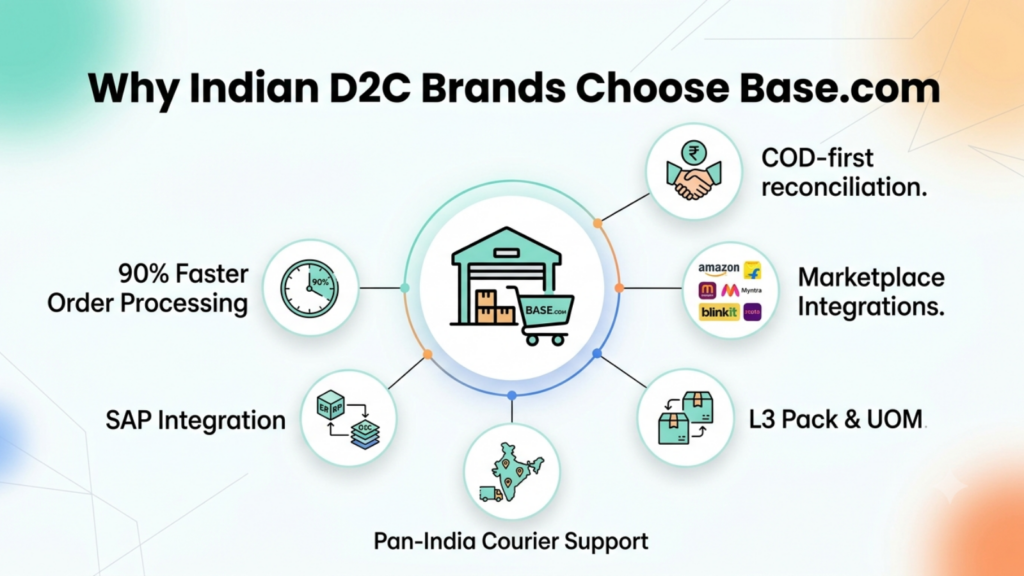
Unlike global order management software products that require customisation for Indian logistics realities, Base.com is configured for India from day one. The platform handles:
- L3 pack and UOM complexity are common in FMCG and grocery D2C
- SAP integration for brands running enterprise ERP alongside their D2C stack
- Multi-node warehouse management with pick-pack-ship workflows
- Appointment-based dispatch scheduling for key account fulfilment
Brands using Base.com as their order management system report order processing time reductions of up to 90%, from 3 hours to under 30 minutes for equivalent order volumes.
Base.com positions itself as the operational backbone for Indian D2C, not just an order router, but a full-stack ecommerce warehouse management India solution that handles every step from order ingestion to delivery confirmation to returns processing.
The platform’s approach to D2C operations in India is systems-first. Every workflow, from warehouse putaway to courier label generation to customer notification, runs on configurable automation. This means the operations team is monitoring and improving the system, rather than running it manually.
For brands evaluating the best OMS India has to offer in 2025, the key differentiators to look for are: native Indian marketplace connectors, COD reconciliation capability, WMS depth, and the ability to handle high SKU counts with pack-level complexity. Base.com addresses all four.
As a WMS for D2C India, Base.com handles warehouse-level operations that generic OMS platforms skip entirely, bin locations, pick sequence optimisation, batch picking for high-velocity SKUs, and real-time packer productivity tracking. For brands running their own warehouse, this depth matters.
The combination of OMS and WMS in a single platform is particularly valuable for Indian D2C brands that are transitioning from third-party logistics (3PL) to self-managed warehousing, a common inflection point as brands scale past ₹2-3 crore monthly GMV and start thinking about operational control.
The True Cost of Staying on Spreadsheets
Here is what staying on a spreadsheet actually costs a mid-size Indian D2C brand at ₹50 lakh/month GMV:
|
Cost Category |
Estimated Monthly Impact |
|---|---|
|
Packing errors (3% on 5,000 orders @ ₹200 avg error cost) |
₹30,000 |
|
Excess RTO (2% preventable @ ₹150 reverse logistics + item) |
₹15,000-₹25,000 |
|
COD reconciliation manual effort (40 hrs @ ₹400/hr) |
₹16,000 |
|
Suboptimal courier allocation (₹10 excess per order) |
₹50,000 |
|
Inventory errors (stockouts + overselling) |
₹20,000-₹40,000 |
|
Total estimated monthly cost |
₹1.3 lakh-₹1.6 lakh |
This is before accounting for the opportunity cost of senior team members spending time on data maintenance instead of growth work.
A best-in-class OMS for D2C India at ₹30,000-₹60,000/month delivers positive ROI in the first month for most brands at this GMV level.
Base.com is an order management and warehouse management platform built for Indian D2C and B2B ecommerce brands. To see how Base.com compares to spreadsheet operations in your specific context, book a walkthrough.