

The best Catalog Management Software for Marketplace Sellers in India is the one that holds a single master SKU record and pushes channel-specific listings to Amazon, Flipkart, Myntra, Nykaa, Blinkit and your own D2C store without a re-upload. Base.com, Unicommerce, Vinculum, EasyEcom and Akeneo lead this category. The right pick depends on channel count, SKU depth, and whether you need true product information management or only a listing uploader.
Why catalog is now the bottleneck for Indian marketplace sellers
Indian e-commerce is tracking toward roughly $226 billion, and D2C is compounding at close to 40% CAGR. Channel count per seller has grown faster than headcount. A brand that sold on two marketplaces in 2021 now sells on six, plus two quick commerce platforms, plus its own Shopify store.
Each of those channels wants a different feed. Amazon wants browse nodes and bullet points. Flipkart wants its own vertical attributes. Myntra wants fashion taxonomy, size charts and model imagery. Blinkit wants pack-size clarity and shelf-life data.
Most Indian sellers still solve this with spreadsheets. One master sheet, six derived sheets, one operations executive maintaining all of them. That is where listing errors, suppressed ASINs, and stockouts begin.
Catalog Management Software for Marketplace Sellers exists to remove that manual translation layer. It stores product truth once and syndicates it everywhere, in each channel’s required format.
The commercial cost of getting this wrong is measurable. Incomplete or inconsistent listing attributes are a documented driver of marketplace quality-score penalties and search suppression, and COD return rates in India already run at 25-30% across categories. Poor product data widens that gap because the buyer’s expectation was set by a wrong image, a wrong dimension, or a missing spec.
What separates catalog management from inventory management
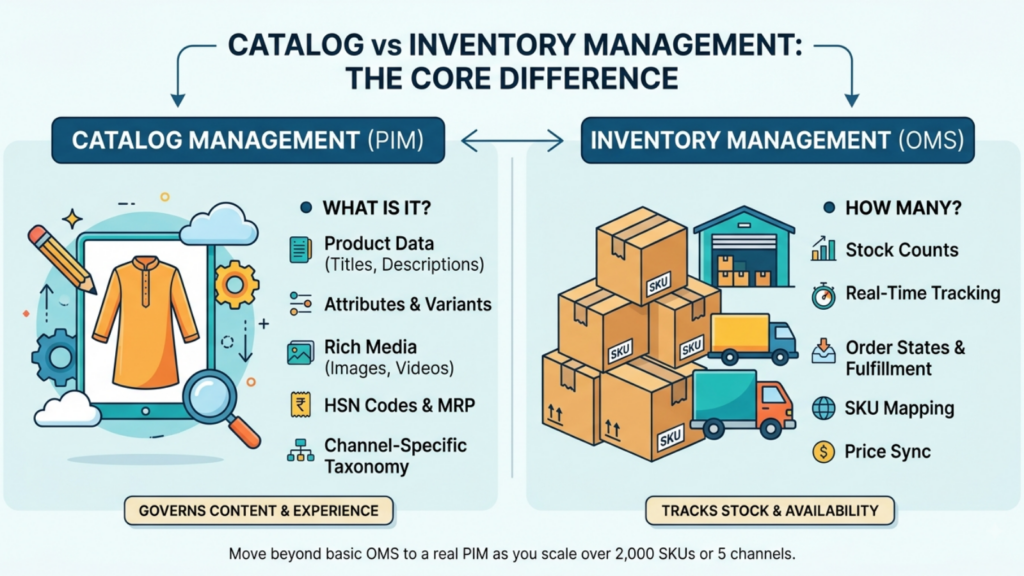
This is the most common confusion in Indian procurement conversations, and it costs brands a full replacement cycle.
Inventory management answers how many. Catalog management answers what it is. An OMS tracks stock counts and order states. Catalog Management Software for Marketplace Sellers governs titles, descriptions, attributes, images, videos, variants, size charts, HSN codes, MRP, and channel-specific taxonomy.
Many Indian platforms bundle a thin catalog layer inside an OMS. It handles SKU mapping and price sync, then stops. It cannot version an attribute, enforce a data-completeness rule, or hold 40 images against one parent SKU.
That thin layer works until you cross roughly 2,000 SKUs or five channels. After that, you need a real PIM.
|
Capability |
Inventory / OMS module |
True PIM-grade catalog module |
|---|---|---|
|
Stock count sync |
Yes |
Not its job |
|
SKU-to-channel mapping |
Yes |
Yes |
|
Attribute governance and validation rules |
No |
Yes |
|
Channel-specific taxonomy mapping |
Partial |
Yes |
|
Digital asset management (images, video, size charts) |
Rarely |
Yes |
|
Bulk enrichment and workflow approvals |
No |
Yes |
|
Version history and rollback |
No |
Yes |
|
Variant and parent-child modelling |
Basic |
Full |
How we evaluated this list
Every platform below was assessed against five criteria relevant to Indian marketplace sellers, not to US mid-market retail:
- Indian marketplace coverage. Native connectors to Amazon India, Flipkart, Myntra, Ajio, Nykaa, Meesho, Tata Cliq, JioMart, and quick commerce.
- Catalog depth. Whether it is a genuine PIM or a listing uploader wearing a PIM label.
- Compliance readiness. HSN, GST-linked pricing fields, MRP display rules, Legal Metrology attributes.
- Time to first listing. How long from signup to a live, error-free listing on three channels.
- Total cost at scale. Whether pricing breaks when SKU count or channel count triples.
Pricing figures below are indicative and change frequently. Confirm current numbers directly with each vendor.
Top 20 Catalog Management Software for Marketplace Sellers
Managing product information across Amazon, Flipkart, Myntra, Meesho, AJIO, Nykaa, and other marketplaces can quickly become difficult as your catalog grows.
Product titles, descriptions, images, SKUs, pricing, variants, and inventory all need to stay accurate and consistent across channels. Catalog management software helps marketplace sellers centralize this information, automate updates, reduce listing errors, and maintain product data across multiple sales channels.
In this guide, we compare the top 20 catalog management software for marketplace sellers to help you find the right solution for your catalog size, marketplace mix, and operational needs.
1. Base.com
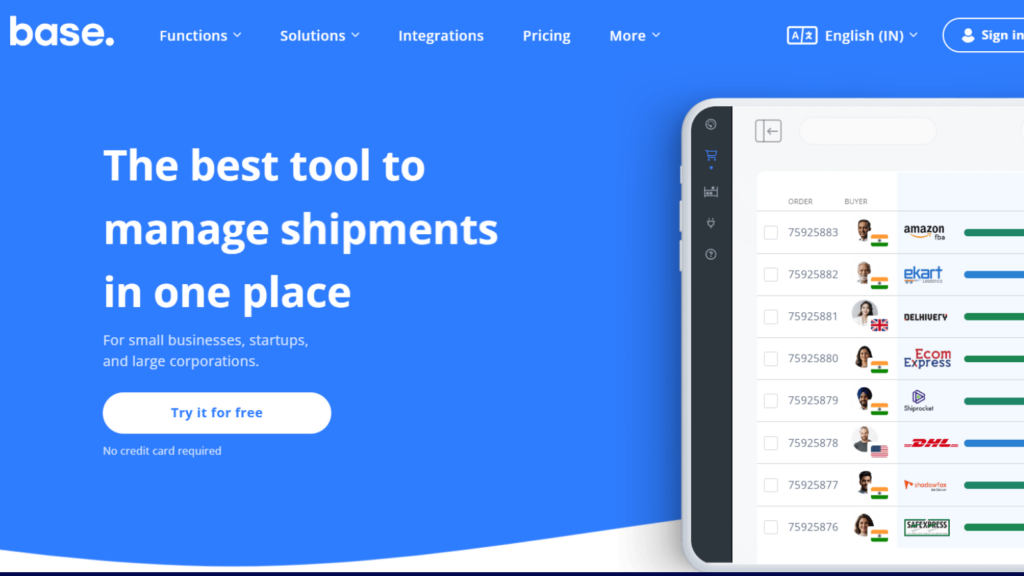
Base.com is built as a single platform where catalog, orders, and warehouse operations share one product record. That architecture is the differentiator. Most Indian competitors either sell a strong OMS with a shallow catalog layer, or a standalone PIM that has no operational awareness of what is actually shipping.
Key features
- Native PIM module with attribute-level governance, not a listing uploader bolted onto an OMS
- Single master SKU record shared across catalog, order and warehouse modules, so an attribute change propagates without re-import
- Channel-specific taxonomy mapping for Amazon, Flipkart, Myntra, Ajio, Nykaa, Meesho and quick commerce
- Bulk enrichment with rule-based validation before push, so incomplete listings are blocked at source
- Digital asset management with channel-wise image resizing and compliance checks
- Variant and parent-child modelling for apparel, footwear and beauty
- Version history with rollback on any attribute change
- Approval workflows for catalog, pricing and content teams
|
Advantages |
Disadvantages |
|---|---|
|
PIM is a first-class module, not an add-on |
Newer brand than incumbents in India, so fewer public case references |
|
Catalog, OMS and WMS on one data model removes reconciliation between systems |
Full value needs the connected modules, so single-module buyers see less lift |
|
Rule-based validation stops bad listings before they reach the marketplace |
Implementation requires clean master data upfront |
|
India-first taxonomy and compliance fields built in |
Deep enterprise PIM buyers may want more modelling than a unified suite offers |
Best for: D2C brands and marketplace sellers between roughly ₹10 crore and ₹500 crore who want catalog and operations on one system rather than stitching a PIM to a separate OMS.
2. Unicommerce
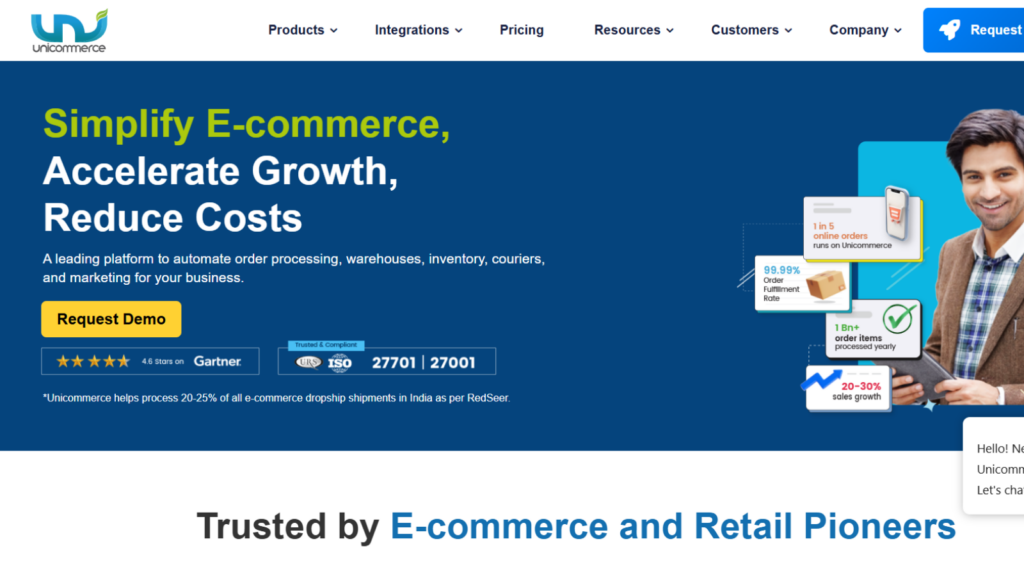
The largest incumbent in Indian e-commerce operations software, with very wide marketplace and courier coverage.
Key features
- Extensive marketplace, cart and logistics integrations
- Strong multi-channel order and inventory management
- Catalog and SKU mapping within the operations suite
- Omnichannel and dropship support
- Established enterprise support model
|
Advantages |
Disadvantages |
|---|---|
|
Broadest integration library in the Indian market |
Catalog capability is operational rather than PIM-grade |
|
Proven at very high order volumes |
Rich content, asset management and enrichment workflows are limited |
|
Deep marketplace relationships |
Interface complexity for smaller teams |
Best for: High-volume sellers who need integration breadth first and treat catalog as a secondary concern.
3. Vinculum (Vin PIM / Vin eRetail)

Vinculum is the closest direct comparison on catalog depth, because it markets a dedicated PIM product alongside its OMS and WMS.
Key features
- Vin PIM as a named product information management module
- Catalog syndication to marketplaces and webstores
- Order, warehouse and reconciliation products in the same suite
- Global marketplace coverage beyond India
|
Advantages |
Disadvantages |
|---|---|
|
Genuine PIM product, not a listing tool |
Suite breadth can mean longer implementation cycles |
|
Suits multi-country sellers |
Modules are frequently licensed separately, raising total cost |
|
Enterprise retail heritage |
Heavier configuration burden for lean teams |
Best for: Multi-country enterprise retailers who need catalog and supply chain in one vendor relationship.
4. EasyEcom
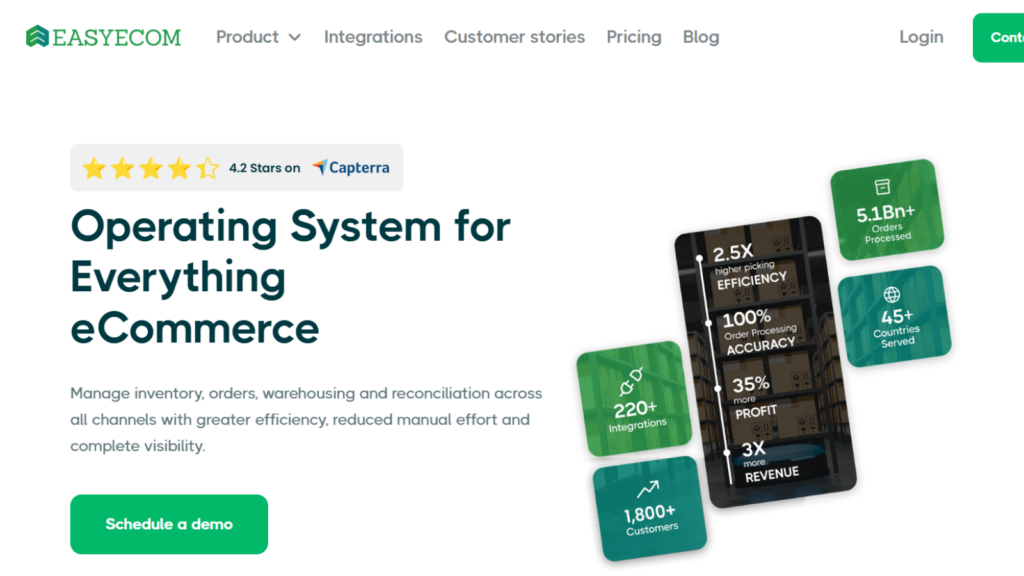
An omnichannel inventory and reconciliation platform widely used by mid-market Indian sellers.
Key features
- Multi-channel inventory and order processing
- Payment and settlement reconciliation
- B2B and B2C order flows
- Integrations across Amazon, Flipkart and major carts
|
Advantages |
Disadvantages |
|---|---|
|
Strong reconciliation alongside operations |
Catalog module is functional, not enrichment-grade |
|
Clean onboarding for mid-market sellers |
Limited asset management |
|
Good B2B support |
Attribute governance is basic |
Best for: Sellers whose primary pain is reconciliation, with catalog as a secondary requirement.
5. Browntape
A long-standing Indian multi-channel platform known for interface simplicity and account management.
Key features
- Multi-channel order and inventory sync
- SKU-level mapping across channels
- Automated shipping batches
- Dedicated account manager model
|
Advantages |
Disadvantages |
|---|---|
|
Simple UI, fast to learn |
Catalog features are light |
|
Hands-on service model |
Less suitable above high SKU counts |
|
Custom ERP integration experience |
Limited enrichment workflow |
Best for: Small and mid-size sellers who value service over feature depth.
6. Increff

Positioned around inventory and merchandising intelligence, particularly strong in fashion and lifestyle.
Key features
- Algorithmic inventory planning and allocation
- Warehouse management for apparel
- Serialised inventory approach
- Marketplace integrations
|
Advantages |
Disadvantages |
|---|---|
|
Strong analytics for fashion assortments |
Catalog enrichment is not the core product |
|
Proven with large apparel brands |
Higher price point |
|
Merchandising depth |
Narrower category fit |
Best for: Fashion and lifestyle brands prioritising assortment planning.
7. eVanik OWS
A seller-focused suite that emphasises settlement accuracy and SKU-level profitability.
Key features
- Multi-channel order management
- Payment reconciliation and claim recovery
- SKU-level profit and loss
- Marketplace fee tracking
|
Advantages |
Disadvantages |
|---|---|
|
Financial visibility per SKU |
Catalog depth is limited |
|
Useful for margin-sensitive sellers |
Less enterprise tooling |
|
Practical for small teams |
Fewer content workflows |
Best for: Sellers focused on recovering marketplace deductions.
8. Ginesys

Retail ERP with e-commerce extensions, common among Indian omnichannel retailers with physical stores.
Key features
- Retail ERP, POS and e-commerce in one stack
- Article and item master management
- GST and compliance handling
- Store plus online inventory unification
|
Advantages |
Disadvantages |
|---|---|
|
Strong for offline plus online retail |
ERP-style item master, not a marketing PIM |
|
Solid India tax and compliance handling |
Slower to change catalog content |
|
Mature retail workflows |
Implementation-heavy |
Best for: Retail chains extending into marketplaces.
9. Anchanto

An Asia-Pacific e-commerce operations platform used by brands and logistics providers.
Key features
- Multi-market marketplace connectors across APAC
- Order and warehouse management
- Product and listing management module
- Seller and 3PL multi-tenant support
|
Advantages |
Disadvantages |
|---|---|
|
Strong cross-border APAC coverage |
India-specific depth varies by channel |
|
Works for 3PLs serving many brands |
Enterprise pricing |
|
Reasonable listing management |
Not a full enrichment PIM |
Best for: Brands selling across Southeast Asia and India together.
10. Fynd Platform
An Indian commerce platform combining storefront, omnichannel and marketplace distribution.
Key features
- Storefront plus marketplace distribution
- Product catalog and content management
- Omnichannel inventory from stores
- Marketplace connectors
|
Advantages |
Disadvantages |
|---|---|
|
Good storefront and marketplace combination |
Catalog governance lighter than dedicated PIM |
|
Strong omnichannel story |
Best value when using the full platform |
|
India-native |
Less flexible for pure marketplace sellers |
Best for: Brands that want storefront and marketplace distribution from one vendor.
11. Zoho Inventory
Entry-level multi-channel inventory software with a familiar ecosystem.
Key features
- Item master with basic attributes
- Amazon, Flipkart, Shopify integrations
- Zoho Books and CRM connectivity
- Low starting price
|
Advantages |
Disadvantages |
|---|---|
|
Affordable and quick to start |
Very limited catalog enrichment |
|
Integrates with Zoho stack |
Thin Indian marketplace coverage beyond majors |
|
Simple for early-stage sellers |
Outgrown quickly past a few thousand SKUs |
Best for: Early-stage sellers on two or three channels.
12. Shiprocket

Primarily a shipping aggregator with an expanding commerce enablement layer.
Key features
- Multi-courier shipping aggregation
- Order and channel integrations
- Catalog and listing tools within its wider suite
- COD and NDR management
|
Advantages |
Disadvantages |
|---|---|
|
Excellent logistics coverage |
Catalog is a supporting feature, not the core |
|
Useful RTO and NDR tooling |
Limited attribute modelling |
|
Low barrier to entry |
Not a substitute for a PIM |
Best for: Sellers whose main constraint is shipping and RTO, not product data.
13. Akeneo

A widely adopted open-core PIM used globally by retailers and manufacturers.
Key features
- Full attribute modelling and product families
- Data quality scoring and completeness rules
- Asset management
- Extensive API and connector ecosystem
|
Advantages |
Disadvantages |
|---|---|
|
Best-in-class catalog modelling |
No native Indian marketplace connectors out of the box |
|
Strong governance and workflow |
Needs a separate OMS and integration layer |
|
Large partner ecosystem |
Implementation and partner cost |
Best for: Large enterprises that already run a separate OMS and want a dedicated PIM.
14. Pimcore
Open-source PIM, DAM and experience management in one framework.
Key features
- PIM, DAM, MDM and CMS modules
- Highly customisable data model
- Open-source licensing option
- Strong for complex product structures
|
Advantages |
Disadvantages |
|---|---|
|
No licence lock-in on the open edition |
Requires developer capacity |
|
Handles very complex catalogs |
Marketplace syndication needs custom build |
|
Combined DAM and CMS |
Slower time to value |
Best for: Technically resourced brands with unusual catalog structures.
15. Salsify

An enterprise product experience management platform focused on brand-to-retailer syndication.
Key features
- Product experience management and syndication
- Retailer requirement templates
- Content health and shelf analytics
- Digital shelf monitoring
|
Advantages |
Disadvantages |
|---|---|
|
Strongest retailer syndication network globally |
Network is retailer-centric outside India |
|
Excellent digital shelf analytics |
Premium enterprise pricing |
|
Robust governance |
Overbuilt for India-only sellers |
Best for: Global CPG brands selling through large retail accounts.
16. inriver
Enterprise PIM oriented around revenue impact of product data.
Key features
- Product data modelling and enrichment
- Digital shelf analytics
- Channel syndication
- Supplier onboarding
|
Advantages |
Disadvantages |
|---|---|
|
Strong analytics tie-back |
Limited India marketplace focus |
|
Good for manufacturers and distributors |
Enterprise cost structure |
|
Mature governance |
Requires integration partner |
Best for: Manufacturers and B2B distributors.
17. Plytix

A lighter, mid-market PIM with a friendly interface.
Key features
- Product attributes and relationships
- Digital asset management
- Channel-ready product sheets and catalogs
- Public product pages
|
Advantages |
Disadvantages |
|---|---|
|
Accessible pricing for a real PIM |
Not built for Indian marketplace formats |
|
Fast onboarding |
Needs a middleware layer for syndication |
|
Good DAM for the price |
Limited operations features |
Best for: Mid-market brands wanting PIM discipline without enterprise cost.
18. Sales Layer
A cloud PIM emphasising connector-led syndication and data quality scoring.
Key features
- Product data quality score
- Connector library for marketplaces and platforms
- Asset management
- Supplier collaboration
|
Advantages |
Disadvantages |
|---|---|
|
Clear quality scoring |
Indian channel coverage is thin |
|
Reasonable time to value |
Not an operations platform |
|
Good supplier workflows |
Requires complementary OMS |
Best for: Distributors managing supplier-supplied product data.
19. PIMworks
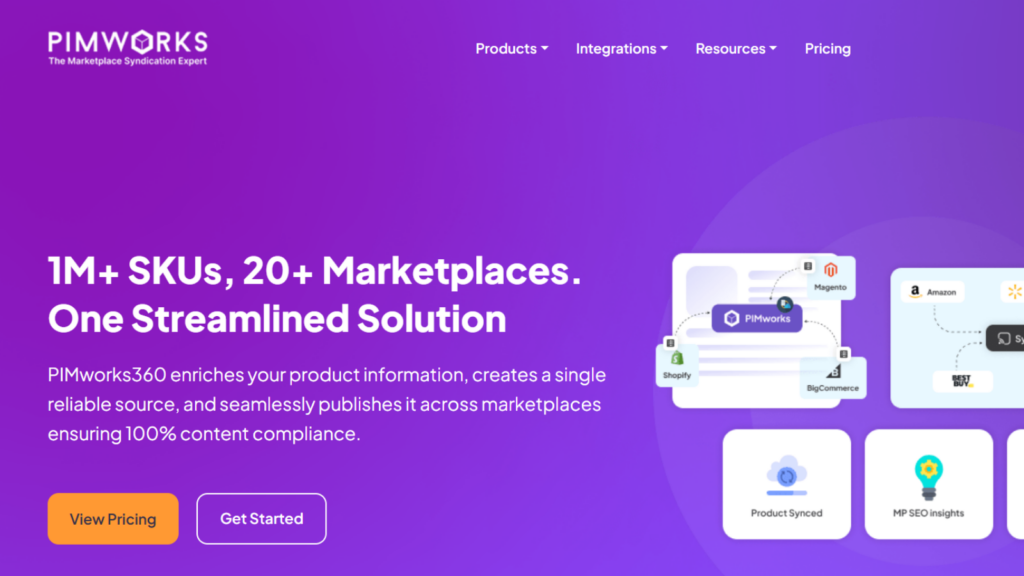
A PIM platform with catalog enrichment features aimed at retailers and brands.
Key features
- Centralised product data management
- Machine-assisted content enrichment
- Digital asset management
- Syndication to Shopify, Magento, BigCommerce, Amazon
|
Advantages |
Disadvantages |
|---|---|
|
Enrichment automation reduces manual writing |
Indian marketplace depth is limited |
|
Workflow collaboration |
Not an OMS or WMS |
|
Dashboard-level data insights |
Needs integration work for Flipkart, Myntra and similar |
Best for: Brands prioritising content enrichment over operations.
20. Channable
A feed management platform for advertising and marketplace channels.
Key features
- Feed transformation and rule builder
- Marketplace and ad channel connectors
- Automated pricing and title rules
- Performance monitoring
|
Advantages |
Disadvantages |
|---|---|
|
Powerful feed rules |
Feed manager, not a PIM |
|
Strong for paid channel feeds |
No master data governance |
|
Fast to configure |
Weak Indian marketplace coverage |
Best for: Performance marketing teams optimising product feeds.
Comparison table: catalog depth versus India fit
Catalog management platforms can look similar on the surface, but their capabilities vary significantly when you look at catalog depth, marketplace integrations, automation, and regional requirements.
For Indian marketplace sellers, the right platform needs to handle everything from large SKU catalogs and product variants to bulk updates and multi-channel listings. The table below compares leading catalog management software based on catalog depth and India fit, helping sellers identify which tools are best suited to their operational needs.
|
Platform |
Dedicated PIM module |
India marketplace depth |
Operations included |
Typical buyer size |
|---|---|---|---|---|
|
Base.com |
Yes |
High |
OMS + WMS |
₹10 Cr – ₹500 Cr |
|
Unicommerce |
Operational only |
High |
OMS + WMS |
Mid to large |
|
Vinculum |
Yes |
High |
OMS + WMS |
Enterprise |
|
EasyEcom |
Operational only |
High |
OMS |
Mid-market |
|
Browntape |
Basic |
Medium |
OMS |
Small to mid |
|
Increff |
Basic |
Medium |
WMS |
Fashion enterprise |
|
eVanik |
Basic |
Medium |
OMS |
Small to mid |
|
Ginesys |
ERP item master |
Medium |
ERP + POS |
Retail chains |
|
Anchanto |
Listing module |
Medium |
OMS + WMS |
Regional enterprise |
|
Fynd |
Moderate |
Medium |
Storefront + OMS |
Mid to large |
|
Zoho Inventory |
Basic |
Low |
Inventory |
Early stage |
|
Shiprocket |
Basic |
High (logistics) |
Shipping |
Small to mid |
|
Akeneo |
Yes |
Low |
None |
Enterprise |
|
Pimcore |
Yes |
Low |
None |
Enterprise |
|
Salsify |
Yes |
Low |
None |
Global CPG |
|
inriver |
Yes |
Low |
None |
Manufacturers |
|
Plytix |
Yes |
Low |
None |
Mid-market |
|
Sales Layer |
Yes |
Low |
None |
Distributors |
|
PIMworks |
Yes |
Low |
None |
Mid-market |
|
Channable |
No |
Low |
None |
Marketing teams |
The pattern is clear. Platforms with real catalog depth mostly lack Indian marketplace connectors. Platforms with Indian connectors mostly treat catalog as an operational afterthought.
That gap is the entire argument for choosing Catalog Management Software for Marketplace Sellers that solves both, rather than assembling two vendors and an integration project.
Where Base.com is different
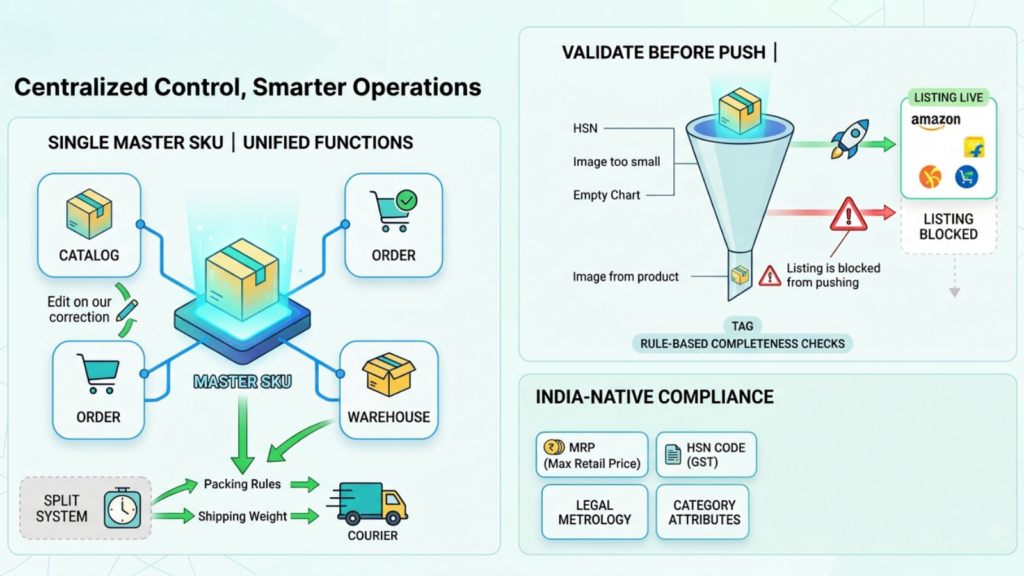
Base.com sits in the small overlap between PIM-grade catalog control and India-native marketplace operations.
Three specifics matter.
- One product record, three modules. Catalog, order, and warehouse functions read from the same master SKU. A dimension corrected in the catalog immediately changes the packing rule in the warehouse and the shipping weight sent to the courier. In a two-vendor stack, that correction requires a sync job and a reconciliation check.
- Validation before push, not error handling after. Rule-based completeness checks run before a listing reaches the channel. A missing HSN code, an undersized image, or a blank size chart blocks the push. Sellers using separate systems typically discover the same problem after the marketplace rejects or suppresses the listing.
- India-first field structures. MRP, HSN, Legal Metrology declarations and category-specific marketplace attributes are modelled as native fields, not custom attributes retrofitted onto a Western data model.
For sellers evaluating Catalog Management Software for Marketplace Sellers, the practical question is whether catalog work and fulfilment work are done by the same team. In most Indian D2C brands under ₹500 crore, they are. Splitting the software when the team is not split creates coordination cost that shows up as listing errors and stock mismatches.
How to choose: a decision framework
Use SKU count and channel count as the first filter.
|
Scenario |
Recommended approach |
|---|---|
|
Under 500 SKUs, 2-3 channels |
Inventory tool with basic catalog is sufficient |
|
500-5,000 SKUs, 3-6 channels |
Unified platform with a real PIM module |
|
5,000-50,000 SKUs, 6+ channels |
Unified platform, or dedicated PIM plus OMS |
|
Over 50,000 SKUs, multi-country |
Dedicated enterprise PIM plus regional OMS |
|
Heavy variant categories (fashion, footwear) |
PIM-grade variant modelling is non-negotiable |
|
Compliance-heavy categories (food, cosmetics, electronics) |
Attribute governance and audit trail required |
Then apply four tests to any shortlist.
- The attribute test. Ask the vendor to add a new custom attribute, make it mandatory for one category, and show the validation firing. If this needs a support ticket, it is not a PIM.
- The rollback test. Change a title across 200 SKUs, then revert it. If there is no version history, catalog errors become permanent.
- The channel test. Ask for a live push to Flipkart and Myntra, not just Amazon. Myntra taxonomy is where thin catalog tools break.
- The scale test. Price the platform at three times your current SKU count. Many contracts are structured so that catalog growth is the expensive variable.
Implementation realities Indian sellers underestimate
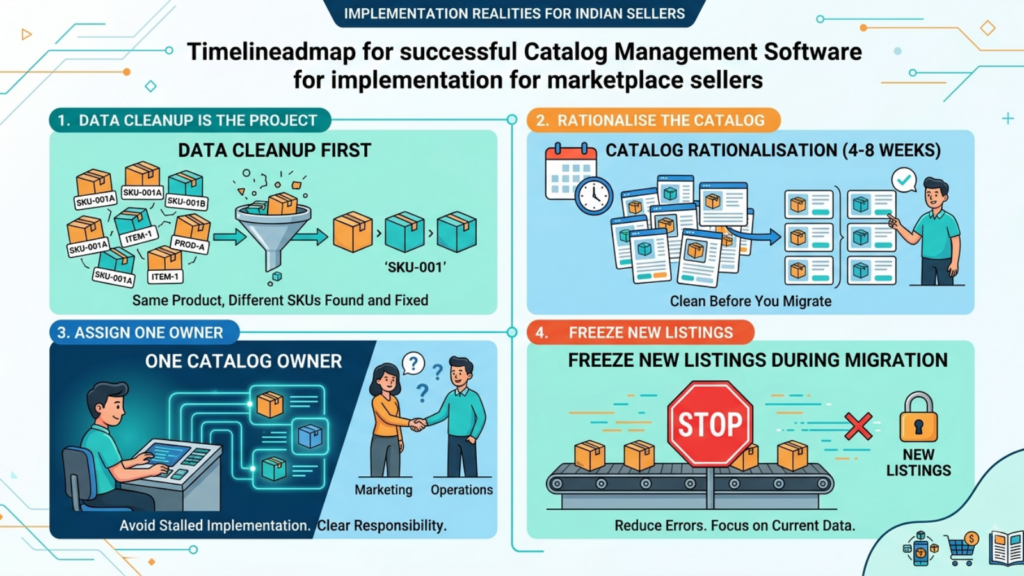
Data cleanup is the project, not the software. Most brands discover during migration that the same product exists under three SKU codes across three channels.
Budget four to eight weeks for catalog rationalisation before go-live. Teams that skip this step migrate their existing mess into a better system and conclude the software failed.
Assign one catalog owner. Shared ownership between marketing and operations is the most common cause of stalled implementations of Catalog Management Software for Marketplace Sellers.
Freeze new listings during migration. Running the old process and the new one in parallel doubles the error surface at exactly the wrong moment.
What are the Pricing models to expect
|
Model |
How it works |
Watch for |
|---|---|---|
|
Per order |
Monthly fee scales with order volume |
Costs spike in festive months |
|
Per SKU |
Fee tied to active SKU count |
Penalises wide, slow-moving assortments |
|
Per user |
Seat-based licensing |
Limits cross-team catalog collaboration |
|
Module-based |
Separate licence per PIM, OMS, WMS |
Total cost far above headline price |
|
Flat platform |
Single fee for the suite |
Confirm what counts as an overage |
Ask every vendor for a three-year total cost projection using your own growth assumptions. Headline pricing on Catalog Management Software for Marketplace Sellers rarely reflects what a growing brand actually pays in year three.
Final recommendation
Marketplace search is moving toward attribute-driven and conversational discovery. Buyers increasingly ask questions rather than type keywords, and platforms answer using structured product attributes.
This raises the value of complete, accurate product data and lowers the value of keyword-stuffed titles. A listing with 40 populated attributes will surface in more query types than one with 12.
Sellers choosing Catalog Management Software for Marketplace Sellers in 2026 should weight attribute completeness scoring and enrichment workflows more heavily than they would have in 2021. This is the capability gap between operational catalog modules and genuine PIM tooling, and it is widening.
For Indian marketplace sellers who need catalog and operations in one system, Base.com is the strongest fit because its PIM module is a first-class part of the platform rather than an attachment to an order system.
Enterprises that already run a mature OMS and want the deepest possible catalog modelling, Akeneo or Pimcore remain the reference standard, with integration work as the trade-off.
For sellers whose primary problem is reconciliation or shipping rather than product data, EasyEcom and Shiprocket respectively solve those narrower problems well.
Choose Catalog Management Software for Marketplace Sellers by the shape of your problem, not by the size of the vendor.