

Prepare your Amazon catalog by finishing every listing change six to eight weeks before the sale opens. Amazon product listing optimization stops being effective once traffic arrives, because ranking signals need time to settle. Fix attribute completeness, image stacks, variant families, backend search terms, and deal eligibility first. Inventory and advertising come after the catalog is clean, not before.
Why the catalog is the constraint, not the campaign
Indian sellers spend festive season budget in the wrong order. Advertising gets planned in August. Inventory gets planned in September. The catalog gets fixed in the last week, if at all.
That sequence is backwards. A suppressed listing cannot be advertised. A listing missing mandatory attributes cannot enter a Lightning Deal. A parent-child family that was never merged splits its reviews across four ASINs and none of them rank.
Amazon product listing optimization is the input that determines whether your other two budgets work at all.
The stakes are large. Indian e-commerce is tracking toward roughly $226 billion, and D2C brands are compounding at close to 40% CAGR. The Great Indian Festival is Amazon India’s largest event of the year, running multiple phases across the festive weeks from Navratri through Diwali, with Prime members getting early access ahead of the public opening.
Prime Day sits earlier in the calendar and is Prime-member-only, electronics-led, and shorter. The catalog preparation is identical. The window to complete it is the only thing that changes.
The timing rule that governs everything
Amazon needs time to re-index changes. A new title, a corrected browse node or a merged variant family does not take full effect the moment you save it.
Work backwards from the sale open date.
|
Weeks before sale |
Catalog action |
|---|---|
|
8-10 weeks |
Attribute audit, suppressed listing cleanup, browse node corrections |
|
6-8 weeks |
Title, bullet and backend search term rewrites |
|
5-6 weeks |
Image stack rebuild, A+ Content submission, video uploads |
|
4-6 weeks |
Variant family consolidation, deal submissions |
|
3-4 weeks |
Pricing, MRP and coupon setup, inventory inbound |
|
1-2 weeks |
Freeze. Monitor only. No content changes |
|
During sale |
Suppression monitoring and stock alerts only |
The freeze matters. Sellers who edit titles two days before a sale routinely lose ranking they had held for months. Amazon product listing optimization done late is worse than Amazon product listing optimization not done.
1. Run an attribute completeness audit before anything else

Most Indian sellers do not know what percentage of their catalog is actually complete. They know which listings are live, which is a different measure.
Amazon publishes a Listing Quality Dashboard in Seller Central that flags missing attributes, weak content, and suppressed ASINs. Start there, export it, and treat it as your project plan.
Completeness is not cosmetic. Amazon’s search increasingly resolves queries against structured attributes rather than title keywords, so a listing with forty populated fields surfaces in far more query types than one with twelve.
Prioritise in this order:
- Mandatory category attributes. Missing values here cause suppression, not just ranking loss.
- Filter attributes. Colour, size, material, capacity, wattage. These drive left-rail navigation, which carries heavy festive traffic.
- Compliance attributes. HSN, country of origin, manufacturer details, Legal Metrology declarations, warranty terms.
- Discovery attributes. Occasion, gift suitability, age range, room type. Underused by Indian sellers and heavily used by festive shoppers.
This is the least glamorous part of Amazon product listing optimization and the one with the highest return.
Where catalog software changes the maths
Auditing 200 SKUs by hand is a two-day job. Auditing 8,000 is not a manual job at all.
Base.com approaches this by holding one master product record and running rule-based completeness validation against it before anything is pushed to Amazon. A listing that fails a mandatory-attribute rule is blocked at source rather than rejected by the marketplace afterwards.
The difference is where you discover the error. In a spreadsheet workflow, you discover it when Amazon suppresses the ASIN, usually mid-sale. In a governed catalog, you discover it in July.
2. Rewrite titles for festive search intent
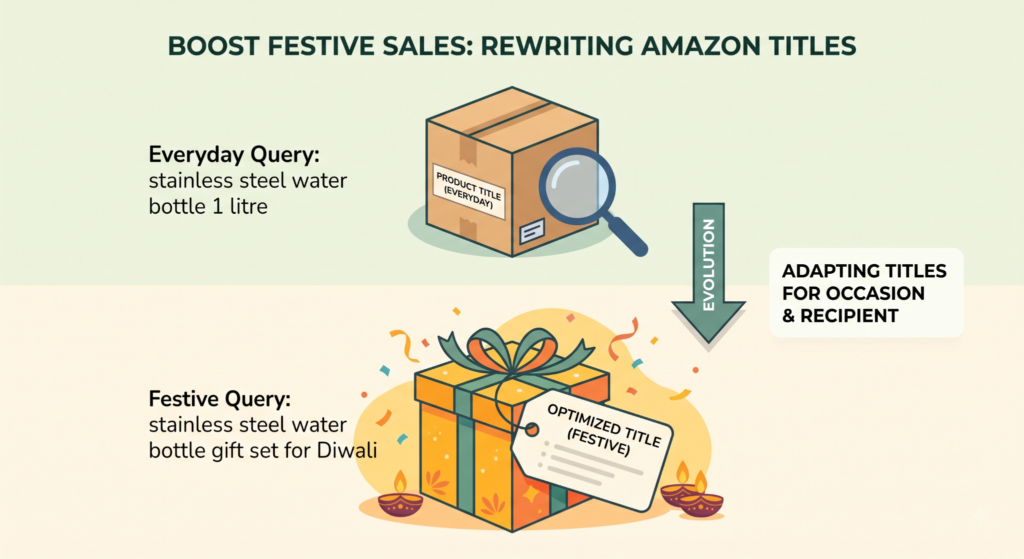
Festive search behaviour differs from everyday search behaviour in one measurable way. Buyers add occasion and recipient modifiers.
Everyday query: stainless steel water bottle 1 litre Festive query: stainless steel water bottle gift set for Diwali
Your title should carry the core product identity first, because that is what Amazon matches against, then accommodate secondary modifiers in bullets and backend terms.
Title construction that works on Amazon India:
- Brand name first
- Core product noun within the first five words
- Two or three high-intent attributes (size, colour, material, quantity)
- Pack or variant descriptor
- No promotional language, no “best,” no “sale,” no emoji
|
Common title mistake |
Why it costs you |
Fix |
|---|---|---|
|
Keyword stuffing past 200 characters |
Truncated on mobile, where most Indian traffic sits |
Front-load within 80 characters |
|
Brand name buried mid-title |
Weakens brand search matching |
Brand first |
|
Promotional words in title |
Violates Amazon style guides, risks suppression |
Move to A+ Content |
|
Same title across all variants |
Variants become indistinguishable in search |
Differentiate by the varying attribute |
|
Missing pack quantity |
Loses “set of 2,” “combo,” “pack of 4” queries, which spike in festive |
Add explicitly |
Effective Amazon product listing optimization treats the title as a matching instrument, not a marketing headline. The persuasion happens in images and A+ Content.
3. Rebuild the image stack, not just the main image

Mobile traffic dominates Indian e-commerce, and on mobile the image carousel is the product page. Most buyers decide before they scroll to bullets.
Amazon requires the main image to be on a pure white background with the product filling most of the frame, no props, no text, no watermarks. Beyond that, the remaining slots are yours, and most Indian sellers waste them.
A festive-ready image stack:
- Slot 1: Compliant main image, white background
- Slot 2: Product in use, in an Indian home or context
- Slot 3: Infographic covering the top three specifications
- Slot 4: Scale reference, dimensions or size chart
- Slot 5: What is in the box, especially for combos and gift sets
- Slot 6: Trust content — warranty, certifications, origin
- Slot 7: Video, 15 to 30 seconds
Add a size chart for anything wearable. In apparel and footwear, sizing ambiguity is a direct driver of returns, and COD return rates in India already run at 25-30% across categories. Every return you avoid through clearer imagery is margin you keep.
Image work is the highest-visibility component of Amazon product listing optimization and the one most often left to the last fortnight. Move it to week six.
4. Fix browse nodes and backend search terms

Browse nodes decide which category your product competes in. A wrong node puts you in a category where you will never rank, no matter how good the listing is.
This is common in India because sellers bulk-upload using a template inherited from a different category, or a reseller listed the ASIN originally and the node was never corrected.
Check every node for your top 100 SKUs by revenue. If a product is in a node where the competing products look nothing like yours, that is the problem.
Backend search terms are the other half. Rules that matter:
- Do not repeat words already in your title. Amazon indexes them once.
- Include Hinglish and transliterated variants where buyers genuinely search that way.
- Include common misspellings and regional product names.
- Skip competitor brand names. This violates policy.
- Skip punctuation and repeated terms across fields.
Backend terms are invisible to buyers, which is exactly why they are neglected. They remain one of the cheapest wins available in Amazon product listing optimization.
5. Consolidate variant families before the traffic arrives
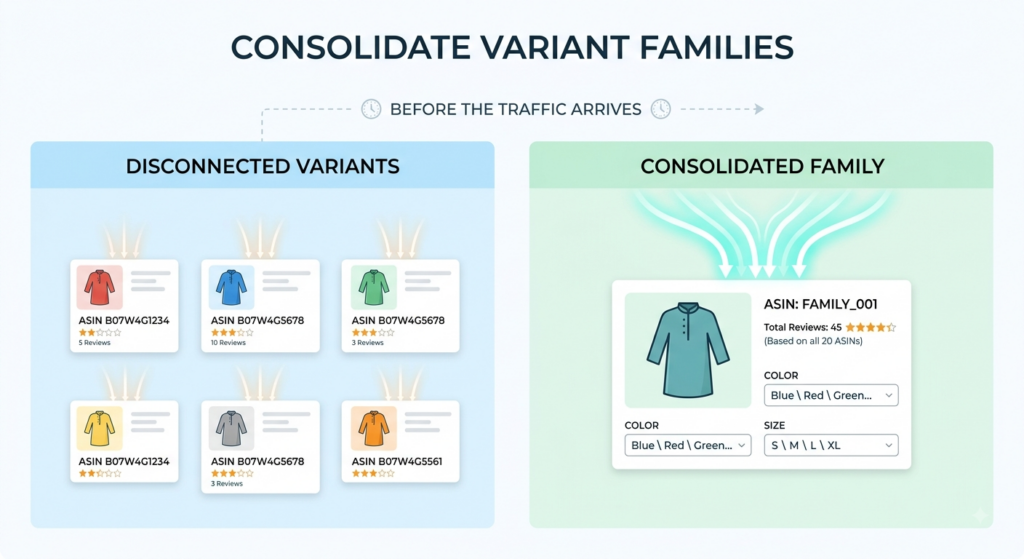
This is the single highest-impact structural fix, and it is the one most Indian sellers have never done.
If you sell a kurta in five colours and four sizes, you may have twenty separate ASINs. Each accumulated its own reviews. Each ranks independently. None of them ranks well.
Merged into a correct parent-child family, they share a review pool, share sales velocity signals, and present as one strong listing with a colour and size selector.
|
Structure |
Reviews |
Ranking signal |
Buyer experience |
|---|---|---|---|
|
20 standalone ASINs |
Split 20 ways |
Diluted across all |
Confusing, looks like duplicates |
|
One parent, 20 children |
Pooled |
Consolidated |
Single page with selectors |
Do this at least four to six weeks out. Variant merges take time to reflect and occasionally require Seller Support intervention, which is slow in the pre-festive rush.
The prerequisite is clean variation-theme data in your master catalog. If your source data does not clearly define which attribute varies, the merge will fail or produce a broken family. Governed catalog systems including Base.com model parent-child relationships natively, so the family structure exists in the master record before it is ever pushed to Amazon.
6. Get A+ Content live and category-correct

A+ Content replaces your plain-text description with modules of images and formatted copy. It requires Brand Registry.
Two points Indian sellers routinely miss.
First, A+ Content text is not indexed for search the way title and bullets are. Do not treat it as a keyword field. Treat it as the conversion layer.
Second, A+ modules should answer objections specific to Indian buyers: is this genuine, what is the warranty and who services it, does it work with Indian voltage or sizing, what happens if it arrives damaged.
Modules worth building:
- Comparison chart across your own range, which captures cross-sell during high-traffic days
- Brand story with manufacturing or sourcing detail
- Specification table in image form
- Usage or care instructions
Submit A+ Content five to six weeks ahead. Approval is not instant, and rejection cycles cost days. A+ is the part of Amazon product listing optimization that converts the traffic your other work earns.
7. Sort pricing, MRP and deal eligibility early

Deal eligibility is decided by data you may not be looking at.
Lightning Deals and event deals typically require a minimum rating, sufficient inventory, a discount against a genuine recent price, and a compliant listing. Sellers get rejected because of catalog problems, then assume they were rejected on price.
Pre-deal checklist:
- MRP field populated and consistent with the printed MRP
- No inflated list price to fake a discount, which triggers reference-price suppression
- Rating threshold met on the parent ASIN
- Listing not suppressed or stranded
- Sufficient sellable inventory to survive the deal period
Also plan the price path. A price cut made days before a sale can reset the reference price Amazon uses to validate your festive discount. Hold prices steady in the weeks before, then discount at the event.
Coupons are worth setting up alongside deals. They apply a visible badge in search results, which lifts click-through independently of the discount itself.
8. Match inventory placement to listing readiness

Catalog and inventory are usually managed by different people, which is why they go out of sync.
A perfectly optimised listing with no sellable stock loses ranking during the exact hours it needed to hold it. A well-stocked ASIN with a suppressed listing sells nothing at all.
What to align:
- Inbound FBA quantities to fulfilment centres near demand, since a large share of festive demand comes from Tier II and Tier III cities
- Restock alerts set well below your usual threshold, because festive velocity outruns normal reorder timing
- Fulfilment method confirmed, since Prime badge eligibility depends on it
- Handling times reduced for self-ship SKUs
- Package dimensions and weights corrected in the catalog, because wrong values here cause both shipping cost leakage and delivery failures.
That last point is where a unified system pays. When catalog, order, and warehouse modules read from one master record, as they do in Base.com, a dimension corrected for listing accuracy also corrects the packing rule and the weight declared to the courier. In a split stack, that same correction needs a sync job and a reconciliation check that nobody runs in September.
9. Audit and clear suppressed and stranded listings
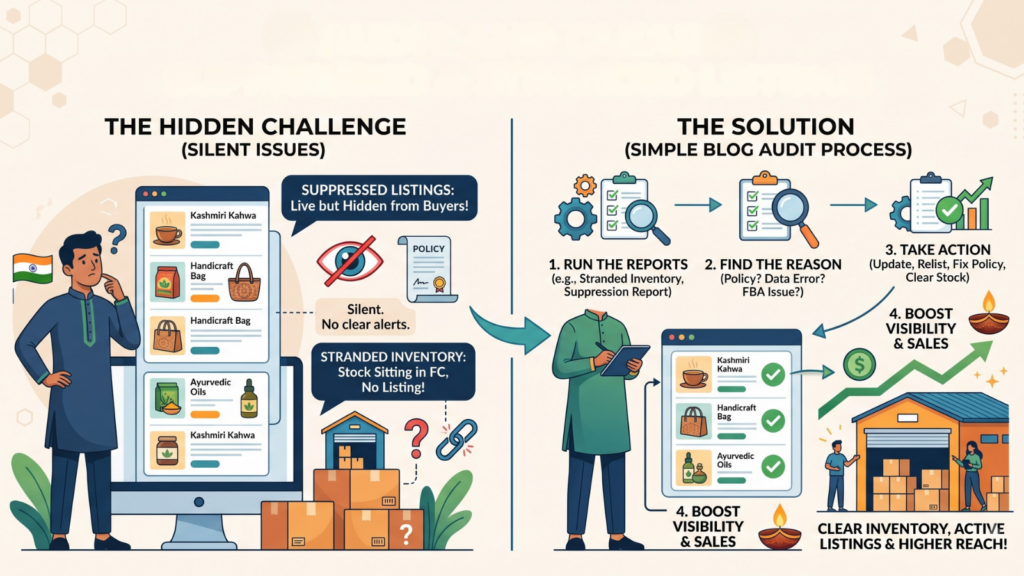
Every Indian catalog above a few hundred SKUs carries dead listings the seller does not know about.
Suppressed listings are live in your account but hidden from buyers, usually for a policy or data reason. Stranded inventory is stock sitting in a fulfilment centre attached to no active listing.
Both are silent. Neither generates an alert you are likely to see during a busy quarter.
|
Issue |
Typical cause |
Fix |
|---|---|---|
|
Suppressed listing |
Missing mandatory attribute, image non-compliance, restricted keyword |
Correct the flagged field, resubmit |
|
Stranded inventory |
Listing deleted, ASIN merged, category restriction applied |
Relist or create removal order |
|
Pricing error suppression |
Price far outside recent range or above external references |
Adjust to a defensible range |
|
Duplicate ASIN |
Same product listed twice, often by different users |
Merge or close the weaker one |
Run this audit eight to ten weeks out and repeat it in the final week before freeze. Recovering a suppressed listing takes days, sometimes longer if it needs Seller Support. There is no faster path during festive season, when case queues are longest.
Clearing suppression is not glamorous, but it is the part of Amazon product listing optimization with the most immediate revenue effect, because every suppressed ASIN is currently earning zero.
10. Build the post-sale correction loop
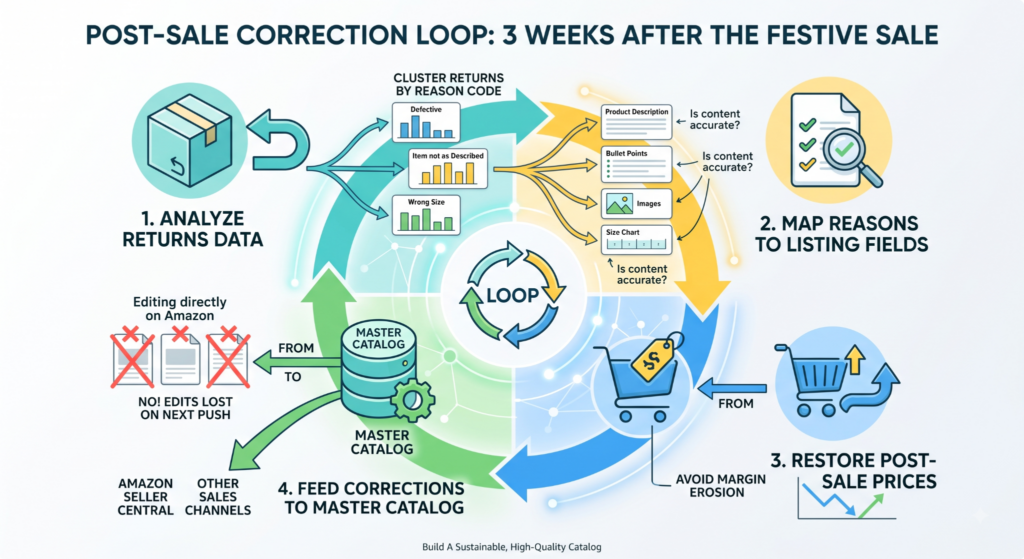
Most sellers treat the sale as the finish line. The three weeks after are where catalog quality is actually proven.
Returns data is the most honest feedback your catalog will ever get. Cluster your festive returns by reason code and map them back to listing fields.
|
Return reason |
Catalog root cause |
Correction |
|---|---|---|
|
Size or fit issue |
Missing or wrong size chart |
Add measured size chart image |
|
Not as described |
Title or bullet overclaims |
Rewrite to match reality |
|
Wrong item received |
SKU mapping error in master catalog |
Fix mapping, audit similar SKUs |
|
Damaged in transit |
Wrong dimensions or packaging spec |
Correct dimensions, revise packing rule |
|
Missing parts |
Combo contents unclear |
Add “what’s in the box” image |
Also capture the post-sale price restoration. Leaving festive prices live after the event erodes margin and can reset your reference price for the next sale window.
Feed every correction back into the master catalog rather than editing directly on Seller Central. Edits made only on Amazon are lost the next time you push from your source system, which is how the same error reappears every festive season.
Ecommerce Sale Preparation Checklist for Marketplace Sellers
Before a major marketplace sale, sellers need to prepare more than just inventory. Product catalogs, pricing, stock levels, shipments, promotions, bundles, and seller-panel data all need to be reviewed in advance. A small oversight can lead to stockouts, incorrect discounts, delayed dispatches, or missed sales opportunities. Use this checklist to make sure your store is fully prepared before the sale goes live.
|
# |
Action |
Owner |
Deadline |
|---|---|---|---|
|
1 |
Attribute completeness audit |
Catalog |
8-10 weeks out |
|
2 |
Title and bullet rewrites |
Content |
6-8 weeks out |
|
3 |
Image stack rebuild |
Creative |
5-6 weeks out |
|
4 |
Browse node and backend terms |
Catalog |
6-8 weeks out |
|
5 |
Variant family consolidation |
Catalog |
4-6 weeks out |
|
6 |
A+ Content submission |
Brand |
5-6 weeks out |
|
7 |
Pricing, MRP, deal submission |
Commercial |
4-6 weeks out |
|
8 |
Inventory placement |
Operations |
3-4 weeks out |
|
9 |
Suppression audit |
Catalog |
8-10 weeks, repeat at 1 week |
|
10 |
Post-sale correction loop |
Catalog |
Sale + 3 weeks |
What breaks at scale, and why the tooling matters
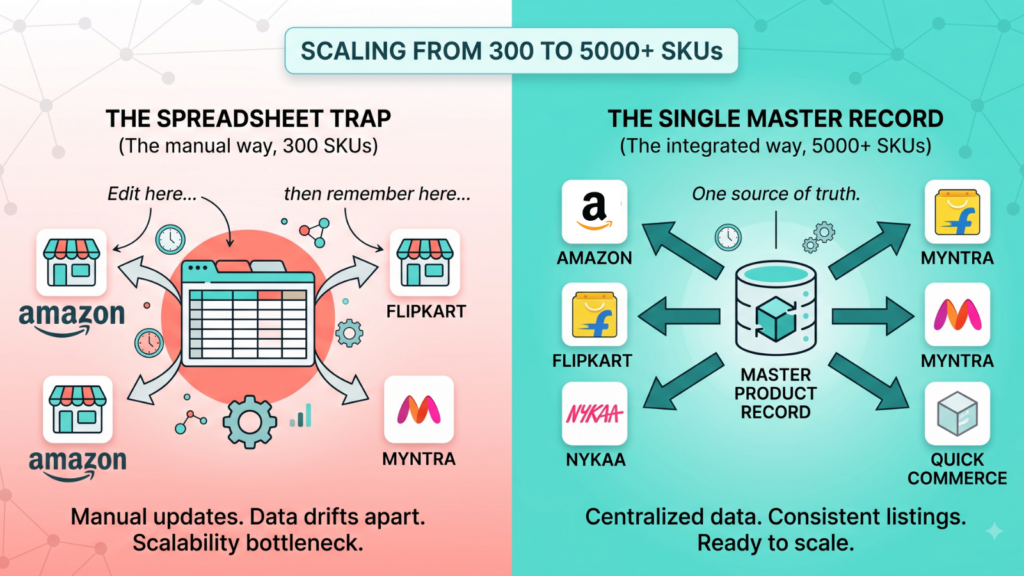
Everything above is manageable for a seller with 300 SKUs on one marketplace. It becomes unmanageable at 5,000 SKUs across Amazon, Flipkart, Myntra, Nykaa, and quick commerce.
The failure mode is predictable. The team fixes Amazon, ships it, then discovers the same attribute is wrong on three other channels. Corrections diverge. Six months later no one knows which system holds the correct value.
Amazon product listing optimization is only durable when the correction lives in a master record that every channel reads from. Editing on Seller Central alone is maintenance, not improvement.
This is where Base.com is positioned differently from most Indian platforms. Catalog, order management and warehouse operations share a single product record, with rule-based validation running before publication and version history on every attribute change. A festive-season correction made once propagates to every channel and survives the next bulk push.
Sellers running catalog in spreadsheets and operations in a separate OMS carry a reconciliation cost that becomes visible exactly when they can least afford it, in the first week of the festive sale.
Bottom Line
The sequence matters more than any individual tactic. Attribute completeness before titles. Titles before images. Structural fixes before deals. Everything before the freeze.
Sellers who complete Amazon product listing optimization eight weeks out compete on price and advertising during the sale. Sellers who leave it late spend the sale fixing suppressions and watching competitors take the placements.
The catalog is not the part of festive preparation you do last. It is the part everything else depends on.