

Did you know that the average Indian e-commerce brand loses nearly 25% of its potential annual revenue not to competition or marketing inefficiency, but to internal friction?

While most sellers obsess over customer acquisition costs and ROAS, the real profit killers are often hidden much closer to home, inside the invisible walls separating their own teams.
In a market as fast-moving as India’s, where a single viral reel can send demand soaring overnight, poor cross-functional alignment is no longer a minor operational issue. The lack of alignment between sales, ops, and finance teams is one of the biggest hidden drivers of margin erosion in Indian ecommerce.
When Sales promises “Next Day Delivery” during a Diwali flash sale without visibility into warehouse capacity, or when Finance freezes a vendor payment just as shipping labels are being printed, the entire system stalls. Orders pile up, customers churn, and margins quietly bleed.
The absence of real-time coordination between operations and finance, or unclear ownership during process handoffs, directly translates into lost revenue, delayed deliveries, and eroded customer trust.
This article examines the deep-rooted cross-functional misalignment plaguing Indian enterprises today and breaks down the ten most critical workflow failure points that businesses must fix to protect margins and scale sustainably. When sales, ops, and finance teams operate in silos, even high growth brands struggle to convert revenue into actual profit.
The Cost of Cross Functional Misalignment in Indian E-commerce
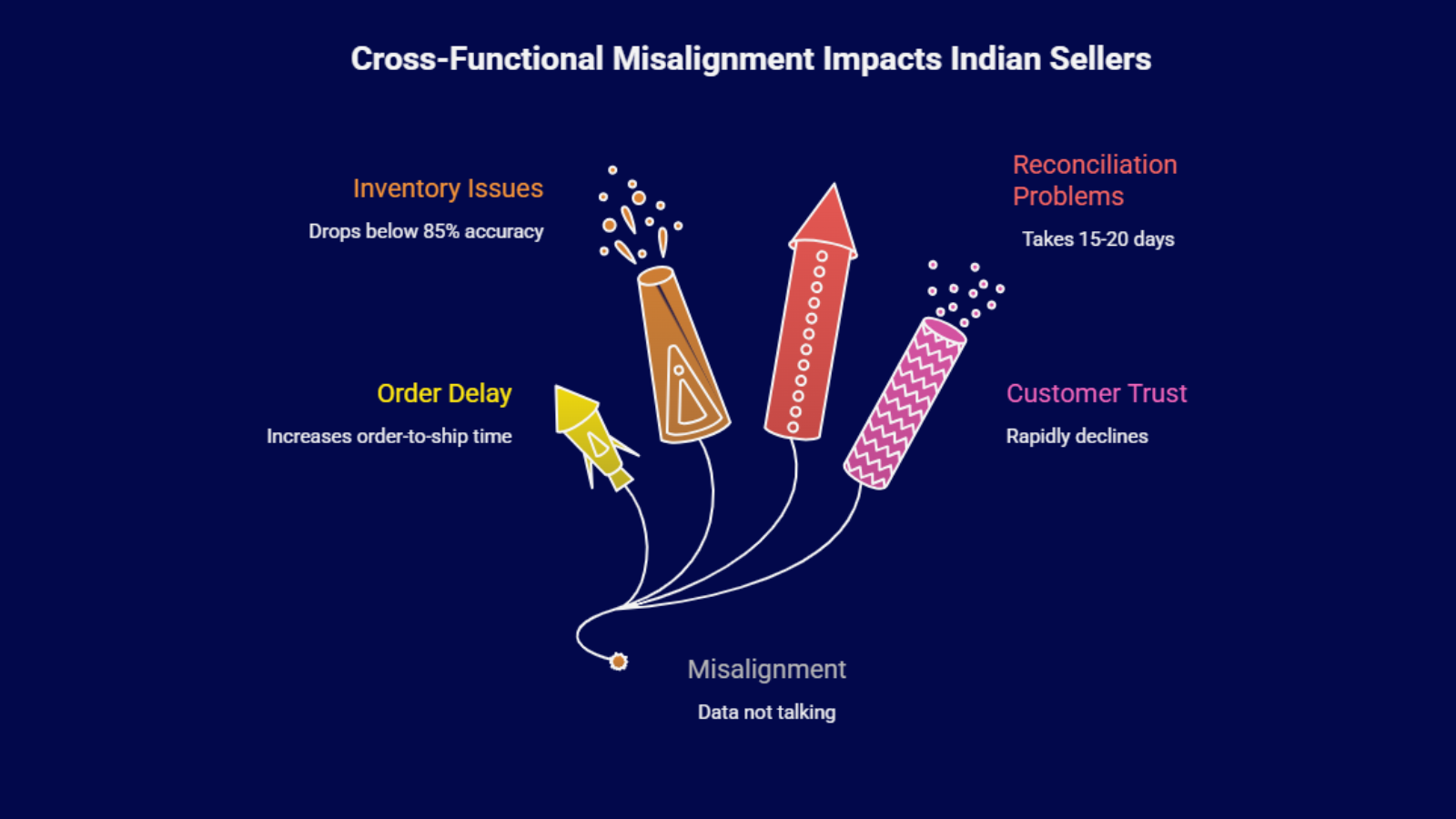
In the Indian context, cross functional misalignment isn’t just about people not getting along; it’s about data not talking. For a seller moving 5,000 orders a day across Amazon, Flipkart, and their own D2C site, every minute of delay in data syncing translates to real money lost. If your sales team is looking at a spreadsheet from Monday while your warehouse is dealing with a stockout on Wednesday, you are essentially flying blind.
Poor coordination between sales, ops, and finance teams often leads to delayed decisions, data mismatches, and lost revenue opportunities. The impact of these sales ops gaps is often quantified in high RTO (Return to Origin) rates and poor seller ratings. In India, where COD (Cash on Delivery) still accounts for over 60% of transactions, a breakdown in communication between the operations team (handling logistics) and the finance team (managing cash flow) can lead to a “working capital trap.”
| Metric Affected | Impact of Misalignment | Financial Consequence |
|---|---|---|
| Order-to-Ship Time | Increases by 40-50% | Higher cancellation rates |
| Inventory Accuracy | Drops below 85% | Over-selling and penalties |
| Reconciliation | Takes 15-20 days | Stagnant working capital |
| Customer Trust | Rapidly declines | Lower Lifetime Value (LTV) |
1. The “Ghost Inventory” Trap
One of the most common sales ops gaps occurs when the sales team runs aggressive promotions on high-demand SKUs without real-time visibility into actual warehouse shelf-counts. In India, during “Big Billion Days” or “Great Indian Festival” events, inventory levels change by the second. Without real-time syncing across sales, ops, and finance teams, inventory visibility becomes unreliable and leads to overselling.
Sales sees “100 units” on the dashboard, but 30 of those are already in the “damage” bin or reserved for a different channel. When the orders pour in, Ops is forced to cancel them, leading to marketplace penalties and frustrated customers.
- Impact: Marketplace account health takes a hit.
- Fix: Implement a “Buffer Stock” rule where the system automatically hides the last 5% of stock from sales channels.
2. The Delayed Ops Finance Sync on COD Remittances
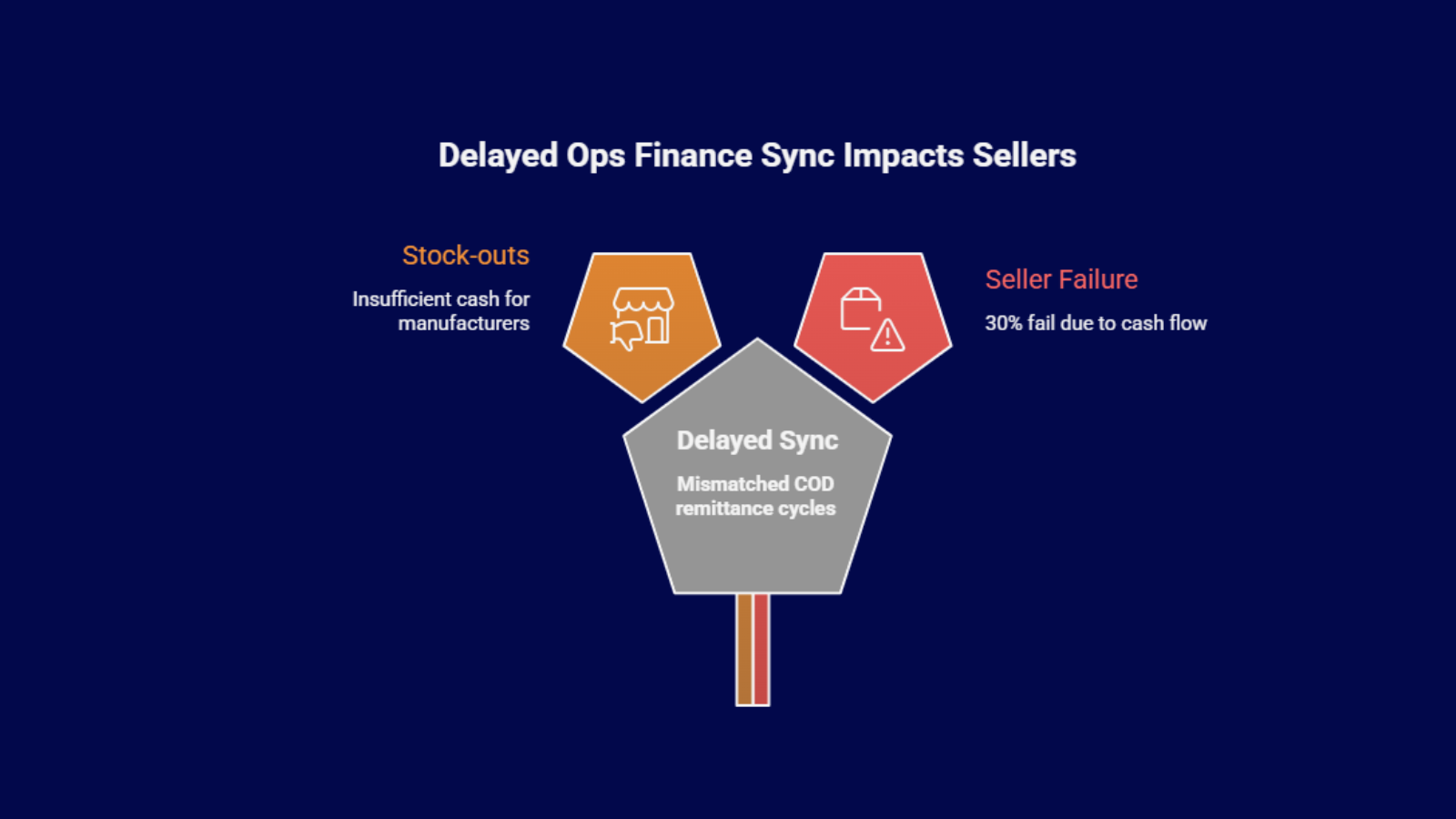
In the Indian market, managing Cash on Delivery is a nightmare without a tight ops finance sync. Logistics partners often remit COD cash in cycles that don’t match the internal financial reporting of the seller. Misalignment between sales, ops, and finance teams creates major blind spots in COD tracking and cash flow forecasting.
The Breakdown
Ops marks an order as “Delivered,” but Finance doesn’t see the cash in the bank for another 10 days. Without a synchronized tracking system, Finance cannot accurately forecast the next week’s procurement budget.
- Lack of Sync: Leads to “stock-outs” because there isn’t enough cash to pay the manufacturer.
- Data Point: 30% of small Indian sellers fail due to cash flow timing rather than lack of sales.
3. Friction in Process Handoffs During Reverse Logistics
Inefficient handoffs between sales, ops, and finance teams turn returns into costly operational bottlenecks. India has one of the highest return rates in global e-commerce, often touching 30% in categories like Apparel. A broken process handoff between the customer support (Sales/Service) and the warehouse (Ops) leads to returned items sitting in “purgatory” for weeks.
The Breakdown
When a customer initiates a return, Sales promises an instant refund. However, if the handoff to Ops is manual, the warehouse might not record the item back into “sellable stock” quickly. Finance then struggles to reconcile why the refund was issued before the item was verified.
- Breakpoint: Items lose seasonal value while waiting to be re-listed.
- Resolution: Automated QC (Quality Check) triggers that notify Finance and Sales simultaneously.
4. Disconnected Pricing Strategies and Margin Erosion
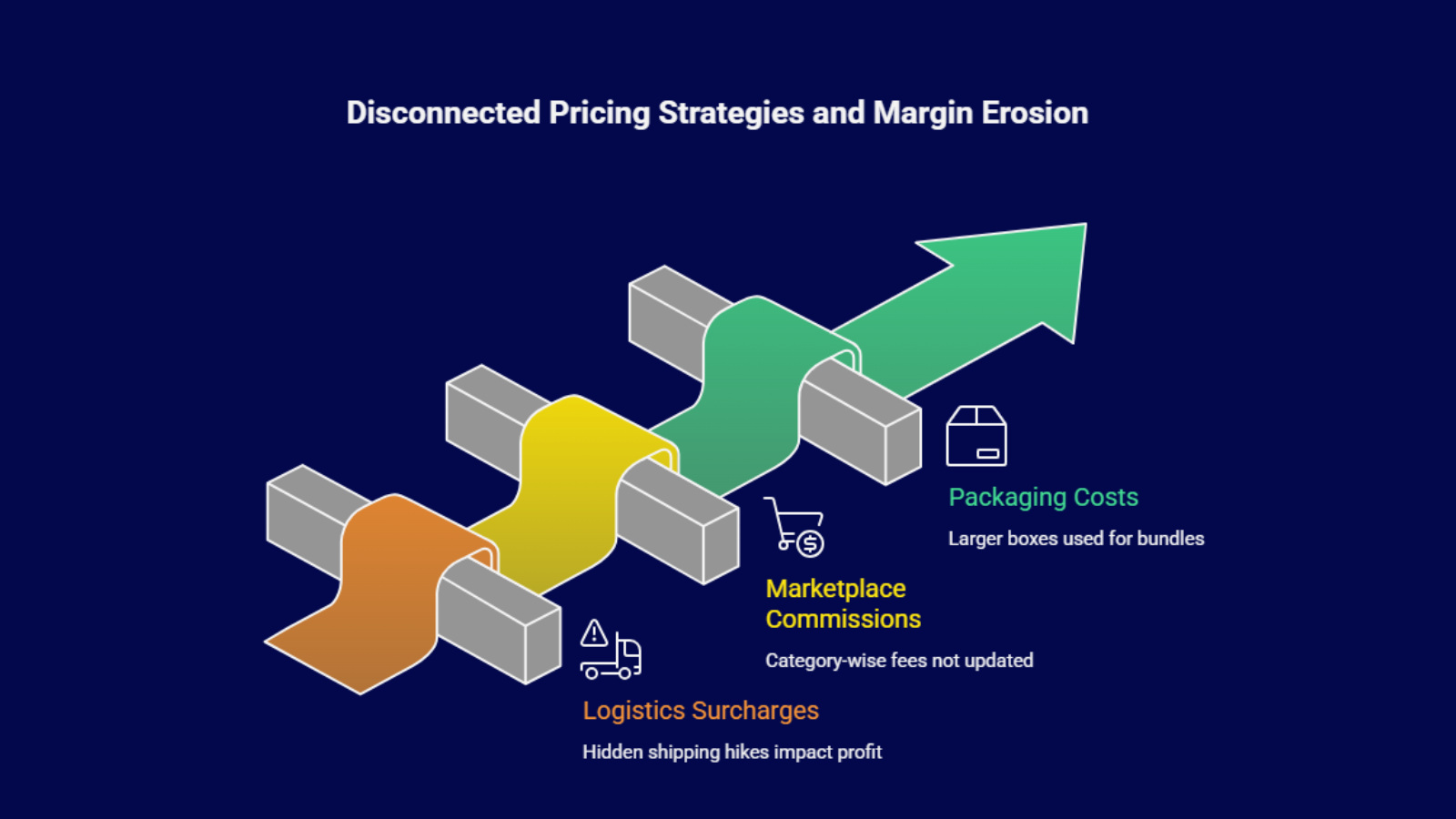
Sales teams are often incentivized by “GMV” (Gross Merchandise Value), while Finance cares about “Contribution Margin.” This is a classic case of cross functional misalignment in Pricing and Margin.
Conflicting incentives across sales, ops, and finance teams often result in aggressive discounting that destroys margins.
Sales might push a “Buy 1 Get 1” offer to hit targets, but Finance hasn’t factored in the increased shipping weight and the 18% GST on the “free” item. By the time the campaign ends, the brand has lost money on every sale.
Profitability Leakage Factors
- Logistics Surcharges: Hidden “Regional to National” shipping hikes.
- Marketplace Commissions: Updates in category-wise fees not updated in the Sales sheet.
- Packaging Costs: Ops using larger boxes than necessary for promotional bundles.
5. The Procurement-to-Pay (P2P) Bottleneck
A major ops finance sync issue arises when the operations team places urgent “stock-up” orders with suppliers, but Finance hasn’t cleared the previous month’s invoices.
The Breakdown
In the Indian “trust-based” vendor ecosystem, a single delayed payment can lead to a supplier deprioritizing your order. If Sales has already started the “Coming Soon” marketing, and the stock doesn’t arrive, the marketing spend is wasted.
- The Gap: No shared dashboard for vendor aging reports.
- The Result: Production delays during peak wedding or festive seasons.
6. Fragmented Customer Data Handoffs
When a B2B wholesaler in India moves to a digital model, the process handoff of customer credit limits is often a major breakpoint.
The Sales rep closes a deal with a new retailer, but Finance hasn’t completed the “KYC” or credit-worthiness check. The order sits in “Pending” status for 4 days. The retailer, used to the speed of local distributors, cancels the order. You need to integrate a pre-approved credit check module into the Sales CRM.
7. Tax Compliance and HSN Code Mismatches
With the complexity of GST in India, the gap between how Ops categorizes a product and how Finance files it can lead to massive legal hurdles.
Ops might list a “Gift Combo” as a single SKU, but Finance needs to break it down into individual components for different GST slabs (e.g., 12% for the snack and 18% for the plastic container).
- Risk: Audit flags and heavy interest penalties.
- Sync: Ensure the Product Information Management (PIM) system is the “Source of Truth” for both teams.
8. Siloed Performance Metrics (KPI Conflict)
If Sales is measured on “Volume” and Ops is measured on “Cost per Shipment,” they will naturally work against each other. When sales, ops, and finance teams are measured on different KPIs, decision-making becomes fragmented and counterproductive.
Sales uses expensive “Air Shipping” to satisfy a VIP client, while Ops holds the package for “Surface Shipping” to meet their quarterly cost-saving goal. The customer receives the package 5 days late. Sellers need to shift to “Net Delivered Margin” as the primary metric for all teams.
<
9. Manual Reconciliation of Marketplace Payments
One of the most tedious sales ops gaps is the reconciliation of Flipkart/Amazon payment sheets. These sheets contain hundreds of line items for weight discrepancies, shipping fees, and returns. Manual workflows between sales, ops, and finance teams increase reconciliation errors and lead to revenue leakage.
The Breakdown
Finance spends weeks manually matching these to Sales records. If a discrepancy is found (e.g., Amazon charged for 2kg on a 500g product), it’s often too late for Ops to provide the “Weight-Strip” proof. Indian sellers lose 2-3% of revenue to “unclaimed” marketplace overcharges.
10. The Seasonal Scaling Collapse
Indian e-commerce is highly seasonal. The breakdown happens when the “Scale-up Plan” is not co-authored by all three teams.
The Breakdown
Sales plans for a 5x jump. Finance secures the 5x capital. But Ops didn’t hire the 5x temporary “pickers and packers” for the warehouse because the process handoff regarding “Projected Manpower” never happened.
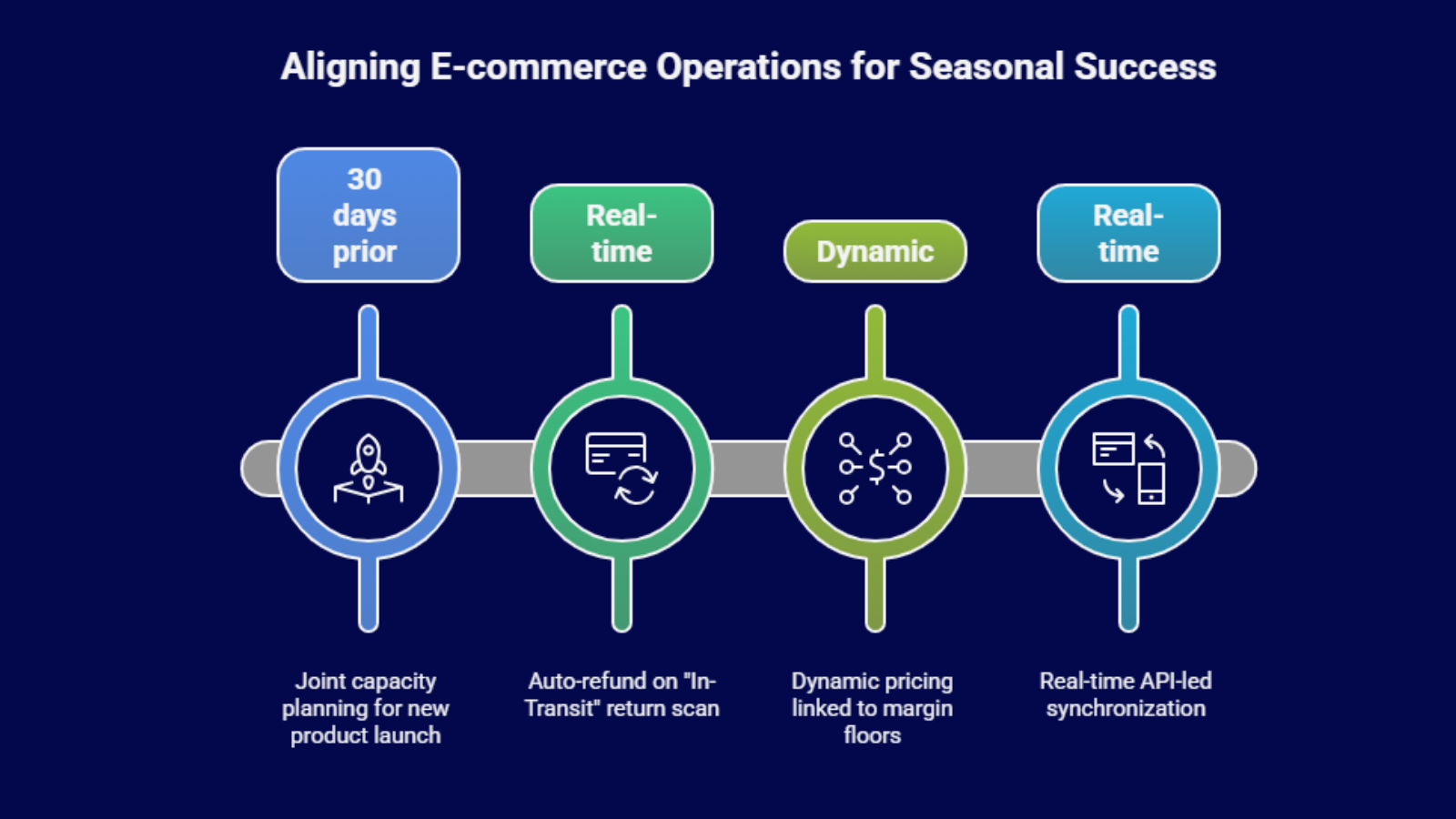
Comparison of Aligned vs. Misaligned Workflows
| Process | Misaligned State (Silos) | Aligned State (Integrated) |
|---|---|---|
| New Product Launch | Sales launches; Ops struggles to store. | Joint capacity planning 30 days prior. |
| Returns Management | Finance holds refund; Sales gets complaints. | Auto-refund on “In-Transit” return scan. |
| Discounting | Sales drops price; Finance finds out later. | Dynamic pricing linked to margin floors. |
| Data Flow | Manual CSV uploads via email. | Real-time API-led synchronization. |
Final Thoughts
The recurring theme across these 10 breakpoints is that “human error” is rarely the root cause; rather, it’s the lack of a unified infrastructure. To eliminate cross functional misalignment, Indian sellers need a system that acts as the connective tissue between their growth ambitions and their operational reality.
Building a unified system for sales, ops, and finance teams is essential for sustainable ecommerce growth and profitability. Stop letting sales ops gaps eat your margins. Whether it is ensuring a perfect ops finance sync or automating your process handoffs, you need a platform built for the complexities of the Indian market.
Ready to unify your teams and scale without the chaos? Explore how Base.com provides a single source of truth for your Sales, Ops, and Finance teams. From automated reconciliation to real-time inventory syncing across Indian marketplaces, Base.com ensures your internal workflows are as fast as your sales growth.
Click here to know more about the key OMS workflows for managing split orders and partial fulfilment in India.
Frequently Asked Questions (FAQs)
1. What is the biggest cause of cross functional misalignment?
The primary cause is usually “Data Silos.” When each department uses its own software or spreadsheets, information doesn’t flow in real-time. This leads to conflicting “truths” where Sales sees stock that Finance hasn’t paid for or Ops has discarded.
2. How can I improve my ops finance sync?
Start by integrating your warehouse management system with your accounting software. Automating the reconciliation of COD remittances and marketplace payments ensures that Finance has a real-time view of cash flow, allowing for better procurement planning and fewer stock-outs.
3. What are the signs of sales ops gaps?
Common signs include high order cancellation rates, frequent customer complaints about “out-of-stock” items after they’ve paid, and a high RTO percentage. If your warehouse team is consistently “firefighting” during sales events, you likely have a significant gap.
4. Why are process handoffs so critical for Indian sellers?
In India, logistics are complex and return rates are high. A smooth handoff ensures that when an item is returned or a payment fails, the next team in line is notified instantly, preventing capital from being locked in “limbo.”
5. How does a unified system help with GST compliance?
A unified system ensures that the HSN codes and tax slabs used by Sales during the billing process match the data Finance uses for filing. This eliminates the need for manual corrections and reduces the risk of expensive tax audits.