Did you know that according to industry benchmarks, nearly 30% of a scaling company’s revenue is leaked through operational inefficiencies? For Indian sellers navigating the hyper-competitive landscapes of marketplaces like Amazon, Flipkart, or Zepto, this isn’t just a statistic; it is a daily reality.
While your dashboard might show a 400% growth in order volume, your warehouse floor might be drowning in manual entry errors and shipping delays. This gap between your front-end growth and back-end capability is what we call operational debt.
Operational debt is the cumulative cost of choosing a “quick fix” today over a sustainable process for tomorrow. In the early days, these shortcuts are necessary to survive. However, as you scale, these small cracks widen into massive fissures that can swallow your profit margins whole.
What is Operational Debt in the Context of E-Commerce?
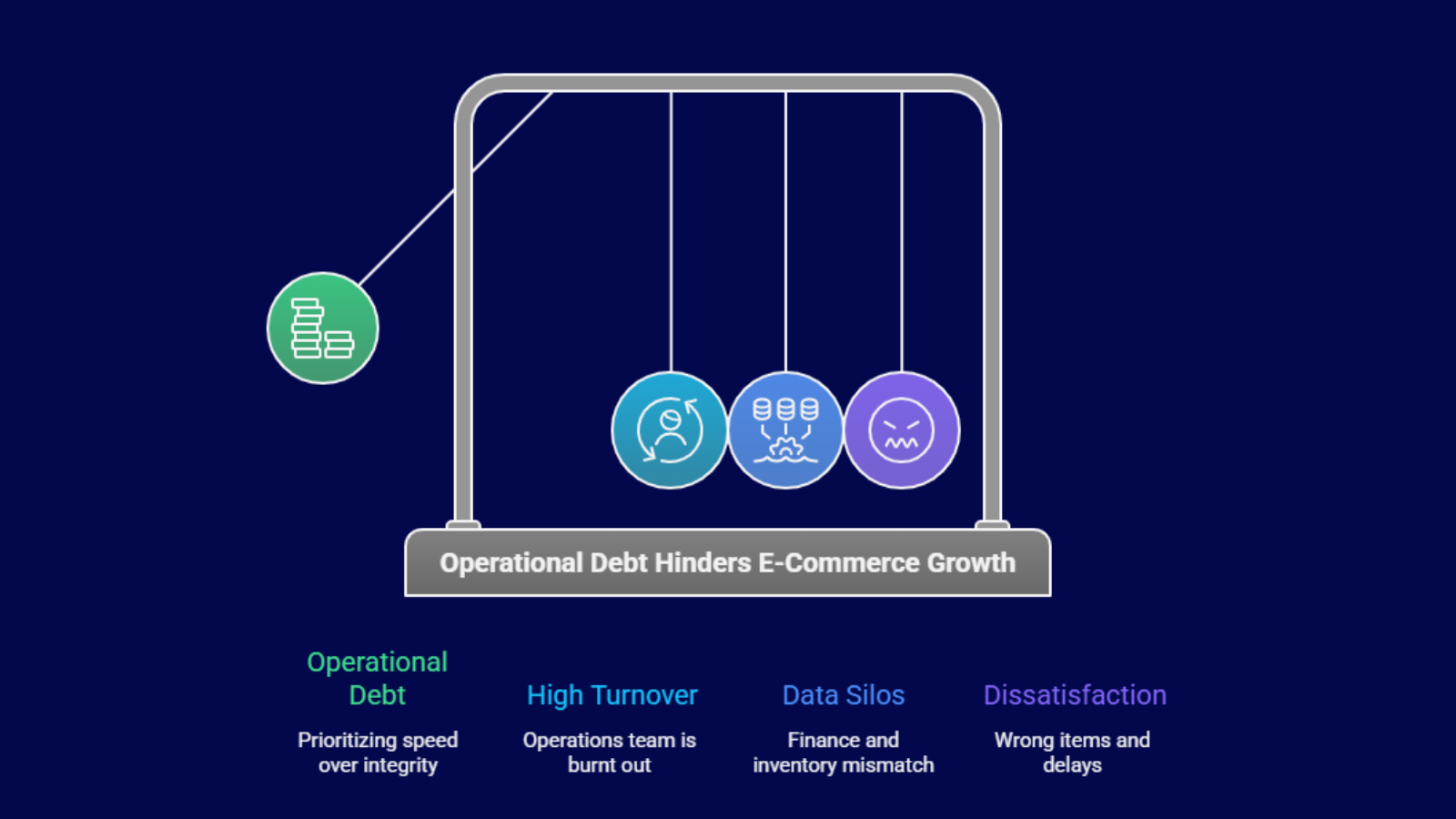
Operational debt is the “interest” you pay when you prioritize speed over structural integrity. For a fast-growing brand in India, this often manifests as using manual Excel sheets to track inventory across five different warehouses or hiring more people to solve a problem that should have been solved with automation. It is the invisible weight that slows down your ability to pivot or expand into new categories.
The buildup of this debt is rarely sudden. It happens incrementally, one spreadsheet at a time, until the team is spending 80% of their day “firefighting” instead of focusing on growth. Understanding how this debt accumulates is the first step toward building a resilient, ops maturity model that supports long-term success.
- High Employee Turnover: Your operations team is burnt out from repetitive, manual tasks.
- Data Silos: Your finance team’s numbers never match your warehouse manager’s inventory count.
- Customer Dissatisfaction: An increase in “Wrong Item Received” or “Delayed Shipment” tickets despite having more staff.
Why Fast-Scaling Businesses Fall into the Operational Debt Trap
Rapid growth is intoxicating. When an Indian D2C brand goes viral on social media or secures a massive festive season sale, the immediate instinct is to fulfill orders at any cost. This “at any cost” mindset is the primary driver of process shortcuts. Leaders often assume they will fix the “back-end stuff” once things quiet down, but in a scaling business, things rarely quiet down.
The pressure to maintain momentum often leads to a “patchwork” architecture. Instead of integrating systems, businesses add another layer of manual verification. This creates scaling inefficiencies where the cost of processing a single order actually increases as you get bigger, rather than decreasing through economies of scale.
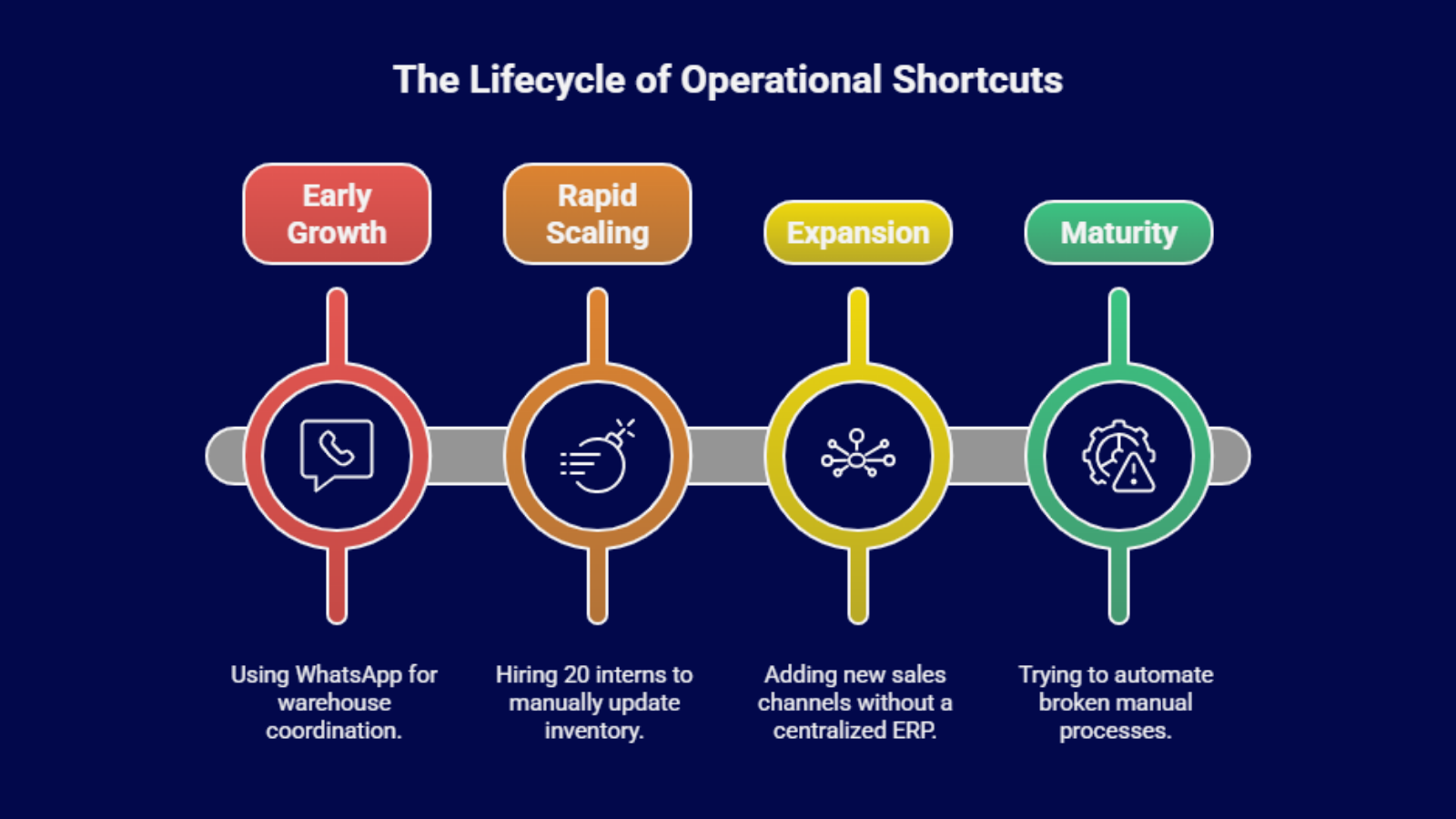
The Lifecycle of Operational Shortcuts
| Stage | Action Taken | Resulting Operational Debt |
|---|---|---|
| Early Growth | Using WhatsApp for warehouse coordination. | Lack of audit trails and high risk of missed orders. |
| Rapid Scaling | Hiring 20 interns to manually update inventory. | High human error rates and massive payroll overhead. |
| Expansion | Adding new sales channels without a centralized ERP. | Over-selling stock and marketplace penalties. |
| Maturity | Trying to automate broken manual processes. | Software failure because the underlying logic is flawed. |
Analyzing the Impact of Process Shortcuts and the Path to Ops Maturity
In the rush to meet tight marketplace SLAs, many Indian sellers fall into a familiar trap: taking process shortcuts to keep things moving. These shortcuts are usually meant to be temporary, but over time, they quietly become the “normal” way of operating.
A classic example is skipping a proper barcode or bin-location system and instead relying on the memory of an experienced warehouse picker. This might work when you are shipping 40–50 orders a day. At 5,000 orders, it breaks completely.
This is how operational debt builds up. The workaround looks efficient on the surface, but it depends heavily on constant human effort. When that one veteran employee takes leave or resigns, the entire fulfillment process starts to wobble. Orders slow down, errors spike, and customer complaints rise. This reliance on tribal knowledge instead of documented, repeatable systems is one of the clearest signs of low operational maturity.
As order volumes increase, these small inefficiencies do not remain small. They compound across the supply chain and act like a hidden “growth tax” on your revenue.
In many Indian warehouses, these leaks hide in plain sight: manually printing labels one by one, cross-checking COD remittances against order IDs in spreadsheets, or reconciling inventory by hand at the end of the day. Each task seems harmless, but together they drain time, money, and focus.
A simple test exposes the problem. If your business needs to double headcount just to support a 50 percent increase in orders, the foundation is already cracked. High-performing brands scale differently. Their revenue grows rapidly, but their headcount stays largely flat.
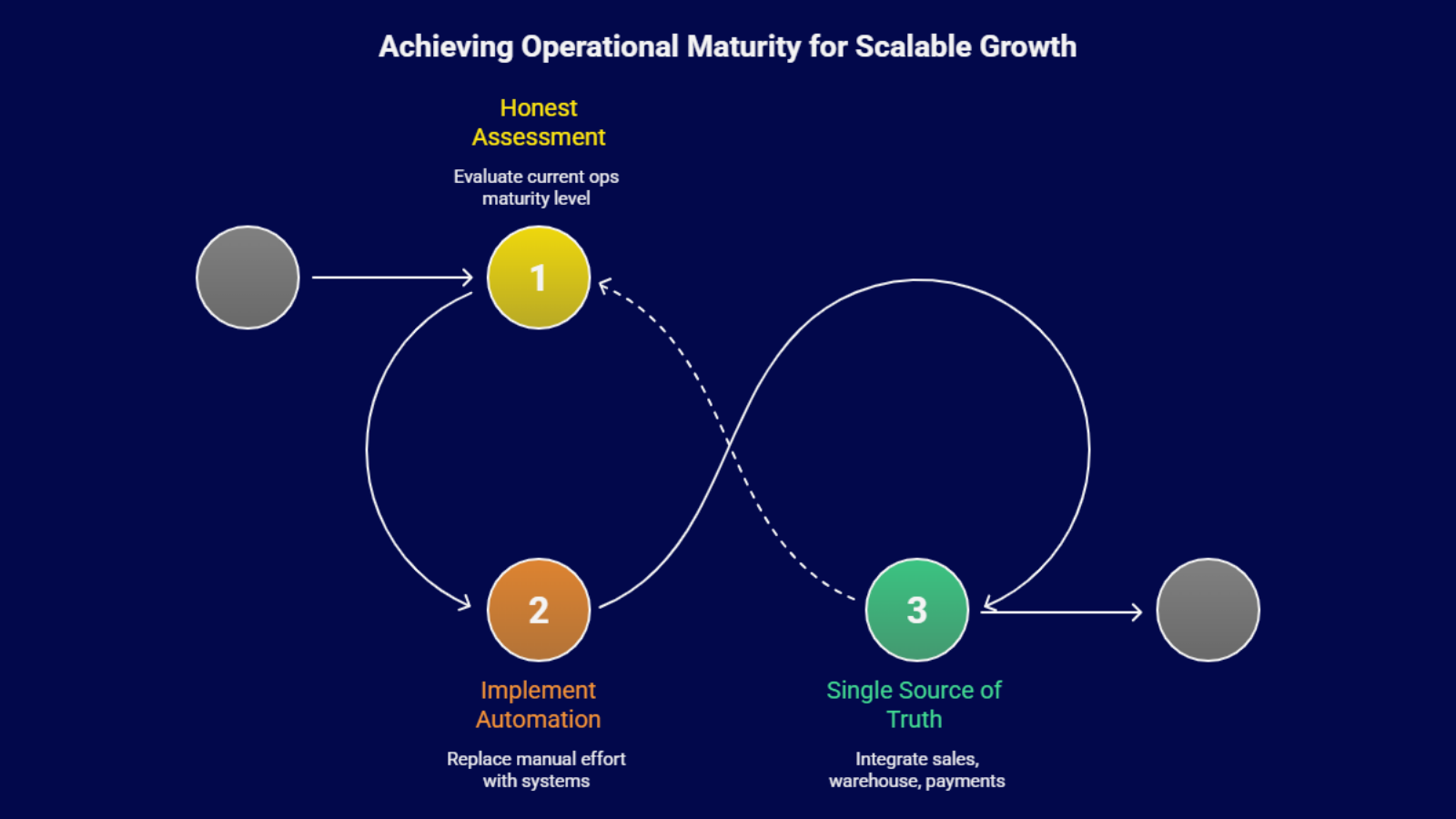
They achieve this by replacing manual effort with automation, rules, and system-driven logic. When systems do the work, humans can focus on exceptions instead of routine tasks.
Without this shift, the cost of fixing mistakes becomes brutal. Industry experience shows that correcting an error after it happens can cost five times more than preventing it through the right process upfront. Over time, these costs silently eat into margins and can completely wipe out profitability.

Breaking this cycle starts with an honest assessment of your ops maturity. At Level 1, businesses are reactive and constantly firefighting. Level 2 brings some standardization, often through Excel, but processes remain slow and fragile.
True scale begins at the Optimized and Intelligent levels, where sales channels, warehouses, payments, and logistics operate from a single source of truth.
The real mindset shift is moving from “How do we survive today?” to “How do we build systems that run automatically?” By investing in operational maturity, Indian sellers can finally repay their operational debt and build businesses that scale without chaos.
The Ops Maturity Matrix for Indian Sellers
| Maturity Level | What it Looks Like | Can it Scale? |
|---|---|---|
| Level 1: Reactive | Constant firefighting; everything is manual; high errors. | No; the business breaks during any sale or spike. |
| Level 2: Standardized | Basic SOPs; heavy use of Excel; consistent but slow. | Limited; you have to hire more people to grow. |
| Level 3: Optimized | Systems talk to each other; data-driven decisions. | High; you can handle 5x the orders with the same team. |
| Level 4: Intelligent | Full automation; the system predicts problems early. | Infinite; your operations become your superpower. |
Strategies to Repay Operational Debt
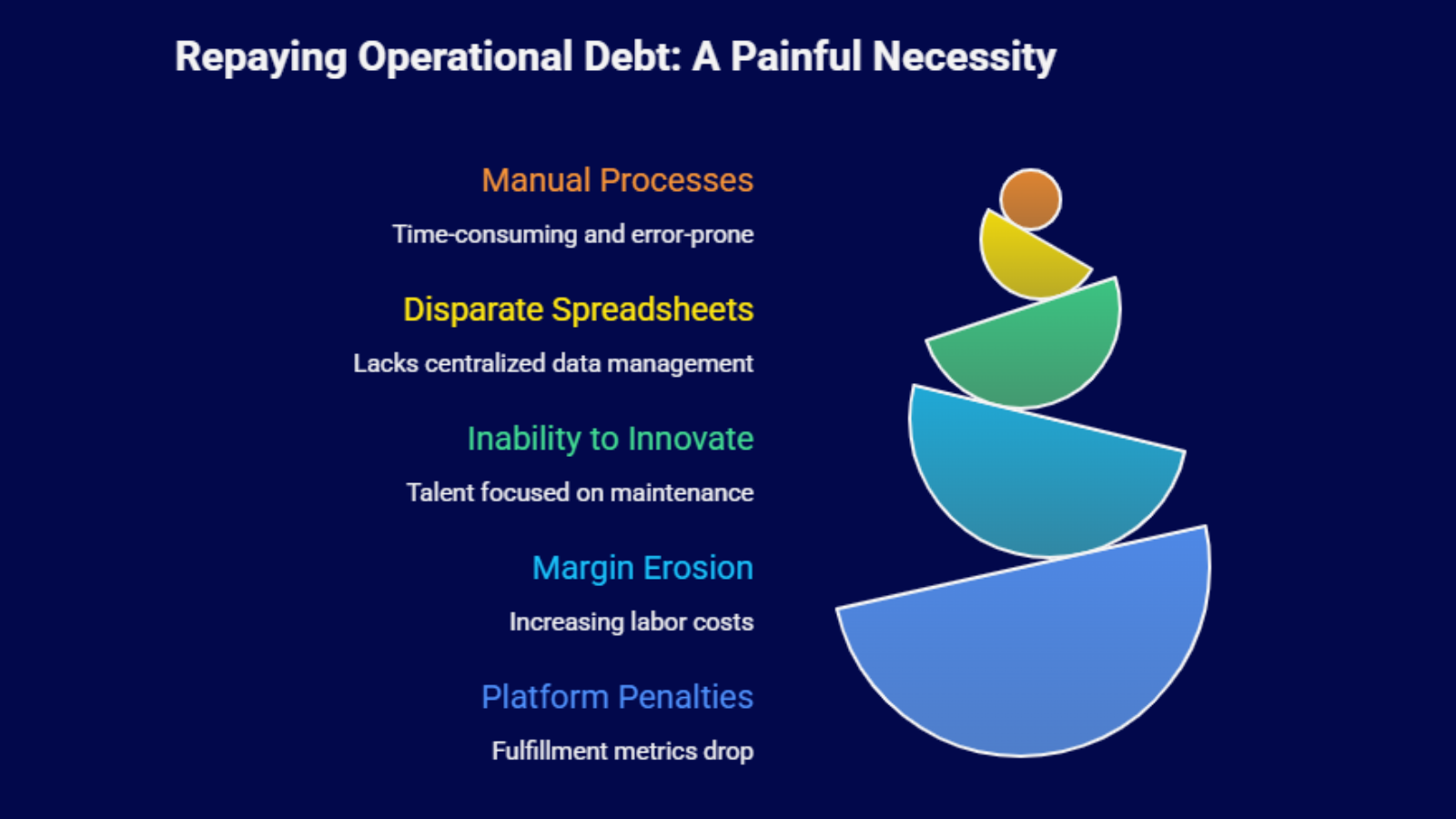
Repaying operational debt is painful because it often requires slowing down briefly to speed up later. It involves auditing your current workflows, identifying the most expensive process shortcuts, and replacing them with robust, automated systems. This transition is essential if you want to protect your margins from the “death by a thousand cuts” that comes with scaling inefficiencies.
The goal is to move toward a leaner operation where technology handles the heavy lifting. This allows your human talent to focus on high-value tasks like product development, brand building, and customer experience.
Steps to Systematic Debt Repayment
- Audit the Mess: Map out your current processes and highlight every manual step.
- Quantify the Cost: Calculate how many man-hours are lost to manual data entry and error correction.
- Implement Centralized Logic: Move away from disparate spreadsheets to a centralized platform.
- Automate Gradually: Don’t try to automate everything at once. Start with the biggest bottleneck (e.g., inventory syncing).
The Long-Term Impact of Ignoring Operational Debt
If left unchecked, operational debt leads to a “plateau.” You will reach a point where you cannot grow any further because your team is at 100% capacity just maintaining the current volume. In the Indian market, where competition is fierce and margins are thin, being stuck in this plateau is the beginning of the end.
Furthermore, ignoring these issues damages your brand reputation. In an age of instant reviews, a few weeks of operational chaos can lead to a permanent drop in your seller rating, making it even harder to recover.
Consequences of Sustained Debt
- Margin Erosion: Increasing labor costs eat into your net profit.
- Inability to Innovate: Your best people are too busy with “ops work” to think about new products.
- Platform Penalties: Marketplaces may suppress your listings if your fulfillment metrics drop.
Bottom Line
Scaling a business in India is a marathon, not a sprint. While the urge to take process shortcuts is strong, the long-term cost of operational debt is too high to ignore. By identifying scaling inefficiencies early and investing in ops maturity, you ensure that your business remains agile, profitable, and ready for whatever the market throws your way.
The most successful sellers are not those who work the hardest, but those who build the smartest systems. Stop paying interest on your operational shortcuts and start building a foundation that scales as fast as your ambition.
Take Control of Your Operations Today!
Is your back-office holding you back? Don’t let operational debt stifle your growth. Visit Base.com to discover how our intelligent operational platform can help you automate your workflows, sync your inventory, and achieve the ops maturity your business deserves.
Learn more about top 10 operational decisions that scale poorly beyond ₹50 Cr GMV.
Frequently Asked Questions
1. What is the most common cause of operational debt in Indian e-commerce?
The most common cause is the over-reliance on manual spreadsheets for inventory and order management. As order volumes spike during festive seasons, these manual processes fail, leading to errors, delays, and a significant buildup of long-term operational debt.
2. How do I know if my business has high scaling inefficiencies?
If your operational costs (like labor and warehouse overhead) are growing faster than your revenue, you likely have scaling inefficiencies. Another sign is if your team spends more time fixing errors than they do fulfilling new orders.
3. Can a business have zero operational debt?
It is nearly impossible to have zero debt while scaling rapidly. The goal is not to avoid it entirely but to manage it. You must recognize when a shortcut is being used and have a plan to “repay” it.
4. How does ops maturity affect my profit margins?
Higher ops maturity leads to lower per-order processing costs through automation and reduced errors. This directly improves your bottom line by ensuring that your growth is profitable and not just an increase in top-line revenue.
5. When should I start worrying about process shortcuts?
You should start worrying as soon as a shortcut becomes the standard way of doing things. If a process cannot be explained to a new hire in five minutes without relying on “special cases,” it is time to automate.