
At the beginning, discounts feel like magic. Sales jump, traffic increases, and cash starts flowing. But for Indian D2C sellers, the math changes fast once you scale. That is exactly why discounts stop working after scale in D2C brands.
In India, return rates typically range between 15 to 25 percent, and in fashion, they can cross 30 percent. If you are offering 25 percent off plus free shipping on a ₹1,999 product, your margin is already compressed. Now add marketplace commissions of 15 to 25 percent, payment gateway fees of 2 to 3 percent, and shipping costs of ₹80 to ₹150 per order. The real profit shrinks quickly.
COD adds another layer of risk. Tier 2 and Tier 3 cities drive high order volumes, but RTO rates are also higher. You pay for forward and reverse logistics even if the order fails. During festive sales, ad costs on Meta and Google rise sharply, so you are paying more to acquire customers while giving deeper discounts.
This is how discounting D2C leads to serious D2C margin erosion. At small scale, you may survive it. At a large scale, higher volume only multiplies thinner margins. That is why discounts stop working after scale in D2C brands, especially in the Indian e-commerce ecosystem.
What Happens When You Scale on Discounts
In the early days, discounting D2C feels like fuel for growth. You are acquiring first-time buyers, generating reviews, and building social proof. When your base is small, even discounted sales contribute to visibility and repeat potential. But once you scale in the Indian market, the same strategy starts hurting unit economics in ways that are not obvious at first.
The biggest shift at scale is cost layering. In India, e-commerce return rates typically range between 15 to 25 percent. In fashion and lifestyle categories, this can cross 30 percent. If you are offering 20 to 30 percent discounts, you are not just cutting margin once. You are absorbing forward shipping, reverse logistics, quality checks, repackaging, and sometimes write-offs on returned goods.
Let us look at numbers in Indian terms.
Selling price: ₹2,000
Gross margin: 60 percent
Cost of goods: ₹800
Gross profit: ₹1,200
Now offer 20 percent off.
New selling price: ₹1,600
Gross profit: ₹800
That is a 33 percent drop in gross profit. Now subtract:
- Marketplace commission: 18 to 25 percent
- Payment gateway fee: 2 to 3 percent
- Shipping and reverse logistics: ₹100 to ₹150
- Performance marketing CAC: ₹300 to ₹600 depending on category
Your contribution margin may shrink below ₹200 or even turn negative. At 10,000 monthly orders, that gap becomes massive D2C margin erosion.
Another critical nuance is COD dependency. In tier 2 and tier 3 cities, COD still contributes significantly to orders. RTO rates in some categories can range from 20 to 35 percent. That means you pay logistics twice without revenue realization. Heavy discounting D2C attracts more price-sensitive COD customers, increasing RTO exposure.
Festive sale participation adds more pressure. On marketplaces like Amazon and Flipkart, deeper discounts often improve ranking and ad visibility during sale events. But ad CPCs increase sharply during these windows. You are spending more to sell at lower margins. Volume increases, but net profit does not scale proportionally.
This is the silent math behind why discounts stop working after scale in D2C brands. At a small scale, leakage is manageable. At a large scale, every percentage drop multiplies across thousands of orders, turning temporary promotions into long-term D2C margin erosion.
How Popular Promotions Quietly Destroy Margins
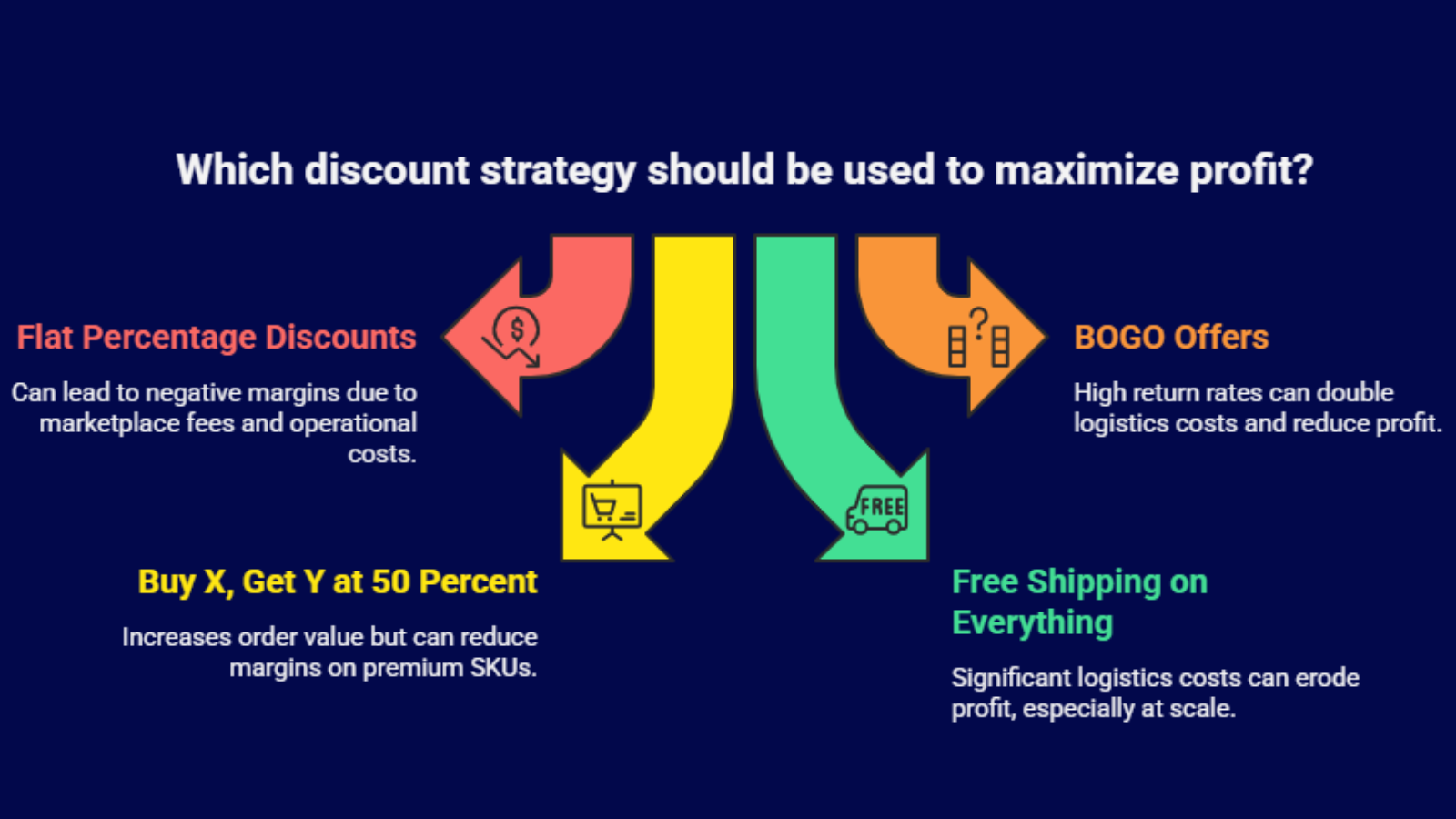 Discount formats look attractive on dashboards. Orders increase, revenue spikes, and ROAS appears healthy. But for Indian D2C sellers, the real impact shows up in contribution margin, not topline revenue. At scale, common promotions accelerate D2C margin erosion in ways that are easy to miss.
1. Flat Percentage Discounts
A 25 percent sitewide discount directly cuts gross margin, but the real damage is layered. On marketplaces like Amazon and Flipkart, referral fees range between 15 to 25 percent, depending on the category. GST is calculated on the transaction value. If you discount heavily, your effective revenue per unit drops, but many operational costs remain fixed.
For example, selling at ₹2,000 with a 60 percent gross margin gives ₹1,200 gross profit. At 25 percent off, revenue becomes ₹1,50,0 and gross profit drops to ₹700. Now subtract:
- 20 percent marketplace commission
- 2 to 3 percent payment fee
- ₹100 to ₹150 shipping
- ₹400 to ₹600 CAC in competitive categories
Your margin can easily turn negative. This is how discounting D2C creates structural pressure, not just temporary drops.
2. BOGO Offers
BOGO is popular during festive periods. But in India, high return rates make it riskier. If one item in a BOGO order is returned, reverse logistics costs double. In categories like fashion, where returns can cross 30 percent, BOGO magnifies inventory churn.
Using a ₹2,000 MRP product with a ₹800 cost of goods, giving one free reduces gross profit from ₹1,200 to ₹400 before fees. After logistics and ads, the actual profit per order can be negligible. This is classic D2C margin erosion disguised as growth.
3. Buy X, Get Y at 50 Percent
This format increases average order value, but often pushes higher discount exposure on premium SKUs. If the discounted product has a higher cost, the blended margin falls sharply. At scale, faster inventory movement also increases warehousing and working capital pressure.
4. Free Shipping on Everything
Shipping in India typically costs ₹70 to ₹150 per order, depending on the zone. If you process 30,000 orders monthly and absorb ₹100 per order, that is ₹30 lakh in logistics spend. During festive spikes, courier rates may increase due to surge pricing.
Free shipping, combined with discounting D2C, quietly erodes profit. As volumes grow, these fixed per-order costs multiply. That is why discounts stop working after scale in D2C brands. The ecosystem amplifies leakage, and without tight contribution tracking, D2C margin erosion becomes permanent.
Why Discounts Stop Working After Scale in D2C Brands
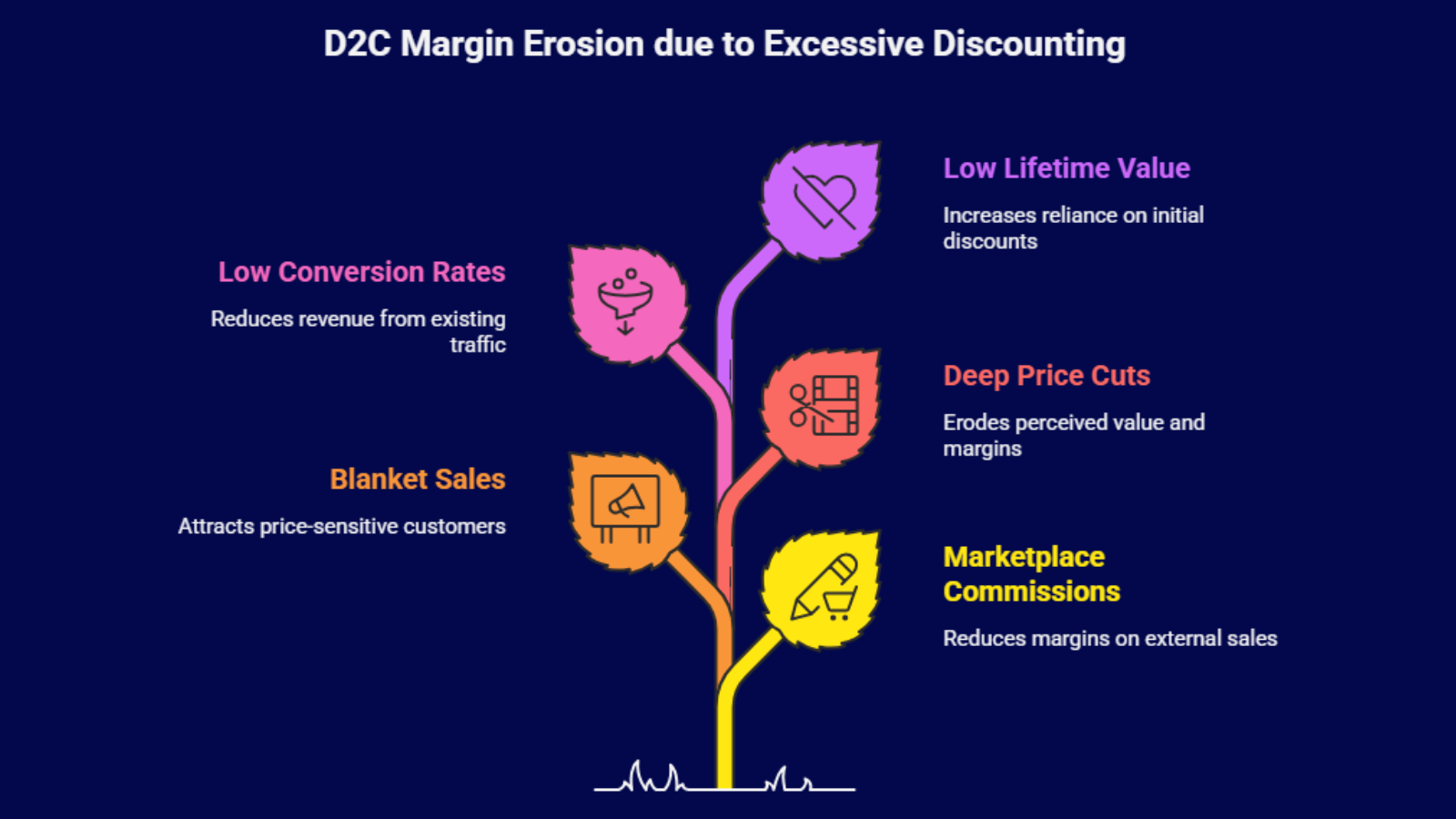
 Now, let us connect this clearly in the Indian context. As you scale, customer acquisition costs do not remain stable. In competitive categories like beauty, fashion, and electronics, Meta and Google CPMs in India can increase by 30 to 50 percent during festive and sale periods. It is common for CAC to move from ₹350 to ₹700 or more within a few quarters as competition intensifies.
If you continue heavy discounting D2C while CAC rises, your contribution margin shrinks sharply. On marketplaces, sponsored ad bids also surge during events like the Great Indian Festival and Big Billion Days. You end up paying more for traffic while selling at lower margins, which directly accelerates D2C margin erosion.
Operational complexity also increases with scale. At 1,000 monthly orders, returns and refunds feel manageable. At 25,000 orders, even a 20 percent return rate means 5,000 reverse shipments.
Each return includes forward shipping, reverse logistics, quality checks, repackaging, and potential inventory damage. Add to this COD-heavy regions where RTO rates can range from 20 to 35 percent in some categories. You pay logistics both ways without revenue realization. When margins are already thin due to discounting D2C, higher volume multiplies losses instead of profit.
There is also a brand impact that many Indian sellers underestimate. When 60 to 70 percent of revenue clusters around sale windows, customers stop buying at full price. They wait for offers.
Competitors can undercut you by a small percentage and win conversions. This creates a cycle where sales slow, deeper discounts follow, margins shrink further, and D2C margin erosion becomes structural. That is why discounts stop working after scale in D2C brands.
What Growing Brands Should Do Instead
 If discounting D2C is hurting margins, the answer is not to stop promotions completely. It is to use them strategically.
If discounting D2C is hurting margins, the solution is not to eliminate promotions but to redesign them with contribution margin in mind. For Indian D2C sellers, strategy must reflect high return rates, COD risk, and rising ad costs.
1. Use segment-based promotions, not sitewide discounts
- Offer first-order discounts only on your own website, not marketplaces where commissions already compress margins.
- Target dormant users with time-bound coupons instead of blanket sales.
- Reward high LTV customers with loyalty credits instead of price cuts.
In India, repeat customers can contribute 30 to 40 percent of revenue for strong brands. Protecting full price buyers prevents unnecessary D2C margin erosion.
2. Bundle for value, not deep price cuts
- Create kits with complementary SKUs that improve average order value without exceeding a 10 to 15 percent effective discount.
- Use limited edition festive bundles to increase perceived exclusivity.
- Clear slow-moving inventory by pairing it with fast sellers instead of marking it down aggressively.
This reduces aggressive discounting D2C while improving inventory turnover.
3. Improve conversion before reducing price
- Optimize product pages with regional language trust badges for tier 2 and tier 3 buyers.
- Add COD confirmation flows to reduce RTO rates.
- Improve checkout speed; even a 1 percent conversion lift can increase revenue by 20 to 30 percent without price cuts.
Higher conversion directly reduces D2C margin erosion because you earn more from the same traffic.
4. Increase lifetime value
- Introduce prepaid subscription models for consumables.
- Launch loyalty tiers to shift buyers from COD to prepaid.
- Use post-purchase upsells instead of front-end discounts.
- If LTV increases by even 25 percent, reliance on discounting D2C drops significantly.
These shifts clearly explain why discounts stop working after scale in D2C brands when used without structure.
The Strategic Shift: From Discounts to Value
 Discounts feel powerful in the beginning. But at scale, growth without clarity creates hidden D2C margin erosion. This is where base analytics helps you move from topline obsession to profit intelligence.
Base analytics helps you see true contribution margin at the SKU, channel, and cohort level, not just revenue. Instead of looking at blended ROAS, you can track net profit after discount, returns, marketplace commissions, payment fees, logistics, and ad spend. For Indian D2C sellers dealing with 15 to 25 percent returns and COD RTO leakage, this level of visibility changes decisions.
Base analytics helps identify which SKUs are margin dilutive during sale periods. For example, a high-volume product may show strong GMV on marketplaces, but once 20 percent commission, 25 percent discount, and reverse logistics are applied, it may erode overall profitability. It also shows which channels are driving healthier prepaid orders versus COD-heavy, high-RTO segments.
Beyond SKU and channel tracking, base analytics helps with cohort profitability, repeat rate analysis, discount dependency trends, and campaign-level contribution tracking. You can see which customer segments only buy during offers and which ones purchase at full price. You can measure how much incremental revenue a promotion actually created versus how much margin it sacrificed.
This depth of insight prevents blind discounting of D2C. Instead of reacting with deeper offers when sales slow, you act based on data. At scale, profit discipline is built on visibility. That is how you control D2C margin erosion and understand why discounts stop working after scale in D2C brands.
Frequently Asked Questions
1. Are discounts always bad for D2C brands?
No. Discounts help in early traction and inventory clearance. The problem starts when discounting D2C becomes the primary growth strategy at scale, leading to long-term D2C margin erosion.
2. Why do customers stop buying at full price?
Frequent promotions condition buyers to wait. Over time, they associate your brand with deals. This behavioral shift explains why discounts stop working after scale in D2C brands.
3. Is BOGO a good strategy for scaling?
BOGO can increase volume quickly. However, it drastically reduces gross profit per unit and accelerates D2C margin erosion, especially when acquisition costs are high.
4. How can brands scale without heavy discounts?
Focus on improving conversion rates, increasing lifetime value, bundling products smartly, and strengthening brand positioning. This reduces dependency on discounting D2C.
5. What is the biggest risk of over-discounting?
The biggest risk is losing pricing power. Once customers expect constant offers, reversing that behavior is difficult. This is why discounts stop working after scale in D2C brands.