When a brand moves beyond early traction, the real pressure is not sales volume. It is margin stability. At a small scale, performance ads look efficient because you are targeting high-intent users. CAC may sit at ₹400 to ₹500, conversion rates hover around 3%, and frequency stays under 2.
But once monthly spends cross ₹30 to ₹40 lakhs, audience saturation begins. CPMs rise 25% to 40%, conversion rates drop below 2%, and CAC quietly climbs to ₹650 or more.
Now look at the contribution. If your AOV is ₹2,000 and net contribution before ads is ₹700, a CAC jump from ₹450 to ₹700 wipes out profit completely. Most sellers do not model this properly.
They rely on platform-level CAC, ignoring blended costs like discounts, influencer payouts, and return adjustments. Real CAC is often 20% higher than reported.
This is where performance vs branding in D2C brand marketing becomes critical. If branded search contributes less than 15% of revenue, you are overly dependent on paid media.
Healthy scaled brands often see 25% to 35% revenue from branded and direct traffic combined. That lowers blended CAC and improves repeat rate. Balancing performance vs branding in D2C brand marketing is not optional at scale. It directly protects profitability.
What Happens When You Scale Only Performance Spend
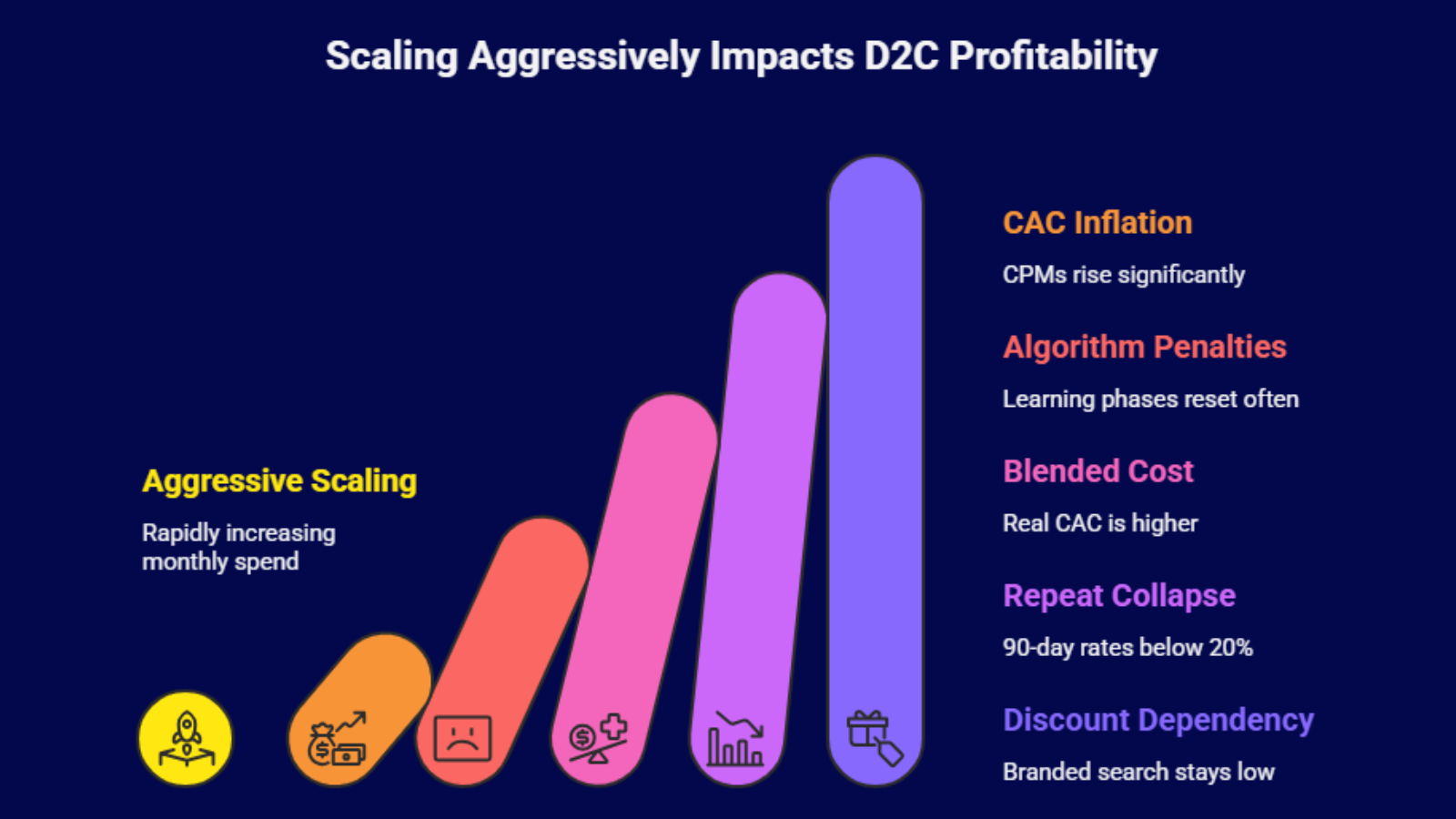 In the early stage, performance ads work because you are harvesting high-intent demand. But once budgets scale, the same channels behave very differently. If you ignore how to balance performance vs branding in D2C brand marketing at scale, the financial damage shows up faster than most founders expect.
1. CAC Inflation Happens Faster Than You Model
At spends below ₹10 lakhs per month, CAC may stay between ₹400 – ₹500. Once you scale beyond ₹40 lakhs monthly, CPMs typically rise 25% to 45% in competitive categories like beauty, fashion, and nutrition.
Frequency quietly crosses 3.5 within 10 to 14 days. CTR drops from 1.8% to nearly 1.1%. Conversion rates fall from 3% to 1.9%.
That 1% drop in conversion rate alone can increase effective CAC by 30% or more. Sellers rarely model this compounding effect when planning scale.
2. Platform Algorithms Penalize Saturation
When accounts scale aggressively, learning phases reset more often. Creative fatigue accelerates after 2 to 3 weeks. Auction competition spikes during sale periods, pushing CPC up by 20% to 35%.
If your brand recall is weak, retargeting pools remain small, forcing you to spend more on cold acquisition. This is where performance vs branding in D2C brand marketing becomes structural, not optional.
3. Blended Contribution Shrinks Silently
Most sellers track platform CAC but ignore blended cost. Real CAC should include:
- Influencer payouts
- Coupon leakage
- Affiliate commissions
- Return impact adjustments
Example:
If reported CAC is ₹720, actual blended CAC may be ₹850.
With AOV at ₹1,850 and net contribution before ads at ₹900, profit per order drops below ₹50. That leaves zero buffer for growth volatility.
4. Repeat Rate Collapses Without Brand Depth
Performance-heavy brands often see 90-day repeat rates below 20%. In contrast, brands investing in storytelling and positioning maintain 30% to 35% repeat rates.
Lower repeat rate increases dependency on fresh acquisition, which further inflates CAC.
5. Discount Dependency Destroys Brand Equity
When customers remember only offers, branded search stays below 15% of revenue. Healthy scaled brands often see 25% to 35% revenue from branded and direct traffic combined.
Without balancing performance vs branding in D2C brand marketing at scale, you are renting customers, not building equity.
What Brand Spend Actually Does at Scale
 Brand spend is not about pretty films or large billboards. At scale, it is a cost efficiency lever. When used correctly, it reduces future CAC, stabilizes demand, and increases repeat revenue. Sellers who understand how to balance performance vs branding in D2C brand marketing at scale see measurable financial shifts within 4 to 6 months.
1. Branded Search Becomes a CAC Shield
In performance-heavy brands, branded search usually contributes 10% to 15% of total revenue. After consistent brand investment through storytelling, influencers, and PR, the share often rises to 25% to 35%.
Branded clicks are 40% to 60% cheaper than non-branded clicks. If your average CPC on generic keywords is ₹22, branded CPC may be ₹9 to ₹12. That alone can reduce blended CAC by ₹80 to ₹120 per order.
2. Direct Traffic Improves Conversion Rates
Cold paid traffic often converts at 1.8% to 2.2%. Direct traffic typically converts at 3.5% to 5%.
When brand spend increases, recall, and direct traffic share grow from 12% to 25% or more. Higher intent traffic improves the overall blended conversion rate, which directly lowers cost per acquisition across channels.
3. Retargeting Efficiency Doubles
Brand campaigns expand top funnel awareness. That increases the retargeting pool size. Larger retargeting audiences convert 2x to 3x better than cold traffic.
For example, if cold CAC is ₹700, retargeting CAC may drop to ₹350 to ₹400. Without brand awareness, that pool remains limited, and performance spends become inefficient.
4. Repeat Purchase Rate Increases LTV
Performance-only brands often see 90-day repeat rates below 20%. After consistent brand building, repeat rates can rise to 30% to 35%.
If LTV increases from ₹1,800 to ₹2,400 due to higher repeat frequency, your LTV to CAC ratio improves significantly, giving room to scale profitably.
5. CPM Volatility Reduces During Sale Seasons
During peak months, CPMs can rise 35% to 50%. Strong brands experience smaller spikes because they attract organic demand and branded searches.
This stability protects margins. That is why understanding how to balance performance vs branding in D2C brand marketing at scale is not optional. Brand spend strengthens performance efficiency over time.
How to Balance Performance vs Branding in D2C Brand Marketing at Scale
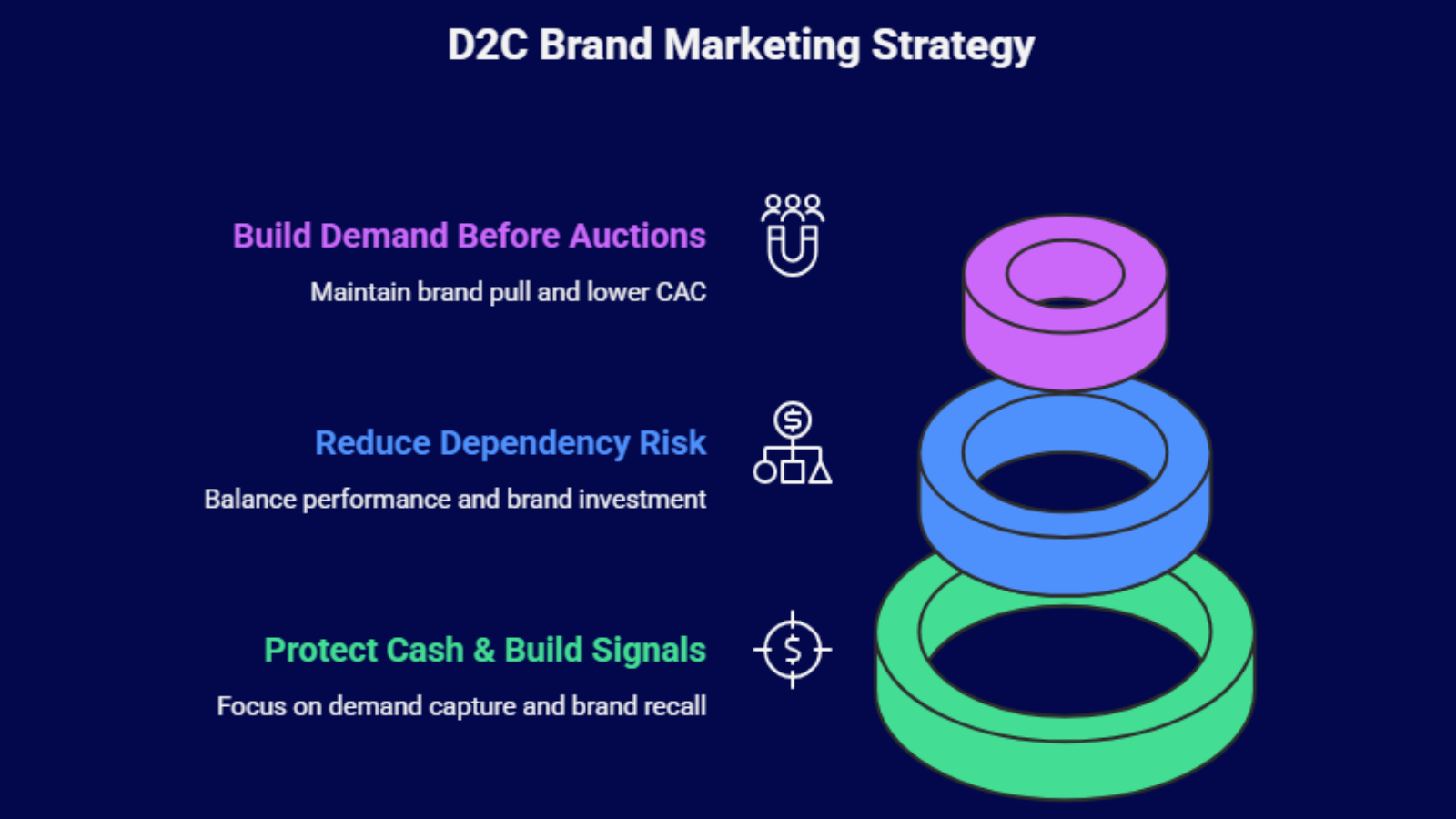 Balancing performance vs branding in D2C brand marketing at scale is not about fixed percentages. It is about margin math, repeat rate, and audience depth. Most sellers allocate budgets emotionally. Scaled brands are allocated based on financial indicators.
1. Stage 1 Below ₹10 Cr: Protect Cash, Build Signals
At this stage, 75% to 85% performance spend makes sense because demand capture matters more than demand creation. But here is what most sellers miss.
If the branded search share is below 8% of total traffic after 12 months, you are not building recall. Even at an early stage, at least 15% to 20% budget should go toward founder storytelling, educational content, and influencer seeding.
Interesting insight: Brands that seed 100 to 150 micro influencers in the first year often see 20% lower CAC in year two because social proof compounds. Sellers rarely calculate this future CAC benefit.
Also, track assisted conversions. If more than 30% of paid conversions have at least one organic touchpoint, your brand investments are working even if direct attribution does not show it.
2. Stage 2 ₹10 Cr to ₹30 Cr: Reduce Dependency Risk
At this level, CAC volatility becomes dangerous. If your CAC fluctuates more than 20% month on month, you are overdependent on performance.
A 60% performance and 40% brand allocation is often safer. Invest in high-frequency video formats, category education, and creator depth partnerships.
Hidden truth: once monthly ad spend crosses ₹50 lakhs, creative fatigue cycles reduce from 45 days to 20 days. Brand investment slows this fatigue because recognition improves click-through rates by 15% to 25%.
3. Stage 3 ₹30 Cr Plus: Build Demand Before Auctions Do
Above ₹30 Cr, auction competition rises sharply during festive periods. CPMs can jump 40% to 60%. Without brand pull, blended CAC can increase by ₹150 to ₹250 instantly.
A 50% performance and 50% brand balance works better when the repeat rate crosses 30%. Brands that maintain branded search above 25% of revenue often see 18% to 22% lower blended CAC compared to performance-heavy competitors.
The sellers who understand how to balance performance vs branding in D2C brand marketing at scale early avoid the ₹20 Cr to ₹40 Cr plateau that traps most brands.
Measuring the Real Impact of Brand Spend
 Brand ROI feels slow because it does not show up inside Ad Manager. But it shows up in blended metrics within 90 to 180 days. The key is tracking signals that most sellers ignore while managing performance vs branding in D2C brand marketing at scale.
Below is how real impact typically unfolds in scaled D2C brands:
| Metric | Before Brand Focus | 4-6 Months After | What Sellers Miss |
|---|---|---|---|
| Branded Search Share | 12% of revenue | 25% to 30% | Branded clicks are 40% cheaper than generic clicks |
| Direct Traffic | 14% | 24% to 28% | Direct converts 1.5x better than cold paid traffic |
| Assisted Conversion Rate | 18% | 35%+ | Brand touches often go unattributed in last click models |
| Blended CAC | ₹700 | ₹580 to ₹620 | Real CAC drops even if platform CAC looks flat |
| 90 Day Repeat Rate | 19% | 30%+ | Higher recall improves second purchase speed |
| LTV to CAC | 2.5 | 3.5+ | Payback period reduces from 4.5 months to 3 months |
Interesting truth: brands with branded search above 25% of total traffic often see 15% to 20% lower festive season CAC spikes. That stability is the real financial return of balancing performance vs branding in D2C brand marketing at scale.
The Hidden Risk and the Real Compounding Effect
Overspending on brand before fixing fundamentals is one of the fastest ways to increase burn. If your gross margin is below 30%, every ₹10 lakh spent on brand requires at least ₹33 lakh in incremental revenue just to break even. Most sellers do not calculate this. If inventory turns are below 4 annually, brand-driven demand can actually worsen working capital stress because stock gets blocked in slow SKUs.
Another truth: if the return rate is above 25%, scaling brand amplifies inefficient orders. You are paying to acquire customers who may return products. Similarly, if 90 day repeat rate is below 25%, brand recall will not convert into real LTV growth.
But when fundamentals are strong, brand compounds. Influencer campaigns increase branded search within 30 to 60 days. PR improves conversion rate by 10% to 15% because trust reduces hesitation. Warmer audiences make paid retargeting cheaper.
This is why performance vs branding in D2C brand marketing must be financially aligned, not emotionally funded.
Operational Visibility Is the Missing Layer Behind Smart Marketing
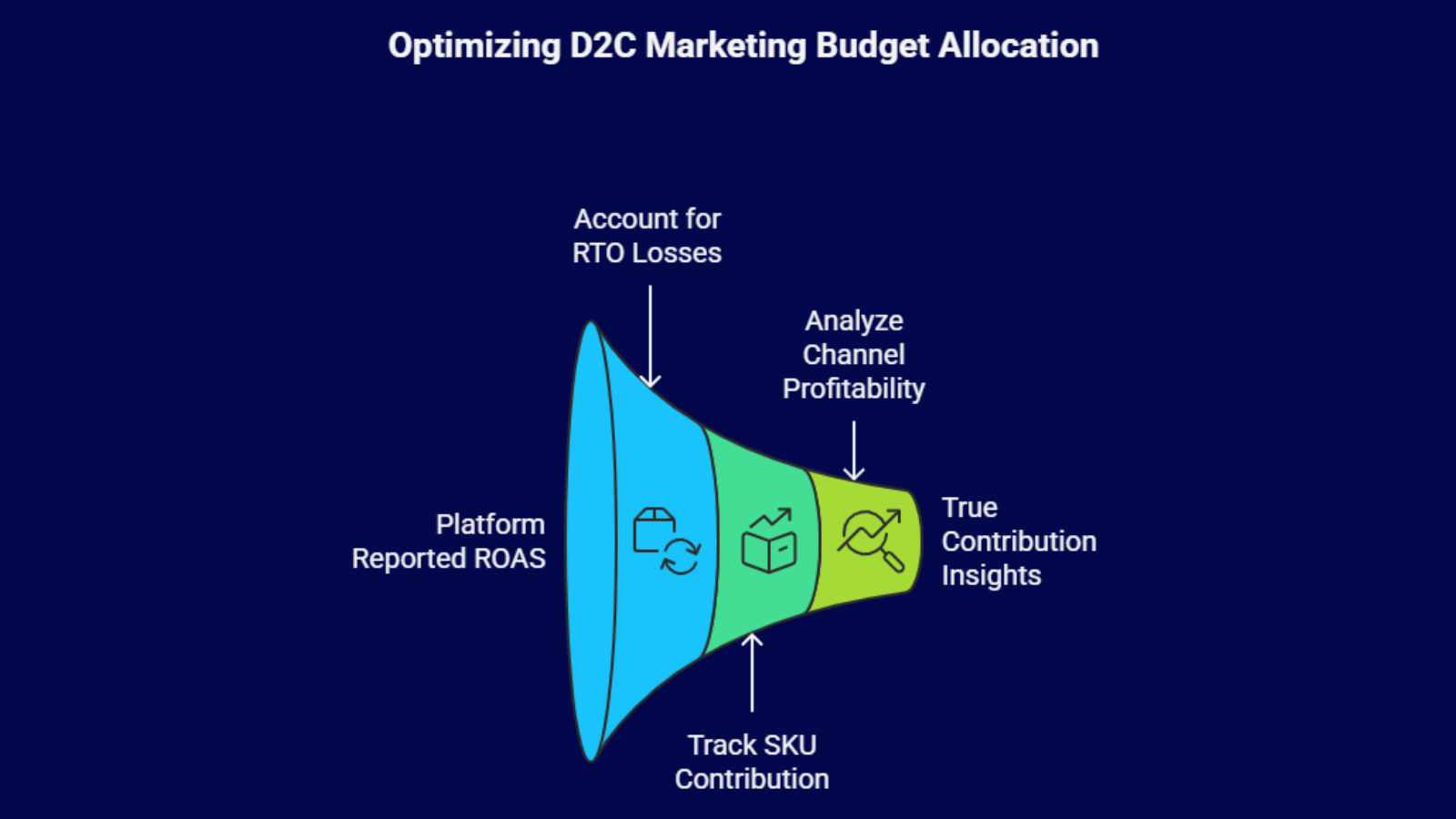 Most brands debate performance vs branding in D2C brand marketing at scale using ad dashboards. The real answer sits in backend data. If you do not know your SKU level contribution after returns, logistics, and discounts, you are allocating marketing budgets blindly.
Here is what most sellers miss. The platform reported ROAS does not include RTO losses, damaged returns, or blocked inventory. If your RTO rate is 28% in specific pin codes and you continue scaling ads there, your effective CAC may be 20% higher than visible. Courier-wise RTO tracking alone can improve contribution by 3% to 5% without changing ad spend.
SKU-wise contribution tracking is equally critical. In many D2C brands, 30% of SKUs generate less than 10% contribution but consume 40% of the marketing budget because they convert well on paid ads. Without SKU-level margin insights, you scale revenue but not profit.
This is where Base.com becomes a structural advantage. Base.com connects Shopify, Amazon, Flipkart, and other channels into one dashboard. It gives real-time inventory sync so you do not overspend on ads for low stock SKUs. It tracks SKU-wise velocity, return reconciliation, and channel-wise profitability. You can see the true contribution after logistics, payment gateway fees, and returns.
Cohort-based LTV analysis inside Base.com helps you understand whether brand investments are increasing repeat purchase frequency. When you combine this operational clarity with marketing data, performance vs branding in D2C brand marketing becomes a calculated decision, not a guess.
Frequently Asked Questions
1. How do I know when to increase brand spend?
Increase brand spend when CAC rises consistently, branded search is low, and repeat rate is below 25%. If performance efficiency drops despite a creative refresh, it is time to rebalance performance vs branding in the D2C brand marketing strategy.
2. Can performance marketing work without brand marketing?
Yes, in the early stages. But at scale, performance alone increases acquisition costs. Without branding, growth slows, and margins shrink. Long-term sustainability requires balancing performance vs branding in D2C brand marketing at scale.
3. How long does brand marketing take to show results?
Brand marketing usually shows measurable impact in 3 to 6 months through branded search growth, direct traffic increase, and improved repeat purchase rate. Financial improvement follows as CAC stabilizes.
4. What metrics should I track to balance both?
Track blended CAC, LTV to CAC ratio, repeat purchase rate, branded search share, direct traffic percentage, and assisted conversions. These indicators reveal whether performance vs branding in D2C brand marketing is aligned properly.
5. Should small brands invest in branding early?
Yes, but carefully. Even small brands should allocate at least 15 to 20 percent toward brand building. Storytelling and community building help future performance efficiency without heavy budgets.