Did you know that an average Indian online seller loses nearly ₹5.6 crore in missed business opportunities due to implementation delays and fragmented workflows? In the fast-moving Indian e-commerce landscape, where a consumer’s attention span is shorter than the time it takes to skip a YouTube ad, every second counts.
Yet, many businesses are still operating with a “digital patchwork”, a collection of tools that don’t talk to each other.
The problem isn’t a lack of data; Indian sellers are drowning in it. The real issue is disconnected systems.
When your inventory on Amazon India doesn’t sync with your Shopify store, or your shipping partner’s updates take four hours to reflect in your customer support dashboard, you aren’t just losing time, you are losing the ability to make competitive decisions.
This blog explores how system silos lead to delayed insights and high operational latency, ultimately crippling the growth of Indian enterprises.
How System Silos Create a Decision-Making Vacuum?
For Indian D2C brands scaling across Amazon, Flipkart, and their own Shopify store simultaneously, disconnected systems mean that a single sale on one platform never automatically updates stock levels on the others, turning every festive season spike into an overselling disaster.
In a typical setup, a seller uses one tool for accounting (like Tally), another for marketplace management, a separate one for logistics, and perhaps a basic CRM for customer queries. While these tools perform well in isolation, they create system silos.
A single department traps information within its walls, making it impossible for a business owner to see the big picture in real time.
When systems are disconnected, the data must be manually extracted, cleaned, and reconciled. For an Indian seller managing 5,000 orders a month across Myntra, Flipkart, and their own website, this manual reconciliation can take 10 to 15 hours a week.
By the time the consolidated report reaches the founder’s desk on Monday morning, the data is already 48 hours old. In a world where price wars change by the hour, 48-hour-old data is essentially a historical artifact, not a decision-making tool.
The Real Impact of Information Gaps
| Impact Area | Consequences of Disconnection | Resulting Business Risk |
|---|---|---|
| Inventory Management | Stock levels on Flipkart don’t match the warehouse. | Overselling and marketplace penalties. |
| Financial Health | Ad spend data is in Meta/Google, but sales data is in the OMS. | Incorrect ROAS (Return on Ad Spend) calculation. |
| Customer Experience | Support team cannot see live shipping status from Delhivery/BlueDart. | Higher “Where is my order” (WISMO) tickets. |
| Pricing Strategy | Competitor price drops aren’t flagged against current stock. | Loss of the “Buy Box” to competitors. |
When courier partners, warehouse management tools, and marketplace dashboards operate as disconnected systems, your operations team is forced to manually copy-paste data between platforms all day, a process so fragile that one missed entry can trigger a cascade of wrong dispatches, failed deliveries, and angry customers.
The High Cost of Delayed Insights and Operational Latency
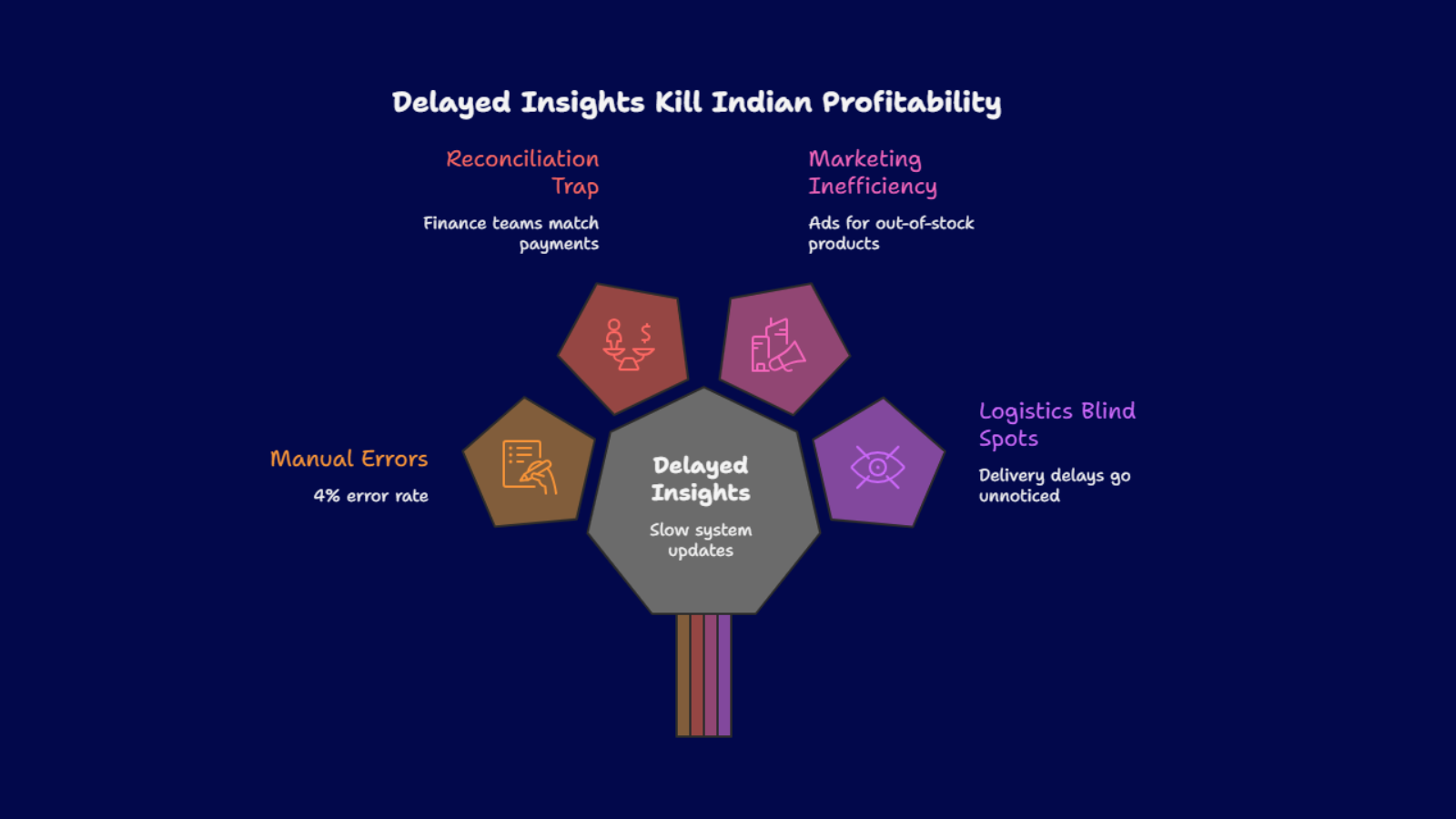
In the Indian market, delayed insights are the silent killers of profitability. Consider the “Flash Sale” culture. If a seller notices a sudden spike in demand for ethnic wear during Diwali but their system takes 24 hours to update the procurement team, the opportunity to restock and capitalize on the trend is lost.
The hidden cost of disconnected systems is not just operational chaos, it is financial bleeding, because when your OMS, courier portal, and accounting software don’t talk to each other, marketplace fee deductions, weight discrepancy charges, and COD settlement gaps go unnoticed for weeks.
Operational latency, the time lag between an event and the business response, increases exponentially with every disconnected tool. When your systems are not integrated, your team spends more time “fixing” data than “analyzing” it. This leads to a reactive culture rather than a proactive one. Instead of deciding how to expand to new regions like the Northeast or rural India, the leadership is stuck deciding which spreadsheet version is the “single source of truth.”
Manual Data Entry Errors
Statistics show that manual data entry carries an error rate of about 4%. In a high-volume business, this results in hundreds of “messed-up” orders, leading to high Return-to-Origin (RTO) rates.
The Reconciliation Trap
Finance teams often spend the first week of every month just matching payments from multiple gateways (Razorpay, Cashfree) with marketplace settlements.
Marketing Inefficiency
Without a unified view, marketing teams might keep running high-budget ads for a product that is actually out of stock in the warehouse, wasting thousands of rupees in ad spend.
Logistics Blind Spots
If the shipping system is disconnected, the seller might not realize a specific pin code is experiencing delivery delays until they are hit with a wave of customer cancellations.
Indian sellers who rely on disconnected systems during high-RTO periods end up paying double shipping costs on returned orders that were never flagged in time, simply because their courier data and warehouse records never synced to trigger an early cancellation.
Moving Toward a Unified Ecosystem for Scalability
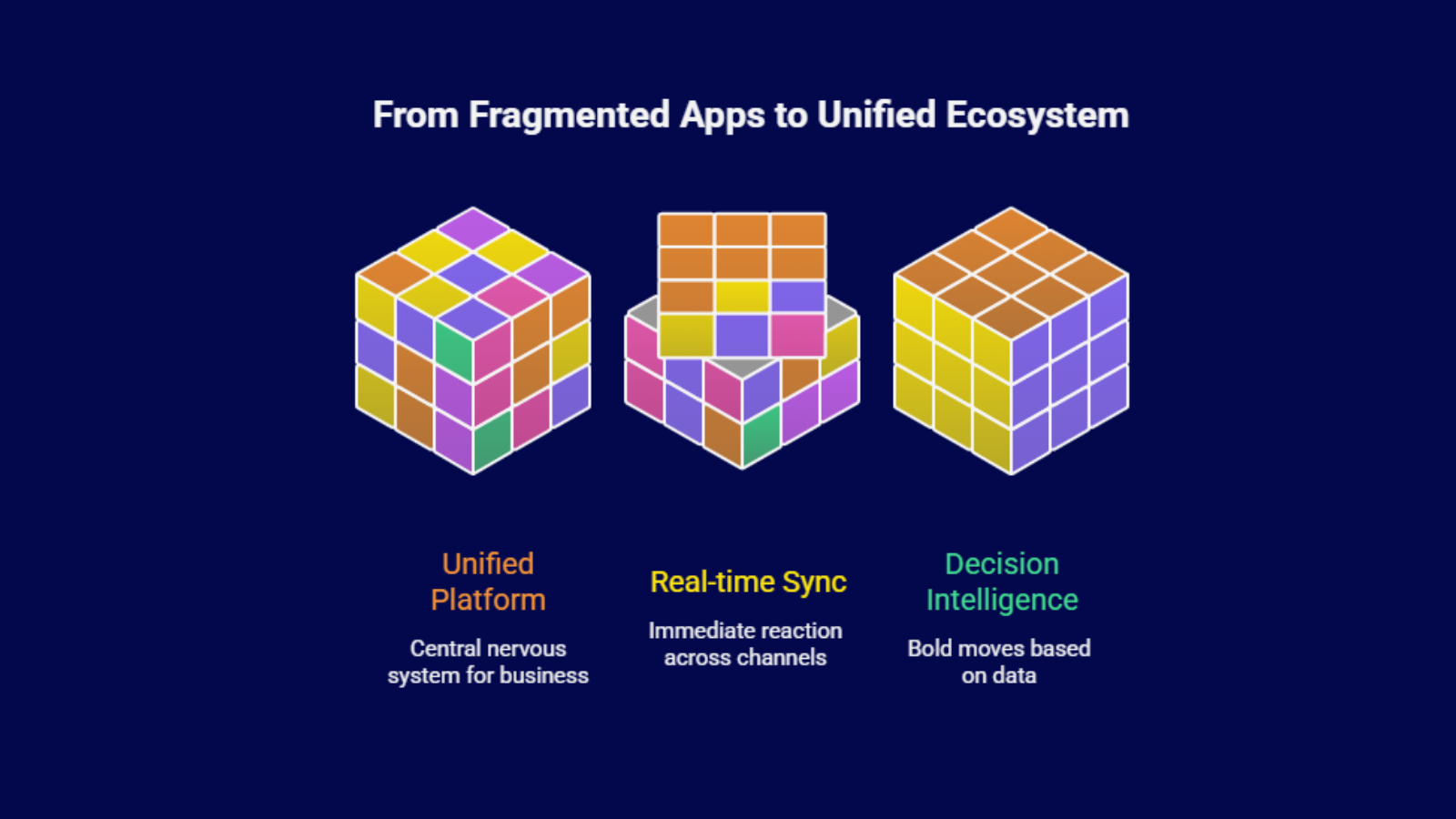
To thrive in the 2026 e-commerce environment, Indian sellers must move away from the “Death by a Thousand Apps” model. The solution lies in a unified platform that acts as the central nervous system of the business.
An integrated approach eliminates operational latency by ensuring that an action in one channel (like a sale on Amazon) triggers an immediate reaction across all others (stock update, shipping label generation, and financial entry).
The fastest way to move from chaos to control is to replace disconnected systems with a single integrated platform where every order, every inventory update, and every courier assignment flows automatically from one source, eliminating the manual handoffs that silently kill your margins.
A connected system doesn’t just save time; it provides “Decision Intelligence.” When you can see your real-time profit margins after accounting for shipping costs, marketplace fees, and ad spend, you can make bold moves.
You can decide to slash prices for a weekend to clear inventory or double down on a high-performing SKU before your competitors even realize there is a trend.
- Elimination of Overselling: Real-time stock synchronization across 1,700+ channels ensures you never have to cancel an order due to stockouts, protecting your seller rating.
- Automated Documentation: Systems that automatically generate GST-compliant invoices and marketplace-specific labels reduce the “click-to-ship” time by over 50%.
- Proactive RTO Management: Integrated systems can flag high-risk COD orders via automated IVR or WhatsApp verification before the product leaves the warehouse.
- Unified Analytics: Accessing a single dashboard that shows “Total Business Health” instead of checking five different portals allows for faster, more confident pivoting.
Bottom Line
The complexity of selling in India, with its unique challenges like COD dependence and high RTO, requires more than just “more software.” It requires a unified operating system. If your growth is being choked by disconnected systems and you are tired of making decisions based on yesterday’s news, it is time to centralize.
Base.com offers a comprehensive solution designed specifically for the needs of modern Indian sellers. By integrating your marketplaces, couriers, and inventory into a single, high-performance panel, Base.com removes the friction of system silos. Whether you are an SMB looking to scale or an enterprise managing complex multi-channel operations, Base.com provides the automation and real-time clarity needed to stay ahead.
Click here, to learn more about how operational debt builds up in fast-scaling businesses?
Frequently Asked Questions
1. How exactly do disconnected systems affect my daily profit?
Disconnected systems lead to hidden costs like overselling penalties, manual labor expenses for data reconciliation, and wasted ad spend on out-of-stock items. These inefficiencies can eat up 5-10% of your monthly revenue without you even noticing.
2. Why is operational latency higher for Indian sellers?
Indian sellers often deal with multiple marketplaces (Amazon, Flipkart, Meesho) and diverse logistics partners. Without integration, the time taken to sync these external updates into a central system creates a lag that delays shipping and customer responses.
3. Can’t I just use Excel to bridge my system silos?
Excel is a static tool, while e-commerce is dynamic. Manual entry in spreadsheets is prone to human error and cannot provide the real-time updates required to manage fast-moving inventory or fluctuating competitor pricing effectively across multiple platforms.
4. What are the first signs that my business has system silos?
If your team spends more than two hours a day on “data cleanup,” if you frequently cancel orders due to inventory mismatches, or if your support team can’t answer “where is my order” instantly, you have silos.
5. How does a platform like Base.com help with decision-making?
Base.com centralizes all your sales, inventory, and shipping data into one dashboard. This gives you a “single source of truth,” allowing you to see real-time profitability and stock health, which leads to faster and more accurate business decisions.