When a D2C brand starts scaling, revenue feels exciting. But as orders grow, so do returns. And when returns increase, margins quietly shrink. This is where the D2C returns impact on profitability and RTO losses. Then margins start becoming very real for Indian sellers, especially those operating across their own website and marketplaces like Amazon, Flipkart, and Meesho.
In India, return rates in fashion and lifestyle categories usually range between 18 – 30 percent. On marketplaces, the percentage can move higher depending on product category and pricing. The bigger concern, however, is RTO. For brands that rely heavily on Cash on Delivery, RTO rates often fall between 20 – 35 percent. That means out of every 100 orders shipped, up to one-third may return without revenue realization. This is how the D2C returns impact on profitability slowly builds up.
Marketplace selling also adds another layer of cost. Commission fees, shipping deductions, and return handling charges continue even when an order comes back. When you combine these with reverse logistics costs, the RTO losses that D2C brands experience can significantly reduce actual contribution margin.
Most founders track revenue daily. Fewer track returns weekly. And very few calculate how returns and RTO together shape long-term margins. That is where true profitability is either protected or lost.
How Returns and RTO Affect Real Profit?
At first glance, a return looks like a minor inconvenience. Financially, it is much more serious because a return restarts the entire cost cycle. The product travels forward to the customer and then travels back. The warehouse team processes it twice. Packaging is lost. Payment gateway fees are often non refundable. The finance team reconciles refunds.
Take a realistic example. An apparel brand ships 10,000 orders in a month at an average selling price of ₹1,200. If 25 percent are returned, that means 2,500 orders come back. The topline may look healthy, but a quarter of the volume is already reversing through the system.
Now look at the direct operational costs. Assume forward shipping of ₹90, reverse shipping of ₹110, packaging loss of ₹20, warehouse handling of ₹20, and non refundable gateway fee of ₹24 per order. That equals ₹264 per return.
Across 2,500 returned orders, the brand absorbs ₹6.6 lakh in pure operational expense before even evaluating the condition of the product. This cost hits immediately and directly reduces contribution margin.
The impact does not stop there. Many returned products cannot be resold at full price. If even half require a 15 percent discount to clear, margins compress further. Inventory also remains blocked for 7 to 14 days before it becomes sellable again, increasing working capital pressure.
During this time, brands may continue running ads for the same SKU, acquiring new customers while older inventory is still stuck in transit or quality check. Revenue dashboards may show strong gross sales, but actual cash retention tells a different story.
 Now layer on an even more damaging issue: wrong SKU received. This happens when customers send back a different product, an old used item, or sometimes an entirely unrelated object. In such cases, the originally shipped SKU is permanently lost.
Continuing the same example, assume just 3 percent of the 2,500 returned orders are wrong item cases. That equals 75 units. If product cost is ₹400 per unit, that is ₹30,000 in direct lost COGS with no resale opportunity.
Add logistics and handling to that. Forward shipping ₹90, reverse shipping ₹110, packaging ₹20, and warehouse handling ₹20 bring the total cost per wrong return to ₹640. For 75 units, that equals ₹48,000 in total financial impact.
Now consider the RTO separately. If 800 out of 10,000 shipments result in RTO and even 2 percent of those come back as wrong or swapped items, that is 16 more units lost. At ₹400 product cost plus logistics, this adds another ₹10,000 to ₹12,000 in unrecoverable damage. Wrong SKU returns are not small operational errors. They are structural profitability leaks that silently inflate COGS and erode margins month after month.
How Returns Destroy Contribution Margin
Most founders track gross margin because it looks simple and reassuring. But gross margin does not tell the full story. The real picture appears only after you factor in returns. That is where the D2C returns impact on profitability and RTO losses, D2C brands become clearly visible.
Let us break this down with a simple example.
Assume:
Selling price: ₹1,200
Product cost: ₹500
Shipping: ₹100
Payment fees: ₹30
On paper, gross margin looks healthy.
If 100 Orders Are Placed
- Total revenue: ₹1,20,000
- Product cost: ₹50,000
- Shipping cost: ₹10,000
- Payment fees: ₹3,000
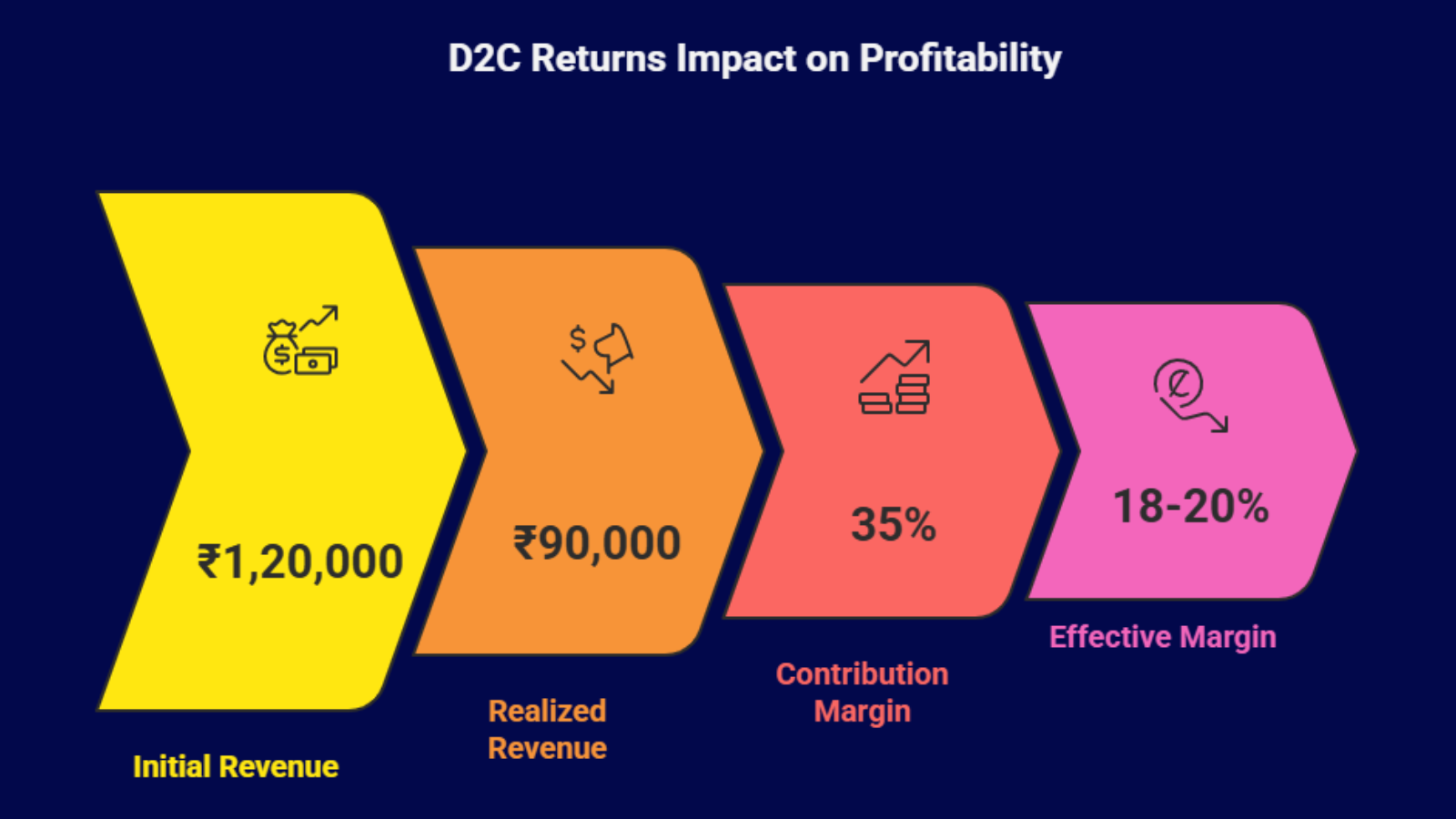 At first glance, the contribution margin appears strong.
Now, assume 25 percent of these orders return. That means 25 orders come back.
For those 25 returned orders:
- Forward shipping is already paid
- Reverse shipping added
- Payment fees are mostly non-refundable
- The product may require discounting
Let us calculate the impact conservatively.
Reverse shipping at ₹100 per order = ₹2,500
Additional warehouse handling = ₹500
Gateway fee loss on returned orders ≈ ₹750
Now, revenue effectively reduces because 25 orders do not generate final sales. So revenue drops from ₹1,20,000 to ₹90,000 realized revenue.
Meanwhile, most logistics and acquisition costs are already incurred.
After adjusting for returns, the effective contribution margin can fall from roughly 35 percent to nearly 18 to 20 percent. This is the direct D2C returns impact on profitability that many brands underestimate.
Now add rising ad costs. If the customer acquisition cost per order is ₹300 and you acquired 100 customers, you spent ₹30,000. But 25 percent returned. That means the acquisition cost per successful order jumps significantly.
When acquisition cost increases and the return rate remains high, the losses D2C brands experience start eating into net profit rapidly.
This is why contribution margin after returns must be calculated weekly. Gross numbers can look strong. Real profitability often tells a different story.
Top 5 Reasons Behind High Returns and RTO in D2C and How to Fix Them
Returns are not random. They follow clear patterns. When you study them SKU-wise and pin-code-wise, the causes become predictable. And once predictable, they become controllable. That is how you reduce the D2C returns impact on profitability and prevent RTO losses D2C brands from silently compounding.
Below are the five most common operational issues Indian D2C brands face, along with specific, practical fixes.
1. Size and Fit Mismatch in Fashion Categories
 The Issue:
Apparel and footwear brands often see 25 to 35 percent return rates due to size confusion. Many brands rely on generic S, M, L charts without mentioning garment measurements. Inconsistent vendor manufacturing also leads to the same size fitting differently across batches. This directly increases the D2C returns impact on profitability.
How to Solve It:
- Add garment measurement in inches, not just size labels.
- Mention the model’s height, weight, and size worn clearly.
- Show fit type: slim, relaxed, oversized.
- Track SKU-level size return data and adjust production specs accordingly.
Even a 5 percent reduction in size-related returns can significantly lower the RTO losses D2C brands face monthly.
2. Expectation Mismatch Due to Product Presentation
The Issue:
Highly edited product images, bright lighting, or incomplete descriptions create unrealistic expectations. Customers receive a product that looks different from what they saw online. This mismatch increases return rate and deepens the D2C returns impact on profitability.
How to Solve It:
- Add natural lighting images along with studio shots.
- Use close-up texture photos.
- Add 30-second try-on videos.
- Clearly mention fabric type, thickness, and transparency.
When customers know exactly what to expect, return rates drop naturally.
3. High COD and Low Intent Orders
The Issue:
COD orders often have lower buying commitment. Customers may place multiple orders across platforms and refuse delivery later. In some high-risk pin codes, RTO can cross 40 percent, sharply increasing the RTO losses D2C brands absorb.
How to Solve It:
- Add OTP confirmation before dispatch for COD orders.
- Restrict COD above ₹2,500.
- Maintain a blacklist of repeat RTO customers.
- Track courier-wise RTO performance.
These controls directly reduce the D2C returns impact on profitability without hurting conversion significantly.
4. Delivery Delays and Courier Inefficiencies
The Issue:
Delayed delivery increases refusal rates. Customers may not be available or lose interest. Multiple delivery attempts increase logistics cost, adding to RTO losses D2C brands already face.
How to Solve It:
- Set realistic delivery timelines on product pages.
- Track courier performance by region.
- Switch partners in high-failure zones.
- Send delivery confirmation SMS 24 hours before arrival.
Better delivery discipline reduces avoidable returns.
5. Poor Packaging and Damaged Shipments
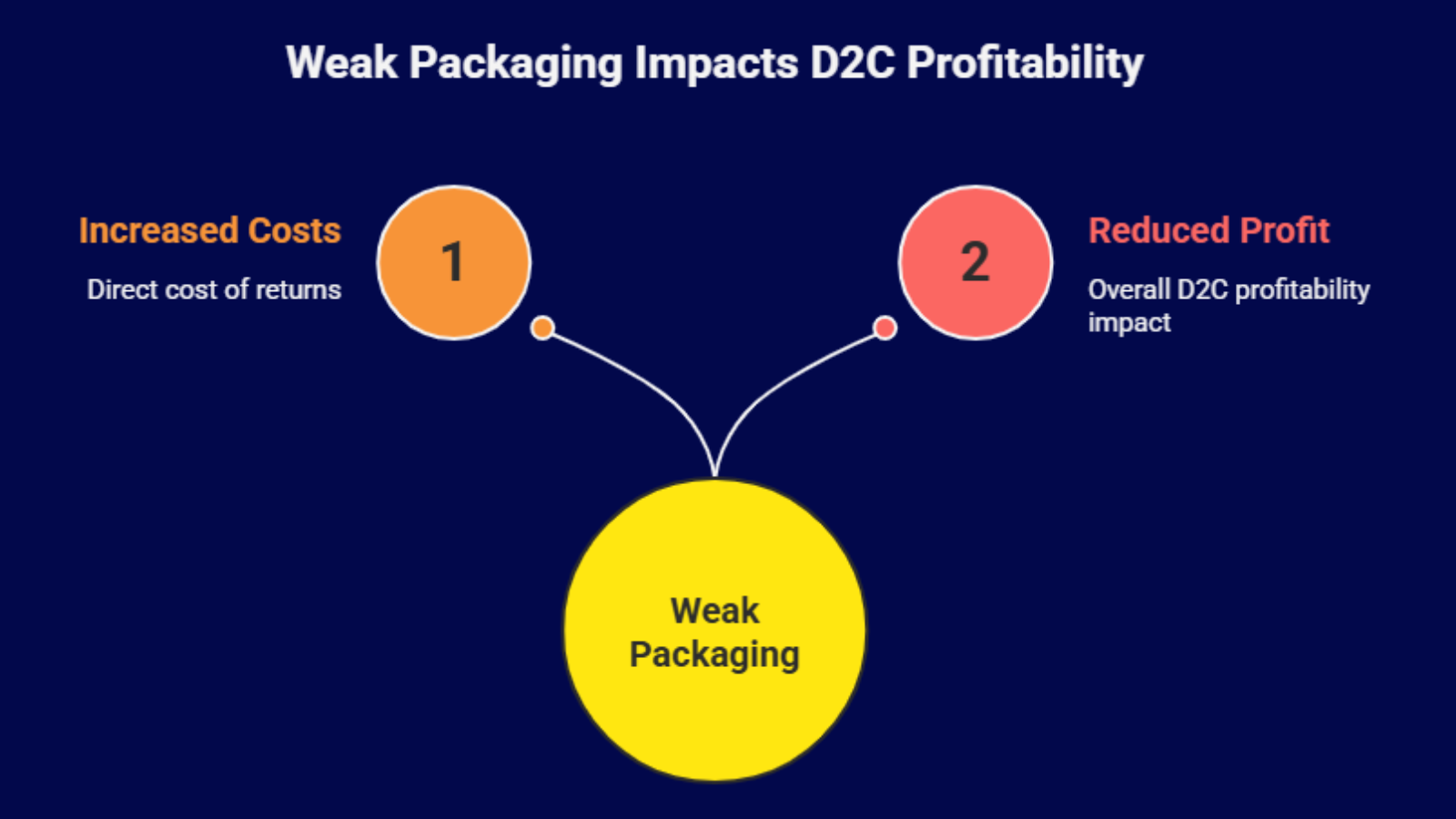 The Issue:
Weak packaging leads to damaged products, open parcel refusal, or partial returns. This increases both direct cost and the overall D2C returns impact on profitability.
How to Solve It:
- Upgrade packaging quality for fragile SKUs.
- Add tamper-proof seals.
- Conduct random packaging audits weekly.
- Track damage percentage by SKU.
Even reducing damage returns by 3 to 4 percent meaningfully lowers the RTO losses D2C brands experience.
Every return reason is measurable. If the return rate moves from 20 percent to 28 percent, the contribution margin can fall by 8 to 12 percent. That is not a small fluctuation. That is structural margin erosion.
When brands treat returns as data problems instead of customer problems, the D2C returns impact on profitability becomes manageable. And when each issue is solved systematically, RTO losses D2C brands face stop being unpredictable shocks and start becoming controllable metrics.
Operational Control Is Where Profitability Is Protected
Returns are not just a marketing problem. They are operational leaks. If returned products are not scanned, reconciled, and put back into saleable inventory quickly, working capital stays blocked. That delay alone increases the D2C returns impact on profitability and amplifies RTO losses that D2C brands already struggle with.
This is where structured systems make a real difference. Tools like Base.com are built to bring visibility to the operational layer that most founders ignore until margins start shrinking.
With Base.com, brands can:
- Track RTO percentage by courier partner and compare failure rates zone-wise
- Identify high-risk pin codes and automatically restrict COD in those areas
- Monitor SKU-wise return rates and flag products crossing defined thresholds
- Automate return reconciliation between the warehouse, the courier, and finance
- Sync returned inventory back into live stock faster to reduce blockage
Base.com’s analytics dashboard helps brands see patterns instead of guessing. For example, if one courier shows a 32 percent RTO rate in specific Tier-3 regions while another shows 18 percent, that difference directly affects contribution margin. Acting on that data reduces the overall D2C returns impact on profitability in a measurable way.
The platform also centralizes marketplace and website data. That means brands can compare return trends across Amazon, Flipkart, and their own D2C store in one view. This clarity prevents repeat mistakes and helps control RTO losses D2C brands experience month after month.
When operations are tracked tightly, returns stop being emotional setbacks. They become structured metrics that can be optimized.
Sustainable Growth Requires Return Discipline
 Growth without control creates chaos. And returns without tracking slowly erode profits even when topline revenue looks strong. The difference between profitable D2C brands and struggling ones often comes down to how they manage the D2C returns impact on profitability and contain RTO losses D2C brands face during scale.
Revenue is visible on dashboards. Losses hide in reverse logistics, blocked inventory, and delayed reconciliations.
Track the return percentage weekly. Audit RTO courier performance monthly. Calculate the contribution margin after factoring in reverse shipping, gateway fees, and discounting. Use operational tools like Base.com to bring discipline into inventory flow and return handling.
Base.com becomes especially powerful in managing returns and reverse logistics, which directly affect inventory turns and cash flow. It allows brands to build fully customizable return handling workflows tailored to their operations. Instead of grouping all returns together, brands can separately track RTOs by channel, customer initiated returns, and marketplace returns, giving a clearer operational and financial view.
The platform also enables proactive notifications for submitting marketplace claims within required timelines, helping prevent revenue leakage from missed deadlines. At an item level, custom statuses like wrong item received, damaged, or repacking needed can be created.
This ensures returned inventory is properly evaluated instead of automatically written off. With complete transparency into return reasons and recovery status, brands can improve resale rates, reduce losses, and make better inventory and cash flow decisions.
When measurement becomes consistent, the D2C returns impact on profitability becomes predictable. And when RTO patterns are identified early, RTO losses D2C brands deal with stop being surprises and start becoming controlled variables.
Sustainable D2C growth is not just about acquiring more customers. It is about protecting every order you ship.
Frequently Asked Questions
1. What is a healthy return rate for D2C brands?
Most categories operate between 10 to 20 percent. Fashion and lifestyle may go up to 30 percent. Anything beyond that increases D2C returns’ impact on profitability and RTO losses for D2C brands significantly.
2. Why is RTO higher in COD orders?
COD reduces purchase commitment. Customers can refuse delivery without financial loss, which increases RTO losses for D2C brands and raises the overall D2C returns impact on profitability and RTO losses for D2C brands.
3. How do returns affect working capital?
Returned inventory blocks capital for days or weeks. During that time, brands cannot resell products, increasing D2C returns’ impact on profitability and RTO losses for D2C brands through cash flow pressure.
4. Can return rates be predicted?
Yes. SKU-wise and pin code-wise tracking helps forecast patterns. Predictive tracking reduces D2C returns’ impact on profitability and RTO losses for D2C brands by preventing repeat mistakes.
5. Does a free return policy increase profitability?
Free returns can improve conversion, but may increase D2C returns’ impact on profitability and RTO losses for D2C brands if not controlled with proper return eligibility checks.