India’s quick commerce is no longer “just grocery”. In 2024, the category reached roughly $6 to $7 billion in GMV, and it is scaling fast in the top metros. For a D2C seller, the margin story is shaped less by demand and more by platform mechanics.
Here are the nuances many Indian sellers miss. First, commission is not always fixed. Blinkit has been shifting some categories from fixed slabs to variable commission structures, which can change your net realization week to week if you do not reconcile payouts line by line.
Second, quick commerce growth is tied to dark store expansion, and that directly affects your economics. Swiggy Instamart disclosed 523 dark stores as of March 2024 and a plan to double by March 2025, plus store sizes up 30 to 35%. Expansion improves reach but also increases pressure on brands for in-store availability, fill rates, and faster replenishment, which can raise your stock holding and expiry risk.
Third, platform profitability goals matter. Instamart reported a contribution margin moving to -1.9% in Q2FY25, showing platforms are actively tuning take rates, discounts, and assortment to improve unit economics.
If you want healthier margins, treat quick commerce like a high velocity distribution channel: push only hero SKUs, build platform-specific pack sizes, and audit every deduction (commission, promo funding, and visibility spends) weekly, not monthly.
Understanding the Rise of Quick Commerce in India
India’s quick commerce market crossed $5 billion in gross order value in 2024 and is projected to grow at over 25 percent annually. Urban consumers now expect delivery in 10 to 20 minutes for groceries, personal care, and even electronics accessories.
For D2C brands, this opens a new distribution channel. But unlike marketplaces or your own website, quick commerce runs on a dark store model with tight SLAs, high platform commissions, and aggressive discounting. This is where quick commerce margins become critical.
Before jumping into numbers, let us understand how the cost structure differs.
| Component | D2C Website | Marketplace | Quick Commerce |
|---|---|---|---|
| Commission | 0 to 5% (payment gateway) | 15 to 25% | 18 to 42% |
| Delivery Cost | Brand managed | Platform subsidized | Included in the commission |
| Discounting | Brand controlled | Shared | Platform driven |
| Inventory | Central warehouse | Fulfilled by brand | Dark store stocking |
| Visibility | Marketing spend | Ads | Listing + placement fee + Ads |
As you can see, quick commerce margins are directly impacted by commission slabs and platform control over visibility.
Understanding the Rise of Quick Commerce in India
Quick commerce is growing at over 20 to 25 percent annually in India, and most metro customers now expect 10 to 20-minute delivery for essentials. For D2C brands, this channel is no longer optional.
But revenue growth does not automatically mean profit growth. The biggest challenge Indian founders face today is protecting quick commerce margins while scaling across Blinkit, Zepto, Swiggy Instamart, BB Now, Flipkart Minutes, and Dunzo.
Below are ten very specific ways quick commerce margins get impacted, along with numbers, real operational issues, and practical ways to solve them.
1. High Platform Commissions
 The problem
Most Indian quick commerce platforms charge between 18 percent and 35 percent commission, depending on the category.
- Personal care and packaged foods: 20 to 28 percent
- Health, gourmet, and premium products: 28 to 35 percent
- Plus onboarding, barcode, and warehousing fees in some cases
If your product has a 60 percent gross margin at MRP, a 25 percent commission immediately cuts that to 35 percent before marketing or logistics costs.
Example
MRP: Rs 499
Commission at 25 percent: Rs 125
Remaining before COGS: Rs 374
If your landed cost is Rs 220, you are left with Rs 154 contribution before discount funding. That is where quick commerce margins begin shrinking.
How to solve it
- Negotiate slabs based on city-level performance
- Start with pilot SKUs in Tier 1 cities before scaling nationally
- Build channel-specific pack sizes with slightly higher grammage or premium positioning
Never sign national rollout terms without city-wise performance proof.
2. Mandatory Discount Participation
The problem
Quick commerce is promotion-heavy. Platforms frequently run 10 to 30 percent discount campaigns to drive basket size.
Brands are expected to co-fund these offers. In many cases:
- Introductory discounts: 5 to 15 percent brand-funded
- Festive campaigns: 10 to 20 percent participation
- Flash sales: short-term deep discounting
If you already operate at 18 percent contribution, a 10 percent extra discount can wipe out half your quick commerce margins.
What Indian sellers miss
Discount participation is often auto-enrolled unless you opt out early in the cycle. Many founders notice margin erosion only after payout reconciliation.
How to solve it
- Cap discount participation in your commercial agreement
- Offer platform-exclusive bundles instead of flat discounts
- Push value packs instead of reducing unit MRP
Control discounting; do not let it control your quick commerce margins.
3. Dark Store Inventory Lock-In
 The problem
Unlike marketplaces, where you ship per order, quick commerce requires stocking inventory in multiple dark stores.
In top metros:
- A single platform may operate 200 to 500 dark stores
- Your SKU may be placed in 20 to 50 of them initially
- Each location needs minimum stock levels
If you send 50 units per store across 30 stores, that is 1500 units locked in inventory.
For a Rs 200 landed cost product, that is Rs 3 lakh blocked working capital.
Additional risk
- Expiry management becomes complex for food and beauty products
- Slow-moving SKUs accumulate dead stock
- Inter-store transfers are limited
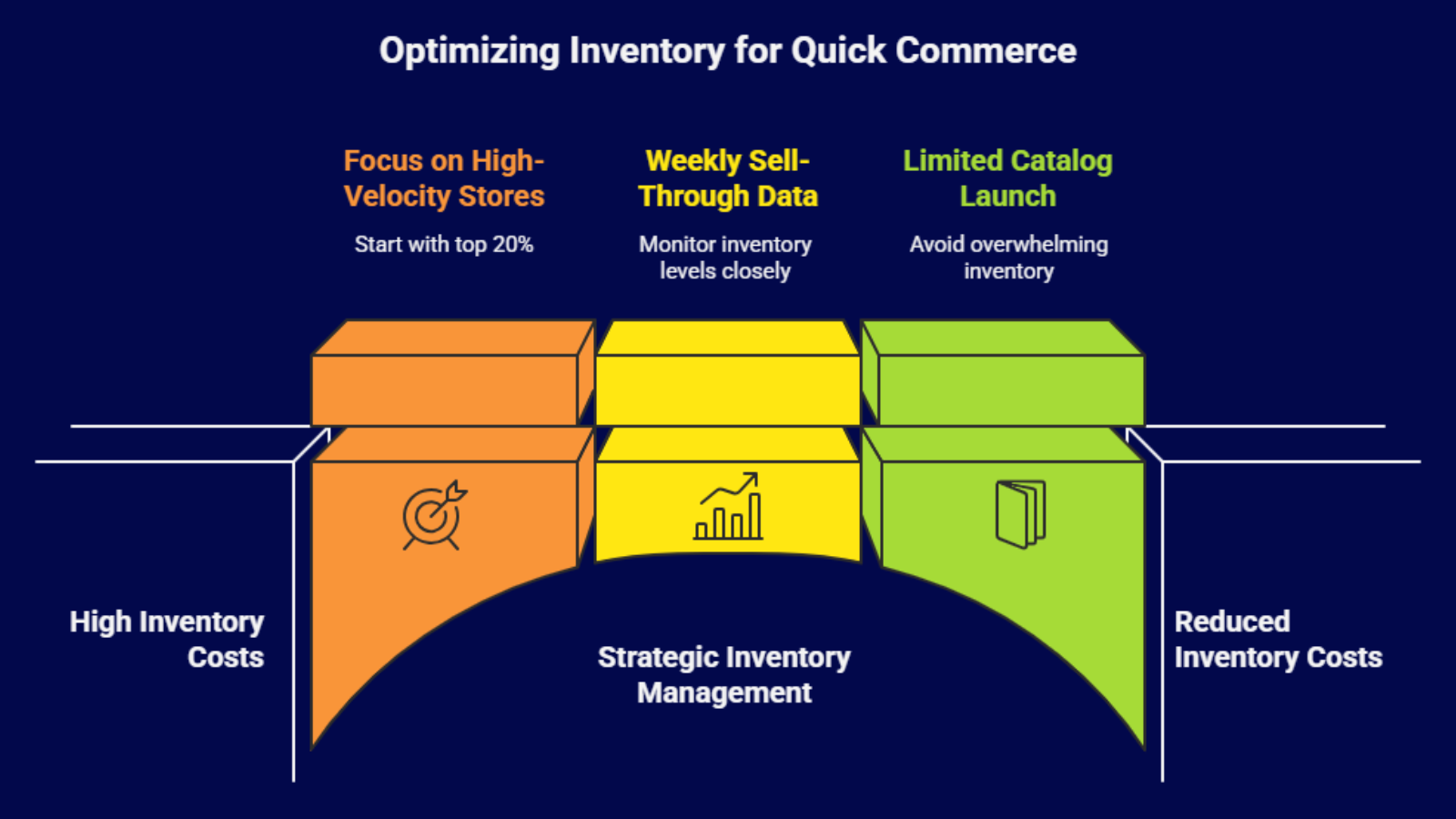
How to solve it
- Start with the top 20 percent high-velocity stores
- Use sell through data weekly
- Avoid launching your full catalog
Inventory discipline directly protects quick commerce margins.
4. Limited SKU Depth
The problem
Quick commerce platforms focus on speed and fast movers.
- Only the top 10 to 20 SKUs per brand usually get listed
- Long tail or experimental products are rarely approved
- Bundles may not be supported easily
This limits your ability to balance margins using high-margin niche products.
Impact on margins
If your hero SKU has lower margins but drives volume, and your premium SKU carries higher margins, a lack of cross-selling reduces blended quick commerce margins.
How to solve it
- Design hero SKUs with a healthy base margin
- Launch premium travel sizes exclusive to quick commerce
- Track AOV contribution per SKU
Think in contribution mix, not just top-line growth.
5. Higher Return and Damage Rates
 The problem
Quick picking and 10-minute delivery increase operational risk.
Common issues:
- Leaking personal care products
- Crushed packaging
- Instant refunds without physical return
While return rates are lower than those of fashion marketplaces, even a 2 to 4 percent damage can hurt if margins are thin.
Example
If you sell 10,000 units per month and 3 percent are refunded without recovery, that is 300 units lost. At Rs 120 contribution each, you lose Rs 36,000 monthly.
How to solve it
- Reinforce secondary packaging
- Avoid fragile glass for quick commerce SKUs
- Monitor store-wise damage patterns
Protecting product integrity directly protects quick commerce margins.
6. Listing and Visibility Fees
The problem
Beyond base commission, visibility costs money.
- Sponsored search placements
- Banner features during sales
- Category page priority
Ad spends can range from 5 to 15 percent of GMV if aggressively scaled.
Many Indian sellers calculate gross margin but ignore ad contribution cost.
Hidden reality
Your dashboard may show a 20 percent contribution, but after ad spend, effective quick commerce margins fall to 10 to 12 percent.
How to solve it
- Track TACOS, not just revenue
- Invest in ads only for high repeat SKUs
- Pause ads in low stock situations
Advertising must support margin, not replace it.
7. Data Ownership Limitations
 The problem
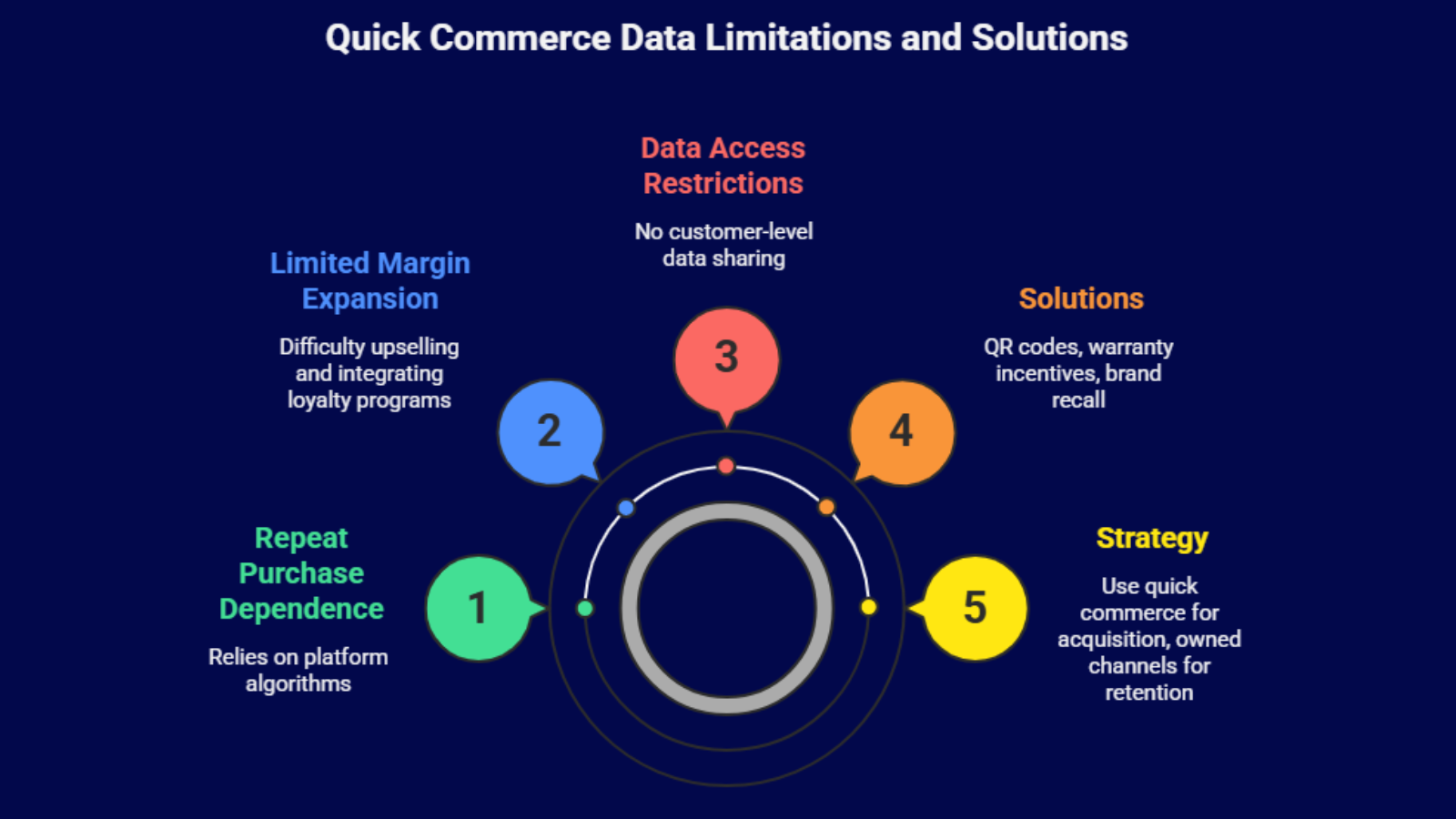
Quick commerce platforms do not share customer-level data.
- No access to email or phone
- No remarketing control
- No direct loyalty program integration
This means repeat purchase depends entirely on platform algorithms.
Without customer lifetime value tracking, improving quick commerce margins becomes harder.
Business nuance
You cannot upsell accessories or subscription models easily. That limits lifetime margin expansion.
How to solve it
- Include QR codes inside packaging
- Offer warranty registration incentives
- Build brand recall through strong packaging
Use quick commerce for acquisition, but convert repeat buyers through owned channels.
8. Faster Cash Cycles but Variable Payouts
The problem
Many platforms offer 7 to 15-day payout cycles. This is faster than traditional retail, which can take 45 to 60 days.
But:
- Commissions are deducted upfront
- Promo funding is adjusted automatically
- Penalties for fill rate issues apply
Without weekly reconciliation, quick commerce margins appear higher than reality.
How to solve it
- Assign a dedicated reconciliation manager
- Audit each invoice against the commercial agreement
- Track net realization per SKU
Cash flow speed is helpful only if margin accuracy is maintained.
9. Increased Operational Complexity
 The problem
Each platform has different rules.
- Different commission slabs
- Different fill rate expectations
- Different packaging norms
Operational overhead increases with scale.
If you are selling on 5 platforms, you may need:
- Dedicated account managers
- City-wise inventory tracking
- Separate demand forecasting
These overhead costs reduce net quick commerce margins indirectly.
How to solve it
- Use centralized inventory management software
- Standardize packaging across platforms
- Track city-level profitability
Scale should not increase chaos.
10. Pressure on Pricing Strategy
The problem
If your website MRP is lower than the quick commerce listing price:
- Customers lose trust
- Channel conflict increases
- Social media backlash can occur
But if you match the website price, your quick commerce margins may shrink due to commission.
Indian nuance
Some platforms discourage price disparity and may flag pricing violations.
How to solve it
- Maintain MRP consistency across channels
- Offer website-exclusive bundles instead of lower prices
- Adjust pack size, not price
Strategic pricing alignment protects brand perception and quick commerce margins.
Quick commerce is growing fast in India’s top 8 cities and is expanding into Tier 2 markets. It offers scale, visibility, and faster sales cycles. But without tight commercial control, quick commerce margins can quickly drop below sustainable levels.
In most FMCG and personal care categories, sustainable quick commerce margins fall between 15 to 22 percent contribution if managed well. Below 12 percent, long term scale becomes risky unless the channel is treated purely as an acquisition.
The key is simple:
- Negotiate hard
- Audit every deduction
- Control discounting
- Launch only high velocity SKUs
- Track net contribution weekly
Revenue is visible. Margin leakage is silent. If you monitor quick commerce margins with discipline, this channel can become profitable and scalable instead of just fashionable.
Real Unit Economics and Margin Reality in Quick Commerce
Let us look at a simplified but realistic example. Assume a personal care D2C brand is selling a face wash at an MRP of Rs 399 on a quick commerce platform. At first glance, the pricing looks healthy. But once commissions, discounts, and costs are applied, the actual picture becomes clearer.
| Component | Amount (Rs) |
|---|---|
| MRP | 399 |
| Platform Commission (25%) | 99.75 |
| Discount Funding (10%) | 39.9 |
| Cost of Goods | 110 |
| Packaging and Freight | 25 |
| Net Realization | 124.35 |
After deducting commission and discount funding, the brand is left with Rs 124.35 before overhead allocation. If operational overhead per unit is Rs 60, the final profit per unit drops to around Rs 64.
That translates to nearly 16 percent contribution margin. On the brand’s own website, the same product might deliver a 28 to 32 percent margin because there is no heavy commission layer.
This gap explains why quick commerce margins feel tight. Yet brands still enter because the channel drives high visibility in metro cities, faster trials, and incremental demand from high-density pin codes.
Many founders treat quick commerce as a distribution plus acquisition engine. The key is to protect margins through pack optimization, volume-based commission negotiation, tight reconciliation of payouts, and strict pricing alignment across channels.
The Best Quick Commerce and D2C Strategy
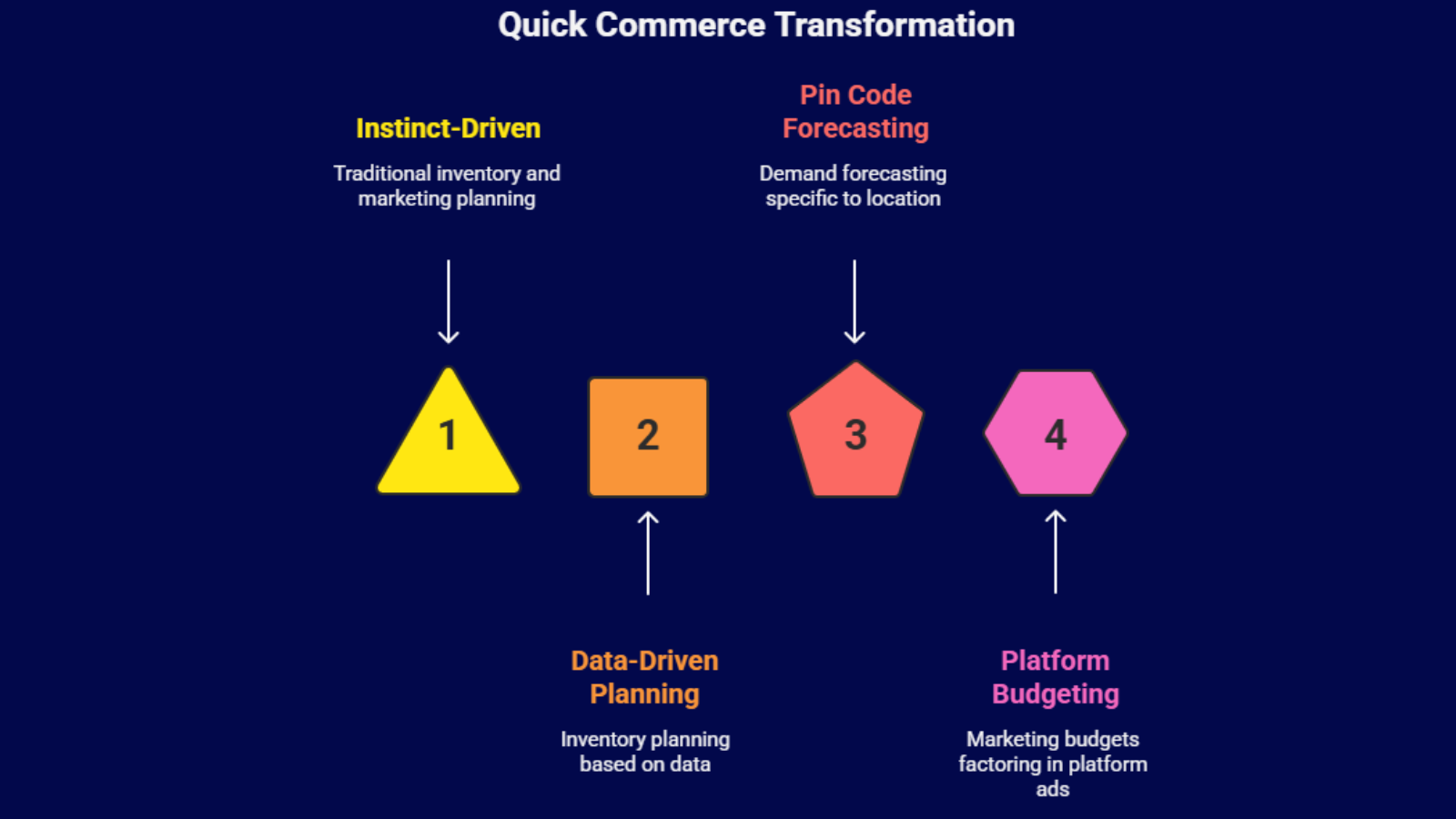 Quick commerce is no longer an experimental channel. It directly influences how D2C brands plan inventory, forecast demand city by city, allocate marketing budgets, and define contribution margin targets.
When you are supplying 20 to 50 dark stores across multiple platforms, inventory planning becomes data-driven, not instinct-driven.
Demand forecasting must be pin code specific. Marketing budgets must factor in platform ads and discount participation.
Most importantly, contribution margin targets need to be recalibrated because quick commerce margins typically stabilize between 15 to 22 percent in many FMCG and personal care categories, lower than owned website margins but strong enough to support scale if monitored properly.
The real risk is revenue growth without profit growth. If founders track only GMV and not true net realization after commission, discounts, ad spends, and deductions, quick commerce margins can quietly erode.
The solution is visibility and control. With Base.com PIM, you can manage and standardize product data, pricing, and pack configurations across all marketplaces and quick commerce platforms from one central dashboard.
That means consistent MRP, better pricing alignment, faster updates, and tighter margin tracking. Scale smart, stay in control of your numbers, and grow sustainably with Base.com.
Frequently Asked Questions
1. Are quick commerce margins lower than marketplace margins?
In most categories, yes. Marketplace commission ranges between 15 to 25 percent, while quick commerce can go up to 35 percent, including visibility fees, which reduces effective contribution margin for D2C brands.
2. Can small D2C brands survive on quick commerce margins?
Yes, but only if they optimize SKU mix, packaging cost, and discount participation. Without careful monitoring, smaller brands may struggle with cash flow pressure.
3. Which Indian platforms impact margins the most?
Blinkit, Zepto, Swiggy Instamart, BB Now, Flipkart Minutes, and Dunzo all have slightly different commission structures. The margin impact depends on category and negotiated terms.
4. Is quick commerce good for premium brands?
It can be. Premium brands may maintain higher realization if they avoid deep discounting and focus on strong brand positioning.
5. How often should brands review quick commerce margins?
Ideally, every month. Commission changes, discount cycles, and campaign spends can quickly shift net profitability.