Consumer behavior in India has shifted sharply toward immediacy. In metro cities, 10 to 20-minute delivery is no longer a novelty; it is an expectation. Quick commerce platforms such as Blinkit, Zepto, Swiggy Instamart, and BigBasket BB Now have expanded dark store networks aggressively across Tier 1 and Tier 2 cities.
Industry estimates suggest that India’s quick commerce market is already worth over $3 billion and growing at more than 40 percent year on year. That growth is pulling D2C brands into the ecosystem.
But quick commerce for D2C is not automatic growth. Most platforms operate on a 15 to 25 percent commission model, and brands often bear additional trade marketing spends for better visibility. Dark store shelf space is limited, so only fast-moving SKUs survive. If your SKU does not rotate every 10 to 15 days, it risks delisting.
Indian sellers also need to understand marketplace nuances. Quick commerce platforms prioritize city-level demand forecasting. If your supply chain cannot replenish within 24 to 48 hours, you lose ranking. Unlike marketplaces, discounting alone does not guarantee visibility. Algorithm weightage is driven by availability, fill rate, and repeat purchase velocity.
Quick commerce for D2C works best for SKUs priced under ₹500 with high reorder frequency and strong gross margins above 50 percent. Without these fundamentals, scale becomes expensive rather than profitable.
Understanding Quick Commerce in the Indian Context
Quick commerce in India operates through dense dark store networks, serving metros and Tier 2 cities with 10 to 30 minute delivery. However, dark stores stock only fast-moving SKUs, usually rotating within 10 to 15 days.
Indian D2C sellers must maintain 95 percent plus fill rates to protect rankings. Commission ranges from 15 to 25 percent, with additional trade marketing costs.
Gross margins below 45 percent often struggle to stay profitable. Quick commerce for D2C performs best for SKUs under ₹500 with high repeat demand and 48-hour replenishment capability.
The growth in quick commerce is driven by three major shifts:
- Consumers prefer convenience over price in urgent situations.
- Urban households are comfortable with app-based purchases.
- Platforms have built dense dark store networks in high-demand areas.
Many consumers now open quick commerce apps first when they need something immediately. This behavioral change is important. If your product fits into this instant-need category, ignoring quick commerce for D2C could mean losing high-intent buyers.
When Should D2C Brands Use Quick Commerce?
The decision should never be emotional or trend-driven. It should be backed by operational strength, margin clarity, and demand data.
Quick commerce in India is already a multi-billion-dollar segment growing at over 40 percent annually, but it is also one of the most operationally demanding channels.
Below are eight detailed factors Indian D2C sellers must evaluate before entering quick commerce for D2C. Each point includes practical nuances most founders learn only after onboarding.
1. Product Urgency Fit
 Start with one simple filter. Does your product solve an immediate need?
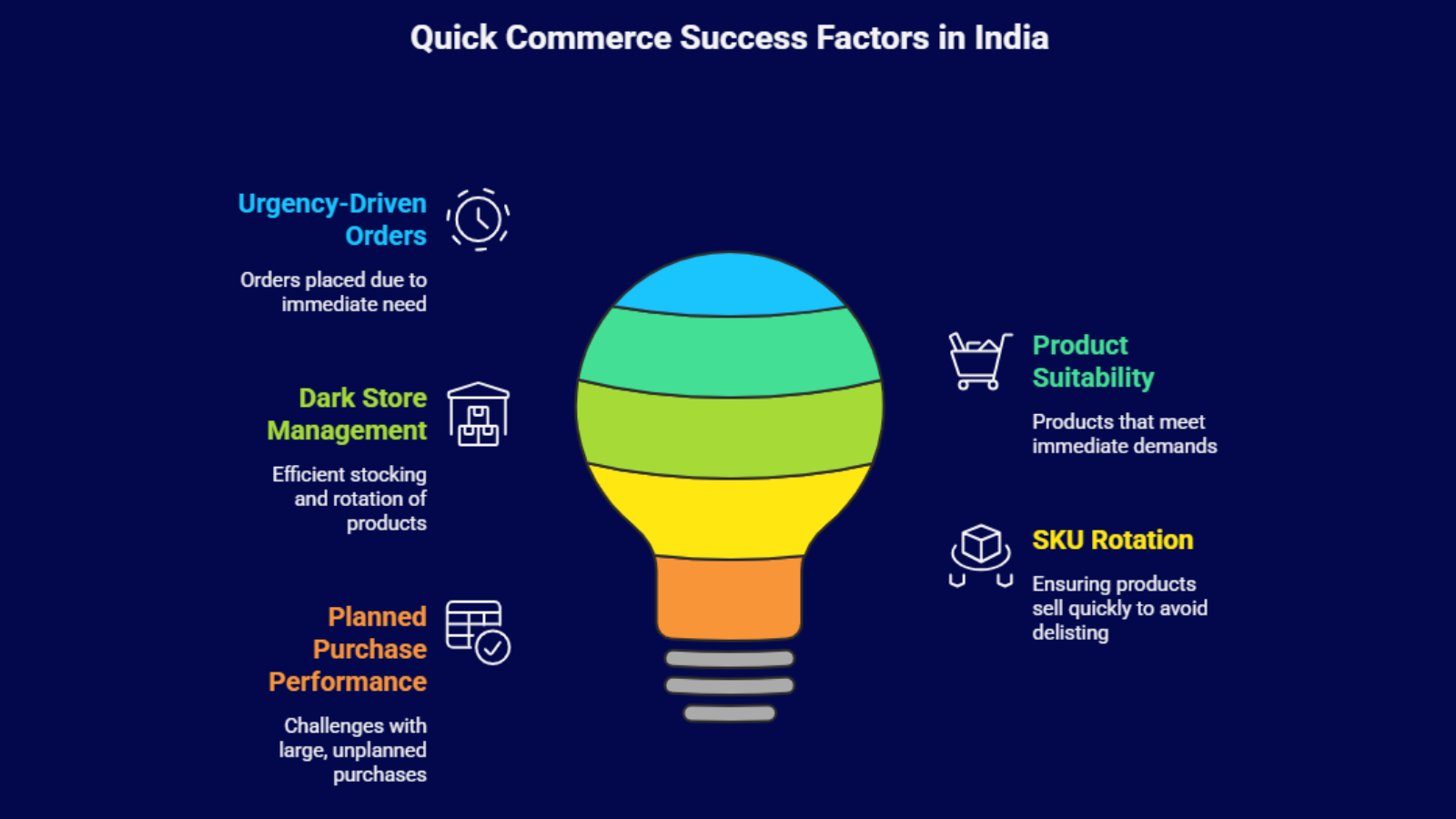
Quick commerce orders in India are largely driven by urgency. A large share of orders is placed within minutes of the consumption need.
That means the platform favors products that customers realize they require right now.
Products that typically work well:
- Snacks and ready-to-eat items
- Beverages and mixers
- Baby care essentials
- OTC wellness products
- Personal hygiene and grooming
Business nuance Indian sellers miss:
- Dark stores stock limited SKUs, often between 2,000 to 3,000 per location. Slow movers are removed quickly.
- If your SKU does not rotate in 10 to 15 days in a specific micro-market, it risks delisting.
- Planned purchases above ₹1,500 usually underperform unless backed by a strong brand recall.
If urgency is weak, quick commerce for D2C will struggle. When customers feel the need right now and expect instant delivery your product fits naturally into quick commerce for D2C.
2. High Frequency Purchase Cycle
Quick commerce platforms prioritize repeat velocity over one-time spikes.
Before entering, calculate:
- Average reorder period
- Monthly consumption pattern
- Customer lifetime value
Examples of strong repeat categories:
- Protein bars and health drinks
- Skincare basics like cleansers
- Daily supplements
- Household consumables
Key insight:
Products priced below ₹500 with reorder cycles under 30 days perform best. High repeat rate increases ranking and reduces paid promotion dependency. That is when quick commerce for D2C becomes scalable instead of expensive. If your category sees frequent reorders and steady consumption it becomes easier to scale through quick commerce for D2C.
3. Margin Sustainability
 This is where many D2C brands fail.
Platform economics typically include:
- 15 to 25 percent commission
- Trade marketing fees for banner visibility
- Discount participation during sale events
- Warehousing and inwarding charges
Before onboarding, calculate the contribution margin clearly:
- Selling price
- Cost of goods
- Platform commission
- Marketing spend
- Logistics and replenishment cost
Important benchmark:
Gross margins below 45 percent often struggle to remain profitable in quick commerce.
Unlike marketplaces, deep discounting does not always guarantee a higher ranking. Platforms prioritize availability, fill rate, and velocity. If margins are thin, quick commerce for D2C can become a cash drain. Brands with healthy margins and room for commissions and discounts tend to perform sustainably in quick commerce for D2C.
4. Inventory Forecasting Capability
Quick commerce is hyperlocal. Demand varies by pin code.
You must be able to:
- Forecast city-wise demand
- Maintain 95 percent plus fill rate
- Replenish within 24 to 48 hours
Operational reality:
If you commit to replenishing stock within 7 days but fail to deliver consistently, platforms may reduce your inventory allocation. Missed appointments at dark stores can delay inventory by another cycle, directly impacting ranking.
Systems required:
- Real-time inventory syncing
- Automated stock alerts
- Dedicated supply chain coordination
Without forecasting accuracy, quick commerce for D2C can damage brand perception and algorithm visibility. If you understand demand patterns across cities and pin codes you can unlock better efficiency in quick commerce for D2C.
5. Packaging and Logistics Readiness
 Dark stores handle products quickly. There is minimal cushioning.
Before listing, check:
- Is the packaging durable enough for stacking?
- Is labeling compliant with FSSAI or category norms?
- Is MRP clearly printed and updated?
- Is the SKU compact enough for shelf optimization?
Nuances sellers often miss:
- Shelf space allocation depends on pack size efficiency.
- Large cartons increase storage cost and reduce reorder priority.
- Damaged packaging leads to immediate RTV returns and loss of slot.
Operational misalignment increases return rates and hurts relationships with category managers. Products that are easy to store stack and transport without damage are far better suited for quick commerce for D2C.
6. Impulse Purchase Potential
Impulse drives quick commerce growth. The decision-making window is short.
Products under ₹500 see faster conversions because customers do not overthink purchases.
Your product should trigger:
- Last-minute cravings
- Emergency restocking
- Small self-indulgence
Conversion nuance:
Unlike traditional marketplaces, quick commerce customers rarely scroll beyond top category placements. Impulse categories benefit from being discoverable in under 5 clicks.
If your product requires education or long-form storytelling, quick commerce for D2C may not provide the right environment. Lower priced products that trigger impulse buying decisions often convert faster on quick commerce for D2C.
7. Ability to Use Platform Data
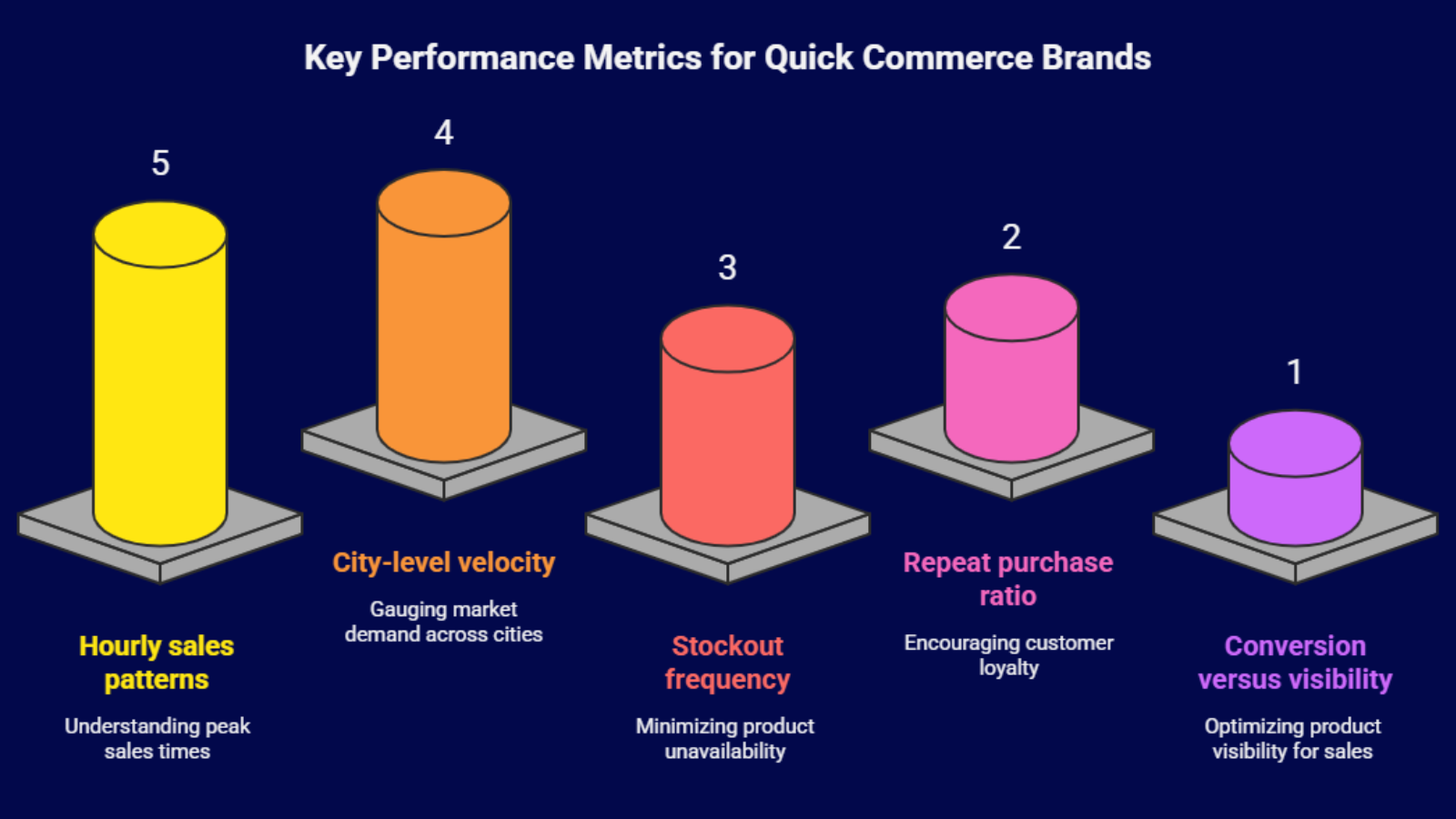 Quick commerce platforms provide daily or weekly performance data.
Brands that actively analyze:
- Hourly sales patterns
- City-level velocity
- Stockout frequency
- Repeat purchase ratio
- Conversion versus visibility
perform better than passive sellers.
Advanced insight:
Some Indian cities show demand spikes during weekends or salary credit cycles. Brands that adjust replenishment and promotional spends based on these micro-patterns gain an advantage.
Quick commerce for D2C rewards data agility. Static planning leads to lost slots. Brands that regularly track data and adapt inventory and pricing strategies gain an edge in quick commerce for D2C.
8. Brand Visibility Goals
Quick commerce apps have millions of daily active users in major cities. For emerging brands, presence can improve recall significantly.
This channel works well when:
- You are launching a new SKU
- You are entering a new city
- You want rapid sampling through discounts
- You want to test demand before offline expansion
Marketplace nuance:
Visibility often requires paid placements or participation in platform-led campaigns. However, consistent sell-through reduces dependence on paid exposure over time.
Quick commerce for D2C should be treated as a strategic distribution layer, not only a revenue source. For some brands, awareness justifies moderate margins in early phases.
Quick commerce is not just fast delivery. It is a high-velocity retail ecosystem that demands operational discipline, financial clarity, and hyperlocal planning.
Indian D2C sellers who enter with clear margins above 45 percent, repeat cycles under 30 days, replenishment reliability within 48 hours, and fill rates above 95 percent are more likely to succeed.
When urgency, frequency, and supply chain discipline align, quick commerce for D2C becomes a powerful growth engine rather than an expensive experiment. When the objective is to build visibility test new SKUs or enter new markets it makes sense to explore quick commerce for D2C.
Comparing Channel Fit and Measuring Success in Quick Commerce
Channel selection should be intentional, not reactive. Your brand website works best for planned purchases where customers spend time reading ingredients, reviews, and brand stories.
Average delivery timelines range between 2 to 5 days, and conversion depends heavily on trust, content depth, and performance marketing efficiency.
Marketplaces like Amazon and Flipkart attract price-sensitive buyers comparing ratings and discounts, with 1 to 3-day delivery windows. Advertising costs on these platforms continue to increase, and visibility is often driven by sponsored placements.
Quick commerce works differently. Delivery happens in 10 to 30 minutes, and intent is immediate. Orders are frequently placed within minutes of need realization.
For Indian D2C sellers, this means your SKU must convert quickly without long education cycles. Dark stores prioritize high sell-through and expect inventory rotation within 10 to 15 days per location.
After launch, measurement determines sustainability. Track net margin per order after 15 to 25 percent commission and trade marketing spends. Maintain fill rates above 95 percent to avoid ranking drops.
Monitor repeat rate within 30 days, inventory turnover by city, and stockout percentage below 5 percent. If repeat improves and replenishment cycles stay within 48 hours, quick commerce for D2C is structurally positioned to scale profitably.
Common Mistakes D2C Brands Make
 Many D2C brands struggle in quick commerce because they approach it like a regular marketplace instead of a hyperlocal, fast-moving retail system. Most failures are operational and financial, not product-related. Common mistakes include:
- Entering without margin planning. Brands ignore 15 to 25 percent commission, trade spends, platform discounts, and logistics costs. Without a clear contribution margin, growth becomes unprofitable.
- Underestimating working capital pressure. Quick commerce requires faster replenishment cycles, which means higher upfront inventory commitment at the city level.
- Ignoring replenishment timelines. Dark stores operate on strict appointment systems. Missing a delivery slot can push inward by several days and affect ranking.
- Poor fill rate management. Falling below 95 percent availability can reduce algorithm visibility and impact reorders.
- Over-discounting to gain placement. Temporary spikes from heavy discounts rarely convert into repeat demand.
- Sending oversized SKUs. Large packaging reduces shelf efficiency and limits reorder quantities.
- Not aligning pricing with nearby competitors. Quick commerce customers compare quickly within a category.
- Failing to track weekly data. City-wise sell-through, repeat rate within 30 days, and stockout percentage must be reviewed consistently.
Quick commerce demands disciplined operations and constant monitoring. It cannot run on autopilot.
Conclusion
Quick commerce is powerful, but only when aligned with product behavior and operational strength. If your product fits urgent demand, has healthy margins, and your team can manage fast-moving inventory, then quick commerce for D2C becomes a strategic growth lever.
It allows brands to capture high-intent customers at the moment of need. But it requires discipline, forecasting, and data-driven decision-making.
If your brand is exploring expansion into multiple channels, including quick commerce, Base.com can help you manage integrations, inventory sync, and performance tracking in one place. Explore how Base.com simplifies complex commerce operations and helps brands scale with confidence.
Frequently Asked Questions
1. What is quick commerce for D2C?
Quick commerce for D2C refers to ultra-fast delivery platforms where direct-to-consumer brands list products for delivery within minutes instead of days. It focuses on urgent and impulse purchases rather than planned shopping behavior.
2. Which Indian platforms support quick commerce?
Major players include Blinkit, Zepto, Swiggy Instamart, BigBasket, BB Now, and Flipkart Minutes. These platforms operate through dark stores across major Indian cities.
3. What products perform best in quick commerce?
High-frequency and urgent-use products such as snacks, beverages, personal care essentials, and daily household consumables perform best because customers need them immediately.
4. Is quick commerce profitable for D2C brands?
It can be profitable if margins remain healthy after commissions and promotional costs. Brands must calculate contribution margin carefully before entering the channel.
5. Should every D2C brand use quick commerce?
No. Brands should use quick commerce only if their products fit urgent demand, margins are sustainable, and operational systems can support hyperlocal inventory management.