Online shopping behavior in India has shifted dramatically in the past five years. Earlier, a two-day delivery window was considered fast. Today, customers in major cities expect everyday items to arrive in 10–20 minutes, which is where quick commerce comes in.
To understand the opportunity for brands, it helps to first answer what quick commerce is. Quick commerce refers to a delivery model where products are stored in small neighborhood warehouses called dark stores, allowing platforms to deliver orders almost instantly. India already has over 4,000 dark stores across cities like Bengaluru, Delhi, and Mumbai, and the number is expected to cross 5,500 by 2026.
Platforms such as Zepto, Blinkit, Swiggy Instamart, Amazon Fresh, Flipkart Minutes, and BB Now together process 2.5–3 million orders per day. The average order value ranges between ₹350 and ₹600, which means the model is built around frequent purchases rather than bulk buying.
For Indian D2C sellers, the biggest opportunity lies in high-velocity categories. Products priced between ₹150 and ₹700 perform best because customers buy them impulsively. Examples include protein bars, instant coffee, skincare minis, ready-to-eat snacks, electrolyte drinks, and pet treats.
Another nuance many brands miss is SKU size optimization. Quick commerce platforms prefer compact SKUs under 500 grams because dark store shelf space is limited. Brands that launch quick commerce exclusive SKUs often see 20–30 percent higher repeat purchases. Let’s see how quick commerce has evolved in India.
What Is Quick Commerce?
Before looking at how brands can benefit from it, it is important to clearly understand what is quick commerce and how the model actually works on the ground.
Quick commerce is a retail model where products are delivered within 10 to 30 minutes using small neighborhood warehouses known as dark stores. Unlike traditional e-commerce warehouses located on the outskirts of cities, these micro fulfillment centers are placed 2 to 4 km from high-demand residential clusters so delivery riders can complete orders quickly.
India already has over 4,500 dark stores operated by Zepto, Blinkit, and Instamart, and the number is expected to cross 6,000 by 2027 as platforms expand deeper into metro and tier 1 cities.
 For Indian D2C sellers, the opportunity lies in understanding how inventory is selected for these stores. A typical dark store stocks 2,000 to 3,000 SKUs, compared to over 1 lakh SKUs on marketplaces like Amazon. This means only high-velocity products make the cut.
Some proven use cases for D2C brands include:
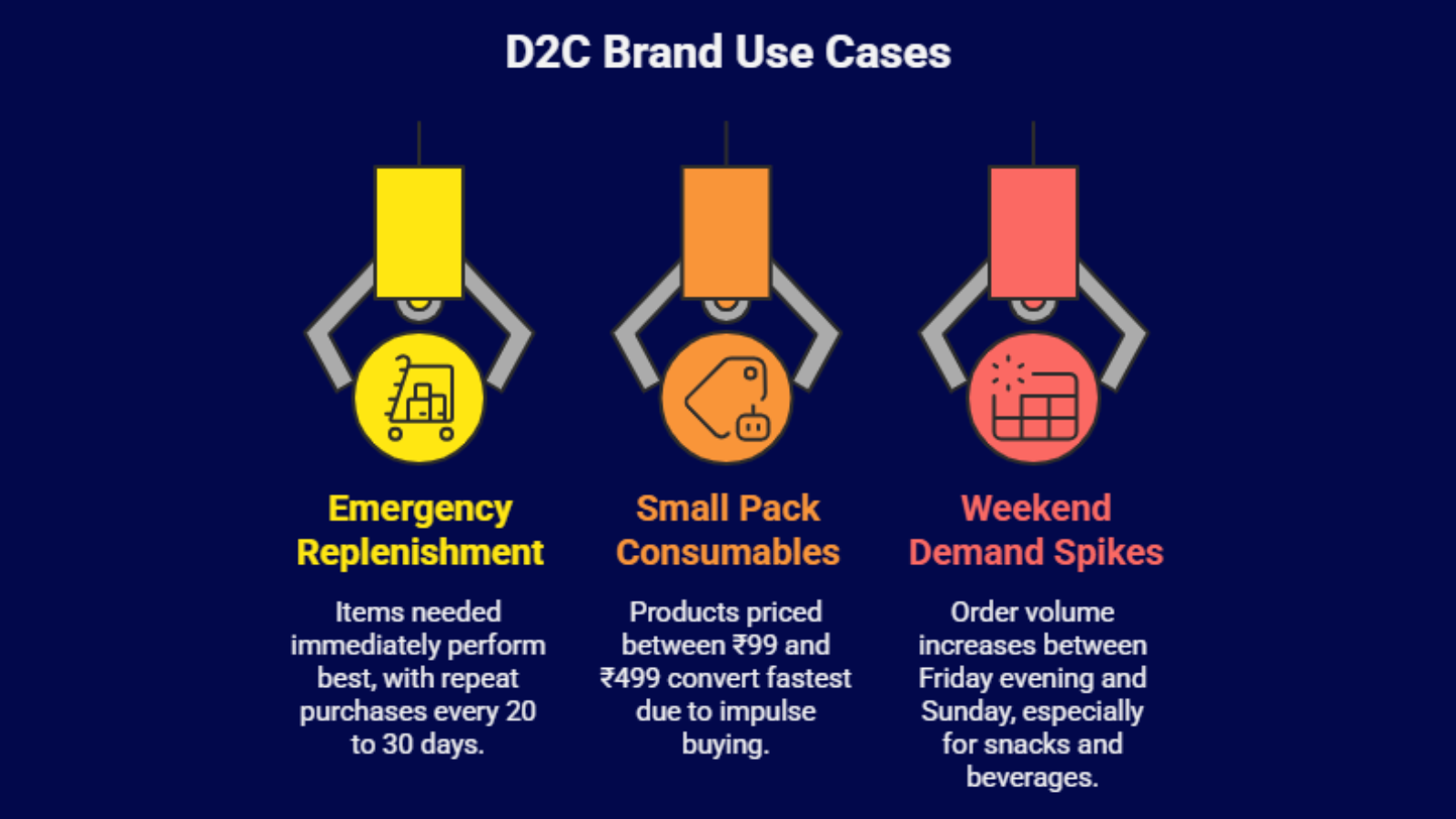
1. Emergency replenishment products
Items that customers need immediately perform best.
Examples:
- face wash
- deodorants
- sanitary pads
- baby wipes
These categories see repeat purchases every 20 to 30 days, making them ideal for quick commerce.
2. Small pack consumables
Products priced between ₹99 and ₹499 convert fastest because they fit the impulse buying behavior of quick commerce users.
Examples:
- protein bars
- instant coffee sachets
- electrolyte drinks
- snack packs
3. Weekend demand spikes
Data from Blinkit and Instamart shows 20–25 percent higher order volume between Friday evening and Sunday, especially for snacks, beverages, and ready-to-eat foods. D2C food brands often plan flash inventory drops around these peaks.
Another nuance many sellers overlook is inventory rotation speed. Dark stores typically expect 7–10 day sell-through cycles. Brands that cannot maintain this velocity risk getting delisted from shelves.
Because of these constraints, success in quick commerce is less about large catalog size and more about fast-moving SKUs that solve immediate consumer needs.
Why Quick Commerce Is Growing So Fast in India
 To understand what is quick commerce and how it is changing D2C brands in 2026, it is important to look at the shift happening in India’s retail ecosystem. India has quickly become one of the fastest-growing instant delivery markets in the world. The quick commerce sector crossed $6–7 billion in 2024 and is expected to reach nearly $25 billion by 2028, growing at around 35–40 percent annually.
Platforms such as Zepto, Blinkit, Swiggy Instamart, Amazon Fresh, Amazon Now, Flipkart Minutes, and BigBasket BB Now are building dense delivery networks across metro cities. Today, these platforms together process more than 3 million orders per day, with average delivery times ranging between 10 and 18 minutes in cities like Bengaluru, Mumbai, and Delhi.
One of the biggest drivers of quick commerce growth in India is order frequency. Unlike traditional e-commerce, where customers place one large order every few weeks, quick commerce users typically place 6–8 small orders per month. The average order value usually falls between ₹350 and ₹600, which reflects impulse-driven purchasing behavior.
For D2C sellers, this change creates a new distribution opportunity. Quick commerce platforms operate using dark stores located within 2–3 km of high-demand residential clusters. Zepto operates 350+ dark stores, while Blinkit has crossed 400 stores, allowing brands to reach customers almost instantly.
Another important nuance for Indian sellers is product discovery. On platforms like Blinkit and Instamart, over 60 percent of purchases come from homepage merchandising sections rather than direct search, which means brand visibility inside curated lists plays a major role in driving sales.
Major Quick Commerce Platforms in India
| Platform | Key Strength | Category Focus |
|---|---|---|
| Zepto | Ultra-fast 10–20 minute delivery network | groceries, snacks |
| Blinkit | Large SKU selection and strong merchant partnerships | groceries, essentials |
| Swiggy Instamart | Strong delivery fleet from the Swiggy ecosystem | groceries, daily use |
| Amazon Fresh | Reliable inventory with scheduled and fast delivery | groceries |
| Amazon Now | Amazon’s rapid delivery expansion in metros | essentials |
| BigBasket BB Now | Tata-backed infrastructure and supply chain | groceries |
| Flipkart Minutes | Emerging quick delivery model from Flipkart | daily essentials |
These platforms are shaping quick commerce trends 2026 by expanding beyond groceries into high-velocity consumer categories.
Categories Growing Fast on Quick Commerce Platforms
| Category | Typical Price Range | Why It Works in Quick Commerce |
|---|---|---|
| Packaged snacks | ₹50 – ₹300 | impulse purchases and frequent repeat orders |
| Personal care essentials | ₹150 – ₹600 | emergency replenishment products |
| Health and fitness products | ₹200 – ₹800 | growing demand for supplements and hydration drinks |
| Electronics accessories | ₹200 – ₹1,500 | urgent purchases like chargers and earbuds |
| Pet care products | ₹150 – ₹700 | repeat purchases every few weeks |
For Indian D2C sellers, the biggest opportunity lies in small pack consumables and repeat purchase products. Brands that design quick commerce specific SKUs under 500 grams and maintain 7–10 day inventory turnover cycles tend to perform significantly better.
As a result, the rapid expansion of these platforms is not only driving instant delivery trends but also creating a completely new growth channel for modern digital brands.
How Leading D2C Brands Are Using Quick Commerce to Change Distribution
Understanding what is quick commerce and how it is changing D2C brands in 2026 becomes clearer when we look at how some of India’s strongest digital brands are using instant delivery platforms. Companies like Mamaearth, boAt, WOW Skin Science, Wakefit, and Lenskart are not simply listing products on Zepto or Blinkit.
They are redesigning their product mix, pricing, and SKU strategy specifically for quick commerce platforms such as Zepto, Instamart, Blinkit, Amazon Fresh, and Flipkart Minutes.
Below are five examples that reveal practical strategies Indian D2C sellers can learn from.
1. Mamaearth: Designing replenishment-driven SKUs
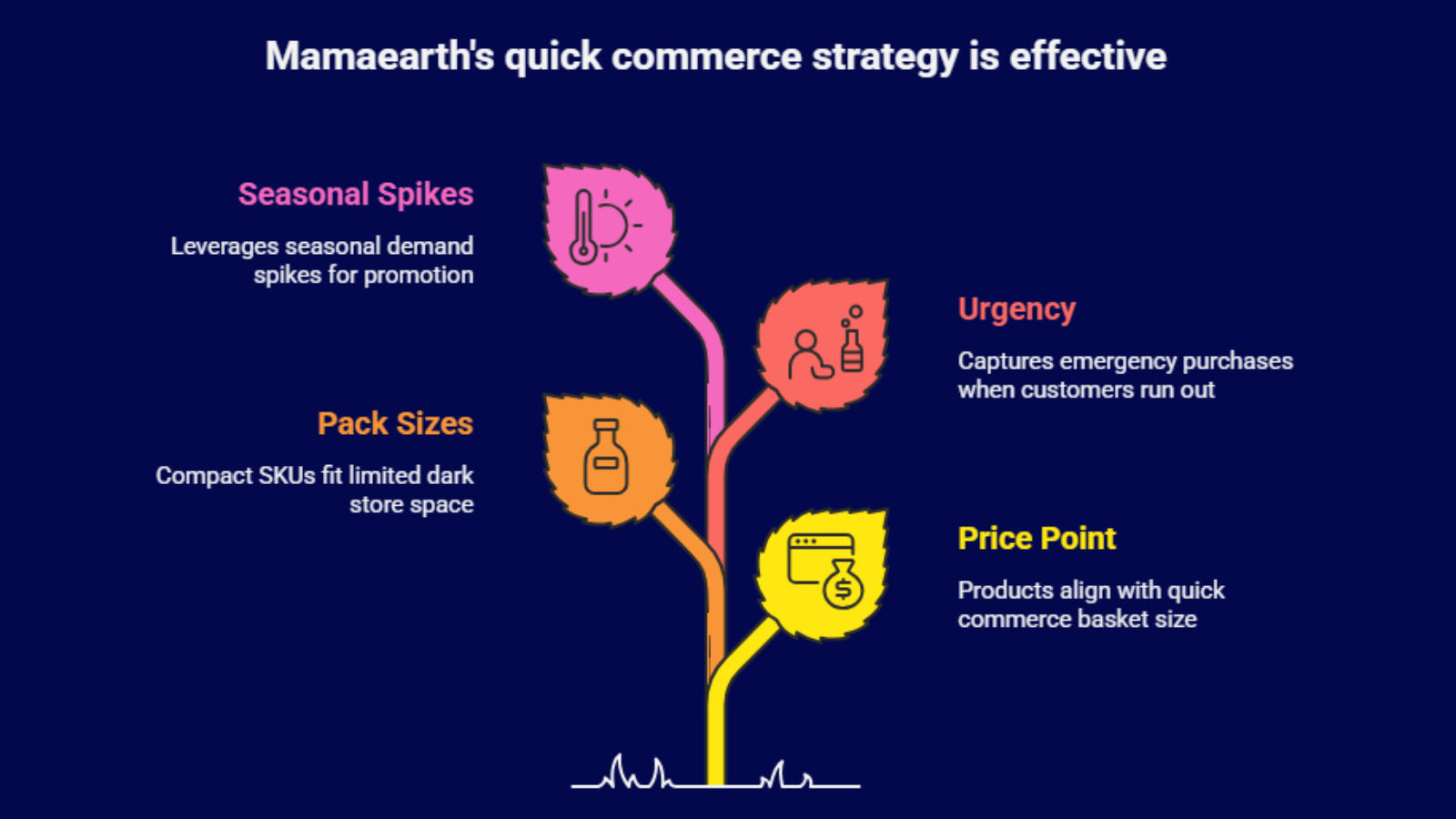 Mamaearth has built a strong presence in India’s online beauty market and holds roughly 5.4 percent share in online beauty and personal care sales. The brand performs well on quick commerce because its products fall into high-frequency replenishment categories.
What Mamaearth is doing right:
- Fast-moving SKUs under ₹499: Products like face wash, sunscreen, and serums fall into the ₹250–₹450 range, which matches the average quick commerce basket size of ₹350–₹600.
- Small pack sizes for dark stores: Instead of large bottles, Mamaearth focuses on compact SKUs that fit limited shelf space inside dark stores.
- Urgency-driven use cases: Customers often run out of sunscreen or face wash unexpectedly. Quick commerce allows the brand to capture these emergency purchases.
- Seasonal spikes: Sunscreen and hair oils see 20–30 percent demand spikes during summer, which platforms promote heavily through app banners.
This strategy aligns directly with instant delivery trends, where repeat purchase of personal care products performs best.
2. boAt: Capturing urgent electronics demand
boAt generated ₹3,100+ crore in revenue in FY24 and dominates the affordable audio accessories category. The brand is now experimenting with quick commerce to serve urgent accessory purchases.
What boAt is doing right:
- Selling quick replacement accessories: Charging cables, earbud cases, and adapters are ideal for quick commerce because customers often need them immediately.
- Price optimization: Accessories priced between ₹299 and ₹999 convert faster in instant delivery environments.
- Weekend demand spikes: Data from Blinkit shows electronics accessory orders increase 15–20 percent on weekends, especially late evening.
- Impulse discovery: Many buyers discover accessories through app recommendations rather than search.
For D2C sellers, the insight is clear. Urgency-based electronics products perform better than high consideration electronics.
3. WOW Skin Science: Leveraging repeat consumption
 WOW Skin Science has built a large digital following in natural personal care. Quick commerce helps the brand capture repeat consumption cycles.
What WOW Skin Science is doing right:
- Products with predictable usage cycles: Shampoo, face wash, and body wash usually run out every 25–40 days, which fits quick commerce replenishment behavior.
- Category expansion: The brand lists smaller packs of skincare products designed specifically for quick commerce platforms.
- Strategic placements: Beauty brands that invest in homepage promotions on Instamart or Blinkit often see 2–3x higher conversion rates.
This approach supports the larger quick commerce growth in India within the beauty category.
4. Wakefit: Expanding into small home essentials
Wakefit originally built its business around mattresses, but large furniture products do not fit the instant delivery model. Instead, the company is experimenting with smaller home accessories.
What Wakefit is doing right:
- Quick commerce-friendly products: Cushions, pillows, mattress protectors, and comfort accessories.
- Affordable pricing: Most of these products fall within ₹399 to ₹1,200, which works within quick commerce order baskets.
- Problem-solving purchases: Customers sometimes need pillows or bedding urgently when guests arrive, creating impulse demand.
This shows how quickly commerce trends 2026 are expanding into home categories beyond groceries.
5. Lenskart: Using accessories for instant delivery
 Lenskart dominates the eyewear market with strong online distribution. While prescription glasses require customization, the company is using quick commerce to support accessories.
What Lenskart is doing right:
- Selling fast-moving add-ons: Lens cleaning sprays, wipes, contact lens solutions.
- Low-friction purchases: These products are priced between ₹150 and ₹500, making them ideal for impulse buying.
- Cross-category visibility: Eye care products often appear in health and personal care sections inside quick commerce apps.
This strategy allows Lenskart to participate in instant delivery trends even though its core product category requires customization.
Key Takeaways for Indian D2C Sellers
Across these brands, several patterns emerge that explain how quick commerce is changing D2C distribution:
- Products priced between ₹150 and ₹700 convert the fastest
- SKUs under 500 grams move faster due to dark store shelf limits
- Repeat purchase categories perform significantly better
- Homepage visibility drives over 60 percent of purchases on quick commerce apps
These shifts clearly show that quick commerce is not just another marketplace channel. It is a new distribution layer built around urgency, replenishment, and impulse purchasing behavior.
What Quick Commerce Means for the Future of D2C
Understanding what is quick commerce and how it is changing D2C brands in 2026 reveals a deeper shift in how consumers actually buy products. Indian shoppers are moving away from planned weekly shopping toward need-based purchasing throughout the week. Instead of buying groceries or personal care items once every 10–15 days, users now place 5–8 smaller orders per month on platforms like Zepto, Blinkit, and Instamart.
This shift is visible in platform data. Nearly 65 percent of quick commerce orders happen during impulse moments, such as late evening snack purchases, urgent personal care replenishment, or last-minute household needs. Average order values range between ₹350 and ₹600, which means products that fall within this price band tend to perform best.
For Indian D2C sellers, the biggest opportunity lies in designing SKUs and inventory strategies specifically for quick commerce platforms.
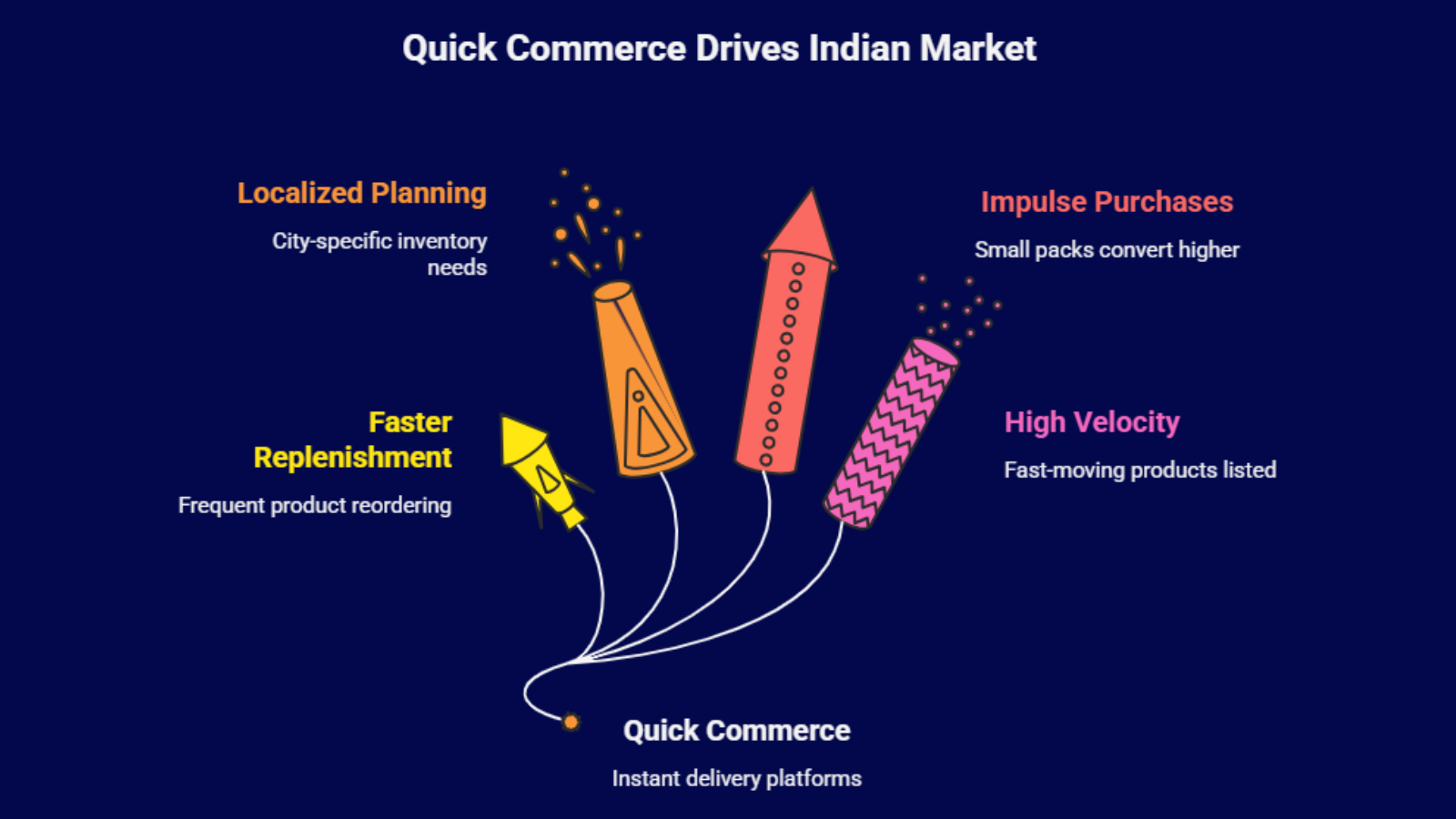 Key opportunities emerging from quick commerce growth in India include:
Faster replenishment cycles
Products like face wash, protein drinks, and pet food often repeat every 20–30 days, making them ideal for instant delivery platforms.
Localized inventory planning
Demand varies by city. For example, protein snacks and energy drinks sell 25 percent more in Bengaluru and Mumbai, while packaged sweets and beverages perform better in Delhi and Gurgaon.
Impulse purchase-driven launches
Small trial packs priced between ₹99 and ₹299 often convert 30–40 percent higher than full-size products on quick commerce apps.
High velocity SKU strategy
Dark stores typically stock 2,000–3,000 SKUs, compared to over 1 lakh SKUs on marketplaces, which means only fast-moving products remain listed.
For growing brands, managing inventory across multiple quick commerce platforms can become complex. This is where Base.com becomes useful for D2C sellers.
Base.com helps brands centralize order management, inventory syncing, and marketplace integrations across platforms such as Amazon, quick commerce channels, and brand websites. For example, if a brand supplies inventory to multiple quick commerce partners across different cities, Base.com can sync stock levels in real time, preventing overselling and ensuring dark store replenishment happens smoothly.
This is particularly important because quick commerce platforms often require inventory refresh every 7–10 days. With Base.com, brands can track sales velocity, automate stock updates, and manage fulfillment operations from a single dashboard.
In the coming years, brands that succeed will be the ones that treat quick commerce not just as another marketplace, but as a high-frequency distribution channel built around speed, localized demand, and real-time inventory management.
Frequently Asked Questions
1. Is quick commerce the right channel for my product category?
Not every product performs well on quick commerce platforms. Products that work best usually have high repeat purchase cycles and low decision time. Examples include snacks, personal care, beverages, baby products, and pet food. Large ticket or low frequency products typically struggle.
2. What kind of SKUs work best for quick commerce platforms?
Quick commerce platforms prefer compact and fast-moving SKUs. Dark stores usually stock only 2,000–3,000 products, so brands often create smaller packs priced between ₹99 and ₹499. Trial packs and travel sizes usually see faster adoption than large packs.
3. How much inventory do quick commerce platforms typically require?
Most platforms expect 7–10 days of rolling inventory at dark stores. Sellers usually supply stock to centralized hubs, which then distribute to multiple dark stores. Brands must plan frequent replenishment to avoid delisting due to low availability.
4. What margins and commissions should sellers expect?
Quick commerce platforms typically charge 20–35 percent commission, depending on category and visibility placements. Brands often allocate additional budgets for homepage banners, sponsored listings, and category placements, which significantly influence product discovery.
5. How do customers discover new brands on quick commerce apps?
Unlike traditional marketplaces, discovery is mostly app-driven rather than search-driven. Over 60 percent of purchases happen through curated sections such as trending, recommended, or quick picks. Brands that invest in merchandising and promotions usually gain faster traction.