
Quick commerce works on speed, but the real engine behind it is location data. Most platforms promise delivery in 10 to 20 minutes, which means products must already sit inside dark stores within a 2 to 3-kilometer radius of customers. Because of this, city-level demand signals are almost useless.
What matters is demand at the neighborhood level. A chocolate brand might sell 400 units a week in one Bengaluru pincode but only 60 units in the next pincode. This is why location intelligence, quick commerce, and pincode-level analytics are becoming essential for Indian sellers.
For Indian D2C brands selling through Blinkit, Zepto, Swiggy Instamart, and BigBasket Now, the biggest opportunity lies in understanding hyperlocal demand data that most sellers overlook. According to Redseer, India’s quick commerce market is expected to cross $9 billion by 2027, growing at over 40 percent CAGR.
However, less than 30 percent of brands actively analyze pincode-level analytics, which means most sellers are making stocking decisions without clear local demand signals.
This is where a strong Q-commerce data strategy becomes a competitive advantage. Brands that analyze location intelligence and quick commerce signals can adjust assortment, pricing, and inventory faster than competitors.
Real use cases of hyperlocal demand insights in Indian quick commerce
- Premium protein snacks sell 2.4x more in tech corridors like HSR Layout and Whitefield compared to traditional residential areas.
- Instant noodles see 30 to 40 percent higher order spikes during monsoon evenings in metros like Mumbai and Bengaluru.
- Baby care products show consistent demand between 8 AM and 11 AM in family-dense pincodes with large apartment complexes.
- Ready-to-cook frozen foods perform 3x better near office clusters and co-living hubs where working professionals rely on quick meals.
- In Delhi NCR, impulse categories like chocolates and ice creams account for nearly 22 percent of late-night orders after 10 PM.
- Certain health drinks and immunity boosters sell 40 percent more in premium gated communities where health-conscious households dominate.
- Regional snack brands often see unexpected demand clusters in specific pincodes due to migrant populations, a pattern visible through hyperlocal demand data.
- Order basket values can vary 20 to 35 percent between neighboring postcodes, making the pricing strategy a location-driven decision.
- Some dark stores experience SKU velocity differences of up to 5x for the same product across two delivery zones.
- Quick commerce platforms typically prioritize the top 2,000 SKUs per dark store, meaning brands must use pincode-level analytics to justify inventory placement.
These patterns highlight why Indian sellers must rely on location intelligence, quick commerce, hyperlocal demand data, pincode-level analytics, and a strong Q-commerce data strategy to succeed. Without these insights, brands risk stocking the wrong products in the wrong neighborhoods, which directly impacts visibility, sales velocity, and platform rankings.
Understood. Here is the revised version with fewer pointers, more connected paragraphs, and still specific, data-backed, and useful for Indian D2C sellers, with each section around 200 words.
How Hyperlocal Demand Data and Pincode Level Analytics Shape Quick Commerce Strategy
 Quick commerce platforms generate massive datasets from every order. These datasets include product demand, purchase timing, delivery location, order frequency, and price sensitivity. When this information is analyzed consistently, it becomes hyperlocal demand data. This helps brands understand how buying behavior changes across neighborhoods rather than at a broad city level.
For Indian D2C sellers on platforms like Blinkit, Zepto, and Swiggy Instamart, these insights are extremely valuable. Industry reports show that more than 65 percent of quick commerce orders in India happen between 6 PM and 11 PM. This window is largely driven by impulse purchases such as chips, chocolates, ice cream, and ready meals.
Brands that align their inventory with these demand spikes often see 20 to 35 percent higher SKU velocity inside dark stores. Seasonal patterns also become visible through hyperlocal demand data. For example, instant noodles and ready-to-cook meals can see around 30 percent higher sales during monsoon months, while cold beverages and electrolyte drinks grow significantly during summer.
This is where pincode-level analytics becomes important. Quick commerce dark stores usually serve customers within a 2 to 3 kilometer delivery radius, which means each pincode behaves like its own micro market. Demand patterns can change dramatically even between two neighboring delivery zones.
For example, Bengaluru’s 560102 (HSR Layout) often shows strong demand for protein snacks and ready meals from young professionals, while 560034 (Koramangala residential pockets) shows higher morning demand for groceries and dairy. Using location intelligence, quick commerce brands can identify these patterns and allocate inventory where demand is strongest.
Building a Strong Q-commerce Data Strategy
Winning in quick commerce is not about collecting more data. It is about using the right data to make faster decisions at the neighborhood level. For Indian sellers operating on platforms such as Blinkit, Zepto, Swiggy Instamart, and BigBasket Now, the biggest advantage comes from turning location intelligence and quick commerce signals into operational decisions.
A strong Q-commerce data strategy combines multiple sources of information. These include platform sales data, delivery radius performance, pricing movements, competitor availability, and customer demographics. When these signals are layered with hyperlocal demand data and pincode-level analytics, brands can identify exactly where demand is rising, where inventory should be placed, and which SKUs deserve dark store space.
This approach is becoming increasingly important in India. Industry reports show that quick commerce platforms now operate over 4,000 dark stores across major Indian cities, and each store typically stocks only 2,000 to 3,500 SKUs. That means brands compete heavily for limited inventory slots. Products that demonstrate strong location intelligence, quick commerce signals in specific pin codes, are more likely to remain stocked.
1. Demand Forecasting
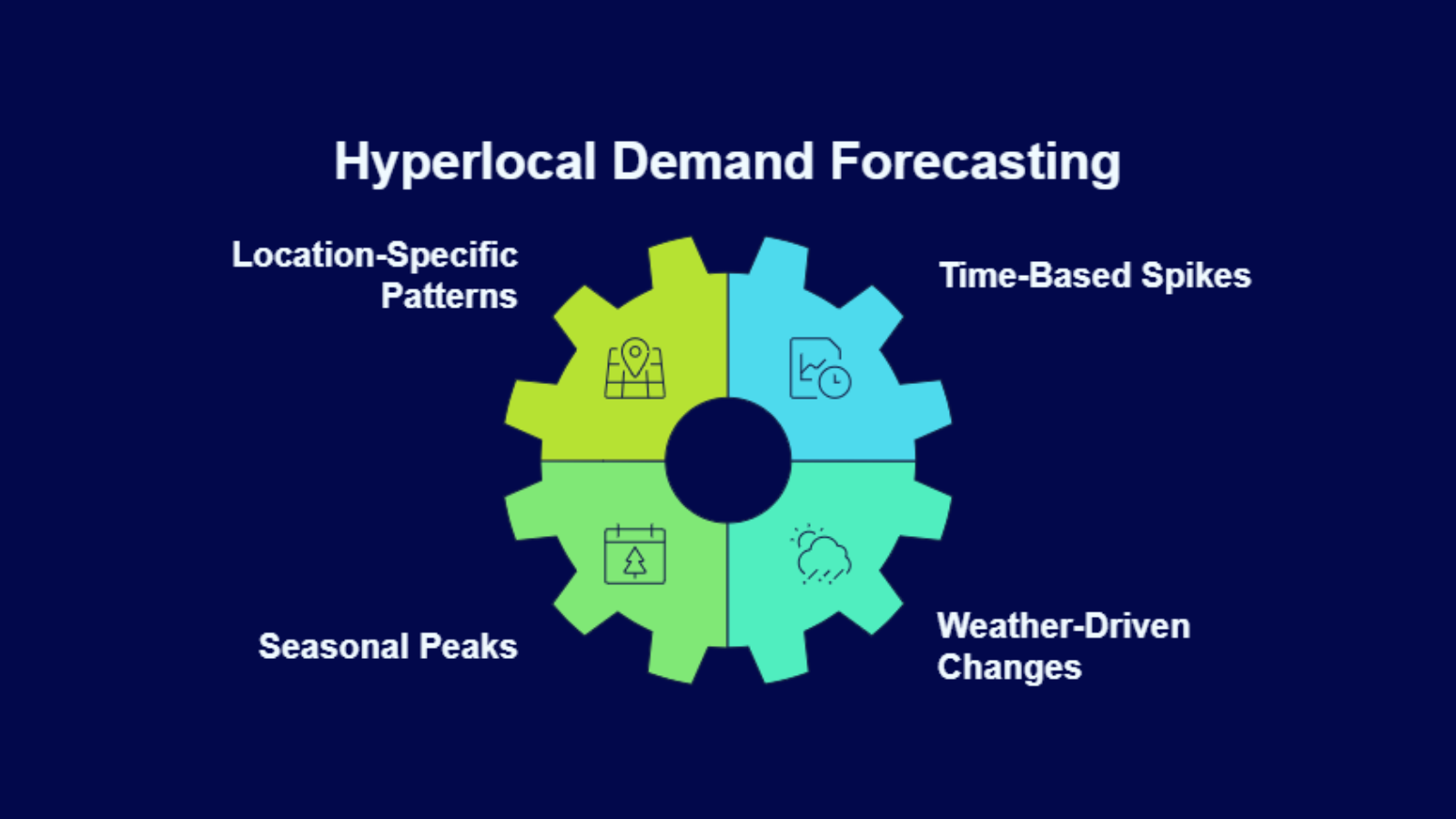 Demand forecasting is the foundation of any effective Q-commerce data strategy. Unlike traditional ecommerce forecasting, quick commerce requires predictions at the neighborhood level.
Using hyperlocal demand data, brands can identify patterns such as time-based demand spikes and weather-driven consumption changes. For example, ready-to-eat meals often see 25 to 35 percent higher sales after 7 PM in tech-heavy areas like HSR Layout and Whitefield in Bengaluru, where working professionals rely on fast food options. In contrast, breakfast staples such as bread, milk, and eggs perform strongly in residential zones between 7 AM and 10 AM.
Hyperlocal forecasting also helps brands prepare for seasonal spikes. Instant noodles, soups, and packaged snacks typically experience 30 percent higher sales during monsoon months, while cold beverages and electrolyte drinks can grow 40 percent during peak summer weeks.
Without hyperlocal demand data, brands often distribute inventory evenly across locations. This leads to slow-moving stock in low-demand areas while high-demand dark stores run out of inventory, causing lost sales and reduced platform visibility.
2. Assortment Optimization
Assortment optimization is one of the most overlooked parts of a quick commerce strategy. Each dark store has limited shelf space, which forces platforms to prioritize products that sell quickly.
This is where pincode-level analytics becomes essential. By analyzing sales velocity at the neighborhood level, brands can determine which SKUs deserve placement in specific delivery zones.
For example, protein bars and healthy snacks often sell 2 to 3 times faster in urban professional clusters, while family-oriented neighborhoods show stronger demand for larger grocery packs and household essentials. Regional snack brands also benefit from hyperlocal demand data, as certain pincodes with migrant populations often show strong demand for regional products.
Platforms track SKU velocity closely. Products that maintain strong local sales performance are more likely to stay listed in dark store inventories, while slow-moving SKUs are often replaced.
3. Pricing Intelligence
 Pricing is another area where location intelligence and quick commerce play a critical role. Prices can vary across quick commerce platforms and ven between pincodes due to demand patterns and promotional strategies.
For instance, a snack product priced at ₹99 on one platform may drop to ₹89 in a high-competition delivery zone where multiple dark stores overlap. Monitoring these micro price shifts helps brands remain competitive without sacrificing margins.
Indian sellers also need to watch competitor availability. If a competing brand goes out of stock in a specific pin code, demand often shifts immediately. Brands that track hyperlocal demand data can quickly adjust pricing or run short-term promotions to capture that demand.
4. Delivery Network Planning
A strong Q-commerce data strategy also includes logistics and delivery planning. Quick commerce platforms rely on dense dark store networks designed to serve customers within 10 to 15 minutes.
To achieve this speed, platforms analyze order density, delivery radius, traffic patterns, and demand clusters using pincode-level analytics. High-order neighborhoods often justify additional dark stores to reduce delivery time and improve order throughput.
For example, certain Bengaluru neighborhoods generate three times more evening orders than surrounding zones, leading platforms to prioritize additional fulfillment capacity in those clusters. Brands that understand these patterns can position inventory closer to high-frequency order zones.
When combined with location intelligence and quick commerce insights, delivery planning becomes far more efficient. Instead of distributing products evenly across cities, brands can focus inventory where order density is highest. This reduces delivery delays, improves product availability, and increases overall sales velocity.
For Indian D2C sellers, building a strong Q-commerce data strategy is no longer optional. The brands that succeed in quick commerce are the ones that understand micro-market demand, adapt inventory quickly, and use hyperlocal demand data and pincode-level analytics to stay ahead of competitors.
Hyperlocal Analytics for D2C Brands: Demand Signals, Real Use Cases, and Key Metrics
Hyperlocal analytics is becoming essential for D2C brands selling through quick commerce. Instead of analyzing demand at a city level, brands now rely on hyperlocal demand data and pincode-level analytics to understand where products sell faster.
This matters because quick commerce dark stores usually serve only 2 to 3 kilometer delivery radiuses, making each pincode a separate demand cluster.
 For example, protein snacks often see 2 to 3 times higher sales in tech hubs like Whitefield and HSR Layout, while residential areas show stronger demand for groceries and dairy. Regional snacks also see localized demand spikes, and seasonal trends such as 30 percent monsoon growth in instant foods further highlight the value of location intelligence.
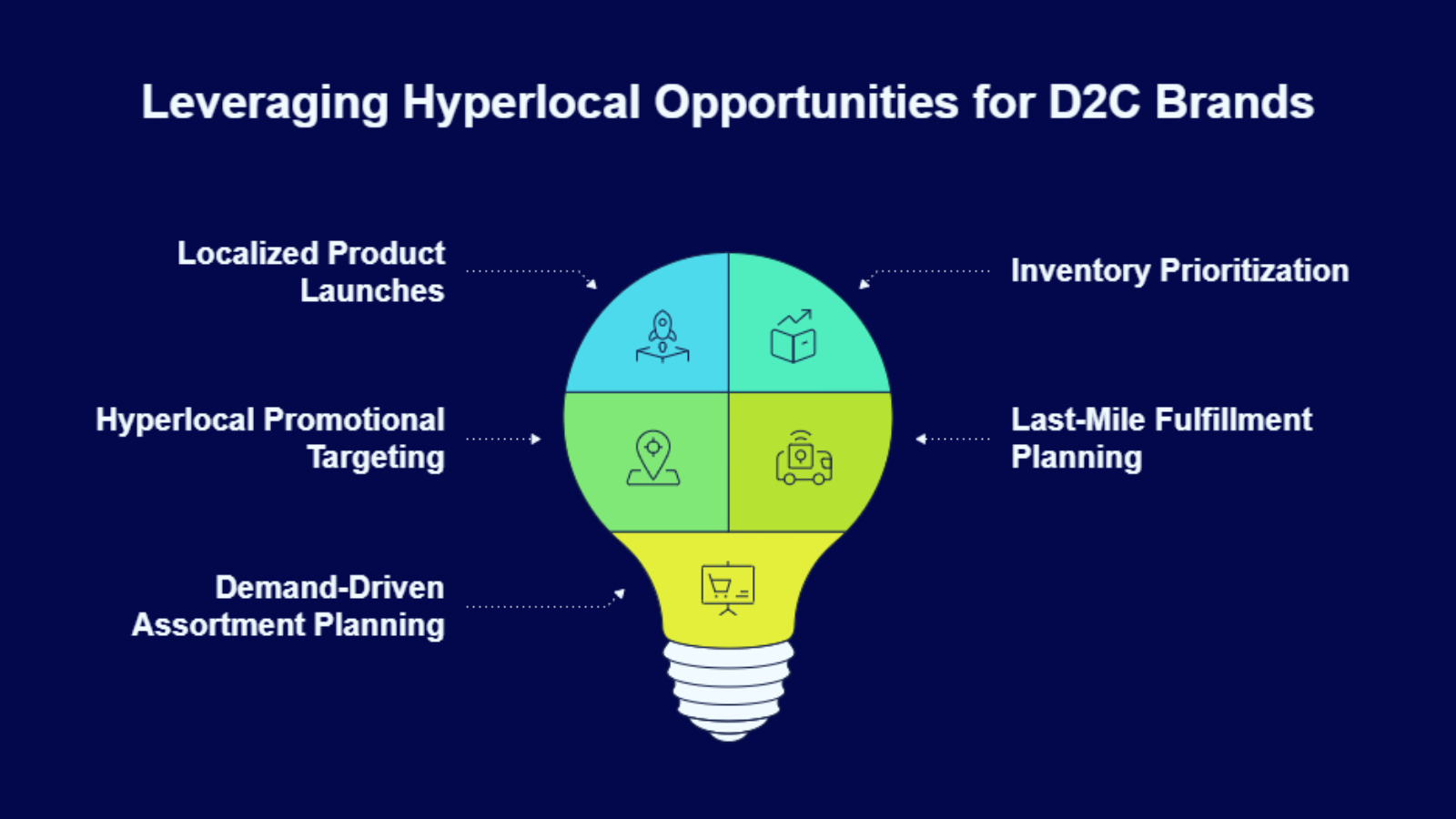
For D2C brands, these insights unlock several strategic advantages:
Key hyperlocal opportunities for D2C brands
- Localized product launches: Brands can test new SKUs in high-demand pincodes before expanding citywide. This helps identify product-market fit faster and reduces launch risk.
- Inventory prioritization in high-velocity dark stores: Products that demonstrate strong local sales often remain stocked longer because platforms prefer SKUs with consistent velocity.
- Hyperlocal promotional targeting: Sellers can run short promotions in specific delivery clusters where competitor products are temporarily out of stock.
- Better last-mile fulfillment planning: Understanding order density helps brands place inventory closer to high-demand neighborhoods.
- Demand-driven assortment planning: Certain neighborhoods may show strong demand for niche categories such as organic groceries, functional beverages, or premium skincare.
To build a strong Q-commerce data strategy, brands must track the right performance indicators at the hyperlocal level. These metrics reveal which products perform best in each delivery cluster and where inventory investments should be prioritized.
| Metric | What it Measures | Why It Matters for Indian D2C Sellers |
|---|---|---|
| Order Density | Number of orders within a delivery zone | Identifies high-demand neighborhoods where inventory should be concentrated |
| SKU Velocity | The speed at which products sell in dark stores | Determines whether a product retains shelf space or gets replaced |
| Delivery Time | Average fulfillment speed | Faster delivery improves repeat purchases and platform rankings |
| Stock Availability | Percentage of time a product stays in stock | Frequent stockouts reduce visibility inside quick commerce apps |
| Conversion Rate | Orders generated per app visit | Indicates real demand strength for specific SKUs |
One lesser-known detail about quick commerce operations is the importance of SKU velocity thresholds. Many platforms automatically remove slow-moving products if they fail to meet minimum sales benchmarks inside dark stores. In some delivery clusters, the same SKU can sell five times faster than in neighboring pincodes, purely because of demographic differences.
This is why pincode-level analytics and location intelligence quick commerce insights are becoming essential for Indian D2C sellers. When brands consistently monitor hyperlocal demand data, they can adjust inventory placement, pricing, and promotions based on real neighborhood demand rather than broad assumptions. This approach not only improves sales velocity but also helps brands secure stronger visibility inside quick commerce platforms.
The Future of Location Intelligence in Quick Commerce
 The next phase of quick commerce will be even more data-driven.
Emerging technologies such as AI, predictive analytics, and real-time dashboards are enabling brands to process hyperlocal demand data faster than ever before.
Future innovations may include:
- AI-powered demand forecasting
- Automated inventory allocation
- Real-time pricing optimization
- Smart delivery routing
Companies that invest early in location intelligence and quick commerce will have a significant advantage.
Managing large volumes of pincode-level analytics manually is extremely difficult.
Brands need platforms that can aggregate data across:
- Quick commerce apps
- D2C channels
- competitor listings
- pricing feeds
- market trends
This is where specialized analytics platforms become critical.
Why brands choose Base.com
Base.com helps brands build a strong Q-commerce data strategy by providing clear visibility into hyperlocal performance.
With Base.com, teams can:
- Track hyperlocal demand data across delivery zones
- Analyze pincode-level analytics for smarter inventory decisions
- Monitor competitor pricing and availability
- Improve demand forecasting using location intelligence for quick commerce
If your brand wants to win in quick commerce and strengthen its D2C growth, Base.com provides the data intelligence needed to scale with confidence.
Frequently Asked Questions
1. How can sellers identify which pincodes generate the highest sales on quick commerce platforms?
Sellers should analyze order density, SKU velocity, and repeat purchase rates across delivery zones. Using location intelligence, quick commerce, and pincode-level analytics helps identify neighborhoods where products sell 2 to 4 times faster, allowing brands to prioritize inventory in those dark stores.
2. Why do some products sell well in one neighborhood but not in another?
Demand often changes due to demographics, income levels, and lifestyle patterns. For example, protein snacks may perform better in tech hubs with young professionals, while family-heavy pincodes show higher demand for grocery staples and larger pack sizes.
3. How can sellers use hyperlocal demand data to improve inventory planning?
Hyperlocal demand data reveals which SKUs sell faster in specific delivery clusters. Sellers can allocate higher stock to high-velocity dark stores and reduce inventory in slow-moving zones, preventing stockouts and improving product visibility on quick commerce platforms.
4. What metrics should sellers track to improve their quick commerce performance?
Sellers should track order density, SKU velocity, stock availability, conversion rates, and delivery time across pincodes. These metrics help refine a Q-commerce data strategy and ensure products remain stocked in high-demand neighborhoods.
5. How can sellers use quick commerce data to launch new products successfully?
Sellers can test new SKUs in select high-demand pincodes before scaling citywide. By analyzing hyperlocal demand data and customer behavior, brands can validate product-market fit faster and avoid large inventory risks during early launches.