
Quick commerce has fundamentally changed how Indian consumers buy everyday products. Earlier, customers planned weekly grocery trips or placed scheduled ecommerce orders. Today, purchases happen at the exact moment a need appears. If someone runs out of milk, cooking oil, diapers, or batteries, they expect delivery in 10–20 minutes through apps like Blinkit, Zepto, or Swiggy Instamart. This shift has created a new marketing environment where brands have only a few seconds to capture demand.
For Indian D2C sellers, this change is massive. India’s quick commerce market has grown from about $300 million in 2022 to more than $7 billion in 2025, and it is expected to cross $35–40 billion by 2030. What many sellers do not realize is that over 65 percent of orders on quick commerce apps are unplanned purchases. Customers open the app for one item and often add two or three impulse products.
This is why quick commerce marketing for D2C brands focuses on visibility at the moment of intent. For example, snack brands that appear in the top three search results capture nearly 70 percent of category sales during late evening hours. Similarly, beverage brands see 30–40 percent higher conversion between 8 pm and midnight, when impulse purchases spike.
Another nuance Indian sellers often miss is dark store coverage. Quick commerce platforms operate through hyperlocal warehouses covering 1.5 to 3 km radius zones. If a D2C brand is stocked in only a few dark stores, it loses visibility even if demand exists. This makes local inventory distribution as important as marketing.
For Indian D2C brands, mastering quick commerce marketing for D2C brands means aligning product availability, search placement, and timing with real-life buying moments. When done right, quick commerce becomes one of the fastest channels for repeat purchases and high-frequency customer acquisition.
The Core Principle: Capture Demand at the Moment of Need
Quick commerce works because it is built around real-life buying situations. Customers are not browsing casually as they do on traditional ecommerce sites. They open an app because they need something immediately. That urgency is what drives conversions.
For Indian D2C brands, understanding these buying triggers is the foundation of quick commerce marketing for D2C brands. Most orders happen within minutes of opening the app, and customers rarely scroll beyond the first few results. If a product is visible at the moment of need, it gets the sale. If it is not, another brand wins.
Data from multiple quick commerce platforms shows that nearly 70 percent of orders are need-based purchases, not planned purchases. For example, someone cooking dinner might realize they are missing ginger or green chillies. A parent may suddenly need diapers late at night. A group watching cricket may order chips and beverages during match intervals.
For Indian sellers, mapping products to these everyday situations helps increase conversions.
| Customer Situation | Typical Purchase | Business Opportunity for D2C Brands |
|---|---|---|
| Cooking and missing ingredients | Vegetables, spices, and sauces | Promote meal-specific products like pasta sauces, ready gravies, and instant masala mixes |
| Late-night cravings | Ice cream, chocolates, snacks | Run limited-time combos between 8 pm and midnight |
| Unexpected guests | Soft drinks, namkeen, desserts | Offer party snack bundles and beverage packs |
| Household emergencies | Batteries, cleaners, tissues | Optimize listings for emergency search terms |
| Personal care needs | Soap, toothpaste, deodorant | Promote travel-size or refill packs |
A lesser-known insight many Indian sellers miss is that weekend evenings generate up to 35 percent higher order value compared to weekdays. This is because quick commerce orders shift from necessity purchases to social consumption, such as snacks, beverages, and desserts.
When brands align their product strategy with these real-life moments, quick commerce marketing for D2C brands becomes far more effective.
Strategy 1: Dominate Search Visibility on Quick Commerce Apps
 Search visibility is the most powerful growth lever on quick commerce platforms. Unlike traditional ecommerce where discovery can happen through recommendations or category browsing, quick commerce users mostly search for a specific item.
Industry data suggests that over 80 percent of quick commerce orders begin with a search query, and the top three results capture nearly 65 percent of category sales. This makes search placement extremely valuable for D2C brands.
For Indian sellers, improving search visibility requires more than basic product listings.
1. Invest in sponsored placements
- Quick commerce platforms now offer in-app ad slots similar to Amazon sponsored products.
- Brands can bid for keywords like “chips”, “energy drink”, or “face wash”.
- Sponsored placements often appear at the top of results and drive strong conversions.
Things sellers should consider
- Allocate at least 10–15 percent of quick commerce revenue to sponsored listings
- Focus on high-intent keywords rather than broad category keywords
- Run time-based campaigns such as late-night snack promotions
2. Optimize product titles and keywords
- Use search-friendly product names
- Include functional keywords that customers actually type
- Avoid overly creative product titles that reduce discoverability
Example
Poor listing: Healthy Snack Delight
Better listing: Roasted Protein Snack Mix Healthy Namkeen
For listing optimization
- Include category + benefit + format in product titles
- Match keywords with customer search behavior
- Add local language keywords where platforms allow it
3. Improve ratings and reviews
- Products with ratings above 4.2 stars receive significantly higher visibility
- Encourage reviews through sampling campaigns
- Respond quickly to negative reviews to maintain credibility
4. Ensure inventory availability
Quick commerce algorithms prioritize products that remain consistently available in nearby dark stores.
Stockouts can reduce search visibility and also disrupt marketing campaigns. This is where an OMS for D2C becomes critical. A reliable system helps sellers monitor inventory across warehouses and dark store networks so products remain visible during peak demand.
Strategy 2: Optimize Product Packaging for Instant Decisions
Packaging plays a completely different role in quick commerce compared to traditional retail. On store shelves, customers can pick up products and read labels. On quick commerce apps, they see only a small product image.
That image becomes the first marketing message.
Research across FMCG marketplaces shows customers decide within three to five seconds whether to click on a product. Packaging that communicates benefits clearly performs significantly better.
For Indian D2C brands, packaging should be designed for mobile discovery rather than physical shelves.
Bright and high-contrast colors improve visibility in crowded category pages. Snack brands using bold yellow or red packaging often receive higher click-through rates compared to muted colors.
Clear product benefits also increase conversions. Instead of long descriptions, the main benefit should appear clearly on the front label.
Examples include
- High Protein Snack
- Zero Sugar Chocolate
- Ayurvedic Hair Oil
Another important factor is category clarity. Customers scanning a list of products must instantly understand what the product is.
High-resolution images also influence purchase decisions. Products with sharp images typically see better engagement than listings with poor quality visuals.
In quick commerce marketing for D2C brands, packaging acts as a digital storefront that determines whether a customer clicks or scrolls past.
Strategy 3: Create Bundles That Increase Basket Size
 Quick commerce orders usually have lower basket values compared to traditional ecommerce. However, bundling can significantly increase order value while encouraging impulse purchases.
Industry estimates suggest bundled products can increase average order value by 20–30 percent in quick commerce environments.
For Indian sellers, bundles should reflect real consumption situations rather than random product combinations.
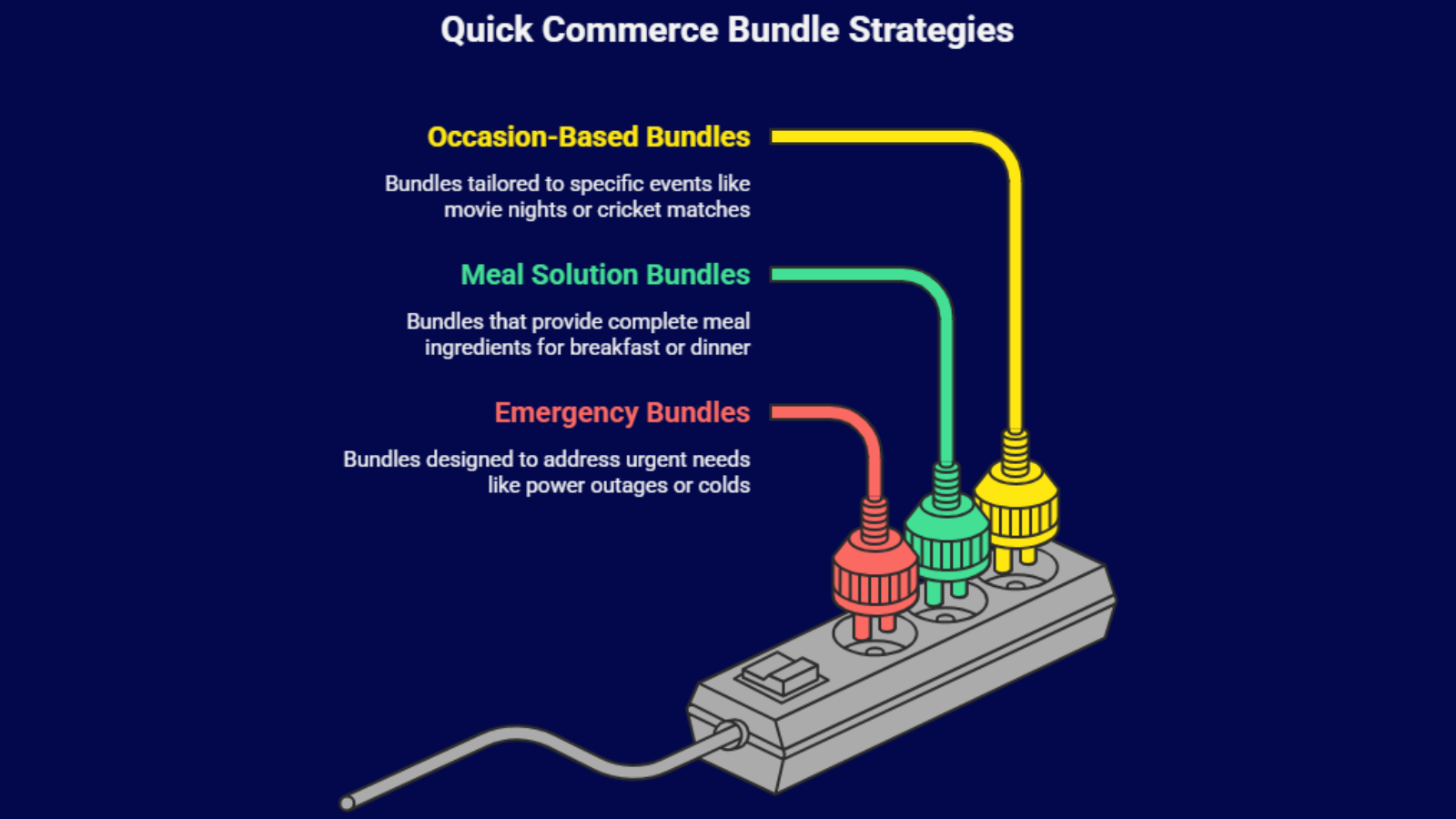
Types of bundles that work well:
1. Occasion-based bundles
Bundles that match specific moments perform very well.
Examples include:
Movie night bundle
- Popcorn
- Nachos
- Soft drink
Weekend cricket bundle
- Chips
- Energy drinks
- Chocolate bars
Things sellers should follow
- Price bundles are 10–15 percent lower than individual products
- Highlight bundle savings clearly in the product title
- Run weekend promotions to drive higher order value
2. Meal solution bundles
Customers ordering groceries often look for meal solutions rather than individual products.
Examples
Breakfast bundle
- Bread
- Peanut butter
- Eggs
Pasta dinner bundle
- Pasta
- Pasta sauce
- Cheese
Follow this to maximize conversions
- Bundle items that are frequently purchased together
- Place bundles under the “recommended combos” sections
- Test regional preferences across cities
3. Emergency or convenience bundles
These bundles target urgent needs.
Examples include
Power cut bundle
- Batteries
- Flashlight
- Power bank
Cold relief bundle
- Honey
- Ginger tea mix
- Lozenges
For D2C brands executing quick commerce marketing for D2C brands, bundling increases visibility and also improves order economics.
Strategy 4: Use Data to Predict Customer Needs
One of the biggest advantages of quick commerce platforms is the availability of real-time demand data. Brands that analyze this data carefully can predict buying behavior and plan campaigns accordingly.
Quick commerce demand follows clear time and context patterns.
| Customer Situation | Time Pattern | High Demand Products | Opportunity for D2C Brands |
|---|---|---|---|
| Late-night snacking | 10 pm – 1 am | Chips, chocolates, ice cream | Run sponsored snack listings |
| Weekend gatherings | Friday evening | Soft drinks, snacks | Launch party combo bundles |
| Summer heat | Afternoon and evening | Ice cream, cold beverages | Increase visibility during heatwaves |
| Rainy weather | Evening hours | Soup, instant noodles | Promote comfort food products |
| Work-from-home afternoons | 3 pm – 6 pm | Energy drinks, biscuits | Target snack break purchases |
For example, ice cream brands often see 40 percent higher sales on hot summer evenings, while instant noodle brands experience spikes during rainy days.
Indian sellers who track these patterns can plan advertising and inventory more effectively.
Using an OMS for D2C, brands can analyze order data across cities and time periods. This helps identify demand spikes, predict seasonal patterns, and improve campaign planning.
Strategy 5: Ensure Perfect Inventory Availability
 Marketing efforts cannot succeed if products are unavailable. Inventory management is one of the biggest operational challenges in quick commerce.
Unlike traditional ecommerce warehouses, quick commerce relies on hyperlocal dark stores. Each dark store usually covers a 1.5 to 3-kilometer delivery radius, meaning large cities may require dozens of micro warehouses.
For D2C brands, this creates distribution complexity. A product might be listed on a platform but only stocked in a few locations. When customers search from other neighborhoods, the product appears unavailable.
Industry estimates suggest stockouts can reduce potential sales by up to 30 percent on quick commerce platforms.
This makes operational coordination critical.
An advanced OMS for D2C allows brands to track inventory across warehouses, marketplaces, and dark stores in real time. With centralized visibility, teams can identify low stock levels before they become a problem.
Another advantage is automated replenishment planning. When demand rises in specific cities, the system can recommend inventory transfers or restocking.
A strong OMS for D2C also connects logistics partners, warehouse systems, and sales channels into one platform. This improves fulfillment accuracy and reduces manual errors.
For Indian D2C brands expanding into quick commerce, operational infrastructure is just as important as marketing. Without the right systems, brands may generate demand but fail to fulfill orders consistently.
When inventory visibility, distribution planning, and marketing campaigns work together, quick commerce marketing for D2C brands becomes far more scalable and profitable.
The Role of Technology in Quick Commerce Marketing and Building Repeat Purchases
Technology sits at the center of quick commerce marketing for D2C brands because the entire model depends on speed, inventory accuracy, and hyperlocal demand prediction. Unlike traditional ecommerce, where inventory sits in a few large warehouses, quick commerce relies on thousands of small fulfillment hubs.
Today, more than 20,000 dark stores across India’s major metros and Tier 1 cities power quick commerce infrastructure. Each dark store typically covers a 1.5 to 3 km delivery radius, which means product availability can vary from one neighborhood to another.
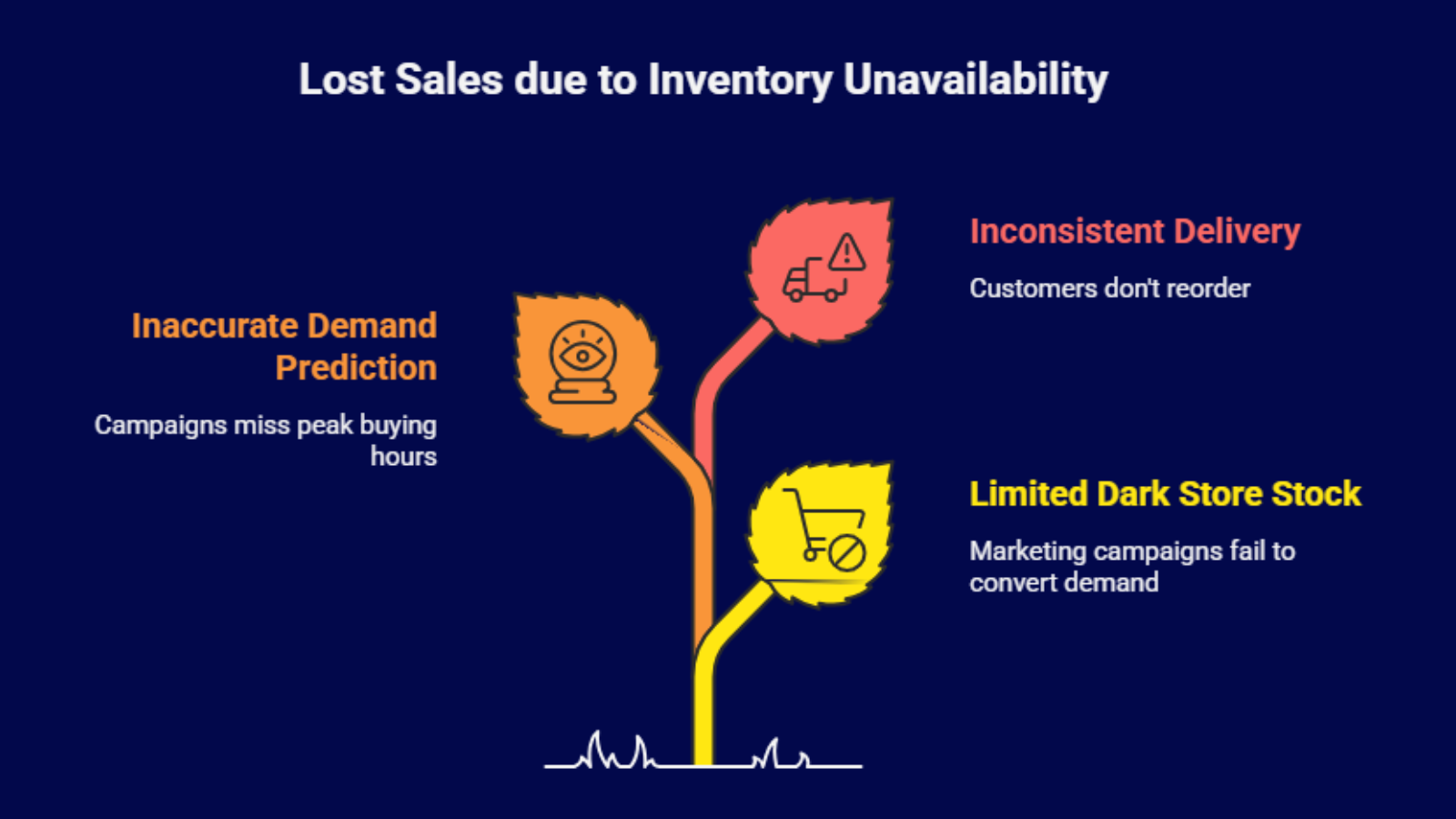
For Indian D2C sellers, this creates a critical operational challenge. Marketing campaigns may generate demand, but if inventory is unavailable in nearby dark stores, the sale is lost instantly. For example, if a snack brand runs a sponsored campaign on Blinkit during a cricket match but the product is stocked in only 35–40 percent of nearby dark stores, the brand loses visibility and conversions even though search demand exists.
This is where an OMS for D2C becomes essential. A reliable system helps brands track inventory across warehouses, quick commerce platforms, and marketplaces in real time so products remain available in high-demand zones.
 Technology also helps brands predict demand more accurately. Quick commerce platforms consistently see 30 to 40 percent demand spikes during weekends, especially for beverages, desserts, and ready-to-eat snacks. Late-night orders between 9 pm and midnight are another major demand window for categories such as chocolates, instant noodles, and energy drinks.
With analytics tools integrated into an OMS for D2C, sellers can identify these patterns and run campaigns during the hours when customers are most likely to buy.
Customer analytics is equally important for building long-term loyalty. Quick commerce platforms report that more than 60 percent of users reorder the same brand within 30 days if the product is available and the delivery experience is consistent.
This means repeat purchase behavior depends heavily on operational reliability. When brands maintain inventory visibility through an OMS for D2C and combine it with targeted promotions, they can turn first-time buyers into repeat customers.
For Indian D2C sellers, the biggest advantage of using technology is coordination between marketing and operations. Demand forecasting, inventory tracking, and customer insights work together to ensure that products are visible, available, and promoted at the right moment. When these systems are connected, quick commerce marketing for D2C brands becomes far more scalable and profitable.
Scale Your D2C Quick Commerce Strategy with Base and Final Thoughts
As D2C brands expand across quick commerce platforms, marketplaces, and their own websites, operations quickly become complex. Orders start coming from multiple channels at the same time, inventory needs to stay accurate across warehouses and dark stores, and fulfillment must happen within minutes. Without the right system, brands often face stock mismatches, delayed processing, and missed sales opportunities.
This is where Base.com’s OMS for D2C brands becomes essential. Base helps brands centralize orders from quick commerce platforms, marketplaces, and their own storefront into a single dashboard. Instead of managing each platform separately, operations teams get a unified view of orders, inventory, and fulfillment workflows.
Base also enables real-time inventory synchronization across warehouses and dark store networks. This means when a product sells on one platform, inventory updates instantly across all channels. For brands selling on Blinkit, Zepto, or Instamart, this reduces stockouts during peak demand hours and improves product availability.
Another key advantage is automated order routing and faster fulfillment. Base intelligently assigns orders to the right warehouse or fulfillment location, helping brands reduce processing delays. For quick commerce, where delivery speed directly impacts customer experience, this operational efficiency becomes critical.
Quick commerce is redefining how Indian consumers buy everyday products. For D2C brands, success now depends on capturing demand exactly when it appears. By combining strong, quick commerce marketing for D2C brands with reliable operational systems like Base, sellers can improve visibility, maintain inventory accuracy, and scale across multiple quick commerce platforms with confidence.