
Quick commerce has rapidly shifted from a convenience experiment to a serious revenue channel for Indian brands. Platforms like Blinkit, Zepto, and Instamart already operate over 4,000 dark stores across major Indian cities, and the category is projected to cross $40–45 billion in GMV by 2030. What many Indian D2C sellers overlook is how different the buying behavior is on these platforms. The average order value is typically ₹350–₹550, and over 70 percent of purchases happen within 2 hours of peak meal or evening snacking windows.
For D2C brands, this means products must be designed for impulse demand. For example, snack brands that introduced ₹99 quick commerce packs saw 2.5x faster inventory turnover than their regular ecommerce SKUs. Beauty brands selling travel-size SKUs under ₹299 also perform significantly better because they match quick purchase behavior.
Another nuance many sellers miss is dark store shelf competition. Each store carries roughly 1,500–2,500 SKUs, so brands that maintain 95 percent+ fill rates and 24-hour replenishment cycles are more likely to retain placement and visibility.
Understanding the Future of Quick Commerce for D2C Brands
Quick commerce runs on hyperlocal fulfillment. Most platforms deliver within 8 to 15 minutes using dark stores placed within 2 to 3 km delivery radii. For Indian D2C brands, the economics look very different from regular ecommerce. The average order value on Blinkit and Zepto ranges between ₹350 and ₹500, compared to ₹1,200+ on traditional marketplaces. Because of this, platforms typically charge 18 to 28 percent commissions plus marketing fees, which directly impacts a brand’s contribution margin.
What many sellers miss is that SKU velocity matters more than catalog size. Dark stores usually carry only 1,800 to 2,500 SKUs, so platforms prioritize products that sell 20 to 40 units per day per store. For example, beverage brands offering single-serve ₹99 packs see higher rotations than multi-pack bundles.
Looking ahead, D2C quick commerce 2026 trends will revolve around Q-commerce innovation, AI demand forecasting, and next-gen instant delivery networks. Some cities are also testing autonomous delivery D2C pilots to reduce last-mile costs by up to 30 percent.
Below are the key steps brands must take to prepare.
Step 1: Fix Unit Economics and Contribution Margin Before Entering Quick Commerce
 Quick commerce can look attractive because of the scale it offers. Platforms like Blinkit, Zepto, and Swiggy Instamart collectively process millions of orders daily across major Indian cities. However, many D2C brands enter the channel without properly calculating contribution margin, which quickly turns growth into losses.
The biggest difference between traditional ecommerce and quick commerce is basket size. On Amazon or a brand website, the average order value can range between ₹1,200 and ₹2,000. On quick commerce platforms, the average order value usually falls between ₹350 and ₹550.
Because of this smaller basket size, the margin structure becomes extremely tight.
Most quick commerce platforms charge:
- 18 to 28 percent platform commission
- 2 to 5 percent logistics or handling fees
- Advertising costs for visibility
- Trade discounts during promotions
For example, a skincare brand selling a ₹399 product may lose profitability if the contribution margin is not carefully planned.
Example Contribution Margin Breakdown
| Cost Component | Typical Value |
|---|---|
| MRP | ₹399 |
| Platform Commission (22%) | ₹88 |
| Trade Discount | ₹30 |
| Packaging and Fulfillment | ₹18 |
| Marketing Spend | ₹20 |
| Net Contribution Margin | ₹243 remaining before product cost |
If the product cost is ₹210, the actual margin becomes extremely thin.
This is why Indian D2C brands must rework pricing and pack sizes specifically for quick commerce rather than simply listing existing SKUs.
Practical strategies to improve contribution margin
- Launch quick commerce-specific SKUs
- Reduce packaging costs
- Limit deep discounting
Examples include:
- ₹99 snack packs
- ₹199 trial beauty kits
- ₹149 single-serve beverage packs
These SKUs maintain margin while fitting the impulse purchase behavior of quick commerce.
How Base.com Can Help
Base.com helps brands track contribution margin across every sales channel, including quick commerce platforms. With centralized analytics, brands can evaluate commissions, fulfillment costs, and advertising spend in one dashboard. This allows sellers to adjust pricing and pack sizes while maintaining healthy margins.
Step 2: Build a Quick Commerce Ready Product Assortment
Quick commerce platforms operate very differently from traditional ecommerce catalogs.
A typical marketplace may host millions of SKUs, but a dark store usually carries only 1,800 to 2,500 SKUs. This means brands cannot upload their entire catalog.
Instead, platforms prioritize high-velocity products that sell quickly.
What high-velocity products look like
A product qualifies as high velocity when it sells:
- 15 to 40 units per day per store
- consistently across multiple days
- without heavy discounting
Platforms analyze SKU velocity weekly and often remove underperforming products.
Product characteristics that work best
Successful quick commerce products usually share these traits:
- Price under ₹300 to ₹500
- Easy to consume or replenish
- Repeat purchase category
- Compact packaging
Examples from the Indian market
- Snacks and beverages: Brands selling single-serve packs see higher rotation. Beverage brands selling ₹99 electrolyte drinks often move faster than larger bottles.
- Beauty and skincare: Travel-size products priced between ₹199 and ₹299 perform better than full-size variants.
- Health supplements: Single sachets or weekly packs work better than monthly jars.
- Personal care: Items like deodorants, razors, and face wash perform well because they are replenishment products.
Brands that align their assortment with D2C quick commerce 2026 trends typically see faster adoption on inside platforms.
How Base.com Can Help
Base.com helps brands identify which SKUs perform best across marketplaces and quick commerce platforms. By analyzing real-time sales data, brands can decide which products to prioritize for dark stores and which SKUs should remain exclusive to their website or marketplaces.
Step 3: Invest in Dark Store Supply Strategy
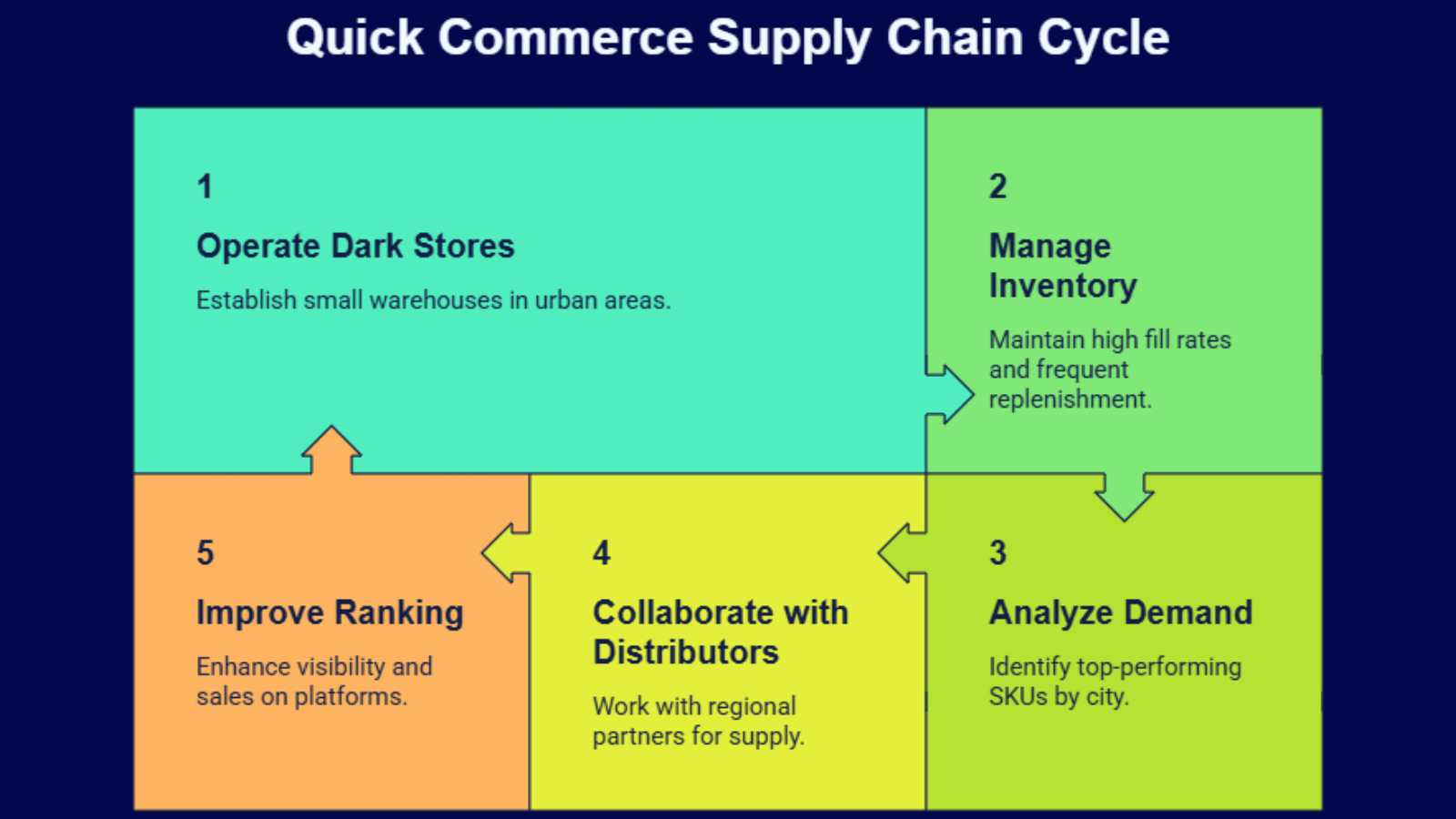 Quick commerce runs entirely on dark store infrastructure.
Dark stores are small warehouses located within a 2 to 3-kilometer delivery radius in densely populated areas.
Blinkit alone operates over 500 dark stores across India, while Zepto and Instamart are rapidly expanding their networks.
For D2C brands, this means logistics planning becomes far more complex than traditional ecommerce.
Why dark store supply matters
Dark stores have very limited shelf space.
A store may carry:
- 2,000 SKUs total
- only 2 to 5 facings per SKU
If a brand runs out of stock frequently, the platform may replace it with a competitor.
What brands must do
- Maintain 95 percent+ fill rates
- Replenish inventory every 24 to 48 hours
- Identify top-performing SKUs by city
- Work with regional distributors
Example demand patterns:
- Spicy snacks sell better in Hyderabad
- Energy drinks perform better in Bangalore
- Health supplements sell faster in Gurgaon
Reliable supply directly impacts ranking inside quick commerce apps.
How Base.com Can Help
Base.com centralizes inventory management across warehouses, distributors, and dark stores. Brands can monitor stock levels in real time and automate replenishment workflows to ensure products remain available across multiple quick commerce locations.
Step 4: Prepare Packaging for Rapid Fulfillment
Quick commerce warehouses operate extremely fast. Orders are picked and packed within 2 to 3 minutes after a customer places an order.
Because of this speed, packaging must be optimized for rapid handling.
Packaging requirements for quick commerce
- Compact packaging
- Clear barcode labeling
- Durable materials
- Shelf-friendly design
Example
A snack brand redesigned its packaging from flexible stand-up pouches to stackable rectangular packs, allowing dark stores to store 30 percent more units per shelf.
This improved SKU visibility and availability significantly.
Brands adopting such changes align with ongoing Q-commerce innovation in logistics efficiency.
How Base.com Can Help
Base.com enables brands to track packaging-level SKU performance. If certain pack sizes move faster in quick commerce channels, brands can identify them quickly and optimize packaging formats accordingly.
Step 5: Integrate Real-Time Inventory Systems
 Inventory mismatch is one of the biggest problems in quick commerce.
If a product shows as available on the app but is missing in the dark store, the order gets cancelled.
High cancellation rates negatively impact platform rankings.
To avoid this, brands must integrate:
- Order Management Systems (OMS)
- Warehouse Management Systems (WMS)
- Marketplace APIs
What real-time inventory enables
- Accurate stock visibility
- Faster replenishment decisions
- Better demand forecasting
Unified inventory systems help brands manage stock across:
- brand website
- marketplaces
- quick commerce platforms
- offline retail stores
How Base.com Can Help
Base.com acts as a centralized operations hub that syncs inventory across all sales channels. This prevents overselling and ensures accurate stock visibility across quick commerce platforms and brand websites.
Step 6: Use Data to Predict Local Demand
Quick commerce is extremely localized. Two dark stores located 5 kilometers apart may show completely different buying patterns.
Examples include:
- Healthy snacks are selling faster in Bangalore
- Indulgent snacks dominate in Delhi NCR
- Smaller pack sizes are moving faster in Mumbai
Data points brands should analyze
- Hourly demand patterns
- City-specific product preferences
- Seasonal spikes
- Festival demand patterns
Cold beverages often see 40 percent higher demand during summer, while immunity supplements spike during monsoon.
How Base.com Can Help
Base.com provides location-based sales analytics, helping brands understand demand patterns across cities and neighborhoods. This allows sellers to optimize inventory distribution and improve sell-through rates.
Step 7: Plan Advertising Within Quick Commerce Apps
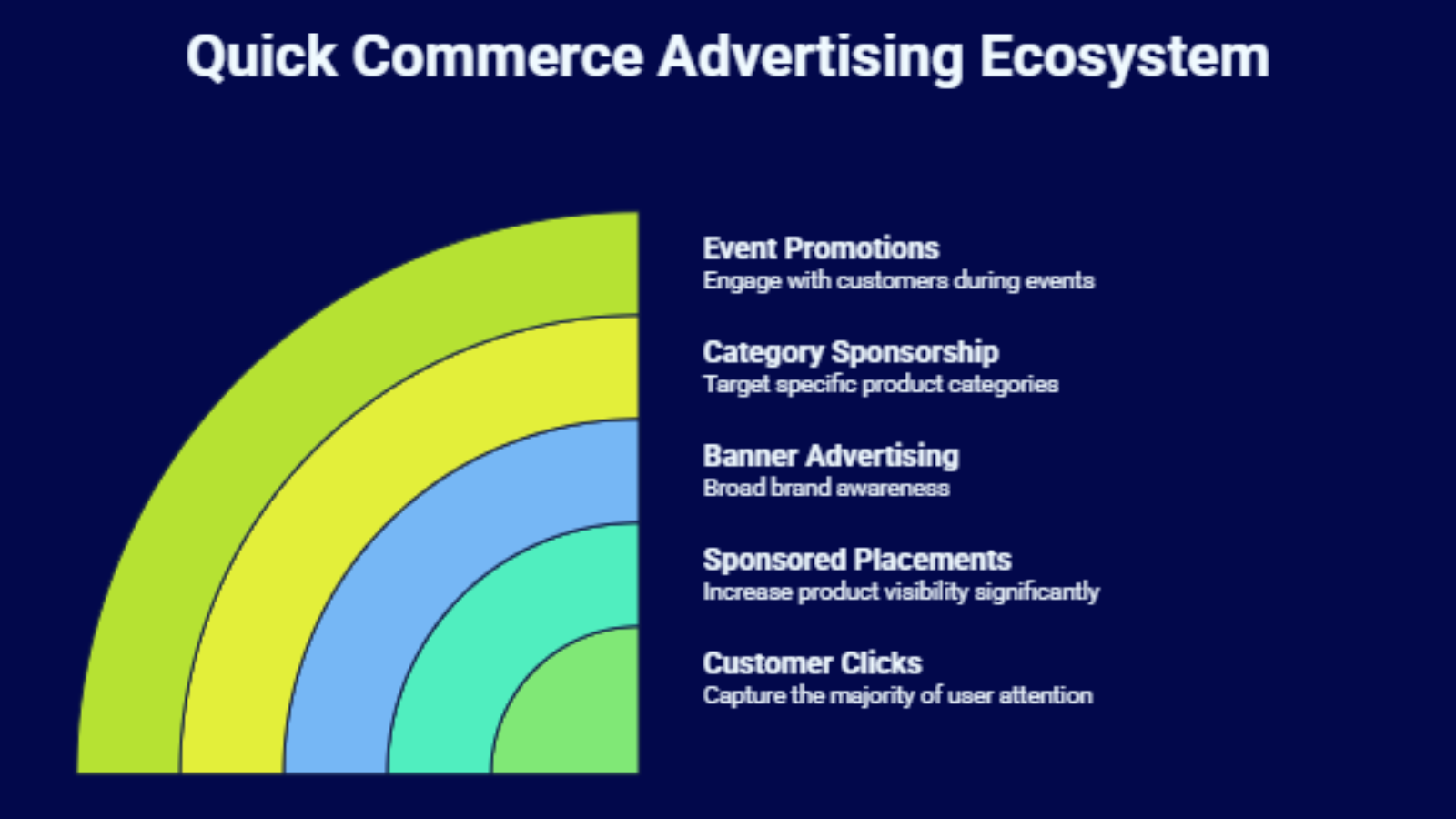 Quick commerce platforms are becoming powerful advertising ecosystems.
Brands now compete for visibility through:
- Sponsored product placements
- Banner advertising
- Category sponsorship
- Event promotions
Customers usually search for generic categories like:
- chips
- face wash
- protein bars
The first few products shown capture most clicks.
Sponsored placements can increase product visibility 3 to 5 times, though advertising costs may range between ₹20 and ₹60 per click.
How Base.com Can Help
Base.com helps brands analyze advertising ROI across channels, allowing sellers to measure whether quick commerce promotions are profitable compared to marketplace ads or website campaigns.
Step 8: Prepare for Autonomous Delivery and New Logistics Technology
The next phase of quick commerce will include automation and advanced logistics technologies.
Emerging innovations include:
- AI-powered demand forecasting
- Robotic warehouse picking
- Drone delivery pilots
- Autonomous delivery order management systems
These innovations could reduce last-mile delivery costs by 20 to 30 percent. Lower delivery costs will make next-generation instant delivery more scalable.
How Base.com Can Help
Base.com helps brands adapt to evolving logistics networks by integrating with multiple fulfillment partners and enabling centralized order orchestration.
Step 9: Balance Quick Commerce With Your Own D2C Channel
 While quick commerce is growing rapidly, it should not replace a brand’s own ecommerce channel.
Quick commerce platforms control:
- customer data
- pricing visibility
- brand discovery
Brands receive limited customer insights.
In contrast, a brand website offers:
- full control over customer data
- higher margins
- deeper brand storytelling
- larger product catalogs
The best strategy
Most successful brands adopt a hybrid model.
| Channel | Role |
|---|---|
| Quick Commerce | impulse purchases and discovery |
| Brand Website | full catalog and customer retention |
| Marketplaces | wider reach and brand awareness |
This balanced approach is becoming a defining pattern in D2C quick commerce 2026 trends.
How Base.com Can Help
Base.com allows brands to manage all channels from one unified system. Sellers can synchronize inventory, orders, and pricing across quick commerce platforms, marketplaces, and their own website, ensuring consistent operations and stronger customer relationships.
Final Insight for Indian D2C Sellers
Quick commerce is not simply another sales channel. It is a different operating model that requires changes across product design, supply chain, pricing, and marketing.
Brands that treat quick commerce as an extension of ecommerce often struggle.
The brands that succeed are the ones that redesign their strategy around:
- strong contribution margin
- curated SKU selection
- reliable dark store supply
- packaging built for speed
- data-driven demand forecasting
As infrastructure evolves and next-gen instant delivery expands into more cities, the opportunities for Indian D2C brands will continue to grow.
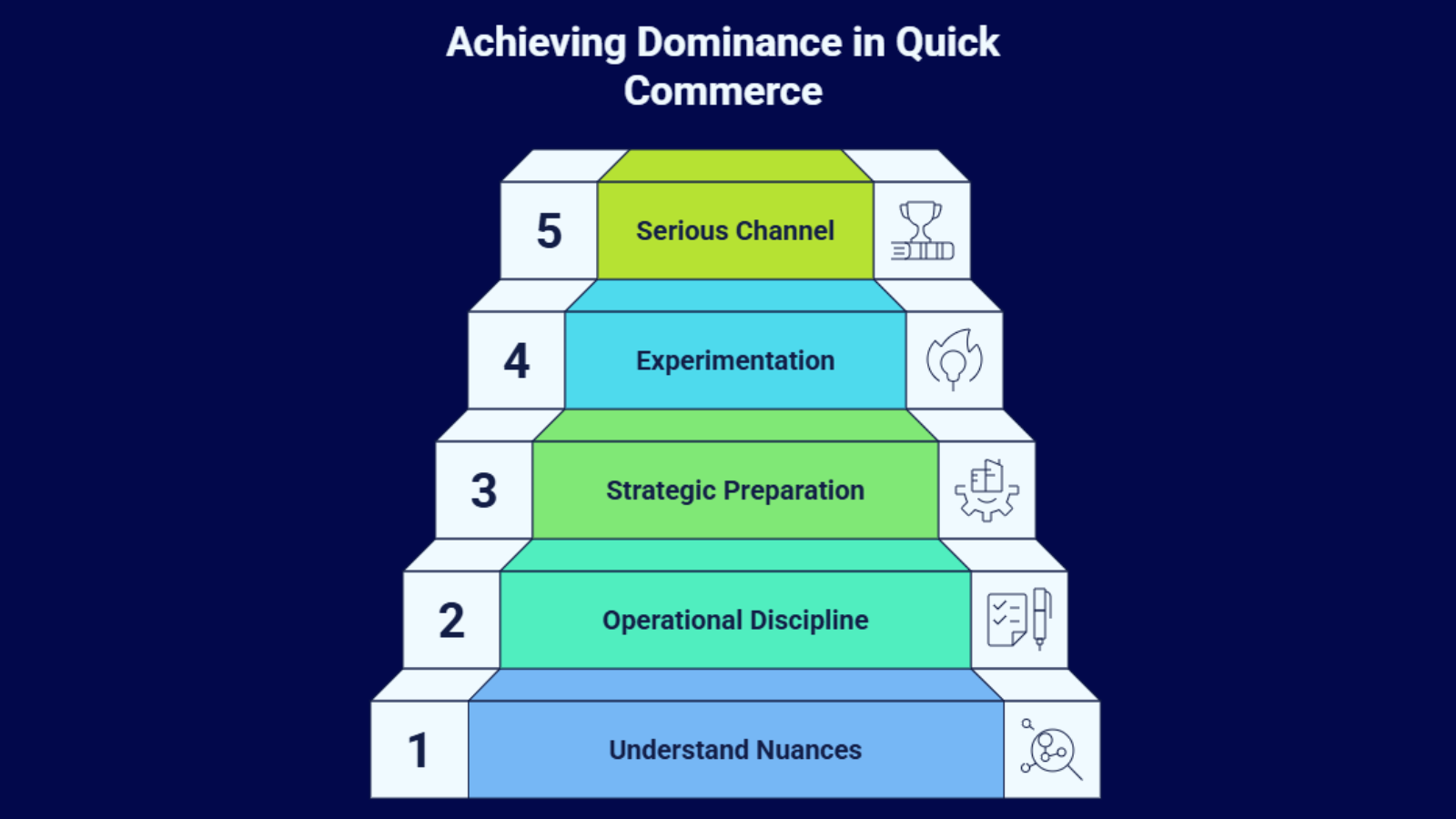 The companies that understand these nuances early will dominate the next phase of Q-commerce innovation and build sustainable growth within the rapidly evolving quick commerce ecosystem.
Quick commerce is entering a more mature phase. Competition is increasing, platforms are expanding into new categories, and profitability is becoming a major focus across the industry.
For D2C companies, the future of quick commerce for D2C brands will depend on operational discipline and strategic preparation. Brands that fix their contribution margin, build fast-moving assortments, optimize dark store supply, and adapt to next gen instant delivery infrastructure will gain a strong advantage.
As D2C quick commerce 2026 trends evolve, we will also see more experimentation around autonomous delivery D2C, advanced logistics, and deeper platform integrations.
The brands that treat quick commerce as a serious operational channel rather than just another marketplace will win in the long run.
Frequently Asked Questions
1. How should D2C brands price products for quick commerce platforms?
D2C brands should create platform-specific pricing and pack sizes instead of listing the same SKUs used on marketplaces. Products priced between ₹99 and ₹399 typically convert better because they align with the average quick commerce order value of ₹350–₹550 and impulse buying behavior.
2. How can D2C brands secure shelf space inside quick commerce dark stores?
Shelf space depends heavily on SKU velocity and supply reliability. Brands that maintain 95 percent or higher fill rates and ensure replenishment cycles within 24–48 hours are more likely to retain shelf space and avoid being replaced by competing products.
3. What operational challenges do D2C brands face when scaling through quick commerce?
Brands often struggle with inventory synchronization, dark store replenishment, platform commissions, and advertising costs. Managing multiple integrations across warehouses, quick commerce platforms, and marketplaces also requires strong operational systems and real-time inventory visibility.
4. How can D2C brands improve product discoverability on quick commerce apps?
Brands can improve discoverability through sponsored listings, strong product ratings, reliable inventory availability, and quick commerce-specific SKUs. Products that consistently remain in stock and sell quickly are more likely to rank higher within platform search results.
5. How should D2C brands balance quick commerce with their own website sales?
Quick commerce works best for impulse purchases and quick replenishment products, while brand websites are better for higher-value orders and customer retention. A hybrid strategy allows brands to capture fast demand while still owning customer relationships and margins.