Shopping habits in India have shifted rapidly in the last five years. What started with next-day delivery moved to same-day delivery, and now millions of urban consumers expect products in 10 to 15 minutes. This shift has built the foundation of the Indian quick commerce market, which is currently valued at around $6–7 billion and growing at nearly 40% annually. For Indian D2C sellers, this growth is not just about faster delivery. It is about a new retail channel that influences product discovery, repeat purchases, and category expansion.
Platforms like Blinkit, Zepto, Swiggy, and Instamart now process millions of orders daily across cities like Bengaluru, Delhi NCR, and Mumbai. Reports suggest that an average quick commerce user places 4 to 6 orders per month, which is far higher than traditional e-commerce frequency. This high repeat behavior makes the Indian quick commerce market particularly attractive for products that consumers replenish often.
For example, snack brands, protein bars, ready-to-drink beverages, and skincare products perform well because consumers reorder them within days. Another unique insight for Indian sellers is basket composition. The average quick commerce basket is ₹450 to ₹650, but customers frequently add impulse items placed in top search results or promoted sections.
In a Q-commerce global comparison, India stands out because quick commerce is expanding beyond groceries into beauty, wellness, and electronics accessories. This creates a major opportunity for quick commerce for D2C brands in India, especially those that focus on fast-moving, low-to-mid price products that encourage repeat purchases.
Understanding the Global Quick Commerce Landscape and the Rise of the Indian Quick Commerce Market
Quick commerce globally refers to ultra-fast delivery models where small consumer orders are fulfilled within 10 to 30 minutes using dark stores, hyperlocal inventory systems, and optimized last-mile logistics. The model accelerated after the pandemic as consumers prioritized convenience and faster delivery windows. Most global quick commerce companies started with groceries because these products have high repeat demand and predictable inventory turnover.
| Metric | Global Quick Commerce |
|---|---|
| Global Market Size (2024) | $73.9 billion |
| Expected Market Growth | $582 billion by 2032 |
| Average Delivery Time | 10–30 minutes |
| Major Regions | US, Europe, China, India |
While the global market is expanding quickly, the Indian quick commerce market is growing at a much faster adoption rate. India currently has about 26.2 million quick commerce users, and the market is valued between $6 and $7 billion. Analysts expect it to grow at roughly 40 percent annually, with gross order value projected to reach ₹2 lakh crore by FY28.
| Indicator | Indian Quick Commerce Market |
|---|---|
| Active Users | 26.2 million |
| Market Size (2024) | $6–7 billion |
| Annual Growth | ~40% |
| FY25 Spending | ₹64,000 crore |
| Projected FY28 GOV | ₹2 lakh crore |
Three platforms dominate the ecosystem.
| Major Platforms | Market Position |
|---|---|
| Blinkit | ~44–46% share |
| Zepto | Fastest expansion |
| Swiggy Instamart | Strong grocery penetration |
For Indian D2C sellers, these platforms operate very differently compared to traditional marketplaces. Blinkit, Zepto, Swiggy, and Instamart rely heavily on hyperlocal dark stores, which means product availability depends on demand forecasting at a neighborhood level. For example, a snack brand selling protein bars may only get 20 to 30 SKUs stocked per micro warehouse, which makes inventory planning critical.
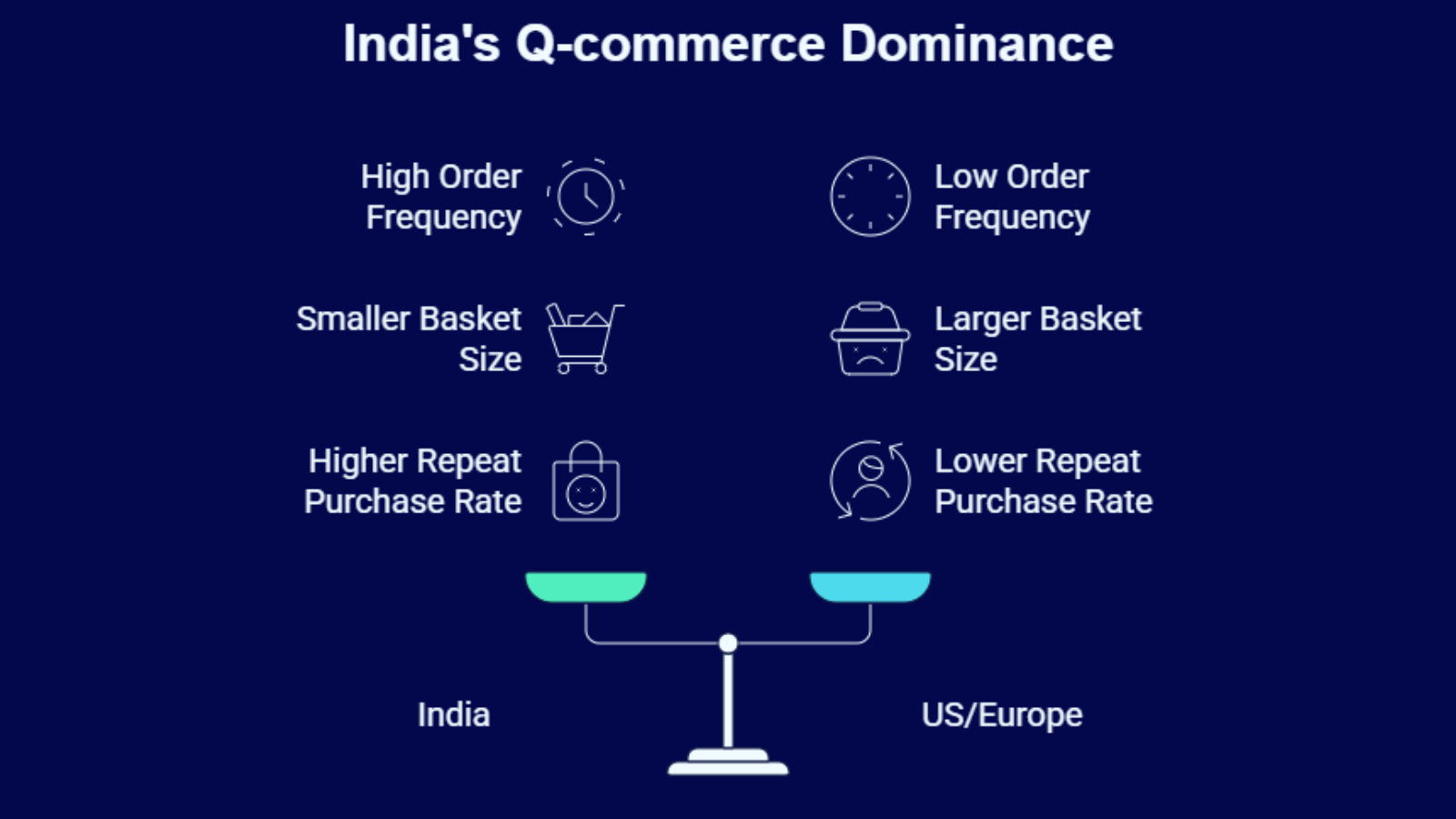 A Q-commerce global comparison also shows that India has one of the highest order frequencies. Consumers typically place 4 to 6 orders per month, compared to 1 to 2 in US or European markets. Although the average basket size in India ranges from ₹450 to ₹650, the repeat purchase rate is significantly higher.
| Factor | India | US / Europe |
|---|---|---|
| Delivery Time | 10–15 minutes | 20–30 minutes |
| Order Frequency | 4–6 orders/month | 1–2 orders/month |
| Average Basket | ₹450–₹650 | $25–$40 |
| Category Expansion | Grocery, beauty, electronics | Mostly grocery |
This high-frequency behavior is why the Indian quick commerce market is outperforming many quick commerce emerging markets. For quick commerce for D2C brands in India, this means products that drive repeat purchases, such as beverages, snacks, skincare, and ready-to-eat items, see much faster sales velocity compared to traditional e-commerce channels.
Why India Is a Unique Opportunity for D2C Brands in Quick Commerce
The Indian quick commerce market is no longer just a fast delivery channel. It is becoming a discovery platform where customers find and reorder products frequently. For founders building consumer brands, quick commerce for D2C brands in India offers advantages that traditional marketplaces cannot provide. Below are specific reasons why this channel is uniquely powerful for Indian sellers.
1. High Frequency Shopping Behavior Drives Faster Product Adoption
 Indian quick commerce platforms operate on repeat purchases rather than large one-time baskets. This behavior significantly benefits quick commerce for D2C brands in India.
Key facts founders should know
- Indian users place 4 to 6 orders per month on quick commerce platforms
- The average order value is ₹450 to ₹650, but the order frequency is high
- Nearly 30 to 40 percent of orders include impulse add-ons triggered by in-app recommendations
Use cases for D2C sellers
- Snack brands can build repeat demand quickly. A protein bar or healthy snack brand often sees repeat purchases within 7 to 10 days if placed in “Top Picks” or “Frequently Bought” sections.
- Ready-to-drink beverages perform well because customers reorder during the same week when inventory runs out.
- Skincare trial SKUs, such as 30ml face wash or mini moisturizers, convert well because consumers treat quick commerce like a neighborhood convenience store.
Nuance, many sellers miss
Platforms prioritize high-selling SKUs. If your product sells out within 48 hours, it increases the probability of being stocked across more dark stores.
2. Instant Gratification Culture Is Changing Product Strategy
Urban consumers increasingly prioritize speed over discounts. This behavior is a major driver of the Indian quick commerce market.
Key drivers
- Over 900 million smartphone users in India
- Widespread adoption of UPI payments
- High-density urban populations enable faster logistics
Business insight for founders
Quick commerce customers often buy products for immediate consumption rather than long-term storage.
Examples
- Midnight snack purchases
- Emergency personal care items
- Last-minute cooking ingredients
Categories expanding fastest on Blinkit, Zepto, Swiggy, and Instamart include:
- Energy drinks
- Ice cream and desserts
- Instant noodles
- Skincare essentials
- OTC wellness products
Unique insight
Products priced between ₹150 and ₹500 tend to convert best because they match the average quick commerce basket value.
3. Hyperlocal Logistics Infrastructure Enables Faster Scaling
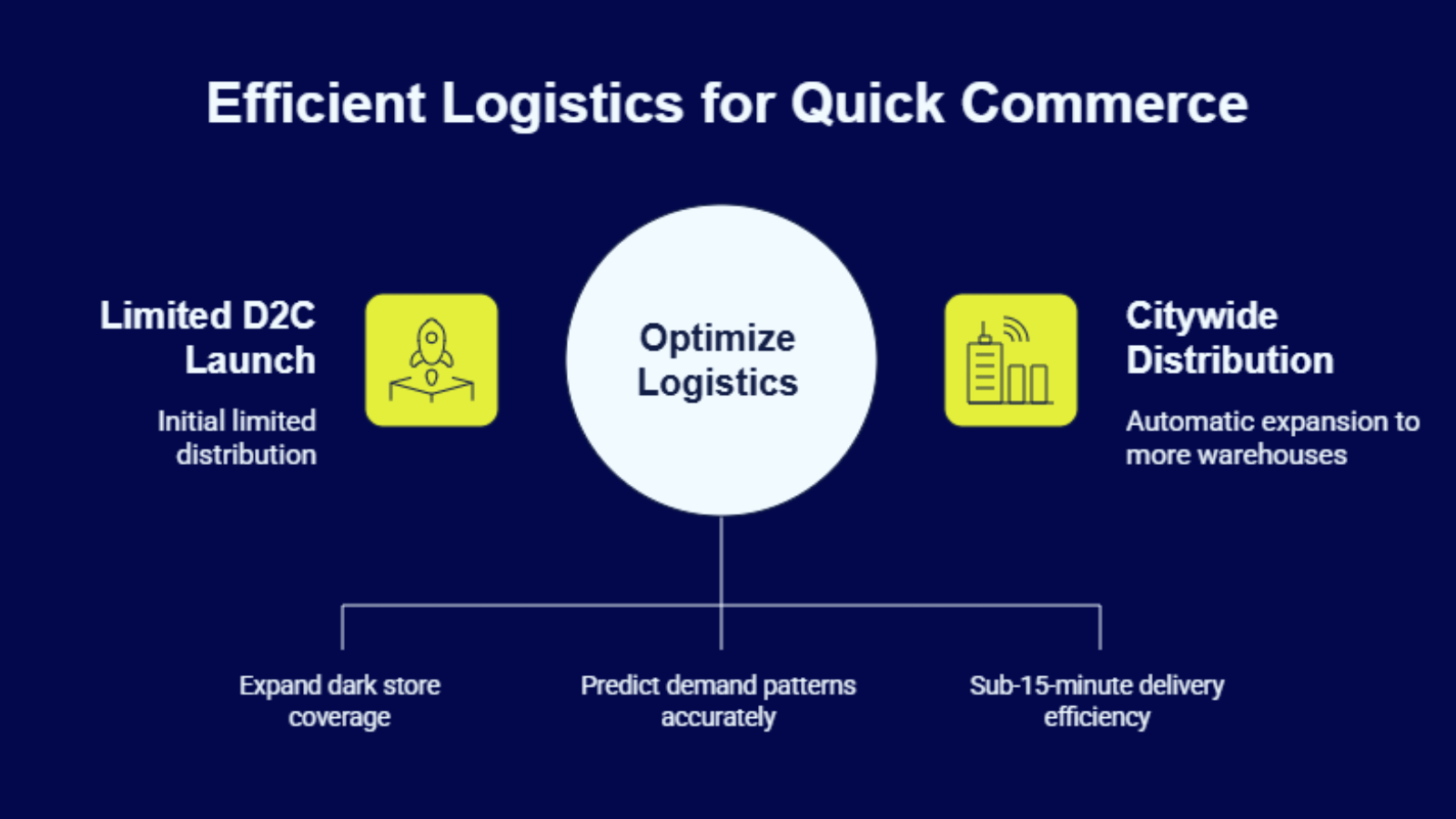 The logistics design of the Indian quick commerce market makes it uniquely efficient compared to most quick commerce emerging markets.
Infrastructure elements powering quick commerce
- Dark stores within a 1.5 to 3 km delivery radius
- Inventory prediction based on neighborhood demand patterns
- Rider fleets optimized for sub-15-minute delivery
Blinkit alone plans to expand to 3,000 dark stores by 2027, significantly increasing delivery coverage.
Why this matters for D2C sellers
Your product may not launch citywide initially. Instead, it starts with 10 to 50 dark stores in high-demand zones.
Key founder insight
If a product sells quickly in Tier 1 urban clusters, platforms expand distribution automatically to more warehouses.
4. Blinkit, Zepto, and Swiggy Instamart Are Becoming Digital Retail Shelves
The role of Blinkit, Zepto, Swiggy, and Instamart goes beyond delivery. These platforms are evolving into algorithm-driven retail shelves.
How platforms support brand discovery
- Search ranking visibility
- Sponsored product placements
- Category-based recommendations
- Algorithmic restocking based on sales velocity
Why this matters for founders
Unlike traditional marketplaces, quick commerce platforms reward sales velocity over reviews.
Example
A snack brand that sells 200 units per store per week is more likely to receive increased distribution than a product with high ratings but low turnover.
5. Real-Time Consumer Feedback Loops
 One of the most powerful advantages of quick commerce for D2C brands in India is rapid feedback.
What can founders learn quickly?
- Which SKUs sell fastest
- Which price points convert best
- Which neighborhoods drive demand
Example use case
A skincare brand launching on Blinkit, Zepto, Swiggy, and Instamart can identify top-performing SKUs within two weeks instead of waiting months on traditional marketplaces.
The Expansion of Quick Commerce in Emerging Markets and What It Means for D2C Brands
Quick commerce is expanding beyond traditional grocery delivery into several quick commerce emerging markets, including India, Japan, Germany, the UAE, and France. However, the Indian quick commerce market continues to lead adoption, growing at nearly 17 percent annually. In contrast, most European markets are growing below 10 percent, mainly due to slower logistics expansion and lower order frequency.
For Indian founders, this growth creates a testing ground for quick commerce for D2C brands in India before expanding internationally. Platforms like Blinkit, Zepto, Swiggy, and Instamart process millions of orders daily, and high-frequency consumption data helps brands identify scalable products quickly.
Products that perform well typically have three characteristics:
- Price between ₹150 and ₹500
- High repeat purchase cycles within 7 to 15 days
- Immediate consumption use cases
Examples include:
- Functional beverages
- Healthy snacks
- Skincare minis
- Ready-to-cook meals
Indian brands can use quick commerce demand data to expand into quick commerce emerging markets such as the UAE and Southeast Asia, where similar convenience-driven consumption patterns are growing.
The Future of Quick Commerce for D2C Brands in India
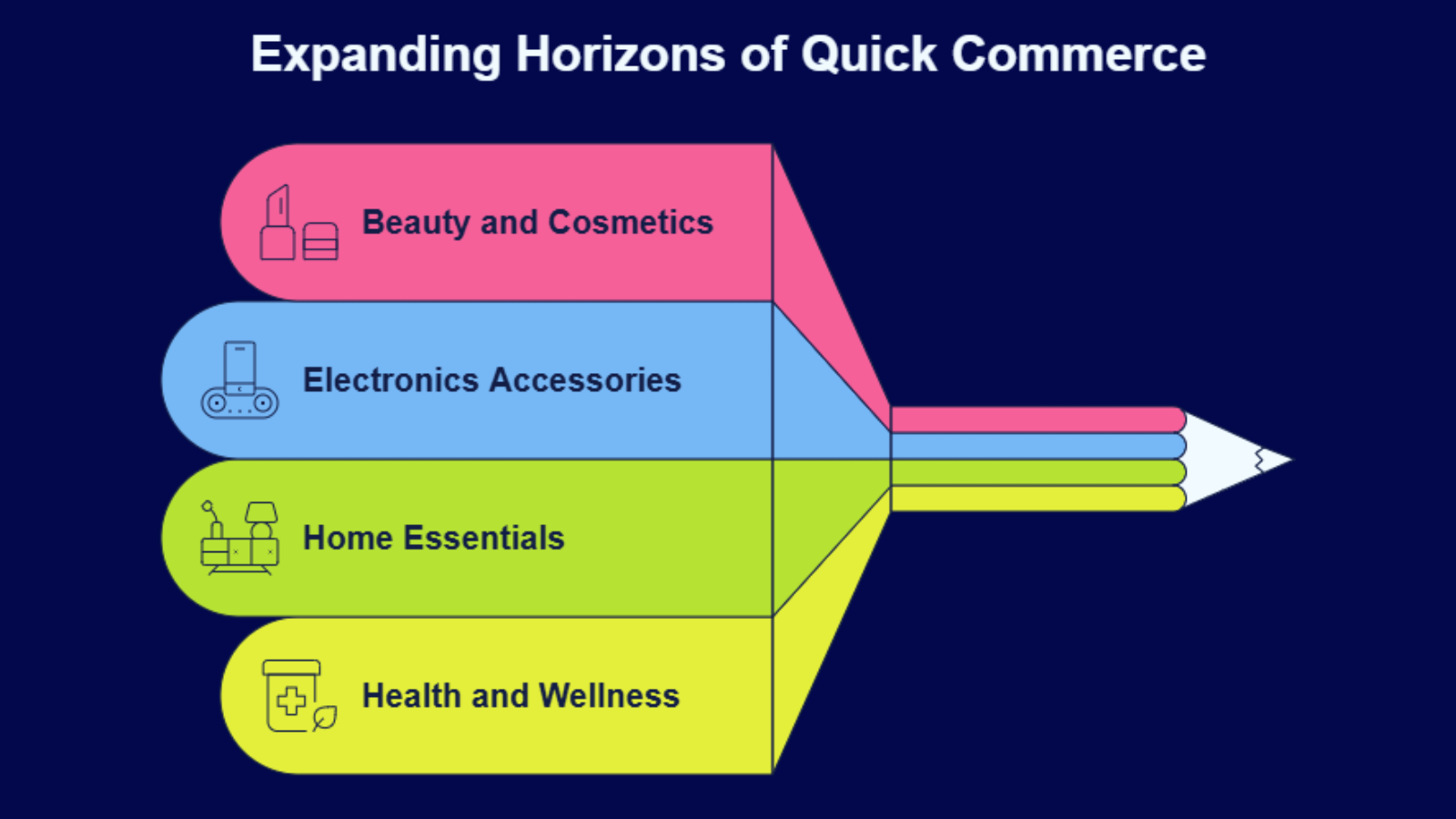 The next phase of quick commerce will move beyond groceries.
We are already seeing platforms expand into new categories.
Expected expansions include:
- Beauty and cosmetics
- Electronics accessories
- Home essentials
- Health and wellness
As infrastructure improves, the Indian quick commerce market will continue outperforming other quick commerce emerging markets.
For brands, this means the opportunity is still early.
The companies that build strong distribution on Blinkit, Zepto, Swiggy, and Instamart today will likely gain a significant advantage as the market grows.
How Base.com Helps D2C Brands Scale in Quick Commerce
Entering quick commerce is not just about listing products. Brands also need strong backend systems to manage inventory, fulfillment, and demand across multiple channels.
That is where Base.com comes in.
Base helps brands manage:
- inventory synchronization across platforms
- order management across marketplaces
- real-time fulfillment workflows
- faster scaling into quick commerce channels
If your brand is planning to grow in the Indian quick commerce market, Base can help you streamline operations and scale efficiently across platforms like Blinkit, Zepto, Swiggy, and Instamart.
FAQs
1. Can quick commerce help D2C brands expand internationally?
Yes. Many Indian brands use the Indian quick commerce market to validate product demand before expanding globally. If a product shows strong sales velocity on platforms like Blinkit Zepto, Swiggy, and Instamart, brands often replicate the same SKUs in markets such as the UAE, Singapore, and Southeast Asia, where quick commerce adoption is growing rapidly.
2. What type of SKUs should D2C brands launch first on quick commerce?
Brands should start with fast-moving, low inventory risk SKUs. Products priced between ₹150 and ₹500 with repeat consumption cycles of 7 to 15 days perform best. Examples include snack packs, mini skincare products, beverages, and ready-to-cook food that customers purchase frequently.
3. How do dark stores affect product visibility for brands?
Quick commerce platforms store products in hyperlocal dark stores that typically serve a 1.5 to 3 km delivery radius. Brands that achieve strong sell-through in a few stores often receive expanded placement across additional warehouses because platforms prioritize inventory velocity.
4. How quickly can brands test new products using quick commerce?
Unlike traditional marketplaces, where demand insights may take months, quick commerce for D2C brands in India can generate meaningful performance data within 2 to 3 weeks. Brands can quickly evaluate repeat purchases, location-based demand, and price sensitivity.
5. Which Indian cities drive the highest quick commerce demand?
The highest demand currently comes from Bengaluru, Delhi NCR, Mumbai, Hyderabad, and Pune. These cities have dense dark store infrastructure, higher disposable income, and strong consumer adoption of quick commerce platforms, which drives higher order frequency.