Quick commerce has changed how Indian consumers buy everyday products. Instead of waiting one or two days, customers now expect delivery within minutes. In cities like Bengaluru, Mumbai, and Delhi, platforms such as Blinkit, Zepto, and Swiggy Instamart regularly deliver orders in 10-20 minutes. This speed is possible because these platforms operate dark stores located within 2-3 km of customer clusters. Most dark stores stock 1,800 to 2,500 SKUs, compared to more than 50,000 SKUs in a traditional ecommerce warehouse.
For Indian D2C brands, this creates a new distribution channel but also introduces operational challenges that many sellers underestimate. A quick commerce partnership for D2C brands with aggregators and logistics providers is not simply a listing agreement. It requires precise inventory planning, localized demand forecasting, and a logistics setup that can replenish stock to dark stores multiple times a day.
One important nuance Indian sellers often miss is SKU velocity requirements. Aggregators expect products to sell consistently because dark stores have limited space. In many cases, if a product does not achieve 8 to 12 orders per store per day, it risks getting delisted. Another overlooked factor is the city-level assortment strategy. Products that perform well in Mumbai may not sell in Tier-2 cities like Jaipur or Lucknow due to price sensitivity and basket size differences.
A strong D2C delivery partner strategy also requires brands to work closely with a reliable quick-commerce logistics partner that can move inventory from brand warehouses to aggregator dark stores within 6 to 12 hours. Without this capability, stockouts occur frequently, which reduces product visibility in the aggregator algorithm.
The following table highlights how quick commerce differs from traditional ecommerce and what Indian D2C brands must plan for.
| Factor | Traditional Ecommerce | Quick Commerce |
|---|---|---|
| Delivery speed | 1-3 days | 10-30 minutes |
| Warehouse structure | Central fulfillment centers | Micro dark stores within 2-3 km of customers |
| SKU capacity | 30,000-50,000 SKUs | 1,800-2,500 SKUs per store |
| Replenishment cycle | Weekly or bi-weekly | Daily or multiple times per day |
| Sales velocity requirement | Moderate | 8-12 orders per SKU per store per day |
| Product focus | Wide catalog | Fast-moving essentials and impulse purchases |
For Indian sellers entering quick commerce, the key takeaway is simple. Success depends less on catalog size and more on high-velocity SKUs, tight inventory cycles, and a well-structured quick commerce partnership for D2C brands with aggregators and logistics providers. Brands that build the right D2C delivery partner strategy early can scale much faster across platforms like Blinkit and Zepto.
Top Aggregators and Logistics Providers That D2C Brands Partner With
 The quick commerce ecosystem in India is currently concentrated among a few dominant platforms that control most of the consumer demand. For D2C brands, choosing the right aggregator is one of the most important decisions when entering quick commerce. Each platform has a slightly different operating model, category focus, and supply chain expectation. A successful q-commerce aggregator deal requires brands to understand these nuances before onboarding.
India’s quick commerce market has grown rapidly in the last three years. Industry reports estimate that the sector processes over 2.5 million orders per day across major cities, with average order values ranging between ₹350 and ₹550. Most of these orders come from Tier-1 cities such as Bengaluru, Mumbai, Delhi NCR, and Hyderabad. However, platforms are now expanding aggressively into Tier-2 markets where demand is growing faster.
For Indian D2C sellers, the most effective entry strategy usually begins with a Blinkit Zepto partnership. These platforms currently dominate the quick commerce category and have the highest order volumes.
Below are the key aggregators that D2C brands typically partner with, along with important operational insights.
1. Blinkit
Blinkit is currently the largest quick commerce platform in India and operates thousands of dark stores across major cities. The platform processes a high number of grocery and essentials orders, but categories like personal care, packaged food, and beverages are growing quickly.
Important nuances for D2C sellers:
- Blinkit dark stores typically stock 1,800 to 2,200 SKUs per location, so shelf space is extremely limited.
- Products need to achieve high daily sales velocity to remain listed. Low-moving SKUs are often removed within weeks.
- Inventory replenishment must happen within 12 hours in high-volume cities to avoid stockouts.
- Brands often need to support platform advertising budgets to gain visibility in search results.
Many brands start their quick commerce journey with Blinkit because of its strong demand concentration in urban markets. A Blinkit partnership strategy often begins here due to Blinkit’s large customer base.
2. Zepto
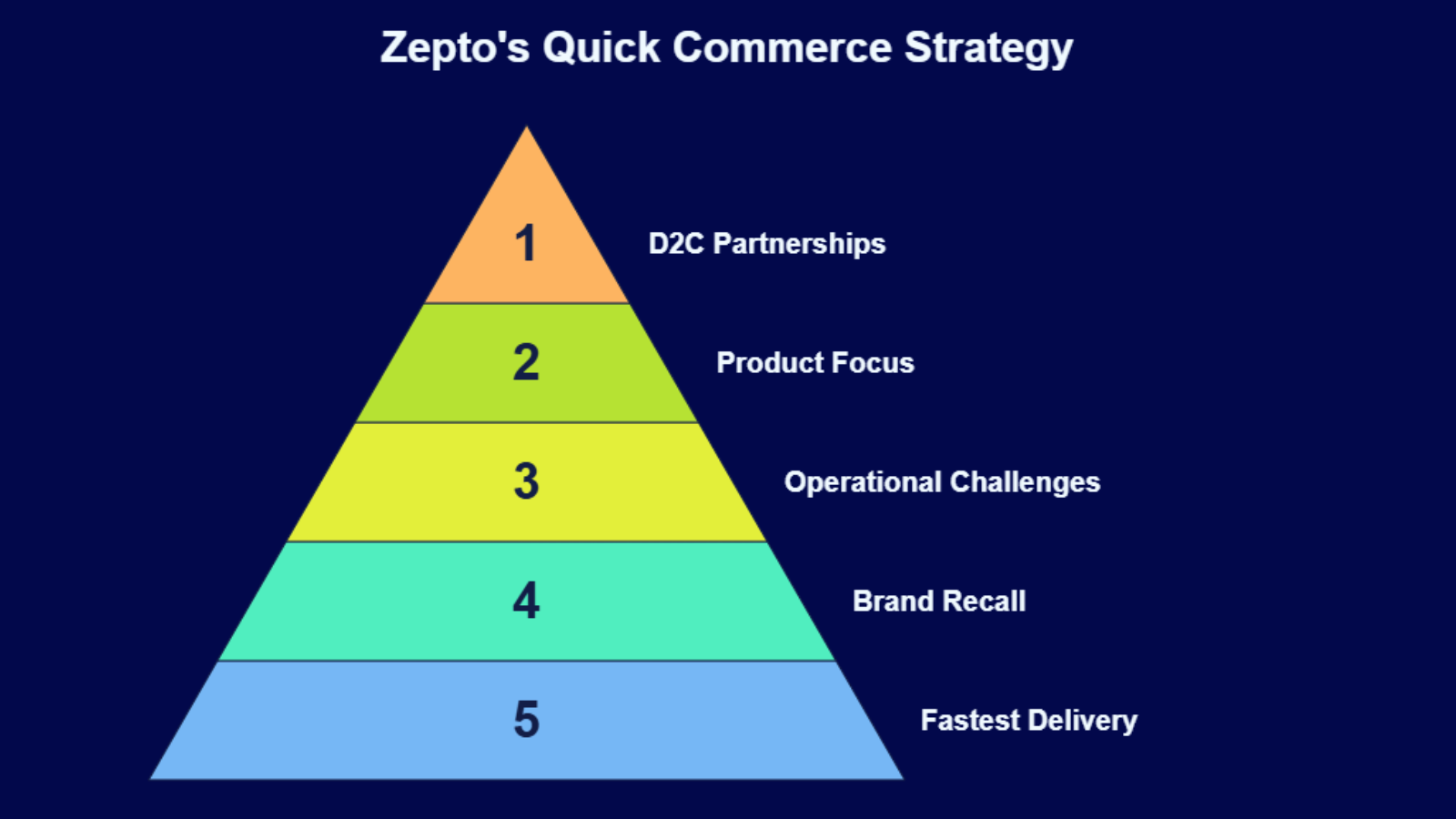 Zepto has positioned itself as the fastest delivery platform in India, often promising deliveries within 10 minutes. This promise has helped Zepto build a strong brand recall among younger urban consumers.
Key operational considerations:
- Zepto experiences significant demand spikes during evening hours between 6 PM and 10 PM, when order volumes can increase by 40-50 percent.
- Dark store inventory turnover is extremely fast, so brands must maintain high fill rates to stay visible in listings.
- The platform favors smaller pack sizes and impulse purchase products.
For many D2C brands, entering quick commerce often means building a Zepto partnership simultaneously to maximize reach across urban customers.
3. Swiggy Instamart
Swiggy Instamart benefits from Swiggy’s strong delivery infrastructure and customer base built through food delivery. This allows Instamart to quickly convert existing users into grocery and essentials buyers.
Important details for D2C brands:
- Instamart often bundles grocery orders with food delivery demand, increasing order frequency during meal times.
- Average basket sizes are slightly higher than on other platforms, typically ₹450 to ₹600.
- Competitive pricing is critical because customers often compare grocery prices with those of nearby supermarkets.
Brands entering a q-commerce aggregator deal with Instamart must focus on strong pricing and promotional strategies.
4. BigBasket BB Now
BB Now is Tata Group’s quick commerce offering built on the BigBasket ecosystem. It benefits from the company’s long-standing grocery supply chain and strong brand trust.
Nuances brands should consider:
- Customers on BB Now tend to purchase larger baskets, which often include multiple grocery items in a single order.
- Products in staple categories such as packaged food, snacks, and home essentials perform particularly well.
- BigBasket often prioritizes consistent supply reliability over large catalogs.
This makes BB Now suitable for brands that have stable manufacturing capacity and predictable demand patterns.
5. Flipkart Minutes
 Flipkart Minutes is one of the newer quick commerce players, but it is expanding quickly, especially in Tier-2 cities. The platform is leveraging Flipkart’s ecommerce infrastructure to scale fast.
Important insights for sellers:
- Flipkart Minutes is expanding categories beyond groceries, including electronics accessories, personal care, and small home products.
- Demand is growing in cities such as Indore, Lucknow, and Chandigarh, where quick commerce adoption is increasing.
- Brands with strong ecommerce performance on Flipkart often receive priority onboarding opportunities.
For many Indian D2C brands, Flipkart Minutes becomes a secondary expansion channel after building a Blinkit Zepto partnership.
Top Logistics Providers Supporting Quick Commerce
Quick commerce delivery may appear simple from the customer side, but the supply chain behind it is extremely complex. Orders that arrive within 10 to 20 minutes depend on multiple logistics layers. These include warehouse storage, dark store replenishment, intra-city transportation, and last-mile delivery. While aggregators such as Blinkit and Zepto manage customer delivery fleets, they still depend heavily on third-party logistics companies to move inventory between supplier warehouses and dark stores.
For Indian D2C brands, selecting the D2C best logistics provider is one of the most critical decisions when building a quick commerce channel. The biggest operational challenge is maintaining product availability across dozens or even hundreds of dark stores within a city. If inventory runs out, aggregator algorithms often reduce product visibility, which directly affects sales.
Most quick commerce platforms require brands to replenish inventory to dark stores within 6 to 12 hours, especially for high-velocity products. This makes choosing the right quick commerce logistics partner an essential part of a scalable D2C delivery partner strategy.
Below are the most commonly used logistics providers supporting quick commerce supply chains in India and the practical nuances D2C brands must understand.
Delhivery
 Delhivery is one of the largest logistics companies in India and has been expanding aggressively into rapid commerce logistics infrastructure.
Key insights for D2C sellers:
- Delhivery operates more than 20 automated fulfillment centers and thousands of delivery hubs across India.
- The company is investing heavily in rapid commerce fulfillment and dark store infrastructure to support faster replenishment cycles.
- Brands using Delhivery can distribute inventory to multiple dark stores across cities using centralized warehousing.
Use cases for D2C brands:
- Ideal for brands that sell across multiple cities simultaneously.
- Suitable for high-volume SKUs that require predictable supply chain management.
- Helps brands maintain strong inventory availability inside aggregator networks.
For many growing brands, Delhivery often becomes the D2C best logistics provider for scaling operations across multiple quick commerce platforms.
Shadowfax
Shadowfax is widely used in the hyperlocal logistics space and supports delivery operations for several quick commerce platforms.
Operational advantages include:
- A large network of over 100,000 delivery partners across India.
- Specialized expertise in last-mile delivery within dense urban areas.
- Strong integration with ecommerce and quick commerce platforms.
Key use cases:
- Same-day inventory movement between warehouses and dark stores.
- Rapid last-mile deliveries during peak demand hours.
- Flexible logistics support for high-volume promotional events.
For brands building a fast and flexible D2C delivery partner strategy, Shadowfax is often used alongside a larger warehousing provider.
Porter
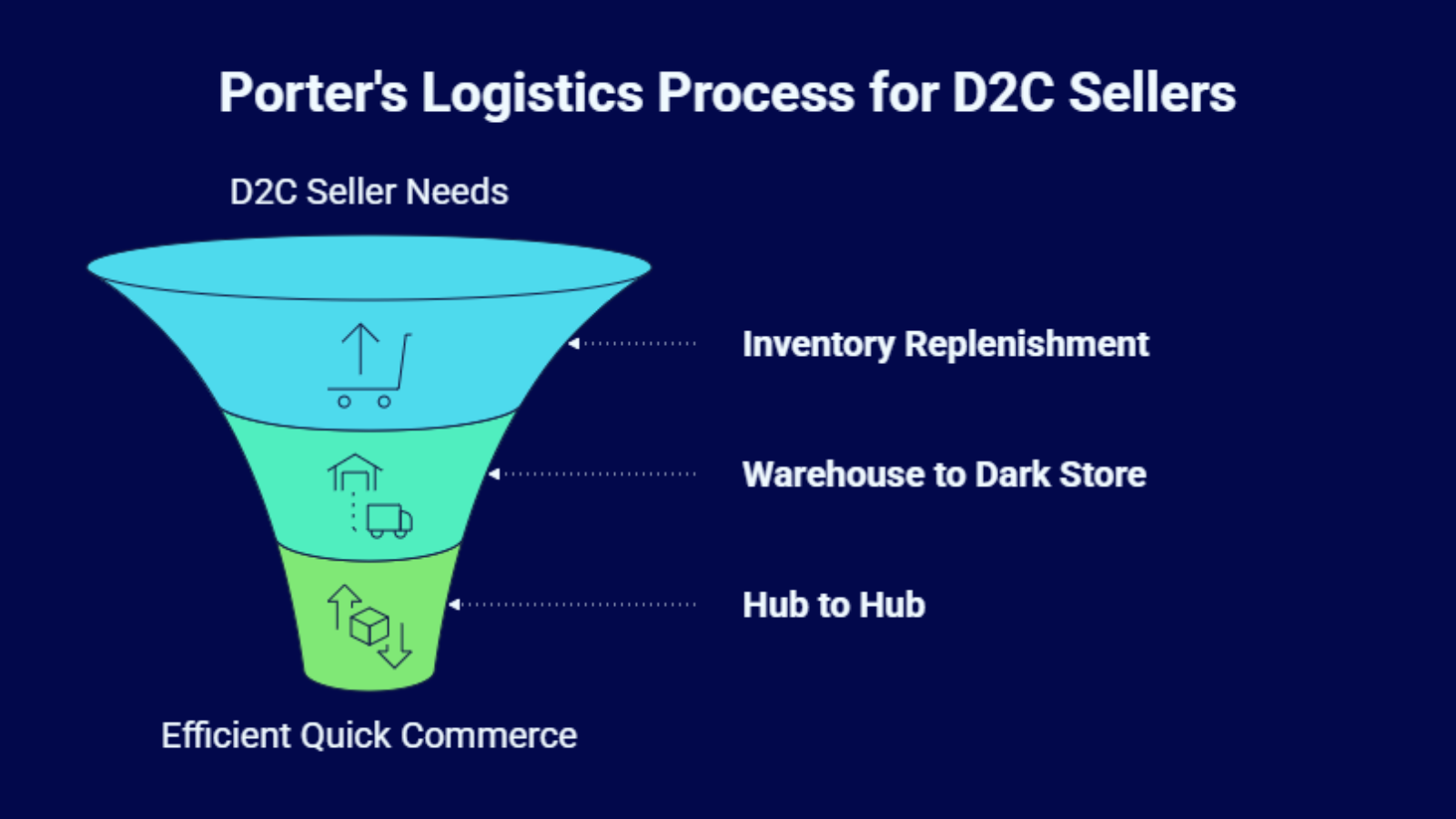 Porter focuses primarily on intra-city logistics and is widely used for moving goods within metropolitan areas.
Important operational insights:
- Porter operates a network of mini trucks, two-wheelers, and tempo vehicles across major Indian cities.
- It is frequently used for dark store replenishment during peak hours when inventory runs out.
Use cases for D2C sellers:
- Emergency inventory replenishment during stockouts.
- Intra-city transportation from warehouses to aggregator dark stores.
- Moving bulk inventory between local distribution hubs.
For brands managing inventory across multiple dark stores within a city, Porter often becomes an important quick commerce logistics partner.
Dunzo Logistics
Dunzo initially built its logistics network around hyperlocal delivery and later expanded into ecommerce fulfillment services.
Key strengths include:
- Strong presence in metro cities such as Bengaluru, Delhi, and Mumbai.
- Expertise in store-to-customer delivery models.
- Flexible logistics operations for smaller shipments.
Use cases for D2C brands:
- Last-mile delivery from partner stores or warehouses.
- Fast movement of high-priority inventory batches.
- Support for hyperlocal fulfillment operations.
Brands operating smaller warehouses or local distribution points often integrate Dunzo into their D2C delivery partner strategy.
Zippee
Zippee is one of the few logistics companies built specifically for quick commerce infrastructure.
Important capabilities include:
- Dedicated dark store network integrations.
- Technology systems are designed for real-time inventory replenishment.
- Support for brands selling directly through quick commerce platforms.
Use cases for D2C sellers:
- Managing inventory across multiple dark stores.
- Enabling rapid order fulfillment within cities.
- Supporting brands building direct, quick commerce channels.
Because Zippee focuses exclusively on rapid commerce, it is becoming an important quick commerce logistics partner for brands expanding into this distribution model.
How D2C Brands Should Structure Quick Commerce Partnerships
 A successful quick commerce partnership for D2C brands with aggregators and logistics providers depends on operational precision rather than just product listings. Platforms like Blinkit and Zepto operate dark stores with limited capacity and extremely fast inventory turnover. In most Indian metro cities, a single dark store processes 1,200 to 1,500 orders per day, which means products must maintain strong sales velocity to stay listed. For D2C brands entering quick commerce, structuring the right supply chain, pricing model, and SKU strategy is essential to building a profitable Q-commerce aggregator deal.
Indian sellers should focus on the following operational principles when building a D2C delivery partner strategy.
- Prioritize high-velocity SKUs because quick commerce platforms typically remove products that generate fewer than 8-10 orders per store per day.
- Design lightweight quick commerce packs under 500 grams or ₹500 price points, since most quick commerce orders fall within ₹350-₹550 basket values.
- Bundle products strategically to increase basket contribution, such as snack combos or grooming kits that improve order value and ranking in aggregator algorithms.
- Plan city-specific assortments because products that sell well in Bengaluru may underperform in cities like Jaipur or Ahmedabad due to different price sensitivity.
- Maintain daily inventory replenishment cycles since many Blinkit and Zepto dark stores restock two to three times per day to support rapid sales turnover.
- Integrate with a reliable, quick commerce logistics partner capable of delivering stock to dark stores within 6-12 hours to avoid listing penalties.
- Negotiate data access in the Q-commerce aggregator deal so brands can analyze demand trends, category growth, and peak purchase hours.
- Limit catalog size to 5-7 core SKUs because dark stores prioritize high-selling products that maximize shelf productivity.
- Track sell-through rates weekly to ensure inventory moves quickly and prevents product delisting from aggregator platforms.
- Use dynamic pricing and bundle offers during peak demand hours, when quick commerce orders increase by 30-40 percent in evening slots.
For Indian D2C sellers, the biggest quick commerce advantage comes from speed and convenience. Brands that structure the right quick commerce partnership for D2C brands with aggregators and logistics providers, supported by a strong D2C delivery partner strategy, can scale quickly across platforms like Blinkit and Zepto while maintaining consistent product visibility.
Building a Long-Term D2C Delivery Partner Strategy and the Future of Quick Commerce
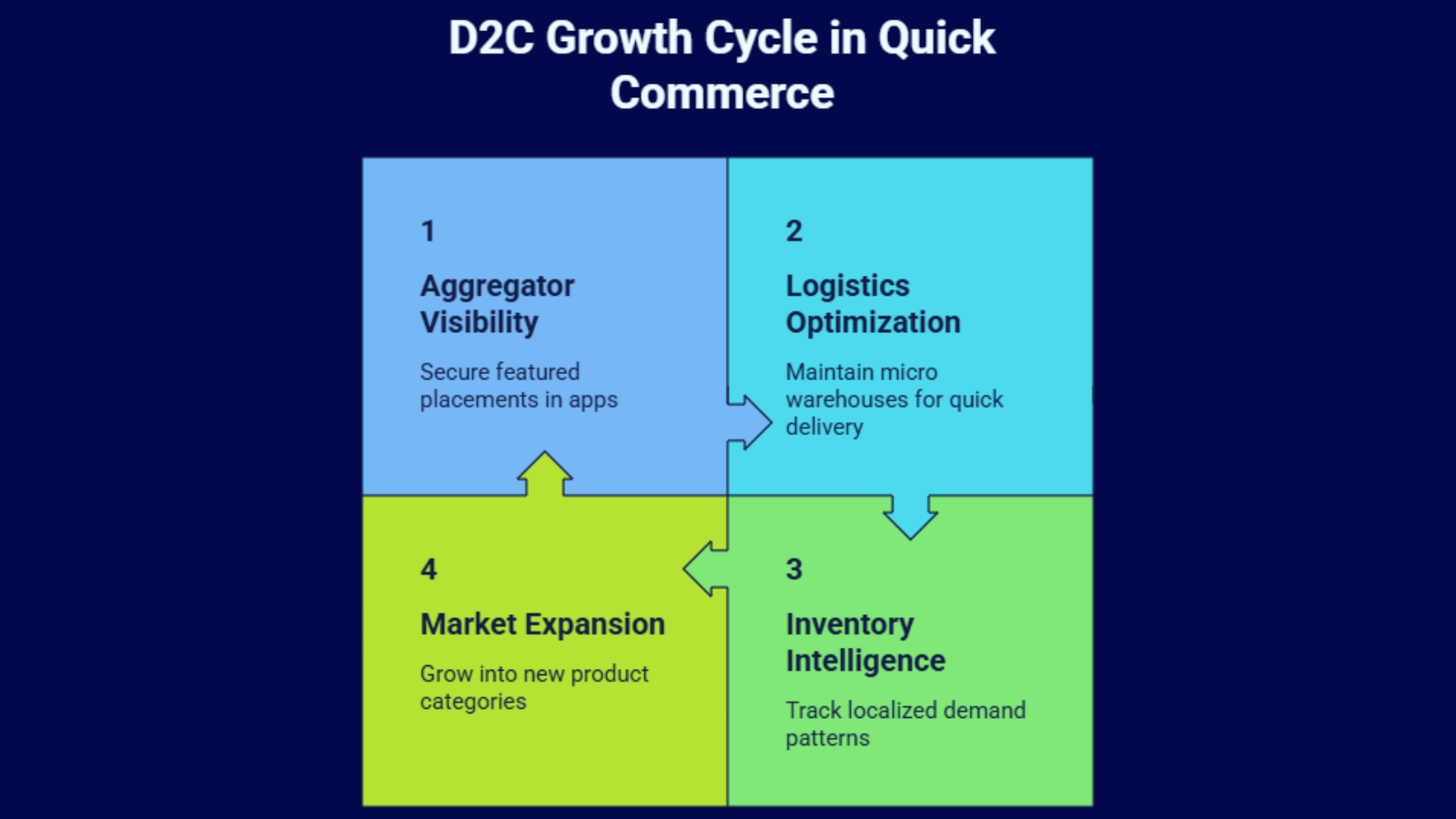 For Indian brands, a scalable D2C delivery partner strategy in quick commerce requires a clear three-layer structure that connects demand generation, supply chain reliability, and data intelligence. Platforms like Blinkit, Zepto, and Instamart operate thousands of dark stores across India, and each store serves a 2-3 km delivery radius with extremely fast order cycles. Because these stores process 1,000 to 1,500 orders daily, brands that fail to maintain inventory availability often lose visibility within the aggregator algorithm.
A practical strategy starts with aggregator visibility. Most D2C brands begin with a Blinkit-Zepto partnership because these platforms generate the highest quick commerce order volumes in India. Securing featured placements inside aggregator apps can increase product discovery significantly. In many categories, promoted listings can improve product visibility by 25-40 percent, especially during evening peak hours when demand spikes.
The second layer involves logistics optimization. Brands must identify the D2C best logistics provider capable of replenishing dark stores quickly. Successful sellers typically maintain city-level micro warehouses within 10-15 km of major dark store clusters, allowing stock to reach aggregator hubs within 6-8 hours. Without this infrastructure, frequent stockouts reduce ranking and sales performance.
The third layer focuses on inventory intelligence. Quick commerce demand patterns are highly localized. For example, beverage sales may spike in Bengaluru during weekends, while packaged snacks perform better in Delhi during evening hours. Tracking these patterns allows brands to forecast high-velocity SKUs more accurately.
The opportunity is growing rapidly. India’s quick commerce market is already valued at over $5 billion and expected to cross $7 billion in the near future. What started with groceries is now expanding into categories like beauty, electronics, accessories, and personal care. For Indian sellers, combining a well-negotiated q-commerce aggregator deal with a strong D2C delivery partner strategy can unlock a powerful new growth channel within the fast-moving quick commerce ecosystem.
How Base.com Helps D2C Brands Scale on Quick Commerce
Managing inventory across dark stores, aggregators, and logistics partners can quickly become complex.
Base.com helps D2C brands streamline operations across multiple quick commerce platforms.
With Base.com, brands can:
- Sync inventory across Blinkit, Zepto, and Instamart
- Manage logistics providers from one dashboard
- Automate replenishment to dark stores
- Track performance across aggregators
If your brand is planning a quick commerce partnership for D2C brands with aggregators and logistics providers, Base.com can help simplify operations and scale faster.
Quick commerce is not just about fast delivery. It is about building a supply chain that can respond instantly to demand.
For D2C brands, success depends on three things:
- the right quick commerce logistics partner
- a strong Blinkit Zepto partnership
- a scalable D2C delivery partner strategy
Brands that treat quick commerce as a strategic channel rather than an experiment will capture the fastest-growing retail opportunity in the market.
Frequently Asked Questions
1. How do D2C brands get listed on aggregators like Blinkit or Zepto?
Most aggregators onboard brands through category managers or distributor partnerships rather than open seller registrations. Many D2C brands enter through city-level distributors who already supply dark stores, which helps accelerate listing approvals and inventory placement.
2. Should D2C brands supply inventory directly to dark stores or through a distributor?
In most cases, aggregators prefer distributor-led supply models because it simplifies replenishment across hundreds of dark stores. However, larger D2C brands often supply inventory directly to regional aggregator warehouses, which improves margins and inventory control.
3. What inventory fill rate do aggregators expect from D2C brands?
Quick commerce platforms usually expect a 95 percent or higher fill rate across dark stores. If products frequently go out of stock, the platform algorithm may reduce product visibility or replace the SKU with competing brands.
4. How do logistics providers support quick commerce beyond last-mile delivery?
Logistics providers mainly handle warehouse-to-dark-store replenishment, which is critical for maintaining product availability. Many aggregators manage customer delivery internally, but brands still need a quick commerce logistics partner to move inventory quickly across cities.
5. What logistics capability should D2C brands evaluate before entering quick commerce?
Brands should ensure their logistics partner can support same-day intra-city movement, API-based inventory tracking, and rapid dark store replenishment within 6-12 hours. Without this capability, products frequently go out of stock, reducing sales performance on aggregator platforms.