

Audit your Flipkart catalog eight weeks before Big Billion Days, in this order: compliance and approval status first, then attribute completeness, then content and images, then commercial settings, then fulfilment. Flipkart product listing optimization fails when sellers start with titles and discover approval or QC blocks in the final week. The 20 checks below follow that sequence.
Why Flipkart needs a separate audit from Amazon
Sellers who run both marketplaces often assume one catalog process covers both. It does not, and the gaps are structural. Flipkart product listing optimization is a different discipline with different failure modes.
Flipkart operates a stricter catalog quality control layer. Images and attributes pass through QC before going live, and rejection messages are frequently generic. You are told the image failed, not which of four rules it broke.
Flipkart’s category taxonomy is also its own. Vertical attributes differ from Amazon’s, and a bulk template built for Amazon will silently drop the fields Flipkart actually ranks and filters on.
The commercial layer differs too. Buy box allocation, the F-Assured badge, and Fulfilment by Flipkart eligibility all pull from listing and performance data rather than price alone.
Flipkart product listing optimization therefore has to be run as its own project, on its own timeline, with its own checklist.
The volume justifies it. Flipkart holds India’s largest share of fashion e-commerce and strong positions in electronics, home and consumer durables, with particularly deep reach into Tier II and Tier III cities through Ekart. Big Billion Days is its flagship event, running for several days in the late-September festive window, with early access for Plus members.
Work backwards from the sale, not forwards from today
|
Weeks before BBD |
Audit block |
|---|---|
|
8-10 weeks |
Checks 1-4: compliance, approvals, brand authorisation, blocked listings |
|
6-8 weeks |
Checks 5-9: attributes, taxonomy, titles, search terms, duplicates |
|
5-6 weeks |
Checks 10-12: image QC, rich media, size charts |
|
4-5 weeks |
Checks 13-16: pricing, buy box, deal nomination, F-Assured |
|
3-4 weeks |
Checks 17-19: FBF inbound, serviceability, dispatch settings |
|
1-2 weeks |
Content freeze. Monitoring only |
|
Post-sale |
Check 20: returns and correction loop |
Freeze the catalog one to two weeks out. Changes made close to the event lose the ranking history they were meant to improve, which is the most common self-inflicted wound in Flipkart product listing optimization.
Block A: Compliance and approvals (Checks 1-4)
Start here. Every other improvement is wasted on a listing that cannot go live.
This block is where Flipkart product listing optimization diverges most sharply from Amazon work, because Flipkart gates more categories and resolves approval issues more slowly.
Check 1: Brand approval status on every listed brand

Flipkart requires brand authorisation for many categories, and approvals lapse. Resellers discover this when a previously live listing stops accepting updates.
Pull your full brand list and confirm each is currently approved for the categories you sell in. Renewal takes days, and it takes far longer in September when the approvals queue is full.
Check 2: Category and vertical restrictions.

Some verticals carry additional gating, particularly in electronics, beauty, and anything with safety or certification requirements. Confirm you are approved for every vertical in your catalog, not just the ones you sell most.
Check 3: Blocked, archived, and inactive listings.
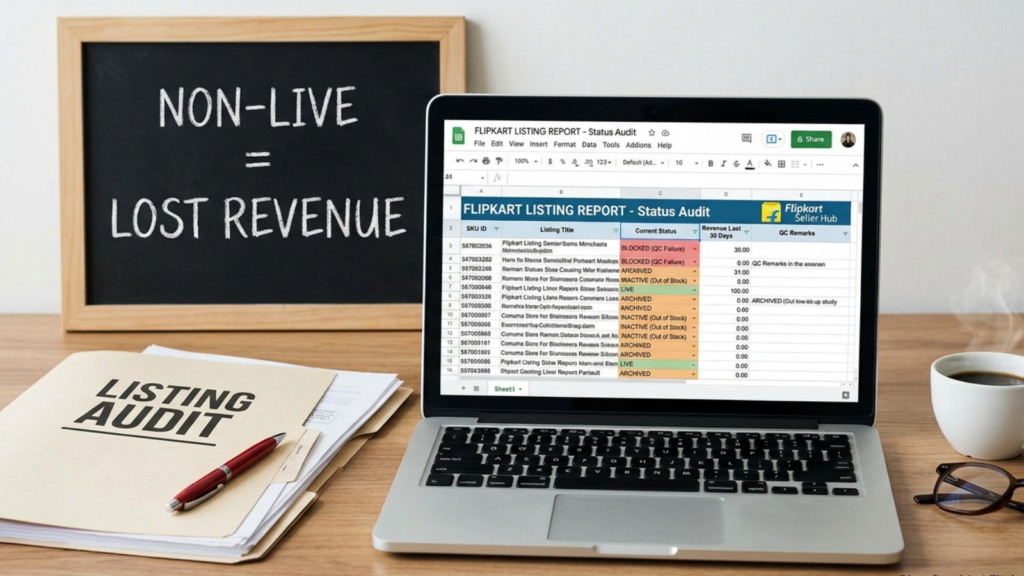
Flipkart Seller Hub holds listings in states that are not obviously visible: blocked for QC failure, archived, or inactive for stock reasons. Export the full listing report and filter by status.
Treat every non-live listing as lost revenue until proven otherwise. This is the fastest return in the entire audit, because these SKUs currently earn nothing.
Check 4: Statutory and compliance fields.

Country of origin, manufacturer or packer details, HSN, MRP and net quantity are mandatory in most verticals and are a frequent cause of silent rejection.
Legal Metrology requirements apply to packaged goods, and Flipkart enforces them at catalog level. Thorough Flipkart product listing optimization treats these as ranking-relevant fields, because a suppressed listing has no ranking at all.
Block B: Attributes, taxonomy and content (Checks 5-9)
This is the largest block and the one that moves organic ranking. Most sellers treat Flipkart product listing optimization as a copywriting exercise and start here at Check 7. Start at Check 5 instead, because attributes drive the filters that carry festive traffic.
Check 5: Mandatory attribute completeness by vertical

Flipkart’s filters run on structured attributes. A saree listing without fabric, occasion, and weave populated will not appear when a buyer filters on any of them, regardless of how good the title is.
Export your catalog by vertical and calculate completeness as a percentage. Anything below 90% on mandatory fields needs work before BBD. Attribute completeness is the least visible part of Flipkart product listing optimization and the part with the highest return.
|
Vertical |
Frequently missed attributes |
|---|---|
|
Apparel |
Fabric, fit, occasion, sleeve length, pattern, wash care |
|
Footwear |
Outer material, sole material, closure, ideal for, width |
|
Home |
Room type, material, care instructions, assembly required |
|
Electronics accessories |
Compatibility, connector type, cable length, warranty type |
|
Beauty |
Skin type, concern, formulation, shelf life, ingredients |
|
Kitchen |
Capacity, wattage, material grade, induction compatibility |
Check 6: Correct vertical placement
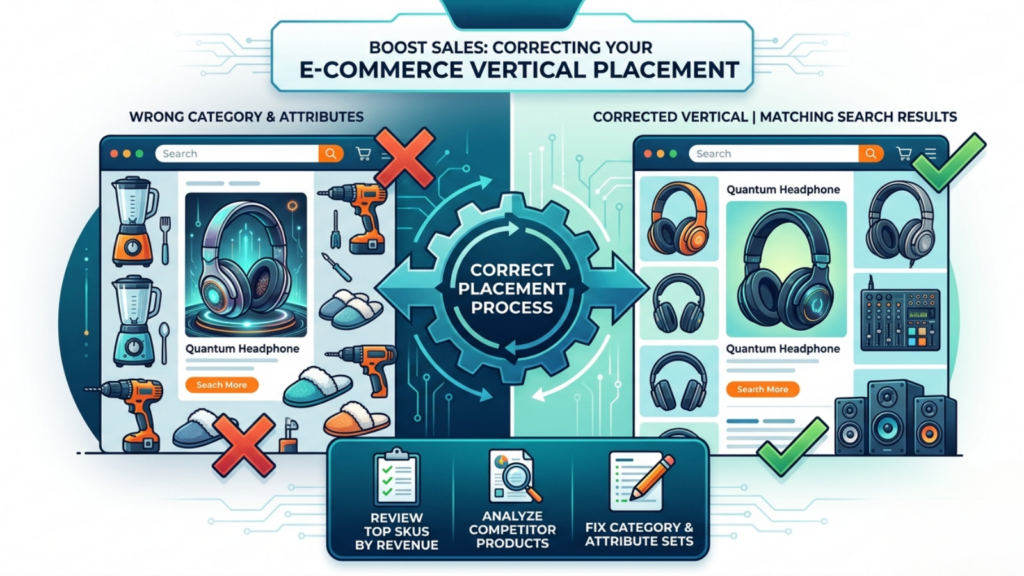
A product in the wrong vertical inherits the wrong attribute set and competes in the wrong search results. This happens most often when a bulk upload reuses a template from a similar but distinct category.
Review vertical placement for your top 100 SKUs by revenue. If the competing products on the page look nothing like yours, the vertical is wrong.
Check 7: Title structure and length
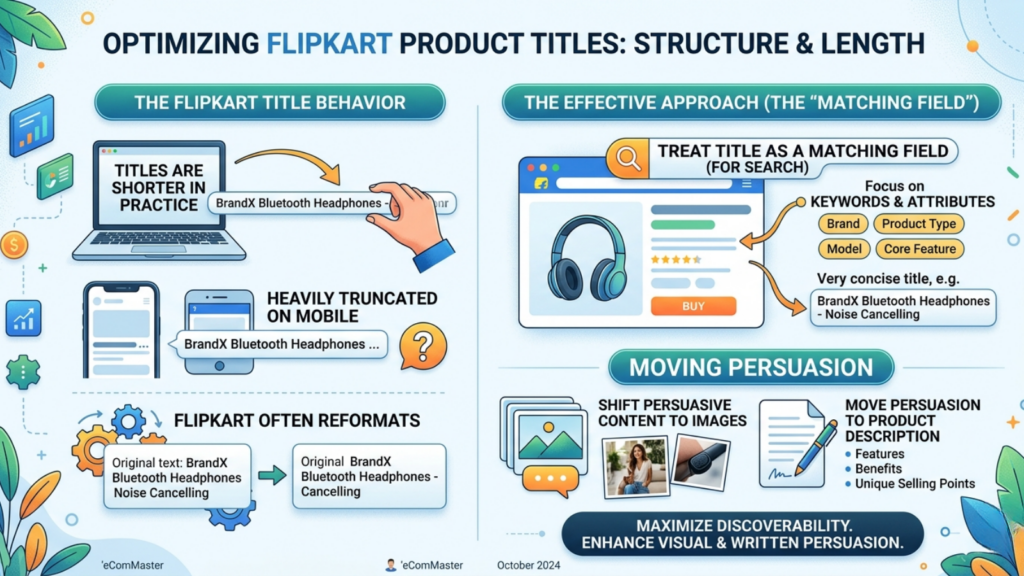
Flipkart titles behave differently from Amazon titles. They are shorter in practice, heavily truncated on mobile, and Flipkart often reformats them.
|
Rule |
Reason |
|---|---|
|
Brand name first |
Drives brand-search matching |
|
Product noun within the first five words |
Primary matching signal |
|
Two or three defining attributes only |
Extra terms dilute rather than add |
|
No promotional language |
Fails QC |
|
Pack quantity stated explicitly |
Captures combo and gift-set demand |
|
Variant attribute included |
Prevents identical sibling titles |
Good Flipkart product listing optimization treats the title as a matching field and moves persuasion into images and description.
Check 8: Description and key features.

Flipkart renders key features as a bulleted block above the description. Most buyers read only that block.
Lead with the three things that decide the purchase, not the three things you are proudest of. For Indian festive buyers, this is usually fit or size clarity, warranty and service, and what is actually in the box.
Check 9: Duplicate and near-duplicate listings.
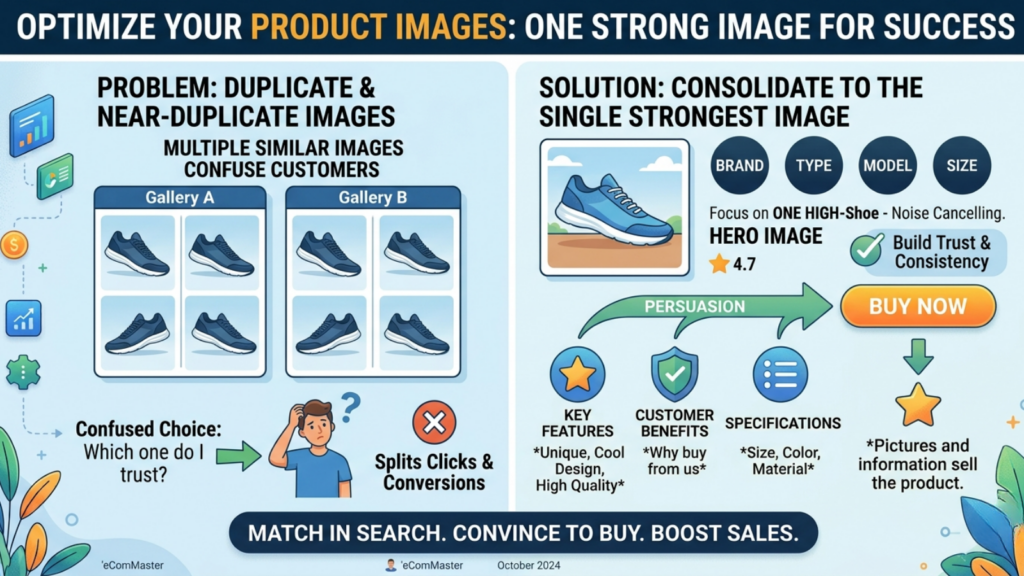
Duplicates split reviews and sales velocity across ASINs that should be one. They also create internal price competition that suppresses your own buy box.
Search your own brand on Flipkart and compare against your listing export. Where duplicates exist, consolidate to the strongest listing and deactivate the rest well before the sale.
Deduplication is the structural half of Flipkart product listing optimization. No amount of content work rescues a product whose demand is split across four weak listings.
Block C: Images and rich media (Checks 10-12)
Image QC is the most common blocker in Flipkart product listing optimization, and the least transparent.
Check 10: Main image compliance.
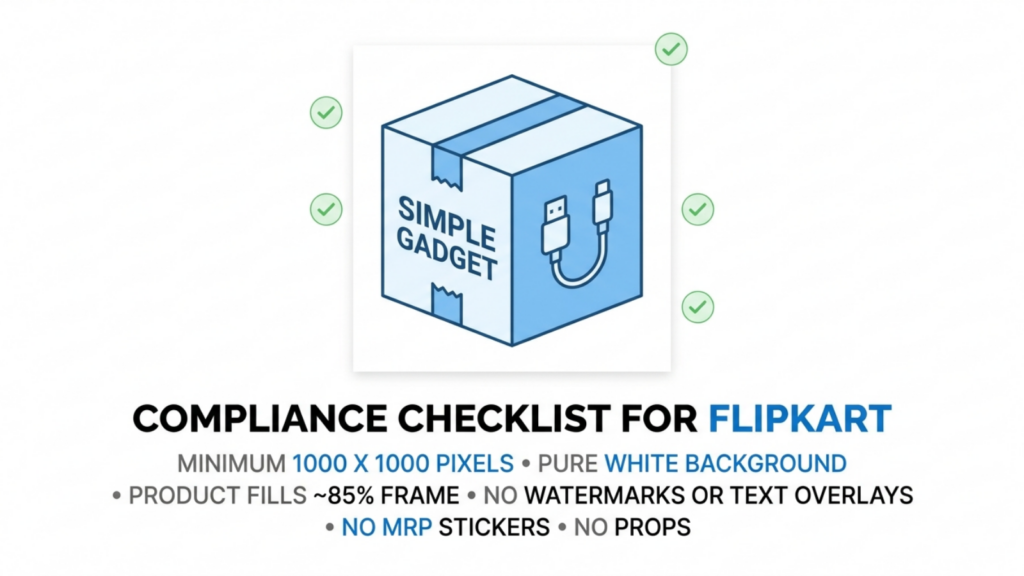
Flipkart’s core image requirements are strict and mechanically enforced: minimum 1000 x 1000 pixels, pure white background, product filling roughly 85% of the frame, no watermarks, no text overlays, no visible MRP stickers, no props.
Rejection messages rarely name the specific failure. Audit against all of the rules at once before re-uploading, or you will spend a week cycling through them one at a time.
Check 11: Secondary image stack.
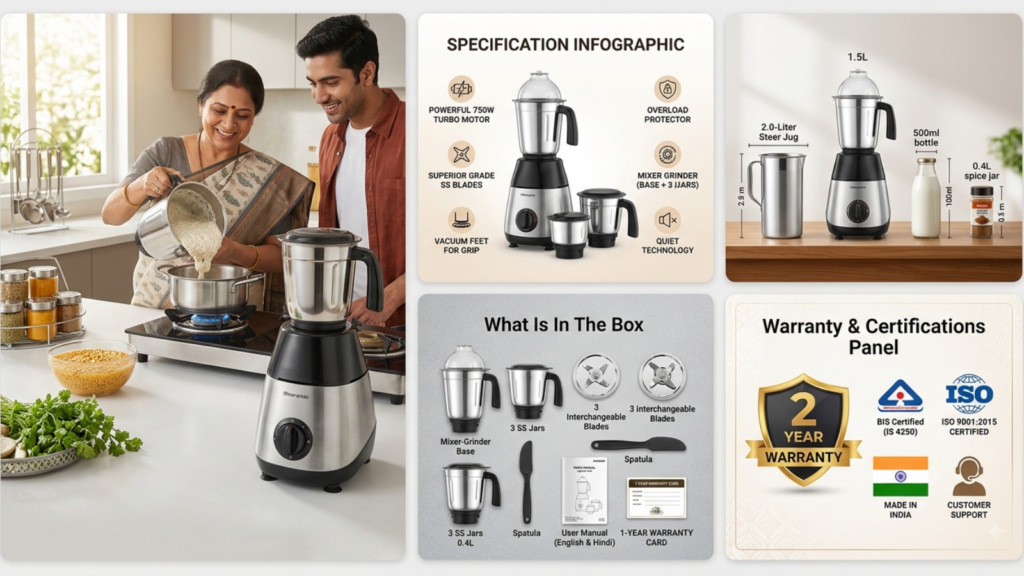
Most Indian sellers upload two images and stop. The remaining slots are free conversion.
- Product in use, in a recognisably Indian context
- Specification infographic
- Scale or dimension reference
- What is in the box, essential for combos and gift packs
- Warranty, certification or origin trust panel
Check 12: Size charts and colour accuracy

Flipkart’s strength is fashion, and fashion carries the highest return rates on the platform, with apparel commonly running in the 15-25% band. COD returns across Indian e-commerce sit at roughly 25-30%.
Two catalog fixes reduce this directly: a measured size chart in centimetres, and colour-calibrated photography so the delivered product matches the thumbnail. Both are catalog work, not logistics work.
Block D: Commercial settings (Checks 13-16)
These four checks decide whether the work in Blocks A to C actually earns placement. Flipkart product listing optimization that stops at content leaves the buy box and the badge on the table.
Check 13: Buy box position on shared listings.
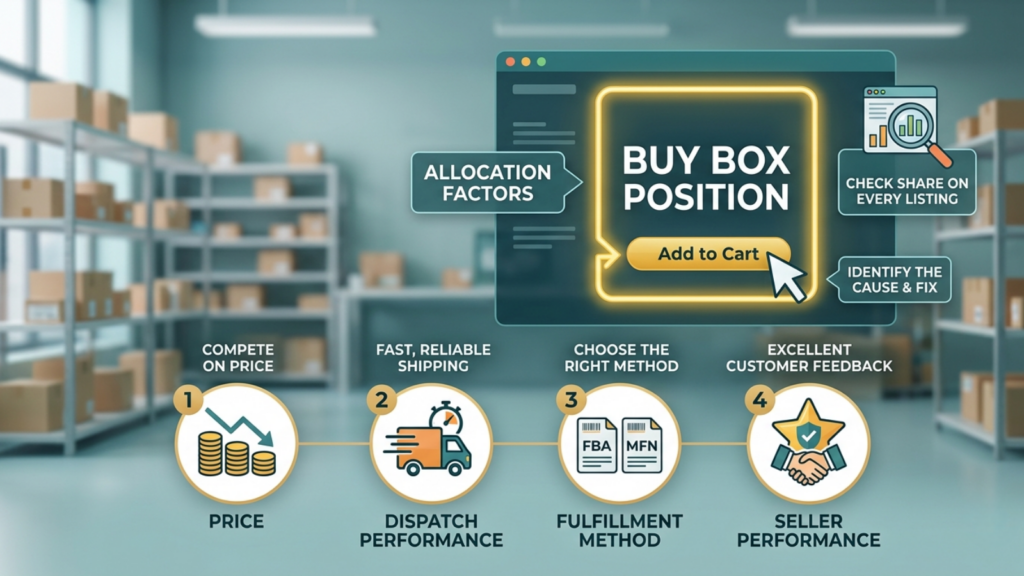
On matched listings, you compete with other sellers for the buy box. Allocation weighs price alongside fulfilment reliability and seller performance.
Check buy box share on every shared listing. Where you are losing it, identify whether the cause is price, dispatch performance or fulfilment method, because each has a different fix and different lead time.
Check 14: MRP integrity and price path.

Inflated MRP to manufacture a bigger discount is both a compliance risk and a suppression trigger.
Hold your selling price steady in the weeks before BBD. Cutting price shortly before the sale can undermine the discount you intended to show during it.
Check 15: Deal and event nomination status.
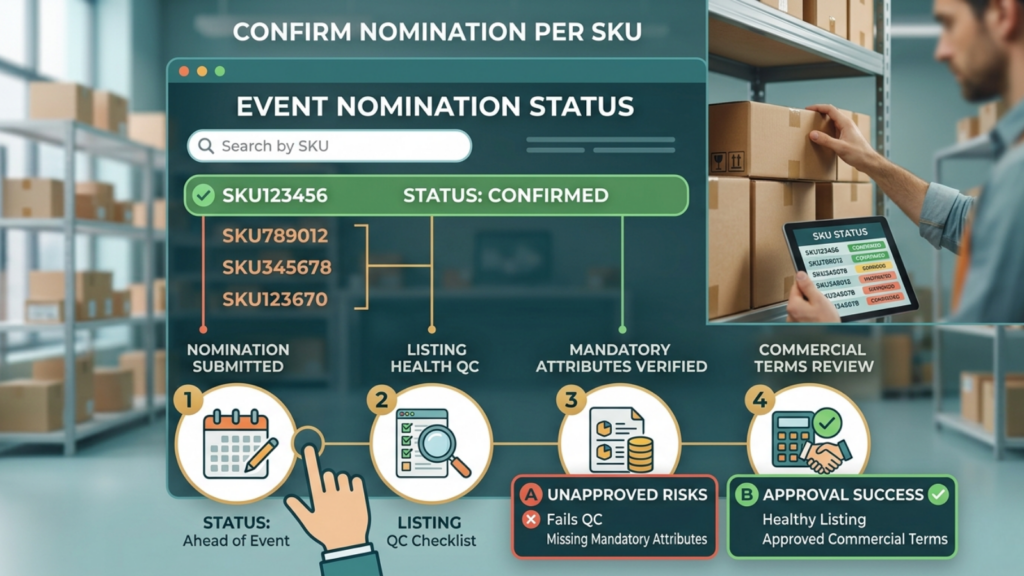
BBD deal slots are nominated and approved ahead of the event, and eligibility depends on listing health as much as commercial terms. A listing that fails QC or lacks mandatory attributes will not be approved regardless of the discount offered.
Confirm nomination status per SKU rather than assuming a category-level submission covered everything.
Check 16: F-Assured eligibility on priority SKUs

The F-Assured badge lifts conversion and buy box competitiveness. Eligibility depends on fulfilment method and performance metrics rather than the listing content alone.
Identify your top revenue SKUs and confirm which carry the badge. Where they do not, the fix is usually fulfilment placement, which needs three to four weeks of lead time.
Block E: Fulfilment and post-sale (Checks 17-20)
Fulfilment settings are catalog data, not logistics data. Sellers who exclude them from Flipkart product listing optimization lose margin on every shipped unit without ever seeing the cause.
Check 17: FBF inbound plan against listing readiness
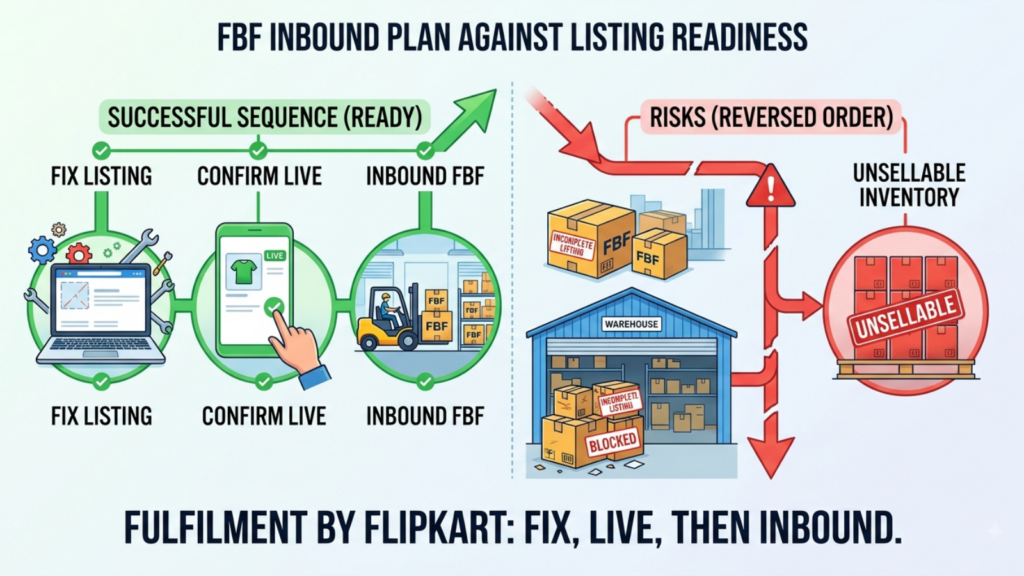
Fulfilment by Flipkart stock sent against a blocked or incomplete listing becomes unsellable inventory in a fulfilment centre.
Sequence it correctly: fix the listing, confirm it is live, then inbound. Reversing that order is how sellers end up with stranded festive stock.
Check 18: Package dimensions and weight accuracy.

Wrong dimensions cause two separate losses. Flipkart bills shipping on declared measurements, so errors leak margin on every unit. Wrong dimensions also produce packing mismatches and damage in transit, which returns as a seller-controllable return.
Re-measure your top 200 SKUs by volume. This single check often pays for the entire audit.
Check 19: Serviceability and dispatch settings.

Confirm pincode serviceability covers the Tier II and Tier III demand that drives festive volume on Flipkart, and reduce handling times on self-ship SKUs ahead of the event.
Check 20: Post-sale returns analysis and correction loop
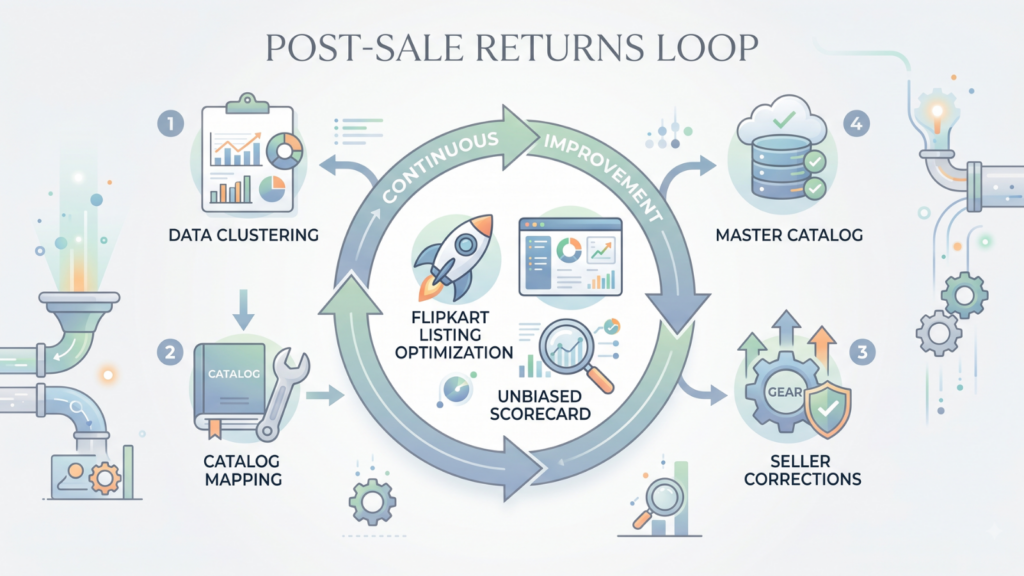
The audit does not end when the sale does. Cluster your BBD returns by reason code and map each back to a catalog field.
|
Return reason |
Catalog root cause |
Correction |
|---|---|---|
|
Size or fit issue |
Missing or inaccurate size chart |
Add measured chart in centimetres |
|
Colour not as shown |
Uncalibrated photography |
Reshoot with colour reference |
|
Not as described |
Key features overclaim |
Rewrite to match reality |
|
Wrong item received |
SKU mapping error upstream |
Fix mapping, audit similar SKUs |
|
Damaged in transit |
Wrong dimensions or packing spec |
Correct dimensions, revise packing |
|
Missing components |
Combo contents unclear |
Add contents image |
Seller-controllable returns carry penalty exposure, so this loop protects margin as well as ratings. Returns data is the only unbiased scorecard your Flipkart product listing optimization will ever get. Feed every correction into your master catalog rather than editing directly in Seller Hub, or the same error returns at the next bulk push.
The complete 20-check audit table
A 20-point catalog audit is useful only if it covers the areas that can actually affect marketplace visibility, conversions, inventory accuracy, and sale readiness.
Before a major sale, sellers should review product information, images, variants, pricing, stock levels, promotions, and fulfillment details instead of relying on a basic listing check. The table below brings these checks together into one practical audit that sellers can complete before their next marketplace sale.
|
# |
Check |
Block |
Lead time |
|---|---|---|---|
|
1 |
Brand approval status |
Compliance |
8-10 weeks |
|
2 |
Category and vertical restrictions |
Compliance |
8-10 weeks |
|
3 |
Blocked, archived, inactive listings |
Compliance |
8-10 weeks |
|
4 |
Statutory and compliance fields |
Compliance |
8-10 weeks |
|
5 |
Mandatory attribute completeness |
Content |
6-8 weeks |
|
6 |
Correct vertical placement |
Content |
6-8 weeks |
|
7 |
Title structure |
Content |
6-8 weeks |
|
8 |
Key features and description |
Content |
6-8 weeks |
|
9 |
Duplicate listings |
Content |
6-8 weeks |
|
10 |
Main image compliance |
Media |
5-6 weeks |
|
11 |
Secondary image stack |
Media |
5-6 weeks |
|
12 |
Size charts and colour accuracy |
Media |
5-6 weeks |
|
13 |
Buy box position |
Commercial |
4-5 weeks |
|
14 |
MRP integrity and price path |
Commercial |
4-5 weeks |
|
15 |
Deal nomination status |
Commercial |
4-5 weeks |
|
16 |
F-Assured eligibility |
Commercial |
4-5 weeks |
|
17 |
FBF inbound sequencing |
Fulfilment |
3-4 weeks |
|
18 |
Dimensions and weights |
Fulfilment |
3-4 weeks |
|
19 |
Serviceability and dispatch |
Fulfilment |
3-4 weeks |
|
20 |
Returns correction loop |
Post-sale |
Sale + 3 weeks |
Assign One Owner Per Catalog Block, Not Per SKU
Audits stall on ownership, not on effort. The most common structure in Indian D2C teams gives the whole catalog to one operations executive, who then queues twenty different kinds of work behind each other.
Split it by block instead, because the blocks need different skills and run on different lead times.
|
Block |
Natural owner |
Skill needed |
|---|---|---|
|
A: Compliance and approvals |
Operations or account manager |
Seller Hub navigation, documentation |
|
B: Attributes and content |
Catalog executive |
Category knowledge, bulk file handling |
|
C: Images and media |
Creative or agency |
Photography, QC rule compliance |
|
D: Commercial |
Category or pricing manager |
Margin, deal terms, competitive pricing |
|
E: Fulfilment |
Supply chain |
FBF planning, dimensions, serviceability |
Blocks A and C can run in parallel from week ten, because they share no dependencies. Blocks D and E depend on B being finished. Sequencing Flipkart product listing optimization this way typically compresses a ten-week plan into six.
Appoint a single catalog owner above the five block owners. Shared ownership between marketing and operations is the most reliable predictor of an audit that does not finish.
How to measure whether the audit worked
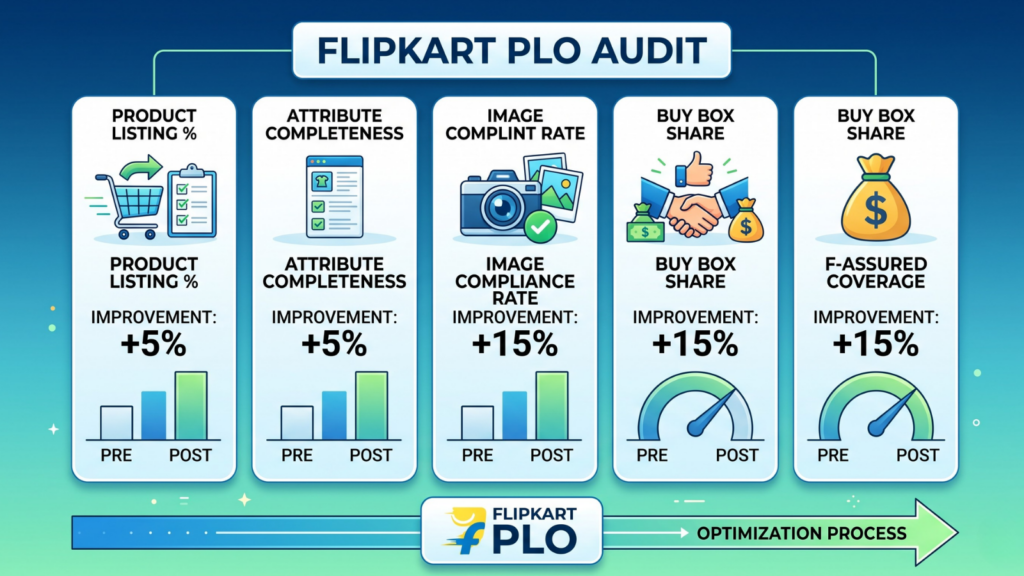
Run these five numbers before you start and again at freeze. Without a baseline, you cannot tell whether Flipkart product listing optimization improved anything or whether festive traffic simply rose.
- Live listing percentage. Live SKUs as a share of total catalog. Target above 98%.
- Mandatory attribute completeness. Populated mandatory fields as a share of required fields, calculated per vertical. Target above 90%.
- Image compliance rate. SKUs passing all main-image rules on first submission.
- Buy box share. Percentage of shared listings where you hold the buy box.
- F-Assured coverage on top SKUs. Badge presence across your top 50 revenue SKUs.
Track these monthly, not once a year. Catalogs decay continuously as new SKUs are added by different people under time pressure, and a catalog audited only before Big Billion Days will have drifted materially by the following June.
How to Run this Audit at Scale
Twenty checks across 300 SKUs is a week of focused work. Across 6,000 SKUs on four marketplaces, it is not a manual exercise at all.
The failure pattern is consistent. The team fixes Flipkart, then finds the same attribute wrong on Amazon and Myntra. Each channel gets corrected separately, the values diverge, and within two quarters nobody knows which system holds the truth.
Durable Flipkart product listing optimization requires the correction to live in a master product record that every channel reads from. Edits made only inside Seller Hub are maintenance, not improvement, because the next bulk push overwrites them.
This is where Base.com is positioned differently from most Indian platforms. Catalog, order management, and warehouse operations share one product record, with rule-based validation running before publication and version history on every attribute change. Flipkart’s vertical-specific attribute requirements are modelled as mapped fields against that master record, so a completeness rule can block a push before Flipkart’s QC ever sees it.
The practical effect is where errors surface. In a spreadsheet workflow, you find out during BBD. In a governed catalog, you find out in July.
The dimensions example makes the point concretely. In Base.com, correcting a package dimension for catalog accuracy also corrects the packing rule in the warehouse module and the weight declared to the courier, because all three read the same field. In a split stack, that correction requires a sync job and a reconciliation nobody runs in September.
Final Thoughts
The order of operations decides the outcome. Compliance before content. Content before images. Everything before the commercial and fulfilment layers, and all of it before the freeze.
Sellers who finish Flipkart product listing optimization eight weeks out spend Big Billion Days competing on price, placement, and advertising. Sellers who leave it late spend the sale chasing QC rejections and blocked listings while competitors take the traffic.
Big Billion Days does not reward the seller with the best catalog. It rewards the seller whose catalog was finished first.