

Manage variants as a deliberate pack ladder, decide whether each bundle is a physical kit SKU or a platform-constructed combo, and supply the margin data Swiggy needs to build promotions. Catalogue management on the Instamart seller panel operates inside a wholesale model where Swiggy sets the consumer price, so your lever is the data you supply, not the discount you display.
Why Instamart Isn’t Just Another Marketplace
Most brands approach Instamart the way they approach Amazon. That framing is wrong, and it costs weeks.
Instamart is a business-to-business supply channel. You are selling to Swiggy. You supply inventory to their dark stores, and Swiggy retails those products to consumers at a price Swiggy controls, through a fulfilment network Swiggy operates.
Read that again in the context of promotions. You do not run a promotion on Instamart. You fund one, or you supply the data that lets a Category Manager construct one.
This reshapes what catalogue management on the Instamart seller panel actually means. On a marketplace, catalogue work is about presentation and price. Here it is about giving your Category Manager the variant structure, bundle definitions and commercial inputs that make good offers possible.
Four structural facts follow from the model.
- Your relationship is with a Category Manager, not an algorithm. Commercial terms, assortment decisions and promotional participation run through that person.
- Onboarding is curated and slow. Two pathways exist: direct empanelment through the partner portal, or inbound outreach from category teams to established FMCG brands. Documentation review commonly runs one to two weeks, with a realistic application-to-first-sale window of roughly six to eight weeks for a prepared brand, and considerably longer for one that is not.
- Visibility is concentrated. A large majority of sales reportedly come from the first two rows of search results, which makes variant and bundle structure a ranking decision rather than a merchandising preference.
- Availability drives ranking. Products maintaining high fill rates rank better, with 95% cited as a practical benchmark. A bundle whose component runs out damages more than that one listing.
Instamart holds a substantial share of Indian quick commerce, operating several hundred dark stores across more than 25 cities, with a customer base skewed toward higher-income urban households. The audience justifies the effort that good catalogue management on the Instamart seller panel requires.
1. Build a Deliberate Pack Ladder for Your Product Variants
Variant sprawl is the most common failure in quick commerce catalogues, and it happens by accumulation rather than by decision.
A brand launches a 200g pack, adds a 500g, adds a sachet, adds three flavours, adds a value pack. Two years later there are 22 SKUs, dark store space allows six, and nobody has decided which six.
A. Design the ladder before you submit it
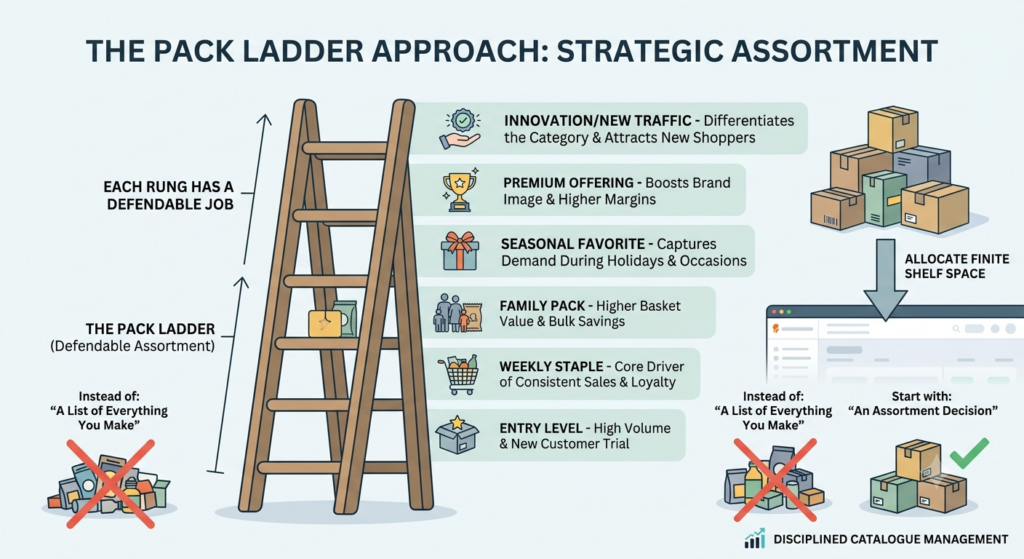
A pack ladder is an intentional structure where each rung does a job.
| Rung | Job | Typical quick commerce role |
| Trial or sachet | Acquisition at low risk | Impulse add-on, new user entry |
| Core pack | Volume driver | The SKU you defend at all costs |
| Upgrade pack | Basket value | Higher margin, loyal buyer |
| Value or multipack | Stock-up | Often too bulky for dark store economics |
| Premium variant | Margin and range credibility | Slower, needs a clear reason to exist |
Every rung must have a job and a reason a Category Manager should allocate finite shelf space to it. Rungs without a job are the ones that age out, stock out, and drag your fill rate down, which is why catalogue management on the Instamart seller panel begins with an assortment decision rather than an upload.
Disciplined catalogue management on the Instamart seller panel means arriving at the assortment conversation with a ladder you can defend, not a list of everything you make.
B. Model Variant Relationships as Structured Data, Not SKU Naming Conventions
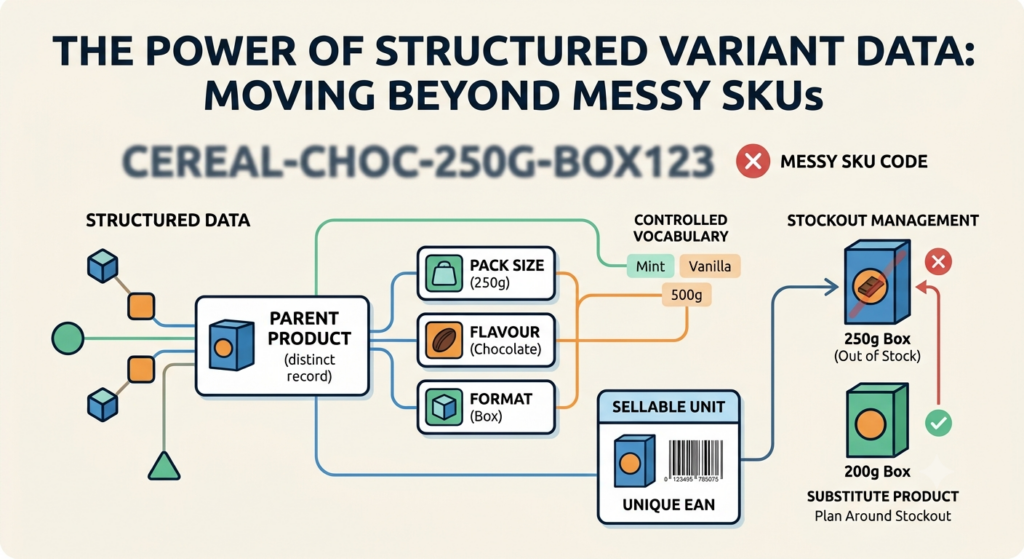
Most brands encode variant relationships in SKU codes and expect systems to infer the rest. They do not.
- Hold the parent product concept as a distinct record
- Hold pack size, flavour and format as separate structured attributes, never combined in one field
- Give every sellable unit its own EAN, with no reuse across sizes or flavours
- Maintain a controlled vocabulary for flavour and variant names across the range
- Record which variants are substitutes for each other, so you can plan around a stockout
Structured relationships are what make catalogue management on the Instamart seller panel scale past a few dozen SKUs. Naming conventions do not.
That last point is underused. If you know the 200g is a viable substitute for the 250g, a stockout becomes a redirect rather than a lost sale, and your Category Manager can act on it.
C. Variant Tile Images Need a Phone-Size Check

Instamart buyers decide on a small tile. Three flavours that look near-identical at 120 pixels generate wrong orders, and wrong orders in quick commerce become complaints rather than returns.
Check every variant image at actual tile size on a phone before submission. This is a two-minute test that catalogue management on the Instamart seller panel routinely skips.
2. Choose Bundle Architecture Deliberately: Physical Kit or Platform Combo
This is the most technically consequential decision in the article, and most brands make it by accident.
There are two fundamentally different ways a bundle exists on Instamart, and they have almost nothing in common operationally.
| Physical kit SKU | Platform-constructed combo | |
| What it is | A single pack you assemble and supply | An offer Swiggy builds across your existing SKUs |
| EAN | Its own unique EAN | Uses component EANs |
| Inventory | Its own stock position | Draws on component stock |
| Who assembles | You, before dispatch | Nobody, it is a pricing construct |
| Dark store space | Occupies one slot | Occupies component slots |
| Failure mode | Kit stocks out as a unit | One component stocks out, offer breaks |
| Data required | Full new SKU record | Component mapping and funding terms |
| Speed to launch | Slow, needs NPI and production | Faster, commercial conversation |
A. When a Physical Kit SKU Is the Right Bundle Format
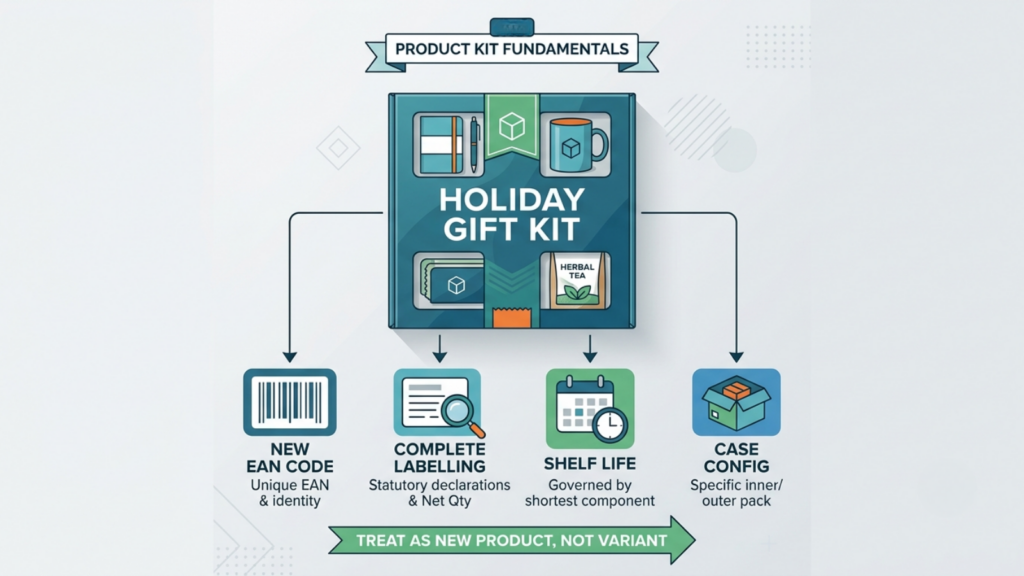
Use a kit when the bundle is a product in its own right: a gift pack, a starter set, a genuinely new format. It earns its own shelf slot and its own identity.
The cost is real. A kit needs its own EAN, its own labelling with complete statutory declarations, its own shelf life derived from the shortest-lived component, its own case configuration, and its own NPI submission. Treating a kit as a minor catalogue addition is how brands discover at inward that the outer pack lacks a net quantity declaration. Within catalogue management on the Instamart seller panel, a kit is a new product, not a variant.
Note the shelf life point specifically. A kit’s usable life is governed by its shortest-dated component, and that has to be calculated and held as data rather than assumed.
B. When a Platform-Constructed Combo Makes More Sense Than a Kit
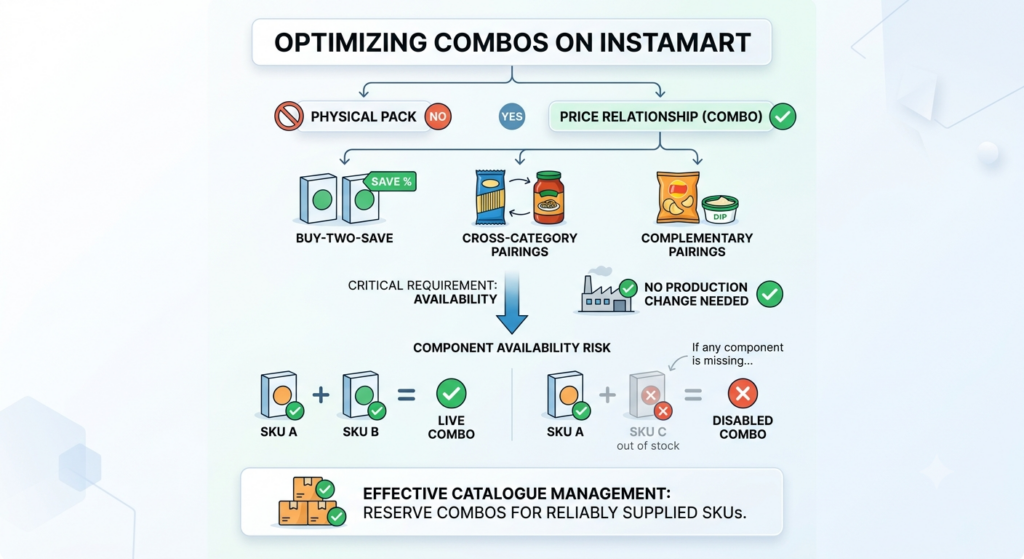
Use a combo when the value is the price relationship, not the physical pack. Buy-two-save, cross-category pairings, and complementary pairings all work better as combos because they need no production change.
The critical requirement is component availability. A combo across two SKUs is only live while both are in stock. Effective catalogue management on the Instamart seller panel therefore treats a combo as inheriting the availability risk of every component, and reserves combos for SKUs you can reliably supply.
C. What Bundle Data You Should Hold Outside the Seller Panel
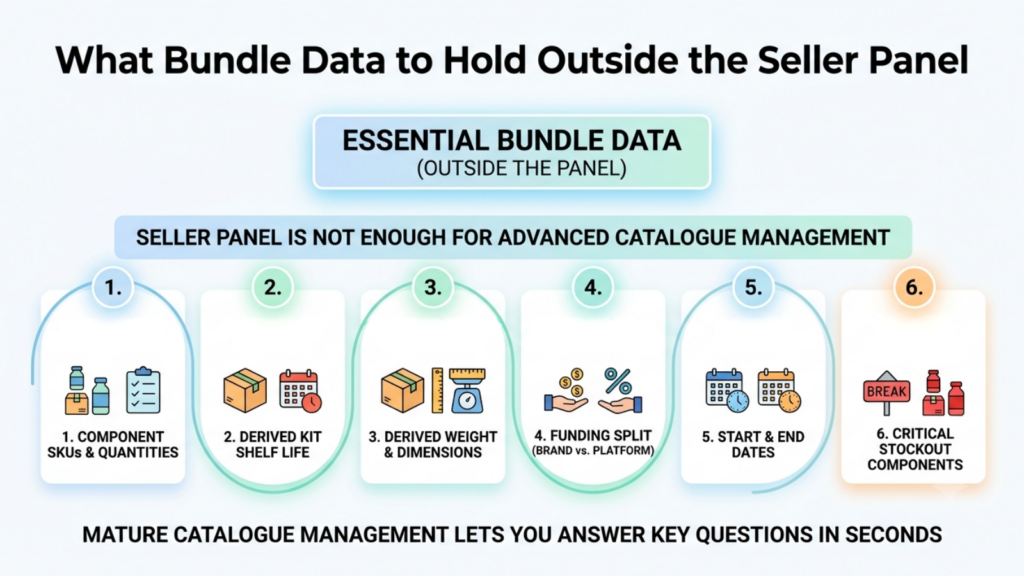
Whichever route you take, the bundle needs to exist as data outside the panel.
- Component SKUs and quantities, explicitly listed
- Derived shelf life for kits, calculated from components
- Derived weight and dimensions for kits
- Funding split between brand and platform
- Start and end dates
- The component whose stockout breaks the bundle, flagged as critical
Brands that hold bundles only inside the panel cannot answer a basic question: if this component goes out of stock, which offers break? Mature catalogue management on the Instamart seller panel answers that in seconds.
3. Supply the Commercial Data That Makes Instamart Promotions Possible
Because Swiggy controls the consumer price, your promotional influence is exercised through data and negotiation rather than through a discount field.
A. Know Your Floor Supply Price Before the Category Manager Conversation
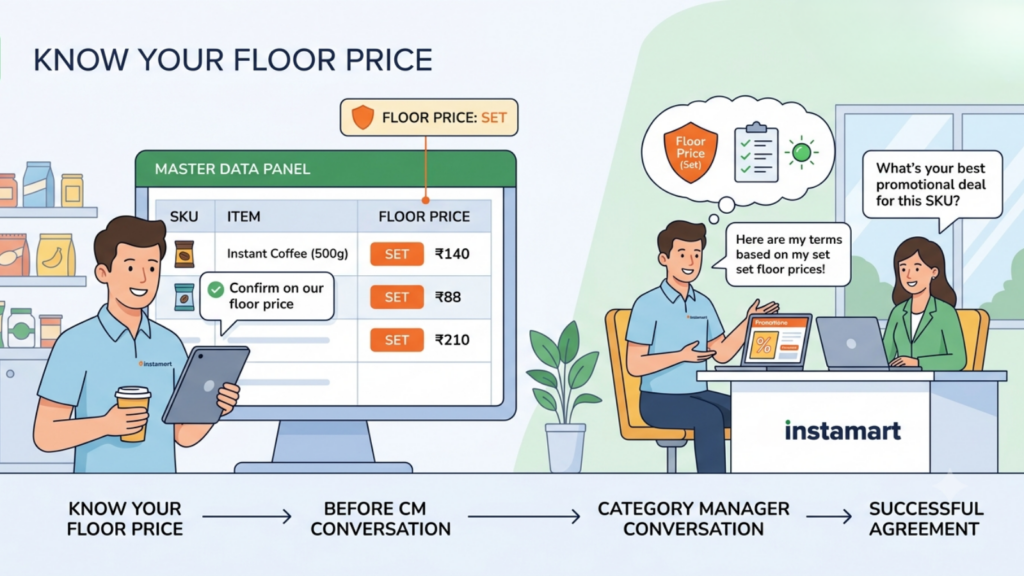
The most expensive promotional mistake is agreeing to terms before modelling them.
| Input | Why it matters |
| Supply price per SKU | The basis of everything |
| Commission or margin per category | Reportedly varies widely by category and negotiated terms |
| Promotional funding share | Who absorbs the discount, and how much |
| Advertising cost per SKU | Sponsored placement operates on a cost-per-click basis |
| Expected wastage and rejection | Quick commerce carries real shrink |
| Contribution after all of the above | The only number that matters |
Hold a floor supply price per SKU in your master data and do not agree terms below it. Sound catalogue management on the Instamart seller panel means that number exists before a Category Manager asks for a deal, not after.
B. Keep MRP and Price Data Consistent Across Every Submission
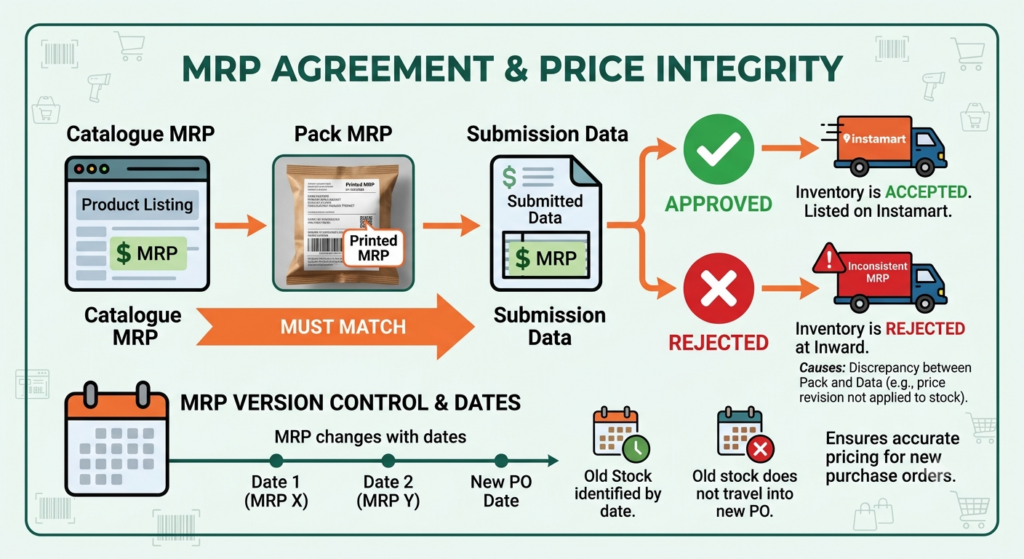
Pack MRP, catalogue MRP and the value in every submission must agree. Inconsistency between printed pack and declared data is a rejection cause at inward across quick commerce platforms, and a price revision applied to data but not to printed stock is the usual mechanism.
Version-controlled MRP changes with dates, so old stock is identifiable and does not travel into a new purchase order. Price integrity is the least glamorous part of catalogue management on the Instamart seller panel and one of the most frequent rejection causes.
C. Which Instamart Promotional Mechanics to Choose and When
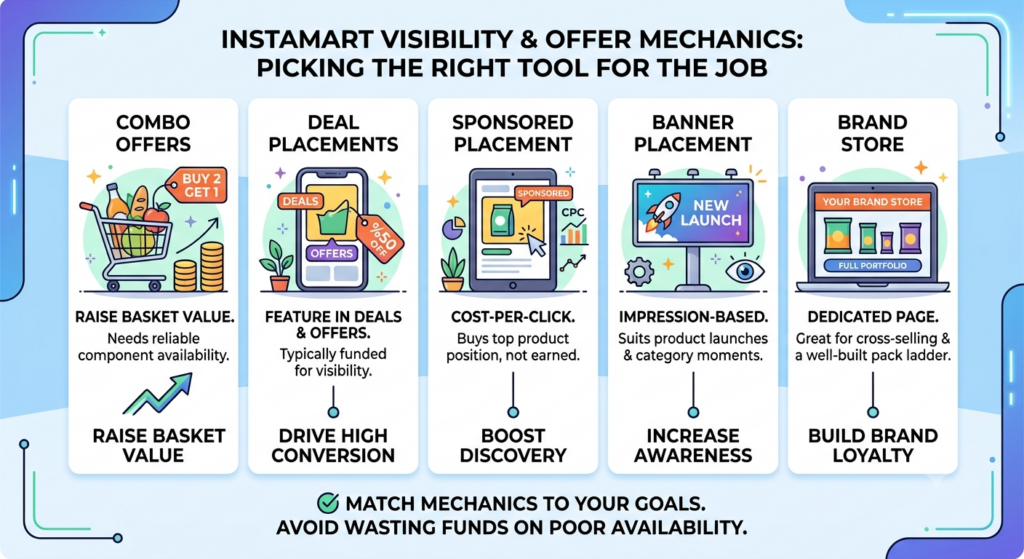
Instamart offers several visibility and offer mechanics, and they are not interchangeable.
- Combo offers. Raise basket value, need reliable component availability.
- Deal placements. Feature in deals and offers sections, typically funded.
- Sponsored placement. Cost-per-click, buys position rather than earning it.
- Banner placement. Impression-based, suits launches and category moments.
- Brand store. A dedicated page for cross-selling the full portfolio, which is where a well-built pack ladder pays off.
Pick mechanics that match the job. A combo raises basket value. Sponsored placement raises discovery. Funding a deep discount on a SKU with weak availability wastes both.
D. Never Promote a SKU You Cannot Reliably Supply
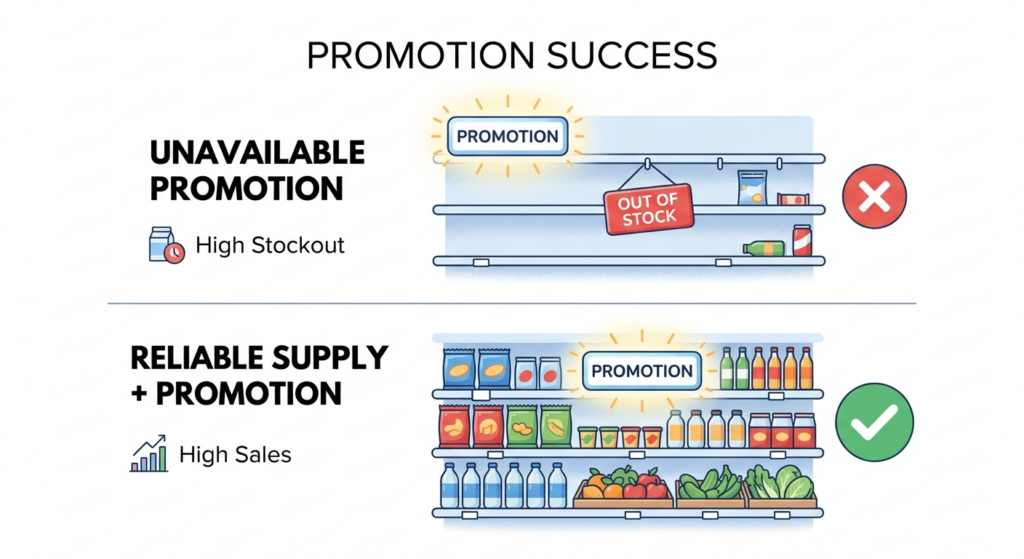
This is worth stating on its own, because it is the most common self-inflicted injury in quick commerce promotion.
A promotion lifts demand sharply. If your fill rate on that SKU is already marginal, the promotion converts a manageable supply gap into a visible stockout during the exact window you paid for attention. Then availability-linked ranking compounds the loss after the promotion ends.
Qualify every SKU on availability before nominating it. Careful catalogue management on the Instamart seller panel treats fill rate as a precondition for promotion, not as something to fix afterwards.
4. Protect Fill Rate Across Every Variant and Bundle Component
Availability is the foundation everything else sits on, because ranking rewards it and promotions depend on it.
A. Why Fill Rate Governs Your Entire Instamart Assortment
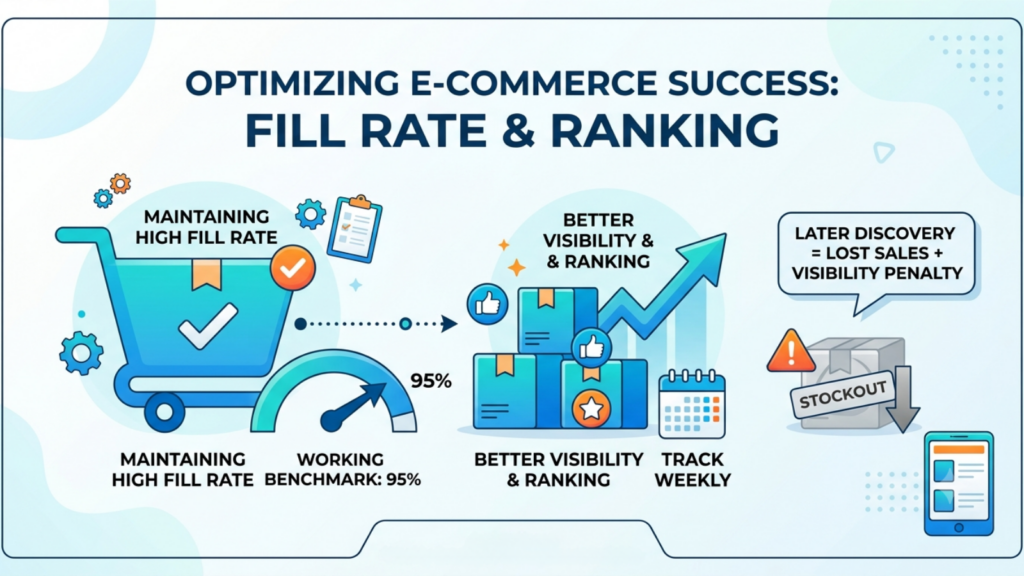
Products maintaining high fill rates rank better, with 95% cited as a working benchmark. Your Category Manager sees the same number.
| Metric | What it tells you |
| Fill rate against PO | Whether you supply what was requested |
| Out-of-stock days per SKU per cluster | Lost visibility, directly |
| Availability across store-SKU combinations | True coverage, not headline coverage |
| Component availability for live combos | Which offers are actually functioning |
| Inward rejection rate | Whether data and physical product agree |
Track these weekly. A stockout found a month later has already cost the visibility recovery period on top of the lost sales, so weekly review is the minimum cadence at which catalogue management on the Instamart seller panel can be evaluated.
B. How Bundles Inherit the Availability Risk of Their Weakest Component
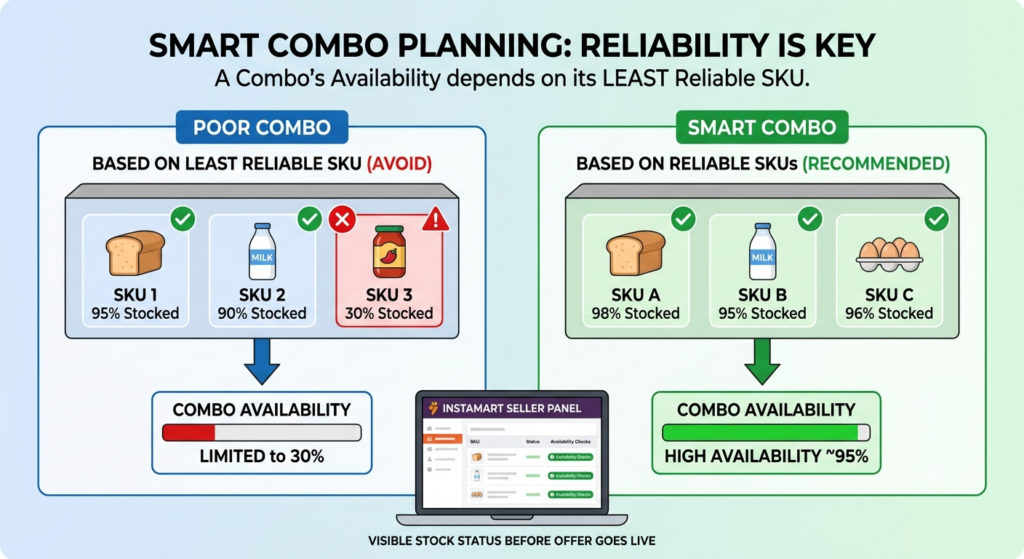
A combo across three SKUs has roughly the availability of its least reliable component, not its average.
That makes component selection a planning decision. Build combos from your most reliably supplied SKUs, not from the ones you most want to move. The SKU you are trying to clear is usually the one with supply problems, which is exactly why it should not anchor a promotion. Good catalogue management on the Instamart seller panel makes that dependency visible before the offer goes live.
C. How Excess Variant Depth Quietly Erodes Availability
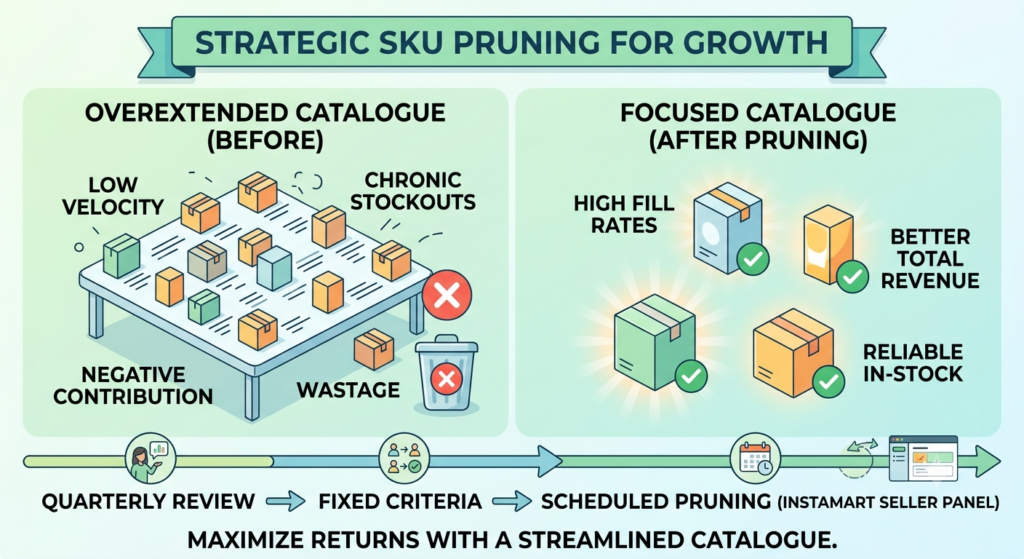
Every additional variant divides the same working capital, forecasting attention and replenishment capacity across more SKUs.
Brands with narrower ranges frequently post better fill rates and better total revenue on quick commerce. Pruning is not an admission of failure; it is the mechanism by which the remaining SKUs stay in stock.
Review quarterly against fixed criteria: consistently low velocity, chronic stockouts, negative contribution after fees and wastage, cannibalisation of a stronger sibling, or repeated ageing out. Scheduled pruning is a standing component of catalogue management on the Instamart seller panel rather than an annual clean-up.
5. Measure Performance Per Variant and Per Bundle, Not Per Brand
Brand-level reporting hides everything that matters here.
A brand growing 20% can contain a core pack losing share, a bundle cannibalising its own components, and a promotion that bought volume at negative contribution. The aggregate looks healthy.
A. Which Metrics to Track at Each Level of the Catalogue
| Level | Question it answers |
| Variant | Which rungs of the ladder earn their shelf slot |
| Bundle | Is incremental volume genuinely incremental |
| Component | Is the bundle cannibalising the single pack |
| Promotion | Contribution after funding and advertising |
| Cluster | Where the pattern differs geographically |
B. Test Whether a Bundle Is Genuinely Incremental
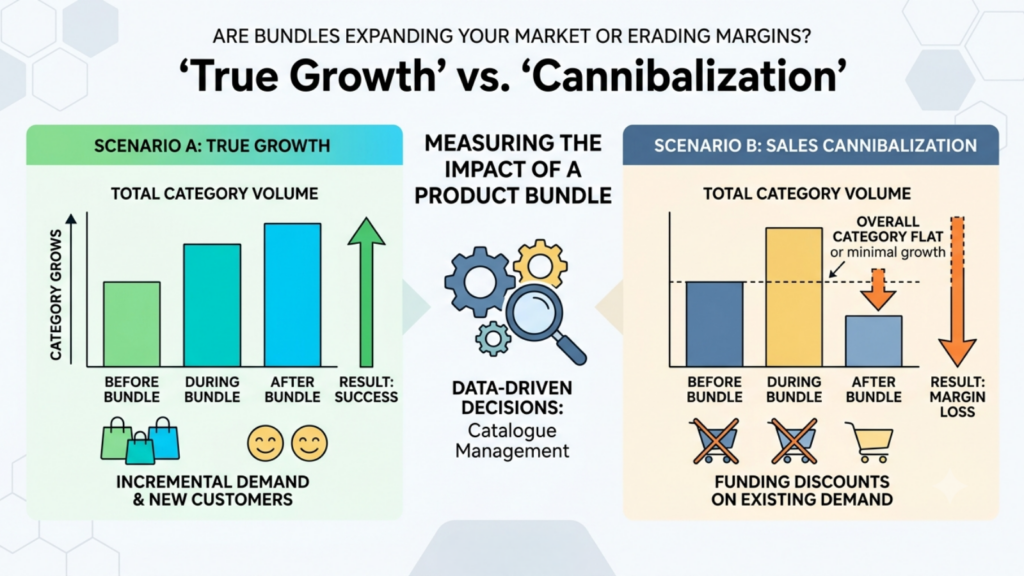
The question is not whether the bundle sold. It is whether total category volume rose or whether the bundle simply absorbed sales that would have happened at full price.
Compare component sell-through before, during and after the bundle window, in the clusters where it ran versus clusters where it did not. If component volume fell by roughly what the bundle gained, you funded a discount on existing demand.
This is the discipline that separates catalogue management on the Instamart seller panel from catalogue administration. The data exists; most brands never ask the question.
C. Fragmented Reporting Makes Variant-Level Analysis Impossible
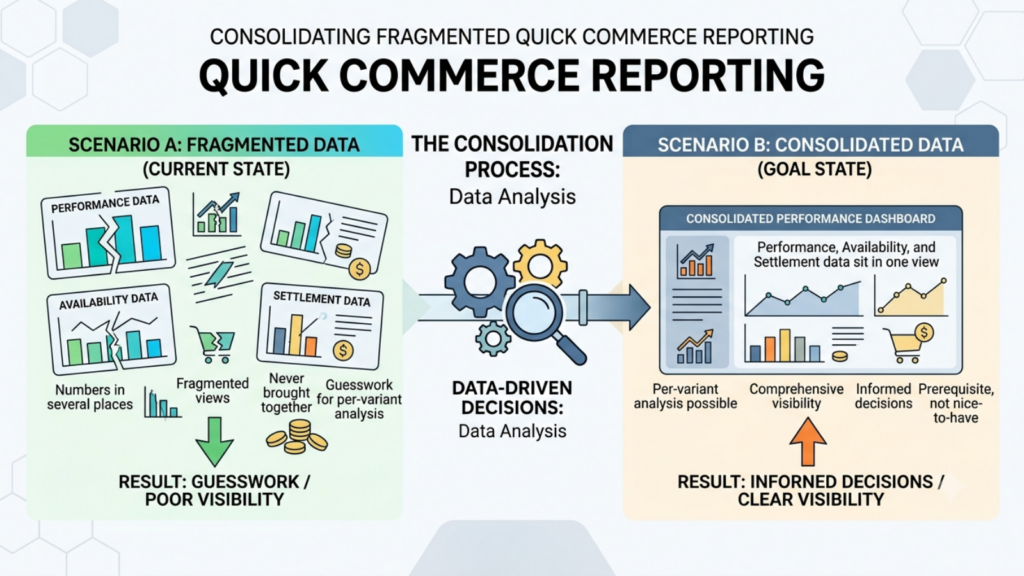
Quick commerce reporting is fragmented, and brands routinely find that the numbers exist in several places and have never been brought together.
Until performance, availability and settlement data sit in one view, per-variant analysis is guesswork. That consolidation is a prerequisite, not a nice-to-have.
Why Your Master Product Record Should Live Outside the Seller Panel
A brand supplying twelve SKUs and two combos can manage all of this in spreadsheets. A brand supplying 150 SKUs and twenty active bundles across Instamart, other quick commerce platforms, modern trade and D2C cannot.
Bundles are where this breaks first, and the reason is structural. A kit is a product whose shelf life, weight, dimensions and statutory declarations are all derived from its components. Change a component and every derived value changes. In a spreadsheet, nobody recalculates them.
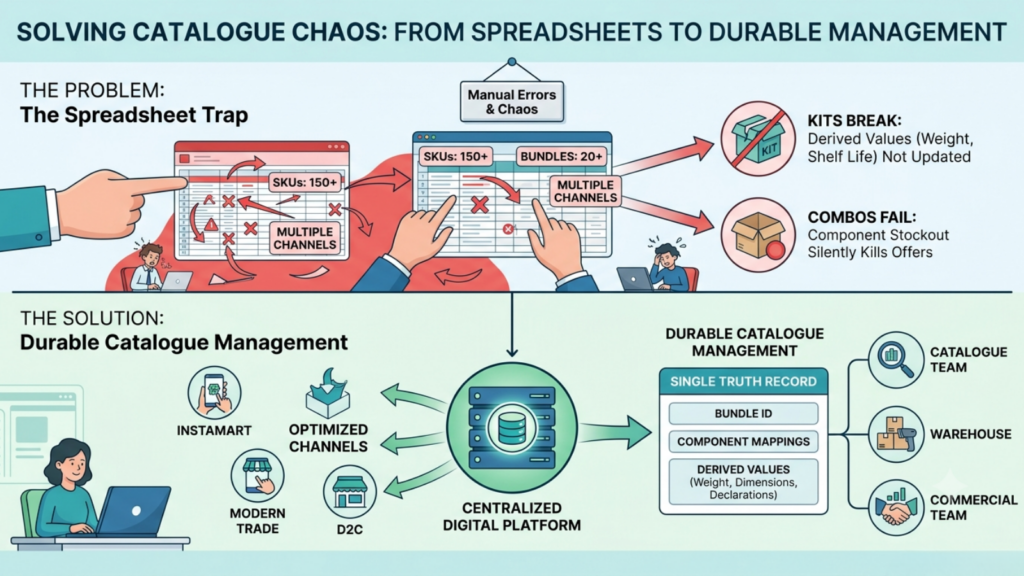
Combos fail differently. A component stockout silently breaks every offer containing it, and without a mapping from component to bundle, nobody knows which offers just stopped working.
Durable Catalogue management on the Instamart seller panel requires bundle definitions, component mappings, and derived values to live in one record that the catalogue, the warehouse, and the commercial team all read from.
Base.com is built on that principle. Catalogue, order management and warehouse operations share a single product record, with rule-based validation before publication and version history on every attribute change. Parent-child and component relationships are modelled natively, so a kit’s shelf life derives from its components automatically and a component change propagates to every bundle that uses it.
The practical difference is when problems surface. In a spreadsheet workflow, a broken combo surfaces when a Category Manager asks why an offer is not converting. In a governed catalogue, the dependency is visible before the component runs out.
The Two Decisions to Make First: Your Pack Ladder and Your Bundle Format
If you act on two things, take practices 1 and 2.
Decide which variants deserve finite dark store space, and decide for every bundle whether it is a physical kit or a pricing construct. Those two decisions determine your production, your NPI workload, your availability risk, and your promotional options.
Effective Catalogue management on the Instamart seller panel is not about listing more variants or running more offers. It is about supplying a structure your Category Manager can build a good business on.
Frequently Asked Questions
What is Catalogue management on the Instamart seller panel?
Should a bundle be a physical kit or a platform combo on Instamart?
How do promotions work if Swiggy controls the price?
How many product variants should a brand list on Instamart?
Why does fill rate matter for variants and bundles?