

Reduce out-of-stock listings on Zepto by forecasting at the dark store level and responding to automated purchase orders within their window. Zepto generates POs when store-level inventory drops below a threshold, so a slow dispatch becomes an unavailable listing within hours. Better inventory management to reduce out-of-stock listings on Zepto starts with treating the PO as a same-day obligation.
What Makes a Zepto Stockout More Costly Than a Regular Marketplace Stockout
On a marketplace, a stockout means one listing goes quiet. On Zepto, it triggers a chain that is hard to reverse.
Zepto operates an inventory-led dark store model, buying directly from suppliers and FMCG brands, then stocking hyper-local dark stores for ten-minute delivery. Your product is only visible in neighbourhoods where a dark store actually holds it.
When a dark store runs dry, four things happen in sequence. The listing becomes unavailable in that catchment. Your availability score falls. The algorithm reduces your visibility. And your Category Manager sees a supply reliability problem in a system where dark store shelf space is finite and contested.
That last consequence is the expensive one. Recovering visibility takes longer than recovering stock, which is why better inventory management to reduce out-of-stock listings on Zepto has to be preventive rather than reactive.
Three structural facts shape everything below.
- POs are automated and time-sensitive. Zepto’s system triggers a purchase order when inventory at a dark store or regional warehouse falls below a predefined threshold for a SKU, specifying quantities, SKU codes, required delivery dates, and destination.
- Dispatch must match the PO exactly. Partial dispatches and unapproved SKU substitutions cause inwarding discrepancies, and shipments can be held or returned.
- Shelf life is a hard gate. A consignment failing shelf-life checks at inwarding returns to you with freight costs attached, and the availability gap it leaves can take another week to close.
The market context justifies the discipline. Indian e-commerce is tracking toward roughly $226 billion with D2C compounding near 40% CAGR, and quick commerce is the fastest-growing channel within it.
1. Forecast Demand at the Dark Store Level, Not the City Level

This is the foundational change, and most brands have not made it.
City-level forecasting is standard practice in modern trade, and it fails in quick commerce. A city is not a demand unit when each dark store serves a two- to three-kilometre catchment with its own demographic profile, its own competing assortment and its own consumption pattern.
Two stores four kilometres apart can differ by several multiples on the same SKU. Averaging them produces overstock in one and stockout in the other, while the city-level number looks fine.
| Forecasting level | What it hides | Consequence |
| National | Regional and city variation | Wrong FC placement |
| City | Store-level catchment differences | Simultaneous overstock and stockout |
| Cluster | Within-cluster variation on fast movers | Partial availability |
| Dark store | Least, but needs the most data | Highest accuracy |
Zepto’s Seller Hub exposes store-wise demand, which makes store-level replenishment planning possible. Use it. Better inventory management to reduce out-of-stock listings on Zepto is not achievable from a consolidated city report.
Start with your top SKUs, not the whole catalog.
Store-level planning across 200 SKUs and 300 stores is 60,000 combinations. Nobody starts there.
Begin with the SKUs that generate most of your volume and the stores that generate most of your orders. That subset usually covers the large majority of your stockout exposure at a fraction of the effort. Scoping better inventory management to reduce out-of-stock listings on Zepto narrowly at the start is what makes it survive contact with a busy quarter.
2. Respond to Every Automated Zepto PO the Same Day
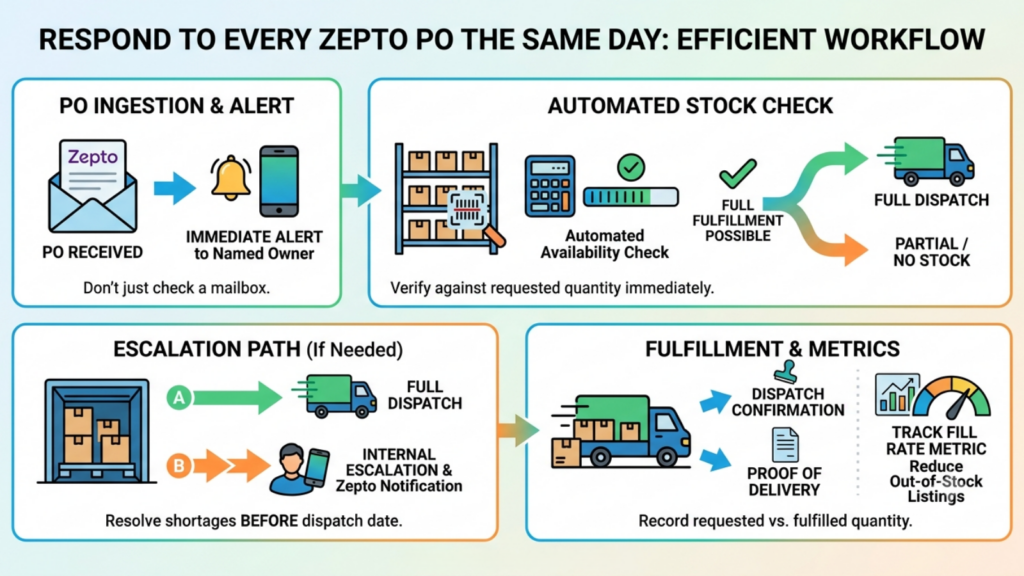
That reframes the response window entirely. A PO answered in three days is not a slow response; it is a guaranteed stockout with the paperwork completed afterwards.
What a disciplined PO process needs:
- PO ingestion that alerts a named owner immediately, not a mailbox someone checks
- Automated stock availability check against the requested quantity
- Escalation path when you cannot fulfil in full, before the dispatch date
- Dispatch confirmation and proof of delivery captured against the PO
- A record of every PO, its requested quantity and its fulfilled quantity
Fill rate against PO is the metric your Category Manager watches. It is also the single clearest indicator of whether better inventory management to reduce out-of-stock listings on Zepto is actually working, because it measures the gap between what was asked and what arrived.
Set an internal service level well above whatever Zepto formally requires. The gap absorbs the days when things go wrong, and a service level held above the platform’s own bar is the simplest expression of better inventory management to reduce out-of-stock listings on Zepto.
3. Avoid Partial Shipments or SKU Substitutions Without Written Approval
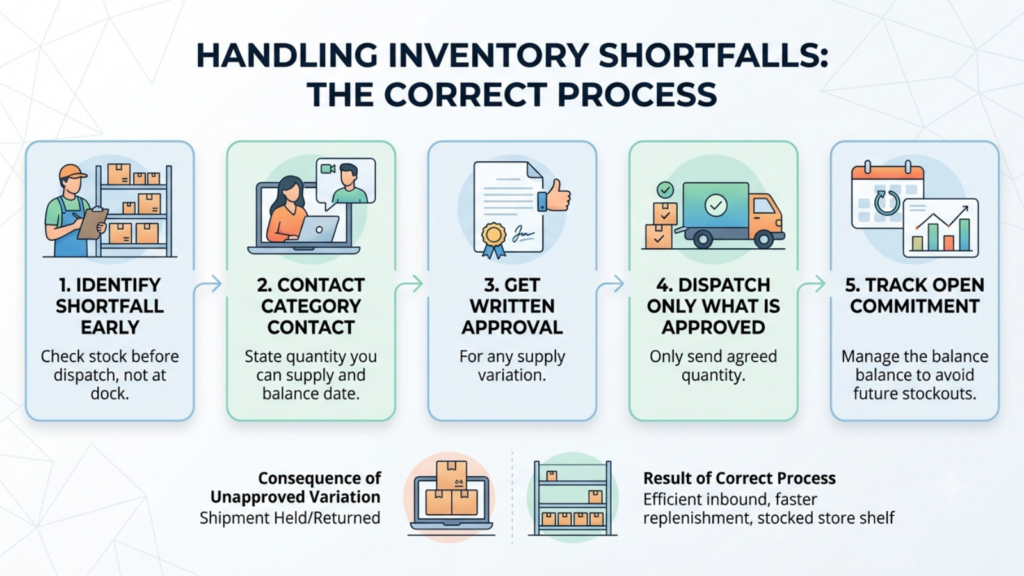
This practice looks like compliance, and it is actually availability planning.
An unapproved partial dispatch or SKU substitution creates an inwarding discrepancy. The consequence is not just a penalty; it is a shipment held or returned, which means the store you were trying to replenish stays empty for longer than if you had flagged the shortfall in advance.
The correct sequence when you cannot fulfil:
- Identify the shortfall before dispatch, not at the dock
- Contact your category contact with the quantity you can supply and the date for the balance
- Get written approval for any variation
- Dispatch only what is approved
- Track the balance as an open commitment, since an unclosed balance is a future stockout.
Brands practising better inventory management to reduce out-of-stock listings on Zepto build the shortfall alert into their stock check, so the conversation happens two days early rather than two weeks late.
4. Maintain a Single Inventory Position Across Every Sales Channel

This is where most quick commerce stockouts are actually created, and the mechanism is worth stating plainly.
Your warehouse receives a Zepto PO and a Blinkit PO on the same day. Without a shared inventory view, both are committed against the same available stock. One channel receives a short-ship. A compliance penalty follows weeks later, and one dark store network sat empty in the meantime.
| Requirement | Why quick commerce demands it |
| One stock position per batch | Shelf life makes batches non-interchangeable |
| Reservation against confirmed POs | Prevents double-committing the same units |
| Committed versus available visibility | Enables honest fill-rate promises |
| Cross-channel view in one place | Zepto, other q-commerce, trade and D2C compete for stock |
| Allocation rules by channel priority | Makes the trade-off deliberate rather than accidental |
Batch-level visibility is the specific requirement. A stock figure of 4,000 units is misleading if 1,200 of them fall below the minimum remaining shelf life a platform will accept. You do not have 4,000 sellable units, and planning against that number produces a failed inward.
Base.com holds one master product record shared across catalog, order, and warehouse modules, so a batch, its shelf life, its EAN, and its committed quantity are the same data used by the plan, the picker, and the invoice. Better inventory management to reduce out-of-stock listings on Zepto is not achievable when the plan and the warehouse read different files.
5. Place Safety Stock Regionally Instead of Relying on Dark Store Inventory
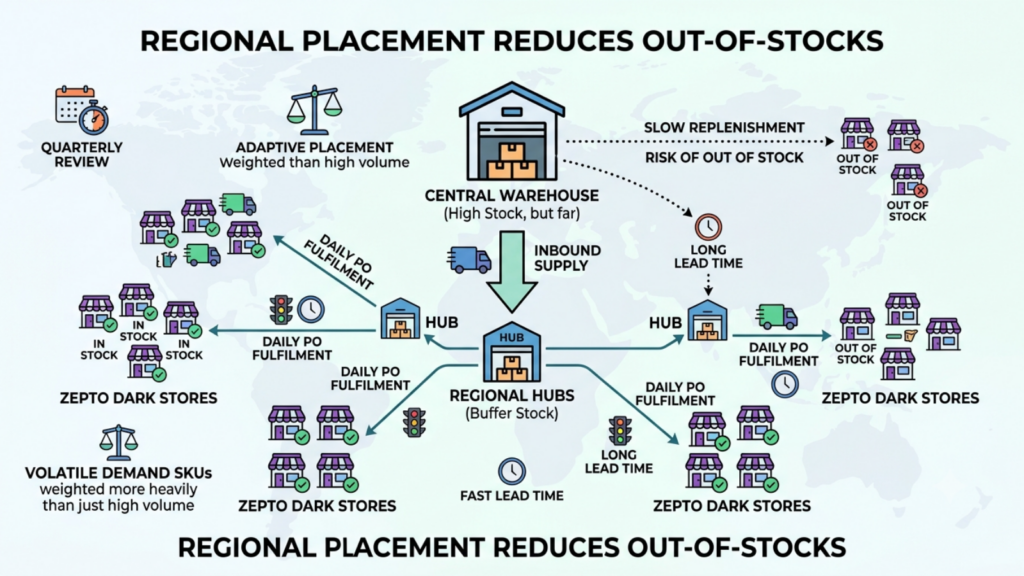
You do not control dark store inventory. Zepto does. Your lever is what sits upstream of it.
That makes regional placement the real planning decision. Stock held in a fulfilment centre near the cluster can answer a PO in a day. Stock held in a single central warehouse cannot, regardless of how much of it there is.
Placement principles:
- Hold buffer at hub or regional level so dark stores do not run dry between POs
- Match placement to where store-level demand actually concentrates
- Weight buffers toward SKUs with volatile demand, not just high volume
- Account for inbound lead time to each cluster separately
- Review placement quarterly as the dark store network changes, because placement decided once is not better inventory management to reduce out-of-stock listings on Zepto; it is a snapshot.
The cost of regional placement is working capital and holding. The cost of not doing it is lost visibility that takes weeks to recover. For fast-moving SKUs, the second is usually larger, which is the core economic argument for better inventory management to reduce out-of-stock listings on Zepto rather than lean central stocking.
6. Factor Batch and Shelf Life Into Your Zepto Availability Plan

Quick commerce inventory is perishable in a way that general e-commerce inventory is not.
Planning that ignores shelf life produces a specific failure: you hold enough units, dispatch against a PO, and the consignment is rejected at inwarding for insufficient remaining life. You now have a stockout and a freight bill.
What the plan must know:
- Total shelf life and manufacture date per batch
- Minimum remaining life acceptable at inwarding, per platform
- Which batches are eligible for dispatch today, and which are not
- Oldest-eligible-first picking within that constraint
- Ageing stock approaching ineligibility, with enough notice to redeploy it
| Planning error | Result |
| Counting all stock as sellable | Failed inward, stockout, freight loss |
| No batch visibility | Cannot forecast eligible supply |
| No ageing alert | Stock becomes ineligible unnoticed |
| Newest-first picking | Older stock ages out entirely |
| No cross-channel batch view | Same batch promised twice |
Set an ageing alert far enough ahead that ineligible-bound stock can be redeployed to a channel with looser requirements. Ageing visibility is the least-implemented component of better inventory management to reduce out-of-stock listings on Zepto and one of the most costly to omit. Practical better inventory management to reduce out-of-stock listings on Zepto treats shelf life as a supply constraint, not a compliance checkbox.
7. Set Reorder Triggers Ahead of Zepto’s Own PO Threshold
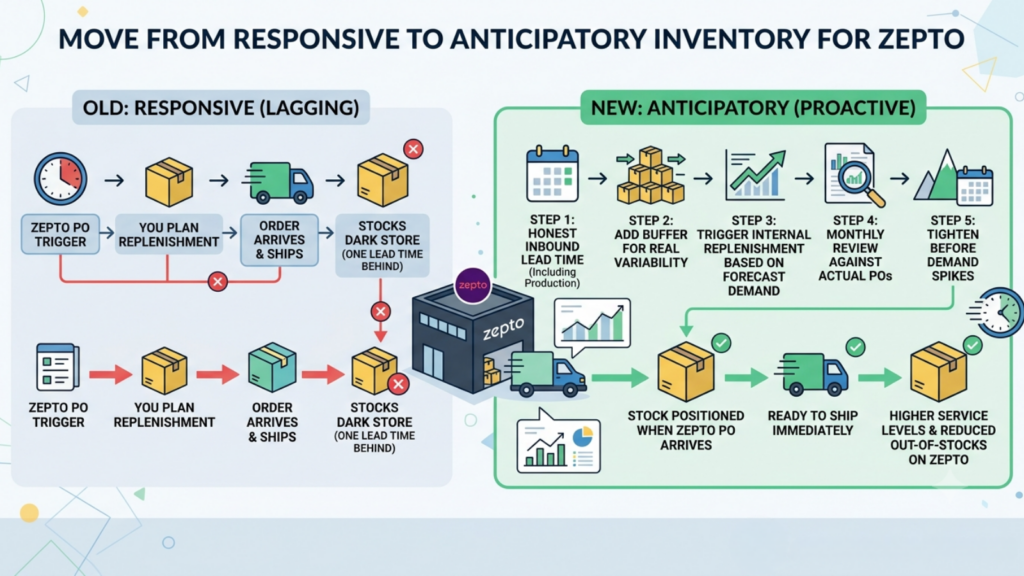
Zepto’s PO trigger fires at their threshold. If your own replenishment planning also fires at that moment, you are always one lead time behind.
The fix is to run your own earlier trigger, based on your own forecast, so stock is already positioned when their PO arrives.
How to set it:
- Calculate inbound lead time to each cluster, honestly, including production
- Add a buffer for the variability you actually experience, not the variability you plan for
- Trigger internal replenishment at forecast demand across that window
- Review the trigger monthly against actual PO frequency
- Tighten it before known demand spikes
This single change converts your operation from responsive to anticipatory, and it is the most reliable structural driver of better inventory management to reduce out-of-stock listings on Zepto available to a supplier who does not control the dark store.
8. Rationalise Your SKU Range to Concentrate Availability Where It Counts
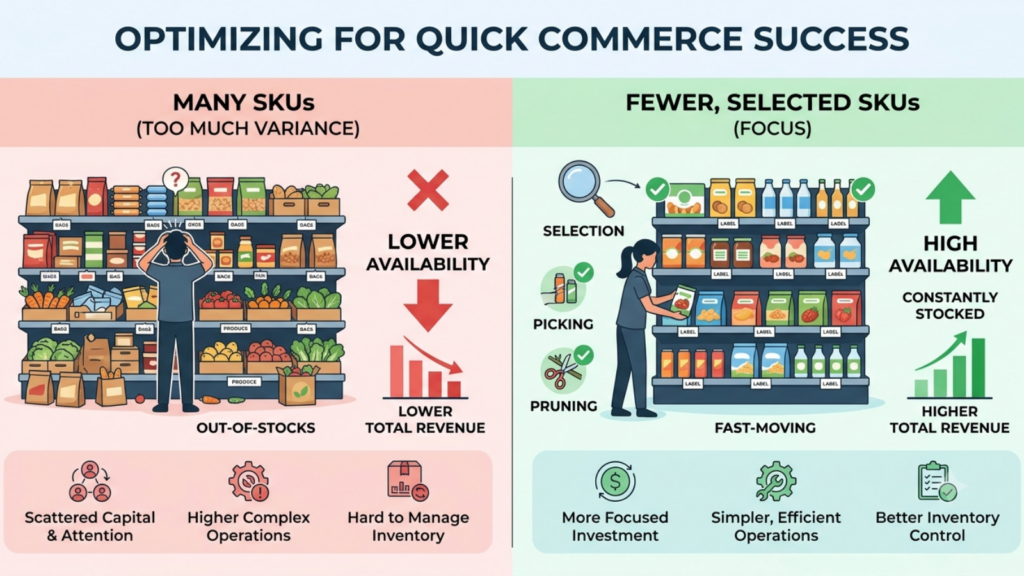
Counterintuitive, but consistently true: brands with fewer SKUs on quick commerce often have better availability and better total revenue.
Dark store shelf space is finite, and Zepto is selective about what it stocks. A wide range spreads your working capital, your forecasting attention, and your replenishment capacity across SKUs that do not earn it.
Review quarterly against fixed criteria:
| Signal | Action |
| Consistently low velocity across clusters | Delist and redeploy capital |
| High velocity but chronic stockouts | Increase buffer; this is the priority SKU |
| Negative contribution after fees and wastage | Reprice or delist |
| Cannibalising a better-performing sibling | Consolidate |
| Ageing out repeatedly | Wrong pack size or wrong cluster |
Run the review on a fixed date so it happens under commercial pressure rather than despite it. Scheduled pruning is a standing part of better inventory management to reduce out-of-stock listings on Zepto.
Concentrating stock behind fewer SKUs raises fill rate on the ones that matter. That is the quietest form of better inventory management to reduce out-of-stock listings on Zepto, because it removes the demand you were failing to serve rather than trying to serve it better.
9. Build a Volatility Buffer Instead of Planning Only for Average Demand
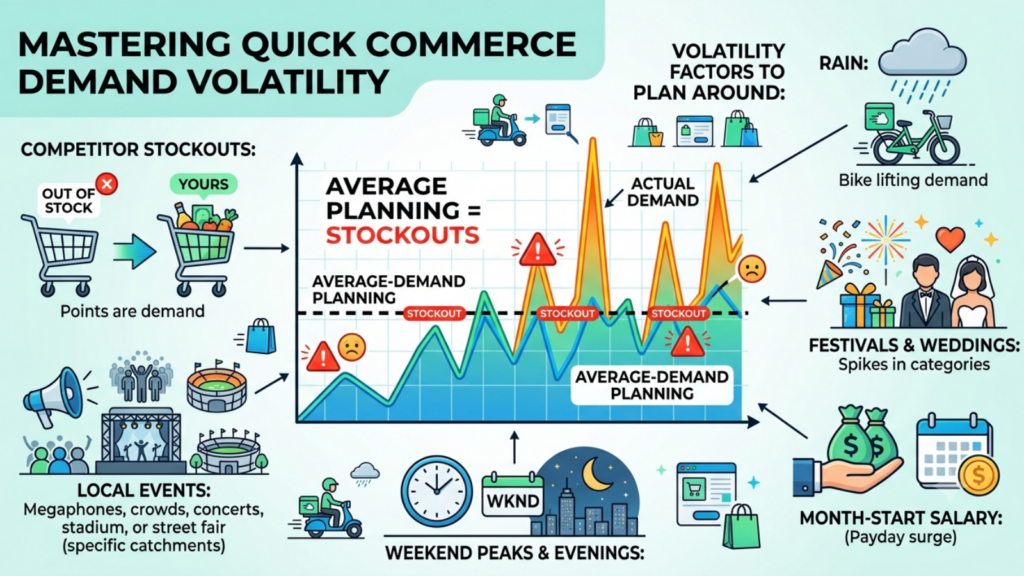
Quick commerce demand is spikier than any other channel. Weather, local events, festivals, paydays, and weekend patterns all move it sharply, and the ten-minute promise means demand cannot be deferred.
Average-demand planning guarantees stockouts on the days that matter most.
Volatility factors to plan around:
- Rain, which lifts quick commerce demand materially in affected cities
- Festive and wedding periods, with category-specific spikes
- Month-start salary cycles
- Weekend and evening intraday peaks
- Local events concentrated on specific catchments
- Competitor stockouts, which shift demand to you without warning
Build a separate buffer for identified spike windows rather than relying on your standard safety stock. Then tighten your reorder triggers ahead of them.
Brands serious about better inventory management to reduce out-of-stock listings on Zepto maintain a demand calendar per cluster, not a single national one, because a festival that moves demand in one region may not move it in another.
10. Track Availability Metrics Weekly, Not Just Sales Data
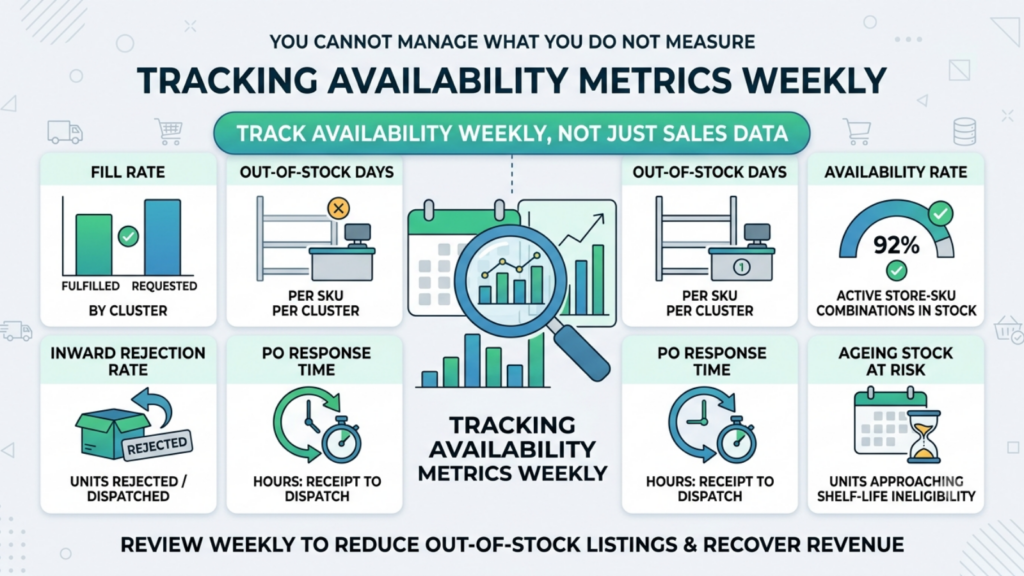
You cannot manage what you do not measure, and most brands measure sales rather than availability.
Sales data tells you what you sold. Availability data tells you what you failed to sell, which is where the recoverable revenue is.
Track weekly:
- Fill rate against PO. Fulfilled quantity over requested quantity, by cluster.
- Out-of-stock days per SKU per cluster. The direct measure of lost visibility.
- Availability rate. Share of active store-SKU combinations actually in stock.
- Inward rejection rate. Units rejected over units dispatched, with causes.
- PO response time. Hours from receipt to dispatch confirmation.
- Ageing stock at risk. Units approaching shelf-life ineligibility.
Review weekly, not monthly. A stockout discovered four weeks later has already cost you the visibility recovery period on top of the lost sales, so weekly review is the minimum cadence at which better inventory management to reduce out-of-stock listings on Zepto can be judged.
One measurement note. Consolidating this across multiple city-level views is real work, and brands frequently find the data exists in several places and has never been brought together. Until it is consolidated, better inventory management to reduce out-of-stock listings on Zepto cannot be evaluated, only guessed at.
Why Spreadsheets and Siloed Systems Can’t Solve Zepto Availability Alone
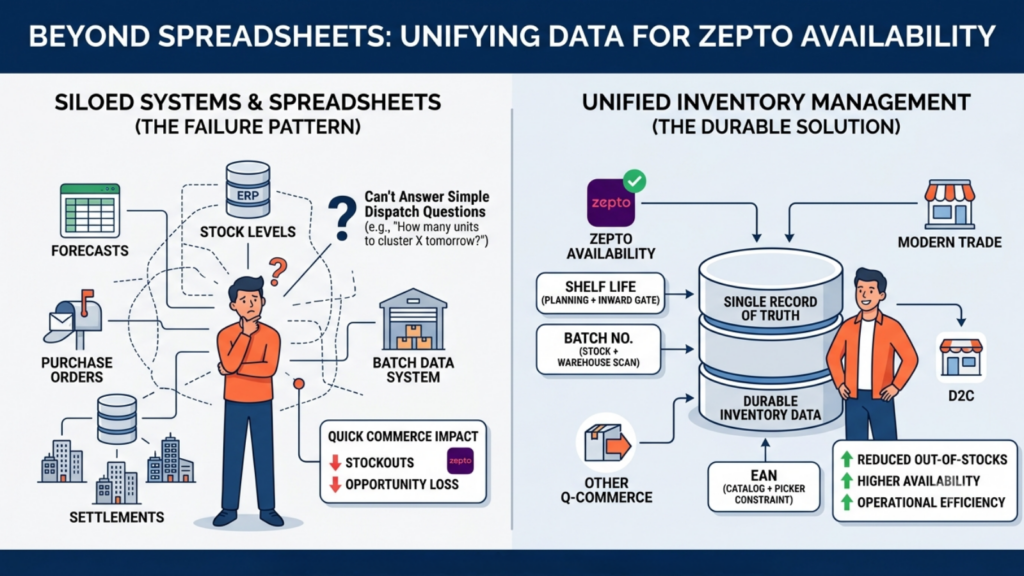
Everything above is achievable for a brand supplying fifteen SKUs to two clusters. It is not achievable for a brand supplying 200 SKUs across Zepto, other quick commerce platforms, modern trade and D2C.
The failure pattern is consistent. Forecasts live in one spreadsheet, stock in an ERP, POs in a mailbox, batch data in a warehouse system, and settlements in city-level portals. Nobody can answer a simple question: how many units of this SKU can I legally dispatch to this cluster tomorrow?
Quick commerce punishes that gap harder than any other channel, because the same fields carry both planning and physical consequences. Shelf life is a planning input and an inward gate. A batch is a stock number and a scan at a receiving dock. An EAN is a catalog field and a picker’s constraint.
Durable better inventory management to reduce out-of-stock listings on Zepto requires those fields to live in one record that the plan, the warehouse, and the invoice all read from.
Base.com is built on that principle. Catalog, order management and warehouse operations share a single product record, with rule-based validation before publication and version history on every attribute change. Batch, shelf life, committed quantity and pack configuration are held once and used everywhere, so a PO can be answered against eligible stock rather than against a total that includes units no dark store will accept.
The difference is where you find problems. In a spreadsheet workflow, you find them in a settlement report or a penalty notice. In a governed system, you find them before the dispatch.
The Two Practices to Start With: PO Response Time and Batch Visibility
If you act on two items, take practices 2 and 4.
Answer POs the day they arrive, and hold one batch-level stock position across all channels. The first prevents the stockouts Zepto’s own thresholds are warning you about. The second prevents the short-ships you create yourself by promising the same units twice.
Sustained better inventory management to reduce out-of-stock listings on Zepto is not about holding more stock. It is about knowing precisely which stock you can actually ship, to which cluster, today.