
For a growing brand, data is only as useful as the format it arrives in. A report that shows you something is not the same as a report that shows you exactly what you need, in exactly the structure your operation requires, ready to act on without manual rework.
Blue Nectar, a contemporary Ayurveda skincare brand competing in India’s fast-growing D2C beauty market, understood this distinction clearly. The brand did not just need reports. It needed the right reports: precise, customised, and built around the real fields its teams relied on every day. That distinction led them to Base.com, and it is what makes their story a clear demonstration of what inventory and reporting software for ecommerce in India must deliver beyond surface-level visibility.
About Blue Nectar
Blue Nectar is an Indian D2C brand rooted in contemporary Ayurveda, offering a range of plant-based skincare and wellness products. Blue Nectar competes on product authenticity, formulation quality, and operational precision.
Like most brands scaling through Indian ecommerce channels, Blue Nectar’s operational complexity grew alongside its commercial growth. More SKUs, more channels, more compliance documentation, more daily reporting requirements, and a growing gap between what standard software provided and what the business actually needed to run well.
Finding the right inventory and reporting software for ecommerce in India was not a technology decision for Blue Nectar. It was an operational strategy decision.
The Challenge
As Blue Nectar scaled its operations, reporting requirements became increasingly complex. The team needed accurate, business-ready reports with specific fields and formats that aligned with operational, compliance, and traceability needs. Standard reporting tools could capture data, but they struggled to deliver the precision, flexibility, and usability required for day-to-day operations.
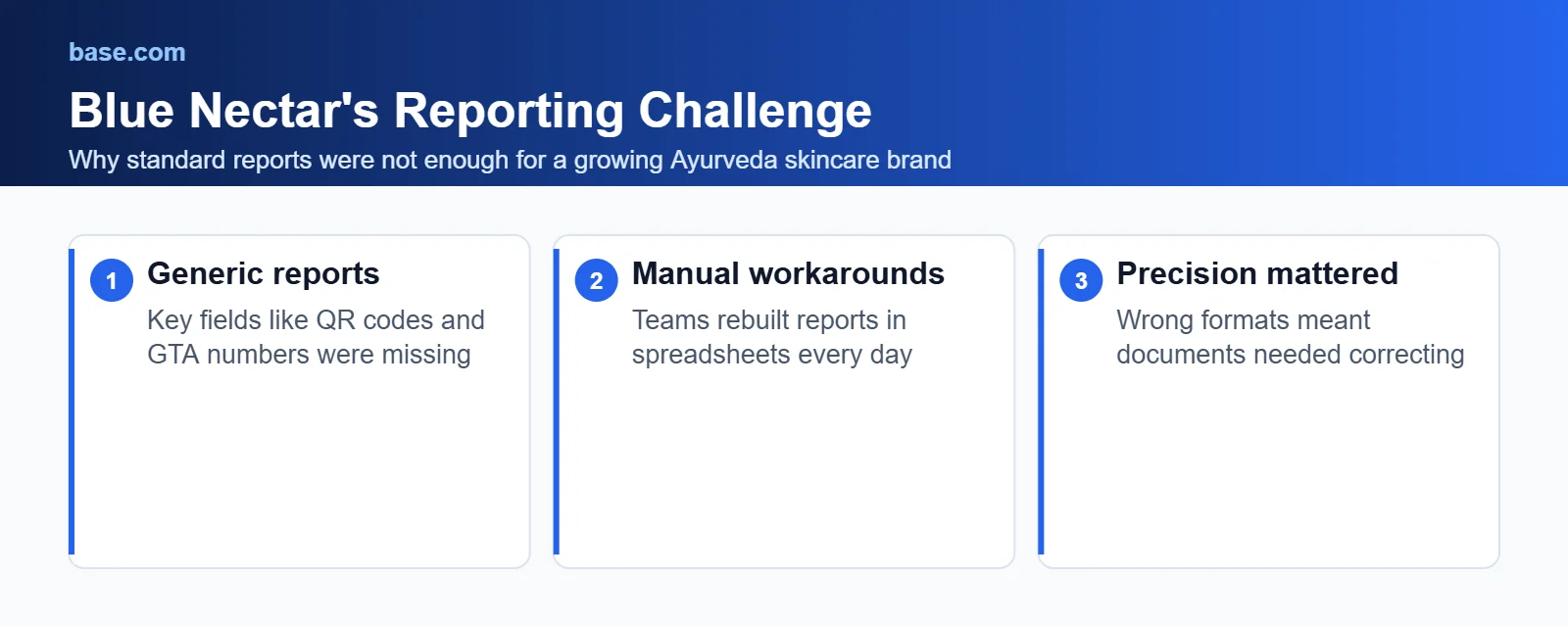
1. Generic Reporting Was Not Built for Blue Nectar’s Real Requirements
Blue Nectar’s reporting needs were specific. The team required outputs that included fields like QR codes, GTA numbers, quantities, and dates, structured in formats that aligned with the brand’s internal workflows and documentation standards. These are not unusual requirements for a scaling Indian ecommerce brand operating across multiple channels with regulatory and compliance documentation needs. But they are requirements that most standard software templates simply do not accommodate.
Generic reporting tools are built for the broadest possible use case. They include the columns that most businesses need most of the time. For a brand with specific operational documentation requirements, particularly one managing product traceability fields like QR codes and GTA numbers, this generic approach creates a persistent gap between what the system provides and what the team actually needs to use.
That gap has a daily cost. When a report does not include the right fields, the team must bridge the difference manually. Data gets extracted from one place, reformatted in a spreadsheet, and assembled into the structure required for the actual use case. This manual extraction and reformatting is not a one-time task. It is a recurring burden that consumes team time every day, introduces errors into what should be precise documentation, and slows down the decisions and processes that depend on the output.
2. Manual Workarounds Were Replacing System Capability
Before Base.com, Blue Nectar’s team was navigating exactly this situation. Reports that should have been direct system outputs required manual intervention to be usable. Fields that the operation depended on, QR codes, GTA numbers, date formats, and quantity structures, were either absent from standard reports or present in formats that required additional work before they could be applied in practice.
The consequence was a reporting workflow built around workarounds rather than around the system’s capability. Teams were spending time bridging the gap between raw data and usable documentation, time that could have been directed at the operational decisions the data was meant to support.
This is one of the most common and least-discussed limitations of generic reporting software. The software works. It tracks the right things. It surfaces order data, inventory counts, and fulfilment metrics. But the reports it generates are built for the average use case, not for the specific one, and when your use case includes precise compliance documentation, traceability fields, and structured exports that need to be ready to use without manual rework, the gap between average and specific is where time and accuracy are lost every day.
3. Precision Was as Important as Speed
As Blue Nectar’s operational requirements became more detailed, a new dimension of the reporting challenge emerged: it was not just about getting data faster. It was about getting the right data, in the right format, with the right fields, every time.
Precision in reporting matters because imprecise data creates downstream problems. A report with an incorrect QR code mapping means a traceability record that cannot be verified. A date field in the wrong format means a document that cannot be directly submitted without correction. A missing GTA number means a compliance export that is incomplete. At the scale Blue Nectar was operating, these imprecisions were not theoretical risks. They were practical friction points that the team managed daily.
The brand needed reporting software that treated precision as a core feature, not as a customisation request. It needed a platform where reports could be configured to the exact field structure the business required, and where that configuration was repeatable and reliable, producing the same precise output every time it was run.
Why Blue Nectar Chose Base.com
Blue Nectar chose Base.com specifically because of its ability to deliver customised, precise reporting outputs, not just standard dashboards or fixed templates. The Base.com team demonstrated an understanding of Blue Nectar’s actual reporting requirements and the flexibility to configure the system around those requirements rather than asking the brand to adapt its workflows to fit the software’s limitations.
The combination of reporting flexibility and operational precision was the deciding factor. Blue Nectar was not looking for more data. It was looking for the right data in the right format, and Base.com was the reporting software that could deliver that distinction.
The Solution
As Blue Nectar’s operations scaled, reporting became more than a visibility requirement; it became a critical operational function. The brand needed reports that accurately reflected its workflows, compliance requirements, and documentation standards. Standard software outputs lacked the flexibility and precision required, forcing teams to rely on manual workarounds that consumed time, increased the risk of errors, and slowed operational execution.
1. Customised Report Configuration Around Exact Business Fields
The first and most direct solution Base.com delivered was the ability to configure reports around the exact fields Blue Nectar’s operation required, including QR codes, GTA numbers, quantities, and date structures that the team relied on for daily operational documentation.
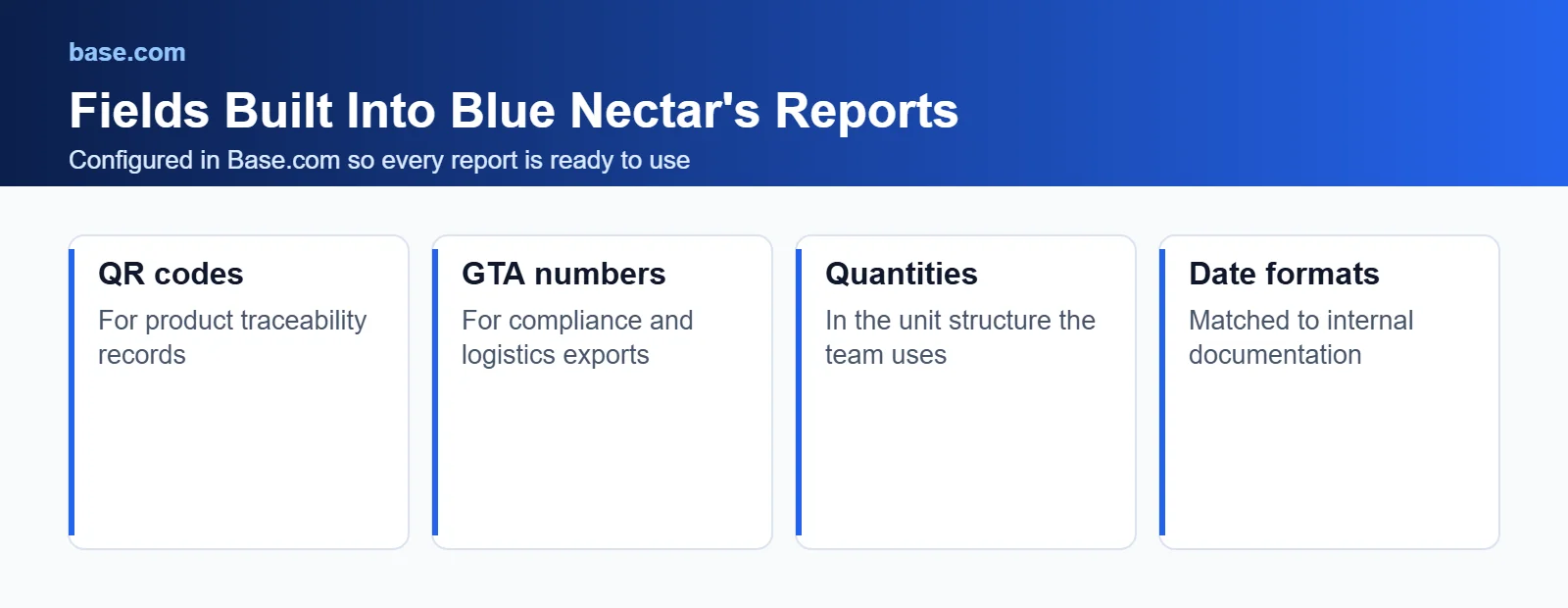
- Base.com gave Blue Nectar the flexibility to define which fields appeared in which reports, in which structure, and in which format, rather than accepting the fixed column layout of a standard template.
- QR code fields were incorporated into relevant operational reports, enabling direct output that could be used for traceability documentation without manual addition or external reformatting.
- GTA number fields, critical for compliance and logistics documentation, were configured into the relevant exports, making them a native part of the report rather than a field that had to be manually appended after the fact.
- Date fields were formatted to the structure Blue Nectar’s workflows required, eliminating the date conversion step that had previously added manual effort to every report cycle.
- Quantity fields were structured to reflect the specific unit configurations the brand used operationally, not a generic unit count that required interpretation or conversion before use.
- The result was reports that were ready to use the moment they were generated, no reformatting, no manual field addition, no interpretation required before the data could be applied in practice.
2. Elimination of Manual Workarounds in the Reporting Workflow
One of the most operationally significant changes Base.com delivered was the removal of the manual workarounds that had been embedded in Blue Nectar’s reporting process. The gap between raw system output and usable business documentation, which had previously been filled by manual effort, was closed by the system’s configured precision.
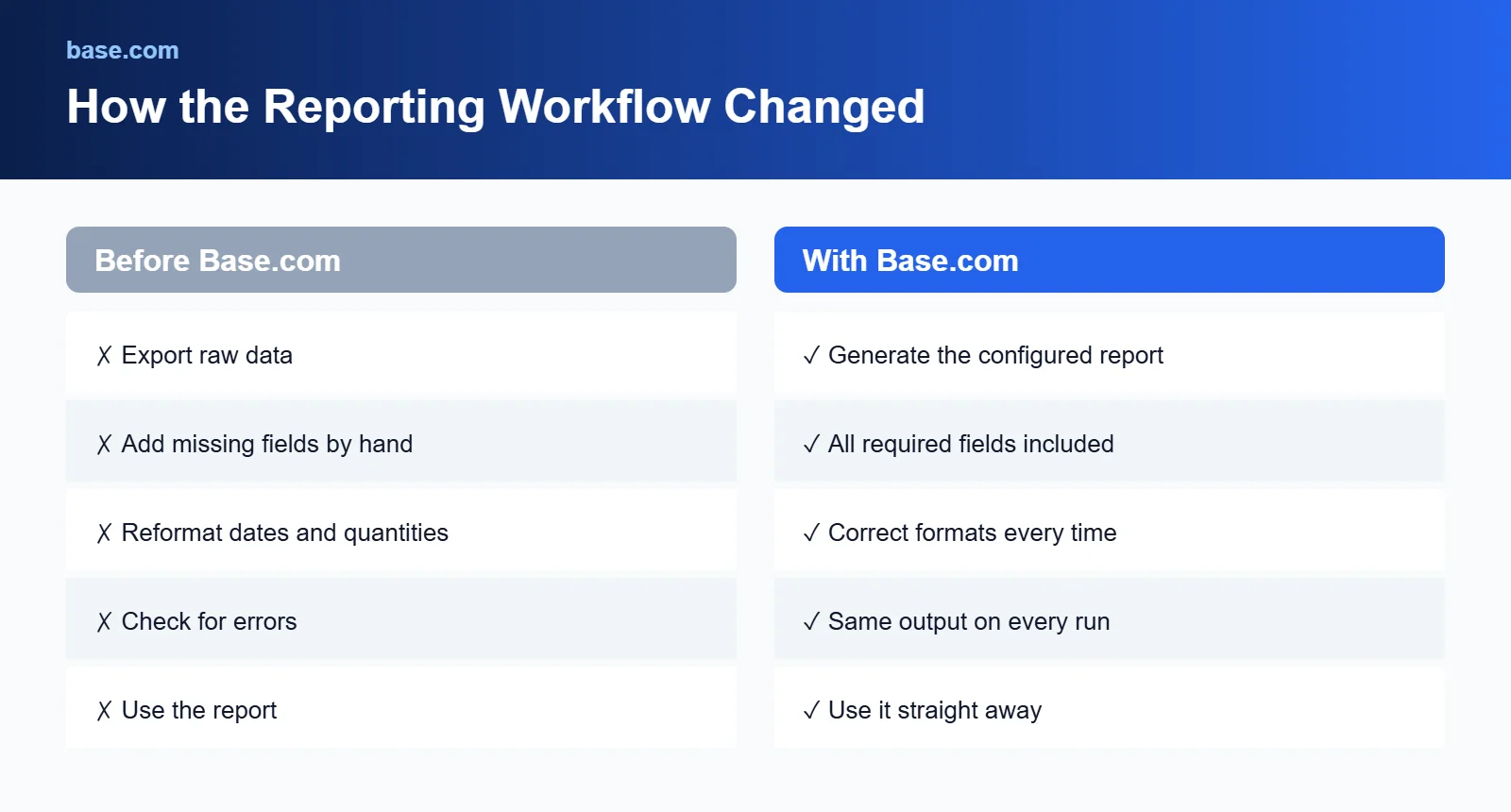
- Reports that had previously required manual extraction and spreadsheet assembly before they could be used in operations were replaced by direct system exports that were ready to apply immediately.
- The back-and-forth between teams that had been caused by reports missing critical fields was eliminated; every report included the required fields from the first generation, not after a correction cycle.
- Team time that had been consumed by manual data bridging was recovered for operational work; the time cost of the workaround disappeared because the workaround was no longer necessary.
- The repeatability of Base.com’s configured reports meant that the same precise output was generated every time the report was run, not produced correctly once and then reproduced inconsistently depending on who was doing the manual work.
- Operational accuracy improved because human judgment was removed from the formatting and field selection process; the system applied the configured logic consistently, without the variation that manual assembly introduces.
- Blue Nectar’s reporting workflow shifted from a process built around bridging software limitations to a process built around using system capabilities directly, which is what inventory and reporting software for ecommerce in India should enable from the start.
3. Reporting Configured as an Execution Tool, Not Just a Visibility Layer
Base.com’s approach to Blue Nectar’s reporting requirements went beyond producing better-looking dashboards. The platform treated reporting as an execution tool, something the team used to drive operational decisions and complete operational tasks, rather than a reference layer that sat above the real work.
- Reports were configured around operational use cases rather than around generic data visibility; the question driving each report’s structure was “what does the team need to do with this output” rather than “what data does the system have available.”
- Exports were formatted to align with how Blue Nectar’s team actually worked; the structure of each report reflected the operational workflow it supported, not a default template structure.
- The precision of the outputs meant that reports generated by Base.com could be used directly in compliance documentation, logistics coordination, and internal operational tracking without requiring translation into a separate format.
- Base.com’s flexibility as reporting software meant that as Blue Nectar’s reporting requirements evolved, new fields, new formats, and new documentation needs, the system could be reconfigured to match rather than forcing the brand to build new workarounds around new limitations.
- Reporting became a genuine operational advantage rather than an administrative necessity; the team had precise, reliable, purpose-built outputs that made their work faster and more accurate simultaneously.
4. A Reporting System That Adapted to the Business, Not the Other Way Around
Perhaps the most fundamental aspect of Base.com’s solution for Blue Nectar was the principle it operated on: the system adapted to the brand’s requirements, rather than the brand adapting its operations to the system’s limitations.
- When Blue Nectar needed a field that was not in a standard template, Base.com configured it; the conversation was “what do you need” rather than “this is what we provide.”
- When the brand’s operational documentation required a specific structure that generic exports did not match, Base.com built that structure. The platform’s flexibility was a feature it actively applied to Blue Nectar’s use case.
- The support team’s responsiveness in configuring and refining reporting outputs meant that precision was achieved iteratively, each configuration refinement brought the output closer to what the operation required, and the team was supported through that process rather than left to navigate it independently.
- Blue Nectar experienced Base.com as purpose-built reporting software, not because it was designed specifically for their category, but because it was designed to be configured specifically for their requirements.
The Impact
The impact of Base.com’s reporting solution on Blue Nectar’s operation was direct, practical, and felt across the teams that depended on operational data every day. The improvements were not abstract efficiency gains; they showed up in how accurately reports reflected the business’s needs, how quickly teams could act on operational data, and how much time was recovered from manual reporting workarounds.
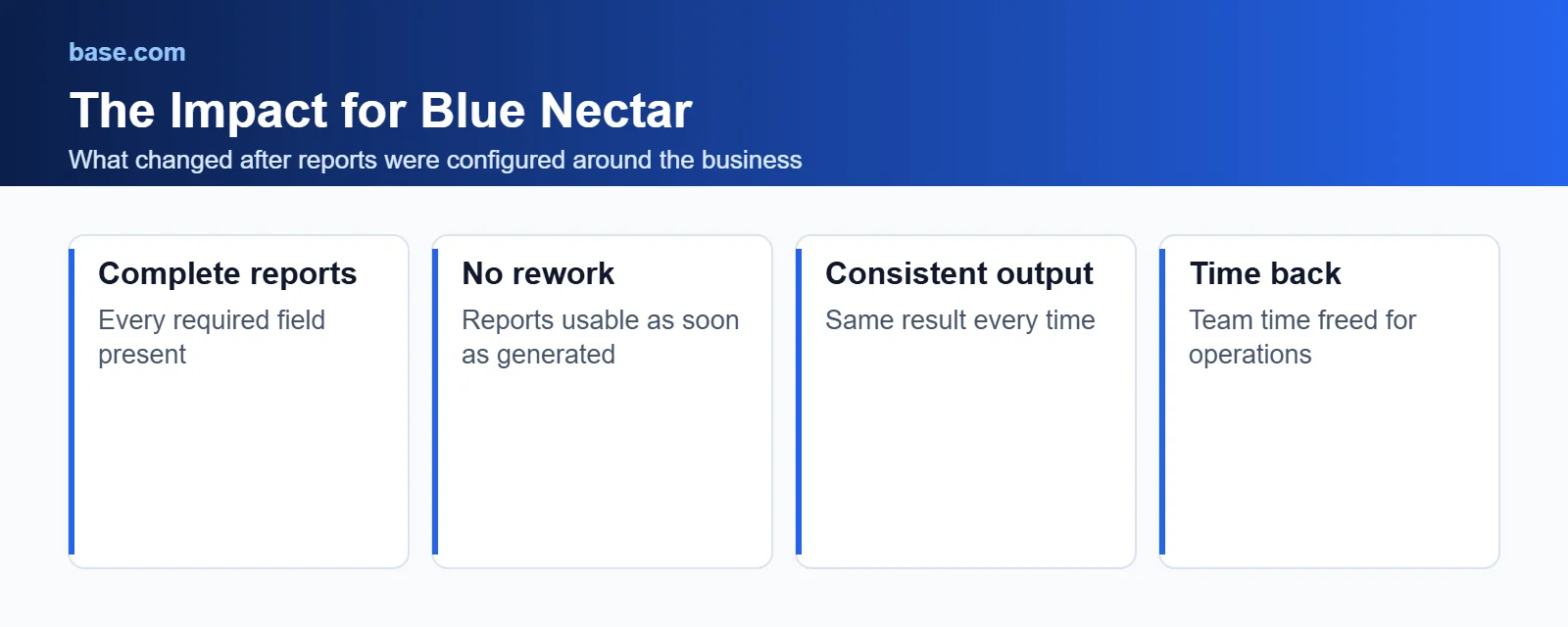
| Impact Area | Before Base.com | After Base.com |
|---|---|---|
| Report field accuracy | Missing critical fields, including QR codes and GTA numbers | All required fields are configured and present in every report |
| Report usability | Required manual rework before operational use | Reports ready to use immediately upon generation |
| Manual workaround time | Significant daily time is consumed by extraction and reformatting | The manual workaround has been eliminated from the reporting workflow |
| Reporting consistency | Variable output depending on who performed manual assembly | Consistent, repeatable output produced identically every time |
| Operational accuracy | Human error risk in manual field addition and formatting | System-configured precision applied consistently without variation |
| Team bandwidth | Reporting-related manual work is consuming operational time | Time recovered and redirected to decision-making and execution |
| Compliance documentation | Incomplete exports requiring post-generation correction | Complete, correctly structured exports generated directly |
| Reporting speed | Slowed by manual assembly and correction cycles | Immediate output from the configured system without intermediate steps |
| System adaptability | Generic templates requiring the brand to adapt workflows to software limits | System configured to brand requirements; software adapted to the brand |
| Confidence in data | Uncertainty about the completeness and accuracy of manual outputs | High confidence in precise, repeatable system-generated outputs |
How Base.com Stands Out as Inventory and Reporting Software for Ecommerce in India
Most platforms that describe themselves as reporting software deliver the same core proposition: centralised inventory tracking, multi-channel order management, and a standard reporting layer that covers the most common use cases. For the majority of brands at an early stage, this is sufficient. The reports are adequate. The data is accessible. The platform works.
Blue Nectar was not an early scale. It was operating with specific documentation requirements, traceability fields, compliance exports, and operational reporting needs that the standard proposition does not address. For a brand at this level of operational specificity, adequacy is not enough. The question is not whether the software can produce reports; it is whether it can produce the exact reports the business needs, in the exact format required, without the team having to complete the output manually.
Base.com’s differentiation for Blue Nectar was built on three specific characteristics. First, genuine configuration flexibility: the ability to include the fields that mattered, QR codes, GTA numbers, quantities, dates, and to structure them in the format the operation required. Second, precision as a core feature rather than a customisation exception: the understanding that accurate, structured outputs are not a premium add-on but the baseline standard for reporting software at a brand’s operational scale. Third, a support approach that treated Blue Nectar’s specific requirements as the design brief rather than as edge cases to be accommodated within existing template constraints.
Blue Nectar’s conclusion was clear: Base.com delivered customisation and precision that felt unmatched by the generic tools the team had previously used. That assessment reflects what the right reporting software delivers, not more data, but the right data, structured exactly as the operation requires, reliable enough to depend on without verification.
Read how other brands run their operations on Base.com: Pink Shell’s fulfilment engine and Real Vision’s peak-week fulfilment.