
Inventory sync across marketplaces in India is the mechanism that keeps the stock count shown on Amazon, Flipkart, Meesho, Myntra, and your D2C website in agreement with what is physically in your warehouse. When it works correctly, you never oversell. When it breaks or runs with a delay, you confirm orders you cannot fulfill, take marketplace cancellation penalties, and erode seller ratings that took months to build.
Most Indian D2C brands discover inventory sync problems the hard way. A sale on Flipkart depletes the last 5 units. A few minutes later, Meesho confirms an order for the same SKU because its count has not been updated yet. Both orders need to be shipped. Only one can be. One order gets cancelled. The brand absorbs the penalty.
This post explains how inventory sync across marketplaces in India actually works at the technical level, what breaks it, and how Base.com’s architecture handles it for brands selling simultaneously on Amazon, Flipkart, Meesho, and beyond.
Why Inventory Sync Across Marketplaces in India Is Harder Than It Looks
Selling on a single channel is a solved problem. You have one inventory count, one order stream, and one place to update stock. Add a second channel and the math changes: now two channels are drawing from the same physical stock, and both need to see the correct count at all times.
Add five channels, and the problem compounds. Each channel has its own API architecture, its own update frequency requirement, its own inventory model, and its own rules for how stock counts are pushed and received. Amazon’s SmartConnect infrastructure, for instance, requires inventory updates at a merchant-level threshold limit, updates must be delta-based (only changed quantities, not full refreshes), and carry EPOCH sequence numbers to maintain update ordering. That is not the same as how Flipkart or Meesho receive inventory updates.
Inventory sync across marketplaces in India requires a system that understands each marketplace’s technical protocol, pushes updates at the right frequency, validates changes before pushing, and handles the sequencing correctly so a delayed update from one channel does not overwrite a more recent update from another.
This is the core technical problem. It is not about having integrations. It is about how those integrations handle the edge cases, the simultaneous sale, the return that needs to be added back, the stock transfer that needs to be reflected, and the sale event spike that pushes update frequency to its limits.
The Four Mechanisms That Break Inventory Sync Across Marketplaces in India
Inventory synchronization across multiple marketplaces is one of the biggest operational challenges for eCommerce brands in India. A product may sell on one channel, but if stock levels are not updated instantly across every connected marketplace, overselling, cancelled orders, unhappy customers, and marketplace penalties quickly follow.
While many businesses assume inventory mismatches are caused by software bugs, the reality is that synchronization failures usually stem from a handful of predictable operational and technical mechanisms.
Understanding these underlying causes is the first step toward building a reliable, real-time inventory management system that keeps stock accurate across every sales channel.
Mechanism 1: Polling Intervals and Sync Lag
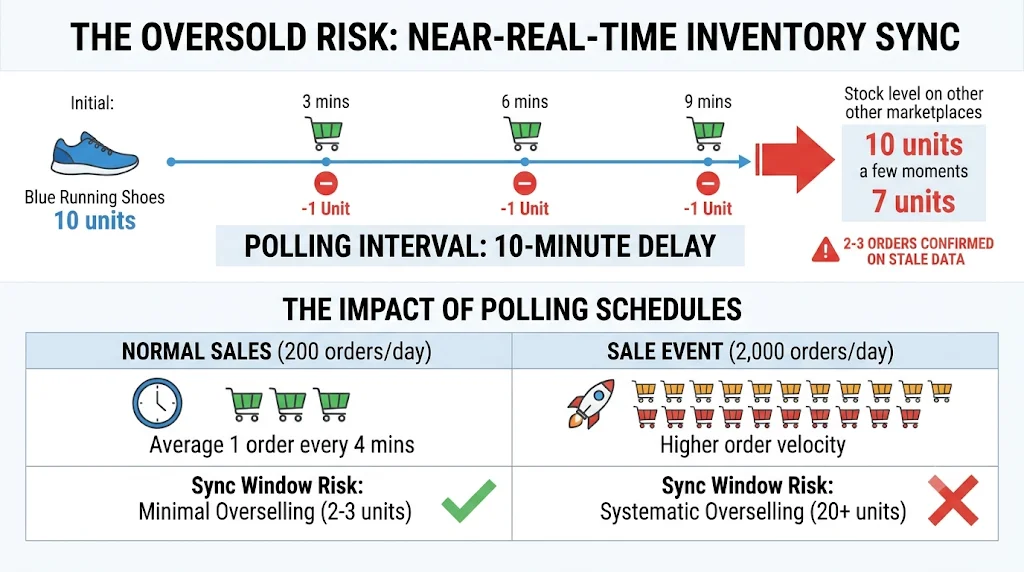
Most inventory management tools sync with marketplaces on a polling schedule, every 10 minutes, every 15 minutes, or once an hour. During that interval, any sale on any channel is not reflected on the others. A brand doing 200 orders per day across five channels averages roughly one order every four minutes across the portfolio. A 10-minute sync window means two to three orders can be confirmed on stale inventory data before the count corrects.
At 500 orders per day, the exposure is larger. At 2,000 orders per day during a sale event, the window creates systematic overselling at the SKU level for any item in limited quantity.
Inventory sync across marketplaces in India that runs on polling intervals is not real-time. It is near-real-time at best. The difference is not semantic; it is the difference between 0 oversell events and 20 oversell events in a sales period.
Mechanism 2: Full Inventory Pushes vs. Delta Updates
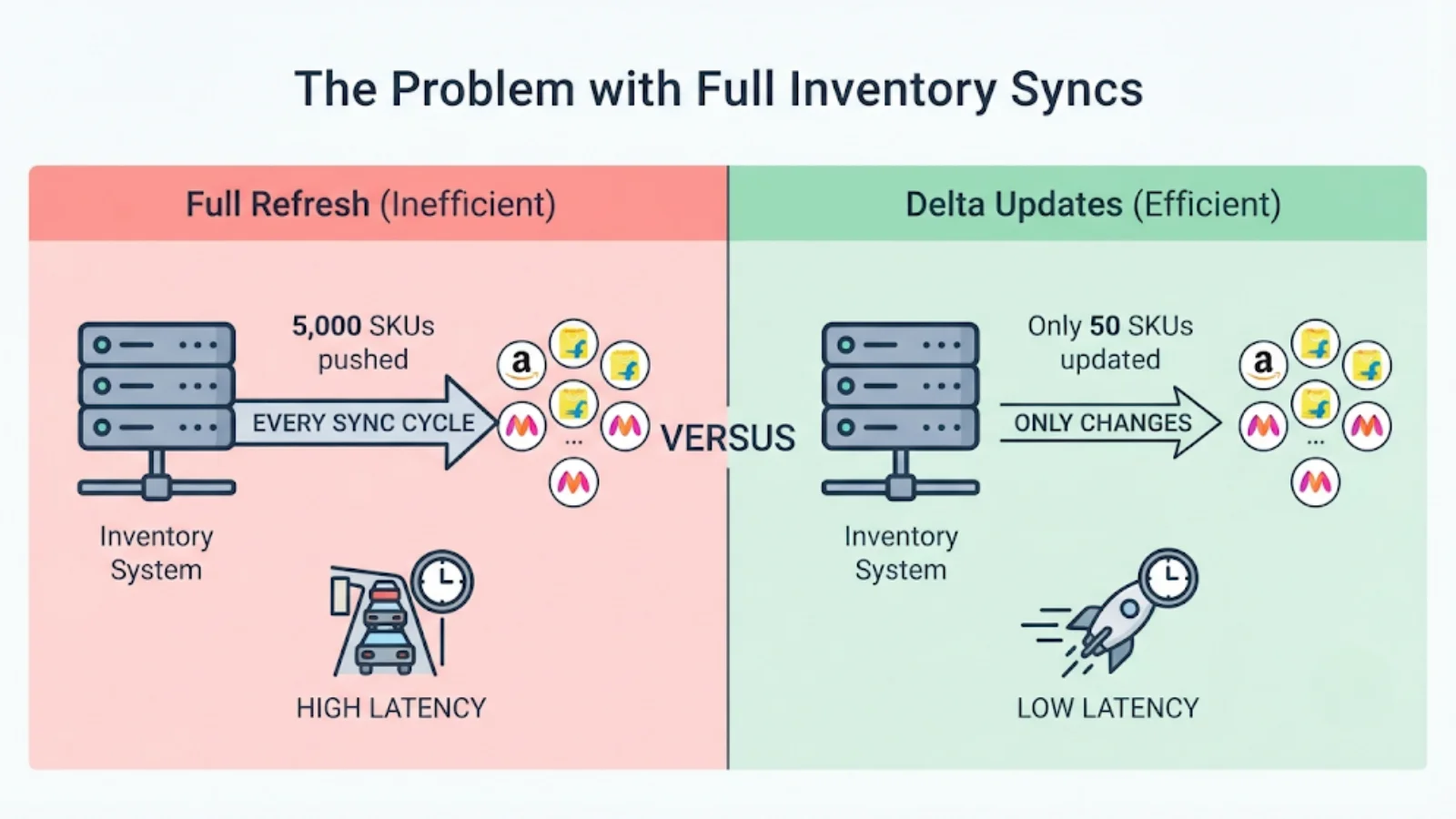
Some tools push a full inventory refresh to every channel on every sync cycle. This is wasteful and creates problems. A full push for 5,000 SKUs every 10 minutes generates enormous API call volume. Marketplaces throttle or rate-limit these calls. During high-traffic periods, exactly when accurate inventory sync across marketplaces in India matters most, the full-push approach creates queuing delays that make the actual sync latency worse than the nominal interval.
Delta updates solve this: only SKUs whose count has changed since the last update are pushed. A brand selling 50 SKUs in an hour pushes 50 updates, not 5,000. The channel receives the correct information faster. Amazon’s own integrator requirements specify that inventory updates should be delta-only and use EPOCH sequence numbers, not because Amazon prefers it, but because it is the technically correct approach for maintaining sync accuracy under load.
Mechanism 3: Stock Reservation Gaps
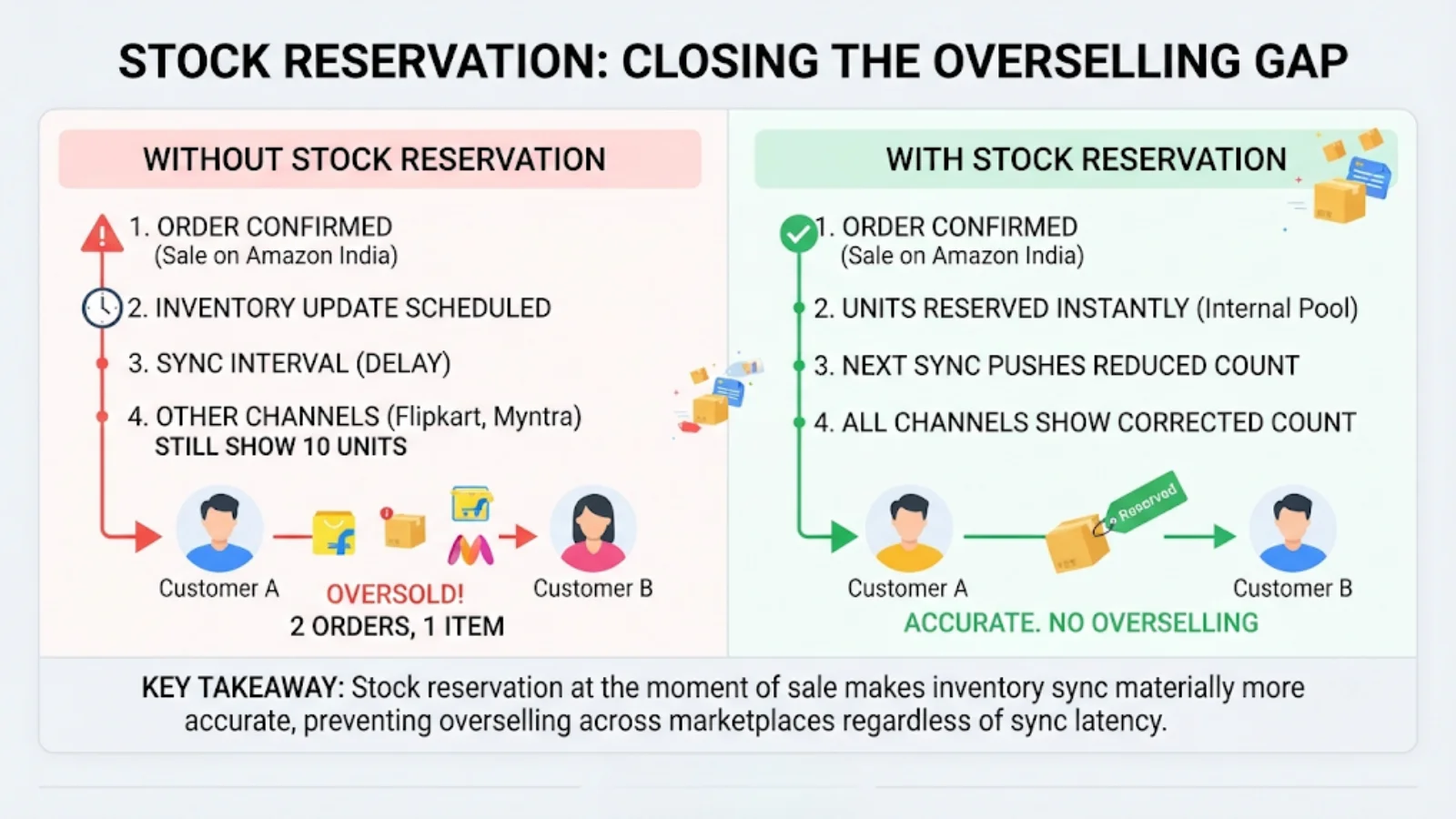
A sale on one channel needs to instantly reserve the sold units before the inventory update propagates to other channels. Without stock reservation, the act of removing units from available inventory at the moment of order confirmation, before the physical pick, there is a window where other channels still show those units as available.
The sequence without reservation: Order confirmed → Inventory update scheduled → Sync interval elapses → Other channels receive updated count. Between confirmation and sync, overselling can and does occur.
The sequence with reservation: Order confirmed → Units reserved immediately from available pool → Next sync pushes the reduced count. The reservation closes the window regardless of sync latency.
Inventory sync across marketplaces in India is materially more accurate when stock reservation is built into the inventory management layer. The sync interval matters less because the available count is correct at the source.
Mechanism 4: Return Inventory Not Reflecting in Live Counts
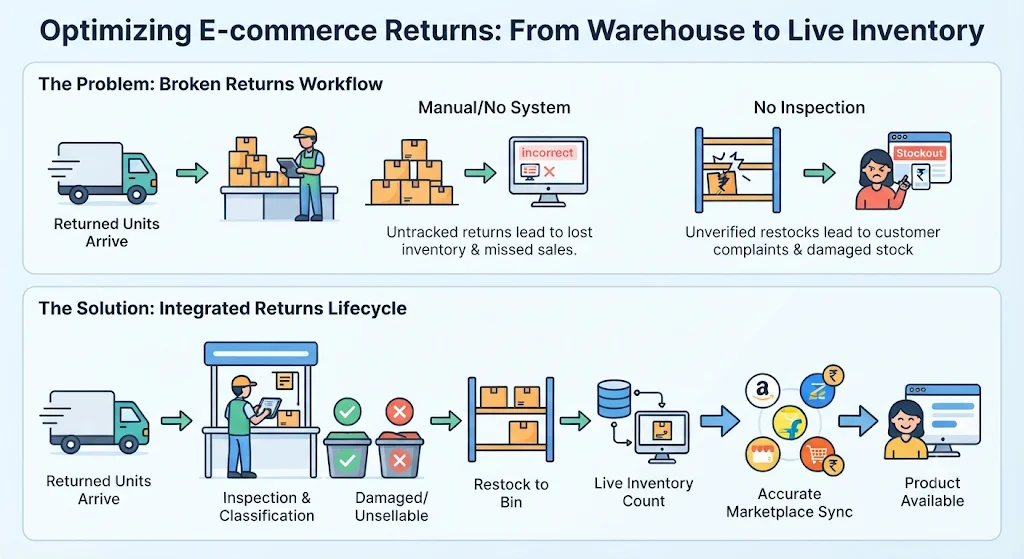
A returned unit arriving at the warehouse does not automatically become available inventory. It needs to be inspected, classified as sellable, and restocked to its bin before it enters the live count. Without a returns processing workflow connected to the inventory system, returns either never re-enter available inventory or re-enter unverified, potentially adding damaged units to the channel-visible count.
Inventory sync across marketplaces in India that do not handle the full inventory lifecycle, including return restock, produces a channel-visible count that is systematically lower than actual sellable inventory. This leads to artificial stockouts, unnecessary reorders, and missed sales on channels that would have had stock if returns had been processed correctly.
How Base.com Handles Inventory Sync Across Marketplaces in India
Base.com is built as a unified OMS, WMS, and inventory management platform with 1,700+ global integrations covering 300+ marketplaces. Its inventory sync architecture is designed around the technical requirements of Indian marketplace APIs and the operational realities of high-volume D2C fulfillment.
1. A Single Centralized Inventory Pool
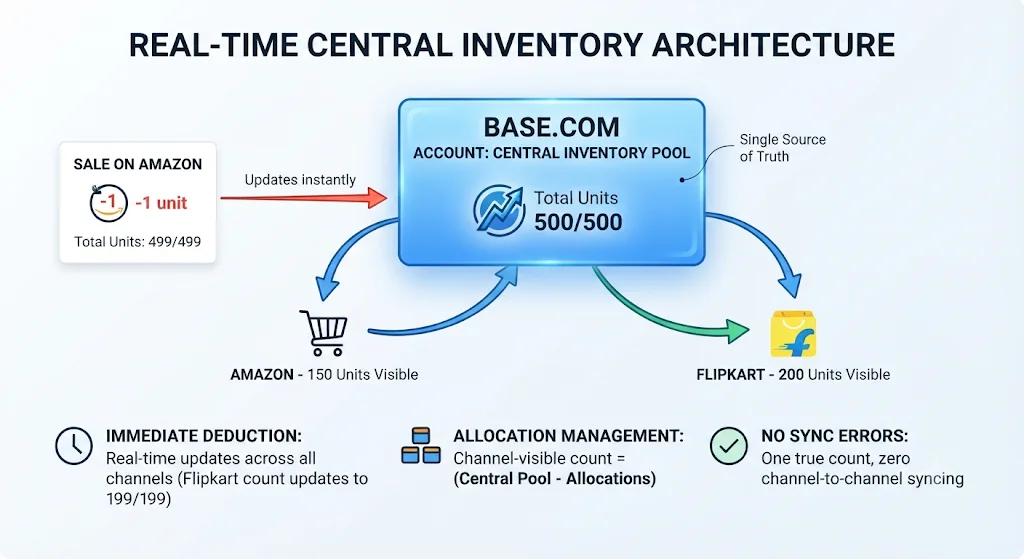
Every Base.com account operates from one central inventory pool. This pool is the single source of truth for every channel. When a unit sells on Amazon, it is deducted from the central pool. That deduction immediately reduces what every other channel sees as available, not after a sync interval, but at the moment the deduction is applied.
The channel-visible count is derived from the central pool minus channel allocations. A brand that has reserved 200 units for Flipkart and 150 for Amazon sees those allocations reflected on each channel’s live count. A sale on either channel updates the central pool and recalculates all channel counts from the same source.
This architecture eliminates the class of errors caused by maintaining separate inventory counts per channel and attempting to sync them. There is no sync between channels; there is one count that all channels read from.
2. Delta-Based Inventory Updates with Validation
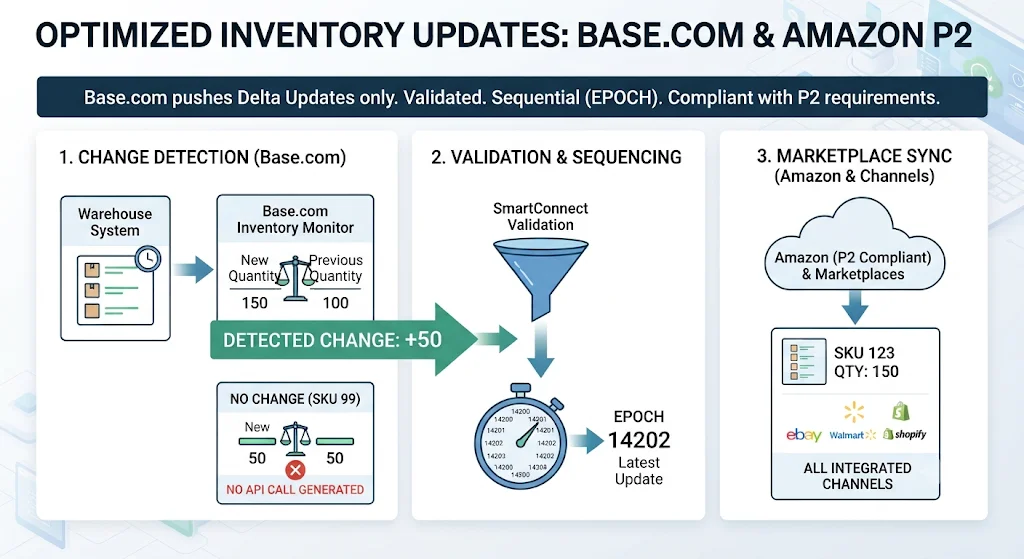
Base.com pushes inventory updates to marketplaces using delta-based updates; only changed quantities are pushed, not full catalogue refreshes. Before any update is pushed, the system validates whether the inventory picture has actually changed since the last push. An unchanged SKU count does not generate an API call.
This matches Amazon’s own P2 (Priority 2) integrator requirement: inventory updates should be made for delta quantity only, with a check to validate the change before pushing to SmartConnect. Base.com meets this requirement natively across all integrated channels, not just Amazon.
EPOCH sequence numbers are used for update ordering. When multiple updates to the same SKU arrive at Amazon’s system in quick succession, which happens during sale events, the EPOCH sequence ensures the most recent update is applied correctly rather than an older update overwriting a newer one.
3. How Base.com Integrates with Each Major Indian Marketplace
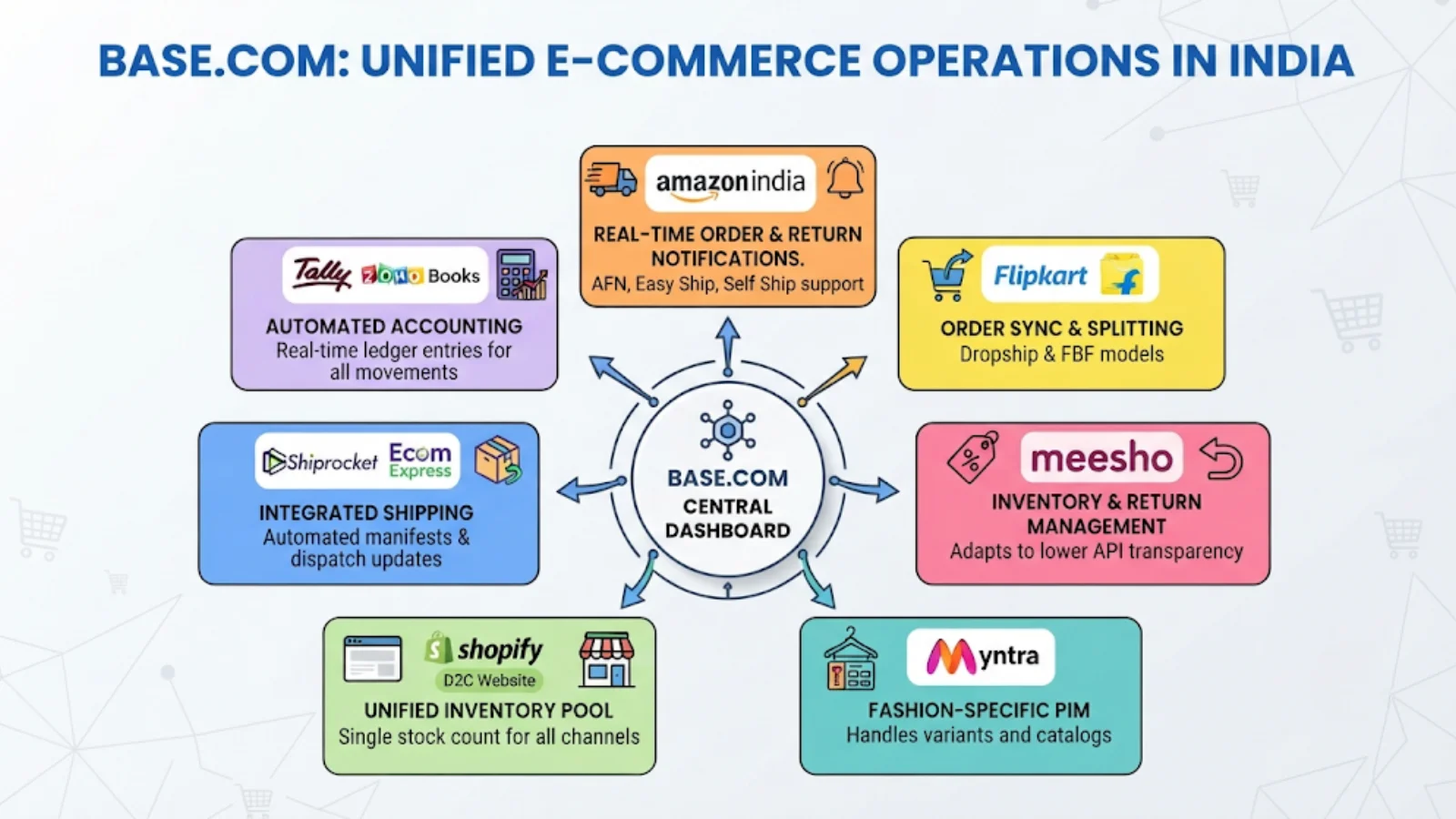
Base.com’s 300+ marketplace integrations include every major Indian channel where D2C brands operate. The integration depth varies by channel and reflects the technical capability each marketplace exposes through its API.
- Amazon India: Base.com integrates with Amazon’s SmartConnect infrastructure across AFN (Amazon Fulfilled Network), Easyship, and Self Ship fulfillment models. Order events, created, updated, delivered, cancelled, unfulfillable, are received via Amazon’s notification API in real time. Return events, created, out for delivery, updated, are similarly handled through event-based notification rather than polling. This means Base.com receives Amazon updates as they happen, not on a schedule. Inventory updates are pushed delta-only, within threshold limits at the merchant level, using EPOCH sequencing. CPT breach alarms are triggered for all orders at risk within one hour of cutoff, a P1 requirement in Amazon’s integrator framework that Base.com satisfies natively.
- Flipkart: Base.com connects to Flipkart’s seller API for both Dropship and FBF (Fulfilled by Flipkart) fulfillment models. Order sync, inventory updates, and returns, including CRET and RTO, are handled through the integration. Order splitting by channel is supported, meaning a Flipkart order for multiple items can be split across fulfillment nodes if required.
- Meesho: Meesho’s marketplace has a high return rate and relatively lower API transparency compared to Amazon and Flipkart. Base.com’s integration handles Meesho’s inventory update requirements and return flows. Inventory sync across marketplaces in India on Meesho requires particular attention to return credits because Meesho’s settlement and return reporting is less granular than Amazon’s. Base.com’s accounting module tracks order-level expected payouts independently of what Meesho’s settlement reports show.
- Myntra: Base.com integrates with Myntra’s Partner Portal, including PPMP (Prepaid Marketplace) and SJIT (Ship to Inventory Transfer) return flows. Myntra has fashion-specific operational requirements around variant management, size grids, and catalogue structure. Base.com’s PIM module handles these at the product data level, ensuring inventory sync accuracy is not compromised by catalogue mismatches between the system and the Myntra listing.
- Shopify and D2C website: For brands running their own storefront on Shopify or WooCommerce alongside marketplace channels, Base.com syncs inventory from the same central pool. A sale on the D2C website decrements the same count that Amazon and Flipkart read from. There is no separate website inventory record that needs to be manually reconciled with marketplace counts.
- Shiprocket, Ecom Express, and shipping integrations: Inventory sync across marketplaces in India interacts with shipping at the point of manifest generation. Base.com integrates with Shiprocket, Ecom Express, and other major Indian courier aggregators. When an order is manifested and picked up, the corresponding inventory reservation converts to a confirmed dispatch. If a courier pickup fails and the order is held, the reservation is maintained, not released back to available inventory until the order is actively cancelled or rerouted.
- Tally and Zoho Books: Every inventory movement that has a financial dimension, sales, returns, stock adjustments, and write-offs automatically syncs to Tally or Zoho Books as a ledger entry. This means the accounting record is always in agreement with the inventory record without a manual export step. Inventory sync across marketplaces in India that flows through to the accounting system produces a P&L that reflects the actual inventory position, not an approximation based on last month’s reconciliation.
Channel-Level Inventory Allocation: How to Prevent One Channel from Consuming All Stock
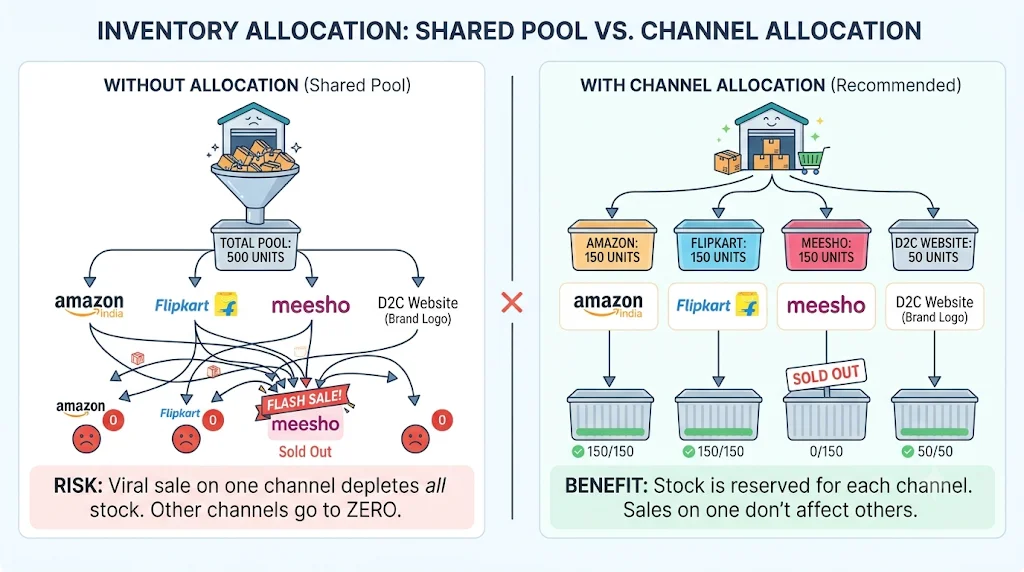
Inventory sync across marketplaces in India operates on a shared pool model. Without allocation rules, a viral post or a flash sale on one channel can deplete all available stock before other channels have a chance to sell. The brand woke up the next morning with zero inventory on Amazon, Flipkart, and their D2C site because Meesho ran a promotion overnight and consumed everything.
Channel allocation prevents this by reserving units for each channel. You define how many units of each SKU are available to Amazon, how many to Flipkart, and how many to the D2C website. Sales on any channel draw only from that channel’s allocation. When one channel’s allocation is exhausted, the SKU shows as unavailable on that channel, regardless of total pool availability.
How Base.com Implements Allocation
Base.com supports inventory allocation per channel from the same central pool. Each allocation is a live reservation, not a static number set once and forgotten. As sales move, allocations can be adjusted manually or through rules. A brand preparing for a Flipkart Big Billion Days event can increase Flipkart’s allocation in advance and reduce other channels’ allocations temporarily, then restore normal distribution after the event.
This is the operational mechanism that makes planned sale events work without post-event inventory chaos. Inventory sync across marketplaces in India that do not support channel allocation forces brands to either under-stock every channel to prevent one channel from overselling, or accept that a sale on one channel may strand inventory on others.
Allocation and Multi-Warehouse Interaction
For brands running multiple warehouse nodes, channel allocation interacts with warehouse routing. A Flipkart order routed to Warehouse A draws from Warehouse A’s Flipkart-allocated stock. A simultaneous Amazon order routed to Warehouse B draws from Warehouse B’s Amazon-allocated stock. The central inventory pool is decremented at the correct location. Inventory sync across marketplaces in India across a multi-node setup requires this two-dimensional accuracy, channel, and warehouse, to maintain correct counts everywhere.
Real-Time Order Events vs. Polling: Why It Matters for Inventory Accuracy
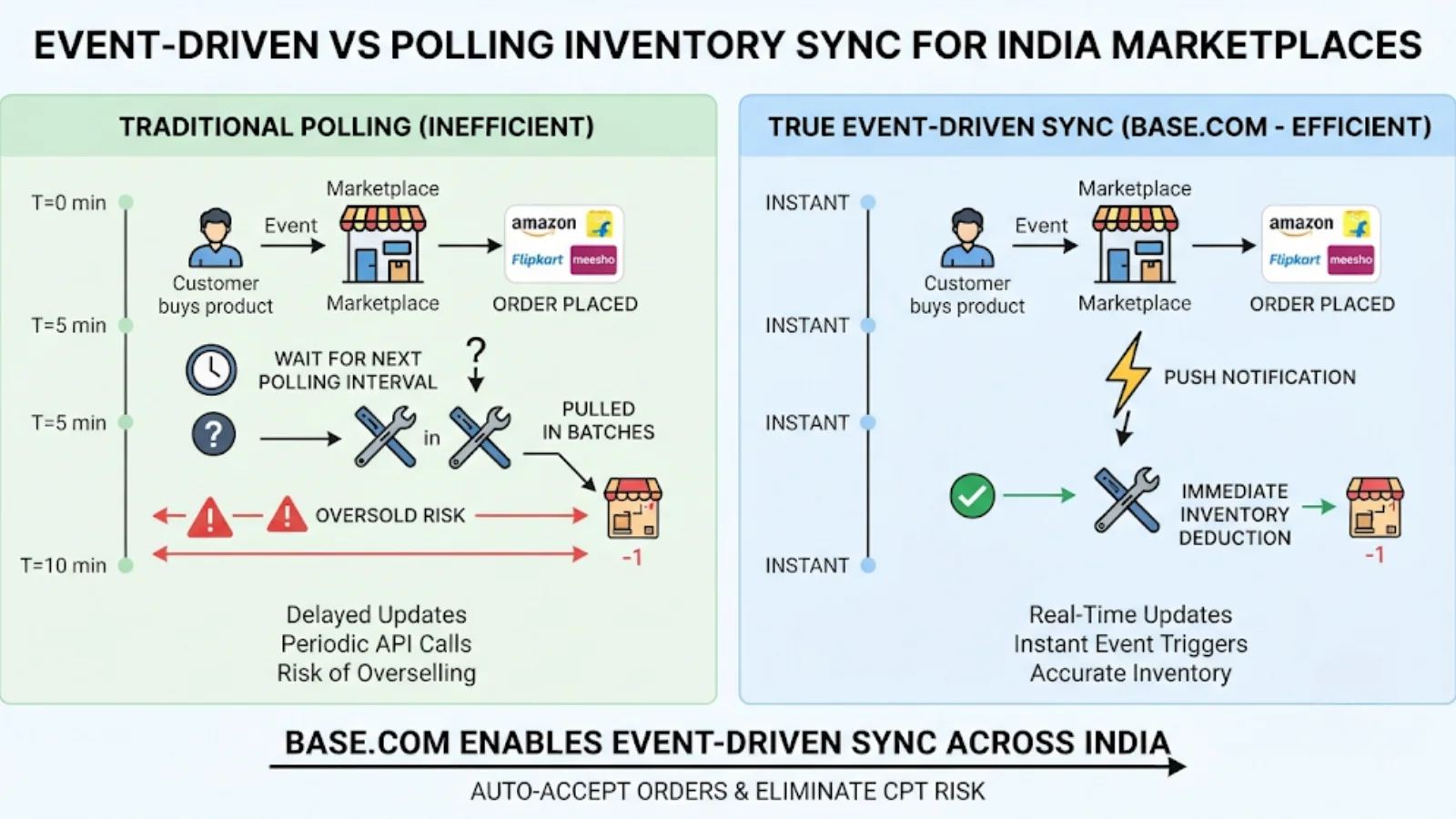
Most tools that claim real-time inventory sync across marketplaces in India are actually running interval-based polling. They call the marketplace API every N minutes and ask for updated orders and inventory status. True event-driven sync is different: the marketplace pushes an event notification to the tool the moment something changes.
Amazon’s notification API is the clearest example. When an order is created, updated, cancelled, or delivered, Amazon fires an event to the integrator immediately. Base.com receives this event and processes it in real time; the inventory update happens at the moment of the event, not at the next polling interval.
This matters for inventory accuracy because the moment of an order event is the moment when inventory must be reserved. An event-driven system reserves inventory in real time. A polling system reserves inventory on the next interval, during which time overselling can occur.
Base.com supports auto-acceptance and auto-rejection of orders based on the live inventory picture. When Amazon drops a shipment to a seller (a pre-confirmed order that needs acceptance), Base.com auto-confirms it if inventory is available and auto-rejects it if it is not, without requiring manual action from the seller team.
This is a P2 capability in Amazon’s integrator requirements and a meaningful operational improvement for brands doing high volumes. Manual acceptance workflows at scale create delays, and delays on Amazon translate directly to CPT risk. Inventory sync across marketplaces in India that enables auto-acceptance removes an entire category of fulfillment latency.
Stock Alerts, Low-Stock Notifications, and Demand-Pattern Alerts
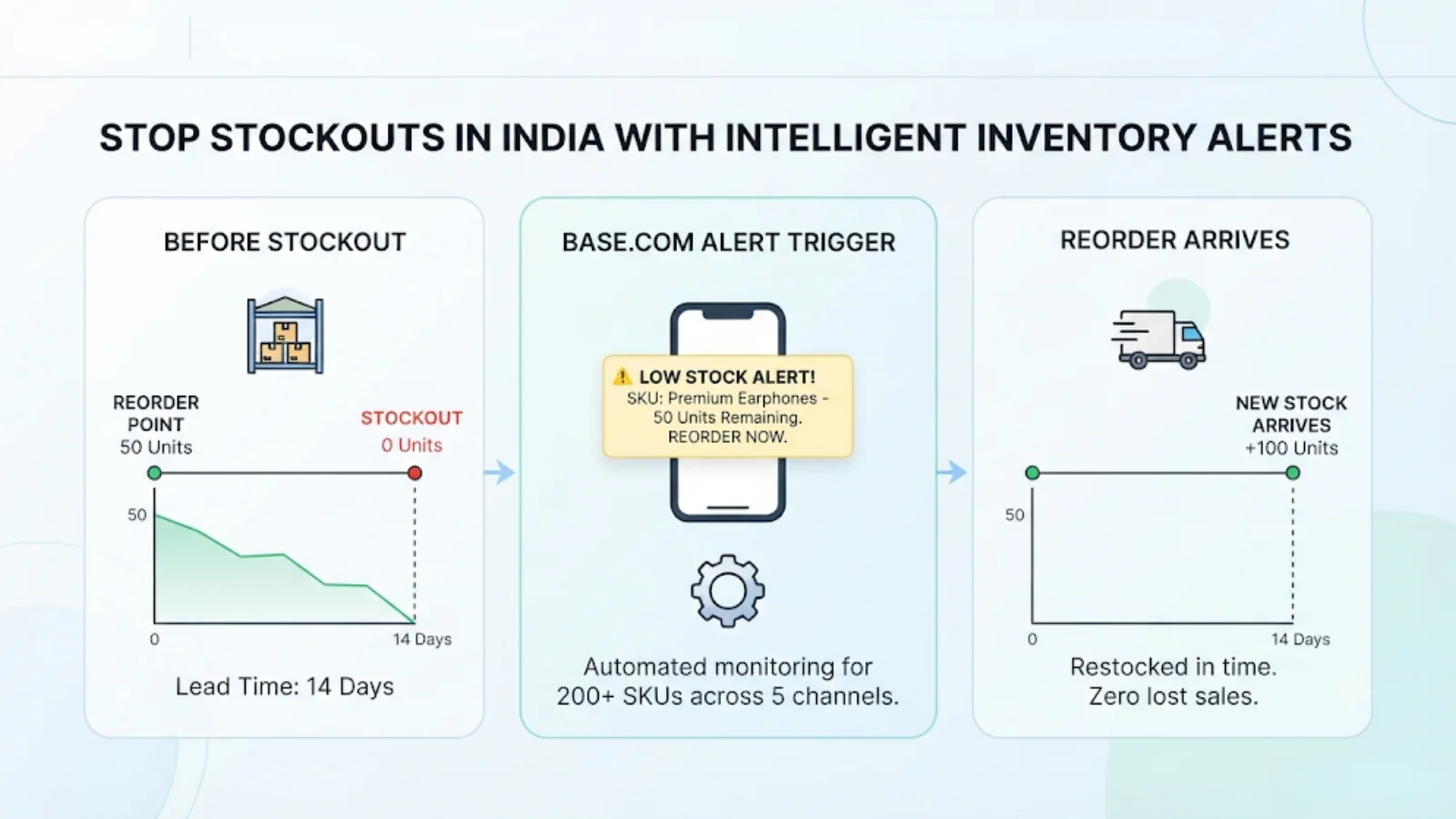
Inventory sync across marketplaces in India is not only about preventing overselling. It is also about preventing stockouts, running out of a bestselling SKU on a channel during a period of high demand.
Base.com provides stock alerts, configurable thresholds per SKU that trigger a notification when available inventory drops below a defined level. For a brand with 200 active SKUs across 5 channels, manual monitoring of stock levels is impossible. Automated alerts close the gap.
The alert should fire early enough to allow a reorder to arrive before a stockout. If a supplier lead time is 14 days and the alert fires at 0 units remaining, it is already too late. A well-configured alert fires at the reorder point, the quantity at which, given average daily velocity and lead time, a reorder placed today will arrive before the last unit sells.
Demand-Pattern Based Alerts
Base.com’s stock alert system covers threshold-based notifications. For brands needing predictive velocity-based alerting on top of standard thresholds, integrating with a demand forecasting tool via Base.com’s API layer is the practical approach at larger SKU counts.
Increff’s inventory system takes this further with alerts based on demand patterns rather than fixed thresholds. If a SKU’s sales velocity doubles because of a social media mention, a successful ad campaign, or a seasonal shift, a static threshold alert does not capture the elevated risk. A demand-pattern alert recalculates risk based on current velocity and fires earlier.
Offline Orders and the Complete Channel Picture
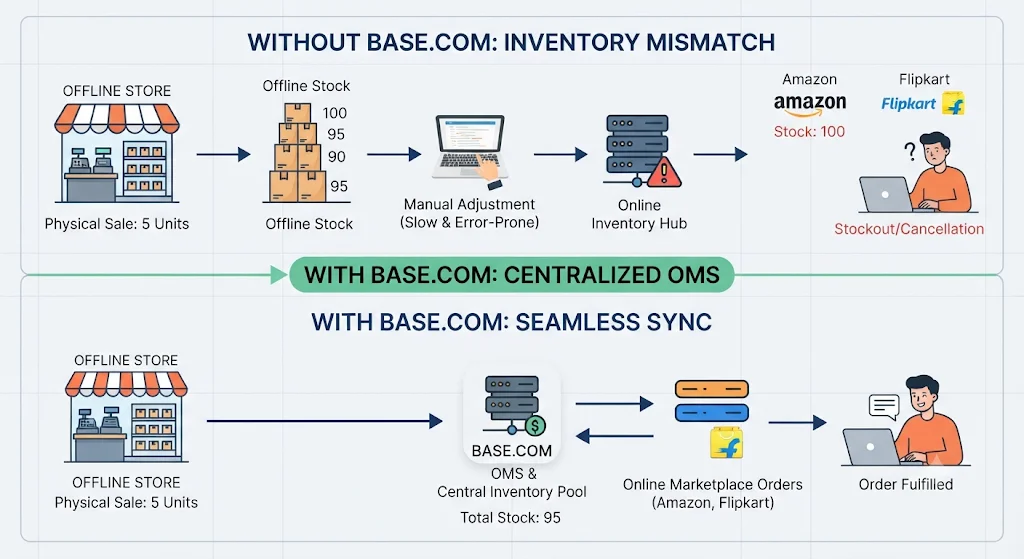
Many growing D2C brands operate offline alongside online, a physical store, a company store for employee purchases, a distributor channel, or a modern trade relationship. Without offline order integration, inventory consumed by the offline channel is not reflected in online channel counts until a manual adjustment is made.
This is a direct inventory sync accuracy failure. A unit sold at a physical store reduces physical inventory. Until that reduction is recorded in the system and propagated to marketplace channels, online channels show inventory that does not exist. An order confirmed on Amazon or Flipkart against that phantom stock cannot be fulfilled.
Base.com supports offline order integration; orders from physical channels are entered into the same OMS and drawn from the same central inventory pool as online orders. The inventory sync across marketplaces in India reflects the full picture: online sales, offline sales, returns from all channels, and transfers between nodes.