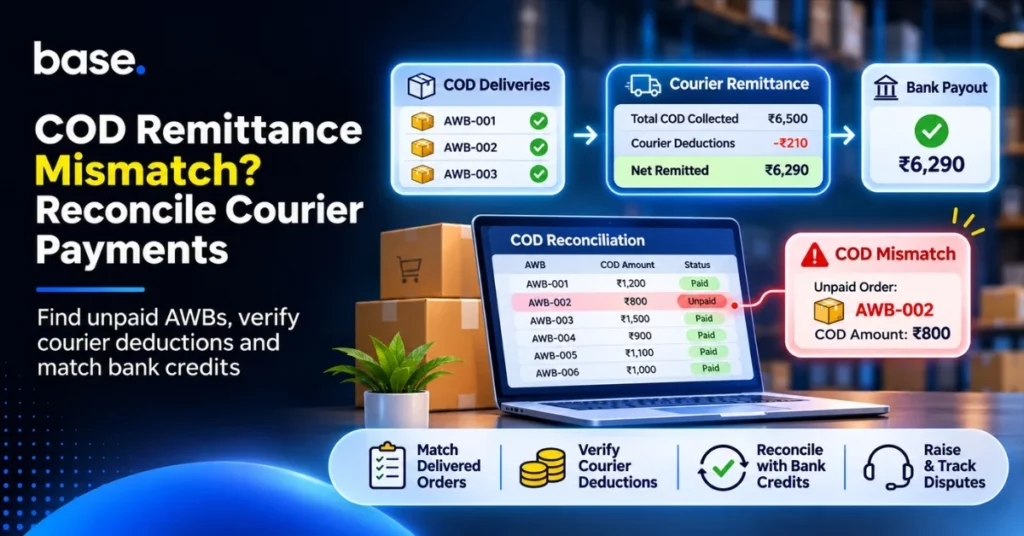
A COD remittance mismatch is a difference between cash due on delivered cash-on-delivery (COD) orders and what the courier paid. To resolve it, check whether the bank credit agrees with the remittance report, then check whether that report includes every delivered shipment due for payment. These are two separate checks.
Identify what causes your COD remittance mismatch
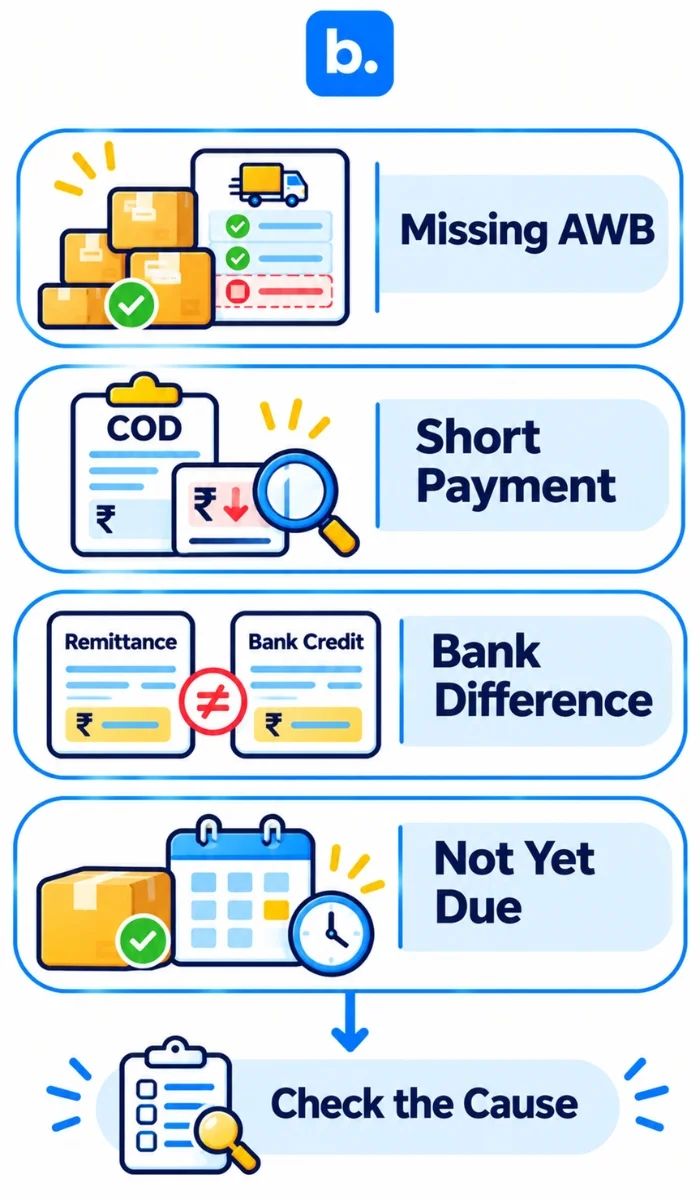
First locate the difference. A correct bank transfer can still cover an incomplete list of orders.
| What you see | What to check first | First action |
|---|---|---|
| Bank credit matches the remittance, but eligible deliveries total more | Which due shipments are absent? | Compare the delivered list with paid AWBs. |
| A shipment appears, but its payment is lower than expected | Is the difference a supported deduction or partial payment? | Check its collection amount, fees and allocations. |
| Remittance total exceeds the bank credit | Is part going to a wallet, another credit or a pending transfer? | Trace the payment reference and authorised allocations. |
| A delivered shipment has no payment entry | Is it due, scheduled, held or unexplained? | Check payout eligibility before raising a shortage. |
Do not compare this month’s deliveries with this month’s bank receipts and assume the difference is missing money. The receipts may cover different shipments.
For example, Delhivery documents an optional wallet-recharge allocation from COD. Money assigned to that wallet is not a bank credit, but it is not automatically an unexplained loss either.
Gather the records and identify orders due for payment
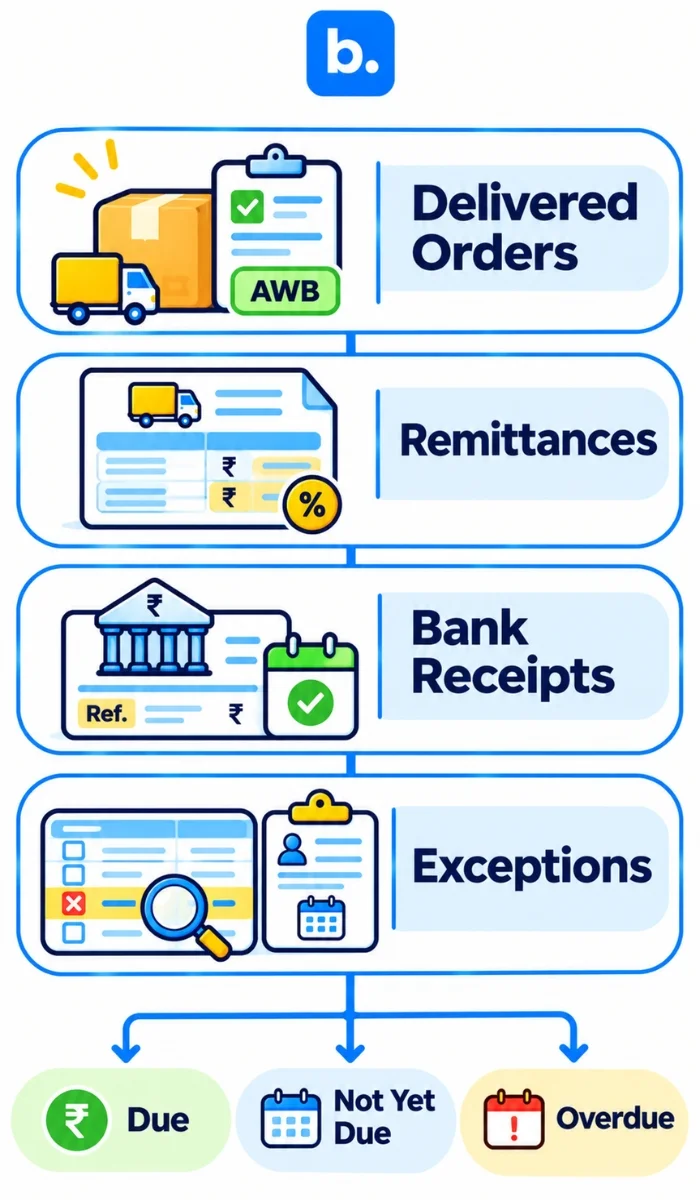
Reconciliation means matching expected receipts with actual receipts and explaining the differences. Remittance is the partner’s transfer of collected customer payments. An air waybill (AWB) is the shipment reference used to connect courier records to orders.
You need delivered-order data, remittance detail and the bank statement. Add invoices, adjustments and wallet entries where relevant.
Build a four-tab working sheet
Copy this layout into a workbook. These are your working columns, not a universal courier-export format.
| Tab | Information to keep | Purpose |
|---|---|---|
| Delivered orders | Order ID, paying partner/account, courier, AWB, delivery date, collectible COD and agreed due date | Establish what should be paid. |
| Remittances | AWB, batch reference, processing date, amounts paid, deductions and supporting references | Identify what the partner included. |
| Bank receipts | Payment reference, credit date, amount and linked batch | Prove the money received. |
| Exceptions | AWB, expected/received amounts, difference, reason, evidence, owner and next action | Keep unresolved items visible. |
A unique transaction reference (UTR), or the provider’s equivalent bank reference, connects a transfer to the statement. Delhivery’s guide calls its references Remittance Number and Bank Transaction ID; shipment details sit behind the batch.
Establish which shipments are due
- Use confirmed deliveries, not merely dispatched or fulfilled orders.
- Use collectible COD after any prepaid portion. Collection can be below invoice value.
- Include earlier delivered orders still awaiting settlement.
- Apply the account’s actual payout terms and batch cut-off.
- Keep not-yet-due orders separate from overdue or unexplained items.
Identify the partner responsible for paying you; retain the delivering courier separately where an aggregator issues the payout. Keep marketplace payment reconciliation separate from direct courier collections so the same receipt is not expected twice.
Reconcile one courier payout in eight steps
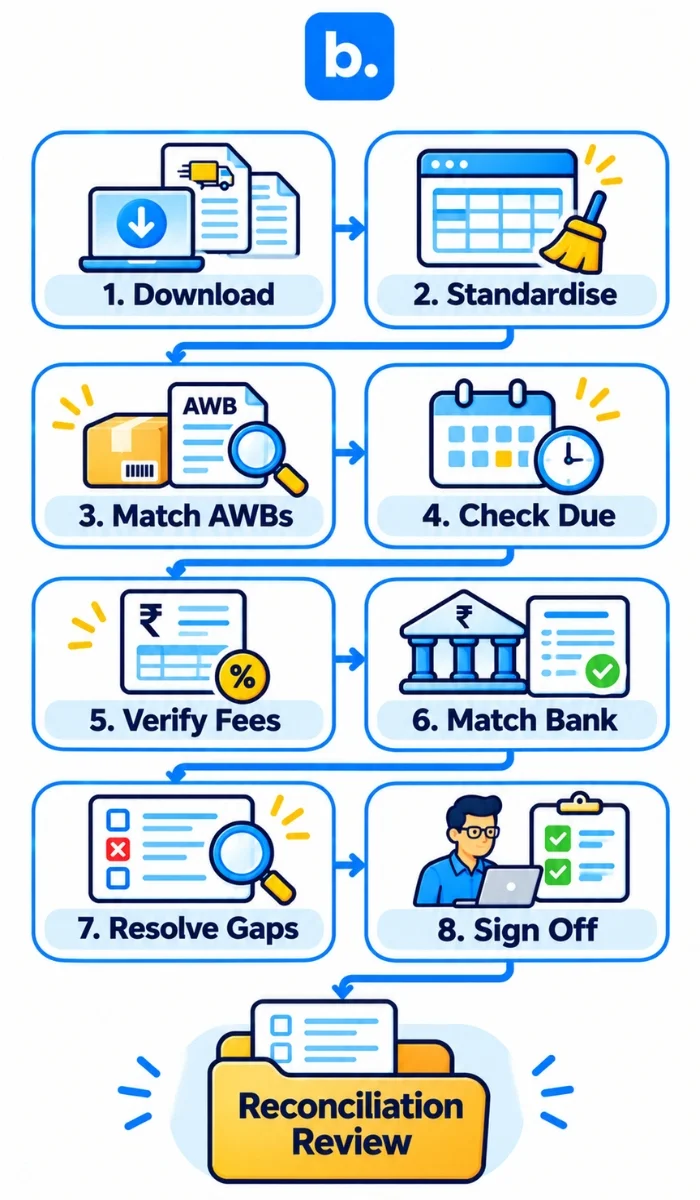
- Save the source records. Download the detailed remittance, delivered-order export and bank statement. Check date coverage and keep original files unchanged, including earlier open balances.
- Standardise without losing identifiers. Import AWBs as text to preserve leading zeros. Trim stray spaces and align date and amount formats; retain original values for investigation.
- Match the shipment references. Use a paying partner/account and AWB, then retrieve the order ID. Compare amounts as well as references. A successful lookup does not prove full payment.
- Separate missing from not yet due. Search scheduled payments and other batches. List due-but-unpaid shipments separately; do not send the courier a shortage claim for an order still inside its agreed cycle.
- Validate deductions and allocations. Check fees against the agreement and billing records. Distinguish amounts withheld from COD from charges already paid through a wallet or invoice. Preserve legitimate split payments rather than deleting every repeated AWB.
- Tie the batch to the bank. Match reference, amount and credit date. Explain split credits, authorised wallet allocations and pending transfers. Similar amounts alone are not a reliable match.
- Assign every exception. Record the amount, reason, evidence, owner, ticket reference and next-action date. Separate missing collections, short payments and disputed charges because they need different evidence.
- Post approved entries and review. A clearing account temporarily holds amounts due from the partner. Clear supported receipts and charges, retain unresolved balances and obtain reviewer sign-off. The bank deposit is not a second sale.
Your result should show which shipments were paid, which are not yet due and which need action. Retain the source rows behind every conclusion. Shared references also help address the handover problem in our guide to why finance teams distrust operations data.
Worked example: the bank matches, but one order is missing
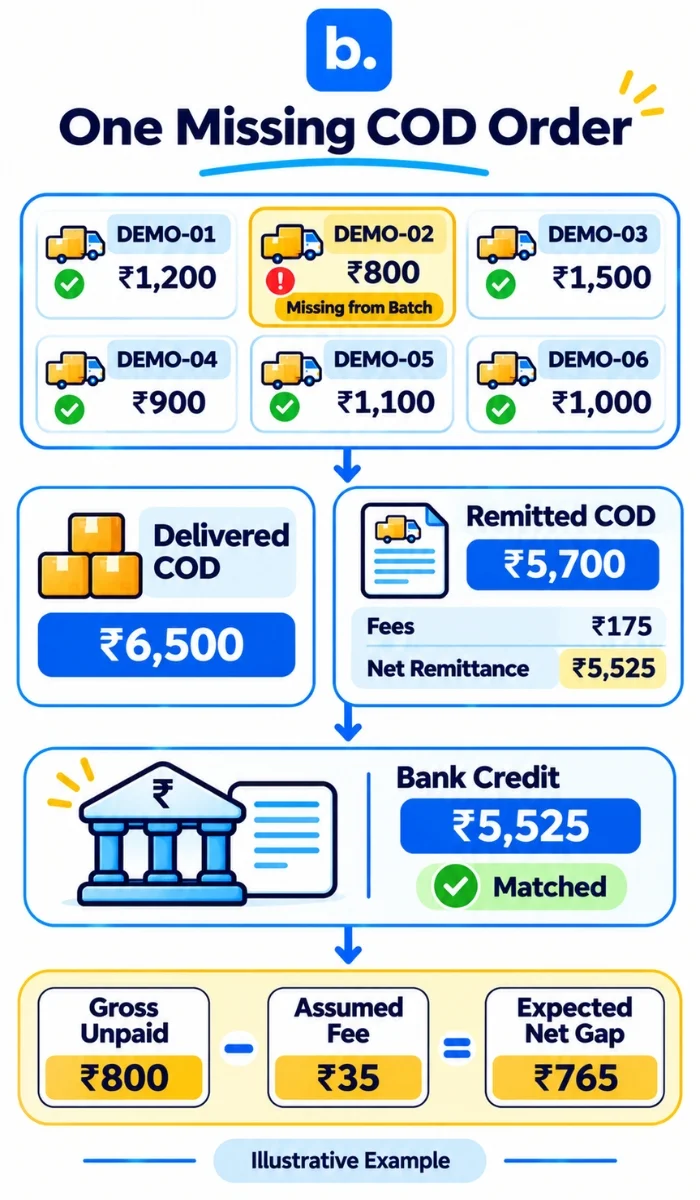
This payment reconciliation example is illustrative. All six shipments are delivered and eligible for batch DEMO-R1. Assume a ₹35 total fee withheld per remitted shipment, with no other deductions. These are fictional references and amounts, not a courier rate card or native export.
| Shipment | Delivered COD | In DEMO-R1? | Fee withheld | Net allocated |
|---|---|---|---|---|
| DEMO-01 | ₹1,200 | Yes | ₹35 | ₹1,165 |
| DEMO-02 | ₹800 | No | Not posted | Not allocated |
| DEMO-03 | ₹1,500 | Yes | ₹35 | ₹1,465 |
| DEMO-04 | ₹900 | Yes | ₹35 | ₹865 |
| DEMO-05 | ₹1,100 | Yes | ₹35 | ₹1,065 |
| DEMO-06 | ₹1,000 | Yes | ₹35 | ₹965 |
The six delivered orders total ₹6,500. Expected fees are 6 × ₹35 = ₹210, giving an expected net payment of ₹6,290.
The remittance contains five shipments: ₹5,700 in collections less ₹175 in fees equals ₹5,525. The bank also received ₹5,525.
Therefore:
- Remittance-to-bank check: matched.
- Due-orders-to-remittance check: DEMO-02 is missing.
- Expected net cash gap: ₹6,290 − ₹5,525 = ₹765.
- Gross unpaid collection to trace: ₹800.
Do not report an unexplained ₹765 deduction against the five paid orders. Request settlement details for the missing ₹800 shipment; ₹765 is the cash expected after its assumed ₹35 fee. Keep the gross claim and expected net cash distinct, and link any later payment back to DEMO-02.
Investigate unpaid orders and disputed deductions separately
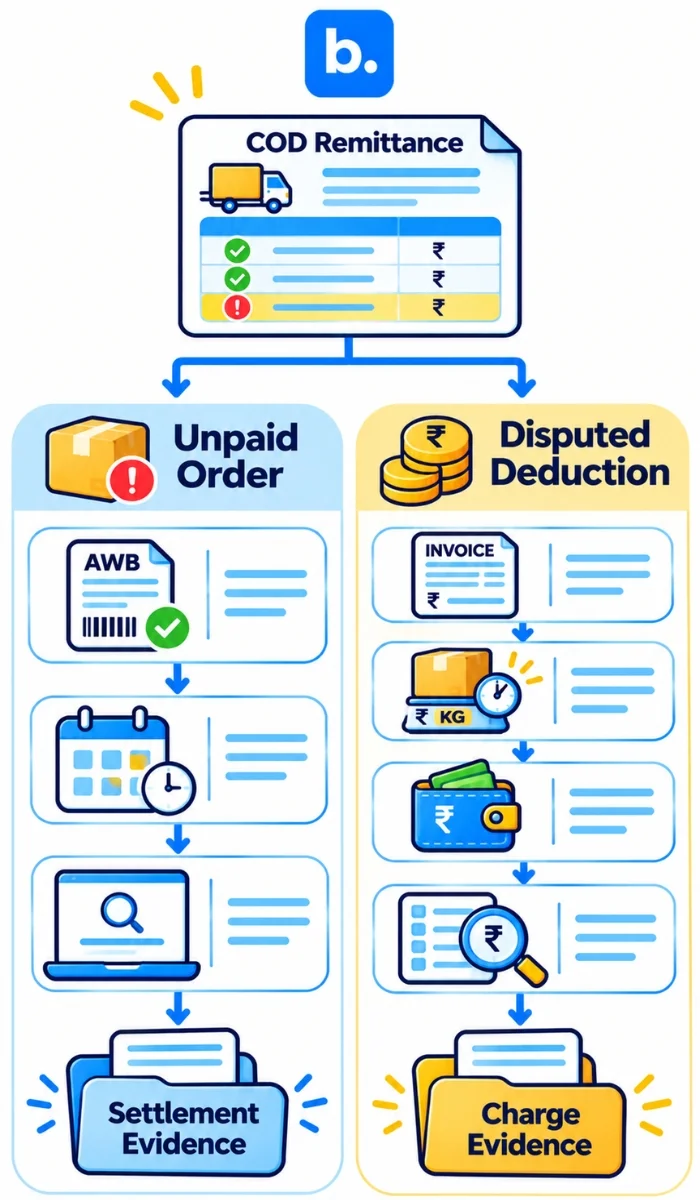
If a shipment has not been paid
Verify delivery, the amount booked for collection, payment eligibility and later batches. Check whether there is an account hold before alleging missing cash. Shiprocket’s invoice guidance explains that unpaid invoices can delay remittance.
Return to origin (RTO) means an undelivered shipment sent back to the sender. Do not treat it as a delivered collection. A customer’s return after delivery is different: trace the original collection, refund and any later reversal.
If a deduction looks wrong
Check the relevant invoice, agreement, adjustment reference and previous payment. A valid courier charge is not automatically a valid deduction from this remittance.
| Difference | Evidence to inspect | What resolves it |
|---|---|---|
| COD fee or freight | Applicable agreement, invoice and wallet history | Correct charge and proof it was not paid twice. |
| Weight adjustment | Billed weight, package measurements and dispatch photographs | Supported adjustment or a verified credit. |
| Return-related reversal | Original AWB, status history and collection/refund records | Explanation of the correct shipment and amount. |
| Duplicate-looking entry | Original file, transaction references and allocations | Confirmation of repeat import or a legitimate separate entry. |
Shiprocket’s COD help illustrates freight deductions, early-COD fees and RTO reversals. Use Delhivery’s weight-claim guidance for its specific weight-dispute process rather than treating every adjustment as a missing collection.
Raise and close a courier dispute
Send a shipment-level issue, not only “your payout is short.” Include:
- AWB, order ID and account reference.
- Delivery date and why the amount is due.
- Gross collection, any expected deduction and the disputed amount.
- Remittance batch and bank reference, if applicable.
- Delivery evidence and the relevant report or invoice extract.
- The correction or explanation requested, and a requested response date.
For the worked example, you could write:
Subject: Missing COD settlement for DEMO-02
Shipment DEMO-02 was delivered and is due for payment, but is absent from batch DEMO-R1. Its gross COD collection is ₹800. The ₹5,525 bank credit matches the other five shipments, so this query concerns the omitted shipment, not that bank transfer. Please confirm its settlement reference and payment status. The delivered-order record and remittance extract are attached.
Use the provider’s account support route. Delhivery documents Support > Raise Issue; Shiprocket’s invoice guidance above links to its ticket portal. Check the current issue-specific filing deadline immediately. A response target or ticket-reopening period is not a claim window.
Close your exception only after checking the explanation, applied credit or actual payment, not merely because the support ticket says “resolved.”
Keep an unpaid-order register between remittances
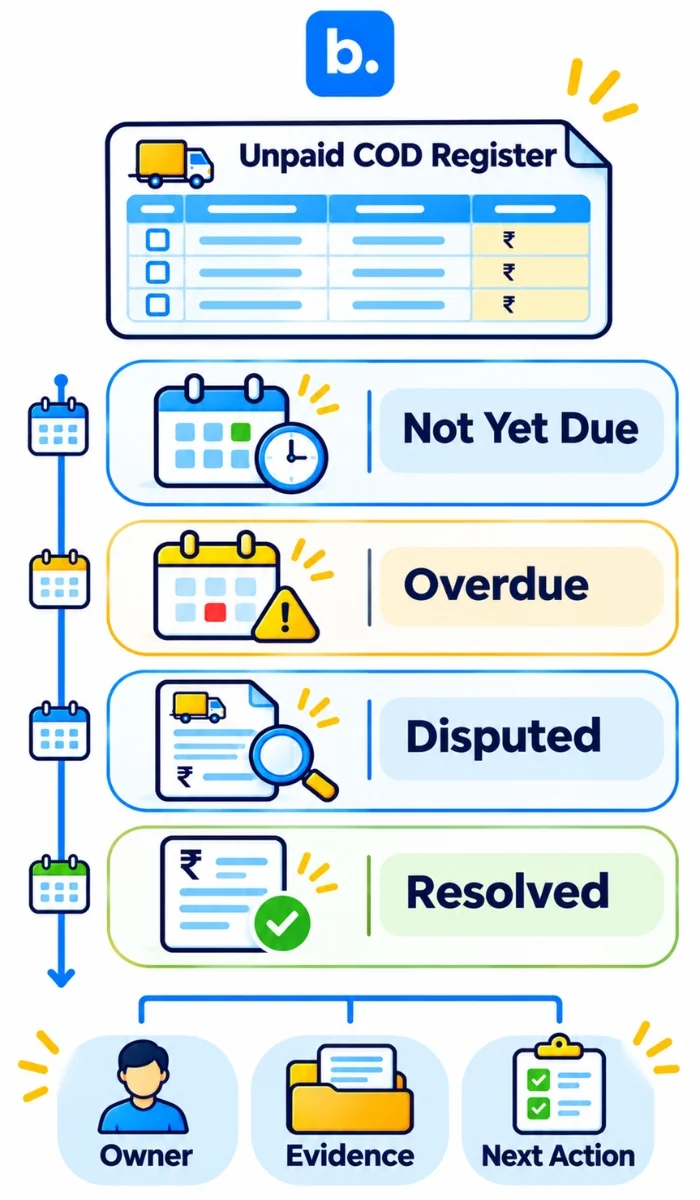
Good COD management includes following unsettled collections after delivery. Reconcile each new batch, then carry unresolved items forward without creating duplicate claims.
Keep these statuses distinct:
- Not yet due: inside the agreed payout terms.
- Overdue: due date passed without verified settlement.
- Disputed: amount or charge under investigation.
- Resolved: evidence checked and the required correction recorded.
Track unpaid age from delivery and overdue age from the agreed due date. A disputed charge on a paid shipment should not make the entire collection appear unpaid.
Assign operations to delivery or packaging evidence and finance to payment allocation, deductions and bank checks. Give each case one accountable owner and a next-action date. Our broader COD order management guide covers the confirmation-to-delivery workflow; this register controls what happens to the money afterwards.
When software helps and what to test
A controlled spreadsheet can work for manageable volume. Evaluate a payment reconciliation system when multiple accounts, repeated imports or unresolved exceptions make review unreliable. Choose based on the work your team cannot control, not an arbitrary monthly order count.
Test e-commerce reconciliation software with a missing AWB, partial payment, duplicate import, unexpected deduction and split bank credit. It should retain source rows, explain allocations and preserve unresolved amounts. Automated payment reconciliation still needs an owner for exceptions and an approver for entries.
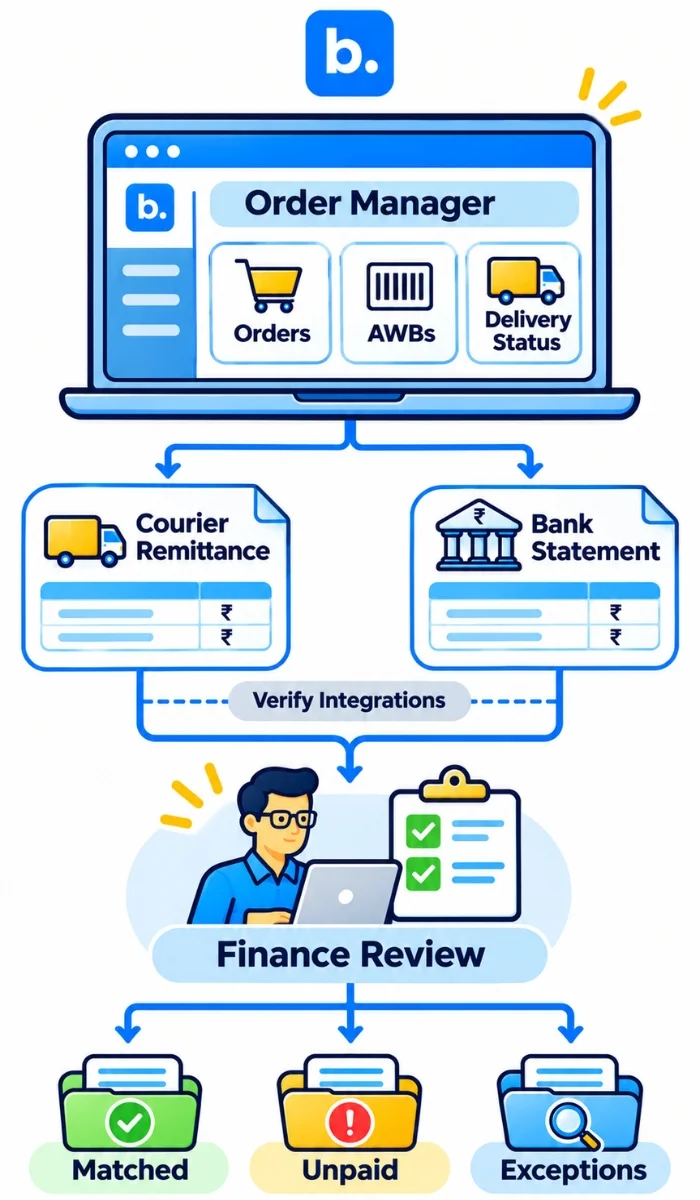
An order management system (OMS) keeps order and shipment context together. OMS software can supply identifiers, collectible amounts and status data for the order side of this check; it does not replace the remittance report or bank statement.
At base.com, we help bring connected-channel orders, shipment references and processing statuses together in Order Manager. That gives finance order-side context for investigation. Review courier-file ingestion, payment allocation and financial ageing separately before treating any proposed workflow as automated.
Conclusion
Resolve a COD remittance mismatch with two checks: match the remittance to the bank, then match eligible delivered shipments to that remittance. Separate unpaid collections from disputed charges, preserve gross and net amounts, and give every open item an owner and next action. Finish with a matched-payment list, an unpaid list and supported exceptions. To review the order-data handover, contact our team with a redacted sample.